Showing posts with label oak. Show all posts

Wednesday, June 2, 2021

Franco Martinetti and the use of oak in Colli Tortonesi Timorasso wines

I had mentioned Franco Martinetti twice in my depiction of the Early and Late Modern histories of the Timorasso variety: (i) his procuring of the Timorasso pomace that was used by Antonello Bocchino in the crafting of her sinle-variety Piemontese grappas and (ii) his collaboration with Walter Massa to produce the barrel-fermented and -aged Timorasso called Martin. In this post I briefly explore the man, the method, the wine.

Cosimo Torlo (Il Ghiottone Errante) describes Franco as "...certainly the most original, elegant, and refined lover of the pleasure of good living ... Franco was among the first to grasp the deep connection that existed between food and wine." And it is the recognition of this connection, and his actions based on that knowledge, that have driven Franco to the heights as "a major actor in the international food and wine scene." Franco's standing in those arenas is illustrated by the fact that (i) he is the only Italian to have been a member of the Académie du Vin de France and (ii) he has been the President of the Académie Internationale du Vin since 2003.

Franco was introduced to the joys of eating and drinking wine by accompanying his father on business trips and he continued his experiential pursuits during his own advertising career. He began to make his own wine in 1974.

Franco entered the wine market utilizing the French negociant model; that is, he owned neither vineyards or cellars. Today he makes wines in the Gavi, Colli Tortonesi, Barolo, and Barbera d'Asti zones. He drives superior product quality by (tastingbook.com):
  • Choosing the ideal variety based on terroir, exposure, and age
  • Supervising the pruning and thinning of the bunches in the vineyards
  • Setting the harvest dates
  • Selecting the grapes that will be used for the wines
  • Establishing and supervising the fermentation and aging processes and duration. 
But it is Franco's work with the Timorasso variety that is of most interest to us at this time. Speaking about Franco's ties to the region, Torlo said, "... it is good that you know that it was he, who many years ago, was among the first to believe in the potential of that area."

In 1996 Massa and Franco Martinetti "began to exchange some considerations  on this vine and both decided to give a decisive acceleration in favor of quality by experimenting with rigorous and effective viticulture and oenological techniques ..." The collaboration resulted in trials (at the Massa facility) wherein Timorassa grapes were vinified and aged in barriques and, eventually, a 1997 barrel-fermented and -aged wine being given the nomenclature Martin (Brozzoni). The 1999 edition of Martin was awarded the coveted Veronelli Guide Sun Award.

Oak as both a fermentation and aging vessel is still a rarity in Colli Tortonesi. In a study on barrel-fermentation of white wines (S. Herjavec, et al., The quality of white wines fermented in Croatian Oak, Food Chemistry, 100, 2007), the authors stated thusly:
One of the practices used to intensify the aroma and flavor characteristics of white wines is to ferment the must in oak barrels ... Wines produced by fermentation and maturation in oak barrels have different flavor characteristics to those which have undergone barrel maturation only after fermentation in stainless steel. One reason for this is that actively growing yeasts are capable of transforming volatile flavor components, extracted from oak wood, into other volatile metabolites.
This metabolite transformation results in what Zac Brown, Winemaker at Alderlea Vineyards, describes as "better integration of the oak and softer mouthfeel when compared to a white that is finished and then transferred into oak barrel to age."

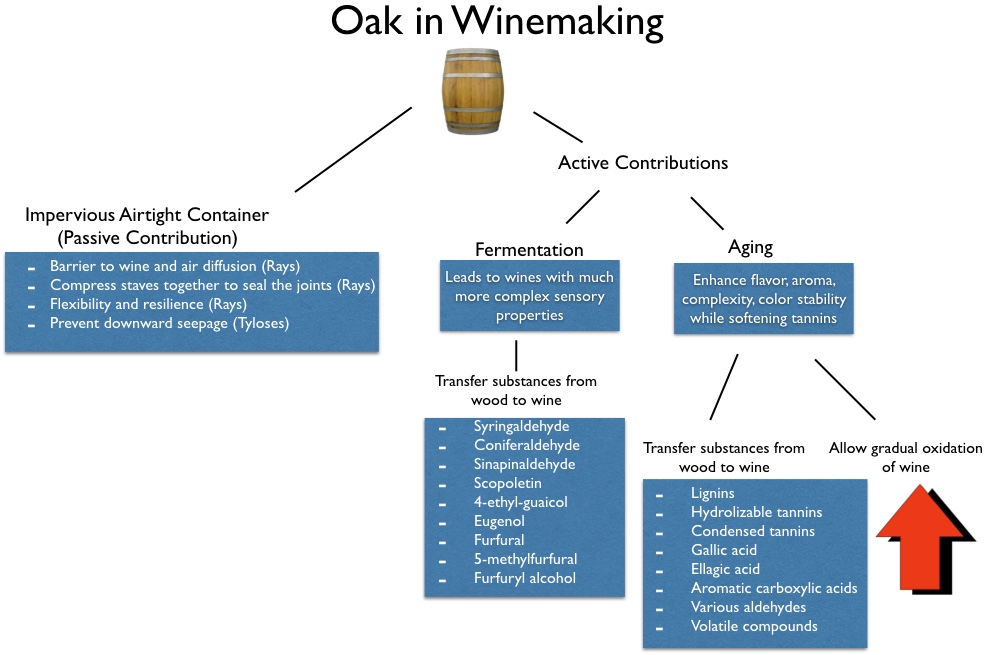
The figure below summarizes oak's contribution to the winemaking process; the associated details can be found here.


The chart below features Martinetti's oak-vessel wines but also presents his stainless steel entrant into the market. 


I have previously mentioned the high regard Veronelli had for the Martin but it will be interesting to taste these two wines side by side as a test of the Ibern-Gomez, et al., observations. According to the authors, "wines fermented in wood barrels are distinguished by the cession of oak wood compounds to the wine." Further, the authors compared control wines fermented in stainless steel to wines fermented in oak barrels and noted the following differences:
  • Total phenolic content was higher for white wines fermented in oak barrels than for wines fermented in stainless steel tanks
  • New phenolic compounds which are characteristic of oak wood (syringaldehyde, coniferaldehyde, sinapinaldehyde, scopoletin, 4-ethyl-guaicol, and eugenol (the latter two being volatile phenols)) were found in the white wines fermented in oak
  • The gallic acid and 4-vinylguaiacol increased in white wines fermented in oak
  • Browning in oak wood white wines was higher than for stainless steel white wines.
  • Furfural, 5-methylfurfural, and furfuryl alcohol from thermal degradation of cellulose and hemicellulose were found in the white wines fermented in oak.
As it relates to sensorial analyses, the following was reported:
  • Tasters described white wines fermented in oak as having golden hues
  • White wines fermented in oak were described as having toasty and spicy aromas
    • Probably due to the 4-ethyl-guaiacol and eugenol
  • Tasters also described a coconut aroma for the barrel fermented wines
    • Probably due to the cis-β-methyl-γ-octalactone detected.
Some Observations on Oak Use In Colli Tortonesi Timorasso
Even though Martinetti pioneered oak use in the region a while ago, there there has not been a thundering herd of adopters following along on the path. Of the wines in my data base, only Daniel Ricci (untoasted acacia and untoasted chestnut for aging), Cascina Gentile (1/3 of wine fermented in untreated oak), Vietti (1/3 of wine fermented in wood), Roagna (large oak casks for fermentation and aging), Mandirola (partial passage through wood and oak towards end of aging process), and Sassaia (barriques for fermentation and aging) are employing wood within their winemaking processes.

Writing in openingabottle.com, Kevin Day characterizes the Timorasso variety thusly: "Timorasso has a rich phenolic character, meaning the natural phenols and polyphenols in the grape yield a lot of aromas, flavors, textures, and characters." Kerin O'Keefe attributes depth, body, and complexity to the wine. In an earlier part of this post I noted that barrel fermentation is used to intensify the aroma and flavor characteristics of white wines. And Chardonnay, for example is well suited to that type of treatment. But Timorasso is intrinsically endowed with those characteristics. Research has shown that barrel-fermented whites have higher phenolic content than their SS-fermented brethren so the high-phenol Timorasso will be further enriched in this area.

Historically, aromatic white wines are kept away from barrel fermentation to prevent oxidation of the delicate aromas. It will be interesting to see how Timorasso aromas present after barrel fermentation.

All that being said, the structure of the Timorasso variety intuitively renders it an attractive candidate for oak treatment.

©Wine -- Mise en abyme

Monday, June 1, 2020

The story of oak wine barrels in eight charts

I have covered the use of oak barrels in wine production in a number of posts over the years but I have gotten to the point where I am able to tell the story in 8 charts. Here goes. 


©Wine -- Mise en abyme


Sunday, May 24, 2020

Oxygen transfer during the oak aging of wine

According to Del Alamo-Sanza and Nevares*, the oak barrel behaves as an interactive vessel with wine, allowing the transfer of substances from the wood to the wine (covered here) and the dynamic transfer of oxygen from the air to the wine.


I cover the transfer of oxygen from air to wine in this post.

Oxygen Transfer Rate
The annual rate of oxygen entry into barrels is the amount of oxygen that enters a barrel full of wine over the course of a year; the unit of measure is mg/L.year. A number of studies over the years (Ribereau-Gayon, 1933; Amerine and Joslyn, 1970; Prillinger, 1965, for example) have defined and refined this measure, but it was Singleton's efforts which sought to establish the oxygen entry point. According to Singleton, oxygen entered the barrel through the dry wood at the top where it is in contact with the headspace.

Vivas and Glories, in a subsequent study, measured oxygen entry into barrels (sourced from Limousin and Centro) full of wine -- wet-wood barrels -- and found that (i) oxygen entry into the wine varied between 20 and 45 g/L for new barrels and 10 mg/L for the 5-year-old barrels. These values have become the accepted oxygen transfer rates for French oak barrels.

In the same study it was found that the oxygen transfer rate was 45 mg/L with a silicone bung and 28 mg/L when the barrel was tightly sealed.

Other later studies have shown that sealing the joints between the staves of full barrels did not prevent oxygen entry into the wine. The conclusion, then, was that oxygen entered the barrel through the wood, joints between the staves, and through the bung; not through the dry wood at the top of the headspace (as had been posited by Singleton). In more recent times, the bung as a source of oxygen entry has seemed to lose prominence with the widespread use of food-grade silicone bungs that allow a tight seal.

The entry of oxygen into the barrel, and its relationship with wine flow into the oakwood, is illustrated in the figure below.


It has been shown that French oak allows more oxygen entry than does American oak. While 50% of American oak's oxygen ingress was through the wood, fully 75% of French wood's ingress was through the same channel. The finer the grain, the greater the oxygen permeation in both species. An oak stave that is 27-mm thick would allow a maximum oxygen transfer rate of 26 ml/L.year.

Oxygen entry through the joints between staves is not uniform along the length of the joint. Rather, it is greater at the middle of the stave, where the pressure is between 0 and 3 bars, and less so at the ends where the pressure ranges between 25 and 30 bars.

The process of topping up the wine barrel has been seen as a source of air entry into the barrel. According to Del Alamo-Sanza and Nevares, however, good management of the barrel-topping process "does not necessarily involve an increase in wine oxygenation."

Oxygen reaching the wine does so both via the wood and the joints between the staves. The oxygen transfer rate of the barrel, then, depends on the wood from which it is constructed as well as the construction process.

Oxygen introduced into the wine reacts with pigments and tannins such that:
  • The red color in wine is stabilized and enhanced
  • Tannins are softened
  • Complex aromas develop
  • Improvement in the mouthfeel and body of the wine is evident.

*This post draws heavily on the work of Del Alamo-Sanza and Nevares (Maria del Alamo-Sanza & Ignacio Nevares (2018) Oak wine barrel as an active vessel: A critical review of past and current knowledge, Critical Reviews in Food Science and Nutrition, 58:16, 2711-2726, DOI: 10.1080/10408398.2017.1330250)

©Wine -- Mise en abyme

Sunday, April 30, 2017

Barrel-fermented and -aged white wines

Oak was the primary fermentation vehicle prior to the post-war inroads made by stainless steel tanks, inroads driven by the latter's perceived advantages:
  • Provides an anaerobic environment
  • Easier to clean, thus reducing the risk of bacterial contamination
  • Increased durability
  • Allowed fermentation temperature control
    • White wines could be fermented cool and thus preserve floral and fruity aromas
    • Cooler fermentation temperatures lowered the risk of off-flavor production
  • Allowed control of fermentation rate.
With all of these advantages arrayed against it, oak had to have some overriding benefits for winemakers to continue using it as a vehicle. And it did. According to Ibern-Gomez, et al*., "Fermentation in oak barrels leads to wines with much more complex sensory properties, largely attributed to the phenols extracted from oak wood."


I will examine these substances and their impacts on barrel-fermented wine in this post.

Oak Wood
As a result of its "strength, resilience, workability, and lack of undesirable flavor," oak is the wood of choice for most wine cooperage applications.


The oak used in the maturation of alcoholic beverages fall into one of three species: Quercus albaQuercus robur, and Quercus sessilis.  Q. robur and Q. sessilis, and their respective subspecies, are European white oaks while Q. alba is the source of 45% of the white oak lumber produced in the US.  American oak used in barrel production is sourced from Kentucky, Missouri, Arkansas, and Michigan but there is no apparent regional distinction.  European oak, on the other hand, may have designations which reach all the way to the forest from which the oak originated.  For example, French oak from the department of Alliers may be sourced from a forest named Tronçais.

Sources: enologyinternational.com; Dr. Murli Dharmadikari; Principles and Applications in Wine Science

The journey from oak tree to wine barrel is shown in the graphic below.


Alcoholic Fermentation in Oak Barrels
Grapes are pressed and the resulting juice is deposited into oak barrels (In many Burgundy white wines the grapes are pressed "whole-cluster"). The juice levels do not fill the tank as space has to be left for expansion of the contents during alcoholic fermentation.

In a study on barrel-fermentation of white wines (S. Herjavec, et al., The quality of white wines fermented in Croatian Oak, Food Chemistry, 100, 2007), the authors stated thusly:
One of the practices used to intensify the aroma and flavor characteristics of white wines is to ferment the must in oak barrels, and Chardonnay is one of the most suitable varieties for this. Wines produced by fermentation and maturation in oak barrels have different flavor characteristics to those which have undergone barrel maturation only after fermentation in stainless steel. One reason for this is that actively growing yeasts are capable of transforming volatile flavor components, extracted from oak wood, into other volatile metabolites.
This metabolite transformation results in what Zac Brown, Winemaker at Alderlea Vineyards, describes as "better integration of the oak and softer mouthfeel when compared to a white that is finished and then transferred into oak barrel to age."

In the case of reductive winemaking, we seek to prevent the rich varietal aromas of Riesling, Petit Manseng, and Gewurtztraminer from oxidizing effects. This environment will be subjected to oxygen effects and it is not recommended that these varietal types be barrel-fermented.

Malolactic Fermentation
According to Sauvageot and Vivier (Effects of Malolactic Fermentation on Sensory Properties of Four Burgundy Wines, AJEV 48(2), 1997), malolactic fermentation (MLF) is a bacterial conversion -- most commonly performed by Leuconostoc strains, due to their tolerance of the high acid and alcohol content associated with wine -- of L-malic acid to L-lactic acid and CO₂.

The main effects of MLF on wine are (i) a reduction in titratable acidity (by 0.1 to 0.3%) and an increase in pH (0.15 to 0.30). In addition, dramatic organoleptic changes to the wine are evidenced (Lonvaud-Funel, Microbiology of the Malolactic Fermentation: Molecular Aspects, FEMS Microbiology Letters):
  • The specific taste of malic acid disappears
  • Sugars are catabolized to produce mainly lactic and acetic acid
  • Citric acid is transformed into acetic acid and carbonyl compounds, notably the butter-flavored diacetyl
  • Wine taste and color are modified due to the metabolic activity of bacteria on phenolic compounds (tannins, anthocyannins).
By synthesizing anti-bacterial compounds and depriving the wine of nutrients, MLF also contributes to its microbial stability (Lonvaud-Funel).

The process is encouraged (Bauer and Dicks, Control of Malolactic Fermentation in Wine, S. Afr. J. Enol. Vitic. 25(2), 2004): in cooler areas where grapes have high malic acid content; in cases where the wine is aged in oak barrels; and when the wine style calls for long-term aging in bottle. The practice is sometimes forsworn in warmer, lower-acid areas and in the cases where undesirable organoleptic changes or the production of biogenic amines result.

Lees Aging
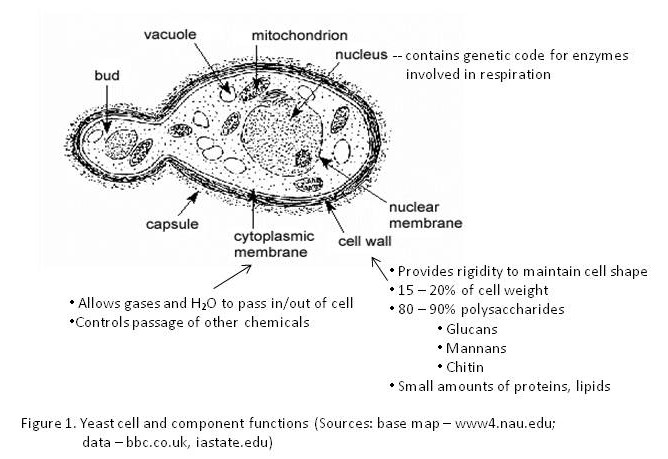
Murli Dharmadhikan (Yeast Autolysis, extension.iastste.edu) defines yeast autolysis as "... self-destruction of the cellular constituents of a cell by its own enzymes" following its death. Figure 1 below shows the component parts of a healthy yeast cell while Figure 2 shows an overview of the process  -- autolysis -- that occurs once that yeast cell has consumed all of the available nutrients and dies. At a high level, autolysis encompasses (i) the degradation of intracellular materials and (ii) degradation of the cell wall.


The detailed autolysis process is shown in Figure 3 below. The yeast extract, product of the degradation of intra-cellular material, is confined to the cell until such time as the cell wall becomes porous enough to allow the material to seep out. It should be noted that degradation and compound creation continues outside the degraded cell walls.

Figure 3. Details of yeast autolysis
The lees-aged wine is enriched by the compounds released during the constituent-degradation process. Compounds released during autolysis include (Thierry Binder, Cremant d'Alsace, TONG #13; Dharmadhikan):
  • Nitrogenous compounds
    • Amino acids -- known to enrich mouthfeel; aroma precursors of acacia honey notes
    • Polypeptides -- sweet and bitter taste; precursors of the autolytic aromas of brioche and toast
    • Peptides
    • Nucleic acid components
  • Polysaccharides -- originates from breakdown of cell wall components
    • Degradation products are glucose and mannose
    • Mannoproteins increase mouthfeel and foam stability as well as contributing to fineness and persistence of bubbles
  • Fatty acids -- important for foam stability, mouthfeel, and flavor. Can be involved in the formation of esters, aldehydes, and other volatile compounds
  • Volatile components
    • Heavy esters
    • Terpene components
    • Higher alcohols
    • Other volatile components.
In order to ensure distribution of the beneficial autolysis products evenly throughout the wine, a process called batonnage -- stirring of the lees -- is undertaken. Batonnage is generally conducted once or twice per week.

Oak Aging
Wine is aged in wooden barrels to: (i) enhance its flavor, aroma, and complexity through transfer of substances from the wood to the wine; and (ii) allow gradual oxidation of the wine.

In the first instance, many of the wood's native aromatic compounds, as well as the aromatic compounds created during seasoning and toasting, are absorbed, and integrated, into the wine, thus contributing to wine richness and aromatic complexity.  For example, hemicellulose will hydrolyze upon exposure to wine, creating, as a result, sugars and acetyl groups.  The sugars are further converted to furanaldehydes and ketones while the acetyl groups are converted to acetic acid during maturation.  A small proportion of lignin will dissolve in wine (these are called native lignins) while some undergo ethanolysis and are oxidized to aromatic compounds.  These compounds have low olfactory thresholds and will, therefore, impact the wine's aromatic profile. As noted by Dr. Murli Dharmadikari, common descriptors of oak-aged wines are oaky, vanilla, smoky, toasty, spicy, and coconut.

In terms of gradual oxidation, wine loss from barrels amount to approximately 2% per year, resulting from the fact that water and ethanol are smaller molecules and will diffuse into the wood and, ultimately, escape as vapor.  If the air in the cellar is dry, more water is lost and the wine is more concentrated in terms of alcohol.  If the environment is too humid then more alcohol is lost, reducing the ethanol content in the remaining wine.  This loss of liquid opens up a space between the wine surface and the barrel which the winemaker generally "tops up" in order to prevent oxidation and acetic spoilage.  During this "topping-up" process, small amounts of oxygen are dissolved in the wine.  Oxygen is also introduced into the wine during winery operations such as filtering and racking.

The oxygen which is now in the wine reacts with resident phenolic compounds in a manner such that: (i) tannins are softened (polymerization and precipitation as well as tannin-polysaccharide combinations); (ii) complex aromas develop; and (iii) there is improvement in the wine's body and mouthfeel.  It should be noted here that the tannin resident in the wine at this time is the oak tannin absorbed from the barrel (30% from the innermost four millimeters of wood).

In the aforementioned Herjavec, et al., study, the authors found that the sensorial characteristics of barrel-aged wines were modified, due to the wood-derived compounds. These wines manifested roundness in taste with a complex retro nasal aroma." Barrel toast also affected flavor perception: aging in medium-toast barrels yielded a smoky, roasted, and raw oak flavor while light toast resulted in a more fruity aroma.

Comparison of Barrel- and Stainless Steel-Fermented White Wines
According to Ibern-Gomez, et al., "wines fermented in wood barrels are distinguished by the cession of oak wood compounds to the wine." The figure below shows the phenolic compounds found in wine fermented in oak barrels.


Further, the authors compared control wines fermented in stainless steel to wines fermented in oak barrels and noted the following differences:
  • Total phenolic content was higher for white wines fermented in oak barrels than for wines fermented in stainless steel tanks
  • New phenolic compounds which are characteristic of oak wood (syringaldehyde, coniferaldehyde, sinapinaldehyde, scopoletin, 4-ethyl-guaicol, and eugenol (the latter two being volatile phenols)) were found in the white wines fermented in oak
  • The gallic acid and 4-vinylguaiacol increased in white wines fermented in oak
  • Browning in oak wood white wines was higher than for stainless steel white wines.
  • Furfural, 5-methylfurfural, and furfuryl alcohol from thermal degradation of cellulose and hemicellulose were found in the white wines fermented in oak.
As it relates to sensorial analyses, the following was reported:
  • Tasters described white wines fermented in oak as having golden hues
  • White wines fermented in oak were described as having toasty and spicy aromas
    • Probably due to the 4-ethyl-guaiacol and eugenol
  • Tasters also described a coconut aroma for the barrel fermented wines
    • Probably due to the cis-β-methyl-γ-octalactone detected.
**********************************************************************************************************
While the process described herein is identified as being associated with oak fermented and aged white wines, it is not exclusive, in its entirety, to that style of wine. For example, a wine fermented in stainless steel could also be subjected to malolactic fermentation and lees residence in the tank or could have those two procedures completed in oak barrels and subsequent aging in same.

*M. Ibern-Gomez, et al., Differences in Phenolic Profile between Oak Wood and Stainless Steel Fermentation in White Wines, Am. J, Enol. Vitic, 52:2 (2001).

©Wine -- Mise en abyme

Friday, July 13, 2012

The intersection of Champagne and oak: Then and now

I have previously written about Champagne production and oak's contribution to wine quality.  This post covers the intersection of the two issues -- then and now.

Prior to the 1950s, Champagne producers vinified their wines in 228-liter oak vats (Tom Stevenson, Oak in Champagne, wine-pages.com; World of Fine Wine (WoFW), Issue 36, 2012; SFGate, Oak and Champagne, 12/13/09).  These vats were neutral (in terms of oak influence) and were used for 25 or more years.  They were expensive, however, so, beginning in the 1950s, Champagne Houses began substituting vats made from other materials for these oaken incumbents.  An example of this is the story of Veuve Clicquot as told by Stevenson.  In 1946 Veuve Clicquot began a 12-year program to switch from oak vats to glass-lined concrete tanks.  Shortly after the conclusion of that program, the company was on the march once again, this time moving from concrete to stainless steel vinification tanks.

According to SFGate, stainless steel tanks afforded a number of benefits to Champagne producers: precise temperature control; an anaerobic environment; and a streamlined, high tech look in the cellar.  Another benefit associated with the stainless steel tank, according to Stevenson, was Champagne-producer access to a malolactic-like creaminess.  Stevenson holds that the most noticeable loss that occurs when a producer moves away from oak is "a certain ampleness of mouthfeel."   Micro-oxygenation produces a textural enhancement that is akin to malolactic and, with the introduction of temperature-controlled stainless-steel vats, producers could now employ that technique to close the "ampleness" gap created by the move away from oak.

By the 1990s then, only three top Houses (Krug, Bollinger, and Alfred Gratien) and two top growers (René Collard and Anselme Selosse) were still fermenting entirely in oak.

But the winds of change are in the air.  According to SFGate, there is a "marked increase in the number of Champagne producers experimenting with wood for fermentation as well as aging."  Michael Edwards (The Finest Wines of Champagne) notes that over 100 Houses and growers are using wood in one or more of the following applications: fermenting in differing barrel/cask sizes; maturing the wines in tonneau; or creating the vin de dosage.

While the Independent (Champagne, 10/22/09) sees this return to oak as a move to further penetrate the British market (the largest Champagne market) by taking advantage of consumers' desire for the delicate hints of vanilla and coconut that accompany the judicious use of wood, both Edwards and SFGate see this move to wood as a pursuit of the benefits of barrel-driven micro-oxygenation.  These benefits, as they see them, are: flavor complexity, added strength, suppleness, depth, and oxidation resistance.  A cautionary note, however; the target wine has to have the character and structure to cope with the oak or it will end up being dominated and the resulting Champagne will be "heavy and clumsy."

Edwards sees three schools of oak in Champagne: old school; traditionalists; and innovators.

The "old schoolers" have always used oak and own barrels that are between 5 and 30 years old.  Bollinger, Krug, Alfred Gratien, and Selosse fall within this camp.  Bollinger vinifies in oak, a practice, it says, which "aids harmonious development of the wine" and guarantees stability in its later life.  Bollinger decides whether to use oak or steel tanks depending on "the character of each year, the grape variety, and the different crus."  The Reserve magnums and La Grande Année are always vinified in oak.  Krug uses small Aragon oak barrels that are 10-15% new and that are covered by a layer of wax to prevent oxidation (Juhlin).  The wine is matured for three months after fermentation and is then transferred between up to 10 barrels in order to gain different "taste shades."  After the desired complexity is obtained, the wine is poured into metal containers to await assemblage.  Alfred Gratien has 800 5-year-old, 228-liter barrels in which the wines are fermented and then matured for 6 months.  According to Juhlin, Nicolas Jaeger, the winemaker, feels that this method results in wines with richer taste, longer-lasting aftertaste, and more interesting properties.  Jaeger in the SFgate article: "The idea is not to make the wines taste oaky, but to give them more structure and finesse and greater length."  Selosse buys 228-, 400-, and 600-liter tanks from Burgundy for its vinification activities.

The traditionalists have "returned to oak for its subtleties of aroma and flavors" and utilize new oak combined with stainless steel or enamel vats.  An example of this type of producer is the aforementioned Veuve Clicquot.  In 2011 the company announced the it was purchasing 30 oak Foudres to add to its vinification repertoire.  The intent with this oak is not to impart oak character to the wine but instead to "broaden the choices of blending components for the vintage cuvée" (Stevenson, WoFW).  Stevenson points out that while this is the stated goal, to the extent that only three vintages will be declared each decade, the yellow label will be the beneficiary of this oak-enriched infusion in the remaining seven years of the decade.  Taitinger also falls into this camp using, as it does, < 5% of oak-aged wine to add complexity (toast and vanilla notes) to its Comtes de Champagne label.

Innovators see oak as an essential element of their winemaking and it is in this camp that Edwards sees some "overtly woody Champagne."

This "phoenix-like" experience for oak is not welcomed in all corners.  According to Stevenson (wine-pages.com) and Juhlin (champagne club.com) Tony Stevenson, the Australian Champagne expert, wanted to reject all Champagnes in a Decanter tasting that had even a hint of oak.  Juhlin sees the elegance of Champagne as being the key to its appeal the world over and worries that the weight introduced by wood might harm its "tenderness and subtlety."  According to Stevenson, "The mellowing aromatic properties of new or relatively new oak conflict with the effervescence and flavor profile of a fully sparkling wine like Champagne, especially when youthful."  He advocates the blending of between 5% and 15% of wooded wine into a cuvée to add complexity without evidence of oak.

It is clear that this trend to use oak in Champagne will only increase with time.  The traditionalists will stay the course (they always have ) but the innovators are the ones to watch.  The challenge for them will be to improve their craft such that the marriage of oak and champagne looks less like the marriage of oak and American Chardonnay and more like the marriage of oak and white Burgundy.


© Wine -- Mise en abyme

Wednesday, July 11, 2012

Oak: Its contribution to wine aroma and overall quality

Wine odor is one of the key markers of wine quality and, as a part of my series on wine quality, I have set myself the task of identifying and characterizing the sources of wine odor and showing how the interactions of these odor components aid in the perception of wine quality.


Wine is aged in wooden barrels to: (i) enhance its flavor, aroma, and complexity through transfer of substances from the wood to the wine; and (ii) allow gradual oxidation to occur.  As a result of its "strength, resilience, workability, and lack of undesirable flavor," oak is the wood of choice for most wine cooperage applications.


The oak used in the maturation of alcoholic beverages fall into one of three species: Quercus alba, Quercus robur, and Quercus sessilis.  Q. robur and Q. sessilis, and their respective subspecies, are European white oaks while Q. alba is the source of 45% of the white oak lumber produced in the US.  American oak used in barrel production is sourced from Kentucky, Missouri, Arkansas, and Michigan but there is no apparent regional distinction.  European oak, on the other hand, may have designations which reach all the way to the forest from which the oak originated.  For example, French oak from the department of Alliers may be sourced from a forest named Tronçais.

Sources: enologyinternational.com; Dr. Murli Dharmadikari; Principles and Applications in Wine Science

Oak wood used in the production of wine barrels must possess the following characteristics (Ronald S. Jackson, Principles and Applications in Wine Science): straight-grained; strong; resilient; fault -free; and free of undesirable odors that could taint the wine.  Once the tree is harvested, the resulting log is first cut into tubular sections and they are, in turn, split into halves, quarters, eighths, and then the final stave size.

The rough-hewn staves are now ready to be seasoned.  The cut staves are stacked in the open air in alternating east-west, north-south rows for a period of about three years.  Open-air drying exposes the staves to wind, rain and UV rays.  The stacks are dismantled and randomly re-assembled annually in order to ensure that a single barrel does not gain an inordinate number of staves from a single tree.  Some producers choose to kiln-dry the staves but, while attainment of the desired humidity levels occurs earlier, it can result in the loss of as much as 70% of desirable compounds.

The oak staves undergo a number of chemical changes as a result of seasoning: (i) ellagitannins are polymerized and become less soluble; (ii) there is an increase/decrease of lignin degradation products (such as eugenol, vanillin, syringaldehyde) in the outer portion of the staves; and (iii) the leaching and degradation of phenolic compounds (such as tannin) by oxygen, rain, and UV radiation.

After seasoning is completed, the staves are cut to their final sizes and then assembled into a shape approximating that of the final product except that one end is open and there are spaces between the staves (these spaces widen as one travels closer to the open end of the assembly).  A heat source is introduced into each proto-barrel through the open end and heat is applied to the inner surface for a duration, and at an intensity, consistent with the level of toast desired for the finished barrel.  The table below shows the chemical changes to the oak that result from varying toast levels.


As stated previously, wine is aged in wooden barrels to: (i) enhance its flavor, aroma, and complexity through transfer of substances from the wood to the wine; and (ii) allow gradual oxidation of the wine. In the first instance, many of the wood's native aromatic compounds, as well as the aromatic compounds created during seasoning and toasting, are absorbed, and integrated, into the wine, thus contributing to wine richness and aromatic complexity.  For example, hemicellulose will hydrolyze upon exposure to wine, creating, as a result, sugars and acetyl groups.  The sugars are further converted to furanaldehydes and ketones while the acetyl groups are converted to acetic acid during maturation.  A small proportion of lignin will dissolve in wine (these are called native lignins) while some undergo ethanolysis and are oxidized to aromatic compounds.  These compounds have low olfactory thresholds and will, therefore, impact the wine's aromatic profile. As noted by Dr. Murli Dharmadikari, common descriptors of oak-aged wines are oaky, vanilla, smoky, toasty, spicy, and coconut.

In terms of gradual oxidation, wine loss from barrels amount to approximately 2% per year, resulting from the fact that water and ethanol are smaller molecules and will diffuse into the wood and, ultimately, escape as vapor.  If the air in the cellar is dry, more water is lost and the wine is more concentrated in terms of alcohol.  If the environment is too humid then more alcohol is lost, reducing the ethanol content in the remaining wine.  This loss of liquid opens up a space between the wine surface and the barrel which the winemaker generally "tops up" in order to prevent oxidation and acetic spoilage.  During this "topping-up" process, small amounts of oxygen are dissolved in the wine.  Oxygen is also introduced into the wine during winery operations such as filtering and racking.

The oxygen which is now in the wine reacts with resident phenolic compounds (pigments and tannin) in a manner such that: (i) the red color in wine is stabilized and enhanced (monomeric anthocyanins combine with tannins to form stable polymeric pigments); (ii) tannins are softened (polymerization and precipitation as well as tannin-polysaccharide combinations); (iii) complex aromas develop; and (iv) there is improvement in the wine's body and mouthfeel.  It should be noted here that the tannin resident in the wine at this time is a combination of grape tannin plus the oak tannin absorbed from the barrel (30% from the innermost four millimeters of wood).

While the discussion above has been limited to oak cooperage, winemakers have been seeking similar benefits -- at significantly reduced cost  -- by using cooperage substitutes.  Using substitutes such as oak chips and staves allow for the transfer of oak flavors to the wine while supplemental techniques such as micro-oxygenation and the use of neutral barrels will facilitate controlled oxidation, the other significant benefit of oak barrels.

For wines with the appropriate phenolic structure, oak maturation can be especially beneficial to the quality of the finished product.


© Wine -- Mise en abyme