The furniture and photographs of famous intellectuals, musicians, and artists adorning shelves laden with books were the same. Even the tiny sign embedded in the building's exterior near the door was the same. Although Bartolo Mascarello was no longer physically there, his presence was palpable as his petite daughter and only heir sat at the same desk where he had hand painted unique, prized wine bottle labels. In that small room where her father had welcomed clients for decades, Maria Teresa Mascarello opened the door for me onto her private life, if only a little.So reads the opening paragraph of Suzanne Hoffman's Labor of Love, the seminal work on the wine family women of Piemeonte. And those were the words that rang in my ears as I prepared to enter into that room for my first visit ever to the estate.
I met Maria Teresa for the first time in June of 2016 at the Piemonte launch of Labor of Love.
 |
| Maria Teresa Mascarello and the author at the June 2016 launch of Labor of Love |


My primary contact during the setup of the trip was Alan Emil Manley and this is who I asked for when we arrived. We were early so Maria Teresa's secretary sat us at the tasting table to await his arrival. On his arrival he indicated that Maria Teresa would be joining us shortly but he would be getting us started in the meantime.
History
Bartolo Mascarello was founded by Guilio Mascarello -- grandfather of Maria Teresa -- on January 1, 1920. Both Guilio and his father Bartolomeo were associated with the local grower cooperative but, using a 10,000-lire loan from a cousin, a loan underwritten by his father, Guilio left the coop to launch his own cantina. The business expanded in the 1930s with the acquisition of vineyard plots in Cannubi, San Lorenzo, and Rué. It was during this early period that the estate's guiding principles were enshrined in its practices (A Wine Atlas of the Langhe):
- Wines made from grapes from a number of vineyards in order to drive consistent quality
- No vineyard selections
In his preliminary remarks at the previously mentioned Mascarello tasting, Antonio Galloni stated that he expected the first flight -- themed "ready to drink" and including the 1995, 2000, 2003, and 2005 vintages -- to clearly exhibit the generational shift from Bartolo Mascarello to his daughter Maria Theresa. During her tenure, the aging time has been shortened, the winery (and the wine) has been cleaner, and they now have the equipment to do proper de-stemming. Maria Theresa got rid of the old barrels, she procured a modern de-stemmer, and the grapes are ripening such that it is easier to separate the Nebbiolo stem from the grape.
Viticulture
By this time Maria Teresa had arrived and she warmly greeted us. Given our lack of the Italian language, it was agreed that Alan would continue the discourse and cantina tour and Maria Teresa would re-join us when we returned to the tasting room.
Today the estate owns 5 ha of vineyards (distributed over four MGAs) and produces between 32,000 and 35,000 bottles of wine, 50% of which is Barolo. The characteristics of the MGAs in which the Mascarello plots are located are shown in the figure below. The characteristics of the individual plots are shown in the figure following.


The estate, according to Alan, is traditional in both its farming and cellar practices. They try to grow balanced fruit rather than going for "super" concentration. Nebbiolo is a vigorous vine and, as such, requires focused canopy and yield management regimes. In the case of canopy management, its utility as a tool in the battle against the effects of global warming also has to be taken into consideration. The vineyard architecture and cultural practices are illustrated below.

Cellar
As we discussed the elements of the cellar, we walked through areas exhibiting very old bottles of wine as well as examples of Bartolo's well-developed and highly regarded wine labels.

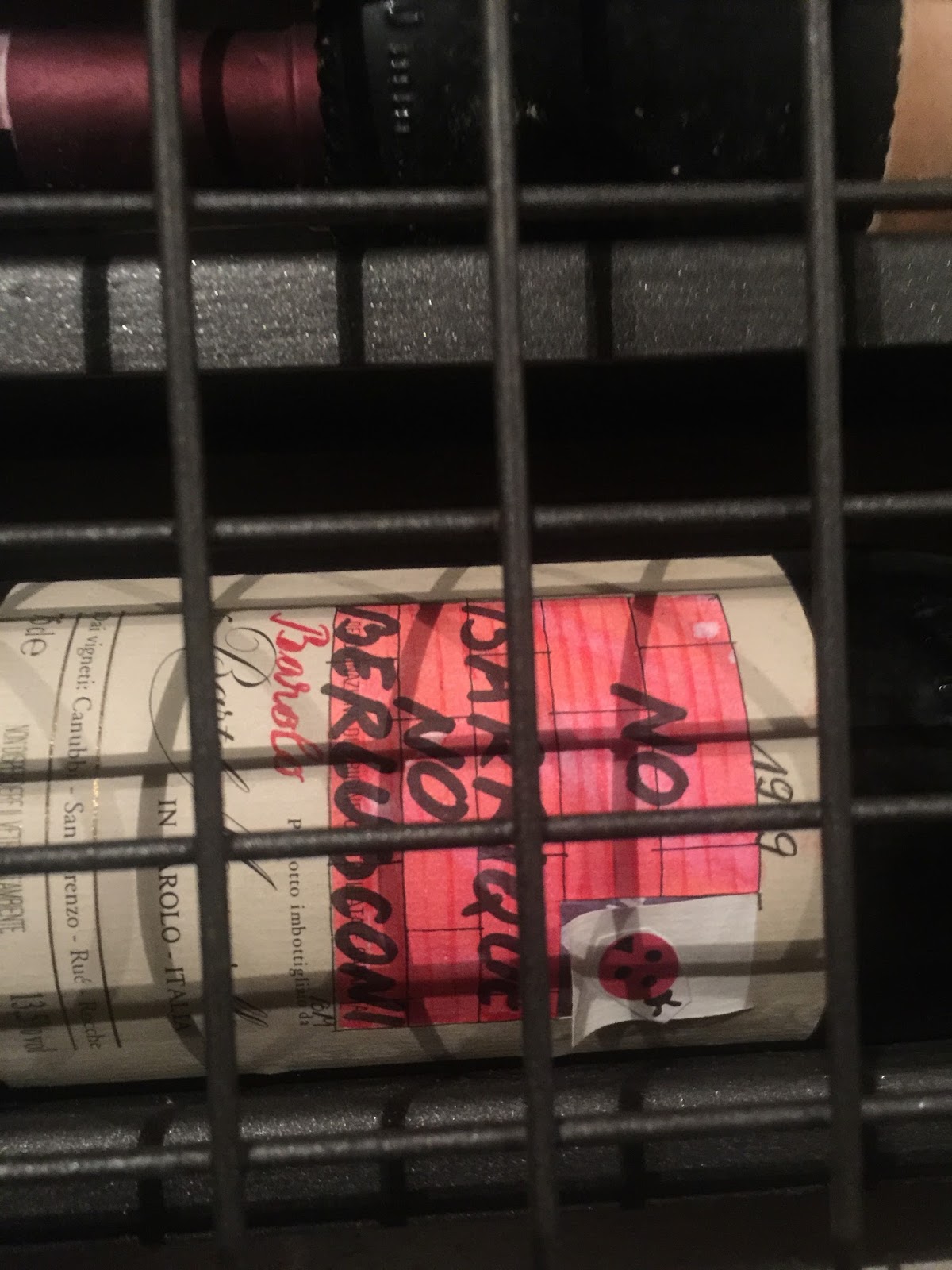
Maria had written an article for Tong Magazine a few years ago in which she described the vineyard and cellar work required to make Barolo in the Mascarello style. I have summarized her writing on the cellar work in the figure below.

The goal, according to Alan, is to make a truly harmonious Barolo. And that task begins with the harvest date: we wait for the skins to tell us when to harvest. Further, there is a strict selection of the grapes that make it into the wine. That selection begins in the vineyard, where imperfect fruit is left on the ground, and continues with a second selection at the sorting table in the cellar.
Fruit from the four plots are mixed in the fermentation vats in a process called "asseblaggio." As the harvest time differs from vineyard to vineyard, recently brought in fruit is added to the mix that is already resident. According to Alan, "the ratios change from year to year as nature gives us different quantities from year to year. What the land gives us becomes our wine. We do not adjust the proportions to keep a constant ratio. For example, in 2012 we had hail only in Rué, and half the fruit was damaged and left on the ground. We simply had less of the Rué fruit in the mix that vintage ..."
The fermentation tanks are fiberglass-lined concrete tanks from the 1940s. The Slavonian oak barrels used in the aging process are changed out every 40 to 50 years. The aging regimes are as follows: Dolcetto and Freisa, 1 year; Barbera and Langhe Nebbiolo, 2 years; and Barolo, 3 years.
Tasting
At the conclusion of the cellar tour we returned to the tasting room to sample the wines. We started with a Barbera 2014. This had been a difficult year with lots of rain. The weather cleared in the last two weeks of September and the first two weeks of October. The best wines of this vintage are excellent. Rose petal, spice, and rusticity on the nose. Good acidity and power.
 |
| Alan in the tasting room |
Next up was the 2012 Barolo, This is a vintage, according to Alan, that they consider "shy" -- it requires a bit of coaxing. That year was never too hot, never too cool. They had hail in Rué and that is the vineyard that provides structure. Strawberries, honeyed nose, dried flowers, green herbs, sweet talcum powder. Delivers on palate. Fine-grained tannins. Lenghty finish.
 |
| Maria Teresa in the tasting room |
The final wine tasted was the 2013 Barolo. This was a cool, classic vintage. After 21 days of maceration they terminated skin contact. Alan expects this wine to begin closing down temporarily sometime in the near future. Strawberries and roses. Honeyed nose with a hint of balsamic. Concentrated yet balanced. Lengthy finish. A wine to be aged and for the ages.
 |
| Alan and Maria Teresa |
As we were going through the wines, Maria Teresa re-iterated the importance of her father's influence in everything that is done on the estate today. This adherence to his teachings is done both to honor him and because it continues to result in excellent wines that appeal to her customers.
Alan was a fount of information and a pleasure to be around if you like diving into the innards of a vat. We truly enjoyed this trip and would like to thank Maria Teresa and Alan for the hospitality and insights.
©Wine -- Mise en abyme


