Showing posts with label Sagrantino di Montefalco DOCG. Show all posts

Wednesday, February 26, 2020

Trailblazer and Evangelist: Marco Caprai and Sagrantino di Montefalco

The Sagrantino grape has a history in its native Montefalco that stretches back 400 years but that extended history did not translate to renown. That is, until Marco Caprai appeared and, by dint of his industry and collaborative efforts, propelled the wine and the region into the foreground in Umbria and Italy, and into the minds and hearts of consumers worldwide. Caprai came to West Palm Wines (WPW) in Tampa recently to share his journey and a selection of his wines.

Marco Caprai

Marco is currently the Managing Director of Armando Caprai, wine venture of the industrial group of the same name. His father, Armando, bought a 2-ha property in Umbria  in 1971 and began making wine. Marco studied Political Science in school but, at the age of 21, it was time for him to join the family business. As he said, rather than go into the fashion or textile arms of the business, he opted to manage the winery, beginning that effort in 1988.

Soon after taking charge of the estate, Marco set his sights on establishing the flailing Sagrantino as the foundational wine of the region. He collaborated with the University of Milan to launch the Sagrantino Project in 1989 and, after intensive studies and experimentation, and gaining the support and cooperation of other regional players, he attained the successes manifested in the wine and the region of today.

The Sagrantino grape was introduced into the area in the 15th century by Franciscan monks who used it for liturgical purposes. The grape is famously rich in polyphenols, resulting in a wine with a deep purple color, full body, structure, and with a capacity for long life.

The Region
The grape can be found in both DOC and DOCG wines. The map below shows the location of the DOC region (granted in 1979 and covering parts of the municipalities of Bevagna, Giano dell'Umbria, Gualdo Cattaneo, Castel Ritaldi, and all of the municipality of Montefalco) and the DOCG region (granted in 1992 and with similar distribution as the DOC region). The DOC and DOCG regions are shown in the heart of the map, within the broader Colli Martani region.

Source: kasteelwijnen.com

The area has a continental climate with average annual rainfall of 700 mm. The gently sloping hills that are a feature of the growing area support vineyards at elevations ranging between 220 m and 472 m a.s.l. Aspects are varied, resulting in a range of micro-climates.

The DOC wines are a Blanco (Grechetto -- min 50%; Trebbiano Toscano -- 20 - 35%; and Trebbiano Spoletino -- 0 - 30%) and a Rosso (Sagrantino -- 10 - 15%; Sangiovese -- 60 - 70%; and other red grapes -- 15 - 30%).The DOCG wines are made from 100% Sagrantino grapes  and can be either dry or Passito. The grapes for these wines have a limited production and are characterized by small bunches, thick skins, and high polyphenol content.

The characteristics of the grape allows for partial drying (as in the case of the passito wine) and long aging. In the case of the passito wine, the grapes are carefully selected and left out to dry for approximately two months after which they are pressed and the must fermented with the skins.

As regards the DOCG wines, yields for the dry wine are 52 hl/ha and 28 hl/ha for the passito. Both wines must be aged for a minimum of 33 months, with a further requirement of minimum 4 months bottle aging. The dry wine must be resident in oak for a minimum of 12 months. The DOC wine requires 12 months aging.

The Vineyards
Marco had by this time increased the family's vineyard holdings from the original 2 ha to 149.7 ha, 89 of which was planted to vine. The farm is cultivated sustainably with grass planted between rows, limitations on the use of pesticides, CO2-emission monitoring, vineyard biodiversity, and adherence to sustainable social and environmental practices.

The Wines
The chart below shows the wines we tasted at the WPW event, the sources of the grapes, and the aging method for each.
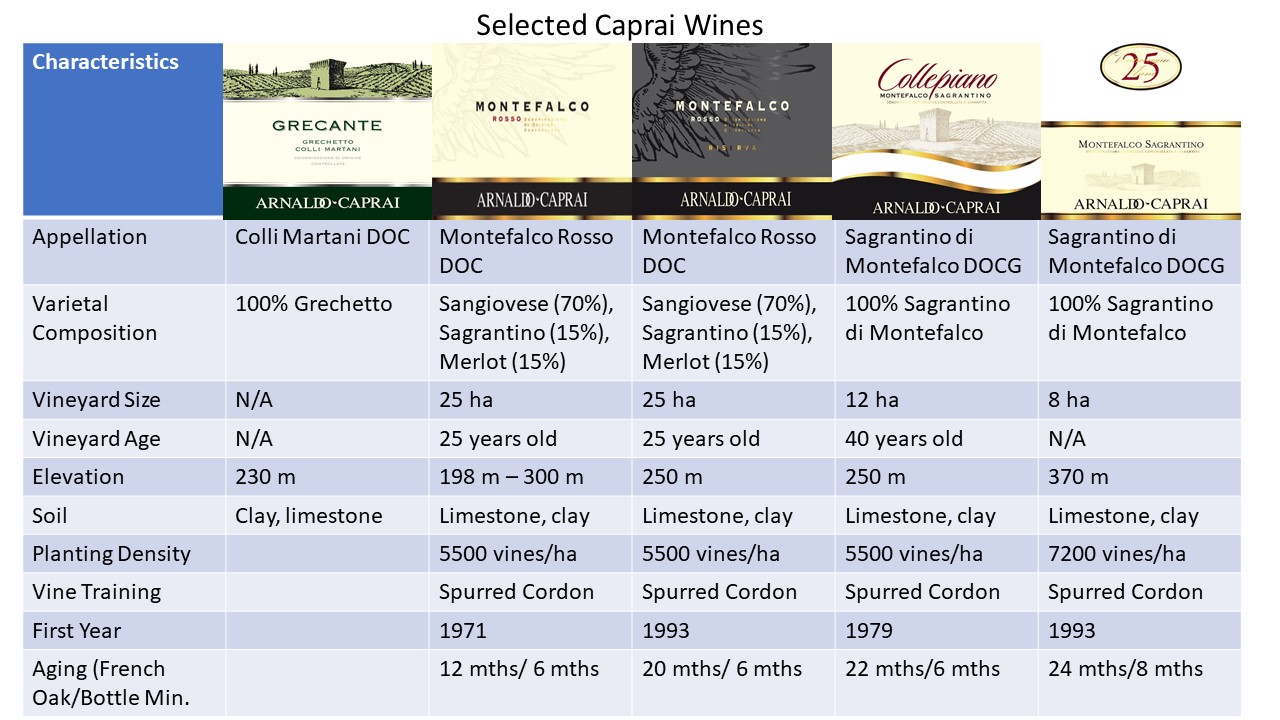

We tasted the 2018 Grechetto Grecante as we milled around the bar. The wine was perfumed, floral, waxy and with yellow fruit on the nose. Herbs, a bitterness, textured and mineral on the palate. The minerality and texture combined to restrain the fruit flavors. Interesting mix of acidity, bitterness, and minerality. Textural intensity diminished with time.

The 2015 Montefalco Rosso showed herbs and violets on the nose, along with a slight nuttiness. Red fruits, medium body, and a peppery finish. The Riserva version of this wine had more of an obvious barrel note on the nose as well as shoe polish, spice, and sweet red fruit. Bright on the palate. Rich red fruit. Medium-bodied. Spicy, long, herby, mineral finish.

Sweet dark fruit and spice were the characteristics that I noted for the nose of the 2013 Sagrantino Collepiano. Smooth and round on the palate. Not as intense and structured as the 2008 we had sampled offline at the bar. Pleasant, rich, and open.

The final wine in the lineup was the 2013 Sagrantino 25 Anni. The initial bottling of this wine -- 1993 -- was a commemoration of the winery's 25th anniversary. The wine was the result of "in-depth research and careful clonal selection of Sagrantino's best grapes" and was awarded Gambero Rosso's Tre Biccheri upon release. The version that we tasted showed deep red fruit and a beautiful bouquet on the nose. Concentrated, with a hint of match flint, vanilla, baking spices, and mango. Structured dark fruit on the palate along with pepper, herbs, and good acid levels. Persistence of pepper gives way to texture. Long, spicy, bitter finish.

********************************************************************************************************
I have visited the Paolo Bea estate in Montefalco and am a fan of his wines. Caprai wines stand in stark contrast to the Paolo Bea wines in that they have a more modern feel. The key here is the difference in winemaking between the two estates.The Caprai wines are aged for up to two years in French oak barriques and then up to an additional 6 months in bottle. Paolo Bea red wines, on the other hand, are aged for 1 year in stainless steel, 2 years in 20- to 30-hl oaken barrels, and then an additional 2 to 4 years in bottle.

Both wines are reflective of their winemakers' visions.

©Wine -- Mise en abyme

Thursday, September 29, 2016

Being natural in Montefalco (Umbria): The Wines of Paolo Bea

Paolo Bea remains active in the direction of his namesake business with his son Giuseppe farming the vineyard and the other son -- Giampiero -- assisiting with vinification as well as being responsible for all commmercial aspects of the business. Giampiero is an architect by training and, in addition to his daily activities, is also responsible for the design of the esthetically pleasing structures that rim the courtyard that you enter from the road on your visit to the estate in Montefalco.

Fermentation building and offices, Paolo Bea

Sideways view of portion of fermentation building
The estate farms 13 ha in Montefalco which, given Paolo's aversion to monocultures, supports five vineyards, two olive groves, and plots for a variety of fruits, vegetables, and grains. Of the 13 ha farmed, three are rented. The Montefalco property is planted to Sagrantino (60%) with the remainder supporting Sangiovese and Montepulciano vines. The estate's guiding principles are as follows:
  • Make note of the weather of the seasons to understand the territory and the cycles of nature and avoid every artificial acceleration
  • Limit to a minimum the treatment in the vineyard
  • Trust to nature the transformation of the grapes into wine
  • Avoid whenever possible that the actions of man dominate the will and effects of nature
  • Respect nature, contributing with our work to maintain the equilibrium between flora and faun of the original land
  • Safeguard the taste of the land, avoiding the use of chemicals in the vineyard and cantina
  • Produce sound products for our health.
View of the farm from the fermentation building

Another section of the farm
Harvesting is done by hand in multiple passes. The first pass yields the grapes for the "important" wines while subsequent passes capture the remaining grapes. The grapes are brought directly from the vineyard to the winery where they are destemmed and crushed. The juices, skins, and seeds are then pumped into tanks in the floor below the receiving level (The estate refers to this as gravity flow but the use of the pump is disqualifying as regards that particular nomenclature.). Vineyard blocks are managed separately throughout the vinification process.

Wines are fermented using natural yeasts and cap management is effected via punchdown. Red wines are fermented and macerated for approximately 50 days while whites are fermented on the skins for a total of 30 days. All fermentation and maceration occurs in stainless steel tanks.


Red wines are passed through a vertical press with the free-run and pressed juices blended immediately. The red wines are aged in stainless steel tanks for one year after which they are transferred for an additional two-years of aging in 30-, 25- and 20-hl oaken barrels. These wines are then bottled and aged for an additional two to four years.


The white and Passito wines are kept in stainless steel for 18 months and in bottle for 1 year.


The grapes for the Passito wine are selected from "less-tight" bunches and are the first grapes selected form the harvest. If there is rain, no Passito wine will be made because of the risk of mold. The skin of the Sagrantino grape is very thick and will succumb to slicing under normal conditions. When it can be cut like a Ricotta cheese, the Passito grape is ready to be crushed.

Tour of the Passito room
After our tour of the fermentation room we were headed to the tasting room when we ran into Paolo Bea himself.

Author, Parlo, and Paolo Bea
As we stepped into the tasting room, we saw an impressive array of bottles, each one containing a Paolo Bea signature wine. In the center of the room, places were set for the tasters along with extensive documentation covering the wines we were about to taste.


Giampiero leading us through the tasting
The first wine tasted was the 2011 Arboreus. The Trebbiano Spoletino vines are more than 100 years old and each plant can produce between 40 and 60 kilo of grapes. The vines are in excess of 3 m tall and grow around trees, eventually killing them. The wine spent 22 days on the skins during fermentation. The wine had an orange color and and orange peel on the nose along with a savory, nutty, asparagus character. Spicy and bright on the palate. A lovely wine.

The second wine was the 2009 Sanvalentino Umbria Rosso IGT and is made from second-passage grapes from all vineyards. In 2009 it was a blend of Sangiovese (60%), Sagrantino (30%), and Montepulciano (10%). This wine spent 32 months in oak. On the nose, sweet herbs, baking spices, and a savoriness. On the palate, sweet red fruit and power with biting acidity. Full-bodied. Mouth-coating tannins. Lengthy finish

The 2008 Pipparello Montefalco DOC Rosso Riserva is a blend of Sangiovese (60%), Montepulciano (25%), and Sagrantino (15%). This wine spent 10 months in stainless steel tanks and 33 months in 25 hl slavonian oak barrels. High-toned, focused, concentrated dark fruit with spice. Huge wine on the palate. Concentrated. Savory with tar and mint notes.

The 2008 Rosso de Vèo Umbria Rosso IGT exhibited red fruits, tar, and a little bit of stewed fruit on the nose. On the palate it showed as relatively simple and lacking in concentration. Giampiero was not satisfied with this wine and opened a second bottle. This second bottle was far more expressive on the nose and showed a lot more concentration. Anise, licorice, tar, and black fruits. Balanced.

We next tasted the 2008 Pagliaro. This is the estate's flagship wine, a 100% Sagrantino that was macerated for 38 days after which it spent 10 months in stainless steel and 33 months in large oak barrels. The vines from which the grapes for this wine are sourced are between 35 and 45 years old. Spice, anise, licorice, tar, and jammy sweet fruit on the nose. Dense and fleshy on the palate with expressive tannins.

The final wine tasted was a new entrant onto the market, the 2007 Cerrete Montefalco Sagrantino DOCG. The vines for this wine are planted in a 3-ha vineyard at the highest point of the Sagrantino area. Total production is 4000 bottles. This wine was produced in 2007 for the first time and was not produced in 2008. Grapes from the vineyard that were not used in this wine in 2007 were used in the Rosso de Vèo wine. Sweet, concentrated, dark fruit along with licorice and tar.  Delivers fully on the palate. This is a beautiful wine. I was so impressed that I bought a six-pack on site.

I buy Pagliaro and Pipparello for my cellar every year. With my fuller understanding of the estate, and a better appreciation of the range of wines, I expect that my list of labels procured annually will expand going forward.


©Wine -- Mise en abyme

Wednesday, September 28, 2016

The Montefalco wine region of Umbria, Italy

Paolo Bea and his wines are legendary. The estate has been growing grapes in the same location since the 15th century and the current proprietor (Rosenthal):
  • Is one of Italy's most passionate natural winemakers
  • Is a founding member of vini veri, a group dedicated to non-interventionist winemaking
  • Has an unshakeable commitment to terroir and "old-fashioned" techniques
  • Is passionate about preserving the unique personality of the region
So it was with great anticipation that we headed out from our Terre Margaritelli visit in Torgiano to Montefalco to its southeast. The drive was pleasant, especially as we passed through the villages leading up to Montefalco and Montefalco proper. The video below serves as an example.


Before describing our visit to Paolo Bea, a word about the region within which its wines are produced. The map below shows the location of the DOC region (granted in 1979 and covering parts of the municipalities of Bevagna, Giano dell'Umbria, Gualdo Cattaneo, Castel Ritaldi, and all of the municipality of Montefalco) and the DOCG region (granted in 1992 and with similar distribution as the DOC region). The DOC and DOCG regions are shown in the heart of the map, within the broader Colli Martani region.

Source: kasteelwijnen.com

The area has a continental climate with average annual rainfall of 700 mm. The gently sloping hills that are a feature of the growing area support vineyards at elevations ranging between 220 m and 472 m a.s.l. Aspects are varied, resulting in a range of micro-climates.

The DOC wines are a Blanco (Grechetto -- min 50%; Trebbiano Toscano -- 20 - 35%; and Trebbiano Spoletino -- 0 - 30%) and a Rosso (Sagrantino -- 10 - 15%; Sangiovese -- 60 - 70%; and other red grapes -- 15 - 30%).The DOCG wines are made from 100% Sagrantino grapes  and can be either dry or Passito. The grapes for these wines have a limited production and are characterized by small bunches, thick skins, and high polyphenol content.

The characteristics of the grape allows for partial drying (as in the case of the passito wine) and long aging. In the case of the passito wine, the grapes are carefully selected and left out to dry for approximately two months after which they are pressed and the must fermented with the skins.

As regards the DOCG wines, yields for the dry wine are 52 hl/ha and 28 hl/ha for the passito. Both wines must be aged for a minimum of 33 months, with a further requirement of minimum 4 months bottle aging. The dry wine must be resident in oak for a minimum of 12 months. The DOC wine requires 12 months aging.

I will describe the Paolo Bea visit and tasting in a follow-up post.

©Wine -- Mise en abyme