Showing posts with label St. Julien. Show all posts

Sunday, September 21, 2025

A tasting of selected vintages (2009 - 1978) of St. Julien's Chateau Léoville Poyferré

"I liked all of the Leoville wines. The Las Cases was big and bold; the Barton, earthy; and the Poyferré elegant and poised." So said Richard Cohen, a member of the Orlando Tasting Group after our triad-concluding vertical tasting of the Poyferré Grand Vin. 


Before describing this most recent tasting, let me provide some background information on the estate.

History
As described previously, the Leoville estates came about as a result of the dismemberment of Domaine Leoville beginning with the sale of selected vineyard plots to Hugh Barton in 1826. Léovile Poyferré surfaced when Jean de Las Cases passed her portion of the remaining estate on to her daughter who, at the time, was married to Baron Jean-Marie de Poyferré. Hence the estate name.

As shown in the timeline below, the estate changed hands twice between 1865 and 1920 but has since remained in the hands of the Cuvelier family. Didier Cuvelier took control in 1979 and his stewardship was instrumental in moving the estate into the top ranks of Bordeaux producers. Didier resigned in 2017 and was replaced by his cousin Sara Lecompte Cuvelier.


Grape-Growing Environment
I have covered the St. Julien grape-growing environment previously. As regards the Chateau Léoville Poyferré environment, the chart below shows the estate's major vineyard blocks (except for one that is dedicated solely to Chateau Moulin Riche), the soil characterizations of those blocks, and general information on the built environment.


The Poyferré vineyards are managed by Alix Combes with David Aguirre as his assistant. The estate's manta is "vigilance, reactivity, adaptation" with human intervention only when necessary. Each vineyard worker is assigned a specific plot and is responsible for meticulous, nature-observant tending of same. The vineyard is ploughed for aeration as well as weed control, a part of the estate's commitment to eco-friendly practices.

Wines and Winemaking
The estate produces two wines: Léoville Poyferré and Pavillion de Poyferré, The Grand Vin is known for opulence, richness and aging potential while the Pavillion is more accessible. The Grand Vin has seen a rapid jump in quality beginning with the 1982 vintage.


Harvest
Three weeks before harvest the winemaking team gets together with consulting enologist Julien Viaud and they go through the vineyard tasting the grape berries to evaluate their ripeness. Analysis of phenolic and technical maturity complement and confirm impressions during daily tastings.
  • Grapes are hand-picked and the clusters transported to the vat house in crates
  • Sorted by hand before destemming and optically before crushing, the latter to remove any vegetal material. 
Vinification
The grapes are vinified plot-by-plot by variety in 57 heat-regulated, stainless-steel tanks, 27 of which are double-walled. Young vines ripen earlier so they are picked and vinified separately. Row-ends are also vinified separately because they ripen later; they are picked later and used for kosher wine.


One-week pre-fermentation cold maceration enhances purity of fruit aromas and color intensity. Non-Saccharomyces yeast is added to the must at this time rather than the traditional Sulfur dioxide.


The must is pumped over daily until the end of alcoholic fermentation. The fermented wine is racked off the skins which are pressed for press wine. 


Some small batches of kosher wine are made from grapes set aside specially for this purpose. Special teams are brought in for this purpose.

Malolactic Fermentation 
In barrels. Because the barrel room is across the street from the vat room, the wine has to be transported over. This was, for a while, done by hand in steel tanks using tractors. More recently underground pipes have been laid to allow transfer of the wine from vats to barrel.

Aging
By variety and plot. Aged in French oak barrels for 18 months.

Tasting the Wines

The wines included in the tasting are shown below. They are arranged in flights by decade.


Year

Cabernet Sauvignon (%)

Merlot (%)

Cabernet Franc (%)

Petit Verdot (%)

2009

60

29

6

5

2003

70

25


5

2000

60

40


1996

50

35

4

11

1995

67

26

7

3

1990

63

25

5

7


1978


The tasting team is shown below. This is the smallest group to date (and, as a result, the fewest number of wines) due to scheduling changes disrupting the original order (Al was a part of the group but the picture was taken prior to his arrival.).


Flight 1: The 2000s

2009 Léoville Poyferré 

Elegant on the nose with blueberries, eucalyptus, baking spices, and fudge. Good acidity. Graphite, forest floor, coal, and a salinity on the palate. Savory. Eucalyptus comes through on the palate. A bit of a green note. Lengthy finish. Beautiful wine -- Author.


Currently a little austere but can't wait to try it in 5 - 10 years. Blueberry notes. Grippy, with lots of black fruits -- Brian.


2003 Léoville Poyferré 
Dark fruit, herbs, spices, tobacco, and cedar on the nose. Good acid level. Earthiness, spice, and plums on the palate. Wine belies the heat of the vintage -- Author.

This was a very Cabernet-dominant vintage. Not as fruit-heavy as some other 2003s. Plums, velvety tannins. Well on the road to full integration. Was my second choice overall of all the wines -- Brian.

This was the wine of the flight.

2000 Léoville Poyferré 
Not as good as the two preceding wines. Almost over-the-hill. Some VA and an odd character. VA becomes more prevalent with time -- Author.

Tart cherries and cedar. A green note and starting to fall off a bit. Some tobacco notes but not there at all -- Brian.

Flight 2: The 1990s

1996 Léoville Poyferré 

Dark fruit, graphite, pencil lead, black pepper, red pepper, and spice on the nose. Beautiful palate. Balanced. Some drying -- Author.

Loads of Petit Verdot in this vintage. Fantastic nose (in retrospect one of the best of the tasting). Wine still needs time. Somewhat reminiscent of a Leoville Las Cases -- Brian.

1995 Léoville Poyferré 
Ginger, mint, eucalyptus, and pepper spice on the nose. Cherry on the palate along with salinity and a savoriness. Unresolved. Short finish -- Author.

While similar to the 1996, the acid and tannins were a little overwhelming for me. Good, not great. Cedar and less fruit than preceding wines. Very shallow/short wine -- Brian.

1990 Léoville Poyferré
Blueberry, eucalyptus, sweaty saddle leather, and cigar box on the nose. Red and dark fruit on the palate. Great finish -- Author.

Wonderful wine. Garnet/Ruby color and a great cherry nose. Luxardo cocktail cherries. Medicinal, but not in a bad way. Hint of thyme as well. Fully integrated and along finish. This wine is ready now -- Brian

This wine was adjudged the wine of the flight.

Flight 3: The 1970s

1978 Léoville Poyferré 

Eucalyptus on the nose. Sour cherry and cough syrup on the palate. Bold aromas and flavors -- Author.

Very short wine but fun. Expectations met for what some called the "miracle vintage." Medicinal with sour cherries -- Brian.

****************************************************************************************************
After the completion of the flights, we voted for a wine of the night. The 1990 took the prize by a wide margin,


©Wine -- Mise en abyme

Tuesday, May 20, 2025

Château Léoville Las Cases: History, environment, grape-growing, and wines

Having completed our study of the Pauillac region, the Orlando Tasting Group now turns its attention to the St. Julien sub-appellation and the Léoville wines.

History
The three current Léoville estates had a common beginning back in 1638 when Jean de Moytie founded a vineyard on a Medoc gravel ridge and named it Mont Moytie. This estate, along with Margaux and Latour, was the earliest wine producer in the region and remained a unit until the period 1826 to 1844 when it was split into three separate entities. The chart below details the history of the estate up until its dismemberment.


From the 1840s on, the Las Cases branch of the Léoville tree was managed by a succession of family members. Somewhere along the way 20 shares were authorized to account for the total ownership of the enterprise. In 1900 one of those shares was issued to Theophile Skawinski, the estate’s general manger. Skawinski was the great great-grandfather of the current owner and, over the years, the family has set itself the task of acquiring every share that it did not already own. That goal was accomplished in 1994 when the Delon family became the sole owners of the estate.

Léoville Las Cases introduced a new wine — Clos du Marquis — from a different terroir in 1902. In the first two decades of the 21st century the enterprise introduced true second wines for each of its primary labels: Le Petit Lion for Las Cases and La Petit Marquis for Clos du Marquis.


Léoville Las Cases Grape-Growing Environment
Saint Julien, being south of Pauillac, is slightly warmer but still subject to similar climate-modification effects (see chart below). The soil is similarly gravelly but has less clay and limestone.


Leoville Las Cases sources the grapes for its wines from two separate terroirs: A walled vineyard (Grand Clos) for the primary wine and a vineyard 500 yards to the west for the Clos du Marquis.


The Grand Clos extends over two small hills and is the heart of the Las Cases vineyard. It lies in the north of St Julien, bordering on Pauillac, and is separated from Chateau Latour by a small stream. The deep gravel soils rest on clay and sand sub-soils. The aspect is SE. 


The vineyard is divided into seven main blocks and, further, into 125 parcels. Cabernet Sauvignon is planted on the hills while Merlot is planted at the bottom of the slopes. 


The vineyard is farmed organically with sustainability the driving force behind vineyard practices:

  • Cover crops between rows to prevent soil erosion and boost soil health 
  • Limits on chemical use. Natural products are used to control pests
  • Efficient irrigation systems.

Vineyard management practices include::

  • Dense planting scheme — forces vines to compete, resulting in lower yields and higher quality
  • Pruning and canopy management by hand; allows for precise control
  • Each plot harvested at optimal ripeness

Winemaking at Leoville Las Cases

Philosophy

The Chateau seeks to produce wines:

  • Representative of their terroirs
  • To be consumed during meals 
  • With great aging potential
  • That improve with age.

Process

The Leoville Las Cases winemaking process is labor-intensive and meticulous and is mostly unchanged from the 19th century. The requirements/steps are as follows:

  • Harvesting of high-quality grapes
  • These grapes are carefully selected and sorted (including optical sorting (a relatively new innovation)) to ensure that only the best grapes make it into the wine 
  • Fermentation vessels include wood, concrete, and stainless steel vats of varying sizes. Eight oak vats are reserved for confiscation of the Grand Vin whike cement tanks are used for all other wines.
  • Movement of wines within the cellar is via gravity flow
  • Malolactic fermentation occurs in tanks
  • Blending is conducted post-MLF but prior to oak aging in order to ensure no oak influence in the construction of the blends
  • Wines are allowed to mature post fermentation so that they can develop their complex flavors and aromas. Recently the wine has been aged for 18 months in 90% new French oak
  • Beginning in 1987, reverse osmosis technology has been employed during the winemaking process to help extract excess water from the mist. This is, of course, controversial among purists. 

Wines of Léoville Las Cases

Grand Vin de Léoville

This wine has been described by Berry Bros & Ruud as “… arguably the most exotically perfumed wine in the Medoc and this can be partially attributed to the must being fermented at lower-than-average temperatures, which leads to its youthful, aromatic richness being retained. On the palate it is powerful and concentrated and marvelously well-balanced.”


The wine is structured, firm, austere, and powerful with top vintages taking 15 - 20 years to lose its tannic structure. The wine displays intense ripe fruit flavors of black currant, cassis, and wild blackberries with subtle floral aromas and finely grained tannins. Depending on the vintage, it can present a more upright Pauillac profile or a more tender St Julien profile.


The wine is a blend of Cabernet Sauvignon and Cabernet Franc. Between 9000 and 15,000 cases are produced annually.


Le Petit Lion du Marquis de Las Cases

This is a true second wine made from younger vines. The blend is approximately 45% Cabernet Sauvignon, 45% Merlot, and 10% Cabernet Franc. The wine shows dominant black fruit flavors, graphite, minerality, tobacco, and grainy tannins.


The wine is designed to be more accessible.


Clos du Marquis

This wine was first produced in 1902 with grapes secured from the top terroirs of St Julien that was a part of the Léoville historic vineyard. This wine offers a fine expression of the St Julien character: structure, complexity, harmony, distinction, and aging potential.


Annual production of between 4,000 and 8,000 bottles per year.


La Petite Marquise

Young vines from the Clos du Marquis terroirs. 56% Merlot, 44% Cabernet Sauvignon.
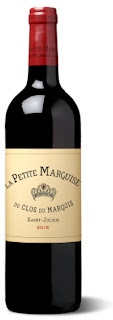


I next address our tasting of the wines from this estate.


©Wine -- Mise en abyme

Tuesday, November 30, 2010

The Medoc sub-region of Bordeaux

On October 8th, I attended a class at Decanter HQ in London led by Decanter Contributing Editor Steven Spurrier and titled Mastering the Medoc and Graves.  In a previous post, I reviewed the class as an event.  In this and subsequent posts, I will report on the regions, the houses, and the wines covered in the course.  I begin the series with a look at the Medoc.


The Medoc is a part of the larger (and storied) Bordeaux wine region which is concentrated around the Gironde estuary and its tributary rivers, the Garonne and Dordogne.  The region owes its winemaking prowess to a number of factors: (i) a temperate climate characterized by humid springs, hot summers, sunny autumns, and relatively mild winters; (ii) the warming influences of the Gironde and the Gulf Stream in the Atlantic Ocean; (iii) its soils (quartz and flint pebbles over a subsoil of marl on the left bank and clay, limestone, and some gravel on the right); and (iv) protection from the ocean winds by the Landes pine forest to the southwest.

The Medoc is divided into two sub-appellations, the Medoc to the north and the Haut-Medoc, with the Medoc covering 4700 hectares and the Haut-Medoc 4300.  The Medoc sub-appellation, called Bas Medoc in earlier times, has heavy, moisture-retaining soils which are much more suited to Merlot than the Cabernet Sauvignon which dominates in its neighbor to the south.  Many areas in the Haut Medoc have large deposits of gravel which were washed down from the Pyrenees thousands of years ago.  This gravel provides excellent drainage and ideal conditions for Cabernet Sauvignon which does not like "wet feet."  These gravelly soils also retain warmth and, in so doing, aid in the ripening of the grapes.

The Chateaux in the the Medoc have been ranked since the 1855 World's Fair and that 1855 Classification, as well as the Cru Bourgeois classification, have been covered in a previous post.

Within the Haut-Medoc appellation there are a number of communal appellations which are renowned for producing some of the finest wines in the world.  Beginning with St. Estephe to the south of Medoc, these communes hug the Gironde until ending with Margaux at the fork which heralds the beginning of the Garonne and Dordogne rivers.  St. Estephe covers 1200 hectares and its wines are considered to be rustic.  They are tannic, muscular, and long-lasting.  Pauillac is 1100 hectares in size with wines that are considered powerful, yet elegant.  There are 15 classed growths but three Premier Crus (Chateaus Lafite, Latour, and Mouton) in this commune.  St. Julien is the smallest of the communes with 900 hectares and has 10 classed growths.  Its wines age well and combine elegance with austerity.  Margaux covers 1300 hectares and its wines are thought to be the most "perfumed, feminine, and elegant."

I will cover the Graves region in my next post.