 |
| Evan Martin, winemaker/owner at Martin Woods |
 |
| Lineup of the wines we tasted |
The tools and techniques employed in constructing the wines are displayed in the table below. It should be noted that, with two exceptions, the wines are all single-vineyard; a key focus of the estate.
Techniques/Practices Employed in the Construction of the Martin Woods’ Wines Tasted at Swirlery
| Wine | Press | Vessel | Fermentation | Aging (Mths) | Barrel Type | Barrel Size (L) | Barrel Age (Years) | Lees |
| Willamette Valley Chardonnay 2018 (Yamhill (55%) and Havlin (45%) | Whole Cluster | Oregon Oak | Indigenous yeasts |
11
|
Oregon Oak | 228, 400 |
7-8
|
Stirring |
| Eola-Amity Hills Chardonnay 2017 (Willakia) | do. | French, OR Oak | do. |
9
|
French, OR Oak | do. | N/A | No stirring |
| Havlin Vineyard Pinot Noir 2017 | 1.5 ton open-top fermenters; 20% whole cluster/whole berries | Ind. yeasts; 17 days on skins; pumpovers & punchdowns | 22 (12 on lees) | French (50%) & OR (50%) oak | 228 (< 5% new) | Yes | ||
| Hyland Vineyard Pinot Noir 2017 | 1.5 ton open-top fermenters; 20% whole cluster/whole berries | Ind. yeasts; 15 days on skins; pumpovers & punchdowns |
10
|
French (50%) & OR (50%) oak | 228, 400 | Yes | ||
| Jesse James Vineyard Pinot Noir 2017 | 1.5 ton open-top fermenters; 20% whole cluster/whole berries | Ind. yeasts; 17 days on skins; pumpovers & punchdowns | 18 (12 on lees) | French (50%) & OR (50%) oak | 10% new | 2 - 10 | Yes | |
| Havlin Vineyard Gamay Noir 2017 | 1.5 ton open-top fermenters; 35% whole cluster/whole berries | Ind. yeasts; 14 days on skins; pumpovers & punchdowns |
9
|
French oak |
228
|
8
|
Yes | |
| Walla Walla Valley Cabernet Franc 2017 (Seven Hills Vineyard and McClellan Estates | 1.5 ton open-top fermenters; 100% destemmed | Ind. yeasts; 16 days on skins; pumpovers & punchdowns | 18 (11 in barrel and 7 in Flextanks) | 3 - 4 | Yes | |||
| 1.5 ton open-top fermenters; 50% whole cluster | Ind. yeasts; 16 days on skins; pumpovers & punchdowns | 18 (11 in barrel and 7 in Flextanks) | 3 - 4 | Yes | ||||
| 1 ton closed-top fermenters; 100% carbonic | Ind. yeasts; 5 weeks for carbonic; pumpovers & punchdowns | 18 (11 in barrel and 7 in Flextanks) | 3 - 4 | Yes |
White Wines
The Martin Woods' Chardonnays are whole-cluster-pressed, barrel-fermented and barrel-aged on the lees. They are unfined and lightly filtered.
Whole-Cluster Pressing
According to Dawson Raspuzzi, whole-cluster pressing is employed in the making of high-end white wines. During this process the entire grape bunch is pressed very gently to release the juice. The resulting product, if the process is done properly, produces a more delicate and less astringent wine due to limited contact with those areas (skins, seeds, stems) with the highest tannin concentration. In addition to its textural contribution, whole cluster pressing increasing the juice/solids ratio as the stems facilitate the complete draining of the press cake.
Alcoholic Fermentation in Oak Barrels
According to Ibern-Gomez, et al*., "Fermentation in oak barrels leads to wines with much more complex sensory properties, largely attributed to the phenols extracted from oak wood."
Alcoholic Fermentation in Oak Barrels
According to Ibern-Gomez, et al*., "Fermentation in oak barrels leads to wines with much more complex sensory properties, largely attributed to the phenols extracted from oak wood."
In a study on barrel-fermentation of white wines (S. Herjavec, et al., The quality of white wines fermented in Croatian Oak, Food Chemistry, 100, 2007), the authors stated thusly:
Oak Aging
Wine is aged in wooden barrels to: (i) enhance its flavor, aroma, and complexity through transfer of substances from the wood to the wine; and (ii) allow gradual oxidation of the wine.
In the first instance, many of the wood's native aromatic compounds, as well as the aromatic compounds created during seasoning and toasting, are absorbed, and integrated, into the wine, thus contributing to wine richness and aromatic complexity. As noted by Dr. Murli Dharmadikari, common descriptors of oak-aged wines are oaky, vanilla, smoky, toasty, spicy, and coconut.
In terms of gradual oxidation, wine loss from barrels amount to approximately 2% per year, resulting from the fact that water and ethanol are smaller molecules and will diffuse into the wood and, ultimately, escape as vapor. If the air in the cellar is dry, more water is lost and the wine is more concentrated in terms of alcohol. If the environment is too humid then more alcohol is lost, reducing the ethanol content in the remaining wine. This loss of liquid opens up a space between the wine surface and the barrel which the winemaker generally "tops up" in order to prevent oxidation and acetic spoilage. During this "topping-up" process, small amounts of oxygen are dissolved in the wine. Oxygen is also introduced into the wine during winery operations such as filtering and racking.
The oxygen which is now in the wine reacts with resident phenolic compounds in a manner such that: (i) tannins are softened (polymerization and precipitation as well as tannin-polysaccharide combinations); (ii) complex aromas develop; and (iii) there is improvement in the wine's body and mouthfeel. It should be noted here that the tannin resident in the wine at this time is the oak tannin absorbed from the barrel (30% from the innermost four millimeters of wood).
In the aforementioned Herjavec, et al., study, the authors found that the sensorial characteristics of barrel-aged wines were modified, due to the wood-derived compounds. These wines manifested roundness in taste with a complex retro nasal aroma." Barrel toast also affected flavor perception: aging in medium-toast barrels yielded a smoky, roasted, and raw oak flavor while light toast resulted in a more fruity aroma.
Cooperage
The oak used in the maturation of alcoholic beverages fall into one of three species: Quercus alba, Quercus robur, and Quercus sessilis. Q. robur and Q. sessilis, and their respective subspecies, are European white oaks while Q. alba is the source of 45% of the white oak lumber produced in the US. American oak used in barrel production is sourced from Kentucky, Missouri, Arkansas, and Michigan but there is no apparent regional distinction. European oak, on the other hand, may have designations which reach all the way to the forest from which the oak originated. For example, French oak from the department of Alliers may be sourced from a forest named Tronçais.
It should be noted that Martin Woods utilizes Oregon Oak in its elevage, a practice I had not previously encountered. Subsequent research has shown that this oak species (Quercus garryana) has characteristics and chemistry similar to European oak and "if very well seasoned the resulting wine might benefit substantially rather like one of the features of French oak" (http://www.oregonbarrelworks.com/Oregonoak.html). Martin Woods restricts the use of new oak to 5% or less.
Lees Aging


The detailed autolysis process is shown in Figure 3 below. The yeast extract, product of the degradation of intra-cellular material, is confined to the cell until such time as the cell wall becomes porous enough to allow the material to seep out. It should be noted that degradation and compound creation continues outside the degraded cell walls.
The lees-aged wine is enriched by the compounds released during the constituent-degradation process.
There is no pre-fermentation cold soak nor is any sulfur added anywhere in the processing. The red wines are mostly whole-cluster-fermented for 14 -17 days with indigenous yeasts in open-top fermenters after which they are transferred to cooperage for elévage. The exception is the Cabernet Franc which is fermented differentially in both closed and open-top fermenters. The benefits that accrue to the white wines from oak usage in elévage are relevant here also.
One of the practices used to intensify the aroma and flavor characteristics of white wines is to ferment the must in oak barrels, and Chardonnay is one of the most suitable varieties for this. Wines produced by fermentation and maturation in oak barrels have different flavor characteristics to those which have undergone barrel maturation only after fermentation in stainless steel. One reason for this is that actively growing yeasts are capable of transforming volatile flavor components, extracted from oak wood, into other volatile metabolites.This metabolite transformation results in what Zac Brown, Winemaker at Alderlea Vineyards, describes as "better integration of the oak and softer mouthfeel when compared to a white that is finished and then transferred into oak barrel to age."
Oak Aging
Wine is aged in wooden barrels to: (i) enhance its flavor, aroma, and complexity through transfer of substances from the wood to the wine; and (ii) allow gradual oxidation of the wine.
In the first instance, many of the wood's native aromatic compounds, as well as the aromatic compounds created during seasoning and toasting, are absorbed, and integrated, into the wine, thus contributing to wine richness and aromatic complexity. As noted by Dr. Murli Dharmadikari, common descriptors of oak-aged wines are oaky, vanilla, smoky, toasty, spicy, and coconut.
In terms of gradual oxidation, wine loss from barrels amount to approximately 2% per year, resulting from the fact that water and ethanol are smaller molecules and will diffuse into the wood and, ultimately, escape as vapor. If the air in the cellar is dry, more water is lost and the wine is more concentrated in terms of alcohol. If the environment is too humid then more alcohol is lost, reducing the ethanol content in the remaining wine. This loss of liquid opens up a space between the wine surface and the barrel which the winemaker generally "tops up" in order to prevent oxidation and acetic spoilage. During this "topping-up" process, small amounts of oxygen are dissolved in the wine. Oxygen is also introduced into the wine during winery operations such as filtering and racking.
The oxygen which is now in the wine reacts with resident phenolic compounds in a manner such that: (i) tannins are softened (polymerization and precipitation as well as tannin-polysaccharide combinations); (ii) complex aromas develop; and (iii) there is improvement in the wine's body and mouthfeel. It should be noted here that the tannin resident in the wine at this time is the oak tannin absorbed from the barrel (30% from the innermost four millimeters of wood).
In the aforementioned Herjavec, et al., study, the authors found that the sensorial characteristics of barrel-aged wines were modified, due to the wood-derived compounds. These wines manifested roundness in taste with a complex retro nasal aroma." Barrel toast also affected flavor perception: aging in medium-toast barrels yielded a smoky, roasted, and raw oak flavor while light toast resulted in a more fruity aroma.
The oak used in the maturation of alcoholic beverages fall into one of three species: Quercus alba, Quercus robur, and Quercus sessilis. Q. robur and Q. sessilis, and their respective subspecies, are European white oaks while Q. alba is the source of 45% of the white oak lumber produced in the US. American oak used in barrel production is sourced from Kentucky, Missouri, Arkansas, and Michigan but there is no apparent regional distinction. European oak, on the other hand, may have designations which reach all the way to the forest from which the oak originated. For example, French oak from the department of Alliers may be sourced from a forest named Tronçais.
It should be noted that Martin Woods utilizes Oregon Oak in its elevage, a practice I had not previously encountered. Subsequent research has shown that this oak species (Quercus garryana) has characteristics and chemistry similar to European oak and "if very well seasoned the resulting wine might benefit substantially rather like one of the features of French oak" (http://www.oregonbarrelworks.com/Oregonoak.html). Martin Woods restricts the use of new oak to 5% or less.
Lees Aging
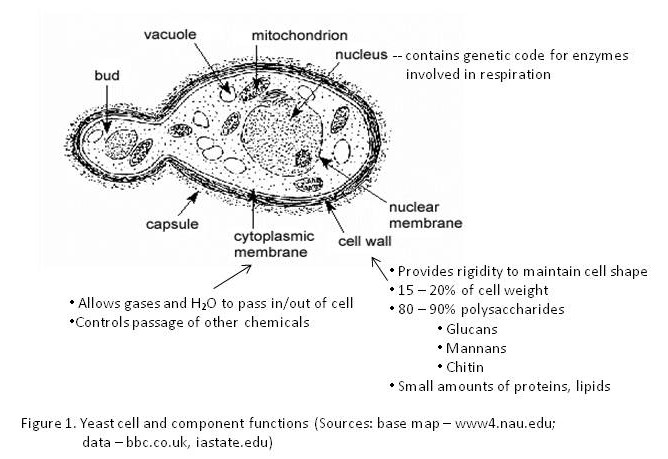
Murli Dharmadhikan (Yeast Autolysis, extension.iastste.edu) defines yeast autolysis as "... self-destruction of the cellular constituents of a cell by its own enzymes" following its death. Figure 1 below shows the component parts of a healthy yeast cell while Figure 2 shows an overview of the process -- autolysis -- that occurs once that yeast cell has consumed all of the available nutrients and dies. At a high level, autolysis encompasses (i) the degradation of intracellular materials and (ii) degradation of the cell wall.

 |
| Figure 3. Details of yeast autolysis |
There is no pre-fermentation cold soak nor is any sulfur added anywhere in the processing. The red wines are mostly whole-cluster-fermented for 14 -17 days with indigenous yeasts in open-top fermenters after which they are transferred to cooperage for elévage. The exception is the Cabernet Franc which is fermented differentially in both closed and open-top fermenters. The benefits that accrue to the white wines from oak usage in elévage are relevant here also.
Whole Cluster Fermentation
Paul Adams (SevenfiftyDaily) identifies the following benefits from whole-cluster fermentation:
- Influences the tannin character of the wine (due to stem inclusion)
- Less intense color but the color that is there is more stable in that it is bound with the tannins
- Provides air space among the grapes and creates channels for juice to flow and circulate
- Helps dissipate the heat created by fermentation.
There is no pump over or punch downs for 7 - 10 days thus allowing carbonic maceration. There is one punchdown per day after this initial period.
Carbonic Maceration
In this method of vinification the grapes are hand-picked in whole bunches and placed serially into the fermentation tank. The weight of the most recently placed grapes causes the lower bunches to burst and the juice that is released begins to ferment. The carbon dioxide that is released during this process causes in-berry fermentation and the production of brightly colored, low-tannin wines with a characteristic fruity flavor.
********************************************************************************************************
Over two posts I have described the sources of the grapes and the winemaking process of Martin Woods Winery. Both elements are of the highest order and clearly explain the quality that the final product displays. The practices are in line with the best winemaking are in line with the best in Burgundy and is innovative in its extensive use of Oregon Oak in fermentation and elévage.
©Wine -- Mise en abyme


