Timorasso is a notoriously difficult grape to grow. And your troubles are not over once you get it into the cellar: it requires extended vessel and bottle aging before it is truly ready to be released on the market. Making Timorasso wine is expensive when you factor in the additional vineyard labor costs and the time, material, and opportunity costs associated with extended aging. Producers wanted a mechanism whereby they could realize some offsetting revenue while they awaited the release of the Derthona and thus was born the concept of the Piccolo Derthona, an earlier-release, lower-cost, 100% Timorasso wine.
I have previously characterized the Piccolo Derthona as being akin to a Rosso di Montalcino but recently came across a more pointed reference: "The name, Piccolo Derthona, is inspired by what is done in French Chablis, a great territory for white wines, where the Petit Chablis is produced with the same goal, that of creating a distinctly fresh and pleasant wine, compared to the richer and more structured Chablis, in our case the Derthona."
The Colli Tortonesi Consorzio has submitted an application to the appropriate authorities for the designation of a Derthona sub-appellation within the Colli Tortonesi DOC covering the production of Timorasso vines within its borders. The submittal covers a Riserva (released a minimum of 2.5 years after harvest), a Derthona, and a Piccolo Derthona (both requiring a minimum of 1 year aging). The difference between a Derthona and a Piccolo Derthona will be based on quality parameters as well as tasting panel assessments.
The picture below show the eight Piccolo Derthonas currently produced from Colli Tortonesi Timorasso grapes.
 |
| Piccolo Derthona wines currently produced in Colli Tortonesi (Picture courtesy of Conrad Mattern) |
The producers currently utilize a mix of reduced aging time (Pomodolce, Boveri Giacomo, Massa, Cantina di Tortona), lower quality/younger grapes (Repetto), or both (Canavero Luca) to distinguish the Piccolo Derthona from the Derthona. The proposed Derthona appellation calls for a similar aging period for both Piccolo Derthona and Derthona so producers will either have to declassify grapes, use grapes from younger vines, or use grapes from lower-quality production sites for the Piccolo wine.
It should be noted that extending the aging period of Piccolo to one year will increase its aging costs and will also cut out an early revenue source for producers who had historically aged the wine for less than one year.
It should be noted that only one of the big-name producers - La Spinetta -- currently offers a Piccolo Derthona and that none of the non-Langhe outsiders do. It will be interesting to see whether this state of affairs continues into the future.
I personally have been concerned that a wine drinker encountering Piccolo as her/his intro to Timorasso may wonder what the fuss is all about and not take the time to explore the variety further.
Below I describe the individual offerings in some more detail.
**********************************************************************************************************
Pomodolce Piccolo Derthona
Pomodolce farms 3 or 4 ha (depending on source) in the Montemarrone municipality of Val Curone. The estate, established in 2005, sources its estate grapes from the areas of Fontanino, Pomodolce, and Barone. The vineyards -- average elevation 380 m -- are sited on calcareous clayey soils and are exposed to the southwest. Vines are planted at 3500 vines/ha and are farmed using organic principles.
The grapes are fermented in stainless steel tanks and aged in-place for 8 months. In contrast, the estate's two Derthona wines are each agaed for 10 months.
Boveri Giacomo Piccolo Derthona
The grapes for this wine are sourced from a Costa Vescovato plot which has been farmed by the family for decades but which has been planted to Timorasso beginning in 2013. Vines are trained Guyot with the between-row spaces grassed.
The grapes are hand-harvested and then soft-pressed with the must clarified prior to fermentation. The wine remains on the lees for 5 - 6 months and is then bottled in the spring following harvest.
Canevaro Luca Piccolo Derthona
This 8- (or 9-) ha estate is located in the municipality of Avolasca at elevations ranging between 300 and 350 m. The vines are farmed organically with grapes for the Piccolo Derthona sourced from younger vines (A total of 1.5 ha is dedicated to Timorasso vines).
The grapes are hand-harvested and soft-pressed prior to fermentation in stainless steel tanks. The wines are aged for 5 months on the lees, with batonnage, and are filtered prior to bottling.
Vigneti Repetto Piccolo Derthona
The Piccolo Derthona is a new wine for the estate. Gian Paolo has described his Piccolo Derthona as "an entry-level wine made from young vines and/or lower quality grapes. This wine has less structure, less body, and a lower price point than the (estate's) Derthona. It exhibits freshness and is suitable for a wine bar."
I tasted the 2019 version of the wine and found saline green olive, a hint of sweet white fruit, and spice on the nose. It was very broad on the palate (wide open, I would say) with underripe citrus fruit and hints of salinity. No hint of the structure that is notable for this variety. The heat on the chest stands in contrast to the 12.5% stated alcohol on the label. Mid-weight, with average length.
Vigneti Massa Piccolo Derthona
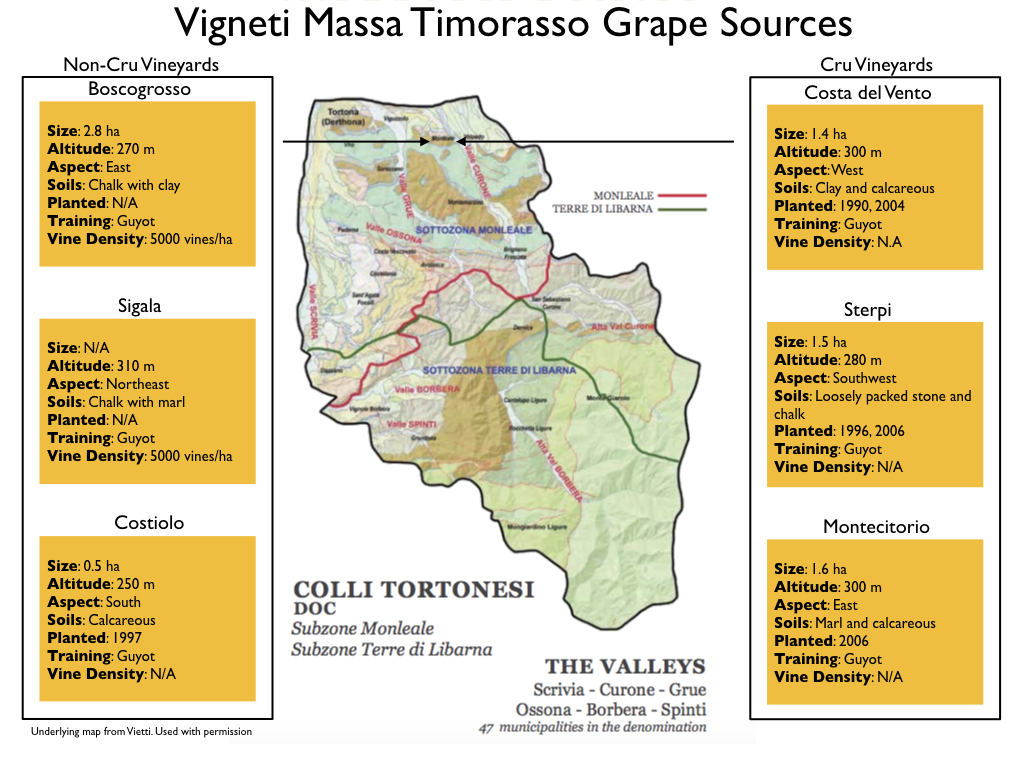
The grapes for the Massa Piccolo Derthona are sourced from the Boscogrosso and Sigala vineyards. The production regime for Massa wines are, in general, as follows:
- Hand-harvesting
- Maceration on the skins in concrete vessels for 48 to 60 hours without sulfuring
- Soft pressing
- Fermentation with indigenous yeasts in stainless steel tanks (20 - 25ºC)
- Spontaneous malolactic fermentation after temperature reduced to 10 - 18ºC
- Wine aged in stainless steel tanks for one year (with batonnage)
- Light filtration prior to bottling
- Minimum 6 months bottle aging.
I tasted the 2018 Piccolo Derthona. Stone fruit, sea spray, minerality, spice, menthol, and a hint of burnt orange on the nose. Much more powerful on the palate than is the case for the the La Spinetta. Lime and lime skin, green tamarind, minerality, salinity, and lip-smacking tannins. Drying finish.
On the day following, sweet white fruit, tempered by a grey slatiness, pea soup, menthol, and spice. Weighty, bracing lime on the palate along with salinity, spice, and a leaden minerality. Bright. Lively. Lengthy finish.
Cantina di Tortona Piccolo Derthona
Grapes for this wine are sourced from Avolasca, Vigguzolo, and Vho where they are grown at elevations ranging between 250 and 450 m in clay and sandy soils with south and southwest orientations.
The grapes are subjected to a 6-hour maceration in an inert environment prior to alcoholic fermentation. The wine is aged for 6 months in continuously suspended fine lees.
Terralba Piccolo Derthona
No information on this wine was available from traditional sources. Conrad Mattern reached out to the proprietor but he had not yet responded at press time.
La Spinetta Piccolo Derthona
La Spinetta purchased 5 ha of land distributed between Montegiocco, Monleale, and Montemarzino for its entry into Colli Tortonesi Timorasso production. The soils are calcareous and clay at elevations ranging between 350 and 400 m and with southeast and southwest exposures.
The grapes are hand-harvested and fermented naturally in stainless steel tanks. La Spinetta's wine ages for 8 months on the lees after which it is filtered and bottled. The wine spends another 3 months in bottle before its release on the market.
The 2019 Piccolo Derthona was La Spinetta's inaugural Timorasso vintage. Neither the nose or palate yelled "Tortonesi Timorasso." This Piccolo was relatively thin.