Showing posts with label Petite Montagne. Show all posts

Sunday, April 29, 2018

Montaigne de Reims: Selected Premier Cru sites

Explicit in Peter Liem's Champagne is the idea that the important terroirs in Champagne's  Montagne de Reims subregion are Grande Montagne, Petite Montagne, and Massif de St. Thiery. I have described the Grand Cru sites of the Grande Montagne in a prior post. Herein I present the Premier Cru sites of Grand and Petite Montagnes as well as important villages of Massif de St. Thiery.

Massif de St Thierry
The 17 villages located in Massif de St. Thierry are beautifully framed by surrounding vineyards and forests. The region's vinous history stretches back to the 11th century when the renown of the wines from the Abbey resulted in the  awarding of a Champagne appellation: the wines of the Montagne de Saint-Thierry. Phylloxera and two World Wars significantly reduced the size of the vineyard but it has rebounded to today's 1001.9 ha. Pinot Meunier (54.31%), Pinot Noir (28.64%), and Chardonnay (16.85%) are the region's staples.

Vineyards of Massif de St Thierry (Source: massif-saint-
thierry.com)

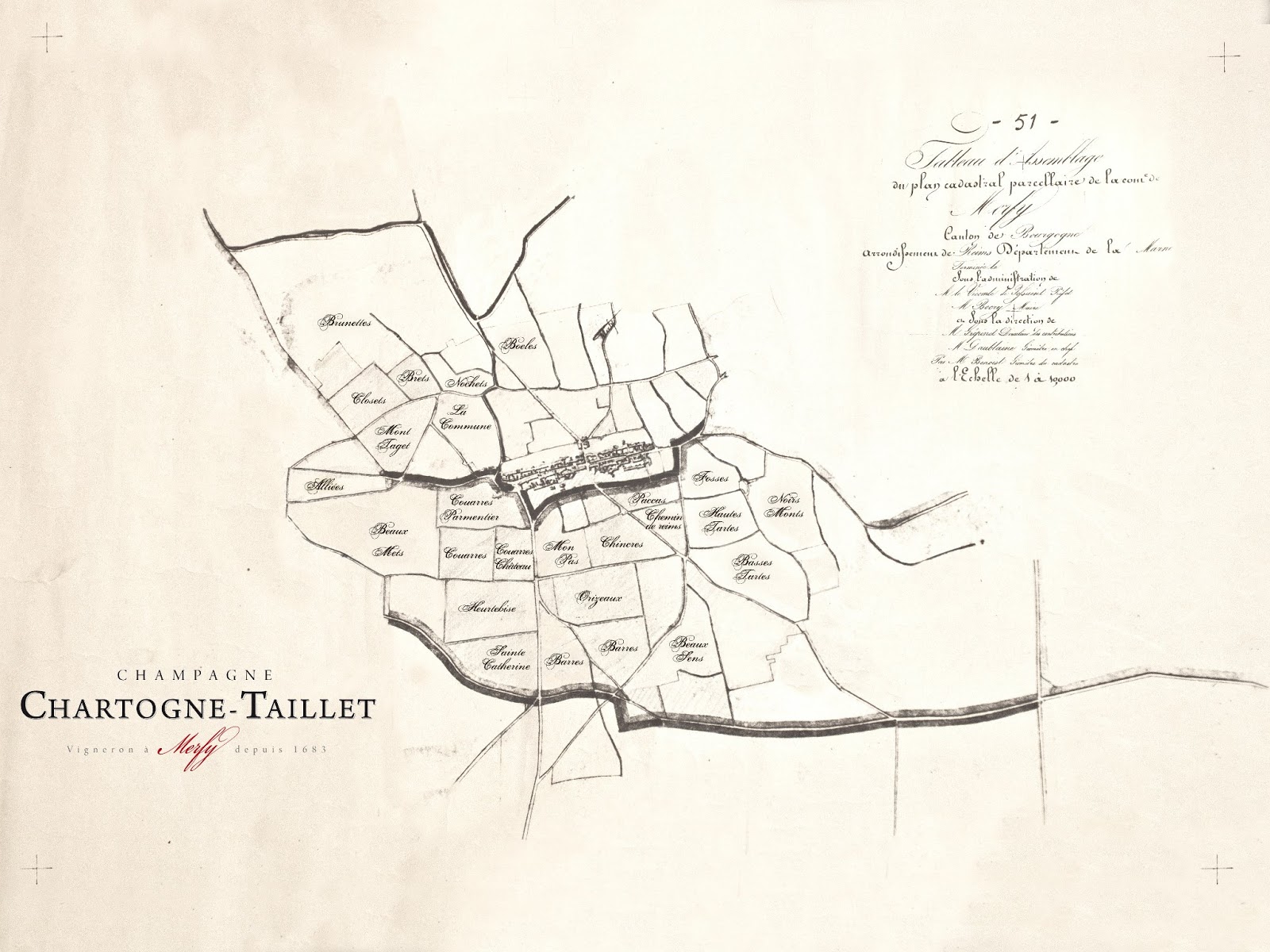
The most important of these villages is Merfy whose vineyards extend over 45.6 ha and rest on soils comprised of clay, sand, and sandstone over chalk. The vineyard slopes are mild with varying exposures. The Merfy village outline is shown in the picture below while the vineyard plots are shown immediately after.

The Merfy vineyards are outlined in red above

Merfy vineyard parcels


Grande and Petite Montagnes
Montagne de Reims is more of a wide plateau than a mountain as its horseshoe shape -- open to the west -- is only 293 m (940 feet) at its highest point. The plateau is mostly covered with thick forests with vineyards occupying the flanks and, depending on their position on the horseshoe, having exposures ranging between northwest and south.

Grande Montagne occupies the northern, eastern, and southern slopes of the horseshoe while Petite Montagne, a lower slope, occupies a northwesterly offshoot. Petite Montagne is 30-ha in size and is one of the two primary homes of Pinot Meunier in Champagne (the other being Vallée de la Marne). The distribution of varieties in the sub-zone is 50% Pinot Meunier, 35% Pinot Noir, and the remainder Chardonnay.

Premier Cru sites can be found at all exposures on the "mountain" as pictured on the map below and  detailed in the table following.

Source: wineroutesfrance.com


Table 1. Premier Cru villages on the Grande Montagne
Village
Description
Soil
Lieux-dits
Tauxières
-          Pinot Noir 80 – 90% of plantings
-          On north bank of the Marne
-          10 inches of topsoil above a very dry chalk
-          Less warm and more cold wind than Bouzy so takes longer to ripen

Trépail
-          Planted almost entirely with Chardonnay
-          Separated from Villers-Marmery by a thick band of forest
-          True mountain wine but with a specific chalk-driven tension and intense minerality
-          Cold and high in elevation. Prone to mildew
-          Chalky terroir yields wines that are racy and austere
-          15 – 30 inches of topsoil above chalky bedrock (deeper towards the northern side of the village

Villers-Marmery
-          Chardonnays that are primarily used in blends

-          Champs d’Enfer – stony, chalky area on the south side of village
-          Brocot – deeper soils
-          Les Alouettes-Saint-Belzs – warm vineyard with a lot of chalk and little topsoil
Ludes
Four distinct sectors:
-          Cran de Ludes
-          Area around the village
-          Area around La Grosse Pierre
-          At the limit of the Ludes boundary
-          Cran de Ludes has very little topsoil, a thin layer of clay then chalk
-          Area around village does not have a lot of topsoil and wines close ones palate
-          Further down the slope has more clay and sand
-          Limit of the Ludes boundary


-          Les Beaux Regards


-          La Grosse Pierre


-          Les Monts Fournois
Chigny-les-Roses
-          131.9 ha
-          58% PM, 24% PN, 18% Chardonnay

-          Le Clos des Pêcherines
-          Clos du Moulins
-          Les Pêcherines
Rilly-La-Montagne
-          312 ha
-          38.9% PN, 36.6% PM, 24% Chardonnay


-          Le Bas Clos
-          Les Bas Moutions
-          Les Clos
-          Les Clos Dérard
-          Les Clos de Prés
-          Les Clos Saint Paul
-          Les Clos Yons
Table constructed with information gleaned from Peter Liem's Champagne and winetomas.wordpress.com, North-facing; East-facing; South-facing

Petite Montagne
The villages of Gueux, Écueil, and Vrigny are of importance in this sub-zone.

Gueux, according to Walters, is located on the northern edge of the Petite Montagne zone. Its soil is a mix of sand, calcareous elements, and tiny marine fossils which date to 45 million years ago. According to winetomas.wordpress.com, the vineyards of this village cover 19.8 ha (489 acres) and is distributed between Pinot Meunier (84.5%), Pinot Noir (11.7%), and Chardonnay (3.8%). Jérôme Prévost is a producer of note in this village.

The villages of Écueil and Vrigny are both east-facing slopes with the former's clay, limestone, and chalk soil (akin to Burgundy) rendering it suitable for Pinot Noir. Most of the other villages in this sub-zone lie on sandy soils which are more suited to Pinot Meunier production. Écueil is 144.9 ha in size of which 76.3% is dedicated to Pinot Noir, 11.8% to Chardonnay, and 11.9% to Pinot Meunier. Sand on the lower slopes act as a foil to phylloxera and some ungrafted vines are planted here. Les Chaillots and Les Gilles are noted lieux-dits in this village. Producers of note in this village are Frédéric Savart and Nicolas Maillart.

Vrigny is 90.7 ha in size with 71.7% planted to Pinot Meunier, 19.5% Pinot Noir, and 9.3% Chardonnay. The slopes in this village are gentle, with varying exposures, and the soils are limestone and calcareous clay. Important lieux-dits are Les Champs de Vallier, Les Clos, Les Linguets, and Les Près, the latter of which rests on deep, fossil-bearing soils. Notable producers are Egly-Ouriet and Roger Coulon.

This submittal completes the review of the Montagne de Reims sub-region of Champagne. See here for a review of the Grand Cru vineyards.

©Wine -- Mise en abyme

Wednesday, April 25, 2018

Montagne de Reims and its Grand Cru vineyards (after Peter Liem)

In his best-selling book Champagne, Peter Liem states that the 20 or so subregions into which the Comité Champagne divides the appellation "... is useful but perhaps a little too granular for most people's needs." He reduces this granularity to the seven subregions that I graphically illustrated in a recent post. In that post I promised to delve into Liem's subregions and began with a look at the Côte des Blancs. I continue herein with the Montaigne de Reims.

The Unions des Maisons de Champagne (UMC) divides its Montaigne de Reims subregion into four subzones:
  • Grande Montagne Reims
  • Massif de St. Thiery
  • Monts de Berru
  • Reims: Vesle & Ardre
Montagne de Reims is a forested plateau south of Reims that is known for rich, full-bodied Champagnes and the dominance of Pinot Noir. According to maisons-champagnes.com, the subregion is comprised of 94 villages, stretches over 7989.30 ha, and has a variety distribution as follows: Pinot Noir, 40.32%;  Pinot Meunier, 33.59%; and Chardonnay, 26%. The map associated with this characterization of the region is shown below.

Modification of a map secured from cambridgewineblogger
.blogspot.com
It should be noted that maisons-champagnes.com combines Petite Montagne, Vesla, and Ardre (shown separately in the map above) into a single subzone called Vesle & Ardre.

In his graphical representation of Montagne de Reims, Liem divides the villages into two buckets: West and North (to include all the villages located outside of the Grande Montagne subzone); and Grande Montagne. In his description of the wines and terroir, however, he does distinguish between Grande and Petite Montagne. Liem does not spill any ink on the villages falling into the maisons-champagnes.com Monts de Berru and Vesle & Ardre (beyond Petite Montagne) subzones.

Montagne de Reims is more of a wide plateau than a mountain as its horseshoe shape -- open to the west -- is only 293 m (940 feet) at its highest point. The plateau is mostly covered with thick forests with vineyards occupying the flanks and, depending on their position on the horseshoe, having exposures ranging between northwest and south. Grande Montagne occupies the northern, eastern, and southern slopes of the horseshoe while Petite Montagne, a lower slope, occupies a northwesterly offshoot.

Grand Cru sites are located on south and north exposures while Premier Cru sites can be found at all exposures. The Grand Cru sites are pictured on the map below and described in detail in the table following.

Source: wineroutesfrance.com

Table 1. The Grand Crus of Grande Montagne.
Village
Description
Soil
Lieux-dits
Tours-sur-Marne
-          Most southerly of the Grande Montagne Villages
-          On north bank of the Marne
-          Newcomer (1955) to grapegrowing
-          Terroir produces combination of mountain (more rigidly structured) and river wines


Bouzy
-          Ranks among the greatest terroirs of Champagne
-          Among warmest terroirs of this subzone
-          True mountain wine
-          Bedrock of hard chalk
-          Some parts of topsoil at 50 cm
-          A 3-m-deep layer of sedimentary soil runs through center of village – ideal for Pinot Noir

Ambonnay
-          Among greatest terroirs of Champagne
-          Portion of vineyard faces SE (Tempers ripeness, resulting in wines more delicate than Bouzy)
-          Three rolling hills provides wider variety of sun exposure than experienced in Bouzy
-          Chalky terroir
-          Soil poor near Bouzy
-          Deeper alluvial soil at the base of the slope in the eastern portion
-          Thinner closer to Trépail
-          More calcareous soil exposed in SE vineyards 9ideal for Chardonnay)
-          Deep topsoils below the village
-          Les Crayères – chalky vineyard on east side of village
-          Les Bermonds
-          La Grande Ruelle
-          Le Bout de Clos
-          Le Parc – thick layers of tufa above the chalk
-          Clos d’Ambonnay – notably calcareous soils (structure, complexity, salinity)
Verzennay
-          418 ha (1033 acres)
-          Pinot Noir darker than in south-facing villages (distinctive gaminess and metallic, iron-like undertone
-          Well-drained soils
-          Some clay-heavy parcels, some chalk-heavy parcels
-          Clay seems deeper

Sillery
-          Located on the flatter land below the slope (other side of A4)
-          92 ha (227 acres)
-          Mild, NE-facing slopes in southern part of village

-          La Loge
-          Les Blauer Germains
-          Les Champs de Romont (southern part of village)
Mailly-Champagne
-          Westernmost Grand Cru in northern Montagne de Reims
-          Classified Grand Cru in 1920
-          70 ha (123 acres)
-          Strong, 80-member Coop operates herein
-          35 lieux-dits
-          400 parcels of Pinot Noir (89%) and Chardonnay
-          Pinot Noir not as powerful and vinous as is the case for south-facing slopes
-          Among the last subzones in Champagne to be harvested (difficulty ripening)
Varied terroir with chalk subsoil
-          Les Baraqumes – cooler site producing structured, spicy PN
-          Les Godats and Les Coutures – further downm the slope; fatter and warmer
-          Les Cotes – Southern side of the chalky ridge so more exposure than the preceding
Data sources: Peter Liem, Champagne, winetomas.wordpress.com. South-facing. North-facing

The Premier Cru vineyards and the remaining subzones of the Montagne de Reims will, in a subsequent post, round out the discussion of the region.

©Wine -- Mise en abyme