Sassaia is a unique and exciting Monferrato-based, Timorasso newbie that is bringing a whole lot of firepower to bear on the problem of producing a high-quality wine that contributes to the image that now cloaks the region. The estate, owned by Italian-American Enrico de Alessandrini, will meld estate and sourced Colli Tortonesi fruit, technology aids, science, and winemaking expertise to ramp up quickly and build a wine capable of making inroads in the international -- especially the US -- markets.
The material presented herein was developed during an extended GoToMeeting session with Enrico and his detailed email responses to a number of follow-up questions.
Enrico de Alessandrini's Personal Journey
The Alessandrini family roots date back to Trento in the 1400s where the ancestors were legal and trade councilors to the nobility and Court Physician to three ruling emperors. Enrico's grandfather moved to Genova in the early 1900s to follow family manufacturing interests and married into a family with Genoa roots. The newlyweds purchased a villa and land in Piedmont between Ovada and Gavi, the selfsame location where Sassaia resides today.
Enrico's father was the physician for Portofino before eventually migrating to the USA where he practiced medicine and was Italian Vice Consul in Virginia. Except for 4 years of study in Italy, Enrico was educated in Virginia. His economics degree, and an additional master’s in business, led him to the world of finance where he focused on commodity investing in the agricultural, industrial, and financial sectors.
Enrico exited the financial commodities business in 2012 and entered the wine world by first importing wine and then investing in vineyards. His interest evolved to wine making and a search for a mentor to teach him how to produce lower alcohol and low-to-no-residual-sugar wines with more freshness and fruit. The search led him to Pierre Naigeon of Gevrey Chambertin. Their collaboration began in 2016 and eventually led Enrico to the University of California--Davis to pursue his Wine Making Certification.
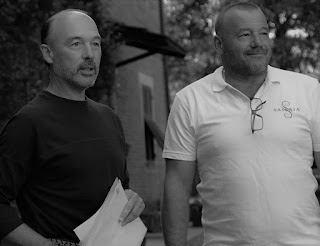 |
Enrico di Alessandrini and Pierre Naigeon
(Source: https://sassaia.com/) |
Strategy and Philosophy
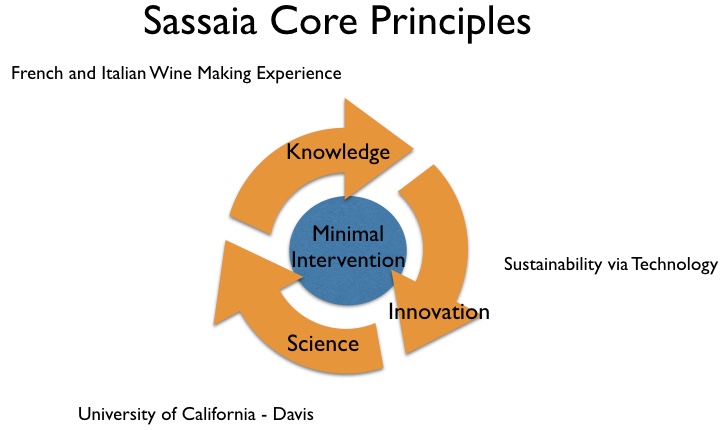
Sassaia's goal is to focus on two core wines (Timorasso and Nebbiolo di Monferrato) with a stable of international varieties serving as gateways to the indigenous base. The guiding principles employed in pursuit of that goal are illustrated below.
Physical and Built Environments and Farming Practices
Sassaia farms 18 ha of land between Alto Monferrato and Colli Tortonesi. The Monferrato soil is (i) of marine origin, (ii)alkaline, (iii) with a calcareous limestone and sandstone subsoil which, in some sites, has a chalk presence. I have covered the Colli Tortonesi soils in a
previous post.
The distribution of varieties planted at Sassaia vineyards are presented in Table 1.
Table 1. Varieties planted at Sassaia vineyards.
Grape | Variety | Planted Hectares | Percent |
Reds | Nebbiolo | 2.5 | 42 |
| Dolcetto | 2 | 33 |
| Cabernet Sauvignon | 0.7 | 12 |
| Sangiovese | 0.5 | 8 |
| Syrah | 0.3 | 5 |
Total Reds |
| 6 | 100 |
Whites | Gavi | 6 | 50 |
| Timorasso | 5 | 42 |
| Chardonnay | 1 | 8 |
Total Whites |
| 12 | 100 |
The Sassaia vineyards are SQNPI (National Quality System of Integrated Production)-compliant. This European certification "is issued by the Italian Ministry of Agriculture on the basis of the farmer's records and chemical tests on the leaves of the final products ... the goal is to preserve environmental biodiversity, minimize the use of pesticides and ensure correct management of the cellar. This model derives from the most advanced European practices Integrated Farming and Integrated Pest Management."
In addition to the above estate-grown fruit, Sassaia sources Timorasso grapes from a number of producers in the Monleale and Castellania communes.
The Timorasso Pursuit: The Early Years
Enrico and Pierre began experimenting with a Burgundian approach to local and international varietals in 2017. The Timorasso fruit for the 2018 test was sourced from the Castellania commune and was processed in the traditional stainless steel method. The vineyard contract allows Sassaia to direct and mange practices such as training, vine tieing, and leaf fertilization.
Further, the vineyard is mapped to the ENOGIS GPS system which provides the capability of using satellite technology to track vine vigor, development, and health. This capability is key in aiding harvest decisions, allowing Sassaia to harvest at low-enough alcohol to allow indigenous-yeast fermentations. It can also be used to determine if the fruit has the stuffing to complete fermentation without YAN additions.
The project came to the attention of Carlo Ricagni, Director for CIA Alessandria, who found the wines "fresh and more approachable much earlier than most." Given the team's interest in Timorasso, Carlo led them to Walter Massa. According to Enrico, both Pierre and he immediately bonded with Walter. From those meetings a plan was devised wherein Pierre would run a few Timorasso trials in Burgundy and report on the results.
Constructing the Sassaia Timorasso Production Architecture (The 2019 Project)
After meeting Walter, the Sassaia team's interest in positioning Timorasso as one one of the two focal points of the enterprise increased. Such a focus demanded the development and implementation of a production architecture, a task which proceeded along two tracks: (i) vineyard establishment and (ii) selection of the production style.
Vineyard Establishment
The team came to the conclusion that its goals, as regards Timorasso wine production, required estate-grown fruit. To that end they sought the counsel of Walter Massa and he recommended sites in Profigate and Ca de Borgo in the Monleale commune. A total of 5 ha of vineyard land was purchased in these two areas.
The vineyards were planted to scions from the original Old Vines on rootstock pertinent to the soil type and average rainfall of the vineyard. The trellis posts are higher-than-standard to facilitate more airflow among the vines and reduced disease pressure.
The Sassaia Timorasso physical and built environments are illustrated in the chart below. The vineyards will begin production with the 2022 vintage.

Grapes will continue to be sourced from the Castellania vineyard at least up until 2022.
Selecting a Timorasso Wine Style
The Sassaia team ran a number of tests to determine the most relevant wine style. Sassaia already had access to grapes using its Castellania contract but, based on Walter's recommendation, also sourced grapes from the Monleale commune for the effort. The higher-potential-alcohol grapes were vinified locally using (i) the traditional stainless steel method and (ii) hyperoxidation in neutral barrique (I am really excited to taste the hyperox wine as the high phenolic content of the Timorasso grape makes it an excellent subject for this wine style. You can learn more about hyperoxidation by viewing my explanation of the topic
here.).
The lower-potential alcohol grapes were harvested in 5 - 6 kg bins and shipped to Gevrey-Chambertin for further processing.
The barrique-fermentation process is illustrated graphically below.
In the barrique-fermented and -aged wine, the oak used was 100% new; in the future they will be targeting 25% new oak.
The Wines
The 2018 vintage was produced in the classic style and is labeled Colli Tortonesi Timorasso. According to Enrico, the alcohol was 14.5% and this level did not allow the indigenous yeast to complete the fermentation. They had to inoculate and the wine ended up with 2 grams residual sugar. Partial malolactic fermentation in stainless steel with the wine spending approximately 1 year on lees prior to bottling.
Pale yellow-gold in color. Tight surface tension but lower viscosity than some of the wines I have encountered.
Citrus, hay, marine, and bruised apple notes initially. Burnt orange, citrus skin, and slate. Light of body. Citrus and citrus skin prevalent.
Fleshes out on the palate with residence. Bitter, nutty, and textured. Spicy finish.
With the further passage of time, sweet fruit and honeyed, waxy nose settles into a saline-licorice-sweet fruit nose. Salinity and slatey minerality with a long, hot finish.
Locally produced 2019 vintage wines are labeled Derthona Timorasso Colli Tortonesi. Both of these wines are presented in Bordeaux-style bottles.
The 2019 hyperoxidation experiment was high enough in alcohol that it required inoculation. At the conclusion of alcoholic fermentation the wine registered 1.5 grams residual sugar and .60 volatile acidity (acceptable but on the high side of the < .4 goal. The wine underwent malolactic fermentation.
The wine produced in Gevrey-Chambertin in
2019 obviously could not be labeled Colli Tortonesi. However, since Derthona "was still just a registered trademark (and not yet submitted to the region as the proposed new appellation name) the consortium permitted Sassaia the use of DERTHONA without Colli Tortonesi Timorasso."
This wine has an exquisitely aromatic nose. A ceiling of rich, sweet white fruit (Gewurtz, lychee) marshals a complex interweaving of green herbs, spices, and lemon-lime notes. Unresolved barrel notes on the palate. Medium weight and smooth. Evenness of transit from the attack to the finish. Green herbs, smoke, and sour butterscotch. Focused and elegant with a lengthy finish.
The oak added richness, roundness, and complexity, along with smoke and butterscotch flavors, while softening some of the citrus notes found in the 2018 stainless steel version.
By the second day, this wine had taken on all the characteristics of a young Puligny-Montrachet: barrel notes, spice, smoke, and mint on the nose; unresolved oak on the palate along with lemon, bright acidity, and minerality. Textured, with a lemony-lime finish.
I loved this wine. And it is not yet ready. The intent is to release it as a Riserva and it is recommended that it be held until September 2022. It will only improve with time.
The winery’s intent is to reduce the oak used from 100% new to 25% new with the 75% neutral containers including Clayver technology. In my opinion, though, it would be a shame to let the current formulation die on the vine. It is too good. The winery may want to consider retaining this formulation as the Riserva and using the more neutral composition as an earlier-release (2 years?) wine. This cultivar is powerful enough to handle oak with ease so maybe the winery’s efforts should be focused on exploiting the various avenues branching off this path.
****************************************************************************************************
The plan going forward is to produce a Derthona and Piccolo Derthona using the traditional stainless steel method and to produce a high-end, Riserva-type wine using barriques for fermentation and aging. Enrico will also work in the future towards separating the pressed wine and blending the components prior to bottling.
The Sassaia team has invested a lot into this project and it will be interesting to see if this mix of technology, science, and Burgundian expertise yields a unique, high-quality wine. The early trials opened the right doors. Lets hope that the current and future work opens consumer minds and wallets.
©Wine --
Mise en abyme