Showing posts with label Brettanomyces. Show all posts

Tuesday, June 6, 2017

"Bad-Brett" management Part II: Repairing contaminated wines

In Part I of this series on Brettanomyces, I laid out the characteristics of the microbe, the contamination routes, and conventional methods employed in controlling its growth. In that post I also referenced some approaches advanced by Dr. Jamie Goode to fix wines that had been contaminated by Brettanomyces. The chart below summarizes both the "control" and "fix" tactics presented by Dr. Goode in the Somm Journal article cited in the chart.


In his book postmodern winemaking, author Clark Smith posits that "... a revolution is taking place within the winemaking industry. Precepts of the modern winemaking system we were taught in school simply don't support the making of the great wines the market demands, and as a result, some of our most successful winemakers have strayed quite far from conventional dogma." These winemakers are using what Smith calls postmodern winemaking to "... merge all of the wine's flavor into a coherent whole like a well-conducted orchestra producing a unified, soulful voice."

As stated in his book, postmodern winemaking does not seek to throw out all elements of modernity and replace them lock, stock, and barrel with a new canon. Rather, postmodern winemaking uses existing pieces where appropriate and substitutes/adds where necessary. Below I provide a graphic representation of wine production under both the modern and Smith's postmodern schemas. The key extensions of postmodern winemaking are provided in red in the below chart.
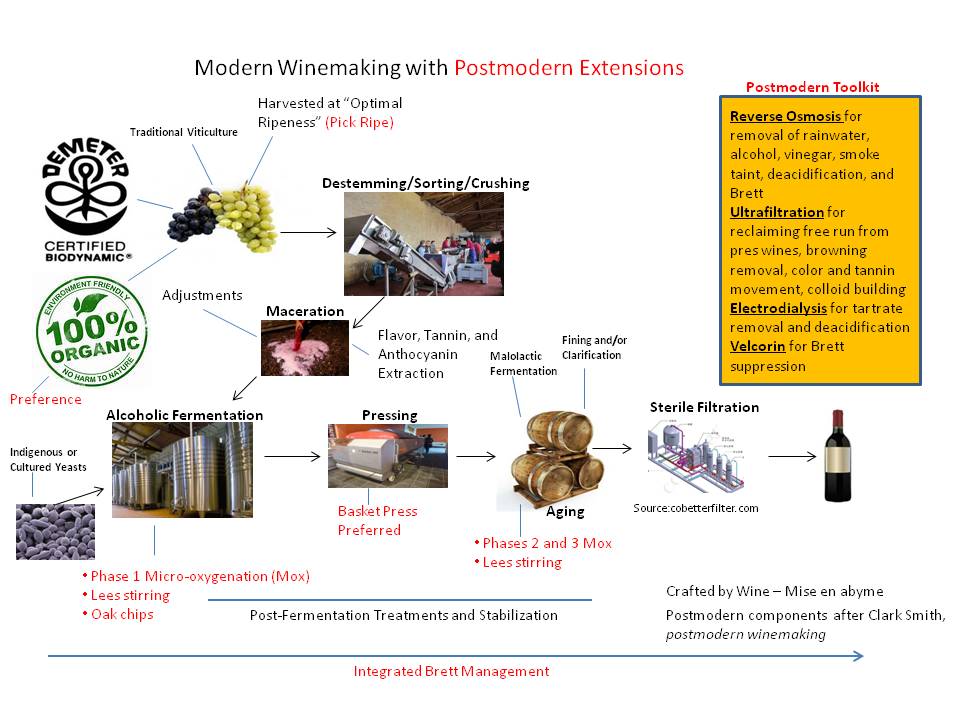

Two things to note in the chart above: (i) towards the bottom, the introduction of the concept of Integrated Brett Management (that will be the focus of Part III in this series); and (ii) the box at the top right which is labeled Postmodern Tookit. Some of the entries in that box map closely to the "fix" tactics proposed by Dr Goode. These Postmodern Toolkit/Fix mechanisms will be the subject of the remainder of this post.

Sterile Filtration
Dr. Goode mentioned filtration as the first option on his list and it is widely viewed as the most effective method of removing Brett cells. In this method, the wine is passed through a .45µ filter which captures any Brett cells in the filter mechanism. Clark Smith is not in favor of this approach to Brett removal:
The focus of postmodern philosophy is the creation and preservation of beneficial macromolecular structure. This structure manifests in wine as colloidal particles sometimes nearly as large as a bacterial cell. The benefits of good structure -- profundity, aromatic integration, and graceful longevity -- appear to be lost in sterile filtration, despite the fact that no tannin material may be retained by the filter. While this lack of residue has convinced some of my colleagues that filtration cannot be harmful to wine structure, I do not concur. My hypothesis is that the action of tight filtration somehow disrupts rather than removes structure.
It should be noted that Clark does not provide any empirical data or prior scientific studies to bolster this hypothesis.

Velcorin
Both Dr. Goode and Clark Smith mention dimethyldicarbonate (DMDC, trade name Velcorin) favorably. This product is a microbial control agent  (produced by Lanxess) that is effective at eliminating a broad range of yeast, bacteria, and molds from wine. The product works by penetrating the cell wall of the offending micro-organism and deactivating enzymes which then leads to the cell's demise. The manufacturer claims that the product has no effect on wine taste, bouquet, or color and breaks down completely into small amounts of CO₂ and methanol. The downside, according to Clark, is that this is a "nasty chemical" and must be handled carefully.

Tangential Flow Filtration
Dr. Goode refers to cross-flow filtration and nanofiltration in his list but Clark places those technologies into a class he calls the Tangential Flow Family of Filtration and they are classified based on the molecular weight of particles that pass through the pores.

Filtration System Application Molecular Weight Range (Daltons)
Crossflow Clarification

200,000 - 500,000
Ultrafiltration

1000 - 200,000

Tannin and Browning Removal 10,000 - 200,000

Protein Removal 10,000 - 40,000

Decolorization 1,000 - 5,000
Nanofiltration

200 - 1000
Reverse Osmosis

50 - 200
Source: Clark Smith, The Crossflow Manifesto, Wine Business, January 2003.

According to Smith, the idea of tangential flow filters developed in the 1960s. One of the major problems with sterile filtration is the fouling of the membrane which occurs when tight pore sizes are used. This fouling prevents the passage of material through the pores. The effective limit of traditional filtration is 0.1µ. Tangential flow filters use the scrubbing action of the flow across the surface of the membrane to keep it clean thus allowing the utilization of ever-smaller pore sizes.

All of the systems mentioned in the table employ the strategy of pumping the wine across the membrane at high velocity. As the wine flows across the membrane it continually scrubs the surface, removing fouling material. The majority of the feed stream does not pass through the filter but is retained upstream and returned to the tank. This stream, called the retentate, contains all of the high-molecular-weight components. The low-molecular-weight material that passes through the filter is called the permeate. A reverse osmosis application is illustrated below.

Reverse osmosis (Source: memstar.com.au)

It should be noted that, of the tangential flow systems mentioned in the table above, reverse osmosis is the only one specifically noted for Brett removal by Clark Smith.

Fungal-Source Chitosan
A Brett-repair technology that was not mentioned by either Jamie Goode or Clark Smith is fungal-source Chitosan. Chitosan is a deacetylated version of chitin, a compound found in the exoskeletons of crustaceans and insects as well as in the cell walls of fungi. According to Olivier Pillet (Chitosan and Brettanomyces: Origin, Impact, and Mode of Action), "the innovation that led to the use of chitosan in oenology is the process for obtaining chitin from a non-animal fungi source, Aspergillus niger." This process provides natural-source chitosan that is both biodegradable and non-allergenic and has been accepted as an oenological process by both the International Organization of Vine and Wine (July 2009) and the European Union (December 2010).

Chitosan has been documented for its antimicrobial properties which depends on the degree of deacetlylation and its molecular weight. Studies have shown that the homogenous incorporation of 4 g/hl dose of the commercial product (No Brett Inside) will "result in the total destruction of the Brettanomyces populations, or, in certain cases, a significant reduction of the contaminating populations" (Pillet).

**********************************************************************************************************
These then are some of the tactical tools that can be employed in the fight against Brett. In my final post in the series I will treat Clark Smith's Integrated Brett Management.


©Wine -- Mise en abyme

Friday, November 2, 2012

The risk of spoilage yeast contamination during natural yeast fermentations

In a comment on my post on indigenous- versus inoculated-yeast fermentations, reader Ben opined that three of the five disadvantages of natural fermentation that I had listed were "discountable" but that the remaining two provided the basis for an "interesting debate."  Ben's comment has prompted me to provide readers with a fuller discussion of the mentioned disadvantages beginning with the current post on spoilage yeasts as a risk in indigenous fermentations.

Absent an inoculation, all yeasts found in grape must and wine will originate from one or more of the following sources: vineyard, grapes, or winery processing equipment (E.J. Bartowsky, Bacterial spoilage of wine and approaches to minimize it, Letters in Applied Microbiology).  According to Loureiro and Malfeito-Ferreira (Spoilage yeasts in the wine industry, International Journal of Food Microbiology 86, 2003), mature, healthy grapes harbor microbial populations (yeasts, lactic and acetic acid bacteria, filamentous molds) at levels of 103 - 105 CFU/g (colony forming unit -- a measure used in microbiology that indicates the number of micro-organisms present in a water sample (www.legionella.com/cfu)), levels that vary based on environmental conditions (rainfall. temperature, grape variety, the application of chemicals in the vineyard).  Yeasts resident on grape berries tend to congregate in areas where juice might escape (Loureiro and Malfeito-Ferreira).  Wine-associated yeasts are identified in the table below.


As seen from the foregoing, yeasts exist in the vineyard environment and on healthy grapes but, for our purposes, the intersection of yeasts and damaged grapes is of significance.  Grapes can be damaged in any number of ways (hail, birds, etc.) but it is the damage caused by phytopathogenic molds that is of greatest interest.  The effects of these molds on grapes and wine are spelt out in the table below.


Loureiro and Malfeito-Ferreira found a number of ascomycetous yeasts proliferating on grapes damaged by sour rot as well as Zygosaccharomyces spp and other spoilage yeasts such as Dekkera bruxellensis.  In a separate study on sour rot, Berata et al., isolated 17 ascomycetous species from sour-rot-damaged samples and only five from sound grapes.  The most significant find was the presence of Zygosaccharomyces bailii, a species which the authors describe as "acidophilic" and "one of the most dangerous wine spoilage yeasts."  Once introduced, this species was recovered from all of the alcoholic fermentation steps.  The authors conclude that "yeast species from sour rot grapes are an important contamination source of wineries and wines."  Loureiro and Malfeito-Ferreira make much the same argument: "For many of the most important wine spoilage species (Dekkera/Brettanomyces), the main entry to the winery is grapes affected by sour rot."  The consensus, then, is that sour rot is the primary vehicle for wine spoilage yeasts transiting from the vineyard to the winery.  Let us now turn our eyes to the winery environment.

According to Woolford et al., (Genome Survey Sequencing of the Wine Spoilage Yeast Dekkera (Brettanomyces) bruxellensis, Eukaryotic Cell 6(4), April 2007), Brettanomyces bruxellensis is a major microbial cause of wine spoilage worldwide and results in significant economic loss.  The yeast makes "the winery itself a primary habitat surviving in the walls ... interior surfaces of presses and fermentation tanks, or on the wood of barrels."  From these positions the microbe is well situated to "colonize the fermenting must or maturing wine."  Wines infected with Brettanomyces will exhibit aromas of mousiness, wet wool, burnt plastic, horse sweat, or barnyard.  According to the same authors, the severity and frequency of Brettanomyces has been on the uptick as winemaking has trended towads wines with higher levels of residual sugar and that are unsulfited, unfiltered, and aged on lees.

Brettanomyces is exceptionally dangerous because it has all of the characteristics of Saccharomyces cerevisiae (ethanol-tolerant, facultatively anaeorobic, can exist without mitochondrial DNA, ferments preferentially in the presence of high glucose under aerobic conditions) but extend beyond it in that, while slower growing, "it can assimilate a wider variety of carbon choices."  These conditions lead to the following progression in a Brettanomyces-contaminated alcohol fermentation (Woolford et al.):
  • Saccharomyces cerevisiae dominates throughout primary fermentation then is replaced by D. bruxellensis during the maturation phase when ethanol concentration is high and minimal amounts of sugar remain.

It was long thought that Brettanomyces contamination was a result of poor hygiene in wineries but contamination persists even in the face of intensive hygiene efforts on their parts (Renouf et al., Interactions between Brettanomyces and other yeast species during the initial stages of winemaking, Journal of Applied Microbiology 100 (6), June 2006).  The research cited in this post seems to indicate that Brettanomyces can enter the winery through sour rot  and can then take up residence within the facility and contaminate batches of wine essentially at will.  Intensive hygiene efforts can clean up an infected location but re-contamination is potentially just another sour-rot affected batch away.  Vigilance in screening for sour rot would seem to be in the best interest of the winery.

Grape must is nutrient-rich and ethanol poor, a candy store for most micro-organisms.  The longer  those conditions exist, the more non-Saccharomyces yeasts will thrive. With the exception of Brettanomyces, most wine-spoilage yeasts are ethanol-intolerant so the quicker that high ethanol levels are obtained, the less opportuntiy for these micro-organisms to proliferate.  The issue with natural fermentations is that they start slowly and take longer to get up to levels in which S. cerevisiae thrives.  And it is in that period that the fermented wine becomes susceptible to the travails of wine-spoilage yeasts.


The remaining disadvantages of natural wine fermentation will be coverd in a number of upcoming posts.

©Wine -- Mise en abyme