Showing posts with label Clark Smith. Show all posts

Sunday, June 11, 2017

Creating postmodern winemaking's structured wines -- after Clark Smith

I had promised that my next post in the series on Brettanomyces would detail Clark Smith's (postmodern winemaking) Integrated Brettanomyces Management schema but I have decided that it is impossible to discuss the topic without providing the reader an overview of postmodern winemaking fundamentals. I provide that overview in this post.

According to Clark, scientific enology starts with the idea that wine is a chemical solution; and it is treated as such, as shown in the figure below.


In this model, wine flavor is the sum of its parts and managing those parts allows control of the whole. Smith sees both the model elements and the approach as being "injurious to wine quality" and identifies a number of instances in the past which hinted at the model's shortcomings:
  • The limited solubility of anthocyanin, as shown in the 1970s work of Riberau-Gayon
  • His (Smith's) ultra-filtration work which shows anthocyanin (molecular weight of 300) unable to pass through a filter with porosity of 100,000
  • As indicated in the figure above, aromatic intensity should correlate to in-solution concentration but micro-oxygenation of Merlot will reduce the bell pepper aromas without a reduction of its pyrazine content.
The path to today's modern winemaking is illustrated below along with the dominant pedagogy. According to Smith, "modern day winemaking has been useful in eliminating gross defects but has done little to promote excellence."


Clark Smith:
From two decades of postmodern retrospection, an aesthetic construct has emerged that not only holds the solution model to be false, but considers the extent to which a wine deviates from "ideal" behavior to be a pretty useful working definition of quality. Solution model behavior is not just incorrect; it is undesirable.
Clark's "solution" to the solution-model problem is structured wines:
In structured wines, ..., tannins, anthocyanins, and other aromatic ring compounds, which are almost insoluble in solution, aggregate into colloids -- tiny beads of various sizes and compositions. It is this fine colloidal structure that allows interaction between the aqueous and phenolic regions in a wine, blending the aromatic properties as if the wine were home to all things.
The elements of this "fine colloidal structure" and the characteristics of a postmodern wine, are illustrated in the figure below.


One of Clark's key concerns around wine colloids is the size to which they can grow -- upwards of 100 nm. While this is not large enough to be concerned about removal by filtration, Clark believes that such a process damages the structure of the colloids, thus rendering them less effective at carrying out the aroma-integration function. 

With this background I will be able to more pointedly discuss Integrated Brett Management.


©Wine -- Mise en abyme

Tuesday, June 6, 2017

"Bad-Brett" management Part II: Repairing contaminated wines

In Part I of this series on Brettanomyces, I laid out the characteristics of the microbe, the contamination routes, and conventional methods employed in controlling its growth. In that post I also referenced some approaches advanced by Dr. Jamie Goode to fix wines that had been contaminated by Brettanomyces. The chart below summarizes both the "control" and "fix" tactics presented by Dr. Goode in the Somm Journal article cited in the chart.


In his book postmodern winemaking, author Clark Smith posits that "... a revolution is taking place within the winemaking industry. Precepts of the modern winemaking system we were taught in school simply don't support the making of the great wines the market demands, and as a result, some of our most successful winemakers have strayed quite far from conventional dogma." These winemakers are using what Smith calls postmodern winemaking to "... merge all of the wine's flavor into a coherent whole like a well-conducted orchestra producing a unified, soulful voice."

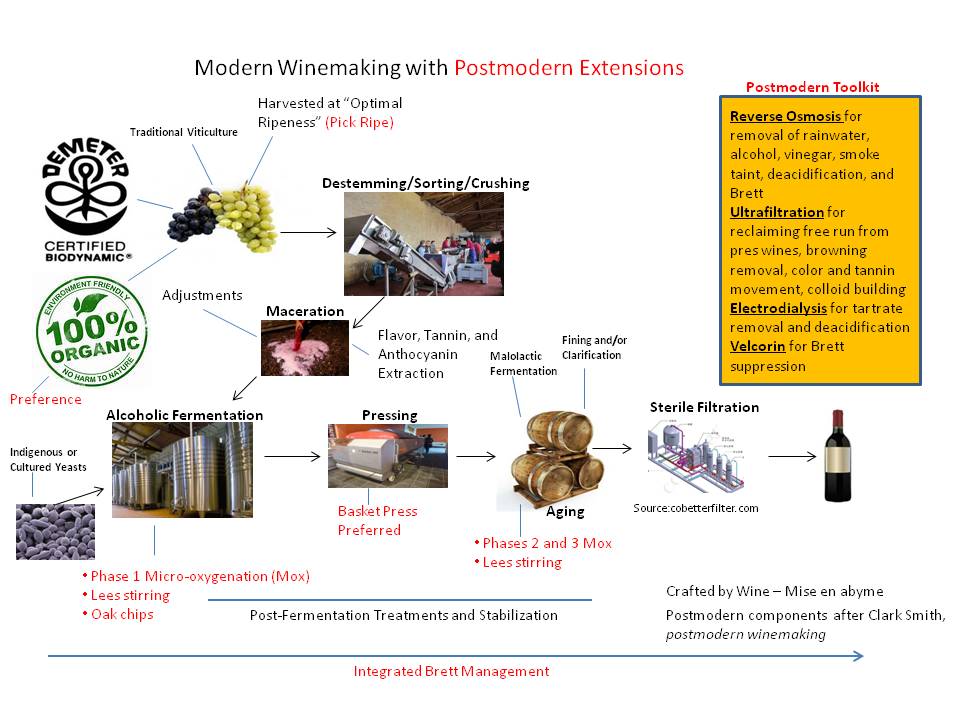
As stated in his book, postmodern winemaking does not seek to throw out all elements of modernity and replace them lock, stock, and barrel with a new canon. Rather, postmodern winemaking uses existing pieces where appropriate and substitutes/adds where necessary. Below I provide a graphic representation of wine production under both the modern and Smith's postmodern schemas. The key extensions of postmodern winemaking are provided in red in the below chart.


Two things to note in the chart above: (i) towards the bottom, the introduction of the concept of Integrated Brett Management (that will be the focus of Part III in this series); and (ii) the box at the top right which is labeled Postmodern Tookit. Some of the entries in that box map closely to the "fix" tactics proposed by Dr Goode. These Postmodern Toolkit/Fix mechanisms will be the subject of the remainder of this post.

Sterile Filtration
Dr. Goode mentioned filtration as the first option on his list and it is widely viewed as the most effective method of removing Brett cells. In this method, the wine is passed through a .45µ filter which captures any Brett cells in the filter mechanism. Clark Smith is not in favor of this approach to Brett removal:
The focus of postmodern philosophy is the creation and preservation of beneficial macromolecular structure. This structure manifests in wine as colloidal particles sometimes nearly as large as a bacterial cell. The benefits of good structure -- profundity, aromatic integration, and graceful longevity -- appear to be lost in sterile filtration, despite the fact that no tannin material may be retained by the filter. While this lack of residue has convinced some of my colleagues that filtration cannot be harmful to wine structure, I do not concur. My hypothesis is that the action of tight filtration somehow disrupts rather than removes structure.
It should be noted that Clark does not provide any empirical data or prior scientific studies to bolster this hypothesis.

Velcorin
Both Dr. Goode and Clark Smith mention dimethyldicarbonate (DMDC, trade name Velcorin) favorably. This product is a microbial control agent  (produced by Lanxess) that is effective at eliminating a broad range of yeast, bacteria, and molds from wine. The product works by penetrating the cell wall of the offending micro-organism and deactivating enzymes which then leads to the cell's demise. The manufacturer claims that the product has no effect on wine taste, bouquet, or color and breaks down completely into small amounts of CO₂ and methanol. The downside, according to Clark, is that this is a "nasty chemical" and must be handled carefully.

Tangential Flow Filtration
Dr. Goode refers to cross-flow filtration and nanofiltration in his list but Clark places those technologies into a class he calls the Tangential Flow Family of Filtration and they are classified based on the molecular weight of particles that pass through the pores.

Filtration System Application Molecular Weight Range (Daltons)
Crossflow Clarification

200,000 - 500,000
Ultrafiltration

1000 - 200,000

Tannin and Browning Removal 10,000 - 200,000

Protein Removal 10,000 - 40,000

Decolorization 1,000 - 5,000
Nanofiltration

200 - 1000
Reverse Osmosis

50 - 200
Source: Clark Smith, The Crossflow Manifesto, Wine Business, January 2003.

According to Smith, the idea of tangential flow filters developed in the 1960s. One of the major problems with sterile filtration is the fouling of the membrane which occurs when tight pore sizes are used. This fouling prevents the passage of material through the pores. The effective limit of traditional filtration is 0.1µ. Tangential flow filters use the scrubbing action of the flow across the surface of the membrane to keep it clean thus allowing the utilization of ever-smaller pore sizes.

All of the systems mentioned in the table employ the strategy of pumping the wine across the membrane at high velocity. As the wine flows across the membrane it continually scrubs the surface, removing fouling material. The majority of the feed stream does not pass through the filter but is retained upstream and returned to the tank. This stream, called the retentate, contains all of the high-molecular-weight components. The low-molecular-weight material that passes through the filter is called the permeate. A reverse osmosis application is illustrated below.

Reverse osmosis (Source: memstar.com.au)

It should be noted that, of the tangential flow systems mentioned in the table above, reverse osmosis is the only one specifically noted for Brett removal by Clark Smith.

Fungal-Source Chitosan
A Brett-repair technology that was not mentioned by either Jamie Goode or Clark Smith is fungal-source Chitosan. Chitosan is a deacetylated version of chitin, a compound found in the exoskeletons of crustaceans and insects as well as in the cell walls of fungi. According to Olivier Pillet (Chitosan and Brettanomyces: Origin, Impact, and Mode of Action), "the innovation that led to the use of chitosan in oenology is the process for obtaining chitin from a non-animal fungi source, Aspergillus niger." This process provides natural-source chitosan that is both biodegradable and non-allergenic and has been accepted as an oenological process by both the International Organization of Vine and Wine (July 2009) and the European Union (December 2010).

Chitosan has been documented for its antimicrobial properties which depends on the degree of deacetlylation and its molecular weight. Studies have shown that the homogenous incorporation of 4 g/hl dose of the commercial product (No Brett Inside) will "result in the total destruction of the Brettanomyces populations, or, in certain cases, a significant reduction of the contaminating populations" (Pillet).

**********************************************************************************************************
These then are some of the tactical tools that can be employed in the fight against Brett. In my final post in the series I will treat Clark Smith's Integrated Brett Management.


©Wine -- Mise en abyme

Sunday, June 4, 2017

Management of "Bad Brett": Part I, the conventional approach

Writing about Brettanomyces in Decanter, Linda Murphy stated thusly:
... at best, Brettanomyces can give wine what many believe to be positive attributes that add complexity and depth: earthy flavours of glove leather, smoked meat, bacon fat, tobacco, truffle, clove and other savoury spices. Yet when B(rett) turns bad, it can give wine the offensive stink of barnyard, manure, plasters, wet dog, sweaty horse blanket, mouse droppings and antiseptic.
Remarking about this contrast in character, Clark Smith (postmodern winemaking) stated: "... most connoisseurs have experienced on different occasions both faces of Brett: the sultry, profound earthiness and the repulsive barnyard stench." It is the latter characteristic that is of most concern to winemakers and it is that character that will be the focus of this post.

In a recent Somm Journal article, noted wine writer Dr. Jamie Goode laid out the issues associated with Brettanomyces (Brett) contamination of wines and offered up a number of control measures and fixes to combat same. Clark Smith, in his book postmodern winemaking, takes the conventional view of Brett and Brett management to task and, instead, proposes a schema he calls Integrated Brett Management. I present these competing views in three posts beginning with this one. But first, some background

Brettanomyces bruxellensis falls within the Fermentative class of wine-associated yeasts (the other classes are Basidiomycetous and Ascomycetes), the most dangerous of the wine-spoiler yeasts. According to Woolford, et al., (Genome Survey Sequencing of the Wine Spoilage Yeast Dekkera (Brettanomyces) bruxellensis, Eukaryotic Cell 6(4), April 2007), Brettanomyces bruxellensis is a major microbial cause of wine spoilage worldwide and results in significant economic loss. Brettanomyces is exceptionally dangerous because it has all of the characteristics of Saccharomyces cerevisiae but extends beyond it in that, while slower growing, "it can assimilate a wider variety of carbon choices."  The key characteristics of Brettanomyces bruxellensis are presented in the chart below and its contamination mechanism in the one following.


It was long thought that Brettanomyces contamination was a result of poor hygiene in wineries but contamination persists even in the face of intensive hygiene efforts (Renouf et al., Interactions between Brettanomyces and other yeast species during the initial stages of winemaking, Journal of Applied Microbiology 100 (6), June 2006).  Research seems to indicate that Brettanomyces can enter the winery through sour rot and can then take up residence within the facility and contaminate batches of wine essentially at will. The chart below shows Brett potential contamination sources and pathways. In the case of sour rot grapes, it can be a direct source (that is, mixed in with healthy grapes brought into the cellar) or via bees interacting with sour rot grapes in the field and then bringing Brett into the winery.


According to Clark Smith:
Except in new cellars, Brettanomyces is a ubiquitous organism, a fact of life. Like athlete's foot, one cannot usually hope to eradicate it. Like keeping one's feet dry, control of this organism based on suppressing growth by denying it facile growth conditions is the most realistic solution. Keep in mind that the goal is to facilitate a truce with Brett so a stable condition exists at bottling.
Central to this growth-suppression approach "... is the maintenance of free SO₂ at a level of around 30 ppm at relatively low pH's in order to maximize its effectiveness by increasing the percentage of the free SO₂ that is in the un-ionized molecular form." This approach greatly reduces the number of colonies of Brett that grow on a petri dish but according to Clark, may actually be reducing the culturability rather than actually killing cells.

In his Somm Journal article, Jamie Goode identified a number of actions that can be taken in the fight against Brett. The actions in the left part of the chart below are conventional growth-suppression activities.


Lisa Van de Water (Monitoring microbes during cellaring/bottling, Practical Winery and Vineyard Journal, January/February 2010) recommends testing the wine in the cellar in order to minimize the opportunity for Brett contamination manifesting in the bottle. According to Ms. Van de Water, 100 cells/ml can lead to visible Brett haze in the bottle and the production of small amounts of CO₂. Sensory changes are "profound" with compounds such as 4-EP and 4-EG present manifested by horse sweat and Band Aid odors and a bitter, metallic finish. Bottle variation is common with some bottles showing the clear evidence of "bad Brett" while others show little impact.

Ms. Van de water recommends culturing the wine on media containing 50 ppm of the antibiotic cycloheximide (to inhibit growth of other yeasts) and, if Brettanomyces is present, the culture will manifest white, hemispherical colonies in three to seven days. The culture will, in addition, produce a strong acetic acid smell.

If Brett is determined to exist in the wine at levels between 1 and 50 cells per ml, then we switch to the right side of the chart above and attempt to "fix" the problem. The most common approach has been to pass the wine through a .45µ membrane (this approach can be used both as a control and fix mechanism) but Clark Smith is opposed to this because he feels that filtration disrupts the structure of the wine.

The other wine fixes mentioned by Dr. Goode are identified as key elements of the postmodern toolkit by Clark Smith and so serves as  a bridge between the conventional and postmodern approaches. I will cover them in the next post on the topic.


©Wine -- Mise en abyme

Thursday, December 24, 2015

2015 Blog Year in Review: Part I, postmodern winemaking

I met Clark Smith three years ago at the Digital Wine Communications Conference 2013, which was held in Logrono, Spain. I ran into him initially at the BYOB party and had some interaction centered around me borrowing his corkscrew to open my wine bottle,. At the time I did not know who he was or or that he was a scheduled presenter at the conference.

I ran into him again the following day and he indicated that someone had borrowed his corkscrew and not returned it. He was bemoaning the loss because (i) it was an expensive piece and (ii) it had sentimental value. For the record, I had returned the corkscrew to him after my usage. At that time I was still unaware of who he was.

I remained clueless as to his identity until the keynote speakers were announced -- Arto Koskelo and Clark Smith -- and my "buddy" strode onto the stage. Arto spoke first and was well received (He is an insider and he had a good story.). Things, however, went downhill fast when Clark began his presentation. And the audience, uncharacteristically, became more hostile the longer he spoke. Words like "wine manipulator" and other such epithets were being hurled in Clark's direction and, during the question and answer session very pointed questions were directed at him. My assessment? It did not go well for Clark. But he seemed oblivious to this fact and carried on through the rest of the conference in an unfazed manner.

At the conclusion of the conference, I overnighted at the Holiday Inn Express at Bilbao Airport as I had an early flight out on Monday. I had gone into town for dinner and, on my return, saw Clark Smith and Doug Frost MS MW checking into the hotel. They were going to be doing dinner in the hotel's restaurant and I joined them for a drink. We had a scintillating, informative, and funny discussion that lasted deep into the night. Doug eventually left and Clark and I carried on. He was very impressive and had more stories than Hans Christian Andersen. I revisited and revised my assessment of him and decided that I would buy his book (postmodern winemaking) and review it on my blog.

And I did. Buy the book, that is. After I begun reading it, I realized that I was insufficiently equipped to credibly review this book. There was a gap -- large enough to drive a Mack truck through -- between my Level 3 WSET knowledge and the material contained in the book; a gap that would need to be filled if I wanted to be able to review this work. So I signed up for the UC Davis Winemaking Certificate Program and successfully completed the requirements in June of this year.

Once I had completed the program, I turned back to the book, but now with a more ambitious objective. Rather than just review the effort, I would evaluate/critique its concepts vis a vis "modern" winemaking principles and practices, the knowledge of which I had acquired in my recent studies. I have written a fair number of posts as I work towards fulfillment of this goal.

The first step was to gather the scattered elements into a single place and to organize them in a manner which would aid me in the endeavor. I next explored what Smith saw as the problem with modern wines and the path that led to this place. Once these foundations had been laid I proceeded to graphically compare postmodern and modern winemaking and to more closely delineate the elements of postmodern winemaking.

The quantity and quality of phenolic compounds (especially tannins, anthocyanins, and co-factors) in the wine (post-fermentation) and the interaction of those compounds, are critical elements in the postmodern winemaking process as laid out by Clark Smith. Before delving into these phenolic interactions, I provided background discussion on grape- and oak-derived tannins, the biosynthesis of anthocyanins, and anthocyanin content as a source of color in red wines.

This is a slow process because of the need to research and post background material so that the reader is equipped to follow along as the assessment proceeds. I will continue the background provision with tannin-anthocyanin polymerization in my next post in this series and then get into the meat of the initial critical aspect of postmodern winemaking. I estimate that my efforts in this area will be spread out over the better part of the upcoming year.

©Wine -- Mise en abyme

Sunday, September 27, 2015

Infographic: The elements of postmodern winemaking (after Clark Smith)

In a previous post, I graphically illustrated the high-level differences between what Clark Smith (postmodern winemaking) calls modern winemaking and what he characterizes as postmodern winemaking. In this infographic, I capture the elements of postmodern winemaking as the baseline for an extensive journey into the method which I will undertake in future posts.


©Wine -- Mise en abyme

Monday, August 24, 2015

Infographic: Modern winemaking vs. Clark Smith's postmodern winemaking

According to Clark Smith (postmodern winemaking), "... a revolution is taking place within the winemaking industry. Precepts of the modern winemaking system we were taught in school simply don't support the making of the great wines the market demands, and as a result, some of our most successful winemakers have strayed quite far from conventional dogma." These winemakers are using what Smith calls postmodern winemaking to "... merge all of the wine's flavor into a coherent whole like a well-conducted orchestra producing a unified, soulful voice."

I have pushed back previously on Smith's assertion re wines and market and presented an architecture for his postmodern winemaking concept. In this mini-post I provide a graphic representation (shown below) of wine production under both the modern and Smith's postmodern schemas as a prelude to a full-throated discussion of the elements.


As stated in his book, postmodern winemaking does not seek to throw out all elements of modernity and replace them lock, stock, and barrel with a new canon. Rather, postmodern winemaking uses existing pieces where appropriate and substitutes as necessary. So, for example, the postmodern winemaker can operate in both the modern and organic viticultural spheres but would prefer organic viticultural practices with its focus on living soils and no synthetic pesticides. The key extensions of postmodern winemaking are provided in red in the above chart and in the box in the top-right labeled Postmodern Toolkit.

I will begin detailed discussion on wine structure under the postmodern schema in my next post.

©Wine -- Mise en abyme

Wednesday, August 19, 2015

Clark Smith (postmodern winemaking): It is all Emile Peynaud's fault

Both Isabelle Legeron (Natural Wine) and Clark Smith (postmodern winemaking) are of a mind that technological advances in the post-WWII period changed the nature of winemaking and wine. As a result, today's product does not compare favorably with the wines of yore. Their solution to this jointly perceived problem differs markedly though, with each casting a jaded eye at the other's selection (natural wine for Ms. Legeron and postmodern winemaking for Smith). Ms. Legeron refers to some of the tools in Smith's postmodern toolkit as "intervention technologies" while Smith titled a chapter in his book "Natural Wine Nonsense." In this post I will explore what Smith sees as the problem with modern wines and the path that has taken us to this special place.

I have previously related how the restriction of access to oxygen resulted in the creation of crisp white wines in Germany, an approach that was quickly adopted in Bordeaux. Smith sees this as the beginning of the end for red wines of pre-war profundity as Emile Peynaud, the famed French enologist, declared oxygen the enemy of wine and, in so doing, launched the age of solution chemistry and scientific enology.

At this time I will take a brief detour to highlight the solution model of wine as described by Smith. According to Smith, scientific enology starts with the idea that wine is a chemical solution. If wine was in fact a solution, it would have the properties/capabilities detailed in the figure below.


In this model, wine flavor is the sum of its parts and managing those parts allows control of the whole. Smith sees both the model elements and the approach as being "injurious to wine quality" and identifies a number of instances in the past which hinted at the model's shortcomings:
  • The limited solubility of anthocyanin, as shown in the 1970s work of Riberau-Gayon
  • His (Smith's) ultra-filtration work which shows anthocyanin (molecular weight of 300) unable to pass through a filter with porosity of 100,000
  • As indicated in the figure above, aromatic intensity should correlate to in-solution concentration but micro-oxygenation of Merlot will reduce the bell pepper aromas without a reduction of its pyrazine content.
The path to today's modern winemaking is illustrated below along with the dominant pedagogy. According to Smith, "modern day winemaking has been useful in eliminating gross defects but has done little to promote excellence."


I would like to push back gently against Mr. Smith's assertion that (i) wines were probably better in the past and (ii) that we lost our ability to produce wines of that type due to the post-war technology advances and winemaking changes.  The implication contained therein is that the wines of yore were "better" than the wines of today. Hence the need for a postmodern-style of winemaking.

First I would take a look at the market and US wine consumption from 1950 to 2010. In the figure below, we see an almost unrelenting increase in wine consumption in the US; even with all that bad wine sloshing about. The data show a 460% increase in total wine consumption and a 1700% percent increase in table wine consumption. In 1950, table wine consumption was 25% of total wine consumed but by 2010 it had grown to 82% of total wine consumed. Folks generally consume sweet wines to cover up faults but this dramatic migration to table wine consumption would seem to indicate improving satisfaction with the quality of the product being presented to the market. Not shown in the figure is the fact that per capita consumption has increased from 0.93 gallons to 2.93 gallons over the same period, an increase of 172%.

Source: wineinstitute.org

As it relates to how good wine was in the past, I direct the readers' attention to the post I wrote refuting Ms. Legeron's similar claim wherein I draw on Paul Lukacs (Inventing Wine) scholarship to lay out the conditions that prevailed pre- and post-war and the role of science (and Emile Peynaud) in bringing winemaking under control. I also direct the reader to a more recent post on the development of the Piemontese wine industry (Simone Cinolto, Soft Soil, Black Grapes) to gain a perspective of traditional winemaking conditions and the risk posed for the wines produced in those environments.

The next time I revist this topic I will look in greater detail at Clark's solution (postmodern winemaking) for getting us out of the rut that we are in.

©Wine -- Mise en abyme

Friday, August 7, 2015

Architectural construct for Clark Smith's postmodern winemaking concept

In his book postmodern winemaking, author Clark Smith advances " a new vision of the winemaker's craft ..." but that vision, and the associated underpinnings, are spread randomly throughout the book. As the first step in what will be a lengthy examination of the proposed concepts, I have attempted to gather the scattered elements into a single place and to organize them in a manner which will aid me in my endeavor.

My framing attempt is captured in the graphic below which arranges the postmodern descriptions into groupings of elements. The relevant text from the authors work is reproduced below the figure.


Foundational Elements
The first grouping -- Foundational Elements -- captures the philosophical underpinnings of the system, its intentions, and guiding principles.

Postmodern Definition
Smith's definition of postmodern winemaking first appears on page 16 of the text and goes thusly: "The practical art of connecting the human soul to the soul of a place by rendering its grapes into liquid music."

Postmodern Objectives
The postmodern objectives, as described by Smith, are as follows:
  • To decentralize the embedded myths that shape modern winemaking but fail to serve winemakers well. These pedagogies include:
    • The application of the solution model, a model that is injurious to wine quality
      • Solution model behavior is not just incorrect, it is undesirable
      • The extent to which wine deviates from "ideal" behavior (as pursued by the solution model) is a pretty useful working definition of quality (p. 23)
    • The direct link between chemical and microbial compositions on the one hand and flavor on the other
    • The use of component aromatics as preferred drivers for quality (p. 11)
  • To merge all the wine's flavors into a coherent whole, like a well-conducted orchestra producing a unified, soulful voice (p. 27)
  • To capture what nature has put in the vineyard's grapes and present it with grace and balance (p. 32)
  • Accessing the mysterious language via which wine communicates subtle emotional messages (p. 135).

Postmodern Tenets/Views
  • We seek to work within the condition of the modernity, incorporating what is useful while moving beyond the hubris of the modern mindset (p. 5)
  • Postmodern wine should not conform to expectations (p. 9)
  • The experience of wine is not actually in the bottle; rather, wine resonates in tandem with its consumer according to the environment of consumption. This interaction possesses features of resonance, harmony and dissonance that are strongly shared and for which "predictive" strategies can be employed (p. 10)
  • Respect for diversity (p. 15)
  • Place premium on quality over image (p. 52)
  • Never use a technique or additive that you aren't willing to disclose and defend (p. 57)
  • Wine's chemical properties does not determine its sensory properties (p. 150)
  • Pragmatism (p. 152)
  • Careful examination of the consequences of innovation and thoughtful auditing for what may have gotten lost in the shuffle aesthetically (p. 188)
  • Suspended structures in wine contains its essence and their exact nature determines wine's ability to touch us in a special, soulful way (p. 202)
  • Wine is a solution containing suspended colloids that are the source of texture, soulfulness, and aromatic integration (p. 206)
Postmodern Principles
On page 77, the author refers to postmodern principles and mentioned the following as one of those principles: "Flavor finesse is achieved through fineness of texture." I was unable to uncover any additional identified principles prior to or post this reference.

Functional Elements
In this section I gathered together the elements which I felt were directly associated with winemaking.

Postmodern Practices
  • Use of organic principles
  • Pick ripe but not overripe
  • Lees incorporation to enhance structural fineness
  • Shape polyphenols that are as small as possible, thus forming into small colloids that maximize surface area and promote hydrophilic/hydrophobic interaction (p. 132)
  • Resolve microbial balance prior to bottling so sterility is unnecessary (p. 203)
According to Smith, these postmodern practices eliminate many of the problems (excessive tannins, bitterness, vegetal aromas, microbial spoilage) that conventional winemakers obsess about (p. 28).

The challenge that the postmodern winemaker faces is the "proclivity of well-extracted, properly ripe musts grown on living soils to produce sulfides.

Postmodern Toolkit
The tools (when used in pursuit of postmodern objectives) which set the postmodern winemaker apart from the modern are as follows:
  • Reverse osmosis
  • Ultrafiltration
  • Micro-oxygenation
  • Oak chips
  • Electrodialysis
  • Crossflow clarification
Postmodern Skill Requirements
  • Control of tannin polymerization
Postmodern Action Item
The author calls on postmodern winemakers to "place a high priority on understanding and evaluating the diverse menu of deacidification options that are soon to be thrown on our plates."


©Wine -- Mise en abyme

Thursday, July 2, 2015

Correcting Lukacs' Inventing Wine with Clark Smith's Postmodern Winemaking?

In a previous post, I reported on Isabelle Legereon's issues with modern-day winemaking (as presented in her book Natural Wine) and utilized information from Lukacs (Inventing Wine) to refute/contextualize some of her arguments. Information gleaned from a reading of Clark Smith's Postmodern Winemaking shows that some of the post-WWII winemaking innovations identified by Lukacs were (i) much more granular than indicated and (ii) originated in Germany, rather than in France (and Emile Peynaud).

As I described it in my earlier post,
The concept of human control of the winemaking process was not new, according to Lukacs. It began with Enlightenment scientists such as Antoine Lavoisier and Jean-Antoine-Claude Chaptal in the 1700s, continued through Pasteur (with his discoveries of the role of yeasts and bacteria in fermentation and spoilage) and the work of Emile Peynaud, both in his lab and working with the Bordeaux Chateaus to convert his research to actionable inputs into the winemaking process. Peynaud's contribution included refrigeration, understanding the role of malolactic fermentation, and the need for rigorous selection in the vineyard. His efforts changed the stylistic and qualitative character of the Bordeaux wines such that the "whites became less tart and vegetal and the reds more supple and sensuous, fuller in flavor but less astringent."
Based on Clark Smith's interpretation of the history of that period, the "tools of 20th century winemaking" were stainless steel, inert gas, refrigeration, and sterile filtration (a product of nuclear energy) and this "modern winemaking revolution exploded out of Germany" in the form of Rieslings that were fresh, sterile-filtered, and completely without oxidative characters. According to Smith: "the idea of a light, sweet, fresh, fruity wine like Blue Nun was as world changing as color television." 

These tools and techniques were adopted by Peynaud and other scientists in France and, from there, migrated to the US. According to Smith, prior to the 1960s, 95% of California wines were either port or sherry styles. With the introduction of Blue Nunn, and the adoption of the associated technologies in Bordeaux, US winemakers followed suit such that, by 1970, the majority of California wine contained less than 14% alcohol.

Adoption of these new technologies was not trouble-free. According to Smith, fully 50% of the wine produced had one or more of the following afflictions:
  • Volatile acidity
  • Aldehyde
  • Geranium tone
  • Heat instability
  • Cold instability.
Heroic work at UCDavis on issues such as pH, sulfur dioxide management, sanitation, oxidation prevention, temperature management, and control of malolactic fermentation led to "an era of clean, competent table wine production."

This base of quality production, plus their success in the 1976 Judgment of Paris, caused the US producers, according to Smith, "to shift from light European knockoffs to big Chardonnays and Cabernets that the French could not match."

In closing, while Lukacs identifies the post-WWII period as important, as it relates to quality winemaking, if Smith's history is accurate, then Lukacs missed both the origin and scope of the advancements.

©Wine -- Mise en abyme