Showing posts with label Luca Currado. Show all posts

Wednesday, August 17, 2016

Practical implications of the Vietti sale

One of the most significant events in Piemonte so far this summer has been the recent purchase of Vietti by Krause Family Holdings for a figure north of €50 million. I shared my thoughts on the deal in a recent post and review its practical implications herein.

The acquisition and sale appear to have been more opportunistic than strategic. Krause has reportedly long been on the hunt for Langhe properties and recently bought the Enrico Serafino property for around €6 million. In the case of the Vietti owners, there is no tradition of vintner-selling of property in the region (Elena, Luca's wife, even said that during our recent tour of their facility), nor has Luca previously evinced any broader vision -- for his winery or the region -- which would serve as evidence of a strategy-based sale. Rather, in his discussion with Tom Hyland, he indicated that the family had been approached by Krause. In the podcast with Levi Dalton, Luca indicated that the family discussed the offer and, while everyone did not agree with the direction, the decision was taken to accept the offer. So the evidence clearly points to tactical decisionmaking (and that is a statement of fact rather than a judgment).

With the foregoing in mind, let us take a look at the potential synergies that may accrue to the Krause family as a result of the acquisition. First, it should be noted that Vietti and Enrico Serafino were acquired in separate transactions by the holding company. This implies separate and lengthy due diligence activities and a judgment that each would be profitable in its own right. And that each would be managed separately in order to meet its individual ROI goal (That being said, it should be noted that the cost of the Vietti acquisition was almost 10 times the cost of the Serafino acquisition and that the cachet gap is probably of similar size.).

In both the Hyland and Levi Dalton interviews, Luca indicated that his remit would remain Vietti but, in the Hyland interview, he indicated that both he and Mario Cordero would act as consultants to Enrico Serafino (It cannot hurt Enrico Serafino to have one of the leading vintners in Piemonte providing advice and counsel regarding its operations.). And the relationship is already bearing fruit for Krause in that Dalla Terre, the long-time distributor of Vietti in the US, has now agreed to distribute Enrico Serafino wines in the US. It is not clear that that would have happened without the current linkage.

The figure below shows the location of the sources of Krause Barolo-targeted Nebbiolo grapes. The data included on the map was culled from a variety of sources to include the Vietti website (instrumental in identifying single-vineyard designates), Barolo MGA (Vietti plots in Barolo crus not previously identified), Galloni (Perbacco and Barolo Castiglione sites), and the Hyland interview with Luca (Enrico Serafino sites).


In his discussion of the Barolo Castigliione and Perbacco grape sources, Antonio Galloni stated that he had, on previous occasions, asked Luca why some of the components had not been bottled as cru wines and had been told that the "sites were not consistent enough from year to year to merit vineyard designated bottlings." In discussing the deal with Tom Hyland, though, Luca indicated that the holdings of the two estates might allow for the development of future vineyard designates. When I look at the map above (and assuming accuracy of the data), I do not see significant enough vineyard overlap to overcome the objections to designates raised with Antonio.

In discussions with Antonio, Luca said that the Serafino holdings might provide him the opportunity to improve the quality of the Perbacco and Barolo Castiglione wines. The question is why? Especially when, as Antonio stated, these wines are already of very high quality. If the winery cannot raise the price of the wine to accompany this increase in quality, then it has embarked on a fools errand. And customers may be resistant to a price increase based on a qiuality improvement that they may not be equipped to detect.

Further, the CEO of Enrico Serafino may be resistant to a potential decrease in the quality of his/her portfolio to benefit the Vietti labels. Just last night I saw a job listing on Linked In for a CEO for Enrico Serafino with clear responsibilities for attainment of the unit's business goals. That is not to say that Krause will not institute mechanisms to incentivize resource-sharing, but they are still in the early phases of building what could be a much larger portfolio of properties (The Vietti sale could give permission to other willing vintners to pursue a similar path and if they could sell and still retain autonomy -- a la the Vietti model -- then Krause would be the preferred home.).

On the other hand, if Krause sought to really extract the synergies of its charges, the potential exists for doing Vietti vineyard designates from sites -- Le Coste, for example -- that it had no access to prior to the sale and to fill the gaps that this might create in the Enrico Serafino portfolio with Perbacco and Barolo Castiglione grapes. This, of course, assumes that these sites merit single-vineyard designation. And, if they merit such designation, the return to the enterprise would be much higher if they were Vietti rather than Enrico Serafino designates. Such an approach would also meet Luca's promise of not increasing the number of bottles produced by Vietti.

From a Krause portfolio management perspective, if growth on the Vietti side exceeds any negative impact on the Enrico Serafino side, then it would have been a win for the enterprise. The challenge for them then, is to put mechanisms in place to allow team play and win-win situations.

Luca has talked about a partnership and it has not been readily apparent to observers. But this may be the area where that partnership plays out. If he can create new products and, in his inimitable style, drive them into the markets successfully, that would result in significant ROI from the Krause Enrico Serafino investment; albeit in a backdoor way. And Luca, having played a principal role in the realization of that new revenue source, could share in the proceeds.

So may, just maybe, this acquisition could have been strategic after all. Krause could have seen the potential of marrying his under-exploited crus with a legendary single-vineyard-producing estate and approached Luca with the idea. The selling point for Luca here would have been monetizing the Vietti property while remaining in control and, in addition, creating new single-vineyard designates from properties which were not available to him. Finally, the family could continue to benefit through sharing in any upside from the agreement. Obviously I have no facts to back up the foregoing but it falls within the realm of possibility.


©Wine -- Mise en abyme

Thursday, August 11, 2016

Vietti (Castiglione Falletto, Piemonte): A pre-sale-announcement visit

Antonio Galloni has described the Castiglione-Falletto-based producer Vietti as "one of Italy's most historic wineries," credited as (i) being one of the first bottlers of single-vineyard Barolos and (ii) having revived the moribund Arneis variety in the 1960s. According to Antonio:
Winemaker Luca Currado, his brother-in-law Mario Cordero, along with their families and tightly knit staff, have taken the early groundbreaking work of Alfredo and Luciana Currado and built upon those successes, reaching an unprecedented level of consistency and quality across the entire range. 
My first encounter with Luca and Elena was at the Galloni Vietti Rocche di Castiglione Retrospective where I had the honor of sitting next to Luca. I found him to be warm, personable, knowledgeable, and committed to his craft. My next encounter was a visit to the estate in June of this year as a part of the launch of Suzanne Hoffman's Labor of Love. Elena led our group on that tour and did a wonderful job of presenting the estate and its products.

As you get closer to the Vietti winery, the roads become narrower, steeper, and winding. My wife was not very impressed with my efforts to navigate our rental car through this terrain. It was with a sigh of relief that I crested the hill on whose top the estate is located and saw some relatively level parking spaces.


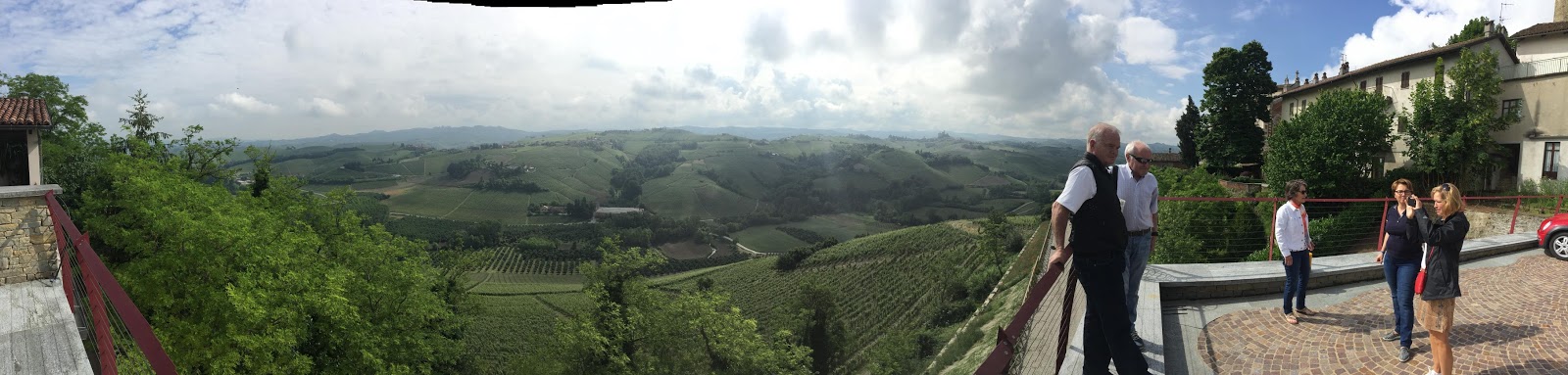
I stepped up to the wrought-iron gates and rang the bell. Elena poked her head out of one of the buildings on the down slope at the same time as Suzanne and the rest of the team drove up. Elena buzzed us in and we walked down the incline towards the cellar. After our welcomes and introductions, Elena suggested that we go back outside to view and discuss the vineyards below the winery. It was slightly foggy but, from the vantage point of the winery, we had a very nice view of the Serralunga Valley. Elena began talking about the estate.


There had been an old winery on the site since at least 1873 -- based on the old bottles found behind the walls in the cellar -- but signs point to wine production on the property way before then.


In those days the property was a farm, rather than the grape monoculture that it is today. By the mid-1800s, they had begun to concentrate on wines and began bottling in the second half of the 1800s.

In the 1960s and 1970s Vietti, based on the activities of Luca and his dad, was one the first local wineries to promote Piemonte in the US. Today 70% of the Vietti production is exported, with the US, at 30 - 35%, the most important market.

One of the stellar figures in the Vietti history was Mario Vietti, an engineer who had lived in Boston for 25 years and only came back to Piemonte upon the death of his brother. Other Piemontese families called him "the crazy American" because he went around looking for sites to buy or rent. And he was the one working the vineyards in all those locations (i) at a time when it was much more difficult and time-consuming to get around than it is today and (ii) where the norm was to farm where you were.

Mario was a visionary. He planted Barbera in 1918 against the common wisdom. Previously, Barolo was fortified and most vineyards had been planted to Barbera. When Mario came back, Barolo was just becoming the "wine of Kings" and farmers were pulling out Barbera and planting Nebbiolo. He planted the Barbera for his personal use.

The chart below shows the current distribution of Vietti grape sources by region and the allocation of the sources by wine label. Grapes are from a mix of owned and long-term-contract (5) vineyards.


The figure shows three labels of Barbera sourced from Alba, one blended (Tre Vigne) and two crus (Vigna Scarrone and Vigna Vecchia Scarrone). The Scarrone vineyard is a 20.55 ha surface which lies below the estate and is planted to 81% Nebbiolo, 11% Barbera, 6% Dolcetto, and 2% other reds (Barolo MGA). It is in this vineyard that Mario planted his Barbera in 1906. A 100-year-old vineyard for Barbera is very unusual today.

In addition to the Alba Barberas, Vietti also produces two Asti Barberas, one a cuvee (Tre Vigne) and the other a cru (La Crena). The La Crena vineyard is a 3-ha plot which was planted in 1932 and has a vine density of 4800 plants/ha. According to Elena, this may have been one of the best quality-for-price acquisitions that the estate has made.

The winery is best known, though, for its five Cru Barolos: Rocche di Castiglione, Lazzarito, Brunate, Ravera, and Villero. Elena refers to them as Garnd Crus. The full complement of Barolo crus from which Vietti sources its grapes are shown in the table below.

       Barolo Crus Farmed by Vietti
Cru Township
Brunate Barolo
Fossati
Ravera
Bricco Boschis Castiglione Falletto
Codana
Fiasco
Pianta
Rocche di Castiglione
Scarrone
Solanotto
Villero
Boiolo La Morra
Rochettevino
Lazzarito Serralunga d'Alba

Elena sees the estate, at 300,000 bottles produced annually, as a medium-sized winery. One of her statements during the course of the visit stands in stark contrast to the current situation: "We are always looking for great vineyards. Wineries never sell but you never know with the farmers."

The vineyards are kept separate but are worked in the same way. Decisions are made regarding the wines after aging in wood. The crus are separated out with the rest being tasted blind and blended for Castiglione and Perbacco.


Nebbiolos are vinified in stainless steel tanks with fermentation and maceration of 35 - 40 days while Barberas complete the process in 25 - 30 days. Malolactic fermentation is conducted in stainless steel tanks or barriques. According to Elena, barriques are used as technical instruments; as an evolution, not a revolution.


At the conclusion of the cellar tour, we repaired to the tasting room to sample a few of the Vietti wines. I will report on that tasting in a subsequent post.

©Wine -- Mise en abyme

Wednesday, May 18, 2016

A historical retrospective (1961 - 2011) of Vietti Barolo Rocche di Castiglione with Antonio Galloni and Luca Currado (Winemaker)

Antonio Galloni described his May 10, 2016 Vietti Barolo Rocche di Castiglione retrospective as a "once-in-a-lifetime vertical tasting ... going back to the inaugural 1961." All of the wines for the tasting (with the exception of the 1982 vintage) were acquired either from the Vietti cellars or the personal collection of the Currado family (The 1982 was secured from the the San Francisco restaurant Acquerello).


Used with permission. Courtesy of Vinous, LLC.

In his opening remarks, Antonio described this as a night of firsts. The attendees were drinking 2008 Pierre Péters Champagne at the reception and this wine remained unreleased at the time of the tasting. Antonio had brought it back from France in his suitcase in March. In addition, Luca Currado (Vietti winemaker), and his wife Elena Penna, were present, making their inaugural visit to one of these tastings. The 1961 Vietti Barolo was one of the foundations on which Barolo single-vineyard wines were built and the estate is honoring that event with a 50th-anniversary celebration, of which the Galloni retrospective was an integral part. The 1961 vintage was to be tasted tonight.

The wines were presented in five themed flights. This approach, according to Galloni, breaks up the palate and keeps everyone fresh. The wines had been opened at 4:30 on the day of the tasting and double-decanted. The younger wines were decanted first while wines from the 1980s were served out of decanters. The tasting was organized as shown in the table below.

Flight Nomenclature Inclusive Vintages
0
Reception 2008 Pierre Péters Brut Cuvée Spéciale Les Chétillons
1
To Start 1986, 1988, 1995, 2011
2
Years of Transition 1996, 1999, 2001
3
Modern Icons 2004, 2006, 2008, 2010
4
The Classics 1982, 1985, 1989, 1990
5
Back to the Beginning 1967, 1971

To Start
The first wine tasted was the 1986. Luca was attending enological school during this vintage when the area was hit by hail on a late morning in early May, causing the loss of 2/3 of the crop. If the hail occurs early enough, you can still make good wine. And they did. This was the wine of the flight. Balsamic, stewed fruit, iron, tea, dried rose petals, herbs and a savoriness on the nose. On the palate intense red fruit along with olives, mushroom, leather, licorice, and white truffle. Balanced with a long, elegant finish.

The 1988 exhibited dark fruit, earth, forest floor, and mushrooms on the nose. Short, sweet, and slightly porty on the palate. Brooding. Not as focused as the 1986. Antonio said that when this wine was introduced it did not attract a lot of commercial attention. The press was in love with the 1985 but old timers like the 1988. Luca indicated that this was his first harvest experience as winemaker with his father.

The 1995 had the longest maceration of any wine they have ever produced. Herby nose initially. Young, with a slight balsamic note. Very young wine on the palate. Antonio remarked that it was almost grape juice.

The 2011 showed an elegant nose with blue fruit, dark fruit, and herbs. Licorice and youthful on the palate. Non-complex but pleasant. Luca likes this vintage. He likes  a wine with acidity and he finds that even though this wine is opulent, it has great acidity. He thinks it will be good in the long term.

Grilled Spanish Octopus with Chickpeas and
Chorizo

Years of Transition
The 1996 was the wine of this flight. Balsamic, dried rose petals, and dried herbs on the nose. Tight focus. Elegant. Engages all elements of the palate. This wine will age forever. According to Luca, Rocche likes cool vintages and such conditions prevailed for this wine. Luca likes it because of its freshness. He called it "super classic."

The 1999 was restrained and elegant on the nose with hints of anise and licorice. Dried tamarind. Perfect balance. Great weight on the palate. Luca liked this wine a lot. It was a difficult wine to sell when he first delivered it to the market. He had been afraid that it would never mature but it started to open up three years or so ago.

The 2011 was the most opulent of the wines tasted to date. Dried fruits with a strong balsamic note. Young and fruity. Luca described it as monolithic while Antonio saw it as having a faster evolution than he had expected. According to Luca, the "most different" of the wines that we had tasted. If he had to do it over, he would harvest this wine earlier. It has more of a modern feel and does not have enough acidity. This wine can be drunk now.

Épaulettes: Rabbit & Reblochon Cheese Ravioli,
Black Truffle

Modern Icons
The 2004 exhibited spice, red fruit, lead pencil, and licorice. Unctuous. Sweetness on the palate along with great acidity, tar, licorice, and anise. Weighty. Rich, long finish. A long growing season and the first vintage of finesse in Barolo (Antonio Galloni).

The 2006 exhibited tar, earth, and licorice on the nose and licorice and anise on the palate. Virile and powerful but with silky tannins.

Herbs, earth, and intense red fruit on the 2008 nose. Sweet red fruit on palate. Medium complexity. Antonio described this as the most surprising vintage. Continues to improve.

Rich red fruit on the nose of the 2010 along with rose petal, mint, and tar. Rich red fruit and anise on palate. Powerful. Lengthy, tart finish. According to Antonio, has been fantastic from the beginning.

Lotte Rôtie: Roasted Monkfish, Foie Gras
Stuffed Morels, Potato, Red Wine

The Classics
According to Luca, these wines were all made by his mom and dad. They inspired him when he was a kid but the family never had the wherewithal to keep stocks of these wines in the cellar.

The 1982 showed Granny's attic, balsamic, soy, and a little maderization. Dried fruit on the palate. Mineral finish. Luca's dad liked this vintage and it is also a favorite of his. If he encounters it on a wine list, he buys it.

The 1985 had an aromatic nose. Hints of pumpkin, truffle, and sweet, bountiful red fruit. Balanced on the palate with a slight portiness. Pleasure to drink. First climate change vintage in Barolo, according to Antonio. Luca has it at its peak.

Sweet red fruit and licorice on the nose of the 1989 and earth, red fruit, and silky tannins on the palate. Lengthy finish. Luca terms this a "super classic."

The 1990 showed balsamic notes, red fruits, dried rose petals, and curry on the nose. On the palate sweet, concentrated red fruit accompanying good acid levels and a distinct curry flavor. Long finish.

Selle d'Agneau Grillée: Grilled Colorado Lamb
Loin, Mushrooms, Spring Onion, Mint Lamb
Sausage

Back to the Beginning
In this flight, some of the earliest Rocches. Beginning with the 1967 which showed dried herbs, portiness, and a stewed character. Not much on the body or finish. Appearance as of colored water.

The 1961 was salmon colored. Maderized with dried out lemon, bitter lemon, and orange rind. Good acid levels. Could be anything.

According to Luca, drinking these wines is like dancing with an old lady -- you have to be careful.

Selection de Fromages

*********************************************************************************************************

This had been an amazing night. The depth and breadth of the wines on offer was truly amazing and to have Luca and Elena present for this event added a level of authenticity and local knowledge that took the tasting to another level.

The dishes that accompanied the courses were excellent and the choice of locale continued Antonio's thrust to show that these Italian wines can thrive in non-Italian-cuisine settings


As a part of the 50th Anniversary Celebrations, Vietti had had 200 memorabilia gift boxes made to mark the occasion. Each attendee at the event left with one of those boxes which the estate had had shipped in for the event.


One of the interesting points of note was the performance of the oldest Rocches versus the 1958 Bartolo Mascarello which we had tasted in London three weeks prior to the Vietti tasting. The Mascarello had been tasted out of magnum and I had described it as pungent with a razor-sharp nose and focus and drinking younger than expected. This wine was vibrant in comparison to the 1961 and 1967 Rocches which both were (relatively) lacking in color intensity and varietal integrity. While storage conditions may play a role in the differences, it should also be remembered that the Mascarello is blended while the Rocche is not.


©Wine -- Mise en abyme

Tuesday, May 17, 2016

Luca Currado's (Vietti Winemaker) perspective on Rocche di Castiglione

When the Galloni Vietti retrospective tasting (held at Vaucluse in New York City) was called to order, I found myself seated next to a gentleman with an Italian accent who seemed to know everyone present and was very comfortable in his skin. He had apparently spent the previous night in Washington DC and was relating his experience while running in that city on the following morning (the day of the tasting).

During the course of his run, he came upon some barriers but could not be bothered with the diversions they dictated, so he clambered over them. Of course this brought every Secret Service Agent and every DC Police Officer to the scene to interdict this threat to the safety and security of the President of the United States. After some investigation they determined that he was just a headstrong Italian winemaker and sent him along on his way. And that was my introduction to Luca Currado, the acclaimed winemaker of the Vietti estate.

Luca and Elena Penna Currado at the Galloni
tasting

As stated previously, this tasting was especially important because the 1961 Vietti Barolo was one of the foundations on which Barolo single-vineyard wines were built. The Vietti estate is honoring that event with a 50th-anniversary celebration, of which the Galloni retrospective is an integral part.

Luca, in his opening comments, indicated that this was an emotional night for him. You see, they do not do this type of expansive tasting everyday, largely because they do not have the library stocks to support such tastings. When he was younger, the estate needed to sell all of the wine it could make because Barolo did not command the value that it does today. Luca said that he had been nervous before tasting the wines but now he was very happy. These wines, he said, are an honor to his father who always described Rocche as "his wine."

Luca described Rocche wine as being like a Swiss watch in that it is very difficult to put together. First, the vineyard is steep and very difficult to work; everything has to be done by hand.  Second, vinifying Rocche is a challenging exercise. They do extended submerged cap and the tannins always take a long time to come together and then ... pop. According to Luca, you have to wait longer for the Rocche tannins to resolve than for any of his other wines.

Castiglione Falletto is located between Serralunga d'Alba and La Morra and its Rocche di Castiglione MGA has elements of both of these bordering communes. According to Luca, Rocche wines have the silky tannins and elegance of La Morra and the complexity, depth and power of Serralunga d'Alba.


©Wine -- Mise en abyme