Showing posts with label Alta Langa DOCG. Show all posts

Friday, November 29, 2019

The DOC(G) sparkling wines of Piemonte

I have been contemplating the construction of an Italian Sparkling Wine Map -- akin to the one I developed for France -- for a while. Every time I sat down to begin the effort, though, I would retreat into a corner, cowed by the vast amount of data that exist and the paucity of real estate on which to model same. After continuously banging my head against the wall, I came to the conclusion that the only way forward -- in order to be as comprehensive as I wanted to be -- was to attack the problem in bite-sized chunks; that is, one region at a time. To that end I have put together the Sparkling Wines of Piemonte map shown below. One look at this map will alert the reader as to the impossibility of capturing the entirety of Italian sparkling wine production on a single chart.


While the region is best known for its Nebbiolo grapes, and the resulting Barolo and Barbaresco wines, the above map shows that many of the appellations provide frameworks for the production of sparkling wine. In most of the cases, the dominant DOC variety serves as the source material. If the producer does desire to do so, he/she could also utilize the much more forgiving Piemonte DOC for sparkling wine production.

The map shows the designation under which sparkling wine is produced in each region and specifies the mix of allowed varieties and their relative proportions. The map also illustrates which wines are made via the Charmat Method and which use the traditional Champagne Method. The Champagne method utilizes re-fermentation in the bottle to produce its bubbles while the Charmat method accomplishes that goal in the following manner:
At the conclusion of alcoholic fermentation, the base wines are assembled into batches and pumped into large, sealed tanks (autoclaves) for the secondary fermentation. Sugar and yeast are added to the tanks and the consumption of the sugar by the yeast results in the Carbon Dioxide that gives the sparkling characteristic to the finished wine.  This method of sparkling wine production is called the Italian (because it was first demonstrated as industrially viable by an Italian, Martinotti) or Charmat (the name of the Frenchman who refined the process such that it became feasible for large-scale industrial production), or Martinotti-Charmat method.  It is felt that this method preserves the aroma of the grapes yielding fruity, floral wines. This second fermentation can run between 20 days and 3 months after which the wine is bottled.
Selected Piemonte sparkling wines are discussed below.

Asti DOCG
Asti DOCG is by far the largest sparkling wine appellation in Piemonte with 9700 ha under vine in 52 municipalities stretching across the provinces of Alessandria, Asti, and Cuneo. Most Asti production is via the Charmat method but, as the map shows, there is a designation for Asti Metodo Classico. The Moscato Bianco grape is used as the raw material for the Asti wine.

Muscat is a large family of grapevines characterized by a unique "muscat" flavor. Moscato Bianco is the primary member in that it is grown in every Italian region and is the key component in at least 13 DOC(G) wines (Moscato d'Alessandria and Moscato Giallo are also very important members of the family.). All red Muscat varieties are directly related to Moscato Bianco which, in addition, has parent-offspring relationships with the two Moscato's mentioned previously as well as Moscato di Scanzo, Moscato di Violetto, and Moscato Rosa.

Outside of Italy, Moscato Bianco has long been cultivated in many temperate European countries. Within Italy, it is mainly associated with Piemonte. In the 16th century, it was widely planted in Asti Alessandria, and Cuneo, with the most important centers of production being Canelli, Santo Stefano Belbo, and Loazzolo. A Moscato d'Asti Consortium was initially formed in 1932, two years prior to the formation of the similar Barolo organization.

The key details of Asti DOCG is presented in the chart immediately following.
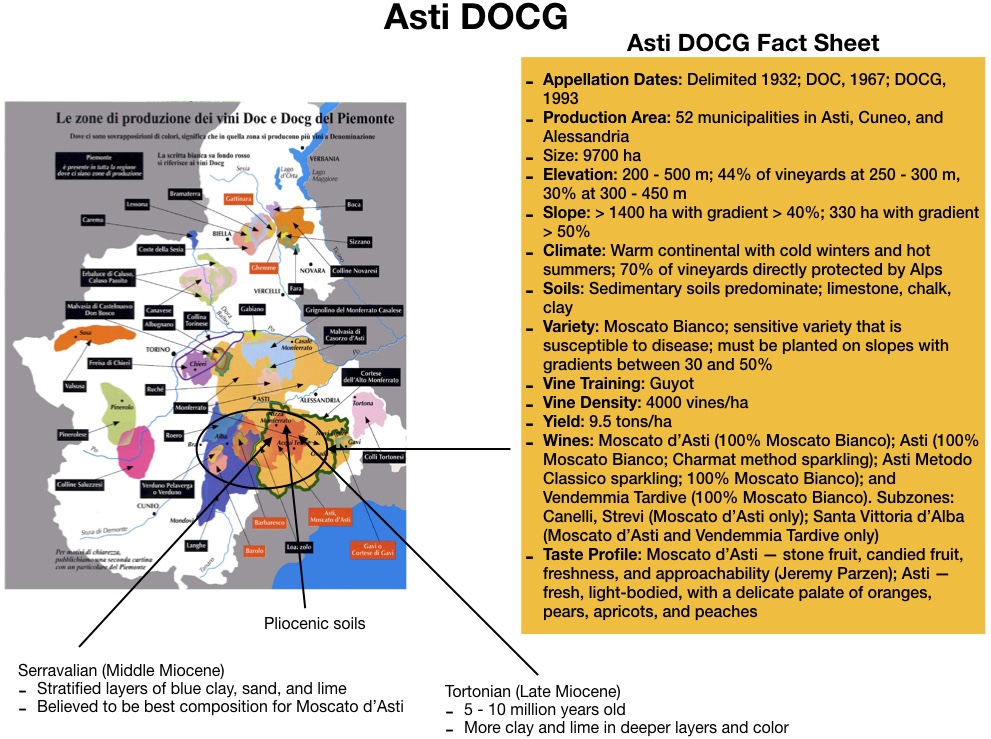

The Metodo Classico wine is produced using the Champenois method but the stars in this region are the Asti and Moscato d'Asti wines, both made using the Charmat method. The Charmat method is preferred, not only because of its lower cost of production and quicker-time-to-market, but also due to its ability to preserve the primary aromas of the variety through the process. The Asti production process is illustrated below.


Alta Langa DOCG
Alta Langa -- DOC in 2002, DOCG in 2011 -- is the new kid on the sparkling-wine block but the combination of its terroir, traditional Champagne varieties, traditional production method, skilled growers, and savvy producers bode well for the future.

The Alta Langa DOCG is spread over 142 communes in the provinces of Alessandria, Asti, and Cuneo. Given the geographic scope of the region, one encounters a variety of climates, exposures, elevations and soil types. In general, the soil is a mildly fertile calcareous clay marl.
Source: altalangadocg.com

Growers in the region have looked enviously at Champagne since the early 1800s. So much so that the Counts of Sumbay planted Chardonnay and Pinot Noir vines with an eye to making a Champagne-like sparkling wine. The chart below summarizes the history of the effort to make a Metodo Classico wine in Piemonte.


Vineyards are required to be planted at 250 m and above on the region's steep, terraced hillsides. Allowed varieties are Pinot Noir and Chardonnay and other non-aromatic grapes. Planting density is a minimum of 4000 vines/ha with the vines trained using the low espalier system and pruned traditional Guyot and spurred cordon. The maximum allowed yield is 11,000 kg/ha.

The Alta Langa producers -- 27 currently -- do not grow enough fruit to meet their needs but that gap is bridged with fruit from 80 growers who own their land and are guaranteed producer-payment for their grapes and labor.

The above two Piemonte sparkling wines would be the ones that most American consumers would encounter domestically.

Gavi/Cortese di Gavi DOCG
Villa Sparina Metodo Classico is produced at the Villa Sparina Resort and Winery, located in Monterotondo, the heart of Piemonte's Gavi DOCG. The facility was founded by the Moccagatta family in the 1970s. The location of the winery is shown in the following slide.


The estate sits on 100 ha, 70 of which are dedicated to grapes for the production of Gavi and Barbera.

Monterotondo is a cru for the Cortese grape of Gavi, the grape that is the basis for the Villa Sparina Metodo Classico Brut. The grapes are grown in vineyards resident at 250 - 300m altitude with mainly south and southwest exposures and soils of clay and marl. The vines are trained Guyot and are planted 4000 vines/ha density.

The grapes for the base wine are fermented in stainless steel tanks over a 3-week period. Second fermentation is carried out in bottles with the wine spending 36 months on its lees.

The wine had an initial breadfruit nose upon opening which gave way to a sweet white flower/fruit, citrus, citrus skin, pineapple and a steadily increasing pepper spice. Peach on the palate with a lemony-lime acidity. Medium weight, not as crisp as I prefer. Sparing, emaciated bubbles. Mineral persistence -- chalky clay -- on the palate. Short finish. The taste profile falls somewhere between a Franciacorta and a Prosecco; shaded towards the Prosecco end of the spectrum.

©Wine -- Mise en abyme

Wednesday, August 14, 2019

Contratto: A high-potential sparkling wine estate in Alta Langa DOCG

Alta Langa DOCG will need to ride the coattails of one or two highly successful producers to attain the prominence coveted by current industry participants  and to act as a magnet to potential market entrants. Contratto, with its lengthy history, savvy ownership, high-quality products, and the marketing muscle provided by its Unesco Heritage Cellars, is in a pretty position to play that leadership role.

I was introduced to Contratto wines by Giampiero Cordero, Sommelier at Ristorante Il Centro (Prioca d'Alba), and he was also instrumental in arranging my visit to its cantina. I used my Apple map for the drive between Alba and Canelli -- home of the Contratto cantina -- which turned out to be a white-knuckle ride up and down the steep hillsides which popped up early in the trip and did not end until a few minutes before its conclusion. I was dreading the ride back.


At the cantina we were welcomed by Luca Cigliuti who is currently responsible for sales to Asia and Latin America. Luca showed us around the cellar as he described the history of the establishment.


Contratta was founded by Giuseppe Contratto in 1867 with the express intent of making an Italian spumante metodo classico and, according to Luca, its 1919 Extra Brut was the first vintage sparkling wine made in Italy.

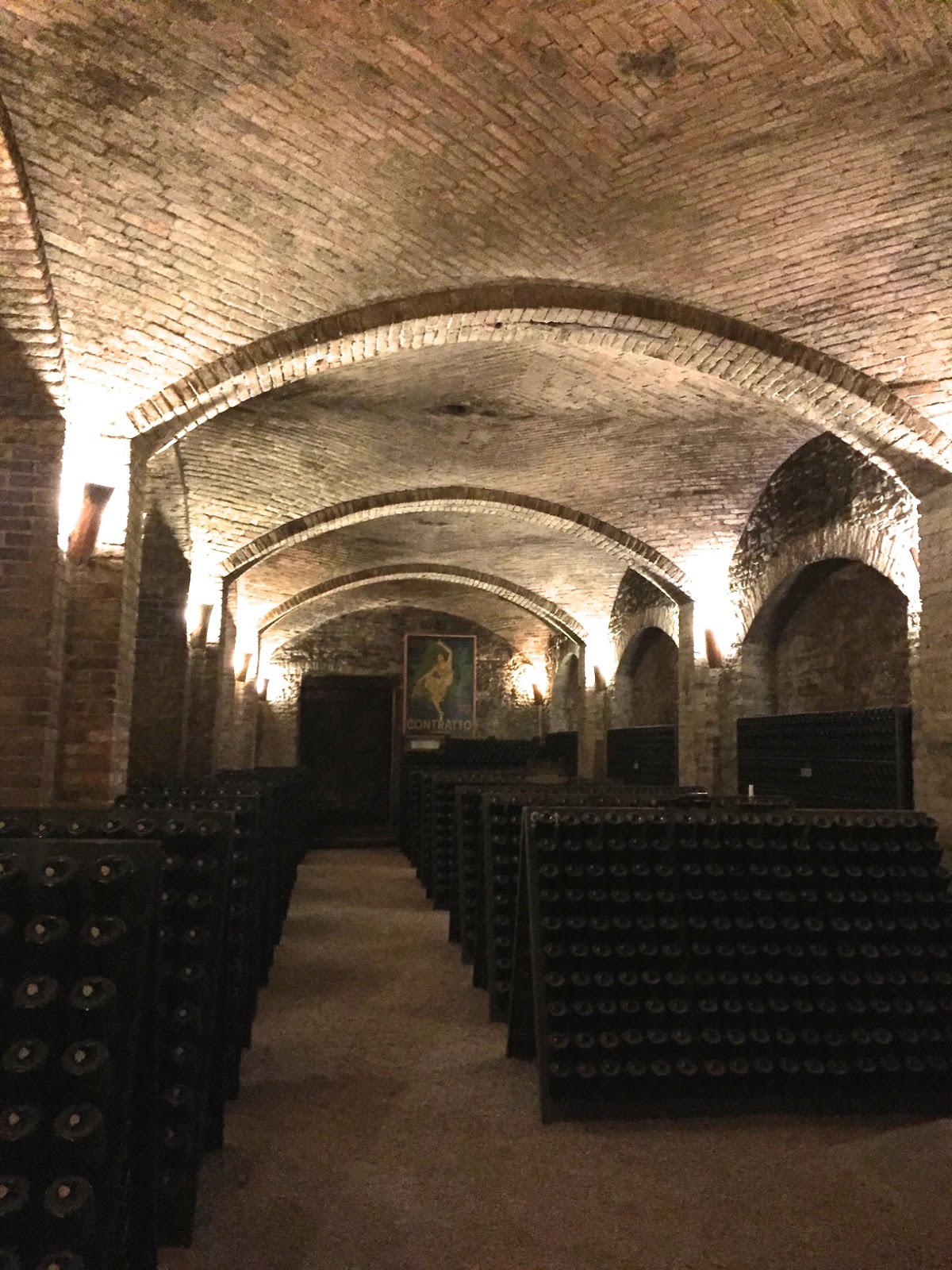
The Contratto cathedral cellars are absolutely stunning; so much so that they are designated a UNESCO Heritage Site. Work on the cellars began in 1872 and was completed after 3 years of labor by 200 workers. The cellars are more than 5000 m² and is built into the heart of the hill that protects Canelli. It is excavated to a depth of 32 m in the tuff limestone.


The estate was in decline when it was bought by Carlo Bocchini in 1993. Bocchini restored the cellars before selling to the Rivetti's in 2011. Prior to buying the property, Giorgio Rivetti had been providing winemaking counsel and had been using the facility to make a metodo classico sparkling wine using grapes sourced from the Oltrepo Pavese region.

At the time of the purchase Contratto produced sparkling wines under the Metodo Classico - Vini Spumante di Qualita, Piemonte DOC, Asti Spumante DOCG, and Asti Spumante Metodo Classico appellations with fruit sourced from vineyards in Oltrepo Pavese, Lozzola, Costigliole d'Asti, and Canelli.

This lineup of fruit sources did not align with the Rivetti vision. This vision was to be a player in the Alta Langa appellation using fruit sourced from its own estate. Vision-realization was a two-step process, the first accomplished in relatively short order, the second unfolding over a longer timeframe. The first step (2014) was to transfer the source of Chardonnay and Pinot Noir from Oltrepo Pavese to Alta Langa. The second step was the purchase of 45 ha of land in Bossolasco to serve as the estate-fruit-source for its Alta Langa DOCG wines.

The Bossolasco vineyard, acquired in 2015, is located just outside of the village of the same name. It sits at 750 m and has a southern exposure. The land was initially used to grow Dolcetto vines and, more recently, medicinal herbs. The vineyard is being farmed organically and, by 2021, will provide the fruit for all Contratto Alta Langa wines.

The winery poduces a couple of Moscato-based wines (De Miranda label) for its Asti Spumante offerings and three non-Alta-Langa metodo classico wines (Millesmate, Cuvée Novicento pas Dosé, Riserva Special Cuvée pas Dosé). The Alta Langa wines are For England Blanc de Noir Pas Dosé (100% Pinot Noir, 48 months on lees, zero dosage), For England Rosé Pas Dosé (100% Pinot Noir, 48 months on lees, zero dosage), and Blanc de Blanc Pas Dosé (100% Chardonnay, 48 months on lees, zero dosage).

With the exception of the Asti Spumantes, all Contratta wines share the same production process:

  1. Grapes are handpicked
  2. Selection in the cellar
  3. In the cellar, staged separately based on vineyard location
  4. Cooled down prior to crushing
  5. Gentle pressing (1 hour pre-press skin contact for grapes destined for the Rosé)
  6. First-run juice used for fermentation
  7. Indigenous-yeast fermentation in stainless steel tanks
  8. 8 months in tanks post-fermentation
  9. Bottled with liqueur de tirage for second fermentation (4 weeks)
  10. Minimum 36 months on lees
  11. Riddling
  12. Disgorgement (glace method)
  13. Aged in bottle 6 months post-disgorgement.

Parlo and Luca

At the end of our cellar tour Luca ushered us into a tasting room. Giorgio Rivetti was on premises because one of his relatives was getting married on the grounds later in the day so Luca invited him in to join us.


Giorgio Rivetti joins us for the tasting

The For England Blanc de Noir Pas Dosé 2011 showed white fruit, yeast and white bread. Tart apple and lemony character on the palate. Small bubbles. Sour finish.

The For England Rosé 2011 had a clean, unyielding nose with a subdued mousse, strawberry flavor, and a bitter finish. Bitter rose water on the palate with limited persistence.

The Blanc de Blanc 2011 was elegant on the nose with biscuit, citrus and yeast on the nose.  Mineral and saline on the palate along with citrus flavors. Persistence on the palate and tight finish.

*********************************************************************************************************************
The Rivetti purchase was consequential for both Contratto and the future of sparkling wines in Piedmont. First, the Rivettis know sparkling wine -- they are the largest Champagne importers in the area. Second, Giorgio is well respected as a winemaker in his own right. Robert Parker, Jr has described him as "One of Italy's most formidable winemaker/proprietors ..." who "displays a masterful touch." Third, the Rivettis have the vision and resources needed to make the estate a powerhouse in the region and the region a powerhouse in the sparkling wine world.

The Rivetti's will need to concentrate all of these positives in order to realize the full potential of this estate.

The ride back was even more harrowing than the inbound journey.

©Wine -- Mise en abyme

Sunday, August 11, 2019

Alta Langa DOCG: Piemonte's burgeoning answer to Franciacorta?

During the Labor of Love pre-launch dinner party, Giampiero Cordero, the Sommelier at Ristorante Il Centro (Prioca d'Alba), introduced me to a sparkling wine -- Contratto Metodo Classico -- with which I was unfamiliar. The wine was intriguing so I sought out Giampiero later on in the evening, seeking additional information. He indicated that the wine was from a new sparkling wine DOCG called Alta Langa and promised to make arrangements for me to visit the winery on the Saturday post the dinner. He did make the arrangements and Parlo and I did make the visit. Before discussing the winery and its wines, I provide some background on the region.

The leading lights of Italian sparkling wine are Prosecco, Franciacorta, and Asti. If you confine your horizon to Piemonte, Asti and Moscato d'Asti are the most prominent. Alta Langa -- DOC in 2002, DOCG in 2011 -- is the new kid on the sparkling-wine block but the combination of its terroir, traditional Champagne varieties, traditional production method, skilled growers, and savvy producers bode well for the future.

Source: altalangadocg.com

Growers in the region have looked enviously at Champagne since the early 1800s. So much so that the Counts of Sumbay planted Chardonnay and Pinot Noir vines with an eye to making a Champagne-like sparkling wine. The chart below summarizes the history of the effort to make a Metodo Classico wine in Piemonte.


The Alta Langa DOCG is spread over 142 communes in the provinces of Alessandria, Asti, and Cuneo. Given the geographic scope of the region, one encounters a variety of climates, exposures, elevations and soil types. In general, the soil is a mildly fertile calcareous clay marl.

Vineyards are required to be planted at 250 m and above on the region's steep, terraced hillsides. Allowed varieties are Pinot Noir and Chardonnay and other non-aromatic grapes. Planting density is a minimum of 4000 vines/ha with the vines trained using the low espalier system and pruned traditional Guyot and spurred cordon. The maximum allowed yield is 11,000 kg/ha.

As is the case in Champagne, the Alta Langa producers -- 27 currently -- do not grow enough fruit to meet their needs. That gap is bridged with fruit from 80 growers who own their land and are guaranteed producer-payment for their grapes and labor.

Alta Langa DOCG covers a Spumante and Spumante Rosata, each built from a minimum of 90% Chardonnay and/or Pinot Noir and a maximum of 10% non-aromatic grape(s), fermented in the traditional method, and aged for a minimum of 30 months on the lees. A Riserva has to spend 36 months on the lees. An Alta Langa Rosso DOC has the same varietal requirements but no stated aging requirement.

Using Avezza Paolo's (one of the producers) practices as an example, the grapes are hand-harvested (a requirement) and taken to the cellar where they are crushed whole. Only the free-run juice is fermented.

Most of the producers ferment in stainless steel tanks but Bera Valter uses a mix of stainless steel and wood, with the majority done in steel. The base wine is placed under crown seal with the liqueur de tirage for the second fermentation (Bretta Rossa blends in a small amount of cuvée from the prior year's production.). The wine rests on its lees for a minimum of 30 months prior to disgorgement and dosage. The aforementioned Contratto always produces a vintage wine with zero dosage and a minimum of 48 months on the lees.

Franciacorta is the most significant Metodo Classico wine in Italy so some comparisons are in order.

Category Franciacorta Alta Langa
First Sparkling wine
1961
1848
DOC
1967
2002
DOCG
1995
2011
Size (ha)
3000
106
Municipalities
19
142
Grape sources Estates (104) Estates and Growers (107)
Soils Glacial morainic (4 types) Calcareous clay marl
Elevation “Gentle hills” Minimum 250 m

One of the things that I find disconcerting about Franciacorta is its richness. This stems from fruit ripening afforded by its relatively southerly location and acidity-robbing, low elevation vineyards. Alta Langa has the potential to produce a crisper sparkling wine given its more northerly provenance and its relatively high elevation.

The Piemonte region has a good track record in handling the Chardonnay grape. While not in the same geographic region, Gaja's Chardonnays take a back seat to no one and I am personally enamored with Aldo Conterno's Bussiador.

In most of the cases, the Alta Langa product is one component of a red-wine centric portfolio for both the growers and the producers. Contratto is one of the exceptions in that it is a standalone sparkling wine establishment within the broader Rivetti portfolio. The challenge for the region will be its relatively small size in a red-wine centric region where there will always be competition for attention and vineyard space vis a vis the the region's red wines.


©Wine -- Mise en abyme