Showing posts with label Vitis vinifera. Show all posts

Monday, September 18, 2023

Iran: A vitis vinifera conquest on its journey to the Far East

Dong, et al., reports on a dispersal of the vitis vinifera CG1 cultivar in four directions from its domestication point in western Asia, as illustrated in the map below.

High-Level view of the early stages of vitis vinifera
distribution from the Western Asia Domestication
Center (after Dong, et al.)

I have previously detailed hypotheses as to how the cultivar spread into Anatolia and across Europe and North Africa, with reports on the Caucasus and the Far East in the offing. Before addressing the latter endpoints, however, I will cover the evidence of transit through Iran, the point of divergence for the cultivar's onward journeys.

According to the authors, the dual domestications occurred 11,000 years ago. The Little Ice Age had ended by this time and the world was transitioning from the Pleistocene to the Holocene Epoch. 

The cold, dry climate associated with the Younger Dryas (12,800 BP - 11,600 BP) led to a rapid reduction in the size of the lushest vegetation belts and reduction in yields of natural stands of C3 plants such as cereals. 

There was  rapid return of wetter weather post the Younger Dryas and this led to the expansion of numerous lakes and ponds and cultivation of annual crops along the shorelines. The first large villages began to appear (up to 2.5 ha) and they relied on cultivated barley and wheat or "their wild progenitors." 

Neolithic farming communities thrived under the favorable climate conditions of the Early Holocene and expanded "along the Levantine Corridor into Anatolia and neighboring regions." This, then, was the first movement of the cultivated grapevine outside of its birthplace. 

Post-Younger-Dryas warming took 1000 years to reach Iran and another 1000 years to reach the heart of Central Asia. Cereal grasses and trees followed the path of this warming; as did agriculture. The Neolithic -- the period of the origins and early development of agricultural economies -- launched in the Levant around 11,000 years ago and was evident in Iran during the period 10,000 BP - 7500 BP.

Within Iran, Neolithisation did not occur in one fell swoop. Rather, it was evidenced as "a gradual unfolding of multiple episodes of Neolithisation producing patterns of change, continuity and adaptation over several millenia." The chart below illustrates the unfolding of Neolithisation in Iran.


Human groups in Iran's Zagros Mountains developed autonomously -- in relation to the Levant -- during the beginning of the Holocene, with local domestication of goats and early stage agriculture based on barley. The material culture has been confirmed by DNA studies which show that humans from the Zagros and Levant were "strongly differentiated genetically and were each descended from local hunter-gatherers." 

There were a number of core areas that were "large enough to have fostered distinct and thriving societies throughout the Neolithic and beyond":
  • Northern, central, and southern Zagros
  • Khuzistan lowland
  • Southern Iran
  • Northeastern Kopet Dag
Of the above, the Khuzistan lowland has "the longest continuous sequence of Neolithic occupation" and the "oldest substantial evidence for agriculture and animal husbandry in Iran." Given our assertion of a nexus between the adoption of agriculture and the adoption of grape cultivation, and the proximity of Khuzistan to the Fertile Crescent, it is quite likely that grape vines were cultivated in Khuzistan at some time in the Neolithic. And that assertion is bolstered by archaeological findings at Hajji Firuj, a Northern Zagros archaeological site which was occupied between 7900 and 7500 BP.

Hajji Firuz was a small village of single-family dwellings with an economy based on a mix of farming and herding, with the latter potentially requiring seasonal migration. The dates of occupation suggest that agriculture and herding at this location was relatively late when compared to Central Zagros and the Khuzistan lowlands. The location of the site is illustrated on the map below.
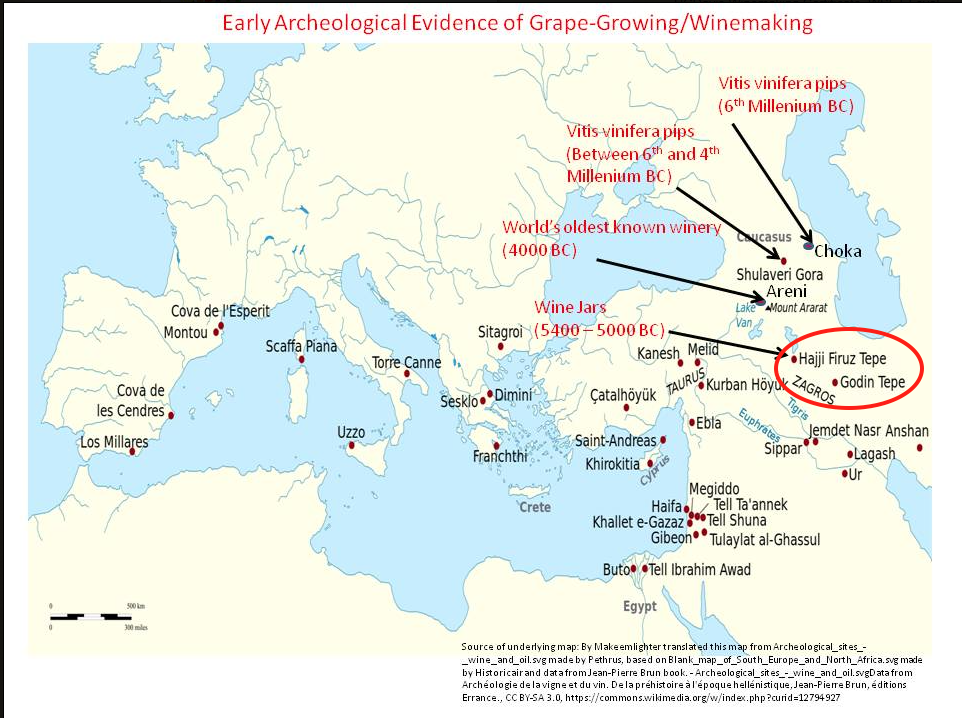
Red oval highlights archaeological sites where proof
 of winemaking in ancient Iran (Persia) was unearthed. 

Hajji Firuz Tepe was the subject of an archaeological excavation in 1968 at which five 2.5 gallon (9 liter) jars were found embedded in an earthen floor along a wall of a Neolithic mud brick building.  Two of these jars had a yellowish residue on the bottom which, after being subjected to infrared liquid chromatography and wet chemical analysis, proved to be a combination of calcium tartrate and terebinth tree resin.  Tartaric acid in the amounts found can only be associated with grapes and the amount of wine that would be housed in the five containers would be much more than required for a single family's use.  Clay stoppers that perfectly fit the openings at the top of the clay jars were found in close proximity to the jars and was assumed to have been used to prevent the contents from turning to vinegar.  These factors led the archaeologists to tag this site as a wine-production facility -- playfully called "Chateau" Hajji Firuz by Dr. McGovern. As wines in Greece even today are resinated, the assumption is that resin was added to Neolithic wines either as a preservative or for medicinal purposes.

Jar from Hajji Firuz Tepe
(Source: alaintruong.com)

The work done by the McGovern team clearly shows the use/consumption of wine within Neolithic Iran. Given that the domestication of vitis vinifera fell within the bounds of the Fertile Crescent, and that the southwestern part of Iran also fell within the bounds of that construct, its transit route into Iran becomes clearer.

Pottery-making in Iran has a history dating back to the early 7th millennium with the advent of agriculture giving rise to the baking of clay and the making of utensils. The use of clay jars for the storage of wine at Hajji Firuz Tepe is, therefore, a temporal fit.

From Iran, vitis vinifera CG1 made its way to the Caucasus and Central Asia. I will cover the former in my next post on the topic.


Bibliography
Saffaid Alibaigi and A. Salomiyan, The Archaeological landscape of the Neolithic period in the western foothills of the Zagros Mountains: New evidence for the Sar Pol-Ezahāb region, Iraq - Iran Borderland, Iraq, Vol 82, Cambridge University Press, December 2020.
Oliver Barge, et al., Diffusion of Anatolian and Caucasian Obsidian in the Zagros Mountains and the highlands of Iran: Elements of Explanation in 'leastcost path' models, Quaternary International 467 (Part B), February 2018.
Dong, et al., Dual domestications and origin of traits in grapevine evolution, Science, 3/3/23
Encyclopedia Iranica, Neolithic age in Iran.


©Wine -- Mise en abyme

Wednesday, August 9, 2023

The spread of vitis vinifera in Western Eurasia

Dong, et al., shocked the wine world by providing genetic evidence of two separate, simultaneous domestications of vitis sylvestris, one in the Caucasus and the other in the Levant. I have described the study methodology and findings in previous posts

I have also written on the methodologies employed by the authors in attempting to answer questions regarding: (i) the diversification history of European wine grapevines and (ii) "when and how distinct grapevine ancestors formed in Europe with relevance to Syl-W introgressions." In this post I illustrate the vehicle and routes for grapevine distribution in Europe and North Africa.

Vehicle for Grapevine Spread
The Agricultural Revolution refers to the switch from hunting and gathering as the main methods of food production to the more sedentary domestication and husbanding of plants and animals. The revolution was characterized by domestication of wild flora and fauna and distribution between the original point of production and outlying areas either by migration or cultural exchange.

In the case of Eurasia and North Africa, “Neolithization” occurred when agricultural innovations developed in the Fertile Crescent were distributed to all points of the horizon on the backs of migrating agriculturists. The chart below illustrates the impetus and dispersal directions in the early part of the West-Asian-origin Agricultural Revolution.


Europe
The chart below shows the major population movements in Europe over the last 50,000 years. Hunter-gatherers who had moved south to escape the Ice Age had repopulated the continent, albeit with low-density groups.


This situation changed approximately 8500 years ago when " a wave of populations from the Middle East entered Europe via Anatolia." This migration wave spread farming practices into the region, "initiating the Neolithic Revolution in Europe."

These Anatolian-sourced farmers made their way into Europe via two routes: (i) a northern route across Central Europe and (ii) a westward route along the Mediterranean coast. The routes are illustrated graphically on the map below. The map also shows the ETA of agriculture for selected regions.


North Africa
According to Simōes, et al., the human population in North Africa had exhibited genetic continuity since the Upper Paleolithic, a period of isolation interrupted by the entry of European Early-Neolithic farmers. A study of genes retrieved from remains at a North African site, referred to as KTG, reveals that these European farmers were descendants of the Anatolian farmers who had spread to Europe by way of the Mediterranean route, eventually reaching the Iberian Peninsula.

These migrants travelled to Morocco around 5500 BCE bringing with them new ways of life, farming practices, domestication traditions, and pottery traditions, all of which were adopted by the indigenous populace. 

A second group of genes show up in the profile of the Moroccan populace. This new migratory group is thought to be descendants of the pastoralists who had exited the Fertile Crescent and crossed the Sinai, traveling along the African Mediterranean coast and arriving in Morocco 1000 years after the descendants of the Anatolian-origin farmers.

Grapevine Distribution
The cultivar CG1, a table grape, made its way out of its domestication center north towards Anatolia and west towards North Africa (for the purposes of this post). Somewhere within the domestication center, or within Anatolia, there was a significant introgression of Syl-W genes into CG1. Shortly thereafter, the Muscat cultivar split off from CG1. The new ancestor variant -- CG3 in the figure below — was used both as a table grape and a wine grape.


As the Anatolian farmers traversed Europe in search of new agricultural land, they carried the CG1 cultivar along with them and it interacted with Syl-W variants along the way to form new ancestor-cultivars in the Balkans, the Iberian Peninsula, and Western France (called the Western European ancestor in the below chart).

Dong, et al., identifies the Moroccan vitis vinifera as being inconsistent with a cultivar that travelled through Europe and then crossed over to Morocco. The vines did not exhibit the shared introgression from Syl-W that all European grapes possess. The Moroccan vines would have transited Africa with the descendants of the Levant-origin migrants, finally bringing vinous relief to the inhabitants 1000 years after it was available just across the strait.

The characteristics of the grapes distributed across Europe are as indicated in the table below.

Ancestry Group

Grape

Date of Split from CG1

Syl-W introgression

CG3

Muscat

10,500 years ago

11.4 - 18% ancient

CG4

Balkan Wine

8070 years ago

ditto

CG5

Iberian Wine

7740 years ago

ditto

CG6

Western European Wine

6910 years ago

ditto + 25 - 30% more recent Syl-W introgression


**********************************************************************************************************
I will continue the series with discussions of the distribution of vitis vinifera north into the Caucasus and east into Iran in upcoming posts.

Bibliography
EurekaAlert, Human Mobility and Western Asia’s early State-level societies, Max Planck Institute of Geoanthropology, 5/26/20.
D. Baird, et al., Agricultural origins on the Anatolian Plateau, 3/9/18.
Jan Bartek, Genomics and Archaeology Rewrite the Neolithic Revolution in the Maghreb, ancient pages.com, 6/28/2023.
B. Bramanti, et al., Genetic Discontinuity Between Local Hunter-Gatherers and Central Europe’s First Farmers, science, Vol 326, Issue 5949, 3 Sept 2009.
Muhal Feldman, et al., Late Pleistocene human genome suggests a local origin for the first farmers of central Anatolia, Nature Communications, 10 (1258), 2019.
Iosif Lazaridis, et al., Genomic insights into the origin of farming in the ancient Near East, Nature 536, 2016.
Iosif Lazaridis, et al., Ancient DNA from Mesopotamia suggests distinct Pre-Pottery and Pottery Neolithic migrations into Anatolia, Science 377, 6609, 25 Aug, 2022.
Fernando Racimo, et al., The spatiotemporal spread of human migrations during the European Holocene, PNAS, April 2020.
Luciana G. Simōes, et al., Northwest African Neolithic initiated by migrants from Iberia and Levant, Nature, 618, 6/-6/23.
Laura Spinney, When the First Farmers Arrived in Europe, Inequality Evolved, Scientific American, 7/1/2020.


©Wine -- Mise en abyme

Saturday, June 10, 2023

The domestication of vitis vinifera: The physical environment

According to Dong, et al., two variants of the wild grape vitis sylvestris were simultaneously domesticated in the Caucasus and Western Asia resulting in two variants of vitis vinifera. The Caucasus-sourced vitis vinifera flourished on both sides of the Caucasus Mountains, and even extended into the Carpathian Basin, but had no impact beyond this limited geographical area. The Western Asia domesticate, by a process of elimination, must be the source variety for the bulk of the world's wine grapes. I will explore the environment wherein this variety was domesticated as well as the people who most likely brought sylvestris to heel. I examine the physical environment in this post.

Vitis sylvestris was domesticated in the early part of the Holocene. The physical environment in Western Asia during this time period is illustrated in the chart below.


Dong, et al., did not specify the location of the domestication center within Western Asia but an eyeballing of their placement of the center on the map would seem to place it within the confines of the region called The Levant. The coverage of the Levant is illustrated in the rightmost map below and the blue arrow illustrates the relationship between that region and the Western Asia Domestication Center.


According to Bar-Yosef and Valla, "lines of evidence demonstrate that cold, wet conditions" dominated in The Levant in the late Pleistocene. This was followed by a dry spell in the transition period and a steady increase in arboreal pollen. An increase in humidity is observed for the in the Early Holocene "in the Middle Euphrates Valley in Northern Syria and from the Lower Jordan Valley" (Bar-Yosef and Valla). The paleoclimatic record shows the following (Bar-Yosef):
  • Late Glacial Maximum (20,000 - 14,500 B.P.)
    • Entire region cold and dry
    • Hilly coastal areas enjoyed winter precipitation and were covered by forests
  • 14,500 - 12,800 B.P.
    • Precipitation slowly increased over the entire region beginning at 14,5000
    • More rapid increase from 13,500 B.P. to 13,000
    • Rate peaked around 13,500 in the southern Levant
  • Younger Dryas (12,800 - 11,600 B.P.)
    • Rate of rainfall decreased
  • 11,300 B.P.
    • Increased rainfall returns
      • Very wet early Holocene in the northern Levant and Anatolia
      • Did not reach the previous peak in central and southern Levant
  • Gradual rise in sea level
    • Post the Late Glacial Maximum and until the mid-Holocene
    • Reduced the flat, sandy coastal plain of the Levant by a stretch 5 - 20 km wide and 500 km long.
During the Holocene, The Levant was characterized by a variety of landscapes running between the southern flanks of the Taurus Mountains of Turkey and the Sinai Peninsula:
  • Narrow coastal plains
  • Two parallel continuous mountain ranges with a rift valley in between
  • An eastward-sloping plateau dissected by many eastward-running ravines.
There was marked seasonality, with cold, rainy winters and hot, dry summers being the norm. Two annual patterns of winter storm tracks were observed:
  1. Humidity from the Mediterranean flowed to the southern Levant
  2. Storms arrive from northern Europe and turn to the northern Levant.
There were three vegetational zones (Bar-Yosef):
  • Where annual precipitation exceeded 400 mm/year, Mediterranean woodland and open parkland 
    • Oak-dominated parkland and woodland provided the"highest biomass of food available to humans." Dense oak forests (> 800 mm/year rainfall) maintain a lower biomass than the open parklands
  • Where precipitation was < 400 mm/year, shrub land and steppic vegetation 
  • Arid-type vegetation.

Effect of the Physical Environment on Vitis Sylvestris/Vitis Vinifera
Environmental conditions have marked effects on grape development today and it is quite likely that grapes reacted similarly in times past. It is likely that vitis sylvestris exhibited different characteristics in the cold of the Pleistocene than did vitis vinifera in the warming period of the Early Holocene. As a matter of fact, the last glacial cycle (115,000 - 11,700 years ago) was the scene of one of the most severe vitis sylvestris bottlenecks, driving worldwide population down to between 10,000 and 40,000 vines.

The warming period began with the retreat of the glaciers and the changes in the physical environment highlighted in map 1 above. Just the mere fact of the warming would have positive effects on the grapevine and its product. Warmer temperatures would lead to riper, more palatable grapes (Remember that grapes in this early period were used as a food source as opposed to a beverage.). This riper, more palatable fruit would stand in stark contrast to the potentially harder, greener product that would have been the norm in the colder, drier Pleistocene.

Increased humidity would have led to more vigorous vines and plumper fruit. Grapes would not only be more palatable, they would also be more substantial.

The forest expansion that resulted from the warming would have also been beneficial to vitis vinifera. The grapevine is a climber and more trees represented more growth/spread opportunities for the population. 

*********************************************************************************************************

In my next post I will explore the culture that most likely domesticated the grapevine.

Bibliography
Bar-Yosef, O., The Natufian Culture in the Levant, Threshold to the Origins of Agriculture, Evolutionary Anthropology.
Bar-Yosef, O., and F. Valla, The Natufian Culture and the Origin of the Neolithic in the Levant. Current Anthropology 31(4) January.
humanpast.net, Food around 11,000 BC.

©Wine -- Mise en abyme

Wednesday, May 24, 2023

Grapevine domestication: A tale of two centers and selected traits

Dong, et al., (Dual domestications and origin of traits in grapevine evolution, Science, 3/3/23) have postulated, based on their study results, a dual origin for vitis vinifera stemming from simultaneous domestications of distinct vitis sylvestris pairs in separate geographic regions. I have previously described the study origin, the history of the progenitor species vitis sylvestris, and the case for dual domestication. In this post I will provide a contemporaneous look at the proposed domestication centers and identify traits selected during the grapevine cultivation process.

The Domestication Centers
The figure below locates the Western Asia (Syl-E1 to CG1) and Caucasus (Syl-E2 to CG2) domestication centers. 

Grape domestication centers (as per Dong, et al.)

According to the authors, the dual domestications occurred 11,000 years ago. The Little Ice Age had ended by this time and the world was transitioning from the Pleistocene to the Holocene Epoch. 

The Western Asia physical environment was varied, inclusive of highlands, mountain ranges, fertile river valleys, and arid and semi-arid landscapes. Notable geographic features included the Taurus and Zagros Mountains, the Anatolian Plateau, the Levant, the Mesopotamian Plain, and the Jordan River Valley. The Caucasus had a similar distribution of environments but with more prominent mountain ranges. River valleys, such as those hosting the Aras and Kura Rivers, provided conditions suitable for early agricultural development.

The populace of the two centers were mainly hunter-gatherers (hunting, fishing, and gathering), with some early agriculturists. Early farmers likely cultivated wheat, barley, legumes, and flax and domesticated animals such as goats, sheep, and cattle.

It is believed that the Caucasus was inhabited by several indigenous groups but the demographic composition is difficult to determine with any precision. Western Asia, on the other hand, was home to some notable civilizations to include the Natufians (Levant) and the pre-pottery Neolithic cultures of Hassuna, Halaf, and Samarra (Mesopotamia).

Domestication Intent and Thrusts
The authors investigated domestication signatures on the cultivars and found both shared and unique manifestations on the cultivars. Most of the shared signals are on chromosomes 2 and 17, "confirming previous findings that that the selection on flower sexual morphs (sex determination region, SDR), berry skin color (VvMybA gene cluster), and berry development (SDH gene cluster) were of great importance during grapevine domestication." The authors further identified shared domestication genes that possibly serve as foundations for grapevine growth, physiology, fruit set, and resistance to biotic/abiotic stress.

The unique manifestations are exhibited in cases where "the same goals were advanced  by using different aspects of common domestication traits." Some examples of the latter are as follows:
  • Improvement of berry palatability through the reduction of alkaloid biosynthesis (MecghR gene cluster in CG1 and TR2 and SSL gene clusters in CG2)
  • Enhancement of carbohydrate metabolism (SWEET17 in CG1 and PFKFB1 in CG2)
  • Perceived berry desirability (BEAT gene cluster for floral scent in CG1 and UFGT gene cluster for berry color in CG2)
  • Response to environmental stresses (UPL6 in CG1 and WAK in CG2).
According to the authors, "... their findings suggest that the initial cultivations of CG1 and CG2 may have been to serve early humans' caloric and micronutrient needs." And such an observation fits with the economic environment described previously; that is, a landscape populated primarily by hunter-gatherers and fledgling agriculturists.

In that both cultivars were domesticated as food sources, the selection of factors suitable for winemaking exhibited in CG2 "could have been serendipitous, and the practice of winemaking with CG2 ... possibly postdates grapevine domestication."

In my next post I will examine the spread of these cultivars outward from their domestication centers.

©Wine -- Mise en abyme

Monday, May 15, 2023

The case for dual domestication of vitis vinifera, as per Dong, et al.

The recent Dong, et al., study has upended the conventional wisdom of a single-point vitis vinifera domestication somewhere in the Caucasus over 8000 years ago. In a series reporting on the study, I have specified the study origin and the history of vitis sylvestris, the accepted progenitor of vitis vinifera. In this post I cover the study findings as regards the domestication of vitis vinifera.

Vitis vinifera sylvestris (Source: floredusud.com)

According to the Dong, et al., study, the wet climate of the Early Holocene (11,700 - 8300 years ago) expanded the geographic spaces capable of sustaining Syl-E (identified in my prior post as the eastern ecotype of v. sylvestris) and the species rose to the occasion by moving westward, occupying a "large geographic space from Central Asia to the Iberian Peninsula."

I have identified six genetic ancestries for cultivated grapes reported out in the Dong, et al., study -- CG1 to CG6 -- each associated with a specific geographic area. For example, CG1 is associated with Western Asian table grapevines and CG2 with Caucasian wine grapevines. CG1, according to the study, "shares the main ancestral components with Syl-E1" while CG2 shares its main components with Syl-E2. This state of affairs suggests the possibility of two domestication events. Further:
  • CG1 and CG2 maintain the highest genetic diversity of all the CG groups
  • CG1 and CG2 manifest the greatest Linkage Disequilibrium decay among all CG groups
  • CG1 and CG2 are less differentiated from their corresponding wild ecotypes
  • The Akaike information criterion-based phylogenetic selection prefers a dual origin tree model which agrees that CG1 and CG 2 are genetically closer to Syl-E1 and Syl-E2, respectively
  • The population split lines of CG1/Syl-E2 and CG2/Syl-E1 pairs resemble that of Syl-E1/Syl-E2 and differ from those of CG1/Syl-E1 and CG2/Syl-E2 pairs.
These data, according to the study, "collectively support a dual origin of v. vinifera and reject the theory of a single primary domestication center."

Both sylvestris/cultivar pairs (CG1/Syl-E1 and CG2/Syl-E2) separated quickly which, according to the authors, is compatible with a "clean-split" scenario. The authors estimate the median population split time to be ~ 11,000 years ago for both pairs "suggesting that the domestication events took place concurrently around the advent of agriculture."

In that CG1 represents the Western Asian table grapevine, and CG2 the Caucasian wine grape vine, the dual-origin schema advanced herein rejects earlier assumptions that wine grape domestication predated table grape domestication. To reiterate, the data suggest vitis vinifera simultaneous origins in Western Asia and the Caucasus, covering both wine grapes and table grapes.

The implications of the foregoing are mind-blowing. It suggests that Syl-E1 and Syl-E2 had self-selected for characteristics that rendered one more palatable as a food source and the other as a beverage. Further, it means that hunter-gatherers within the regions had been interacting with these ecotypes in their natural habits and habitats for many years prior to the instance of dual selection and propagation of the characteristics embodied in CG1 and CG2.

My next post will highlight how domesticated grapes spread from these points of origin to the major wine regions.


©Wine -- Mise en abyme

Tuesday, June 16, 2020

The ancient roots of viniculture

From its origins in the Near East, vinification had diffused to Egypt and Lower Mesopotamia by 3500 - 3000 BC and to Crete by 2200 BC.  From Crete it migrated to Rome and its colonies and then up the major rivers to Europe and from there to the New World.

In his book exploring the origin of viniculture (Ancient Wine: The Search for the Origin of Viniculture, Princeton University Press, 2003), Dr. Patrick E. McGovern pointed to a number of ancient origin stories and their inability to stand up to even the most elementary scrutiny.  While these apocryphal tales can be easily brushed aside, the field of archaeology has provided some tantalizing clues as to the origin of wine.

According to Dr. McGovern, the modern day wine grape can probably trace its roots back to a climbing vine called Ampelopsis that lived over 500 million years ago.  Isolation -- spawned by the breakup of the super-continent Pangea, desertification, and other natural barriers -- led to today's plant family Vitaceae.  Vitaceae, according to Gyulai et al. (Morphogenetics of Ancient Vitis -- A Genotype Reconstruction), are woody climbers comprising between 13 and 17 genera (subdivisions), inclusive of Vitis, and 700 species.

According to Patrice This et al. (Historical origins and genetic diversity of wine grapes, Trends in Genetics, 2006), the Vitis genus is comprised of 60 inter-fertile species, of which Vitis vinifera L is the only species used extensively in winemaking.  This species, according to This et al., first appeared approximately 65 million years ago and is the only species in the genus that is indigenous to Eurasia.  Two forms of the species still exist in Eurasia and North Africa today: V. vinifera subspecies vinifera (sativa) and V. vinifera silvestris (sylvestris).  Silvestris is the wild form of the species, according to This et al., while vinifera is its domesticated counterpart.

The wild form of V. vinifera can be found today from Portugal to Turkmenistan and from the Rhine riversides to the northern forests of Tunisia. The characteristics of the modern Eurasian wild grape are as follows: astringent; small fruit with many seeds; high acidity; tough skin; and black or dark red color.  Silvestris is also largely dioecious; that is, the male and female reproductive organs are carried on separate flowers (as opposed to hermaphroditic, where the male and female sex organs reside on the same flower thus simplifying the fertilization process).  Research has shown that primitive forms of silvestris were hermaphroditic (Dr. McGovern) and, up to today, between 2% and 3% of silvestris retain that characteristic (Dr. José Vouillamez, Anatolia -- Cradle of Wine? Wines of Turkey presentation).

The sameness of the wild grape stands in stark contrast to the diversity of subspecies vinifera (as of today, almost 10,000 clonal types exist and 99.9% of the world's wine is made from its grapes). According to Dr. McGovern, this "... diversity is recent and the result of choosing traits that are desirable and propagating them by cuttings or routings."  What was the source of these traits?  The literature is unanimous in finding that silvestris, the wild Eurasian grape, was, at some time in the past, taken into cultivation by our forebears and domesticated.  The capability of selecting and propagating traits was, according to Dr. McGovern, unknown to humans of the Paleolithic age.


Doctor McGovern states that while it cannot be ruled out that Paleolithic man did not have some contact with wine -- the Paleolithic hypothesis -- humans living in that era did not have the technology or lifestyle to be credible actors in the domestication of silvestris and vinification of its juice.  He instead points to the Neolithic era as being the most likely answer to the when question.

Writing in Penn Museum's Expedition (The Beginnings of Winemaking and Vinification in the Ancient Near East and Egypt, 39(1), 1997), McGovern et al., propose the Neolithic as being the first period in our annals when all of the requisite conditions for domestication  of the wild grapevine were present simultaneously; a position supported by Yuval Noah Harari in his book Sapiens. The charts below -- constructed from information gleaned from Sapiens -- shows (i) the Agricultural Revolution beginning about 12,000 BC and (ii) the technology and knowhow which make the case for these early farmers being the first systematic winemakers (It should be noted that Harari places manipulation of grapevines much later in the historical cycle than does the archaeological evidence.).


A number of archaeological findings serve to cement the Neolithic as the period within which the grapevine was domesticated and wine made and also allows us to narrow down the answer to the where question.

Hajji Firuz Teppe, an ancient town located in the northern Zagos Mountains of Iran, was the subject of an archaeological excavation in 1968 at which five 2.5 gallon (9 liter) jars were found embedded in an earthen floor along a wall of a Neolithic mud brick building.  Two of these jars had a yellowish residue on the bottom which, after being subjected to infrared liquid chromatography and wet chemical analysis, proved to be a combination of calcium tartrate and terebinth tree resin.  Tartaric acid in the amounts found can only be associated with grapes and the amount of wine that would be housed in the five containers would be much more than required for a single family's use.  Clay stoppers that perfectly fit the openings at the top of the clay jars were found in close proximity to the jars and was assumed to have been used to prevent the contents from turning to vinegar.  These factors led the archaeologists to tag this site as a wine-production facility -- playfully called "Chateau" Hajji Feruz by Dr. McGovern.  As wines in Greece even today are resinated, the assumption is that resin was added to Neolithic wines either as a preservative or for medicinal purposes.

In 2010, researchers with UCLA and the Armenian Institute of Archaeology and Ethnography unearthed evidence of the world's oldest known winery in the village of  Areni in southwestern Armenia. "Beneath a layer of sheep manure inside a cave, the remains of crushed grapes and vessels for collecting and fermenting grape juice, dating to 6100 years ago, were discovered. This proved that humans produced wine systematically 1000 years earlier than thought" (Smithsonian Magazine).

Winemaking equipment consisted of a 2-foot deep vat buried next to shallow, 3.5-foot-long basin made of hard-packed clay with elevated edges. This suggests foot-treading of grapes with the juice from the trampled grapes drained into the vat where it was left to ferment. The below 14th century winemaking facility that I visited during a trip to Rioja illustrates the concept.

14th-Century "crush-pad" in Rioja


The wines at Areni-1 were stored in jars post-fermentation where the cool, dry conditions of the cave resulted in perfect wine cellaring conditions. Traces of a grape used in red wine production today were found on pot sherds at the excavation site providing a new link between ancient and modern wine production (Smithsonian Magazine).

Winemaking artifacts found at Areni-1 (Source: www.si.edu)

According to Patrice This et al., "Uncertainty remains about the place and period of the original domestication ... but archaeological and historical evidence suggest that premier domestication occurred in the Near East."

McGovern takes the position of the Near East as the locale and the Neolithic as the period.  Doctor Jose Vouillamez sees Transcaucasia as the consensus center of origin for botanists, archaeologists, and historians but avers that recent findings in genetics, archaeology, and linguistics point to southeast Turkey between the Tigris and Euphrates Rivers as the point of origin. Sean Myles et al., (Genetic structure and domestication history of the grape, PNAS 2010) only goes as far as claiming a Near East origin for vitis vinifera subspecies vinifera.

©Wine -- Mise en abyme

Monday, April 16, 2012

The origin of wine: The when and where

In my previous post on the origin of wine I noted the scientific consensus that the vitis vinifera that is used in the production of 99.9% of the world's wines is a domesticated version of vitis vinifera silvestris, a wild Eurasian grape that still survives today in a number of Eurasian and North African habitats.  The modern wild grape is dioecious, must be cross-pollinated by insects, and fruit is only produced by the female plant. Somewhere in our distant past, and at a specific geographic location, someone(s) took this wild grapevine into cultivation and selected for plants that were hermaphroditic (self-pollination by wind; fruit production by every flower) and bore larger, juicer, and tastier fruit with fewer seeds.  The questions to be answered are: when and where did this domestication occur?

Doctor McGovern (Ancient Wine) states that while it cannot be ruled out that Paleolithic man did not have some contact with wine -- the Paleolithic hypothesis -- humans living in that era did not have the technology or lifestyle to be credible actors in the domestication of silvestris and vinification of its juice.  He instead points to the Neolithic era as being the most likely answer to the when question.  Writing in Penn Museum's Expedition (The Beginnings of Winemaking and Vinification in the Ancient Near East and Egypt, 39(1), 1997), McGovern et al., propose the Neolithic as being the first period in our annals when all of the requisite conditions for domestication  of the wild grapevine were present simultaneously:
  • Humans were living in year-round communities
  • The above was brought about partly as a result of the domestication of many different plants and animals
  • People living in this era had invented bread and beer, both requiring fermentation with yeast
  • Pottery vessels (which would become important for the storage and transportation of wine) first appeared around 6000 BC.
A number of archaeological findings serve to cement the Neolitihic as the period within which the grapevine was domesticated and wine made and also allow us to narrow down the answer to the where question:
  • Pips from vitis vinifera vinifera dating to the 6th millennium BC were found at Chokh in the Dagestan Mountains of the northeast Caucusus (McGovern et al.)
  • Pips from vitis vinifera vinifera dating to between the 6th and 4th millennium BC were found at Shomutepe and Shulaveri in Transcaucasia (McGovern et al., This et al.)
  • Discovery of "wine jars" dating to between 5400 and 5000 BC at Hajji Firuz Tepe in Iran.
Hajji Firuz Teppe, an ancient town located in the northern Zagos Mountains of Iran, was the subject of an archaeological excavation in 1968 at which five 2.5 gallon (9 liter) jars were found imbedded in an earthen floor along a wall of a Neolithic mud brick building.  Two of these jars had a yellowish residue on the bottom which, after being subjected to infrared liquid chromatography and wet chemical analysis, proved to be a combination of calcium tartrate and terebinth tree resin.  Tartaric acid in the amounts found can only be associated with grapes and the amount of wine that would be housed in the five containers would be much more than required for a single family's use.  Clay stoppers that perfectly fit the openings at the top of the clay jars were found in close proximity to the jars and was assumed to have been used to prevent the contents from turning to vinegar.  These factors led the archaeologists to tag this site as a wine-production facility -- playfully called "Chateau" Hajji Feruz by Dr. McGovern.  As wines in Greece even today are resinated, the assumption is that resin was added to Neolithic wines either as a preservative or for medicinal purposes.

According to This et al., "Uncertainty remains about the place and period of the original domestication ... but archaeological and historical evidence suggest that premier domestication occurred in the Near East."  McGovern takes the position of the Near East as the locale and the Neolithic as the period.  Doctor Jose Vouillamez sees Transcaucasia as the consensus center of origin for botanists, archaeologists, and historians but avers that recent findings in genetics, archaeology, and linguistics point to southeast Turkey between the Tigris and Euphrates Rivers as the point of origin.  The genetic aspect of this claim does not seem to be supported by the Sean Myles et al., study (Genetic structure and domestication history of the grape, PNAS 2010) which only goes as far as claiming a Near East origin for vitis vinifera subspecies vinifera.

From its origins in the Near East, vinification had diffused to Egypt and Lower Mesopotamia by 3500 - 3000 BC and to Crete by 2200 BC.  From Crete it migrated to Rome and its colonies and then up the major rivers to Europe and from there to the New World.

Hello world.


© Wine -- The View From Orlando

Friday, April 13, 2012

The origin of wine: The grape story

The origin of wine is shrouded in the mists of time, legend, religion, and myth but this reality should not dissuade us from peering through the mist seeking, as we do in so many areas, answers to the question "How did it all begin?"

In his book exploring the origin of viniculture (Ancient Wine: The Search for the Origin of Viniculture, Princeton University Press, 2003), Dr. Patrick E. McGovern pointed to a number of ancient origin stories and their inability to stand up to even the most elementary scrutiny.  For example, some of the ancients held that wine had sprung from the blood of humans who had fought with the gods (and apparently lost).  In a Persian origin story, one King Jamsheed was such a lover of grapes that he had them placed in a jar (to ensure a year-round supply) and had that jar labeled "poison."  One of the harem consorts had been suffering with a terrible headache and, I guess, to end the misery, drank the liquid that had pooled in the jar.   After a long, deep sleep, she awoke, miraculously cured of her condition.  She, of course, relayed the story to the king who recognized the medicinal benefit of the brew and ordered that it be made in greater quantities for broader consumption (he had a captive customer base)

While these apocryphal tales can be easily brushed aside, the field of archaeology has provided some tantalizing clues as to the origin of wine, and it is these pointers that I will relay using, as my guide, works from Dr. McGovern (who, by the way, is the Scientific Director of the Biomolecular Archaeology Laboratory for Cuisine, Fermented Beverages, and Health at the University of Pennsylvania Museum) and other leading scholars in the field.  The effort will be broken down into two phases: (i) an examination of the origin of the wine grape and (ii) an attempt to identify the geographical and temporal origins of viniculture.

According to Dr. McGovern, the modern day wine grape can probably trace its roots back to a climbing vine called Ampelopsis that lived over 500 million years ago.  Isolation -- spawned by the breakup of the super-continent Pangea, desertification, and other natural barriers -- led to today's plant family Vitaceae.  Vitaceae, according to Gyulai et al. (Morphogenetics of Ancient Vitis -- A Genotype Reconstruction), are woody climbers comprising between 13 and 17 genera (subdivisions), inclusive of Vitis, and 700 species.  The figure below shows selected elements of the Vitis taxonomy.


According to Patrice This et al. (Historical origins and genetic diversity of wine grapes, Trends in Genetics, 2006), the Vitis genus is comprised of 60 inter-fertile species, of which Vitis vinifera L is the only species used extensively in winemaking.  This species, according to This et al., first appeared approximately 65 million years ago and is the only species in the genus that is indigenous to Eurasia.  Two forms of the species still exist in Eurasia and North Africa today: V. vinifera subspecies vinifera (sativa) and V. vinifera silvestris (sylvestris).  Silvestris is the wild form of the species, according to This et al., while vinifera is its domesticated counterpart.

The wild form of V. vinifera can be found today from Portugal to Turkmenistan and from the Rhine riversides to the northern forests of Tunisia. The characteristics of the modern Eurasian wild grape are as follows: astringent; small fruit with many seeds; high acidity; tough skin; and black or dark red color.  Silvestris is also largely dioecious; that is, the male and female reproductive organs are carried on separate flowers (as opposed to hermaphroditic, where the male and female sex organs reside on the same flower thus simplifying the fertilization process).  Research has shown that primitive forms of silvestris were hermaphroditic (Dr. McGovern) and, up to today, between 2% and 3% of silvestris retain that characteristic (Dr. José Vouillamez, Anatolia -- Cradle of Wine? Wines of Turkey presentation).

The sameness of the wild grape stands in stark contrast to the diversity of subspecies vinifera (as of today, almost 10,000 clonal types exist and 99.9% of the world's wine is made from its grapes).  According to Dr. McGovern, this "... diversity is recent and the result of choosing traits that are desirable and propagating them by cuttings or routings."  What was the source of this traits?  The literature is unanimous in finding that silvestris, the wild Eurasian grape, was, at some time in the past, taken into cultivation by our forebears and domesticated.  The capability of selecting and propagating traits was, according to Dr. McGovern, unknown to humans of the Paleolithic age.


© Wine -- The View From Orlando