Showing posts with label DLynn Proctor. Show all posts

Tuesday, December 29, 2015

2015 Blog Year in Review: Part IV, Galloni's Brunello di Montalcino 2010 and DLynn Procotor's Pinnacle of Penfolds

In this year-end review of activity on the blog during the course of the year, I follow up yesterday's post on La Paulée with revisits of two additional high-profile tastings.

Antonio Galloni's 2010 Brunello di Montalcino Tasting
Antonio Galloni's Vinous builds community with subscribers through Vinous Events which are targeted at "fostering dialog and education through once-in-a-lifetime seminars, tastings and dinners." One such event was a tasting of 2010 Brunello di Montalcinos held at New York's Lincoln Ristorante on Tuesday, September 29, 2015. This was a limited-seating event which promised "a comprehensive look at a number of the very best Brunellos from Montalcino's exceptional 2010 vintage" wherein the attendees would "taste the entire stylistic range ... from the super-classic to the ultra-modern" paired with offerings from Chef Jonathon Benno of the Lincoln in the unparalleled setting of the restaurant's East Dining Room. A graphic of the wines tasted is presented below.


Highlights of the tasting were as follows:
  • The Il Poggione was traditionally made and, according to Antonio, is the single wine that offers the highest value for money in Montalcino and brings together a lot of things that are characteristic of Italy.
  • The Salicutti was stunning. An almost Burgundian expresssion of Sangiovese. Powerful, intense, and long without being heavy. Great tannic structure and perfect weight on the palate. Can be drunk now but will also reward patience.
  • The Pian dell'Orino was also stunning. An explosion of flavor and intensity. This wine was constructed using traditional methods and was the best wine tasted up to that time.
  • The Cerbaiona was the best of the wines on display that night endowed as it was with finesse, elegance, layered complexity, and a wonderful balance.
This tasting exceeded the expectations that had been set at the time of the offer. My disappointments were twofold: (i) I did not get there early enough to mingle and so did not have an opportunity to assess the quality and interests of the attendees beyond my table mates (who were fantastic, by the way) and (ii) that Soldera and Poggio di Soto were not among the wines tasted (The quality and excellence of the tasting were not diminished by their absence but I just felt that they belonged in this company.)

Penfolds Pinnacle of Australian Wine Tasting at Pebble Beach Food and Wine
DLynn Proctor headlined a panel at Pebble Beach Food and Wine (April 9 - 12, 2015) titled Penfolds and the Pinnacle of Australian Wine. In addition to himself, the panel included:
  • Greg Harrington MS, Founder and Winemaker, Gramercy Cellars
  • Ray Isle, Executive Wine Editor, Food & Wine
  • Kim Beto, Vice President of Key Accounts, Southern Wine and Spirits of Northern California.
The tasting was divided into non-Grange and Grange flights, the former consisting of six bottles and the latter of five. The non-Grange labels, drawn from the Penfolds Collection, were RWT, Magill Estate, and St. Henri.


The 1998 exhibited notes of spice, leather, tobacco, smoked meat, burnt toffee, chocolate, and mint. On the palate a savoriness and surprising youth. Intense, bright, some salinity, spiciness, and slightly grippy tannins. Long, spicy finish. According to DLynn, 2.4% Cabernet Sauvignon included. The nose on the 2009 was unyielding. Slight vegetality. Weighty on the palate with a great core of fruit. Intense. Eucalyptus notes. It is not as structured as the 1998 but a beautiful wine nonetheless.

The 1997 RWT had a layered complexity with a perfumed nose and accompanying notes of eucalyptus, mint, earth, spice, and dried tree bark. Delivers on the palate but not on the promise of the nose. Rich and powerful with blackberry, cedar, and truffles dominant. Long, drying finish. The 2012 RWT had a core of blackberry fruit supporting notes of dark chocolate, soy, and mahagony. Concentrated fruit on the palate along with a saline character. Balanced by appropriate tannin structure and acidity. Lengthy finish.

Magill Estate is a 5.1 ha property and is, according to DLynn, the spiritual home of Penfolds. The wine is 100% Shiraz and the 2004 exhibited notes of green bark, coconut, petrol, smoke, charcoal, and toffee along with a hint of phenolics. On the palate elegant and balanced with a drying finish. The 2012 was more "in your face" than was the 2004. Same nose as for the 2004 but with more intensity. Dark fruits and brightness on the palate.

The Grange flight consisted of wines from the 1986, 1989, 1998, 2008, and 2010 vintages.


I had tasted the 1986 as a part of our Five Decades of Penfolds Grange tasting and had described it as having aromas of dill, bay leaf, thyme, phenolics and a little greenness. I had also described it as balanced and savory and having integrated tannins and a long finish. Similar characteristics exhibited at this tasting except for a hint of portiness that I had not evidenced previously.

The 1989 wine had also been tasted earlier and in that case I described it as having ripe fruit, molasses, savoriness, beef broth with dark fruit and molasses on the palate. The notes for this tasting aligned somewhat in that I evidenced an aromatic high tone along with pyrazine, sugar cane, and molasses on the nose to go along with dark fruit, pyrazine, and molasses on the palate.

The 1998 had rich, dark, ripe fruit along with baking spices and pepper on the nose. Palate-filling. Rich and concentrated with a long creamy finish. Hint of port.

The 2008 was perfumed on the nose with baby talcum powder, sawdust, chocolate dust, and cocoa dust. Elegant on the palate with sweet ripe fruit and a hint of green. Toffee, coffee, chocolate, and a long smooth finish.

The 2010 also exhibited an elegant nose. On the palate thick, rich dark fruit. As Yogi Berra would have said, "Its future is ahead of it."

All in all this was a fun tasting. Dlynn and Greg made stellar contributions to the affair with DLynn being "always on" and Greg having taken the necessary steps to be prepared for the event.

©Wine -- Mise en abyme

Monday, November 10, 2014

Five decades of Penfolds Grange: A vertical tasting

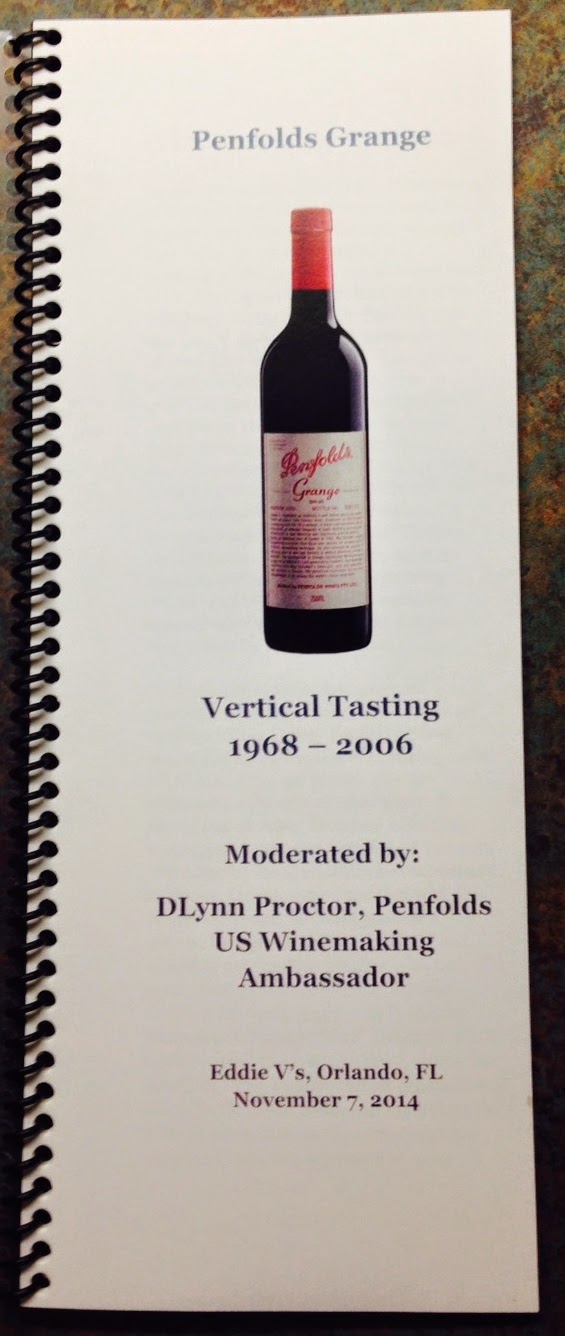
Described by Hugh Johnson as the "only first growth of the southern hemisphere" and by Robert Parker as "the world's most exotic and concentrated wine," Penfolds Grange is definitely the most famous wine coming out of Australia and a fixture in the cellars of serious wine collectors around the world. These considerations, plus our love of the wine, caused Ron to propose a vertical tasting to our group. We agreed immediately and Ron set about making plans for the tasting. The wines would be sourced from his cellar and participants would re-imburse him for the cost. I invited Dlynn Proctor, Penfolds US Winemaking Ambassador, and one of the stars of the movie SOMM (and a valued friend), to guide us through the tasting; and he agreed. The tasting was held last Friday night and I recount it in this post.


Photo courtesy DLynn Proctor, Penfolds

Penfolds Background

No one was as important to the development of Penfolds Hermitage Grange (Penfolds Grange since 1990) than the then winemaker Max Schubert but the founding and nurturing of the company can be traced back to Dr. Christopher Rawson Penfold and his wife Mary. Dr. Penfold, who was firm in his belief in the medicinal value of wine, planted some French vine cuttings around his home in Magill, Adelaide -- called the Grange -- upon his emigration to Australia in 1844. He produced port and sherry from the resulting grapes for dispensation to his patients. Upon his death, Mary took over the running of the winery and, in this task, she was ably assisted by her son-in-law, Thomas Hyland. Thomas and Georgina, Mary's daughter, assumed management responsibility when Mary retired in 1884 and the family members retained control until 1976. The company is now owned by Treasury Estates.

Penfold's wine production consisted primarily of fortified wines and brandy up until the 1950s. Jeffrey Penfold Hyland, reacting to his perception of changing tastes, asked Max Schubert to look into the increased production of table wines. As a part of that mandate, Schubert visited the wine-growing areas of Europe and was very impressed by the aged wines he encountered in France. He was convinced that, with the proper technique, he could produce a quality, long-lived wine in Australia and sought to put that into practice with the production of an experimental vintage -- utilizing the Syrah grape -- of Penfold's Hermitage Grange in 1951. The early wines were not well received. So much so that the board, in 1957, forbade further production of the wine. Schubert continued to produce the wine in secret and, as the earlier vintages stabilized, they began to receive more favorable consideration. These favorable comments trickled back to the board and, in 1960, they authorized Schubert to resume production of the wine. Of course, he had never stopped and, thanks to his “cheekiness," there has been an unbroken string of Penfold's Grange produced since the experimental vintage in 1951.

From the beginning Penfold's has pursued a multi-vineyard, multi-district grape-sourcing strategy bolstered by a "house style" of complete, controlled fermentation followed by aging in new American oak barrels. The grapes for the wine are sourced from vineyards in the Barossa Valley, McLaren Vale, and Magill, all regions falling within the Adelaide "super zone."

The Tasting

We gathered at Eddie V's on Sand Lake Road in Orlando at 6:00 pm as scheduled but Ron and DLynn had beaten us there and had hatched out a tasting strategy. We already knew that the tasting would be conducted in four flights but they had made a determination as to which flight would lead off and the order in which the others would follow. We prepped for the heavy lifting by drinking two wonderful bottles of Champagne: a Krug 1990 and a Pommery 1999 in mag.


A Dlynn sandwich

Tasting team
Ron made an opening statement and then introduced DLynn. DLynn was brilliant all evening, a veritable fount of information on Penfolds as a company, the wines, the winemakers, the vintages. The guy is a walking Penfolds Grange encyclopedia. He began by asking the rhetorical question "What is Grange?" "It is technically Bordelaise," he said. Max Schubert, the first wiinemaker, went to Bordeaux twice and fell in love with the Bordeaux wines he tasted. In those early days Bordeaux wines did include some Syrah and some of the best wines he tasted on those trips were Cabernet-Syrah blends. He wanted to make that type of wine but the Cabernet Sauvignon available in Australia at that time was not very good. Schubert wanted to make a wine that would age for 50 years -- a la the great Bordeauxs -- and, in his view, that made the vineyard pre-eminent. It was not until 1964 that Cabernet Sauvignon -- a kiss, according to DLynn -- was introduced into Penfolds Grange.

1980s Flight

The first flight was the wines from the decade of the 1980s: 1980, 1982, 1986, and 1989.


We tasted from oldest to youngest in each flight so the Grange 1980 was the first one up. DLynn said that this had been a cooler vintage (by Australian standards). The wine exhibited aromas of coconut oil, violets, earth, game, and mint. Balanced, with the acidity and 12.9% alcohol fitting perfectly into the matrix of the wine. Long, balanced finish with rich, oily aftertaste. Rhonesque.

The 1982 Grange Hermitage was a blend of Shiraz and 6% Cabernet Sauvignon (DLynn). This had riper fruit than the 1980 and showed jammy, stewed fruit, prunes, coconut, anise, cedar, mint, tobacco, and leather. On the palate it was ripe fruit, richness, concentration, a saline character, and an earthiness. Long finish with a saline aftertaste. This was more of a New World wine than was the 1980.

The Penfolds Grange Hermitage 1986 was the last vintage for winemaker Don Ditter (who had taken Chief Winemaker responsibility from Max Schumer in 1976). The wine was 13% Cabernet Sauvignon and had aromas of spice, dill, bay leaf, thyme, phenolics, and a slight green note. Savory. Great balance. Slight dill flavor on the palate. Integrated tannins and a long finish.

The 1989 vintage was made by John Duvall (winemaker from 1986 to 2001) and was markedly different from any of the wines tasted to date. The vintage had been peculiar in that it was wet and cool early then hot for the remainder of the growing season. This wine was 9% Cabernet Sauvignon. Ripe fruit, molasses, savoriness, beef broth, blackpepper and blue fruit on the nose. Dark fruit and molasses on the palate. Rich.

The wine of the flight, as voted by the team, was the 1980 vintage.

2000s Flight

The wines included in this flight were from the 2001, 2004, and 2006 vintages.


The 2001 Grange was the final Duvall vintage. According to DLynn, this was one of the hottest Grange vintages ever. He spouted statistics of 14.02% abv, pH of 3.52, and TA of 6.89. The wine smelled porty, alcoholic, oily. It was ripe and fat, with the most obvious tannins to date. Alcohol present. Broad-guaged, alcoholic finish. Acid-averse.

The 2004 vintage experienced an even, moderate growing season which resulted in (according to DLynn) a complete wine. 4% Cabernet Sauvignon. On nose coconut, dill, savoryness, richness. Round and rich on the palate. Excellent texture. Long finish.

The 2006 was a conundrum. DLynn described it as old world and new world in the same vintage. Rain late in the growing season had fattened up the clusters. I got porty, overripe fruit on the nose along with dill, wax, creme brulee, coconut, and a savoryness. On the palate not a full, round mouthfeel. Drying/green tannins. Stewed fruits, short finish, and a "pale", drying aftertaste.

The 2004 vintage was voted wine of the flight.

1990s Flight

This flight included wines from 1990, 1994, and 1998.


The 1990 Grange showed toffee, praline, pencil lead, blackpepper, and ripe black fruit on the nose. Rich, ripe fruit on the palate. Concentrated, with a long finish. Very Graves.

1994 was a cool vintage and that is reflected in the pyrazine, bell pepper, black-eyed peas notes on the nose. Plum. Sandalwood. Rich.

The 1998 had ripe fruit, baking spices and pepper on the nose. Salinity and richness on the palate. Super concentrated. Late-arriving tannins. Sappiness. Long, creamy finish. DLynn felt that even at 14.23 % abv, this wine was technically balanced.

The team selecetd the 1990 as the wine of the flight.

1960s/70s Flight

This flight consisted of wines from 1968, 1971, 1976, and 1978.


The 1968 presented aromas of espresso, vanilla, mocha, cocoa, leather, blackpepper, gunoil, coconut. A sweet La Mish on the palate. Mushroom, savory, complex. I called it a 1985 Heitz Martha's Vineyard. Steve called it an '85 BV Georges de la Tour. I loved it. We all did, as a matter of fact.

The 1971 was oxidized.

The 1976 was 11% Cabernet Sauvignon and exhibited herbs, fennel, gunflint, chocolate, and coffee on the nose. Someone yelled "Haut-Brion." It was very Bordeaux-like and we got into a heated discussion when trying to determine the wine of the flight because it came down to this Bordeaux style versus what I will call the "When-Napa-was-Napa" style exhibited in the 1968.

I did not capture any notes for the 1978. Steve described it as expressing coffee, fig newtons, chocolate-covered caramels, and sawdust.

At the culmination of a warm debate (and a number of ballots, with some changed votes), the 1976 was chosen as the wine of the flight by one vote. The wines of this flight were clearly the class of the bunch (given the type of wines that are drunk on a regular basis by the people in the room) and the winner of this flight automatically was the wine of the night.

As Steve noted, somewhere in the mid-80s, Grange shifted to a bigger, bolder style, reminescent (or a harbinger) of the California path. The wines are wonderful, great-tasting, and gain complexity with age. I doubt whether the more modern wines will gain the type of complexity and class we saw demonstrated in the wines of the 1960s and 1970s.

But that was only the tasting. We still had dinner to do. But I will not bore you with the details. The wines we drank at dinner are displayed below.


Photo courtesy DLynn Proctor
Remnants of the battle. Photo courtesy Steve Alcorn


©Wine -- Mise en abyme