Showing posts with label Piemonte dry white wines. Show all posts

Friday, October 9, 2020

The distribution of dry white wines in Piemonte

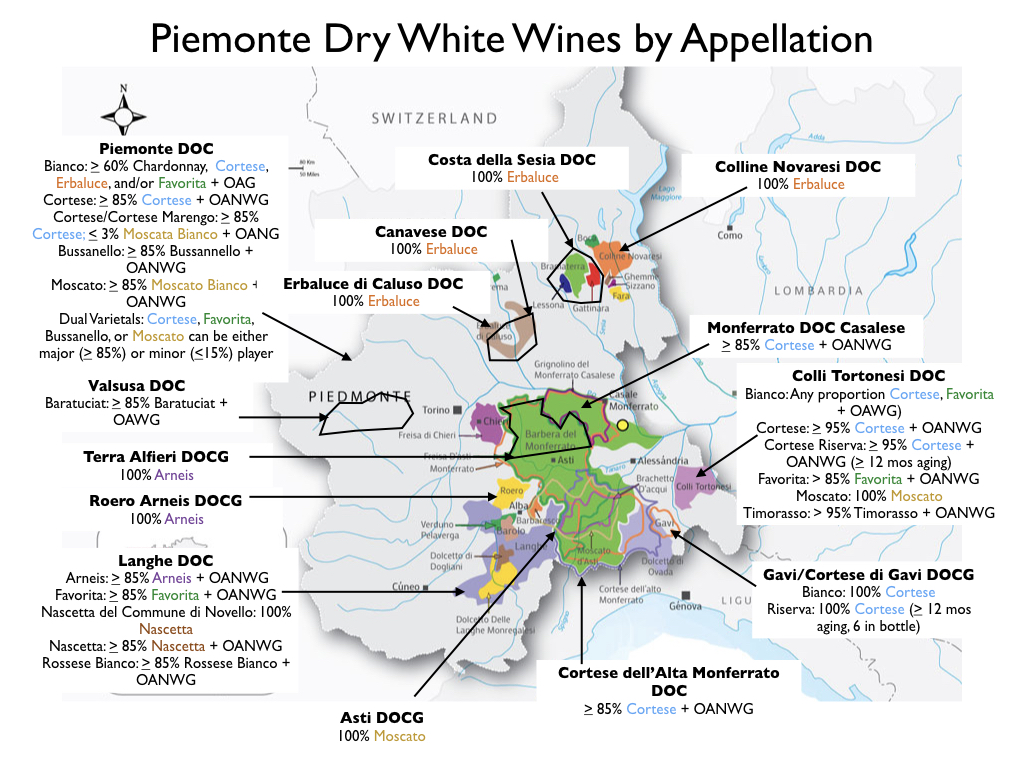
Piemonte is best known for its red wines -- primarily in the southern part of the region but also with  strong representation in the north -- based on Nebbiolo but it is also the source of vibrant indigenous white wines; wines that I have captured in the chart below and describe in the links below the chart. Erbaluce-based wines dominate in the morainic soils of the north while Cortese-based wines hold sway in the limestone soils of the south. The wine to watch, in my estimation, is the Timorasso.


Arneis


Cortese

Erbaluce


©Wine -- Mise en abyme

Wednesday, October 7, 2020

Piemonte dry white wines: Langhe Rossese Bianco

In the land of obscure Piemonte white varieties, Rossese Bianco is downright vanishing. And its obscurity is further compounded by the fact that a number of other Italian varieties carry the same, or similar, names. DNA analysis shows that Rossese Bianco is neither the same or related to any of the varieties listed below:
  • Rossese di Dolceacqua (Liguria; synonym for the Provence variety Tibouren)
  • Grillo (Le Spieza, Liguria)
  • Ruzzesa (Le Spieza, Liguria)
  • Pigato
  • Rossese Bianco de San Biagio (Savona, Liguria)
  • Rossese di Campochiesa (Savona, Liguria; red variety).
The foregoing notwithstanding, it is commonly held that Rossese Bianco made its way from Liguria into Piemonte in the 19th century. It was widely planted in Alba, Sinio, and Roddino in Cuneo Province but largely disappeared from the region. It was saved from extinction in the mid-1970s when the Manzone family re-discovered it on an old family vineyard in Monforte d'Alba. Since 1982 Manzone Giovanni has produced a white wine from the grape and, after many years of research and consultation with the University of Turin, a new DOC -- Langhe Rossese Bianco -- was formalized.


Rossese Bianco, according to the literature, "owes its name to an intense amber or even pinky shade on the fully ripe grape ..." The characteristics of the variety are as follows:
  • Berries -- Small; spheroid; thick, very waxy, greenish-yellow skin with light-gray accents
  • Bunches -- Medium-large size; medium compact; wide; conical; well-developed
  • Vine -- Poor vigor and average productivity.
Today there are a total of five Langhe producers farming 2 ha of Rossese grapes. The grapes are generally fermented in stainless steel tanks except for one case where there is a mix of barrel and stainless steel vinification. The wine is generally aged for 1 year on the lees with batonnage. One producer ages in barrique, another in steel tanks, and a third in a mix of wood and stainless steel.

According to one source, Rossese "... will remind you of Vermentino but with more flesh and delicate fruit aromas and flavors (ripe citrus, nectarine) and stronger herbal nuance." A second source describes the wine as having "good alcohol" and being "fresh and lively with typical fruity notes ... full-bodied with lively acidity and good persistence on the palate."


©Wine -- Mise en abyme

Wednesday, September 30, 2020

Baratuciat: Another emergent Piemonte white cultivar and wine

Writing in Forbes, Tom Hyland estimated that, at time of publication, approximately 300 indigenous Italian grape varieties were employed in wine production in a country blessed with between 2000 and 3000 native grapes. And a number of these varieties fall into the category of "recently discovered;" as is the case of the Piemontese white cultivar Baratuciat.

Modification of  FederDoc map

According to the literature, Baratuciat, at that time a table grape, was first mentioned in 1877 in the Ampelographic Bulletin. It was not considered as a wine grape due to its vigor and the resultant difficulty in ripening bunches. Approximately 20 ha was under vine but the grape fell into oblivion with the onset of Phylloxera in 1928 and the later industrialization of the area around Turin.

The ancestral home of Baratuciat is Val di Susa, an east-west valley -- between the Graian Alps to the north and the Cottian Alps to the south -- which extends for 50 miles from the French border to the Turin outskirts. And it was in that ancestral home that the rebirth of the variety was launched.

A grape grower by the name of Giorgio Falca took over the care of his grandfather's hundred-year-old vines in Almese -- a municipality in the portion of the valley closest to Turin -- during the 1960s. He was pleased with the wine resulting from the grapes and began working with officials to determine the identity of the cultivar and its feasibility as a wine grape.

Three micro-vineyards were planted in the Rivera area at the end of the 1990s and the enological potential of the variety was tested for over 10 years. 

The first farmer to plant Baratuciat commercially was Guiliano Bosio who, in 2007, deployed 3500 square meters of vines on the hill of Almese in the hamlet of Magnetto. To date he has production capacity of 4000 bottles and his Gesa Veja label has earned Silver Medals at the Decanter World Wine Awards in 2017 and 2018. 

In 2016 the variety was added to the DOC Valsusa and in 2018 it was registered in the National Catalogue of Grape Varieties. There are currently a dozen producers farming 3 ha of this cultivar in Valsusa DOC.

Baratuciat cultivar

Baratuciat growing on a pergola in Valsusa DOC


The winemaking process for this cultivar generally begins with a 12-hour cold soak followed by pressing and fermentation with selected yeasts in stainless steel tanks. The wines are aged for 4 to 5 months in steel, and an additional month in bottle, before being released commercially.

According to fondazioneslowfood.com:
The wine is straw yellow with greenish notes. The aroma is intense with green apple, pineapple and grassy notes and eucalyptus and acacia honey aromas. It is complex in the mouth, with a long tangy finish, accompanied by a firm acidity. It can age more than 4 years.
Some Baratuciat is currently produced in Monferrato, introduced by Enrico Drueto who, in 2008, concluded an agreement with Falca to experiment with various rootstocks with the understanding that half of the cuttings produced would be returned for new vineyards in Almese. According to the literature, the climatic diversity and calcareous soil of Monferrato combined to produce a distinct wine from the one produced in the Susa Valley. The Monferrato wine was less fresh, more full-bodied, and had more structure.


©Wine -- Mise en abyme

Friday, September 25, 2020

Piemonte dry white wines: Cortese

One of the unifying themes in the Piemontese white wines that I have explored on this journey is the freshness of the wines, a result of the high levels of natural acidity in the source cultivars. You can add the Cortese variety to this list. 

The cultivar makes its first appearance in the literature in 1659. It is a highly productive, thin-skinned grape that is grown mainly in the provinces of Asti (35 municipalities) and Alessandria (51 municipalities). It is noted for delivering bone-dry wines that are crisp and flinty with floral and peach aromatics. It is sensitive to powdery mildew.

The chart below shows the Cortese wines approved for production in the Piemonte region.
 

The chart does show that, except for the Piemonte and Colli Tortonesi regions, the wines are confined to Monferrato. With the exception of Gavi DOCG (100% Cortese) and the Colli Tortonesi Bianco (any proportion in blends with other white varieties), all of the sub-Piemonte regions prescribe a minimum of 85% Cortese in their wines.

The regions within which Cortese is produced are discussed below. It is generally held that the best of the wines are produced in Gavi because the grape is properly ripened therein. Not so much in the other regions as they have a harder time getting the grapes fully ripe, leading to heightened acidity.

Gavi/Cortese di Gavi DOCG
Gavi (also called Cortese di Gavi) is a Piemonte region dedicated to the production of wines from the (white) Cortese grape. According to enricosrafino.it, "The Gavi area, the southern part of Alto Monferrato, rises from the banks of the Tanaro River into the mountains of the Apennines and the water divide between Piedmont and Liguria."

Gavi DOCG indicated by red circle to the bottom-
right of the Piemonte map

The region spools out over the hills of 11 communes in the province of Alessandria. It gained DOC status in 1974 and was promoted to DOCG in 1998. The allowed wines in the appellation are a Bianco, Bianco Riserva, Spumante, and a Spumante Metodo Classico, all made from 100% Cortese.

The Gavi climate is characterized by cold winters and hot, airy summers. Again from enricoserafino.it: "The combination of the Ligurian sea breeze and the Apennine snow make this particular corner of Piedmont so special." In addition to the Apennines, the region is also influenced by the presence of the Alps. Significant day-night temperature variation allows flavor concentration while preserving crisp acidity in the wines.

The mineral-rich soils of the region are purported to contribute to the flavors of the Gavi wine. The complexity of the soilscape is displayed in the chart below.

To summarize the chart, the northern part of the region is dominated by red ferrous soils and gravel mixed with clay from ancient alluvial activity while the central area alternates between soils of marl and sandstone. The south has fossil-rich white soils composed of clay-calcareous marls.

Serafino.it credits the region's climate and the soils on the hillside vineyards as being responsible for the complexity of the wines. "Highly reputed for its 'white soils' is the area of Gavi Village, very well known for clear-cut character, amazing freshness, as well as complex wines that here become the Gavi del comune di Gavi DOCG."

I tasted two Gavi wines as a part of this exercise: a 2018 Marchesi di Barolo and a 2018 La Scolca Gavi dei Gavi.


The Marchesi di Barolo showed parsley on the nose, along with a red pepper spice and expansive minerality. Broad on the palate, with citrus (young lime) and minerality preceding a long spicy finish.

The La Scolca was intense on the nose, with green herbs, lemon and muted honeydew melon. Intense acidity on the palate with a sourdrop character yielding to a cupric mineral finish. Much more acidity than the Marchesi di Barolo wine. This wine screams out for food. Both wines were of excellent quality but the Marchesi is a more all-purpose wine in that it can be drunk on its own while the La Scolca needs a friend.

Monferrato DOC Casalese Subzone
Monferrato DOC encompasses 689 ha of vineyards spread over 229 municipalities (116 in Asti and 113 in Alessandria). Monferrato is a set of recently formed hills with the oldest in the upper and lower regions and comprised of crenaceous and calcareous marls and fossil shells from the Miocene. The area around the Tanaro River is the most recent and is primarily Pliocene Astian sands of sedimentary origin.

The Casalese subzone covers vineyards in 39 municipalities in the Province of Alessandria. It is the same area as for the Grignolino del Monforte Casalese DOC.

Cortese dell'Alta Monferrato DOC
This 200-ha zone received its DOC status in 1979 and is allowed to produce Cortese wines with grapes grown in 51 municipalities in Alessandria and 35 in Asti. It is the largest of the areas planted to Cortese.

Cortese dell'Alta Monferrato

The disciplinaire requirement calls for vineyards on hills and with suitable position and orientation on clayey-calcareous soils. The vines prefer these hilly soils, poor in organic and mineral substances and arid in the summer due to poor water retention.

Allowed yields in this area are 10 tons/ha.

Colli Tortonese DOC
This 191-ha zone encompasses 30 municipalities and, before the onslaught of Timorasso, Cortese dominated its hills.


According to italianwine.guide, the Cortese wines produced herein are light and straw-colored, with green reflections. "The bouquet is extremely delicate, pleasant, persistent and characteristic. The taste is dry, light and with a hint of almond. 


©Wine -- Mise en abyme
Saturday, August 8, 2020

Piemonte dry white wines: The instances of Favorita and the Malvirà example

My recent experiences with Piemonte dry whites have piqued my curiosity to the extent that I will be exploring the category in greater detail. I explore Favorita-based wines in this post.

Favorita has been shown to be the exact same variety as Vermentino, which is, itself, primarily grown in Sardegna (68%) and Tuscany (14%). Fully 80% of known Favorita plantings are found in Piemonte. The main characteristics of the variety are shown in the chart below.

Favorita wines are made in Piemonte according to the requirements shown in the following chart.

It should be noted that, in addition to Favorita, Colli Tortonesi DOC hosts high-quality white wines from the Timorassa and Cortese varieties.

I secured a bottle of the 2015 Langhe Favorita from Malvirà in order to evaluate this instance of Piemontese white.


Malvirà, located in Canale in Roero, was established in the 1950s by Giuseppe Damante. He subsequently passed the business over to his sons Roberto and Massimo in 1974. The sons transformed the business from a primarily bulk-wine supplier to one focused on quality. Today they plant 42 ha across six cru vineyards. The vineyards are farmed organically with all of the wines being sourced from estate fruit.

The Malvirà Favorita is sourced from three Canale vineyards: Saglieto (south to southeast exposure at 200 m elevation), Trinita (southwest exposure), and Bossola. The soils in these vineyards are calcareous clay and sand and the vines are between 30 and 40 years of age. Yields are at 50 hl/ha.

The wine is made from 100% Favorita grapes. The grapes are fermented in stainless steel tanks for 7 10 days and then aged in tanks for 4 - 8 months.

Floral, initially, with green herbs accompanying rich, intense fruit notes and spice. Full, round fruit intensity on the palate. Bright. Ripe lime with a slate minerality that gives way to a chalky minerality. Persistence of acidity through all phases. Excites the salivary glands in a low-key fashion. Loooong finish.

After a respite, I went back to the wine. I was now getting sweet white fruit, limestone minerality, salinity, and red pepper. On the palate, sweet fruit along with acidity and salinity. Great weight and lengthy finish. 

This wine continues the string of excitement on which I have been tugging in this exploration of Piemonte dry whites. I loved it. 

In terms of pairings, the literature sees this class of wine as perfect as an aperitif or as an accompaniment to fish, a typical Piemonte starter, or Risotto. I can't wait to try examples from the other identified regions.

©Wine -- Mise en abyme