In the Regenerative Organic Alliance's
Regenerative Organic Certification, soil health and carbon sequestration are key activities in the Soil Health and Land Mangement component of the architecture. And, reducing the amount of carbon that is released from the soil -- plus storing additional carbon in said soil -- are key to both improved soil health and the battle against climate change.
I have previously detailed a number of strategies and tactics for the retention/increase of soil carbon levels. In this post I will examine Biochar as an additional and unique method of increasing soil carbon levels.
Biochar -- What Is
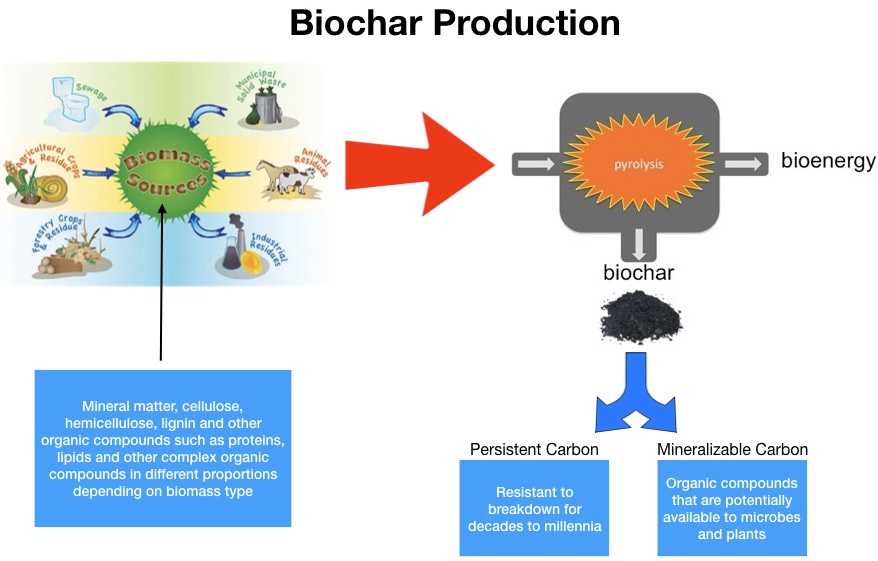
Biochar is a charcoal-like substance resulting from burning organic and forestry waste at high temperature (450 - 750 degrees C) in an oxygen-free environment -- a process called pyrolysis. During pyrolysis, the organic material is converted into biochar -- a stable form of carbon that cannot easily escape into the atmosphere -- biofuels (such as bio-oil and synthetic gas), and residual heat (Spears, Six, Chukwuka,
et al.). The process is illustrated in the figure below.
The initial phase of the process typically requires more energy than it produces. "In the end, however, pyrolysis is 'exothermic,' meaning that it produces more heat than is required to originate the 10% of the final energy produced making it a rather efficient process particularly in light that it is capturing available carbon at the same time." (Gaunt).
According to Dr. Gaunt,
Biochar has been labeled a "carbon negative" energy source because it has the possibility of sequestering more carbon than is produced. The chief benefit of biochar .. is the wide variety of feedstocks that it can be made from. Further, it can also produce a variety of energy outputs ... and, of course, biochar... Another flexibility that biochar has is that it can be produced at a wide range of scales from a simple cookstove to mobile farm pyrolizers and all the way up to large-scale "biorefineries."
Biochar History
The soil scientist Wim Sombroek discovered "Terra Preta de Indio" (Black Earth of the Indians) in Amazonia 60 years ago. He postulated that the indigenous peoples had created and maintained these darker soils between 500 and 8000 years ago by continually depositing cooking-derived charcoal, along with charcoal and/or fresh biomass from agricultural waste and forest clearing (Six). The buildup of charcoal biomass overtime acted on the soil in a number of ways: (i) it became very dark in color; (ii) its organic content was extremely high, as was the content of its carbon and nutrients (such as nitrogen, phosphorous, potassium, and calcium); and (iii) it became extremely fertile, in comparison to adjacent, highly weathered soils.
These Terra Preta soils continue to hold high levels of carbon to the present time (Spears). These findings suggested that the application of biochar to soils could enhance its agronomic potential (Cirò).
Physical Characteristics
Increased soil carbon results in the soil retaining more water, resulting in better crop yields during droughts, a reduction in soil erosion, increased plant nutrient retention, and increased biological diversity. Higher soil carbon levels also hold soil particles together so that less erosion occurs. Most soil organic carbon manifests as decompositional material and exudates.
The physical characteristics of biochar are summarized in the rightmost structure in the figure below.
Biochar Applications
As is the case for other initiatives focused on increasing the carbon content in the soils, biochar is seen as having potential in the areas of climate mitigation and soil health. The chart immediately following illustrates how biochar's elemental composition can be a driving force in its role as a climate-effects mitigator.
The figure below shows the porous structure of a biochar nodule. This structure is key to a number of the agronomic biochar benefits (elaborated in the table following the below image).
 |
| Image of porous structure of biochar (Source: researchgate.net) |
Six and Rieger advance cautionary notes as it relates to biochar adoption. According to Six, the technology is:
- High cost
- Not widely available
- Variable due to different sources and types of feedstock and processing
- In need of more info and studies on its performance and benefits.
Rieger's objections are as follows:
- In some cases yields may decline because of the sorption of water and nutrients by the biochar
- Reduces the availability of these resources for the crop
- Has also been shown to inhibit germination
- The sorption of pesticides and herbicides by the biochar can reduce their efficiency
- Some biochar can act as a source of contaminants:
- Heavy metals
- Volatile organic compounds
- Polycyclic aromatic hydrocarbons
- Dissolved organic carbon
- The reduction in nitrous oxide emissions is not universal and emissions even increase sometimes
- The fine ash associated with biochar is the perfect source for dust, posing a risk for respiratory diseases
- Long-term removal of crop residues -- like stems, leaves, and seed pods -- for use in the production of biochar can reduce overall soil health by diminishing the number of soil organisms and disrupting internal nutrient cycling
- The increase in cation exchange capacity depends on the composition of the soil
- It is minimal in soils with high clay or organic matter content, especially at realistic rates of biochar addition
- In light pH soils, an increase in soil pH is not desirable
Biochar-Compost Mix
In a study done for the European Project FERTPLUS, the study team investigated the use of biochar only, compost only, and a biochar-compost mix to "evaluate their potential for closing the cycle of nutrients in different agro-climatic regions across Europe" (Sanchez-Monedero,
et al.).
The rationale/hypotheses behind the compost-biochar mix were as follows:
- Composting is a microbial process that requires favorable growing conditions for the micro-organisms involved
- The addition of biochar to a composting pile theoretically can modify key physiochemical parameters and provide a more suitable habitat for the micro-organisms involved and promote microbial growth
- The changes experienced by the biochar surface during composting also would have benefits in terms of nutrient retention.
Both the biochar-only and compost-only threads returned similar results (improved tilth, increased water-holding capacity, etc.). Unlike biochar, however, compost is quickly broken down by microbial action in soil over months to, at most, decades, depending on the climate. Biochar, on the other hand, lasted at least 10 times longer in most soils.
The study showed important biochar synergistic effects when it was added to compost (Sanchez-Monedero,
et al.):
- The compost is more nutrient-rich, more biologically diverse, more humidified, and more stable
- The biochar keeps the compost moist and aerated, promoting increased biological activity
- Nitrogen retention is increased
- Compost maturity and humic content is improved
- Plant growth was improved.
Biochar Viticulture Applications
I examined two separate biochar viticultural studies, one conducted by the Biochar Lab Group of the Institute of Biometeorology of Florence and the other reported on in Wine Business Monthly of April 2016. The former was carried out at an Antinori vineyard in Montepulciano beginning in 2009. The latter covered an olive grove in Spain, three vineyards in Italy, arable crop rotation in Belgium, and a greenhouse-grown tomato crop in Spain.
The Antinori Merlot vineyard was amended with 22 t/ha of biochar in 2009, and again in 2010, and showed the following results:
- Grape production up 68% in the plot treated with biochar when compared to an untreated plot
- An increase in plant-soil water retention
- Long term effect on soil quality
- Carbon sequestration
- Improvement in soil chemical and biological parameters.
The result reported herein has led, according to the authors, to other Tuscan estates adopting the approach.
The findings from the Wine Business studies were as follows (Rieger):
- Results confirmed the potential of biochar to improve soil physical properties and to achieve a long-lasting increase of soil health in all listed agro-climatic regions
- No negative effects on soil quality or crop yield in pure biochar applications
- Biochar did not show any detrimental effects on crop performance.
***********************************************************************************************************
Biochar is attractive on a number of different levels: It has the potential to aid in the municipal waste disposal overhang; the products of pyrolysis both contribute to climate mitigation efforts; and removing unstable carbon from the environment and sequestering it in a way that also contributes to soil health is fairly attractive.
I have pointed out a number of issues associated with the technology but these are problems to be solved rather than being kill-shots. I expect to see biochar soil amendments in vineyards as we move forward into the future.
Bibliography
Chukwuka,
et al., Biochar: A Vital Source for Sustainable Agriculture, Intech Open, 2020.
Pimentel and Burgess, Maintaining sustainable and environmentally friendly fresh produce production in the context of climate change, Global Safety of Fresh Produce, 2014.
Giulia Cimò, Characterization of Chemical and Physical Properties of Biochar for Energy Purposes and Environmental Restoration, PhD Thesis, 2013.
Dr. John Gaunt, Low-Temperature slow pyrolysis offers an energetically efficient strategy for bioenergy production, biocharfarms.org.
S. Joseph,
et al., The Properties of Fresh and Aged Biochar, Biochar International.
Jeff Rieger, Vineyards Experiment with Biochar as Soil Amendment, April 2016, Wine Business Monthly.
Sanchez-Monedero,
et al., Agronomic Evaluation of Biochar, Compost and Biochar Blended Compost across Different Cropping Systems: Perspective for the European Project FERTPLUS.
Johan Six, Biochar: is there a dark side? ETH Zurich, 1/4/14.
Stephanie Spears, What is Biochar? Agriculture, 5/16/18.
©Wine --
Mise en abyme