Showing posts with label Chianti Classico. Show all posts

Monday, May 20, 2024

Giacomo Tachis and the foundations of Super Tuscandom

He is said to have dragged Italian wine "kicking and screaming" into the 20th century by changing the style and the way the wines were perceived. According to Piero Antinori, he was "instrumental in the evolution, not only of Tuscan wines, but Italian wines." These words of praise from lofty wine perches were aimed at none other than Giacomo Tachis who drinksbusiness.com has referred to as "the father of Italian wine."

As shown in the timeline below, Giacomo was born on November 4, 1933 in the vicinity of Turin. 


He graduated from the Alba School of Oenology in 1954 and took jobs first at a Sparkling Wine House and then a large distiller prior to being hired into the Antinori fold as a Junior Oenologist by Niccolò Antinori. Within a short space of time was promoted to Technical Director with responsibility for (i) expanding the winery's output and (ii) developing products that would meet the expectations of the world market. This was a tall order because wines from the region were not well regarded at that time. Wines were of poor quality due to :
  • High-yielding Sangiovese clones
  • Low-density planting
  • Poor site selection
  • Unhygienic cellar practices
  • Old, dirty barrels.
Quality was further affected by an increase in the white grape contribution to the blend. Chianti Classico had historically been a blend of Sangiovese and Canaiola plus 5% of the Malvasia grape. In 1967 the formula was adjusted to allow up to 30% of the blend to be Malvasia and Trebbiano. This led to thin, watery wines lacking in structure and ageability.

Giacomo was a great admirer of the French Oenologist Emile Peynaud and had been working with him to understand his processes and to determine which elements could be implemented in Tuscany to resolve the wine quality issues. Peynaud had garnered fame due to his very successful efforts in cleaning up the Bordelaise wines. His practices included:
  • Harvesting fully ripe grapes
  • Accepting low acid levels in grapes and wine 
  • Controlled temperatures in the cellar, especially during fermentation
  • Understanding and controlling malolactic fermentation
  • Aging wine in clean oak barrels.
The plan was to use Peynaud's methods to clean up the Antinori wines but, before landing that plane, Giacomo was asked to assist Piero's uncle, Marchese Mario Incisa delle Rochetta, in taming the Cabernet Sauvignon wines from his Bolgheri estate. The Marchese had planted his Tenuta San Guido estate in Bolgheri in 1948 with cuttings sourced from the Bordeaux vineyard of Chateau Lafitte-Rothschild. The grapes had been faithfully fermented but the resulting wines were rather rustic. Incisa delle Rochertta reached out to Piero to have Antinori distribute the wines and he agreed to do so if Giacomo were named chief winemaker on the project. All parties were on board and the rest is history.

Tachis blended the 1966, 1967, and 1968 vintages and released 6000 bottles as Sassicaia 1968. That wine was an immediate and smashing success. Further, he added the 1970 crop to the blend for the 1970 vintage. That was also a success and the label has never looked back.

With the Sasicaia success under his belt, Tachis turned his full attention to the core project, fruit from the Tignanello vineyard. In 1970 Antinori released a Chianti Classico with the smallest percentage (5) of white wine allowed. This wine was called Chianti Classico Riserva Vigneto Tignanello. The initial Tignanello release occurred in 1971 and featured Sangiovese plus small percentages of other local varieties and aging in oak barriques.

The second vintage of Tignanello was released in 1975 and included the following modifications:
  • All white grapes eliminated from the blend
  • 20% Cabernet Sauvignon and 5% Cabernet Franc added to the Sangiovese backbone
  • Pumpovers employed to facilitate tannin extraction
  • Malolactic fermentation induced
  • Wines aged in new French oak barriques.
The Peynaud influence was on full display in this vintage.

In 1978 Antinori released a Cab-based blend using grapes sourced from Solaia, Tignanello's sister vineyard. In this wine the Sangiovese and Cabernet Sauvignon percentages from Tignanello were switched. By this time Tachis had become so famous that his name on a project almost guaranteed commercial success.

Tachis retired from Antinori in 1993 -- a run of 32 years -- but continued to consult with the company on its Super Tuscans as well as with other companies on their initiatives.The below chart curates the labels with which Tachis has been associated during the course of his career.


Giacomo Tachis died in 2016.

©Wine -- Mise en abyme

Monday, October 2, 2023

Revisiting the Chianti Classico UGAs

I have previously treated the Chianti Classico zonation initiative, based largely on reporting from Decanter. I revist and expand on that effort based on recent work on the topic by John Szabo MS in his vehicle, Wine Align.

According to John Szabo, the Chianti Classico zonation effort is a continuation of the quality pursuit launched by the Consorzio when it introduced Gran Selezione as a quality level above Riserva. The purpose of that initiative was twofold:
  1. Distinguish some of the highest quality wines from the denomination
  2. Claim a secure spot in the luxury-wine tier.
That effort can only be viewed as a success:
  •  154 wineries now make at least one Gran Selezione wine
  • That class accounts for 5% of the region's production but 13% of its revenue, a clear testament to market acceptance of the value proposition
The zonation process is illustrated below. 


Chianti Classico declined to pursue UGAs based on soils and topography because of the geologic complexity of the area. As shown in the chart below, the region possesses a diversity of soils: marl (San Casciano Val di Pesa); calcareous clay (Greve and all zones at lower altitudes); sandstone (backbone of Chianti Mountains); limestone (central and southern portions of the district); and tufa (around Castelnuevo Berardenga). When limestone and sandstone are found in alternating layers, that soil is called Galestro. Clay-limestone mixes are called Alberese. According to Berry Bros & Rudd, "The sandy alluvial soils of the lower sites yield fuller, meatier wines while the limestone and galestro soils of the higher vineyards deliver finer, more ethereal examples" (bbr.com).


"The UGA areas are thus not mapped out exclusively according to geology or elevation or microclimate, even if these elements are of course taken into consideration. But the real boundaries were drawn up along cultural and historical lines, refining areas of broadly shared historical heritage and winemaking philosophy." Eleven areas were specified with eight going into effect immediately and three slated to be implemented subsequently. The initial specification only includes the Gran Selezione category. 


The charts above contain much greater detail than previously reported on the geologic characteristics of the UGAs as well as the characteristics of the wines emanating therefrom.

As regards the UGA wines, a producer can place the name of the UGA on the label if the grapes are sourced exclusively from within the UGA. This requirement will be applied retroactively to include wines from the 2022 vintage.

Beginning with the 2027 vintage, UGA wines will be required to contain a minimum of 90% Sangiovese, with the remainder of the restricted to a limited number of native Italian red grape varieties. This latter requirement shuts out the international varieties Cabernet Sauvignon and Merlot.


©Wine -- Mise en abyme

Thursday, November 10, 2022

Contextualizing the newly minted Chianti Classico sub-zones

There has been a lengthy ongoing discussion among invested parties as to the need for sub-zones within the Chianti Classico DOCG. In June 2021, a specific sub-zone proposal was presented to the members of the Chianti Classico Consorzio and was approved by an overwhelming majority. I provide some context in this post.

Chianti Classico DOCG
Production Zone
The modern Chianti Classico production zone encompasses a series of hills -- elevation between 200 and 600 meters -- that are bordered by Siena to the south, the Florentine town of San Casciano Val di Pesa to the north, the hills of the Arno River Valley to the east, and the Elsa River Valley to the west. Originally referred to as Chianti, the area shaded in blue in the map below was recognized as a wine region since the 13th century but was legalized as such by a decree issued by Grand Duke Cosimi III de Medici in 1714. A Ministerial Decree issued in 1932 expanded the Chianti region to cover eight sub-zones, one of which was the original Chianti. The former Chianti was expanded to its current borders (shown in the map below) and given the name Chianti Classico in a bow to its historical origins. Chianti Classico was granted DOCG status in 1996.

Tuscany wine region map (ateliersetsaveurs.com)


Approximately 10,000 ha of vineyards are planted of which 7100 ha is classified DOCG. Vineyards have traditionally utilized the Guyot training system -- or a derivative known as the Tuscan bow -- but, more recently, spurred cordon is being implemented as it aids mechanization without sacrificing quality.

The DOCG production discipline requires a maximum yield/ha of 7500 kilograms, yield/vine of not more than 3 kg, and minimum planting density of 3350 vines/ha. Average planting density runs between 4500 and 6500 plants/ha.

The varieties planted in the region are shown in the table below.


To be designated DOCG, a wine must be made of a minimum 80% Sangiovese and up to a maximum of 20% of the following regionally produced varieties: Canaiolo, Colorino, Merlot, or Cabernet Sauvignon. A Chianti Classico D'annata cannot be sold until 1 year after the harvest and must be a minimum 12% abv. A Chianti Classico Riserva must spend 2 years in oak and a minimum 3 months in bottle. Alcohol levels must be 12.5% or greater.

After over two years of study, The Chianti Classico Consorzio announced the introduction of a new tier of wine positioned above the Riserva. This new tier is called Gran Selezione and is designed to communicate the quality of the wines resulting from replanting over 60% of the regions vines in the past 15 years. The wines must be: made from estate-grown grapes with yields not to exceed 52.5 hectoliters/ha; 80% Sangiovese; spend 30 months in oak; and spend three months in bottle. While some producers saw this as a positive step, potentially leading to single-vineyard offerings, others saw the possibility for creating greater confusion as the consumer wades through the thickets of Chianti, Chianti Classico, IGT, and the relevant tiers.

Climate
The Chianti Classico climate is continental, with long summers and cold winters. Various aspects of the climate are illustrated in the chart below.

Sources: Map - pinterest.com; information - Nesto and
di Savino, Chianti Classico

As shown on the chart, the combination of the Chianti and Pratomagno Mountains block morning sunlight from the region. In the southeast of the region, the upper Arno River valley opens up to the east and south, allowing in some morning sunlight.

According to Nesto and di Savino, climate change is forcing vineyards to migrate to higher elevations. Thirty years ago, according to the duo, vines planted above 350 m subjected their growers to ridicule; 350 m was considered prime real estate for Sangiovese. Today 500 m is desired. Alcohol levels are increasing such that in the warmer Chianti Classico areas, less sun is preferred, leading to a preference for north and northeast exposures in those zones.

As it relates to seasonal weather hazards, there is potential for bud damage from spring frosts and damaging summer hail resulting from warm humid winds rising from low to high elevations. 

Landscape and Soils
Coltorti, et al., provide insight into the population of rock types encountered in Siena Province (see chart directly below) while Bonini and Sani and Amato and Vallatto, respectively, provide soils distribution in Chianti Classico by percentage and by location.


As shown in the preceding charts, the region possesses a diversity of soils: marl (San Casciano Val di Pesa); calcareous clay (Greve and all zones at lower altitudes); sandstone (backbone of Chianti Mountains); limestone (central and southern portions of the district); and tufa (around Castelnuevo Berardenga). When limestone and sandstone are found in alternating layers, that soil is called Galestro. Clay-limestone mixes are called Albarese. According to Berry Bros & Rudd, "The sandy alluvial soils of the lower sites yield fuller, meatier wines while the limestone and galestro soils of the higher vineyards deliver finer, more ethereal examples" (bbr.com).

Calls for Chianti Classico Sub-Zones
Over the years a number of proponents have advanced arguments for dividing the broader Chianti Classico into sub-zones as a means of better defining the region’s wines. A subset of those voices — and their arguments — are presented in the following.

Walter Speller (Chianti Classico -- a call for subzoning, insidechianticlassico.com, 2/8/14) called for the Chianti Classico officials to take a cue from Côtes-du-Rhone Villages and divide Chianti Classico into sub-zones based on the main villages and allow producers to print the names of the villages on the labels. According to Walter, "this would provide the perfect structure to make the necessary, complex terroir research manageable" as it would be cut down into logical portions. This approach has historically been treated with disdain because, the argument goes:
  • Soil compositions are too complex and diverse
  • The hills offer too many expositions and altitudes to really corral them in such a simplistic system.
Roberto Stucchi (The Evolution of Chianti Classico, insidechianticlassico.com, 2/28/14) predicted zonation as a natural evolution. According to Roberto, the zone was "too large and diverse to be locked in the current DOCG regulations which make no distinction between the extremely diverse expressions of Sangiovese in its original territory. The evolution that he saw was first a commune-level zonation which would eventually be superseded by a village-level facility.

Michael Schmeizer (The map has arrived, now where do we go? insidechianticlassico.com, 10/15/14) spoke positively about a commune-level zonation allowing the region to sidestep the ever-present Chianti vs Chianti Classico conversation but was adamantly against restricting it by category (Gran Selezione, for example) "as this sends the signal to the market that a Chianti Classico normale cannot be special or unique, and robs the smaller producers of their advantage."

Unità Geografiche Agguniative (UGA): The Chianti Classico Sub-Zoning Solution
UGA, translated as Additional Geographic Units, has been regulated by wine laws since 2013 and defines a place of origin within a DOC/G which can be added to the name of the wine. A UGA can be an entire administrative area (a commune), a part of an administrative area, or a smaller locality within the commune (Frazione). Soave DOCG has 33 UGAs and, rather than a quality classification, each highlights the wines available therein.

Chianti Classico declined to pursue UGAs based on soils and topography because of the geologic complexity of the area. Instead, they opted to embrace the traditional areas of production with a strong terroir connection and sense of identity. Eleven areas were specified with eight going into effect immediately and three slated to be implemented in three years. The initial specification would only include the Gran Selezione category but is expected to be expanded in the future to include Riserva and Annata wines as well as additional sub-zones. The initial Chianti Classico UGA schema is illustrated graphically in the chart below.


Some points of note:
  • Four of the proposed UGAs are village level (and three of those village-level UGAs are in Greve in Chianti)
  • As part of this process, the Consorzio has already been able to describe the types of wine that are characteristic of each area
  • The initial implementation ignored calls to not restrict the zones to a specific category (it currently only covers Gran Selezione) but this is considered a temporary state of affairs.
  • This approach incorporates Robert Stucchi's evolutionary model (commune then village) into a hybrid model (mix of commune and village).
I personally look forward to gaining a deeper understanding of Chianti Classico wines by drinking within and across these new zones. I also look forward to the promised expansion to additional zones and wine categories.

©Wine -- Mise en abyme

Saturday, September 24, 2022

Il Guercio and Uno from the Tenuta di Carleone estate (Radda in Chianti, Chianti Classico, Tuscany)

Tenuta Carleone di Castiglione, located in Chianti Classico's Radda in Chianti, is the fruit of the vision of an Austrian entrepreneur - Karl Egger -- and the winemaking skills and regional knowledge of an English expat -- Sean O' Callaghan.

Egger and his family were regular visitors to Chianti and eventually decided to start a winery. Towards that end he bought a 100-ha property comprised of wooded hills, small rivers, and fertile plains. For the winemaking effort he was put in touch with Sean O'Callaghan, who was, at the time, working with another producer in the area. The winery was launched in 2012.

The focus is Sangiovese and 7 ha of the estate has been set aside for growth of the variety. The vineyards sit on a mix of limestone, sandstone, and compacted shale soils. 

Sean's farming philosophy revolves around organic and biodynamic principles with most of the property organic; or in the process of being so. As regards winemaking, he is non-interventionist, opts for long macerations, and eschews fining and filtration.

The estate produces three 100% Sangiovese wines (Uno, Il Guercio, and Chianti Classico); one Sangiovese dominant wine (Due; 95% Sangiovese, 5% Merlot); a Cabernet Franc and Merlot blend (Il Randagio); a 100% Alicante Bouschet (Tinto); and a Sangiovese Rosato.

I recently tasted the 2020 Il Guercio as well as the 2019 Uno. 

The Il Guercio is made from Sangiovese grapes sourced from the 700-m asl Mello vineyard in Gaiole in Chianti. Grapes are late-picked and fermented in steel and cement tanks with 20% whole bunches. The wine is macerated for 4 months and aged in steel and cement tanks for 12 months.

The wine had a complex nose with lifted aromatics. Beeswax, red and black pepper, green herbs, dark cherry, baking spices, and ginger. An altogether pleasing nose. Red cherries and a biting acidity courses down the spine of the palate to a spicy, persistent finish. Medium weight and whole-palate-engaging. Non-aggressive tannins. Youthful but not unpleasantly so. Boatloads of post-tannin promise.


The 2019 Uno showed very sweet red fruit, beeswax, lifted aromatics, forest floor, depth, vanilla, sawdust, fresh wood chips, red pepper, and a savoriness. Elegant. Acidity and red fruit on the palate. Broad. Persistent. Metallic, with green tannins. Long, woody finish.


©Wine -- Mise en abyme

Saturday, August 27, 2022

A tasting of selected Carpineto Tuscan wines

Kissimmee's Vintage Vino recently hosted a tasting of selected Carpineto wines and, while I was unable to attend in person, I bought the particular wines to taste at my leisure.

The Carpineto winery was founded in 1967 in Chianti Classico by Giovanni Carlo Sacchet and Antonio Carlo Zaccheo and has subsequently expanded to include holdings in other major Tuscan wine producing regions. The company "prides itself on its sustainable, carbon neutral farming techniques and ... aromatic, ageworthy, approachable ... wines."

Fruit for its wines are sourced from "500 ha of sustainably farmed land spread among 5 carbon neutral estates ..." The locations and characteristics of those estates are illustrated in the chart below.


The wines included in the tasting were as follows:
  • Vino Nobile di Montepulciano Riserva 2016
  • Brunello di Montalcino 2016
  • Chianti Classico Riserva 2016
  • Chianti Classico Gran Selezione 2015
  • Farnito Cabernet Sauvignon 2015
  • Molin Vecchio IGT 2012.
The Brunello di Montalcino was vinified with frequent pump-overs during a 15-day maceration period. The wine was aged in Slavonian oak for 3 years and an additional 6 months in bottle. This wine is complex on the nose with notes of violets, berries, and black pepper. Balanced on the palate with tar, curry, spice, and mint flavors accompanied by a stony minerality. A long, sweet finish.

The Vino Nobile de Montepulciano Riserva is primarily Sangiovese along with Canaiolo and other authorized varietals. The skin and must was macerated for 10 - 15 days with frequent pump-overs. The majority of the wine was aged for 2 years in 5500 L Slavonian oak barrels with a small component aged in French oak barrels. The wine was further aged in bottle for 6 - 8 months prior to release on the market.

Tobacco on the nose along with dark fruits, baking spices, rust, and mint. Black fruits, black pepper, and a savoriness. Great acid levels.


The grapes for the Gran Selezione were sourced from a 2-ha plot on the Dudda estate. Grapes were hand-selected and then vinified by indigenous yeasts in small stainless steel tanks. The wine was aged in French oak for 18 months. Red fruit, baking spices, licorice, and baked almonds on the nose. Balanced red fruit on the palate.


The Chianti Classico Riserva is primarily Sangiovese with contributions from Canaiolo and other red varieties. The wine is vinified with medium-duration maceration and then aged in Slavonian and French oak barrels for 12+ months. The wine is transferred into stainless steel tanks prior to bottling. 

Rich and layered on the nose, with notes of raspberry, vanilla, ripe fruit, and currants. Soft, full, round mouthfeel. A creaminess accompanies bright acidity and chewy tannins. Flavors of cherry, raspberry, and coal. A long, slightly bitter finish. Bright future. One of my favorites of the wines in this group.


The Farnito is made from 100% Cabernet Sauvignon grapes sourced from the Gaville and Montepulciano estates. The grapes were fermented in stainless steel tanks with 10 - 15 days of maceration and periodic pump-overs. The wines experienced full malolactic fermentation  before aging for 12 months in used French and American oak barriques. The wine spends an additional 8 months in bottle before it is released on the market. 

Elegant on the nose with aromas of violets, dark fruits, baking spices, mint, and a creaminess. Broad-based on the palate with black fruit flavors and tar preceding a green, herby finish.


Unlike the other wines, the Molin Vecchio is IGT; but it does not allow that fact to get in its way. Grapes are sourced from a Montepulciano vineyard that was planted in 1995 at 4464 vines/ha. Planted varieties include Sangiovese, Canaiolo, Colorino, and Merlot, all on 420A rootstock.

The wine is a blend of 80% Sangiovese clone A548, 10% Cabernet Sauvignon clone CL15, and 10% Syrah clone 470. The grapes were subjected to small-lot fermentation using indigenous yeasts. The must was macerated for 15 days with frequent aeration, pump-overs, and punch-downs. After malolactic fermentation the wine was aged in new French and American oak barrels for 12 months. The wine was racked and bottled unfiltered and then aged for an additional 4-5 months.

Black fruit, smoke, bacon fat, nutmeg, vanilla, and currants on the nose. Nose transits to the palate. Great weight with silky tannins and a long, rich finish.


Overall, a good lineup. I was especially pleased with the Chianti Classico Riserva and the Molin Vecchio.


©Wine -- Mise en abyme

Sunday, February 21, 2021

Chianti Classico's Bibbiano: The longest-standing monument to the Sangiogenius of Giulio Gambelli

Vigna del Capannino, the primary Cru vineyard of Chianti Classico’s Bibbiano estate, is planted to Montalcino-origin Sangiovese grosso vines acquired in the 1950s with the assistance of the Sangiovese master Giulio Gambelli. 

The Bibbiano property dates back to 1089 but grape growing only came to the fore with its acquisition by the Marzi brothers in 1865. The Gambelli-Marzi relationship began in 1942 while the former was employed at the Enopolio in Poggibonsi. Gambelli was invited to go hunting at the estate with then owner Pier Tommasi Marzi, beginning a relationship that would redound to the benefit of the estate for many a year thereafter. Nesto and di Savino stipulate that Gambelli considered the Marzi relationship as the most consequential of his career.

Bibbiano has had two significant transformations in the post-war period, the first significantly influenced by Gambelli, the second led by Stefano Porciani.

Post-WWII, Marzi and his son-in-law Alfred Merroccheri embarked on a project to rebuild the vineyards and winery. They joined the Consorzi in 1948 and, between 1950 and 1970:
  • Constructued a large wine cellar
  • Planted 20 ha of specialized vineyards
  • Planted 10 ha of olive groves
  • Totally modernized the equipment.
Gambelli provided assistance while still employed at the Enopolio and Bibbiano subsequently became his first client when he left to become a consultant. He contributed to Bibbiano in terms of decisions on new systems, aging methods, and wine style and bouquet (He was also been responsible for procuring the Sangiovese grosso cuttings from Sant'Angelo Scala in Montalcino for the 1950s planting of the Capannino vineyard.). Gambelli's wine style called for traditional Chianti Classicos fermented in glass-lined, non-temperature-controlled cement vats and aged in Slavonian botti.

By 1999 Bibbiano was being managed by Tommaso and Federico Marzi and the vineyards were, according to Nesto and di Savino (Chianti Classico):
  • Old and in need of replanting
    • Many of the vines had died
    • Some were so old that their production was too low from an economic point of view
    • Others had been poorly trained and were too old to withstand the stress of retraining
    • The remaining vines were so weak that they needed to be green-harvested twice so that the fruit could mature
The brothers called on Stefano Porciani for assistance in revamping the estate. Stefano had been the Technical Director of the Chianti Classico Consorzio from 1992 to 2001 and had managed the operation of the Consorzio's Chianti Classico 2000 project. With his base of knowledge accumulated from that project, he began replanting vineyards, with the Bibbiano Capannino vineyard the first in line.

Capinnino was not dissimilar to many Montalcino vineyards in terms of temperature (14 - 15.3 ℃), average rainfall (60 - 70 cm), exposure (southerly), and soil (clay-dominant), so the previously planted Sangiovese grosso was a good fit for the replantation. In 2009 the vineyard was planted with "the organic genetic material that Gambelli had selected in Montalcino." The rootstocks utilized were the clay-philic 775 and 779 Paulsen. Vine density was updated to 5000 vines/ha, the rest of the estate replanted, and an underground drainage system installed to round out the vineyard modernization. The entire project was completed in 2012. The current-day estate is illustrated in the chart below.


I recently tasted the 2016 vintages of the estate’s Gran Selezione wines made with grapes sourced from its two cru vineyards: Vigne de Montornello and Vigna del Capannino. Both of these wines are fermented over 33  days in cement vats, with délestage, aged for 12 months in French oak barrels, 12 months in Slavonian oak barrels, and 6 months in bottle. These wines still adhere to the Gambelli principles except that the cement vats are now temperature controlled and French oak barrels precede Slavonian oak barrels in the aging schema.

I tasted the two wines with the Orlando BBF tasting group and then at home the following evening.


The 2016 Montornello Gran Selezione showed sweet plum, wax, and a clayey note on the nose. Sour cherry on the palate, along with a balsamic note. Saline with a metallic note. Aggressive tannins. Long, sour, chalky finish.

The 2016 Vigna del Capannino Gran Selezione was elegant on the nose with sweet fruit, prominent hymenaea courbaril, which faded into the background with residence, richness, and neutral shoe polish. A full, round mouthfeel. Balanced. Silkier tannins than encountered in the Montornello. Juicy. Blackpepper-driven finish.

The cuttings for the Capannino vineyards were secured from Sant'Angelo in Montalcino, the subzone which Kerin O'Keefe identifies as the hottest and driest of the Montalcino subzones. In their book Chianti Classico, Nesto and di Savino identifies the west and southwest portions of Chianti Classico as being the warmest in that region and the Bibbiano location in Castellina places it squarely into warmer territory. These wines were good but did not exhibit head-turning complexity.


©Wine -- Mise en abyme

Friday, January 22, 2021

Sangiovese Viticulture, Part II (Cont’d): 20th century to present

At the turn of the 20th century, viticulture in Chianti was characterized by an imbalance of promiscuous versus specialized vineyards, the mezzadri-directed grape growing, and vineyards in the midst of the plague of the phylloxera louse. The foregoing contributed to a lack of quality of the wines produced in the region.

In the first third of the century, we begin to see an increase in the number of small, specialized vineyards, a response to the steadily increasing price of Chianti. This incentivized some owners and sharecroppers to make the switch to monoculture. These small vineyards generally had row spacing of 1.5 to 2 meters and vine spacing of 0.8 meters.

The broader population of mezzadri was resistant to these specialized vineyards because of the impact on their self-sufficiency.

In addition to its straight-up devastation of the vineyards, phylloxera also affected the mezzadri practices for replacing dead vines or planting new vineyards. As discussed in my most recent post, these plantings had utilized the propagginazione, capogatto, magliolo, or barbatella methods and all were rendered untenable by the presence of the louse in the soil. Instead, the mezzadri planted new vines by field (dry) grafting the cultivar scion onto the phylloxera-resistant rootstock. At that time the rootstock most commonly employed was 420A.

1950 - 1980
Vineyards 
The sharecroppers deserted the land in droves in the period 1950 - 1970 in pursuit of the steadier income from the factories in the north of the country. This was not only a loss of labor for the vineyards, but also a loss of know how, with the attendant deleterious effects on the industry. Many vineyards and terraces fell into disrepair and abandonment.

Mezzadri leaving Tuscany for the industrialized
North (Source: invitationto.com)

Abandoned farms (Source: invitationto.com)

For the owners who were interested in continuing to make wine, this removed one of the impediments to increased specialization and the figures below show that they took advantage of the opportunity.

Table 1. Vineyard Plantings in Chianti: Selected Periods


 Before 1964

1970

1977

Specialized Vineyards (ha)

900

2648

6877

Promiscuous Vineyards (ha)

8277

8178

6122

    Totals

9177

10,826

12,999


The numbers show an overall increase in planted hectares over the period due largely to sharp increases in specialized vineyard plantings.

But the mezzadri labor in the vineyard had to be replaced in order for the remaining vineyards to function. The solution? Large agricultural machines and “clean cultivation.” Bulldozers were introduced at this time and, according to Nesto and di Savino, they destroyed the old stone terraces and altered the contours of the vineyards in the quest for more vineyard economies of scale. Tractors were utilized for many tasks historically down by the mezzadri and vineyard spacing — 2500 vines/ha — reflected this new reality.

Mechanization led to the small, terraced vineyards being supplanted by large vineyards located in areas more amenable to mechanization; valleys or low-exposure sites which retarded grape ripening.

Clean cultivation involved removing all vegetation from the topsoil except the vines. This practice minimized competition for soil nutrients and maximized yields. There were a number of negative effects, however:
  • A reliance on herbicides for weed removal 
  • Synthetic fertilizers replacing natural ones such as manure
  • Increased erosion rates
  • Destruction of flora and fauna in the topsoil
  • The mixture of synthetic chemical and soil compaction (caused by heavy machinery) was deleterious to topsoil ecological diversity.
In this period, newer vineyards were planted in the lower and middle slopes, with the vines planted downslope in rittochino. These practices led to soil erosion on steep slopes or in areas with loose soil.

Rootstocks
The most popular rootstock in the first half of the 20th century was 420A: it was drought- and phylloxera-resistant; had high active lime resistance, and reduced the vegetative growth of the cultivar. 

In the 1960s and 70s Kober 5BB gained attention due to its high yield per plant. It later fell into disrepute after it was shown to be responsible for the lack of concentration in Chianti Classico.

Training Systems
Late-19th-century vines were trained to stakes in the alberello system or to trees in the testucchio system. In the 20th century, trellising systems became more complicated as wires were utilized for shoot support. Until the 1970’s the system of choice in  Chianti was the Tuscan Arched Cane. Also called capovolto and Curved Guyot, this system called for the bending of the dominant cane into a bow or arched shape, with the cane then tied to the bottom wire of the trellis. The arching of the cane allowed for denser foliage and higher yields but, with the bunches at different heights, was a headache for manual harvesting.

Tuscan Cane

Single and double Guyot are similar to capovolto and were utilized simultaneously. Single and double cordon versions of cordone speranato were subsequently adopted.

1980s to Current Day
In the late 1980s it was becoming clear that Chianti Classico was falling behind its fellow Tuscan travelers Brunello di Montalcino and the Super Tuscans and, as shown in the chart below, the Consorzio took steps to address the issue.


The chart below illustrates the the elements of the current Sangiovese viticultural architecture with specific reference to Chianti Classico and Montalcino.


Farming Practices
As in the rest of Italy and the world, Sangiovese growers are extending beyond conventional viticulture to organic and biodynamic because of the challenges afforded by the former.


Training Systems
According to Nesto and di Savino, largely due to the presence of Esca, growers in Chianti Classico are moving away from low cordon-spur pruning and back to cane pruning. The cuts that are necessary as the spurs get longer leaves large wounds in the cordon that serve as entry points for Esca. "Because these cuts are in older wood, where sap circulation is slower and more limited, mal dell'esca can easily enter the vine through them. Vines are especially vulnerable during the dormant winter period, when they have no sap to thwart a fungus attack" (Nesto and di Savino). Guyot or Tuscan arched cane resist esca more effectively than cordone speronato trained vines (Nesto and di Savino).

According to Kerin O’Keefe (Brunello di Montalcino), the dominant training system in Montalcino is cordone speranato with most producers having two nodes per cordon. The advantages of this system are (O’Keefe):
  • It facilitates mechanized pruning and harvesting (most Montalcino producers perform all vineyard maintenance and harvesting by hand but more and more are using mechanization for pruning and canopy management)
  • It best regulates the plant’s production of grape bunches
  • It favors a uniform leaf canopy
  • It encourages mature vines to produce smaller bunches.
Guyot, according to O’Keefe, was widely planted in Montalcino in the 70s and 80s but was abandoned due to its encouraging the Sangiovese vines to produce too many clusters and berries. Research has shown that, even at different planting densities, cordone speranato produces superior grapes when compared to those trained Guyot (O’ Keefe).

Alberello is a heritage training system.

Planting Density
The right planting density is crucial for quality wines as competition forces the vine to produce fewer, less-compact bunches. (O'Keefe). In Montalcino growers stay under the 8 - 10,000 vines/ha common in other growing areas. It is felt that 5000 vines/ha is optimal for that zone with some of the oldest vineyards coming in at 2200 - 3300 vines/ha and the highest zones going up to as much as 7000 vines/ha.

Canopy Management
A balanced canopy in Montalcino provides optimal photosynthesis and protects against excessive sunlight, with the latter of especial importance in Montalcino due to the prohibition on irrigation.

In Chianti Classico, Michael Schmelzer of Monte Bernardi has introduced a system of braiding -- intrecciatura -- the tender green shoots at the top of the canopy around the top wire of the trellis. This allows the vine to express its growth, leading to higher yields, better tannin ripeness, earlier ripening, lower alcohol, and higher phenolic compound content (Nesto and di Savino)

©Wine -- Mise en abyme

Friday, January 15, 2021

Sangiovese, the cultivar at Italy's core: Part II, Viticulture -- 15th to 19th century*

Sangiovese is the most widely planted of the Italian varieties (63,000 ha; 10% of all plantings) and is the basis for some of the most important wines in Central Italy. I had previously written about the variety but ongoing research has yielded additional information, requiring an updating of the original material, as well as the way in which it is presented. Towards that end, I will present a more comprehensive view of the variety in four separate posts: clones, viticulture (broader Tuscany in the 14th century; Chianti, 15th to 19th century; Chianti, 20th century), winemaking, and wines. I continue herein with 15th- to 19th-century Chianti viticulture.

Chianti wine has its deepest roots in the period between 1450 and 1550 and a “culture of carefully managed vineyards of Sangiovese in Chianti and Val di Greve dating back to at least 1552” (Nesto and di Savino). Alberello and Testucchio (discussed in a previous post) were two of the most important vine-training systems utilized in the region during the covered period.

Vine Training
Alberello Vine Training
Alberello-trained vines, normally supported by chestnut stakes, were planted in rows along the gradient of the steep hills of Chianti with distances of 1 meter between vines and rows. Olive and fruit trees were sometimes planted among the vines, with the olives especially prized due to their value. According to Nesto and di Savino, the pre-Phylloxera Lamole vineyard was specialized and was planted at more than 10,000 vines/ha. Chianti was so tightly associated with low-training that the method was called all'uso del Chianti when employed elsewhere.

Low-trained vines on steep hillsides will result in steady erosion of topsoil and, over time, a loss of productivity. The farmers in Chianti addressed that problem in two ways. First, they planted the vine rows along the contour of the slope. This impeded the flow of water (and soil) downslope and allowed for more water to be absorbed into the soil. In the case of even steeper slopes, the farmers built stone walls that "would hold back the land and create terraces." 

Alberello-trained vineyard with chestnut staves and 
terraces (For example purposes only; actually a
Mt. Etna vineyard)

Constructing these terraces required "... backbreaking work of countless sharecroppers to break up and excavate the rocks and strata of hardened clay, limestone, and sandstone below the top soil" (Nesto and di Savino). The terraces were configured as follows:
  • Vine rows ran parallel to the curve of the walls
  • Terrace walls preferably faced south providing cover from the cold north winds
  • Radiant heat stored in the rocks warmed the vines, thus advancing ripening
  • Moisture seeping through the walls served as a natural form of irrigation
  • These terraces ranged between 5- and 12-meters wide; the steeper the incline, the narrower the terrace.
Controlled water movement down the terrace levels was of critical importance and was facilitated by a variety of drainage schemes.

Testucchio Vine-Training System
Whereas the alberello is a low-trained system, the Testucchio (local Tuscan name for the hedge maple) was a system of "running vines up trees with tree branches or reeds stuck into the ground to support the vines planted in between ... The testucchi formed a wall of vegetation that usually surrounded a field where other crops were grown or covered a field themselves, in parallel lines." Such a system is illustrated below.


This system was a massive producer of fruit -- in addition to protecting the vines from heat in the summer and absorbing excess humidity during rainy periods -- but, unfortunately, they were rarely fully ripe and generally were the source of low-quality wines.

The ideal locations for this system were soils deep and fertile enough to support the tree growth. In the first half of the 1800s in Chianti, this system was used in the fertile plains and in the low hills. This system was increasingly employed as the mezzadria system became more institutionalized (Nesto and di Savino).

Mezzadria
Mezzadria was an evolution of feudalism where the landowner and sharecropper (mezzadro) collaborated in a profit-sharing scheme wherein the landowner provided raw materials, implements, and housing and the sharecropping family:
  • Grew grapes and olives for the production of wine and olive oil
  • Grew vegetables and wheat
  • Raised animals for milk and cheese
  • Raised chickens for eggs
  • Raised other animals for food.
According to Nesto and di Savino, the 1779 period saw the “solidification and expansion of the mezzadria system in Tuscany and Chianti in particular.”

Vine Planting — Replacement and New
The growers had a number of means available to them during this period for replacing vines or planting new vineyards.

Vine Replacement
There were three methods for vine replacement: propagginazione, capogatto, and magliolo. The chart below illustrates the functioning of the initial two systems.


The magliolo system makes use of 2-year-old budwood, approximately 1 meter in length, with the short stub of a 1-year-old cane at one end. The unencumbered end of the budwood is forced into the ground until only the stub is left exposed. This approach is used in a variety of planting scenarios.

Planting New Vineyards
The system for planting new vineyards is similar to the magliolo system described above as regards the implantation of budwood but differs in that the budwood used has been subjected to a type of maturation prior to planting.

According to Nesto and di Savino, lengths of cane from 2-year-old canes are selected and the end with the oldest wood placed into moist, loose soil. After 10 to 12 months, the wood is removed from the soil and is shown to have grown a tuft of roots (That tuft of roots resembles a beard — barba — hence the name barbatella (singular).). This wood is now ready for planting. 

Barbatella

In the Fall prior to planting, a trench 1-meter-wide, and of similar depth, is dug along the contour of the hillside and is halfway filled with rocks; largest rocks at the bottom, smaller ones at the top. The barbatelle are placed in the middle of the trench -- equi-distant from each other -- which is then filled out with loose, rich dirt. The vines are often planted in a quincunx pattern (Nesto and di Savino).

The Quincunx planting system is, essentially, a square planting system with a fifth plant in the center.

Quincunx planting system (http://e-tesda.gov.ph/)
As described in quincunx.it:
In viticulture, the quincunx is a planting pattern: the vines, trained as bushes, are arranged in staggered rows that repeat the lines hinted at in the quincunx. It was the favorite system of the ancient era, because at the same time it met the requirements of order, efficient use of the space and aesthetics: the vineyard looks symmetric regardless of the terrains shape.
It is a way of doing viticulture that is very expensive in terms of energy and economic resources: machinery, in fact, can only be employed to a limited extent. Furthermore, to grow and maintain a healthy bush vineyard planted in the quincunx pattern, it is essential that the growers have a long experience in the area where they operate. 
Vine Diseases and Infestations
The region confronted a number of vine diseases and infestations in the latter half of the 19th-century and the early part of the 20th. The first instance was powdery mildew in the 1852 - 1853 period. “The traditional remedies proved to be completely unfounded and useless and were unable to prevent the destruction of the vineyards. Only the new fungicidal substances containing sulphur gave concrete results, but in order to use them, it was necessary to overcome the consolidated opposition of the farmers who were against the rise of such techniques, not only because of the cost, but also because they required the acceptance of the scientific theories of the time” (Mocarelli and Piñeiro).

Downy mildew followed soon after and its solution was the use of copper sulfate. The onslaught of these two diseases overwhelmed the capabilities and knowledge bases of the mezzadri, forcing the region towards a more scientific approach to viticulture. 

The mother of all vine problems was the Phylloxera louse. First evidenced at Castello di Brolio in 1885, it had, by 1932, touched every corner of the region. As was the case throughout Europe, the solution was replantation with vines cleaved to phylloxera-resistant rootstock.

In addition to its economic impact, phylloxera caused a loss of biotype diversity (due to abandonment) and a re-ordering of the cultivar landscape. Sangiovese, for example, became the dominant red variety while Trebbiano Toscana substituted for Malvasia Bianco on the white-variety front.

Viticulture Issues in the 19th Century
In the 19th century it was commonly held that the wines of Tuscany, Umbria, and Marche were of poor quality (Mocarelli and Piñeiro):
  • The maritate system resulted in vines married to tall plants full of leaves which, in turn, prevented the full ripening of the grapes
  • Wide variety of grapes grown in bulk
  • Different types of grapes, though ripening at different times, is harvested simultaneously and co-fermented
  • Mezzadria system promotes quantity over quality 
  • As late as the 1880s, there were still few farmers cultivating low vineyards and specialized vineyards were still rare.
Bettino Ricasoli, proprietor at Castello di Brolio and father of the modern Chianti recipe, identified, as early as 1833, a set of mistakes commonly made by the growers of Chianti and advanced relevant solutions. The mistakes (Nesto and di Savino):
  • Vines planted too densely within rows
  • Leaving heads without cordons forced canes to grow directly from the trunk 
  • Sowing crops among the rows allowed vegetation to bury grape bunches
  • Leaves stripped form low-trained vines too early.
From the middle of the century, Ricasoli had been engaged in the promotion of agriculture capable of raising the economic destiny of the country. In his Regolamento agrario (1843), he advocated that (Nesto and di Savino):
  • Vines be trained low on hills and where exposures were excellent
  • Testucchio system be used with discretion near streams and in flat areas. 
“Guided by his belief in the technical and scientific renewal of agriculture, Baron Ricasoli transformed his Tuscan “Castle of Brolio” into an oenological laboratory to create Chianti” and “ succeeded in convincing the farmers to modify obsolete cultivation criteria.”

Summary 
Chianti wine had its deepest roots in the period between 1450 and 1550 and a “culture of carefully managed vineyards of Sangiovese in Chianti and Val di Greve dating back to at least  1552” (Nesto and di Savino). Alberello and Testucchio were two of the most important vine-training systems utilized in the region during the covered period.

Low-trained vines on steep hillsides will result in steady erosion of topsoil and, over time, a loss of productivity. The farmers in Chianti addressed that problem by planting the vine rows along the contour of the slope and, on steeper slopes, building stone walls that "would hold back the land and create terraces." 

In the 19th century it was commonly held that the wines of Tuscany, Umbria, and Marche were of poor quality. Bettino Ricasoli, proprietor at Castello di Brolio and father of the modern Chianti recipe, identified, as early as 1833, a set of mistakes commonly made by the growers of Chianti and advanced relevant solutions.

By the end of the period, the region had confronted and mitigated powdery and downy mildew but phylloxera was still an ongoing scourge; its solution was known, however, and was being implemented.

Bibliography
Luca Mocarelli and Manuel Vaquero Piñeiro, Viticulture in the Italy of the Mezzadria (Tuscany, Umbria and Marche) in A. Silvia, et al., Ed., A History of Wine in Europe, 19th to 20th Centuries, Volume I: Winegrowing and Regional Features, Palgrove, 2019.
*Draws heavily on Nesto and di Savino, Chianti Classico.

©Wine -- Mise en abyme

Sunday, October 11, 2020

Villa Rosa of Castellina in Chianti: Building on the foundations established by Giulio Gambelli, the "Sangiovese Whisperer"

I have previously noted the significant contributions of the "Sangiovese Whisperer," Giulio Gambelli, to the success of heavyweights such as Soldera, Poggio di Sotto, Cerbaiona, and Montevertine. He played a similar role at Villa Rosa, another notable Chianti Classico producer.

Villa Rosa is a 126-ha estate -- 30 of which are devoted to vineyards and 15 to olive groves -- located in Castellino in Chianti and, until 2015, under the ownership of the Lucherini Bandini Family. In 2015 the estate was purchased by the Ceechi Family, concluding the 70-year run of the former owners.

Giulio was friendly with both families and no doubt advised on the initiative. The Villa Rosa cellarman, Oletto, transitioned with the new owners. In describing Giulio to Corriere della sera Firenze, he stated thusly:
"A hunter drawn to wine," so he liked to define himself. But over time he was given the name "Bicchierino," as an expert taster but also a talent in knowing how to recognize the nuances of one of the most representative vines of Tuscany in the glass: Sangiovese. He has helped to develop some of the best known companies in the Italian wine scene and with simplicity, in a historical period in which enology was done above all with the heart.
The stature of the Villa Rosa Gambelli-era wines are illustrated by the inclusion of the 1969 and 1971 Chianti Classico Reserve in a tasting titled "Tasting the history of Giulio Gambelli: a (perhaps) unrepeatable tasting, from Villarosa 1969 to Soldera 1999" (Carlo Macchi, lavinium.it, 4/21/16). . Macchi remarked on the "... exceptional youth, complexity, freshness, and depth of practically all the wines tasted .. " and Gambelli standing out "in the round as the absolute master of Sangiovese."

All of the wines were characterized by "absolute longevity, with backbone and almost always incredible aromatic and gustatory depth." Macchi continued:
In some cases we have had before us wines that perhaps can no longer be made, with marked acidity, low alcohol (12.5%) and characteristics of finesse, elegance and shelf life that is not really obvious to imagine in many products of these years. Maybe then they were rough and, especially those born in the nineties, did not follow the prevailing taste, but these bottles proved that Giulio Gambelli was always right.
Villa Rosa sits between the hills of Castellino in Chianti on calcareous clay soils  that combine albarese limestone and marl shale. The grape growing areas of the estate are illustrated in the graphic below.

Vineyard image from villarosa.wine

The Ceechi Family has doubled down on Gambelli's love of, and committment to, Sangiovese. They have fully embraced the concept of Gran Selezione as the apex of the Chianti Classico quality pyramid and have undertaken a number of initiatives at Villa Rosa to implement this vision. The first step was the implementation of a comprehensive soil profile study with the objective of locating crus on the estate. The intent here was to combine the scientific information gleaned from the soil profiles with the qualitative information base of the winegrowers in order to determine the rootstock and clones that would allow the best expression of Sangiovese in differing terroirs.

The second step was the modification of the vineyard environment based on the Step 1 findings. In this phase the Palazione Vineyard -- originally planted in 1965 -- would be gradually renovated  with older vines maintained and cuttings from those vines used as scions for new/replacement plantings.

The third step was, beginning with the 2015 vintage, declaring its top wine a Gran Selezione. After over two years of study, in 2013 the Chianti Classico Consorzio announced the introduction of a new tier of wine that was to be positioned above the Riserva. This new tier was called Gran Selezione and was designed to communicate the quality of the wines resulting from replanting over 60% of the region's vines in the prior 15 years. The wines must be: made from estate-grown grapes with yields not to exceed 52.5 hectoliters/ha; 80% Sangiovese; spend 30 months in oak; and spend three months in bottle. Producers could begin offering these wines using their 2010 vintages. 

While some producers saw Gran Selezione as a positive step, potentially leading to single-vineyard offerings, others saw the possibility for creating greater confusion as the consumer wades through the thickets of Chianti, Chianti Classico, IGT, and the relevant tiers. In the intervening years, as pointed out in Tom Hyland's Forbes article, Chianti Classico producers have become more accepting of the scheme; Villa Rosa falls within that camp.

The estate's Gran Selezione entry is 100% Sangiovese fermented for 22 months and then aged in Tonneaux for 15 months, in concrete for 3 months, and then in bottle for an additional year.


The estate's other wine, Ribaldoni, is classed Chianti Classico DOCG. It is fermented/macerated for 15 days after which it is aged in Tonneaux for 12 months and then a minimum of 6 months in bottle.


It will be very interesting to taste the 2015 Gran Selezione against some of the newer vintages yielded by the changes in the Villa Rosa vineyards. The 2015 vintage is reflective of the inputs of Giulio Gambelli but vineyard changes should change the taste profile of the wines. Given that newer vintages will most likely be a mix of older and younger vines, it will take some years before a meaningful contrast can be drawn.

©Wine -- Mise en abyme

Saturday, October 3, 2020

Montevertine: Another Sangiovese estate illuminating the legacy of the Sangiovese Whisperer, Giulio Gambelli

With visits to Italian vineyards (or any outside the US, for that matter) out of the question, I have turned to reporting on wines where I have drunk multiple vintages but have not yet reported on the label in my blog. Using this approach, I researched and posted on three Montalcino wines (Soldera, Poggio di Sotto, and Cerbaiona) and discovered that they had each used Giulio Gambelli as their enological advisor. Mr. Gambelli started with these estates when they were in the fledgling stages so a significant portion of their success must be attributable to his efforts. Based on that perspective, I set out to find other Sangiovese-based estates with which he had been associated. I found such an estate in Montevertine (best known for its iconic Le Pergole Torte label and wine) and report on it in this post.


Montevertine grows grapes and produces wine approximately 3 km outside the Chianti Classico commune Radda in Chianti.


The location in question was in use since the 11th century but its life as Monvertine began with its purchase by Sergio Manetti (an iron and steel industrialist) in 1967 as the site for a holiday home. Manetti planted 2 ha of vines, and erected a small winemaking cellar, as part of the property refurbishment. His idea was to produce small quantities of wine that be could be given as gifts to customers, employees, and friends.

The first vintage produced was 1971 and it was so good that Manetti arranged to have some bottles sent to Vinitaly in Verona; they were well received. This initial success prompted Manetti to leave his existing career and instead become a full-time wine producer. In pursuit of that goal he built out a team that included the aforementioned Giulio Gambelli and with Bruno Bini as the cellarman. The estate's only label (at that time) was named Montevertine.

Over time, Sergio planted new vineyards and developed the guiding principles (simplicity, respect, detail-oriented, know-how) that guide the estate to this day.

Sergio's quality focus, and his vision for his wine, led to him leaving the Chianti Classico Consortium in 1981. Today a Chianti Classico DOCG wine is comprised of a minimum of 80% Sangiovese and maximum 20% of other red grapes to include Colorino, Canaiolo, Cabernet Sauvignon, and Merlot. But that was not always the case. The original Chianti DOC specification (1967) required, in addition to the Sangiovese, between 10 and 30% of white grapes for, according to Jancis Robinson, "the entirely expedient reason that it provided a convenient use for the substantial proportion of pale-skinned grapes then planted in the zone ... The great majority of white wine grapes that used to go into Chianti, blanching its colour and diluting its flavour, were the most basic sort of Trebbiano whose wine is generally near flavourless ... " Sergio refused to include Trebbiano in the Montevertine blend and, in the ensuing dispute, left the consortium and the Chianti Classico denomination. 

Sergio, unfortunately, died in 2000 and management of the estate passed to his son Martino. When Gambelli died, his protégée Paolo Salvi joined the Manetti team as enologist.

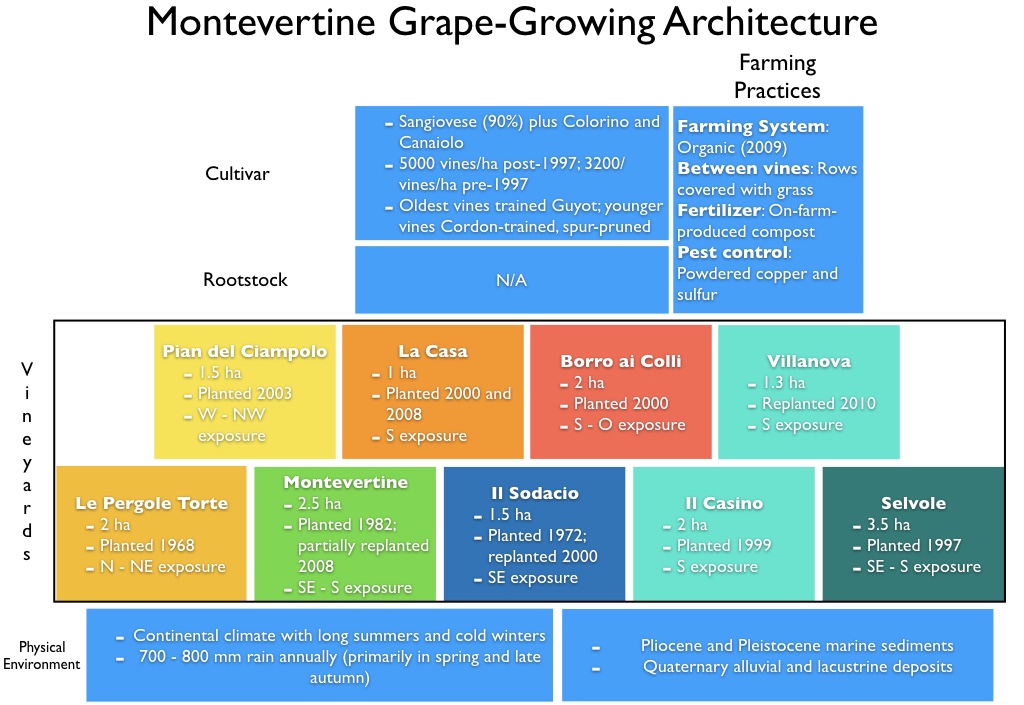
The current estate is 18 ha in size and is planted to Sangiovese (90%), Colorino, and Canaiolo. The Montevertine grape-growing architecture is illustrated graphically in the chart below.


As shown below, the estate produces three wines, all blends of the estate's cultivars.


The Le Pergole Torte was first released in 1977 and was the first 100% Sangiovese wine produced in the Radda in Chianti area. It is made from the best grapes drawn from the vineyards planted between1968 and 1999.

Tasting Selected Vintages of Le Pergole Torte
I have tasted a number of the Le Pergole Torte vintages.

The 2006 Le Pergole Torte showed spice, violets, faded roses, and a slight balsamic on the nose. Rose water, sour cherry, black pepper, and salinity on the palate. Elegance with an ethereal finish.

The 2008 Le Pergole Torte showed berries, earth, herbs, and leather on the palate. Sour cherry, spices, and velvety tannins on the palate. Elevated acid levels. Lengthy finish

2009 was a hot vintage and the wine reflected as such. Ripe red and black fruit on nose and palate along with mint and spices. Leather and tobacco on the nose. Lengthy finish.

The 2012 yields were down due to uneven ripening. Dark fruit, licorice, and spices on the nose with a sour cherry character and velvety tannins experienced on the palate. Lengthy finish.

The 2013 Le Pergole Torte was tasted on a rooftop restaurant overlooking the square in front of the Duomo in Milan. Elegant, and not because of the setting. Intense nose of dark cherries, plum and licorice carries through to the palate. Lengthy finish. This wine will be around for a while.


©Wine -- Mise en abyme