Showing posts with label History of Wine. Show all posts

Sunday, December 26, 2021

Early efforts at winemaking on the American East Coast: The Jamestown Settlement experiment

Prior to the Spanish monks planting their first vines in California (1769; then part of Alta California, a colonial property of Spain), the first experiment in winemaking by the English settlers on the east coast had already run its course. I provide some context in the following.

Explorerer/Settler Encounters with North American Wild Grapes
The east coast of North America was well-endowed with native wild grape vines if one is to believe the accounts of early explorers and settlers (However, unlike the indigenous inhabitants of Mexico, the peoples native to the eastern seaboard did not utilize these grapes in any kind of beverage.).

According to the Norse Sagas, Leif Erickson sailed from Greenland in 1021 to an unknown country to the west. Erickson named this land Vinland due to the profusion of berries (Recent study on artifacts recovered from an archaeological site at L'Anse aux Meadows in Newfoundland shows that Vikings occupied the site in 1021.).

Giovanni da Verrazzano was an Italian explorer who, while in the employ of King Francis I of France, charted the east coast of North America between the Carolinas and Newfoundland. In 1524 he encountered a region "so lovely" that he called it Arcadia and therein he found "many vines growing naturally, which growing up, took a hold of the trees as they doe in Lombardy ..."

Giovanni da Verrazzano, Explorer

Jacques Cartier, a French explorer also in the employ of Francis I, came across an island rich in grape vines and named it "Bacchus Iland."

The first reports of wine production on the east coast of North America is sourced to the pirate John Hawkins. During his 1565 trip to the New World, he provided food aid to a bedraggled group of Huguenots who had sought to establish a settlement at Fort Carolina at the mouth of Florida's St John's River. The settlement had run into difficulty. Hawkins claimed that despite all the troubles the Frenchmen had encountered, they still managed to make 20 hogsheads of wine. The French refuted this claim, indicating that any wine they had was from external sources. 

If this was not the first instance of wine production in the "US," it did birth such an event. Florida was, at that time, part of Spain's New World possessions so the Spaniards undertook an expedition to expel the French from their foothold at Fort Carolina. The expedition was successful and the Spanish established a settlement on nearby Elena Island (now Parris Island) to deter any future incursions. It is reported that the settlers had planted a vineyard by 1568 but it is not clear as to whether these were native vines or vitis vinifera.

In 1584, Sir Walter Raleigh's first expedition landed on Hatarask Island in North Carolina and found "a carpet of of grapes growing down to the water's edge."

Both the Pilgrims in the north and the Jamestown Settlement in the south made note of the abundant native grape vines that they encountered.

Let us step back and take a look at some of the native grape species that the aforementioned explorers and settlers might have encountered.

Table 1. Selected native grape species that early explorers/settlers would have encountered.

Species

Description

Vitis labrusca

  • Labrusca or northern fox grape 
  • Large berries that may come in black, white, or red
  • Best-known of the native species
  • Concord is a pure example of this species

Vitis rotundifolia

  • Round leaf grape
  • Grows on bottom lands, river banks, and in swamps
  • Commonly called Muscadine
  • Scuppernong the best-known variety

Vitis riparia

  • Found in both the north and south
  • Riverbank grape
  • Small-berried and harsh-tasting

Vitis aestivalis

  • Summer grape
  • Adequate sugar in its berries and free of the “foxy” odor of the labrusca

Vitis cordifolia

  • Winter grape
  • Harshly herbaceous

Vitis rupestris

  • Sand grape
  • Favors gravelly banks and dry water courses 
  • Distributed through the region around southern Missouri and Illinois down into Texas
Source: Culled from Thomas Pinney's A History of Wine in America (UC Press, 1989)

Jamestown: The First Winemaking Experiment
The Jamestown Settlement, funded by the Virginia Company, was established in Jamestown, Virginia in 1607 with 104 English men and boys. It was the first permanent English settlement in North America. The early settlers were "struck by the rich profusion of grapes" that adorned the surrounding woods. William Strachey, an English writer who served as Secretary and Recorder for the colony between 1610 and 1611, lauded the young wine made from these native grapes by Doctor Lawrence Bohun, "the first experimental scientist in Jamestown and one of its first physicians." While living in Virginia, Bohun produced wine and, as such, is the first named winemaker in the US.The quality of these wines, were less-than-stellar, however, as indicated by a request from the incoming Governor Lord De La Mar that one hogshead of the wine, "sour as it is," be sent to England as a sample.

King James of England saw the production of silk and wine in the colony as a source of wealth that would place England on an equal status footing with its European rivals Spain and France. The Virginia Company also needed profits to pay returns to its shareholders. These were two of the catalysts to a Virginia 1619 law requiring each householder to annually plant and maintain 10 vines. The settlers were to be aided in this effort by eight skilled French vignerons who had been sent to the colony along with vine plants. The latter is significant because it is the first recorded instance of vitis vinifera on the eastern seaboard. Further, the settlers were provided with a winemaking manual that was prepared by the King's Master of Silkworms and Wine, a Frenchman named John Boneil.

All in all, this initial effort at creating a Virginia wine industry was unsuccessful. A little wine was made from native grapes and sent to London in 1622 but was not well received. This first experiment in winemaking ran aground on a number of rocks:
  • Tobacco grew very well in Virginia and there was growing demand for the crop in Europe. Given the choice of planing vines which made unsatisfactory wine and the cash crop tobacco, the settlers voted with their pocket books every time.
  • The native wild grapes were unsuitable for the production of wine
  • The settlers blamed the vignerons for the lack of progress but a number had been killed and others wanted to cash in on growing tobacco rather than the unsatisfactory grape vines. The settlers were so upset with the vignerons that they sought to bar them from growing tobacco.
  • There were significant impediments to growing vitis vinifera in Virginia (Pinney):
    • The area experienced climate extremes, with the vines alternately blasted and frozen
    • Summer humidity steamed the vines and presented a hospitable environment for fungal diseases such as powdery and downy mildew and black rot (These diseases were unknown in Europe prior to the mid-1800s)
    • Destructive insect pests such as the grape leaf hopper and grape berry moth.
According to Pinney, "... the failure to make anything out of wine-growing in the face of a prosperous tobacco industry soon led men to give up a losing game." The boomtown mentality of Jamestown was "ill-suited to the patient labor and modest expectations of wine-growing."

But this would not be the last word on winemaking in Virginia; or on the American east coast.


©Wine -- Mise en abyme

Monday, December 20, 2021

Monks on a mission: The spread of winemaking through colonial Mexico and Spanish South America

The Spanish were directly responsible for the drubbing of French wines at the hands of the American upstarts at the Judgment of Paris tasting. More specifically, Spanish priests were the culprits. It's a long story -- told in two parts -- so strap in.

European wine grapes (vitis vinifera) were first brought to the New World by Christopher Columbus on his second voyage (1493 - 1496), the first installment in the Columbian exchange. Columbus brought settlers and seeds and cuttings for wheat, chickpea, onions, grapes, olives, sugar cane, and fruits on that journey with the express intent of settling the island of Hispaniola. The Caribbean provided less-than-ideal conditions for grapegrowing and this initial attempt at making wine in the New World was a failure (as was also the case for grain and olives). At this point the French wines were still ahead; but so was Mexico.

Mexico
Presented with a second opportunity to protect the self-respect of the wines of its fellow continental traveler France, Spain demurred and took a second bite at the apple of wine production in the New World. 

Pre-Columbian Mexico was home to grapevines. The inhabitants of the time used the grapes to make a drink which included other fruits and honey. The Aztecs called the fruit of the vine acacholli, while the Purépechas (seruráni), the Otomis (obxi), and the Tarahumaras (uri) all had their own nomenclature. These grapes, primarily due to their high acidity, were deemed by the Spanish conquistadores to be unsuitable for the production of wine.

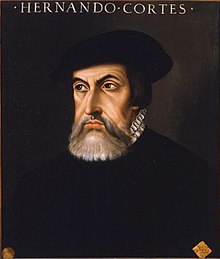
The Spanish had vitis vinifera vines in their possession, however, and began planning for their deployment. On March 20, 1524, Hernan Cortes, conqueror of the Aztecs and Governor of New Spain, ordered each lieutenant to plant the equivalent of 1000 feet of vines for every 100 slaves they possessed.

Hernan Cortes

This order fueled a significant expansion of the vineyards around Mexico City in the areas of Tacubaya, Puebla, and Hidalgo. Vines were cultivated immediately by the priests who needed wine for the celebration of Mass. According to one source, "They were the ones who transformed inhospitable deserts into areas of cultivation and wine-growing." The Jesuits and Franciscans consolidated the grape varieties planted by other friars and named it the "mission grape." 

The expansion of wine production continued with vines being planted northwards from Mexico City to Querétaro, Guanajuàlo, and San Luis Potosi. Vines were very successful in Parras Valley and, subsequently, Baja California, Sonora and the Puebla vineyards Tehuacan and Huejotzingo.

Parras Valley is the largest and oldest grape-growing region in Mexico. Wild vines were found in the valley by priests and settlers exploring the area in 1549 and they founded a mission there, naming it Santa Maria de Las Parras (Parras translating to vines). The mission made wines from the wild grapes and were soon shipping wines and brandies from this region to other parts of New Spain. Mission grapes also did well here and cuttings eventually made their way north to the formative Napa Valley. The Marqués de Aguayo winery was founded in Parras Valley in 1593. The winery officially ceased business in 1989.

As the Mexican wine industry flourished, less wine was imported from Spain, a distressing state of affairs for Spanish producers. They petitioned the King (Philip III) and he issued an edict in 1595 banning the production of wine and the planting of new grape vines anywhere in New Spain. In spite of the ban, he issued commercial rights to Don Lorenzo Garcia allowing the production of wine and brandy. Don Lorenzo founded the Hacienda de San Lorenzo winery in Valle de Parras in 1597 to exploit his license. The winery is still in operation today under the name Casa Madero.

Winemaking continued to flourish in New Spain prompting Charles II to issue an edict in 1699 banning the production of wine in New Spain except for sacramental purposes. This religious exception allowed a Jesuit priest to plant the first vines in Baja California at the Loretto Mission. In 1791, Jesuit Priests attempted to revitalize large scale production at the Santo Tomas Mission in Baja California. In 1843, Dominican Priests planted grapes at a mission in today's Valle de Guadalupe. The Mexican Reform War of the 1850s called for many of these lands to be returned to the state. The Santa Tomas Mission was sold to a group of investors and became Mexico's first commercial winery -- Bodegas Santo Tomas.

Colombia
Jesuit missionaries brought vines into Colombia from Mexico in 1530 and succeeded in crafting some wines but were forced to discontinue production after the 1595 ban by Philip III.

Peru
The first vines were planted in the heights of Chile in the 1540s but farming them was laborious so they were moved downhill towards the coast in the vicinity of Ica. The original vines were planted to suport the Catholic mass but the locals began enjoying the wine out of church as well. The wine became so well known that it was exported to Bolivia to fuel the entertainment needs of Potosi, the then "Paris of South America."

The Spanish ban on local wines caused some producers to bargain with the Crown to produce a local aguardente -- the birth of Pisco -- while others switched crops, and the remainder continued quietly producing wine.

Chile
The first grapevines were brought to Chile in 1548 by Francesco de Carabantes, a Spanish Friar. The first Chilean grower was Francisco de Aguirre, who delivered his first harvest in 1551. Other sources credit Rodrigo de Araya who was cultivating grapes in the Chilean Central Valley at the same time. Pretty soon vitis vinifera was cultivated along the length and breadth of Central Chile and Spanish-sourced varieties dominated the Chilean wine scene until disrupted by French varieties beginning in 1851.

Bolivia
Grapevines were first planted in Bolivia by Spanish missionaries in the 1560s but the tropical climate proved inhospitable to vitis vinifera.

Argentina
The first cuttings planted in Argentina were brought in from the Chilean Central Valley in 1556 by one Father Cedrón. The first small plantings occurred in San Juan and Mendoza but by the end of the 16th century vineyards could be found in every settled region. 

Growers gravitated to the Cuyo region over the first 200 years due to its high altitude, favorable climate, and plentitude of water. A total of 120 vineyards were located in Mendoza by 1739.

Grape Varieties
During the first 100 years of viticulture in the above discussed regions, missionaries brought over a number of grape varieties either in the form of seeds or sticks. The white varieties included Muscat of Alexandria, Mollar, and Palomino while the red was Listán Prieto. The Listán Prieto was the most significant planting and is sometimes referred to as the mother grape of the Americas.

Listán Prieto is native to the Castille region in Spain and was brought to the Canary Islands where it flourished. There are very limited plantings of this variety in Castille today with some supposition that it was wiped out by Phylloxera.

When brought to the Americas, the variety was generically called Criolle but had different names depending on location: Mission in Mexico, Negra Criolla in Peru, Pais in Chile, Missionera in Bolivia, and Criolla Chico in Argentina. This variety represented over 90% of the plantings in Argentina and Chile in 1833.

With the passage of time, crossings of these founding varieties occurred with Torrontés in Argentina being the most significant. There are three different Torrontés varieties: Torrontés Riojano, Torrontés Sanjuanino, and Torrontés Mendocino. Some 150 native criolla varieties have been identified to date.


©Wine -- Mise en abyme

Thursday, December 2, 2021

The role of Saint Benedict in the identification and cru-ing of Burgundian terroir

As illustrated in my graphical summation of the history of wine styles -- described in Lukacs' Inventing Wine: A New History of one of the World's Most Ancient Pleasures -- the next significant development in wine after the Fall of Rome is place-based wines out of Burgundy. According to Lukacs, the "first wines prized for their ability to display ... individualized aroma and flavors" were made in Burgundy by the Cistercian order which had been founded in 1098. This order was focused on piety and hard work and devoted a lot of effort to tending their vineyards. In his APAVM FAW lecture (titled St. Benedict and the Blessings of Burgundy), Dr. Jonathon Britto provided insight into events leading up to and surrounding the Cistercians and Burgundian wine.


Gregory of Tours was a prelate, historian, and chronicler who "resided at the junction of Rome of antiquity and the emergence of the medieval world" and "documented the continuity of Gallo-Roman civic culture through the early Middle Ages." This Gregory was the first to sound the praises of the wines of Burgundy in a 591 writing. According to Dr. Britto, King Guntrum of Burgundy had donated land to the monks in 587.

Gregory of Tours

Saint Benedict established "the Rules," which became the governing principles of monastic life. The Rules provided for a balance of prayer, work, and study. Charlemagne was enamored and had them copied and distributed throughout his realm in the 8th and early 9th centuries in order to encourage monks to adopt the principles. Saint Benedict's Rules, according to Dr. Britto, "laid the groundwork for community discipline of labor and this ethic, plus the donation of fertile land for the growing of grapes, was the kernel for successful viticulture in Burgundy.

St. Benedict (Portrait (1926))  
Herman Nieg (1849–1928);
Heiligenkreuz Abbey, Austria

The Benedictine Abbey of Cluny was founded in 910 by Duke William I of Aquitaine and was given to the monks "untethered." The deed of gift "included vineyards, fields, meadows, woods, waters, mills, serfs, and lands (cultivated and uncultivated)." 

The Abbey started out on a modest scale, but at its peak was home to 1,000 monks and seeded monastic life throughout Europe. Such a large contingent of monks required administration, fields, and food and was financed partly through indulgences and partly through wine trade. The Benedictines became major landowners with holdings in Gevrey-Chambertin and Vosne-Romanee in Burgundy plus holdings in Rhone, Champagne, and the Loire Valley. 

When completed in the early 12th century, the Abbey was the largest church in Christendom and remained the largest building in Europe until the 16th-century completion of the new St. Peter's in Rome. Cluny was plundered and destroyed during the French Revolution.

While, on the face of it, Cluny was a success, a number of resident monks felt that monastic life had been "challenged and traded for a commercial life." These "conservatives" felt that the only way to resolve their internal conflict was to leave Cluny and return to a stricter observance of the Christian monastic tradition. 

In 1075, Robert Moleme was given permission by Pope Gregory to leave Cluny and establish his own Abbey. Robert de Moleme and his monks acquired a plot of marshland south of Dijon at a place called Citeaux and set up an Abbey as the seat of a new Cistercian Order. The Citeaux monks returned to the original Benedictine ideals of manual work and prayer, dedicating themselves to charity and self-sustenance. 

Robert was called back to Cluny and left the Abbey in the hands of Steven Harding, and Anglo-Saxon who had lost his holdings during the course of the Norman invasion. He was elected Abbot and led the Cistercian community ably. The Cistercians grew, "forging alliances with the Duke of Burgundy and, by both donation and purchase, acquired vineyards in Meursault and Clos Vougeot."  They eventually encircled Vougeot with the wall that stands to this day.  The wall was completed at the end of the 15th century. 

Harding was a prolific recorder of contemporary events and wrote that the Cistercians were the first to notice that different vineyard plots gave different wines consistently. According to Lukacs, over the course of many vintages, these monks were able to identify the characteristics of individual vineyard plots and to note that these differences were, in some cases, manifested by "only a few steps separating an excellent grape-growing spot from a merely good one." The monks marked out these plots by their differences, in some cases building a stone wall to create a "cloistered vineyard." 

Lukacs takes the position that the monks did not intend that their demarcations single out one vineyard as better than the other. Rather, they were saying that the grapes sourced from these vineyards made reliably noticeably different wines and they thus needed to be so identified. The wines from Clos Vougeot and other Cistercian crus were perceived as being so different as to be worth the trouble and expense of overland shipping to the relevant markets or waterways for onward transit.

Dr. Britto: The Cistercians therefore "laid the first foundation for labeling the Burgundy cru and the region's terroir philosophy. It was the Cistercians who defined every tiny parcel of vineyard land, identified the good and the bad points, the geology and micro-climate, and the different flavors and yields.

The diligence inherent in the Benedictine rules, and the application of the work ethic, were instrumental in the identification and mapping of the Burgundian crus that we know today.


©Wine -- Mise en abyme

Thursday, July 2, 2015

Correcting Lukacs' Inventing Wine with Clark Smith's Postmodern Winemaking?

In a previous post, I reported on Isabelle Legereon's issues with modern-day winemaking (as presented in her book Natural Wine) and utilized information from Lukacs (Inventing Wine) to refute/contextualize some of her arguments. Information gleaned from a reading of Clark Smith's Postmodern Winemaking shows that some of the post-WWII winemaking innovations identified by Lukacs were (i) much more granular than indicated and (ii) originated in Germany, rather than in France (and Emile Peynaud).

As I described it in my earlier post,
The concept of human control of the winemaking process was not new, according to Lukacs. It began with Enlightenment scientists such as Antoine Lavoisier and Jean-Antoine-Claude Chaptal in the 1700s, continued through Pasteur (with his discoveries of the role of yeasts and bacteria in fermentation and spoilage) and the work of Emile Peynaud, both in his lab and working with the Bordeaux Chateaus to convert his research to actionable inputs into the winemaking process. Peynaud's contribution included refrigeration, understanding the role of malolactic fermentation, and the need for rigorous selection in the vineyard. His efforts changed the stylistic and qualitative character of the Bordeaux wines such that the "whites became less tart and vegetal and the reds more supple and sensuous, fuller in flavor but less astringent."
Based on Clark Smith's interpretation of the history of that period, the "tools of 20th century winemaking" were stainless steel, inert gas, refrigeration, and sterile filtration (a product of nuclear energy) and this "modern winemaking revolution exploded out of Germany" in the form of Rieslings that were fresh, sterile-filtered, and completely without oxidative characters. According to Smith: "the idea of a light, sweet, fresh, fruity wine like Blue Nun was as world changing as color television." 

These tools and techniques were adopted by Peynaud and other scientists in France and, from there, migrated to the US. According to Smith, prior to the 1960s, 95% of California wines were either port or sherry styles. With the introduction of Blue Nunn, and the adoption of the associated technologies in Bordeaux, US winemakers followed suit such that, by 1970, the majority of California wine contained less than 14% alcohol.

Adoption of these new technologies was not trouble-free. According to Smith, fully 50% of the wine produced had one or more of the following afflictions:
  • Volatile acidity
  • Aldehyde
  • Geranium tone
  • Heat instability
  • Cold instability.
Heroic work at UCDavis on issues such as pH, sulfur dioxide management, sanitation, oxidation prevention, temperature management, and control of malolactic fermentation led to "an era of clean, competent table wine production."

This base of quality production, plus their success in the 1976 Judgment of Paris, caused the US producers, according to Smith, "to shift from light European knockoffs to big Chardonnays and Cabernets that the French could not match."

In closing, while Lukacs identifies the post-WWII period as important, as it relates to quality winemaking, if Smith's history is accurate, then Lukacs missed both the origin and scope of the advancements.

©Wine -- Mise en abyme