Showing posts with label Decanter Great Piedmont Reader Weekend. Show all posts

Friday, February 1, 2013

Massolino: "Family-Style" Barolos

Sunday October 14th was the last day of the Decanter Piedmont Reader Weekend; and we were not happy about that. We had had a great time to date visiting wineries, speaking to proprietors, eating great food, and drinking great wine; and we did not want it to end.  Well, pouting would not help.  We had a full day of activities still ahead of us, beginning with a morning winery tour and tasting with Massolino estate in Serralunga d'Alba.

Serralunga d'Alba is a small, medieval village in the Langhe region of Piedmont that is 7100 meters long, 1800 meters wide at its widest point, sits on a hill 414 meters above sea level, and serves as the eastern flank of the Barolo wine production zone.  According to massolini.it, Serralunga d'Alba is one of only three of the 11 Barolo communes that are contained in their entirety within the production zone (the remaining two are Barolo and Castiglione Falletto).

According to Gambero Rosso (Serralunga Barolo: The unrushable wine; gamberorosso.it), Serralunga d'Alba has "compact, sandstone-based soils dating from the Helvetian period."  These soils are high in sand, limestone, iron, phosphorous, and potassium and, as a result, produce wines that are intense and structured and that need time to mature.

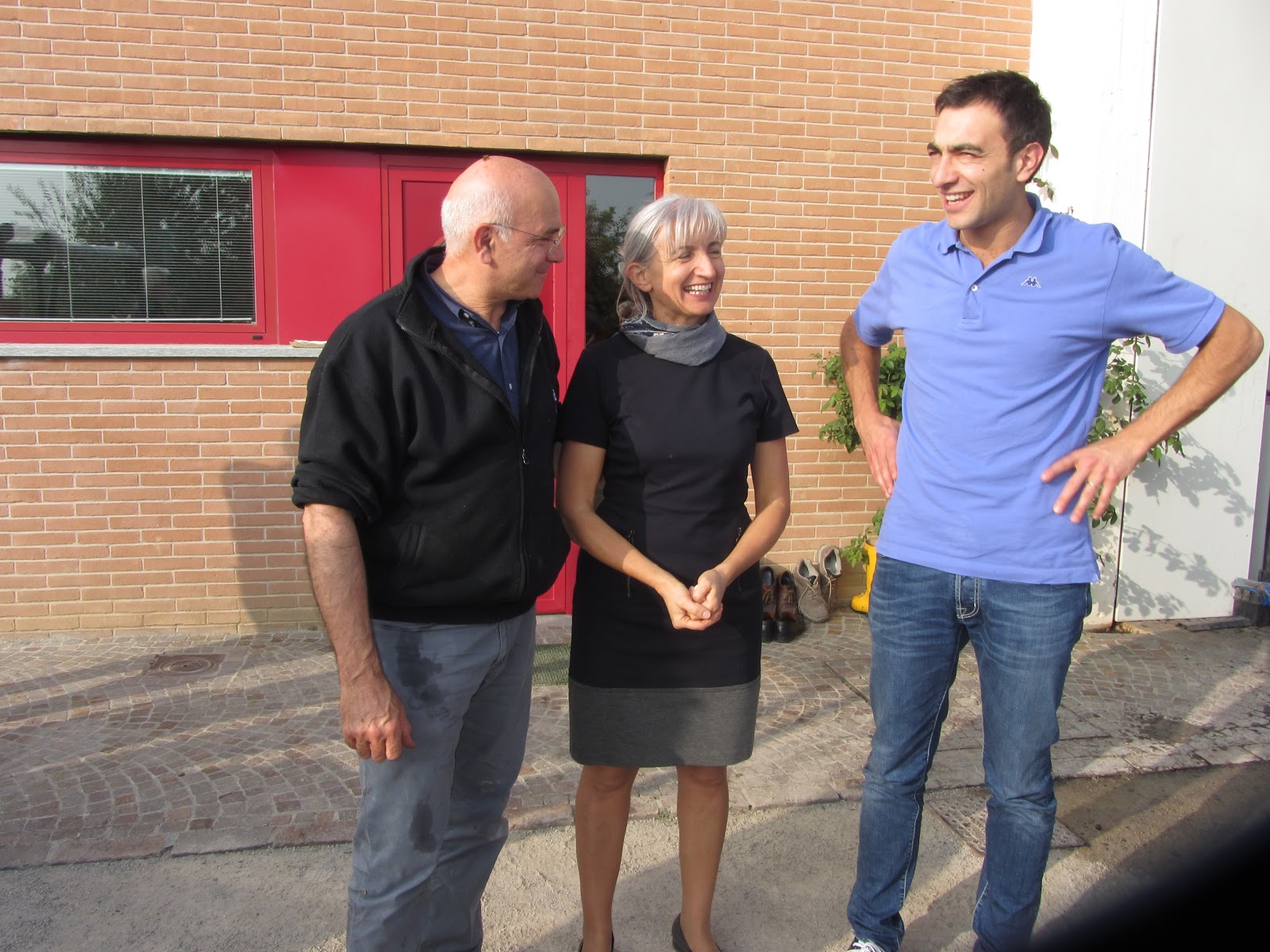
When we arrived at the Massolino Cantina after our trip from the hotel, we were greeted in the courtyard by a smiling Franco Massolino who proceeded, during the course of an introductory "seminar" in the courtyard, and continuing dialogue during the course of our walking tour, to detail the estate's philosophy and practices.


The Massolino winery was created by Giovanni Massolino in 1896 and all through the years it has been operated as a family enterprise with brothers Franco and Roberto, enologists both, managing the current incarnation.  The style of wine espoused by the family is a pure expression of Nebbiolo which demonstrates a balance between power and excellence.  Franco refers to this style as "classic" and sees aging in large barrels as a key enabler of that style because the barrels respect and protect the classic bouquet of Nebbiolo.  There was an idea in the market, according to Franco, that consumers would like a wine that was dark in color and some winemakers began to use barriques for aging in order to acquire this darkening effect.  That is not classic Nebbiolo and the decision was made by the estate in 2006 to return to its roots and only age Barolo in large bottes.


Massolino is focused on the production of the highest quality wines possible and, towards that end, grows all of its own grapes. The principal estate vineyards are detailed in the table below.


The grape varieties planted at Massolino vineyards include Barbera, Dolcetto, Nebbiolo, Moscato, and Chardonnay.  The estate began making Chardonnay wines in 1991 based largely on a sense that the variety would thrive in the region's chalky soil.

Fermentation is carried out in resin-lined cement tanks or stainless-steel tanks.  Cement tanks are desirable for their ability to maintain purity of fruit and freshness, according to Franco.  He also mentioned that 10 to 15 years ago, consultants had been recommending deserting cement tanks for stainless steel.  Massolino had not gone down that path and now cement is back in vogue.  Their choice is to use cement vats and when those are not available then use stainless.

Large Slovenian oak casks are used for aging all the wines with the exception of the Chardonnay and Barbera which are aged in barriques.

After our walk-through of the winery, we repaired to the tasting room to sample some of the estate's offerings:
  • 2011 Chardonnay -- The grapes were picked a little early in the cycle.  Some of the fruit was aged in cement and some in oak and then blended. Golden yellow color. Sweet white flower and vanilla nose.  A rich creaminess resulting from 9 months of battonage.  Chalky minerality and spiciness.  Persistent finish.
  • 2011 Dolcetto -- Stainless steel and cement in search of a pure expression of fruit.  Cherries.  Good body. Spicy. Fresh. Soft tannins. Long finish.  Franco felt that this wine would be great with appetizers but felt that the freshness and tannins would allow it to be drunk with the entire meal.
  • 2011 Barbera -- Fermented in stainless steel and cement. Turpentine and petrol on the noseRed pepper and rust on the palate.  Tight and short on the finish.
  • 2010 Barbera -- 5000-bottle production.  Aged for 18 months in barrique.  Extracted color and more appealing nose.  Strawberry and spice.  RIch with good acidity.
  • 2010 Langhe Nebbiolo -- Violet, green flower, dill, marine, spiciness.  Freshness and purity of fruit.  Non-corrosive tannins.
  • 2010 Barolo Classico -- Translucent. Sweet tar, tobacco, and hint of violets.  Molasses on the palate along with weightiness, texture, and balance.
  • 2007 Margheria -- Perfumed nose.  Fresh, pure fruit. Elegant with a long finish.
  • 2007 Parafada -- Closed.
  • 2007 Parussi -- Tar. Green bean. Non-complex.Chalky minerality. Long finish.
  • 2005 Riserva Vigna Rosada -- Complex. Bean. Stale beer. Elegance.Late-arriving tannin. Great acidity with a long mineral finish.

This winery's focus on quality was evident in Franco's conversation as well as the look and feel of the surroundings.  This is an estate that knows the type of wines that it wants to produce and is doing so to the tune of 120,000 bottles annually.  The winery has explored what modernity has to offer and have adopted the things that have improved the quality of the operations but have discarded those which have led away from what they perceive to be the traditional style (the family style) of Barolo.


©Wine -- Mise en abyme

Tuesday, December 11, 2012

Tour and tasting at Poderi Aldo Conterno: Decanter's Great Piedmont Reader Weekend

We had just spent 5 hours with one of the most enthralling wine producers -- Angelo Gaja -- in the world and were now on our way to a tour and tasting with Gianfranco Conterno of Poderi Aldo Conterno.  His was going to be a tough job.  We were sated -- both gastronomically and mentally -- and our best bet would probably have been a crowning siesta.  But no.  We had a schedule and we were going to stick to it.  Gianfranco would have the task of bringing us along and keeping us focused on the present.

Poderi Aldo Conterno was founded when Aldo Conterno parted ways with his brother Giacomo shortly after the former's return from a 5-year stint in the US.  His time overseas had expanded Aldo's mindset while his brother, who had never spent any extended time away from the Langhe, remained loyal to the traditions of the region. Under the direction of the father, the brothers split the equipment and inventory, with Giovanni retaining ownership of the historical family cantina while Aldo went off and created today's Poderi Aldo Conterno.  Aldo focused on making wines which, while not modern, were less tannic and backward than was traditional.  He came to be known fondly as "the King of Barolo." Aldo Conterno died on May 30, 2012, leaving the winery to his sons Franco, Stefano, and Giacomo.

Poderi Aldo Conterno is located in Bussia, a village in Monforte d'Alba.  It is surrounded by 25 ha of vineyards at 400 meters altitude and with a south southwest aspect.  The soil is comprised of alternating layers of compact gray sand and white and blueish calcareous marls.

Used with Decanter's permission

In addition to the vineyard surrounding the Cantina, the Conterno family own three cru vineyards in Bussia: Romirasco, Cicala, and Colonello.  Romirasco -- located at 410 meters altitude on Soprano Hill -- has a SSW exposure and a clayey calcareous soil which is rich in calcium carbonate and iron.  The Nebbiolo vines in this vineyard are 50- to 55-years old.  The Cicala vineyard is located on concave slopes with southeast exposures. The soil profile is similar to Romirasco's except that it is browner in color.  The vines here are 50-years old.  The vines at the Colonello Vineyard are 35- to 40-years old.  All of these vineyards are farmed organically.

Giacomo with Decanter's brain trust (used with Decanter's permission)

Aldo Conterno has a 7000 square meter cellar with room for 1 million bottles.  They produced 250,000 bottles during the 1970s but but has reduced that number to 80,000 bottles today.  According to Giacomo, small production levels is the price that they have paid for going organic.  Alcoholic fermentation (with indigenous yeasts) occurs in stainless steel tanks (with the exception of the Granbussia which is fermented in large Slavonian oak casks) while the resulting wines are aged in large Slavonian oak casks -- Barolos -- or French oak barriques -- all other wines.  The Conterno wines are bottled unfined and unfiltered.


At the conclusion of the cellar tour we settled in for a tasting of the Conterno offerings. First up was the 2009 Bussiador Chardonnay Langhe B. DOC.  According to Giacomo, they were the first to think that Chardonnay would have the chance to flourish in Barolo. In his view, Chardonnay grown here expresses the minerality of the area.  The Chardonnay grapes are grown on 35- to 40-year old vines resident on 2.56 ha of the Chastain vineyard and, while the winery has the capacity for 30,000 bottles, they only vinify 6000 bottles.  The wine is placed in stainless steel tanks until the initiation of alcoholic fermentation when they are transferred to 100% new oak barriques for its completion and for malolactic fermentation.

On the nose minerality, sweet white flower, apple pear, rusticity, vanilla, and a hint of pineapple.  On the palate, clean, grapefruit, minerality, long finish with some heat. According to Giacomo, this wine should live on for 9 or 10 years.

The second wine tasted was the 2009 Il Favot Langhe Nebbiolo DOC.  The grapes for this wine are sourced from 20-year-old vines from a number of vineyards in Bussia.  After hand harvesting, the crushed grapes are allowed to stay in contact with the skins in stainless steel tanks in order to increase the color and tannin levels in the finished wine. Vinification occurs in the stainless steel tanks where the wine will remain for 6 months post-vinification.  The wines are transferred to 100% new oak barriques at the end of that six month period and will mature therein for another 18 months after which they are bottled.

On the nose violets, deep plum, sweet vanilla, turpentine.  On the palate spicy, rustic, fresh, plum, slight green characteristic.  Balanced.  Giacomo saw this wine as being ready in 3 to 4 years but with the stuffing to last up to 10 years.

The 2008 Colonello Barolo DOCG was made from grapes grown in the highest position in the namesake vineyard.  Giacomo saw this as being a classic vintage with harvest ending in the first week of November.  The must stayed in contact with the skin for 30 days.  After vinification the wine was racked a number of times before being transferred to large Slavonian oak casks for 29 months of aging.

Violets, plum, tar, and a hint of phenolics on the nose confirmed on the palate along with a spiciness.

The 2008 Cicala Barolo DOCG is treated in the same manner as was the Colonello. Violets, plum and tar on the nose with spice, freshness, coating minerality, and a blackpepper finish.  5500 bottles of this wine were produced.

The grapes for the 2008 Romirasco Barolo DOCG is sourced from the 3.8 ha vineyard of the same name.  This wine is aged an additional 2 months in oak casks relative to the wines from the other cru vineyards.  Dark cherry, licorice, and tar on the nose with an elegant long spicy finish.

The Granbussia Riserva DOCG is the flagship wine of the estate.  The 4950-bottle production is made from grapes drawn from the Cicala (15%), Colonello (15%), and Romirasco (70%) vineyards.  These grapes are co-fermented in wood with 60 days of skin contact and spends another 32 months maturing prior to bottling.  The wine is stored for another 12 to 18 months after bottling.  This wine was first introduced in 2005 and that was the vintage that we tasted.

On the nose tar, roses, violets, plum and figs.  On the palate richness, tar, graphite, freshness and elegance.  Long finish with some heat.


At the outset I said that we had presented Giacomo with a tall order given what had preceded him.  He came through.  The winery has a story to tell, having, as it does, such a storied pedigree and such excellent wines.  Giacomo himself was earnest and passionate and served as an excellent counterpoint to the whirlwind that had gone before.  Wonderful capper to a wonderful day.


©Wine -- Mise en abyme

Tuesday, November 27, 2012

Winery tour and Tasting with Angelo and Gaia Gaja: Decanter's Great Piemonte Reader Weekend

On Saturday we boarded the bus in front of our hotel and headed north.  Our destination? The Barbaresco winery of Angelo Gaja, the Piemontese winemaker credited by Wine Spectator with "driving Italian wine to higher ground."  This was the second stop on our Decanter Great Piemonte Reader Weekend which had kicked-off with a Truffle hunt and a winery tour at G.D. Vajra.

We were scheduled for a tour and tasting at the Gaja winery, followed by lunch at a nearby restaurant. We were told that Mr. Gaja would be our host on this tour but we were also warned that, this being harvest time, there was a possibility that he would be unable to meet that commitment.  In the event that he could not make it, his daughter, Gaia Gaja, would stand in his stead.  We had steeled ourselves for this possibility and let out a collective sigh of relief when we rolled up to this imposing, walled enclosure and the electronic gate was being operated by a slight-of-stature, distinguished-looking gentleman: Angelo Gaja.  He was here and we would be spending the next 5 hours in his company.  Heavenly.

We disembarked and he welcomed each of us with a broad smile and an effusive handshake.  We initially toured the courtyard of the winery while Mr. Gaja described the improvements that had been made to the winery and the surrounding vineyards since 1982.  Sometime during this courtyard discussion we were joined by Gaia Gaja.  While in the courtyard, Mr. Gaja pointed up to the tower on the hill and said that that was our final destination.  The tower had been purchased by Gaja several years ago and had been connected by an underground tunnel which had been dug meter by meter over many winters.  We stepped into the winery to begin our journey to the tower.


The first room that we entered was devoted to a collection of "unique" pieces of art and larger pieces were sprinkled throughout the winery.  As we wended our way through rooms with casks and barrels, Angelo kept up a steady stream of conversation on the winery and winemaking operations.


After a fairly extensive walk underground, we debouched onto the ground floor of the castle and then made our way outdoors into a trellised garden.  The trellises were bare, the result of a plant-stripping storm which had recently passed through the area.

Used with permission of Decanter

Used with permission of Decanter
This was definitely not a wine geeky tour.  Mr. Gaja spent a lot of time on the tradition and history of the winery, his philosophy, and the challenges of getting his vision implemented in a culture which values inertia.  After completing a tour of the castle and grounds, we made our way to a room which was set up for our tasting.

Used with permission of Decanter

The table below shows the totality of the wines produced by Gaja.  The actual tasting was drawn from the subset pictured below.


We were led in the tasting by Gaia Gaja.  The first wine tasted was the 1998 Alteni di Brassica in magnum.  This 100% Sauvignon Blanc wine is classified Langhe DOC and is sourced from a vineyard attached to the famed Sori San Lorenzo as well as the Sauvignon Blanc grapes planted in Sperss after its purchase in 1988.  According to Mr. Gaja, the Alteni di Brassica gets its high acidity from Sori San Lorenzo and its sweetness from Sperss.  The wine was fermented in temperature-controlled stainless steel tanks and aged in barriques for 6 months.  The wines from the two vineyards are blended after aging.  This wine exhibited petrol, rust, and green phenols on the nose.  On the palate a hint of tannin accompanying medium+ acidity, minerality, and a long, spicy finish.

Next up was the 2009 Barbaresco DOCG in magnum.  According to Angelo, rain during this vintage caused a collapse of the surrounding hills.  Unfortunately this rain happened to coincide with flowering resulting in "more stems than berries."  It was hot during the summertime and ripening proceeded "beautifully" but "there was more skin than juice." This wine had ripe rhubarb and pomegranate on the nose along with tar.  A lean structure accompanying drying tannins on the palate.

The Sori Tildin 2001 magnum is classified Nebbiolo DOC and is 95% Nebbiolo and 5% Barbera.  According to Angelo, Sori means top of the hill facing the sun and this vineyard was purchased in 1964 by his grandfather.  It has historically been considered one of the best locations in Barbaresco.  The Barberesco soil, according to Angelo, is older and softer and softer soil yields a softer wine.  The soil is comprised of compact clay and limestone below a sandy top layer.  The vineyard is at 300 meters altitude and is always windy.  Dark fruit and licorice on the nose.  Elegance, acidity, balance, and length on the palate.

The Costa Russi 1998 was sourced from 70- to 80-year-old vines in the Costa Russi vineyard.  The vines are planted horizontally with densities of 4200 vines/ha with higher spacing between vines to compensate for higher humidity.  This wine is 95% Nebbiolo and 5% Barbera and is classified Langhe Nebbiolo DOC.  Blackberry and red fruits on the nose along with tar and a florality.  Ripe fruit and spiciness on the palate.  Drying tannins on a long finish.

The Sperss 1989 magnum is classified Barolo DOCG.  This vineyard was bought in 1988 according to Angelo, and has a lot more iron in the soil than any of the other vineyards. Wet wood and blood character along with a blueing on the nose.  Slight bitterness and heavy iron content on the palate.  Metallic tannin.

The 1978 Barbaresco DOCG showed its age in the color and exhibited a piney characteristic along with white spice on the nose.  Great weight on the palate, rust, dried fruits and a spiciness to go along with a long finish.

At the conslusion of the tasting we repaired to a nearby restaurant for lunch.

Used with permission of Decanter

Angelo Gaja is an inveterate and accomplished storyteller.  From the moment we stepped off the bus until we re-embarked 5 hours later, our ears were his.  He told stories about the expansion of the winery over the years, the procurement and incorporation of the Barbaresco castle into the Gaja winery holdings, how he got his daughter to come home and join the family business, the family history, how he had moved Gaja from a local player to a worldwide power, what it means to be an artisan winemaker, and about the greatest wine he had ever drunk.  And we listened captivated and open-mouthed.  Where did the time go?

©Wine -- Mise en abyme

Wednesday, November 7, 2012

Lunch and winery tour with G.D. Vajra: Decanter's Great Piemonte Reader Weekend

Azienda Agricola G. D. Vajra, a winery owned by Milena and Aldo Vaira, produces Nebbiolo, Barbera, and Dolcetto wines in the Barolo commune of the Langhe sub-region of Piemonte. In this post I will discuss our lunch and winery visit hosted by this esteemed estate as a part of Decanter’s Great Piedmont Reader Weekend.

The G. D. Vajra (The family name is Vaira, similar pronunciation as for the winery, with the difference in spelling resulting from a printer's error which the owners retained as the winery name.) vineyards cover 60 hectares and are planted to Nebbiolo at elevations between 350 and 400 meters and Dolcetto and Barbera at lower elevations.  In addition to the vineyards in Barolo (Bricco delle Viole, Fossati, La Volta, and Coste de Vergne) the Vairas have taken over control of the Serralunga d'Alba vineyards (Baudana and Cerretta crus) of Luigi Baudana via a purchase by the Vaira children.  Giuseppe is the winemaker for the wines produced from these vineyards.

We were scheduled to begin the day's events with a lunch at Tra Arte e Quercie (between art and oak trees) in Monchiero with Giuseppe Vaira (of G.D. Vajra).  When we arrived at the destination, we were greeted warmly by Giuseppe in the restaurant courtyard and treated to a short discourse on the area, the restaurant, and our activities for the remainder of the day.  After this sun-soaked introduction, we were ushered into the restaurant for a much anticipated lunch paired with Vajra wines.


The first wine tasted at lunch was the 2011 Langhe Riesling.  According to Giuseppe, 2011 was a warm vintage in Langhe, one that will prove to be exciting because of the incidences of rain and hailstorm.  He saw it as reminescent of the 2008 vintage.  Prior to the 2011 vintage, the Langhe Riesling was called Langhe Bianco.  The vines for this wine were planted 21 years ago and the wine, according to Giuseppe, is notable for its sense of place, its personality, and its ability to pair well with regional foods.  This wine had a lot of tropical notes and was perfumed and floral.  It reminded Giuseppe of a Trocken from Rheingau.  On the palate, lime, a sweet minerality and refreshing, palate-cleansing acidity.  To me, a fruitier version of a JacobsCreek Steingarten Riesling.

Our second course, the Pumpkin Pudding with Cheese Fondue, was paired with a 2010 Dolcetto d'Alba.  The beauty of Dolcetto, according to Giuseppe, is that it can be a difficult teenager so you have to give it extra love.  It needs a good vineyard in order to blossom and needs to be smelled and tasted regularly in the cellar.  It is a reductive wine and has to be racked two to three times more than Barbera.  It is truly a high maintenance wine.  This wine exhibited cherry and blueberry notes which carried through to the palate.  It paired beautifully with the meal which served to extend and expand the weight and reach of the wine on the palate and in the finish.


The Langhe Nebbiolo 2010 DOC was Giuseppe's favorite of the wines we were tasting at lunch.  The wine was made from grapes sourced from young vineyards.  It is not yet focused but its potential is apparent.  Giuseppe described it as ethereal and a perfect pairing for cheeses.  Florality and spicy cherry notes with proto-Barolo tannins and power accompanying a long finish.

The final wine tasted at lunch was a 2008 Barolo Alba, a gentler and more approachable style of Barolo.

At the conclusion of lunch, we embarked on a truffle hunt in the forest adjoining the restaurant and, following that, travelled to the Vajra facilities for a winery tour and taste-through of the remaining wines in the portfolio.

Upon our disembarkation at the winery, we were greeted by Aldo and Milena.  In describing his philosophy, Aldo indicated that he sees the winemaker's task as deriving the greatest harmony possible from the factors at his disposal: terroir; diversity and complexity of soil; and grapes (each variety bringing its own characteristics).  He expressed that being able to interact with customers was a gift and that his greatest disappointment is not knowing each and every pwerson who drinks his wine.  Post our conversation with his parents, Giuseppe referred to his Dad as the creative mind in the business and his Mom as the support structure.


As we toured the facility we learned that Vajra had gained the first organic certification in Barolo in 1971 but had stepped back from that arena in the 1990s.  They farm all of their own vineyards and practice green harvesting in order to ensure high quality in the surviving grapes.  A first sort of the grapes is conducted in the vineyard at harvest.  A table has been placed between the crusher and destemmer in order to allow a sorting for stems and minimal stem effects in the wine.  Top quality grapes make it into the top wines while second level red grapes are bottled as Langhe Rosso.  WInes are subjected to long periods of maceration in stainless steel tanks.


Upon completion of the tour we repaired to the tasting room to complete our immersion in the Vajra wines.  The first wine up was the 2011 Dolcetto d'Alba.  This was the current release of the wine tasted earlier in the day and had similar characteristics.  Grapes for this wine were sourced from southern exposures in the Costa di Vergne and Fossati vineyards.


The 2009 Barbera d'Alba Superiore was sourced from the Bricco delle Viole vineyards blended with grapes from the Bric Bertoni vineyard in Serralunga d'Alba. The wine was macerated for 35 days and then spent 2 years in large casks prior to bottling.  The 2009 vintage in the Langhe resulted in richer wines and this wine was no exception.  It had great aromatic strength with cherries and blueberries dominant.  Minerality and acidity on the palate preceding a spicy, medium-long finish.

The 2008 Barolo Bricco delle Viole exhibits violet florality, rusticity, iron, orange zest, and sweet tobacco on the nose.  Tannic on the palate but elegance shines through.

Cerretta is an up-and-coming, clay-limestone vineyard in Serralunga d'Alba from which 300 cases of the Barolo Cerretta is produced.  This 0.8 ha vineyard was originally planted in 1970 and lies on Serralunga d'Alba's eastern slope.  These wines are fermented partially in oak and partially in stainless steel and are aged in Slavonian casks for 36 months.  The 2008 Barolo Cerretta exhibited violets, cocoa, tar, mint, and chocolate on the nose.  On the palate, depth, complexity, and a long finish.  The 2008 Barolo Baudana, drawn from another famed Baudana cru, is also grown on limestone soils.  This wine had a rustic minerality, violet, tomato, dried tobacco leaf, leather, and sweet tobacco on the nose and elegance on the palate.


All in all a wonderful day.  Giuseppe was a wonderful host and teacher all day and it was a pleasure to observe the lovingkindness that suffuses the entire family as they work towards their objectives.  Wonderful wines.

©Wine -- Mise en abyme

Wednesday, October 24, 2012

Truffle hunting in wine country: Decanter's Great Piemonte Readers' Weekend

This was going to be a high-intensity weekend so there was no time to be messing around.  We were launching the weekend with a lunch at Tra Arte e Quercie (between art and oak trees) in Monchiero with Giuseppe Vaira (of G.D. Vajra) followed quickly by a truffle hunt in a private preserve owned by the restaurant's proprietor.  Decanter had sent us reams of information on truffle hunts (what to wear, psychological and physical preparation prior to the hunt, in-hunt demeanor (end-zone celebrations were prohibited), and the proper way to handle the potato in the event of a "kill") so we were ready for the event.  I felt a twinge of sympathy for the truffles in our target zone because I knew that they were overmatched.  But I will get back to that later.  First let us take a look at exactly what we were hunting.

The white truffle of Alba (tartufo bianco; or trifola d'Alba in the Piemontese dialect) is a mycorrhizal fungi which lives in a symbiotic relationship with a host tree wherein it acquires minerals from the soil and passes them on to the plant and utilizes plant-provided carbon for its own growth and reproduction.  The truffle is generally found in the Langhe, Roero, and Monferrato regions of Piemonte in humid, north-facing internal hill slopes with elevations not exceeding 700 meters and with pH values ranging between 6.6 and 8.5 (simplyflavors.com).  The truffle has an affinity for the trees such as oak, willow, poplar, linden, lime, sweet chestnut, and hazelnut.

The truffle has a distinct aroma (earth, tree roots, and old cheese according to lifeinitaly.com) and is famous for said aroma as well as the taste and perceived aphrodisiac qualities. The desirable qualities of the white truffle, plus declining harvest levels, combine to make this an extremely expensive delicacy with prices ranging to $2000/lb and beyond.  The truffles are harvested by truffle hunters (trifulaus) and their dogs (previously pigs but they are rather unruly) during the "season" which stretches from early October to early December.  The dogs are trained by first being able to find hidden cheese, then cheese hidden in association with truffles, then the truffle only.  The dogs are rewarded for each find with some type of treat.  In the field the dog is more easily dissuaded from destroying the truffle than is a pig.

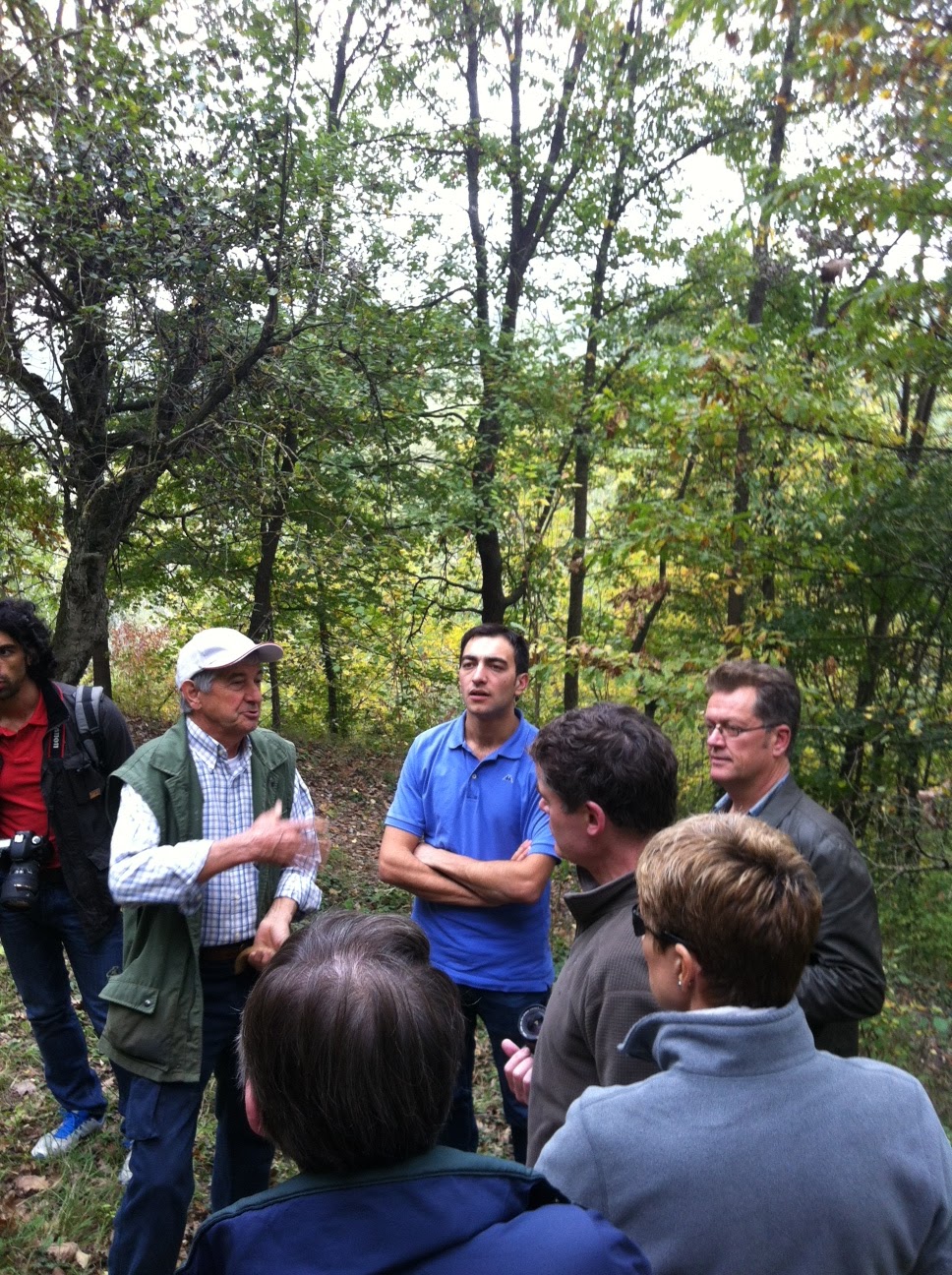
Back to the hunt.  Ezio is our trifulau.  According to Giuseppe (and the restaurant literature) he is a great truffle hunter who has been pursuing this passion (initially a job) since he was a boy.  He has his own truffle "range" located down the hillside from the elevated position of the restaurant.  Did I mention that Ezio was also the proprietor of Tra Arte e Quercie?  Well he is and after managing the production and serving of our meals, he changed into his great-white-truffle-hunter garb, picked up his divining rod (waist-high shepherd's crook with a metal tip), collected his trusty companion (looked like a golden mutt), gave us all hiking sticks, and strode off into the "jungle."  We were on our way.


As we started down the hill, we were talking loudly and laughing.  Nerves I thought.  We were venturing into the unknown.  Would we prove ourselves equal to the challenge? How would we react when we came face to face with the prey?  Would we stand firm? Or cut and run?  Ezio looked back at us with a disapproving glare and whispered something to Giuseppe.  We were obviouly not hunters.  We would most likely scare the prey away. But no, that was not his biggest concern.  No, you see, secrecy is the thing that is valued most among the trifulau.  If you find a truffle at a particular spot, you will continue to find more truffles at that spot in the future.  If you reveal that spot (inadvertently or otherwise), other hunters will harvest in your stead.  Truffle hunters keep going back to the well. Silently.

Suddenly Ezio stopped and placed his finger to his lips.  He signaled for us to stop walking and talking. I rolled my eyes.  I had been to Disney.  This was going to be the contrived drama scene with some rustling in the underbrush and then we would move on.  But no. It was not that way.  We heard some voices approaching.  How could this be?  We were on private land.  Surely Ezio would jump out and confront these people as they passed about thirty feet below us on a hunt of their own.  But he did not.  As they passed on he indicated that they were poachers and it was best to not let them know that we were there.  He did not want them potentially doubling back and spying on his hunting operation.

After that crisis passed, we continued on our walk to the area where Ezio was going to show us his magic.  In anticipation of our arrival, he had not harvested in this area for two days.  He wanted to improve the chances of our coming out of this hunt with success. When he got to this slightly flatter area, he stretched out his staff in the manner of Moses reaching out to part the Red Sea and the dog went bounding off with her nose close to the ground.  She was nuzzling around in the underbrush in an area defined by the outstretched divining rod.

Suddenly she stopped running around and started urgently nosing a particular spot. Quick as a flash Ezio was kneeling beside her, guiding her head with his hands, exerting a gentle pressure as he sought to ensure that the truffle was not close enough to the surface for the dog to damage it.  He then moved her back from the site, reached into an heretofore unnoticed slit in the back of his jacket, and pulled out a metal claw with a wooden, elongated handle.  He began to clear the underbrush and dig gently into the soil with this implement.  Just prior, he had reached into the pocket of this jacket and retrieved a reward treat which he gave to the dog.  We were silent as we watched the operation. Then Ezio reached into the soil and held up a small dark object between his thumb and forefinger.  He muttered something and then passed the object on to Guiseppe.  Small black truffle, said Giuseppe.  And we all touched it.  And smelled it.  This was our first time.  And it did smell like truffle oil.


And so we continued for another hour or so and our trove grew.  Small black truffles. Small white truffles.  Large white truffles.  I was busy calculating what my take was going to be from this afternoon's book of work.  When Ezio signalled that our work here was done, we jauntily walked back up the hill.  We were in high spirits.  We had confronted the truffle in the wild and had emerged victorious.  And we had Ezio's trophy bag full of victims to prove the point.  As we got to the top of the hill, we stopped at the gate of Ezio's residence.  His daughter-in-law was standing there holding his grandson.  The grandson struggled to be placed on the ground so that he could run over to his grandfather.  The two embraced lovingly and Ezio reached into his pouch, retrieved one of the large, valuable, white truffles and gave it to his grandson.  This 2-year-old kid looked at the truffle intently and then brought it up to his nose and smelt it.  He then passed it back to his granddad.  The cycle renews.

By the way, our reward for the day's work was the opportunity we had to see a master ply his craft. Oh well.


©Wine -- Mise en abyme