Showing posts with label Decanter. Show all posts

Thursday, October 18, 2012

The Langhe exposed: Decanter's Great Piedmont Reader Weekend

Decanter’s Great Piedmont Reader Weekend, held in Langhe (Piedmont) from Friday, October 12, to Sunday October 14, was the third in a series of trips designed to take advantage of the company’s position in the industry to expose a small group of its readers to leading proprietors/managers of a selected wine region.  The prior two events were held in Bordeaux and the Duero, respectively, and were both exceptional in their own right.  My prior experiences with Decanter, plus no prior experience with the Piedmont region, convinced me to sign up for this trip.

The scheduled activities for the weekend were: visits to Vajra, Gaja, Poderi Aldo Conterno, and Massolino wineries where we would be led in tastings by the proprietors; lunches and dinners in area restaurants, some hosted by winery proprietors; and a truffle hunt.  Our base of operations was to be the Il Boscareto Resort and Spa.  The Decanter personnel along for the trip were Sarah Kemp, Publishing Director, Emma Jones, Events Manager, and Peter McCombie MW.  I will cover the individual elements of the trip in subsequent posts but my initial, high-level impressions are covered herein.

The weather for the duration of our trip was picture perfect (contrary to pre-trip weather forecasts), with chilly morning mists yielding to bright, sunny days and with temperatures in the low-to-mid 60s.  These clear, bright days afforded clear views of the vineyard-clad slopes of the area; slopes that are bisected by winding mountain roads connecting turreted-hilltop town to turreted-hilltop town.  And, through it all, vineyards claiming various aspects of the multitudes of slopes in their mad dash from hilltop prominence to the valleys below.  The pleasant temperatures were also a boon during outdoor activities such as truffle hunting, vineyard walks, and winery facility tours (extensive in the Gaja case).


Beyond my gratitude for the weather, and the beauty of the Langhe scenery, I would also like to acknowledge the kindness and generosity of each of the proprietors whom we visited.  Our visit coincided with harvest in the Langhe yet these individuals set the time aside (between 3 and 5 hours): to explain the region and their winemaking philosophies and practices; to lead us in tutored tastings of their estate offerings; to host us at lunches (Gaja and Vajra); and to answer any and all questions completely and with an honesty and forthrightness that was truly refreshing.

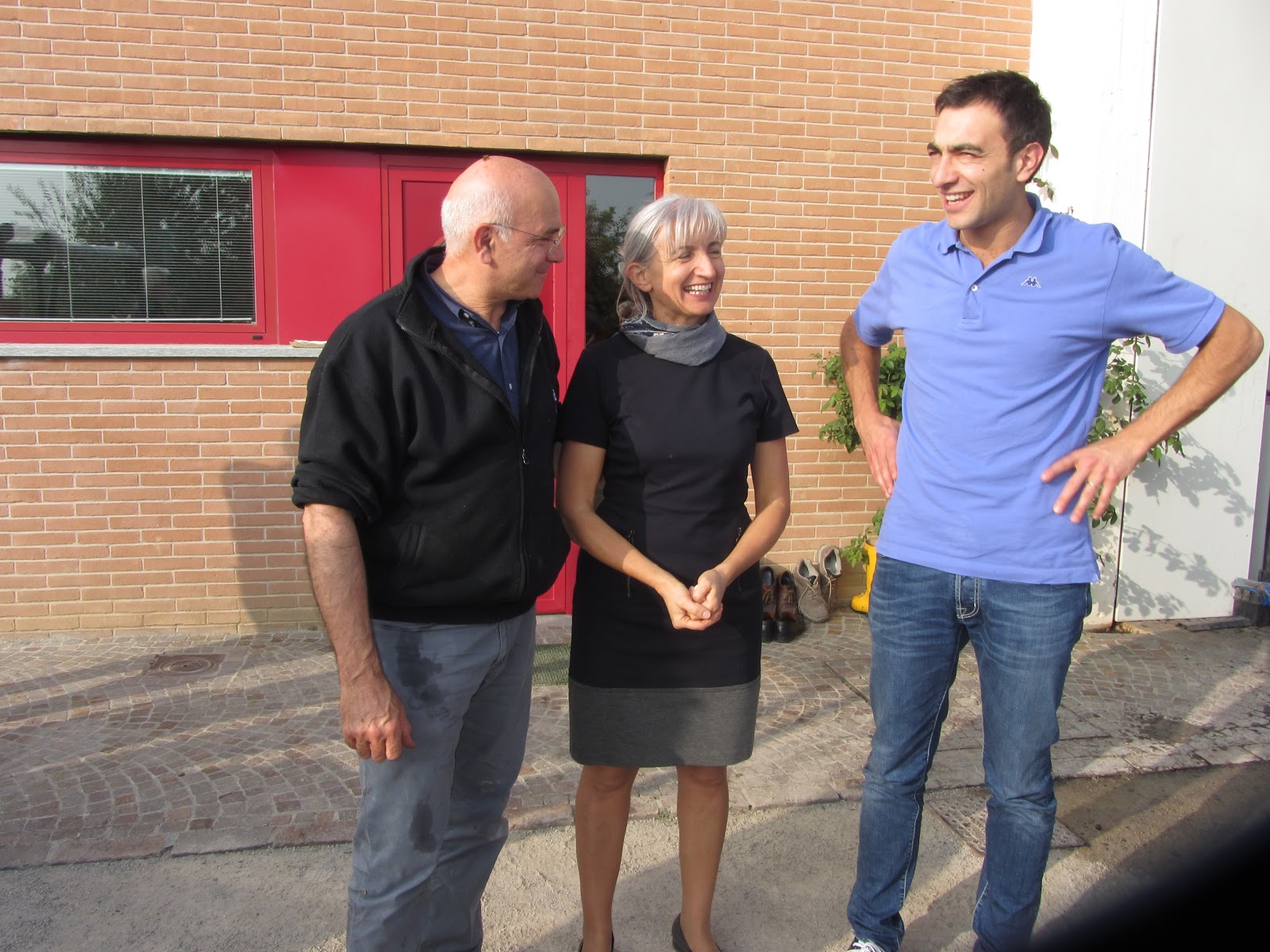
Giuseppe Vaira
Plus Mom and Dad
Angelo Gaja holding court in the courtyard
Gaja and Gaia
Giacomo Conterno
Franco Massolino
As an example of this generosity, let us take the case of the Gaja visit which occurred on Saturday, October 13th.  First off, the winery does not accept visitors in the normal course of events and, secondly, is closed on the weekend.  Yet both Angelo, family patriarch, and Gaia, his accomplished daughter, were both present to lead us through the day’s activities.  After an architectural tour of the facilities (designed to show how the winery had evolved), and a lesson on the history of the company, Angelo turned the reins over to Gaia to lead us through a tasting of vintage Gaja wines from magnums.  Absolutely phenomenal.  After the tasting, the Gajas hosted us for a lunch wherein a different set of magnums were opened to accompany the meal.  At the conclusion of the lunch we were each given a set of documentation and a magnum of 2004 Gaja Sperss enclosed in a patterned wooden box.  A stunning, unexpected gift that was humbly accepted by each recipient.  Floored us it did.


A feature of the previous Decanter trips had been extended access to leading regional estate proprietors/managers.  This trip did not disappoint in that regard.  We spent 2+ hours with Giuseppe Vaira at a tasting lunch on the first day, followed by a 45-minute truffle hunt (on which he accompanied us), followed by a visit and tour of the Vajra operations during crush – and at which time access was expanded to include his mother, father, sister, and brother – and, finally, capped by an hour-long tasting of the company’s offerings that had not been experienced at lunch.  The Gaja name is one of the most recognized in Italian wine circles and Angelo Gaja has been a tireless advocate of his family’s wines and his region.  We spent an extended period with him and Gaia and I had the distinct privilege of sitting next to him at lunch and to benefit, at a personal level, from his quick wit, sharp mind, and ever-present humor.  He is a storyteller. Giacomo Conterno walked us through an educational tasting of the Aldo Conterno wines (he poured each and every glass) and through the vineyards arrayed in the hills above the winery.  Franco Massolino did much the same, in terms of the tasting, while regaling us with stories regarding the prowess of his aunt at both the bottling and labeling stations in the winery.  The opportunity to listen and learn from practitioners of this art for such extended periods in a concentrated period of time was a very attractive proposition for me.


The team for the Piemonte experience numbered 12 individuals, six of whom had been on at least one of the previous Decanter trips.  It was a fun group that gelled immediately and was, in addition, very respectful of each other’s time, the proprietors’ contributions, and Decanter’s efforts.  The group dynamics and interaction contributed significantly to the success of the trip.
This trip was immaculate in both its conception and execution, with no hitches or hiccups along the way.  I credit Decanter for assembling such a high-powered roster of wineries and enlisting the proprietors in the conspiracy to provide its readers with a host of memorable experiences. Emma (Jones now) was her usual “model-of-efficiency self and excelled at the task of herding cats.  Sarah Kemp descended on us from on high post the lunch on Friday and from then on functioned effectively as the bridge between the team and the proprietors (with all of whom she appeared to have extremely good relations) as well as serving as the fulcrum for many in-team discourses about wine-industry-related issues.

In closing, I must say that this trip was a rip-roaring success.  Decanter once again married its readers’ loyalty, love of wine, and sense of adventure with the food, wines, fabulous accommodations, and people of a leading wine region with the result being a spectacular experience for lucky readers.  I am ready for the next trip to a region that is unencumbered by the weight of our previous passage.

©Wine -- Mise en abyme

Wednesday, February 16, 2011

Key Issues Facing the Wine Industry: Sarah Kemp, Publishing Director, Decanter

China, and its evolution as a wine consuming/producing nation, is one of the most significant issues confronting the wine industry for the foreseeable future.  So said Sarah Kemp, Publishing Director, Decanter, when our conversation turned to key wine industry issues.  In previous posts I have reported on aspects of our conversation to include her entry into the wine publishing business and Decanter's positioning vis a vis its readers.  In this post I report on Sarah's views on the issues facing the wine industry.

According to Sarah, a fact that is not widely known is that by 2014, China will have as much acreage under vine as does Australia.  With this rapid growth of in-country capacity, it is probable that the west will be absorbing commodity wines from China in the not-too-distant future.  Wines made from grapes grown in China are not generally highly regarded but she tasted some Chinese wines that showed promise on her last trip over.

While future Chinese exports merit some consideration, the issue at hand is its seemingly insatiable appetite for First Growth Bordeauxs.  Sarah illustrates the state of affairs by revealing that 60% of the production of a particular St. Emilion chateau is going to China while 40% of Farr Vintners (UK wine merchant specializing in the purchase and sale of top Bordeaux wines) 2010 revenue was attributable to sales into the Asian market.  It is Sarah's contention that the business being done with China is under-reported because no one is tracking wines that come into the UK before being re-exported to China.  This increased demand is impacting the price of both new and old vintages of Bordeaux First Growths.

In response to a question on how the Bordelaise would balance new markets versus old, Sarah stated that top proprietors do not want to lose their traditional markets because the Chinese market is still immature and may not be able to withstand a shock at this early stage.  Snubbing traditional markets could prove to be a flawed strategy if such a shock were to occur.

A second big story, according to Sarah, is South America's rise in quality wine production.  This is a major challenge to Australia and New Zealand whose problems are compounded by UK advertising programs based on a "3 for £10" mentality.  This advertising program provides a great challenge for the really good wines.  Decanter just concluded an Australin Chardonnay tasting (February issue) and many of these wines were well received by the tasting panel and garnered good scores but selling these wines into the market will be difficult.

A third issue, especially for the European wine industry, is falling consumption.  There are a number of factors driving this issue: (i) there is greater concern in Europe about health and wellness issues; (ii) much more focus on physical appearance and the things that need to be done, and avoided, in order to promote a better look; and (iii) a generation that is growing up with new world wines.  In the latter case, the US experience may be a shot across the European bows.

Sarah foresees a major Bordeaux chateau being snapped up by Chinese investors at some point in the future.  There is already Chinese ownership of minor Bordeaux properties (February, March Decanter issues) but if it is so prestigious to own a bottle of a First Growth, think how much more prestigious it would be to own one of those properties.

Friday, February 11, 2011

Part II of my Conversation with Sarah Kemp, Publishing Director, Decanter

On Friday February 4th, I sat down with Sarah Kemp, Decanter Publishing Director and founder of Decanter.com, to discuss Decanter, its readers, and key wine industry issues.  I reported on Sarah's entry into the business in a previous post and now turn to a discussion of Decanter and its readers.


Sarah sees Decanter as a magazine for people who are interested in wines with personality; non-commodity wines.  Wine, according to Sarah, has a language all its own and exerts a socializing influence on its adherents.  She cited the Yquem Bordeaux Weekend experience to illustrate her point.  The weekend brought together people from different countries and backgrounds yet, within a few minutes, attendees had "gelled."  They shared a love of wine and a common language and could converse at length on the subject without the eyes of the other party "glazing over."

Decanter is a communication tool and a reader is making a statement when he/she take out a subscription to the magazine; according to Sarah, "they have crossed a bridge."  Decanter strives to meet that customer's expectations by providing content and events that entertain, guide, and educate on old and new regions, personalities and estates.  Decanter accomplishes these objectives by bringing a "broad church" of experts to the table.  One of Sarah's jobs is to find the best and most authoritative experts and provide them a platform and, in so doing, expose the reader to a broad range of views on any single topic.  Decanter will have done its job if the information and events that it provide increases the confidence of the reader in his/her own taste.

Wednesday, February 9, 2011

Part I of a Conversation with Sarah Kemp, Publishing Director, Decanter

Decanter is the UKs foremost wine magazine and one of the most respected across the globe.  With a 90-country subscriber base, Decanter commands the attention of the world's major fine wine producers as they seek to get their message heard above the clamor that is the world wine industry.   Its mix of news, interviews, and wine/wine-region reviews keeps its subscriber base informed  on industry happenings and aids purchasing decisions.  Its eclectic mix of world-renowned contributors, its online offshoot, and a newly minted education initiative all contribute to making Decanter readers some of the best-informed wine consumers in the world. 

Sarah Kemp is the Publishing Director of Decanter and the founder of Decanter.com.  I sat with her to gain some insight into the magazine's view of the issues confronting the wine industry today and will report on that conversation in this and two subsequent posts.

I first met Sarah at the Decanter-organized Bordeaux d'Yquem Weekend and was favorably impressed by this fun-loving, story-telling bon vivant who exhibited a deep knowledge of, and connection with, the Bordelaise.  At the time I asked her if I could interview her for my blog at some future date and she responded in the affirmative.  Once it was determined that I was going to be in London for the Chateau La Mission Haut-Brion tasting, we agreed to meet on Friday, February 4th  for our conversation.


I arrived at the Blue Fin Building in London's Southwark district in good time for our 11:00 am meeting and took the elevator to the ninth floor.  I was met at the elevator by Shreena, a TA in the Events organization, and led through a warren of desks and magazines and industrious-looking young people to Sarah's office where I was welcomed with a warm hug (We do not stand on formality here.).  I had not seen Sarah since the evening of the dinner at Chateau d'Yquem so we spent some time catching up and reminiscing.  It was a blast; and then we turned to the business at hand.  I told Sarah that I wanted the conversation to focus on three broad areas: How she got into the business (wine and publishing); Decanter's role and positioning vis a vis its readers; and the key issues facing the wine industry.  She said "let's go."  And we went.

Based on Sarah's telling, where she is today is totally attributable to a number of key influencers in her life.  Her grandfather loved wine while her father had no palate.  When she attained her 16th birthday, her grandfather gave her a copy of Hugh Johnson's Wine Companion (2nd edition) and the lovely drawings and vignettes in the book sparked her imagination.  This initial flame was fanned by two early relationships.  First, a boyfriend whose father was an avid oenophile (and a subscriber to Decanter no less) and, second, a girlfriend who took her to many a wine tasting.  Her father did not have a palate but he was a journalist and from a young age Sarah was surrounded by writing, publishing, and media-related issues.

Sarah's first publishing job was with the magazine Field which, ironically, is just down the hall from where she sits today.  When an opportunity to work for Decanter presented itself, she leapt at it and, after 25 years, with the magazine remains excited about where she works and its prospects.

Even though she has this senior position at Decanter, Sarah does not view herself as a wine expert a la Jancis Robinson (She subscribes to the adage that the more you learn about wine, the more you find out how much you don't know.).  Rather, Sarah views herself as a passionate wine drinker and wine lover;  akin to a Decanter reader.  Bordeaux wines are her first love but she also has an appreciation for wines from the Stag's Leap District of Napa, Washington State, and South America.


She finds the wine industry eminently fascinating with family-owned businesses sitting side-by-side with corporate titans and drama and soap operas, especially in Bordeaux, being the order of the day.

This post covered Sarah's introduction to wine and the magazine industry and her perspective of her positioning within that environment today.  In subsequent posts the conversation will cover Decanter and its readers and wine-industry issues.

Tuesday, November 30, 2010

The Medoc sub-region of Bordeaux

On October 8th, I attended a class at Decanter HQ in London led by Decanter Contributing Editor Steven Spurrier and titled Mastering the Medoc and Graves.  In a previous post, I reviewed the class as an event.  In this and subsequent posts, I will report on the regions, the houses, and the wines covered in the course.  I begin the series with a look at the Medoc.


The Medoc is a part of the larger (and storied) Bordeaux wine region which is concentrated around the Gironde estuary and its tributary rivers, the Garonne and Dordogne.  The region owes its winemaking prowess to a number of factors: (i) a temperate climate characterized by humid springs, hot summers, sunny autumns, and relatively mild winters; (ii) the warming influences of the Gironde and the Gulf Stream in the Atlantic Ocean; (iii) its soils (quartz and flint pebbles over a subsoil of marl on the left bank and clay, limestone, and some gravel on the right); and (iv) protection from the ocean winds by the Landes pine forest to the southwest.

The Medoc is divided into two sub-appellations, the Medoc to the north and the Haut-Medoc, with the Medoc covering 4700 hectares and the Haut-Medoc 4300.  The Medoc sub-appellation, called Bas Medoc in earlier times, has heavy, moisture-retaining soils which are much more suited to Merlot than the Cabernet Sauvignon which dominates in its neighbor to the south.  Many areas in the Haut Medoc have large deposits of gravel which were washed down from the Pyrenees thousands of years ago.  This gravel provides excellent drainage and ideal conditions for Cabernet Sauvignon which does not like "wet feet."  These gravelly soils also retain warmth and, in so doing, aid in the ripening of the grapes.

The Chateaux in the the Medoc have been ranked since the 1855 World's Fair and that 1855 Classification, as well as the Cru Bourgeois classification, have been covered in a previous post.

Within the Haut-Medoc appellation there are a number of communal appellations which are renowned for producing some of the finest wines in the world.  Beginning with St. Estephe to the south of Medoc, these communes hug the Gironde until ending with Margaux at the fork which heralds the beginning of the Garonne and Dordogne rivers.  St. Estephe covers 1200 hectares and its wines are considered to be rustic.  They are tannic, muscular, and long-lasting.  Pauillac is 1100 hectares in size with wines that are considered powerful, yet elegant.  There are 15 classed growths but three Premier Crus (Chateaus Lafite, Latour, and Mouton) in this commune.  St. Julien is the smallest of the communes with 900 hectares and has 10 classed growths.  Its wines age well and combine elegance with austerity.  Margaux covers 1300 hectares and its wines are thought to be the most "perfumed, feminine, and elegant."

I will cover the Graves region in my next post.

Sunday, November 14, 2010

Cellar Tour and Dinner at Château d'Yquem with M. Pierre Lurton, GM: Decanter d'Yquem Weekend

We made our way back to Les Sources de Caudalie after the Château Cheval Blanc visit and, after stopping to take pictures at Petrus and a few other château, what had originally been billed as an afternoon free quickly became a mad dash to be ready in time for our transit to Château d'Yquem.


When we started out, the light was failing and it was fully dark by the time we got to our destination.  Based on the vehicles' climb up the slope to the château, and the orientation of the lights in the distance, one got the sense that the daytime view would be dramatic.  There was some disappointment that we would not experience that view on this visit (a feeling that was enhanced when M. Lurton mentioned, during the introductions, that the daytime view was spectacular).  We turned into a gravel driveway and pulled into a darkened courtyard that was surrounded on all sides by buildings and/or walls.


There was a commotion to our left and three people came crunching towards us in the dark.  One of the two males gave Sarah Kemp a welcoming peck on the cheek and then proceeded to shake everyone's hand.  This was Pierre Lurton, General Manager of both Château dYquem and Château Cheval Blanc.  He was accompanied by Valérie Lailheugue, who was introduced as being responsible for Corporate Communications but, as the evening wore on, it became evident that she was the institutional memory of the Château.

After these "in-the-dark" introductions, M. Lurton indicated that we would go visit the cellar.  He said that  he was not going to spend a lot of time on the workings of the Château as we would probably find it boring after two days of listening to similar material.  The cellar was fronted by a brightly lit foyer whose walls were decorated with framed pictures of vines and bunches of grapes. M. Lurton stopped in front of these pictures and began to speak.


He begun by informing us as to his responsibilities at both Yquem and Cheval Blanc and indicated that he was also making wine in Argentina.  He referred to d'Yquem as possessing "sensual terroir" and said that its 105 hectares (the Yquem website says 188 hectares of which 113 is under vine) sits in the middle of the 2000-hectare Sauternes appellation.  He briefly explained the botrytis-formation process and told us that the traditional Yquem blend is 80% Semillon and 20% Sauvignon Blanc.  The grapes are picked beginning in the middle of September and continues through an average of six waves.

As we walked through the cellar, M. Lurton continued his discourse.  Wines from individual plots are stored separately in the fermentation room.  The wines are stored in 100% new oak and are in barrel for 34-40 months.  Annual production is between 500 and 1000 barrels.  The Chinese market has been good for the company but the biggest consumer of d'Yquem continues to be Italians.


After leaving the cellar we repaired to the tasting room.  Glasses were already set up in anticipation of our arrival and M. Lurton and Valérie went behind the bar and began pouring the 2007 d'Yquem for us to taste.  M. Lurton indicated that the 2007 vintage was a good one in Sauternes.  The grapes were late-picked because of an Indian summer with the earliest picking on September 10th and the last of six waves occurring on November 6th.  The wine has 125 g/l of residual sugar and 14% alcohol.  It has a golden color and, on the nose, botrytis, rust, intense pure fruit, light honey, peach, pineapple, and a sense of the complexity that is embodied in the wine.  The wine exhibits a little spiciness and a very long finish.  It was bottled 8 months ago.


Upon completing the tasting we decamped to the courtyard and made our way over to the Reception and Dining rooms.  We entered a small foyer and to the right was a cream-colored room with white trim and furnished with stunning period pieces.  On the walls were ancient-looking tapestries and paintings and, covering a part of the polished wood floor, a beautiful Parisian rug.  This was the room in which the champagne reception was being held.  I gingerly stepped into the room so as not to break anything.  My wife stepped right in and sat in one of the chairs to change from her cellar shoes to her dinner togs.  I held my breath waiting for the antique chair to break and bring her crashing to the ground and me a bill from Château d'Yquem for damage to their property.  But the chair held up and I started breathing again.  In my relief I hastily downed a glass of the Veuve Clicquot which had appeared as if out of thin air.


The reception lasted for about 30 minutes before we were summoned to the Dining Room, the setting of which is shown in the picture below.  A seating chart on an easel showed where everyone would be sitting and individual name tags stood at attention on a sideboard.


The first course was a Medley de Saint-Jacques aux Truffes (Scallops with truffles).  The presentation was excellent and a member of the wait staff circulated with a bowl of brown truffle sauce as an accompaniment.  Some diners poured the sauce directly over the course while others placed it on the side.  This course was paired with the 2007 vintage of Y, the Château's dry white wine.  The wine had a botrytized nose to go along with nuttiness, rusty nails, lemon zest, grassiness, tropical notes and white fruits.  This wine paired very well with this course.


The second course was Noix de Veau (round filet of Veal), Girolles (chanterelle mushrooms) et Tombée d'Epinards (cooked-down spinach).  This course did have an optional rust-colored sauce as an accompaniment and was paired with a 1996 d'Yquem.  The wine was delicate and fresh and less rich than the 2007 tasted earlier.  I found this pairing to be a little rocky as my palate kept asking "where's the red?"


For our next course we had a selection of cheeses (Comté, Roche baron, Bleu d'Aurergne).  The final course was a Gratin de Pamplemousse (crusted grapefruit) and was paired with a 1988 d'Yquem.  This wine had an excellent bronze color and was rich but balanced.  This wine paired excellently with this course.


This was a truly excellent meal both in terms of the gustatory items as well as the environment that was created for us that evening.  The setting was fabulous and will be imprinted on my memory for a very long time.  M. Lurton was a gracious host and was ably assisted in that endeavor by Valérie.  M. Lurton regaled us with story after story drawn from his personal experiences and Sarah matched him tale for tale.  It was a pleasure to be sitting next to her, and diagonally across from him, so that I could absorb both the words and facial expressions of these two as they bantered back and forth.

We did not want to leave. But, alas, we had to.

Wednesday, November 10, 2010

Château Cheval Blanc visit with Pierre Olivier Clouet, Technical Director: Decanter d"Yquem Weekend

We arose on Saturday morning and, after breakfast, boarded two vans for transit to Château Cheval Blanc.  Master of Wine James Lawther was especially helpful during the course of the journey, pointing out the landmarks and points of interest as we traversed this hallowed ground.


As we turned into the road on which Château Cheval Blanc is located, James pointed to a nearby château and identified it as Château l'Evangile, the producer of one of my favorite Pomerols.


After we disembarked into the château courtyard, three men came hurrying up to greet us.  The youngest of the three (barely out of diapers I would say) introduced himself as Pierre Olivier Clouet, Technical Director of Cheval Blanc and, he said, he would be leading the tour as well as hosting us at the subsequent sit-down lunch.


Prior to 1832, according to Pierre, Cheval Blanc was a part of La Tour Figeac, the vineyards of which lie northwest and west.  Cheval Blanc consists of 37 acres (35 of which are planted to vine at any one time) and is planted 60% Cabernet Franc and 40% Merlot.  The Château is only one of two in the St. Emilion Appellation which is classified as Premier Grands Crus Classé A (the other is Château Ausone).  The Château has been in the hands of the Laussac-Fourcaud (later Fourcaud-Laussac) family continuously until it was acquired jointly by LVMH and Belgian businessman Albert Frère in 1998.  Pierre Lurton, of the famed Bordeaux Lurton family, was installed as General Manager after the acquisition (While at dinner at d'Yquem later that evening, M. Lurton regaled us with a funny story regarding his interview for that position.  I will recount that story in my post on the Yquem visit.).

Continuing the discussion, Pierre noted that St. Emilion was characterized by Merlot and limestone but that there was no limestone on the Cheval Blanc property.  Cheval Blanc stands at the limit of Pomerol (and at this time he points out l'Evangile, Petrus, Certan) and has huge dollops (my word, not his) of Pomerol soil. The Cheval Blanc soil composition is 40% clay, 40% gravel, and 20% sand.  This is important to the château because, in his view, 80% of wine quality potential lies in the soil; excellent wines come from good soil.  The soil at Cheval Blanc is poor in nitrogen and water -- very dry -- and this stresses the vines into producing lots of tannin, aroma, and acidity.


The factors that he focuses on in managing the vineyards are: quantity of grapes produced, maturity, and protection against diseases.  The château manages quantity through winter pruning, green harvesting, and soil fertilization.  Vines are pruned in the winter to retard development.  The goal is to have 7 buds/vine plant but the pruning is vine-specific and a particular plant may end up with more or less.  Using this process, vineyard workers can only prune 300-400 plants per day.  Green harvesting reduces the likelihood of rot and increases concentration in the remaining grapes.  The château sprays to protect against diseases but in decreasing quantities.  They are moving more to planting vetch (a flowering plant in the legume family) on fallow soil in order to purge and aerate the soil.

Pierre identified three types of maturity: technology, aromatic, and tannin.  He sees technology maturity as revolving around finding a good balance between sugar and acidity, with acidity being key to the ageability of wines.  Aromatic maturity strives for freshness, with greenness at one end of the spectrum and botrytization at the other.  Tannins flow between density and ripeness.  These three maturities need to be optimized on the same day in order to begin picking fruit.

After this discussion in the courtyard, we moved into the cellar to discuss vinification.  Pierre pointed out the heavy cranes overhead and indicated that they were in the midst of a major expansion project which would provide additional space for storage and small fermentation vats.


Château Cheval Blanc's vinification process is "classical."  Sorting is essentially by the pickers in the vineyard who select the best bunches.  These bunches are carried to the sorting tables in small baskets for additional assessment before being pressed.  Juice flows into concrete fermentation vats and when a vat is full fermentation is initiated by adding artificial yeast to the mix.  Artificial yeasts are used to guard against the risk of incomplete fermentation resulting from the exhaustion of natural yeasts during the process.  The juice is pumped over the cap three times per day and this pumping over continues until fermentation is complete.  Maceration continues for 15+ days until a 4-member committee calls a halt to the process. Malolactic fermentation occurs in vats because this yields, according to Pierre, purer fruit and greater elegance.  After malolactic fermentation, the wine is racked and sulfur is added.


Blending occurs 6 months after fermentation.  The wine is aged for 16 to 18 months in new French oak with racking every three months.  They protect against oxygen during racking by using nitrogen to force wine from a full barrel into a clean empty barrel through a connecting, air-tight rubber tube.  Using this process, 33 barrels are racked every day, with 5 weeks required to rack all of the cellars.  After 6 or 7 rackings, the wine is left to be clarified by gravity.

Barrel quality is assured by conducting blind tastings with coopers- and Cheval Blanc staff.  These tastings are done across all coopers and then for the barrels from a single cooper.  This process is utilized to select coopers as well as to improve the tightness-of-fit of the barrels sent to the Château.

At this point we concluded the tour and proceeded to a champagne reception and lunch.  These will be covered in a subsequent post.

Tuesday, November 9, 2010

Château Smith Haut Lafitte Cellar Tour and Les Sources de Caudalie Dinner: Decanter d'Yquem Weekend

Photo courtesy Ogodinho with permission.
Chateau Smith Haut Lafitte is a property located in the Pessac-Léognan commune of the Graves sub-region of Bordeaux and is owned by Florence and Daniel Cathiard, former members of the French National Ski Team.  Decanter had arranged for Yquem Weekend participants to visit the winery for a cellar tour at 6:00 pm on Friday and we showed up on schedule for this opening event.  The tour was listed as optional but, in a testament to the high interest level of the participants, everyone showed up.

The tour was led initially by Xavier Feuillerat, the individual in the winery tasked with that activity. According to Xavier, the château can trace its roots back to 1365.  The name is derived from the Old French word Lahite -- hill -- and, thus, Haut Lafitte is top of the hill.  In 1770 the property was bought by one John Smith who modified the château's name by adding his surname in the primary position.  At one time in its history the château was owned by Lodi Duffour-Duberger, one-time mayor of Bordeaux and the individual who had been charged with the development and ratification of the 1855 Bordeaux Classification.


The current owners were married in 1968.  Daniel's father ran a grocery chain which he went home to manage after his father died in 1970.  In addition to growing that business into a major mid-market chain, Daniel launched a sports-themed chain called Go Sport and both of these businesses were sold in 1990 and Château Smith Haut Lafitte bought with the sale proceeds.

The property consists of 67 hectares, 56 of which are planted to red wine grapes.  Xavier indicated that the white wine grapes were farmed biodynamically with the plots ploughed by horses, no insecticides, and vines pruned only when the moon was in a certain phase.  The white wines are fermented in 50% new French oak over a 3-week period and stored on the lees for 12 months with battonage.  The composition of the white wine is 90% Sauvignon Blanc, 5% Semillon, and 5% Sauvignon Gris.  The composition of the red wine is 35% Merlot, 55% Cabernet Sauvignon, and 10% Cabernet Franc.


By this time Madame Cathiard had joined the tour and taken over leadership responsibilities and proceeded to refute the claim of biodynamic farming.  She said they would never be biodynamic.  The château does use organic compost and plough with horses but the latter is, according to her, to avoid compacting the soil in a particularly fragile area.

James Lawther, Madame Cathiard, and Technical Director Fabian Teitgen
According to Madame Cathiard, when they bought the property 20 years ago, they were concerned with the fertility of the rootstock and have had an ongoing vine-replacement program to address this issue.  The oldest vines on the property are 52 years old and can go 6 to 7 meters into the soil.


It takes 3-5 years before they begin picking grapes from the new plants and the press from these grapes go into the second wine (Les Hauts de Smith).

The winery has an on-site cooperage which produces three barrels per day.  This production is sold to the second label and to Cognac and Armagnac producers and some used in-house.

Madame Cathiard took us into a sub-basement with access secured through an electrically operated door which opened upwards from the floor.  As we descended into the room she indicated that it was named Le Paradis -- the paradise.  On the left-hand side of the room was a table on which lay every size of wine that is produced at the château, proceeding from smallest to largest.  On the right side of the room was a line of bottles of the château's red wines arranged from oldest to most recent.  At the front of the room was a glass cube containing a wine bottle which, through the influence of imbedded mirrors, appeared to be the entrance to a hole stretching to infinity.


Photo courtesy of Ogodinho. Used with permission.
Photo courtesy Ogodinho. Used with permission.
At the conclusion of the cellar tour Madame Cathiard took us to the château's tasting room where we tasted the 2008 vintage of the white wine.  Madame Cathiard described it as evolving nicely with aromas of grapefruit and white flowers.  James Lawther, the Decanter MW accompanying us on the trip, described the wine as having freshness and balance with visible but harmonious oak, and grapefruit and apricot on the nose, exuberance on the palate, and good length and depth.

At the conclusion of the visit we thanked Madame effusively and wended our way back to Les Source des Caudalie's La Table du Lavoir restaurant for dinner.  One of the thoughtful things that Decanter had done was to check for food allergies/preferences ahead of time and to pass that information on to the locales at which we ate.  The menus were presented to us with options or personalized for those with specific needs.  The menu for the dinner at La Table du Lavoir was as follows:

Course 1:  Onion tart with anchovies and black olives, rocket salad parmesan or Foie gras from the Landes with Lillet caramel and toast; accompanied by Chateau Smith Haut Lafitte Blanc 2007.
Course 2:  Sea Breem filet à la plancha, ink of squid risotto, red sweet pepper juice or Duck magret, seasonal mushrooms and juice; acompanied by Chateau Smith Haut Lafitte Rogue 2000.
Course 3:  Warm soft chocolate cake, Bourbon vanilla ice cream or Figs tart, almond milk sorbet; accompanied by Chateau Smith Haut Lafitte Rouge 1998.

This was a great getting-to-know-you dinner and set a phenomenal baseline of communication for the entire group.  By the way, the 1998 was the preference of the group as the 2000 needed to be decanted fro a while.

Monday, November 8, 2010

A Review of Decanter's d'Yquem Weekend Event

Decanter had billed it as a Bordeaux Readers d'Yquem Weekend and, at the end of the day, the Readers had had a lot of d'Yquem and (maybe as a result) a singularly exhilarating weekend.  This post reviews and assesses the overall program while subsequent posts will examine the individual elements in greater detail.

I became aware of this event when I visited Decanter's HQ in London a few weeks ago to attend the Steven Spurrier class on Mastering the Medoc and Graves.  While we were at lunch Steven mentioned the event and shared the promotional literature with us.  As laid out, Decanter proposed a weekend in Bordeaux with the following features:  Limited to 16 people; Les Sources de Caudalie as the hotel of choice; cellar tours of Châteaus Smith Haut Lafitte, Cheval Blanc, and d'Yquem, each tour to be led by a senior manager of the Château; post-cellar-tour lunch at Château Cheval Blanc and dinner at Château d"Yquem; transportation to and from all events; Decanter senior managers and a Master of Wine to accompany tour members on the trip.  I saw this as a fantastic opportunity to be introduced to Bordeaux from the top and, simultaneously, have the opportunity to interact with Decanter senior management and a Master of Wine for an entire weekend.  I jumped at the opportunity.

I flew into the Bordeaux airport a little after midnight on Thursday and spent the rest of the night at a hotel in the city of Bordeaux.  I headed out Les Sources de Caudalie a little after 1:00 pm.  I had never stayed at the establishment but was familiar with it through the writings of George Taber.  In his book In Search of Bacchus (Scribner, 2009), Taber described it as "... a small luxury hotel" whose "rooms are furnished with antiques, no two of them the same. One suite is in a fisherman's hut built on stilts in a small artificial lake."  We were given notice of our impending arrival at Caudalie by the sight of the square, squat tower with big, bold letters announcing Château Smith Haut Lafitte.


 Les Sources de Caudalie is directly across a narrow street from Château Smith Haut Lafitte but we had to delay our entrance into the property while another taxi backed gingerly out of an even narrower stub-driveway that serviced the hotel.  Once we unloaded the car and stepped into the entranceway, I had a clear sense that this was a special place.  The lobby was small but well appointed and looked out on the artificial lake described by Taber.  Beyond the lake ran row after row of gold-, rust-, or brown-robed vines whose leaves individually reflected the seasons impact. The reception staff were courteous and helpful without being fawning.


Our room was not ready so we had lunch and then hung at the bar drinking champagne.  While at the bar we met Sarah Kemp, Decanter Publishing Director. She was very disarming and our interaction at this initial meeting signaled that it was going to be a fantastic weekend.


Our schedule called for assembly in the hotel lobby at 5:50 pm for an optional tour of the Château Smith Haut Lafitte cellar, said tour to be led by Decanter Contributor James Lawther MW.  At this juncture I was introduced to the other members of the tour group (12 of us in all) as well as members of the Decanter team whom I had not previously met.  We took a short walk in the dark to the Château Smith Haut Lafitte cellar and was ushered into the building to begin our tour.  The tour was initially led by a senior staff member at Smith Haut Lafitte but Madame Cathiard, co-owner of the property, joined our group shortly after the tour began and guided us the rest of the way in.


Madame Cathiard gave us a spirited and enthusiastic exposition on the winery and its wines and set an overall high tone which was maintained by all of the wineries that we visited over the course of the weekend.  I will cover the winery visits in greater detail in future posts but, at this point, would like to provide my perspective on the event as a whole.

Decanter  over-delivered (not a bad thing) and, in so doing, exceeded my wildest expectations.  I live for memorable experiences and this one truly fit the bill.  We had cellar tours of Châteaus Smith Haut Lafitte, Cheval Blanc, and d'Yquem led by Florence Cathiard (co-owner), Pierre Olivier Clouet (Technical Director), and Pierre Lurton (General Manager), respectively, and, in so doing, gained insights into the workings of those enterprises at a level (and in a setting) that would have been difficult to realize had I pursued it on my own.   In addition to the cellar tours, we had sit-down meals at Cheval Blanc and d'Yquem that were hosted by M. Clouet and M. Lurton, respectively, and nothing relaxes a wine person like good food and their own wines.  They were very relaxed.


One of the results of the event was that like-minded individuals were brought together on hallowed ground.  We are all wine collectors who love talking about wine and sharing a glass of wine and good food with good friends.  We all saw the d'Yquem event as a "must do"; and did.  I enjoyed every one that I met and will have ongoing relationships with a number of the people that I met there.


The final contributing element to the success of the weekend was the human element: the Decanter team.  They worked unceasingly to ensure that the weekend lived up to its hype.  Emma scurrying about with her ever-present clipboard, whipping service-providers into shape, herding recalcitrant readers between events in order to keep us on track, and ensuring that the spa worked as advertised by taking the first honey-something-or-other wrap.  Lacey working diligently behind the scenes with an ever-present smile and upraised glass.  James was a peach. A Master of Wine who has not read his own reviews. Who was helpful and always ready with a detailed explanation or tasting note when called upon.  He gave running commentaries as we drove through the various communes and even stole us away for a trip through St. Emilion while the other van was making a Macaroon stop.


Sarah was wonderful to be around.  She is exceedingly knowledgeable about wine issues, events, trends, and people and appears to be well-connected in Bordeaux.  She is a great conversationalist who loves laughter; and a glass of wine.  When I asked what were her objectives in launching the event, she said she wanted to share her experiences with the magazines' readers.  I asked about her measure of success and she said "You guys still speaking to us in the breakfast room on Sunday morning."  Her easy banter with Madame Cathiard and M. Lurton attests to her connectedness and relationships with the leading lights of the community.  During the dinner at d"Yquem it was was obvious that they had socialized a lot because they almost had to cast lots to determine who would tell the next story; stories which they both seemed to know.

This was an inaugural event and, in my opinion, it was stunning.  Decanter does not know if/when/where they will have a second event but if they do you can bet your life on one thing.  I'll be there.