Showing posts with label Cuba. Show all posts

Tuesday, January 3, 2017

Out and about in Havana: In search of the co-op

I was awakened by sunlight streaming into our room through the sliding glass door leading onto the balcony. After a top-level breakfast at Sierra Maestra, we went down to the hotel lobby to explore options for our second day in the city.

We decided to start off with a city tour and opted for one of the Classic American cars parked outside the hotel. The problem, though, was that the person who solicited our business was not the same person driving the car. The person with whom we negotiated the deal spoke perfect English. Once we got into the car and engaged the driver, we realized that this was not going to work. The driver had very little English; a slight problem when you are looking forward to a narrated tour -- in English. We asked the driver to pull over and got out. We then went to plan B: the hop-on, hop off buses.

Hop-on, hop-off service is ubiquitous in tourist destinations around the world and is a great way of getting an overview of a new city at your own time and pace. The problem with the Havana service was the frequency (or, rather, the lack of same) and the paucity of information conveyed by the onboard "tour guide"(who also doubled as the cashier). After a frustratingly long wait, the bus showed up and we (wait for it) hopped on.


We began our ride in Verdado and traversed the entire length of the Malecón to Old Habana, with one or two stops along the way.

View of the Malecon with Straits of Florida in background

Sea wall and promenade of the Malecon

View of the waters from the Malecon sea wall

View Vedado to Old Havana

Hotel Nacional, as viewed from the Malecon
We disembarked at Central Park and immediately made our way over to the brightly colored vintage American cars that were lined up waiting for passengers. As we walked among the cars, we were constantly asked whether we wanted to take a tour of the city in one of the cars. Or if we wanted to have our pictures taken sitting in one of the cars.

The area was bustling with tourists walking among the cars, getting into cars at the beginning of trips, or getting out of cars at the conclusion of tours. As I stepped across the street to take a wide-angle shot of Parlo among the cars, I sensed someone coming towards me. Out of the corner of my eyes I saw him pause and look down at my socks (The tops of my socks displayed the colors of the Jamaican flag.). I could see the wheels turning over in his head as he sought to incorporate this observation into his approach. And then he pounced. He greeted me like a long lost brother. He loved Jamaica (I am not Jamaican); his Grandmother came to Cuba from Jamaica when she was 5 years old; etc., etc.

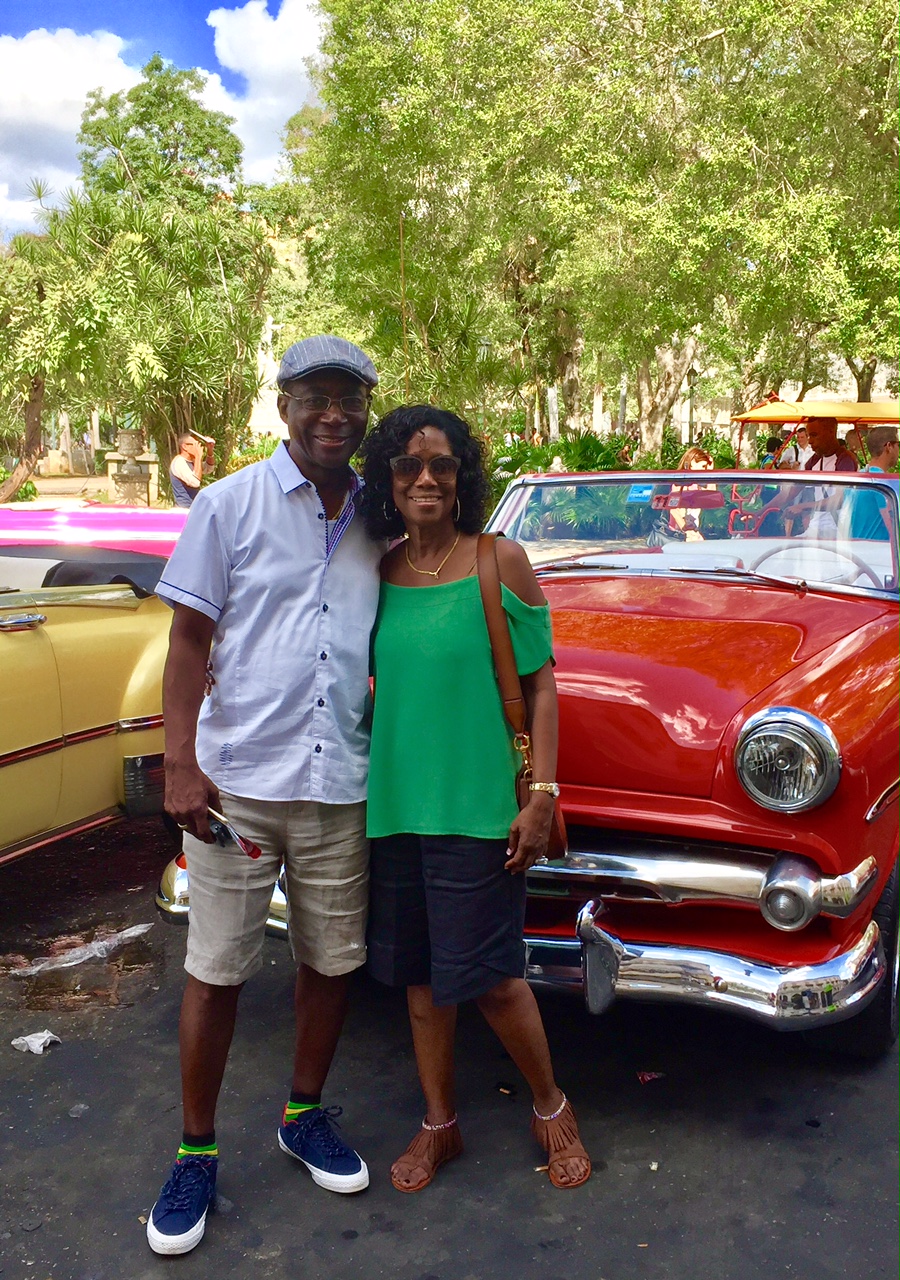

After this hearty opening, he proceeded to the lines of whether we wanted to take a city tour in one of the cars; or wanted to have our pictures taken sitting in one of the cars. Now he did not own a car. He was what I have previously described as a "steerer." When he realized that we were not interested in any car-related activities, he pitched going to the co-op where we could purchase cigars significantly below the price being charged at the hotel. This sounded interesting because I thought I would see some cigar production activities. And, according to my guy, the co-op was within walking distance.


We headed west away from Central Park and then turned south. Conditions deteriorated rapidly and we appeared to be swimming upstream against a mass of humanity that was hell bent on getting out of the area that we were going into. After walking for a little while I realized that this was the area that my wife's friend had pointed out to me from my hotel room as an area to avoid. Well, we were already in it.  My wife was cheerily taking photographs of her surroundings as we went along and I kept thinking "I know the crime rate is low in Cuba but I wished you had left that ring in the US."


We walked for a while. People looking at us because we were obviously tourists. Our "guide" hailed folks along the street and in some of the apartments which lined the street on both sides. He was as a big game hunter returning to the village with a trophy kill. Us.

After what seemed like an eternity, we turned into a dilapidated apartment building and walked down a hallway off which a number of doors opened. Living quarters all; and not very palatable. This was definitely not what I had expected when we set out on the "visit to the co-op."

There were a few other souls in the room perusing the cigar display. A woman was attempting to close a sale with a reluctant buyer so my guide launched into sales mode. Purchasing the cigars here would be helping these people and the price was significantly lower than at the hotel. As he went through the spiel, he was handing me different packaging options: Cohiba in bulk; smartly packaged Robustos; and a pocket-sized edition.

During the time that I smoked cigars seriously, Cohibas had always been my favorite. But there was an adage among Cohiba smokers: There are many more Cohibas sold than are made. There was no controlling for authenticity in this environment so I would not bite. My guide was not happy.


But he perked up when we said that we needed to have lunch. He knew just the place, he said. So we embarked on another long march to the other side of the old town. I will cover that experience in a subsequent post.

©Wine -- Mise en abyme

Monday, December 26, 2016

Out and about in Havana (Cuba): Day 1

First some context. We traveled to Cuba during the official period of mourning for Fidel Castro's death. The restrictions on public activity put in place to honor his death colored the lenses through which we saw Havana and served as a limiting factor on our Havana experience.

When Fidel's death was first announced, I was unsure as to whether it would be a good idea to embark on the planned trip. After many consultations with my wife (who would be accompanying me on the trip), my family, and friends, I decided to continue as planned.

Once we got to Cuba, the effects of the mandated restrictions on daily life became readily apparent. First, no public playing of music or dancing was allowed. And this held true for the man (or woman) in the street as well as the professionals plying their trade in the nation's cultural centers.

On the day of our arrival, the restriction on alcohol sales was still in effect. This curtailed the sales of alcohol beverages except at a restaurant in a hotel. And if the hotel/restaurant was government owned, they were excluded from the exception. The restriction on alcohol sales expired on our second day in town but the restrictions on music and dancing remained in place for our entire stay.

The impact of these restrictions manifested itself in interesting ways. For example, we met a group of Rice University boosters who were traveling with the baseball team as part of an educational visit. The team was slated to travel around the country, playing against teams and attending lectures, all contributing to college credits for the athletes. With Fidel's death, the Cuban players were no longer able to play the scheduled games, leaving the Rice University tour leaders with the unenviable task of keeping 40+ players occupied when more than half of their daily activities had been wiped out.

So back to the task at hand.

After a lengthy check-in process (not the norm), we decided to do lunch in Sierra Maestra, the Havana Libre's top restaurant located on its 25th floor. The views of Havana and the sea from the vantage point of the dining room were stunning. One of the things which struck me as unusual though was the lack of boating activity in the waters around Havana. The waters off the coast of Havana are the Florida Straits, the body of water that connects the Atlantic Ocean to the Gulf of Mexico. One of the givens in the waters of the coasts of Florida and the Caribbean islands, is a lot of boating and other water activities. For the duration of my stay in Havana, the only boats I saw in the water were the two cruise ships pictured below and a Roll on-Roll off cargo ship exiting the harbor.


While we were at lunch, Parlo struck up a conversation with a grandmother, mother, and kid and was so engrossed in it that I decided to vacate the premises. I figured I could get some writing in while she was otherwise engaged. After a while, the daughter and son accompanied Parlo back to our room (the young lady was of Cuban heritage and lived in Miami) to give me pointers as to the way things were during the mourning period, things I could and could not do, and places to avoid. From our room we had a pretty good view of Old Havana so she was able to physically point out areas to me as she spoke.

After the young lady left (we were going to meet them for dinner at 8:00 pm at a location outside the hotel), Parlo and I began discussions as to what to do with the remainder of the day. I preferred to start exploring on the morrow but she wanted to get out immediately. Neither of us were budging so she decided to go tour the city on her own. She rented a CoCo taxi (a three-wheeled vehicle with a single seat for the driver upfront and space for up to three passengers in the rear). She was gone for  a while and came back all bubbly and full of stories of the places they had visited and the pictures she had taken. I regretted my decision.


After Parlo's return, we began preparations for dinner. As mentioned, Parlo had arranged for us to have dinner with the family she had met at lunch. The dinner was scheduled for 8:00 pm at a restaurant called La Torre, located on the 35th floor ( or 33rd or 36th, depending on your source) of the Focsa Building. The Focsa building was within walking distance of our hotel so we strode out of the hotel lobby and into the streets of Vedado. Our destination is the tallest building in Vedado so finding our way there was not going to be a problem.

As we were walking a man approached us, engaging us in conversation as we went. He asked where we were from (He loved the US), how did we like Cuba so far, and where we were going. When we told him the name of the restaurant, he told us that it was closed as a result of Fidel's death. We said we wanted to see that for ourselves so he offered to show us the way. We got there and the restaurant was closed. He then offered to take us to one of the best paladares (small, family-run restaurant, usually setup in a converted part of a home) in Vedado for our dinner. We walked with him to this paladar named Santa Barbara, but it was full. He walked us to a second paladar but, after we were seated, we found out that this establishment was not selling alcohol beverages because of Fidel's death. Faced with the choice of a drinks-free dinner at that establishment versus dinner with wine at the hotel, we opted for the latter.

In Havana, tourists are a key part of the city's income source. The needs of these tourists are met by restaurants, hotels, bars, nightclubs, craft shops, and suchlike. But there is a thriving industry of business facilitators. These are folks who approach you on the streets and try to steer you to a particular establishment be it a restaurant, a taxi, or cigar co-op (as we will see in my upcoming post). These "steerers" are compensated by the benefiting establishment but are not averse to receiving a token of the buyers appreciation. The gentleman who attempted to help us find a place to eat that night was a steerer.


©Wine -- Mise en abyme

Sunday, December 18, 2016

Selected Cuba accommodations for the discerning traveler

In May of 2015, I wrote a blog post titled "Short- and long-term implications of US-Cuba travel liberalization for Caribbean tourist destinations" wherein I posited:
  • In the short term, a slow but steady increase in the number of US tourits visiting Cuba
  • Displacement of European and Canadian tourists by US tourists if liberalization accelerated
  • US tourists will demand higher levels of service than the OECD tourists they will be displacing 
  • A need for between 98,000 and 116,000 additional hotel rooms, in the longer term, to support the potential 3.2 million yearly US tourists.
In my recent trip to Cuba, I kept an eye open for currently available accomodations with which these higher-services-demanding US tourists would be comfortable.

Accomodations on the island currently fall into two categories: Hotels and casas particulares. The casas particulares came about as a part of the government's "initiative" to allow private ownership of selected types of businesses and allows a homeowner to rent a part of the home to a visitor. This type of accomodation varies all over the map in terms of consistency of service and location, is relatively bare-boned, and has limited applicability to the non-adventurous US traveler.

More to the liking of this type of tourist will be the hotels located to the west of the old town and currently grouped around the area close to the beginning of the Malecon, the 5-mile-long boulevard that stretches from Vedadao to Old Havana. I will share some pictures of two of these establishments in this post.

Traveling in from the airport to Havana, my eyes soaked in the countryside of this heretofore unvisited land. And everywhere you looked, you saw signs of disrepair: the cars; the buses; the buildings; and the people. After about a 40-minute ride, we arrived at a reasonably modern-looking structure, our hotel for the duration, the Tryp Habana Libre. This hotel is one of three in the area currently managed by the Meliá Hotel Group. The hotel's location is indicated on the map below.

Source: http://www.lib.utexas.edu/
Tryp Habana Libre had been owned by the Hilton Group, under the name Hotel Habana Hilton, before being expropriated by Fidel Castro . The hotel became Fidel's HQ when he entered Havan ain January 1959 and was eventually nationalized, along with all other US hotels, in October 1960.

The hotel has a total of 25 floors with standard accomodations below the 20th floor and executive-level accomodations on floors 20 and above. These two groups both have separate check-in and breakfast facilities. The hotal has seven associated restaurants and a pool on the topmost floor. The pictures immediately below were taken in our room and show, in my opinion, the type of accomodation that a discerning traveler would be comfortable with.


In addition to Tryp Habana Libre, we spent a fair amount of time at the Hotel Nacional, the 85-year-old luxury hotel that sits on a hill on the Malecon in Vedado and affords absolutely beautiful view of sunsets, the ocean, and people, both on the Malecon and on the hotel grounds. Some pictures of/from the Malecon follow.

Hotel Nacional from the upper dining room at Tryp Habana Libre


Jesse Jackson -- contemplating the future at
Hotel Nacional 


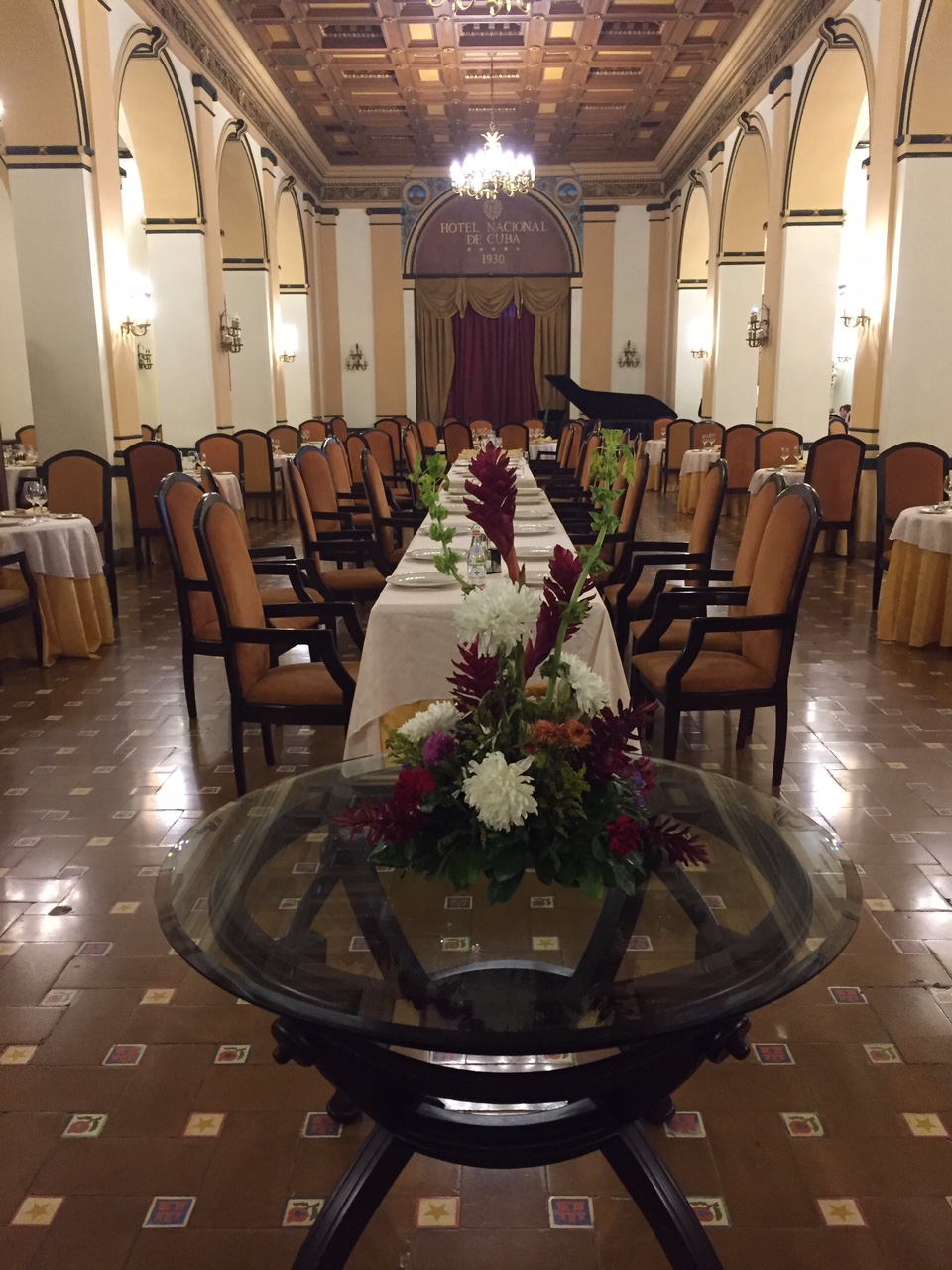
Dining Room at Hotel Nacional


©Wine -- Mise en abyme