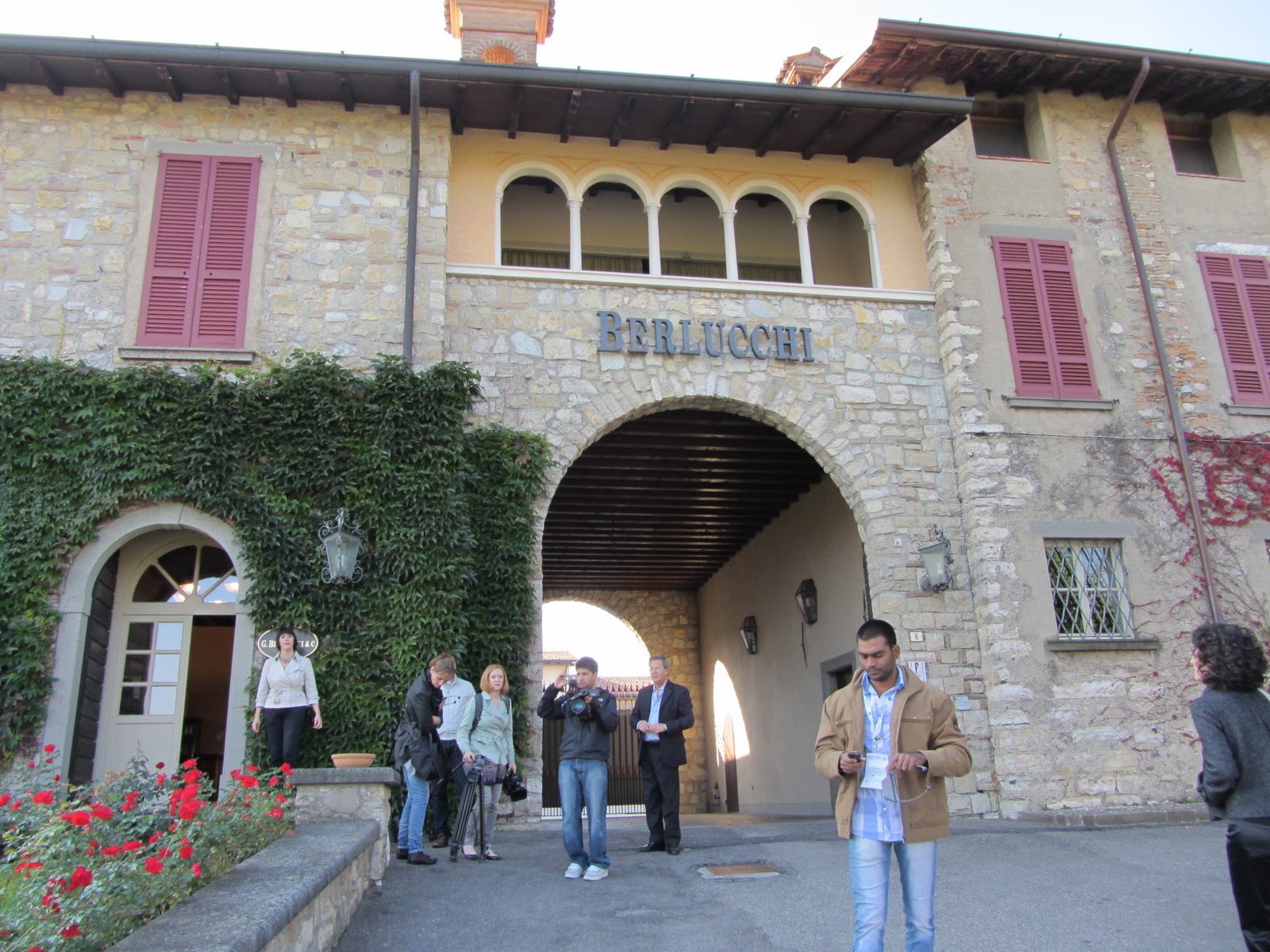
We were welcomed outside the winery by a large group which included Arturo Ziliani, Vice President and Chief Winemaker and Cristina Ziliani, Head of Public Relations, Communications, and Image. Cristina did most of the speaking at this time and informed us that we had been tardy and would have to hurry in order to complete the appointed program. Headsets were distributed to us as we made our way into the winery and positioned ourselves in a semicircle around Arturo and, as he explained, his translator. Hence the headsets.

When we had settled down, Arturo utilized a presentation on a large flat screen TV to explain the estate's viticultural and vinicultural practices. He was especially proud of the company's Coquard presses. According to www.winenews.it, these presses are insatiable and, further, "A fast and efficient press avoids the insurgence of uncontrolled microbiological processes that occur among the grapes in the crate. The Coquard's inclined plate favors the rapid descent of musts, thus clarifying the wine with this first natural filtration while at the same time limiting the time in contact with the skins." The pressure exerted on the grapes by the press can be automatically adjusted based on its reading of pre-set parameters. According to Arturo, every major Champagne House utilizes this technology but Berlucchi was the first non-French estate to acquire it.

After completing our tour of the vinification facility, we re-boarded our bus for the trip over to the cellar and Palazzo Lana Berlucchi. We were warmly welcomed there by another staff contingent and taken on a tour of the cellars where the wines are bottled for re-fermenting and aging after assemblage. Depending on the wine style, a bottle can spend anywhere from 18 to 60 months in the Berlucchi cellar. Berlucchi still uses some manual riddling to concentrate the spent yeast into the neck of the bottle but has supplanted it with machines for the most part. Automatic riddling, via the gyro palette, was developed by the Cava industry in the 1970s and has been adopted by traditional sparkling wine makers the world over. The method can reduce the riddling time to as little as three days in comparison to an average of six weeks for a hand-riddled wine.


As Arturo explained it, the pressure in a Franciacorta bottle is six atmospheres (with the exception of Satén which is bottled at 5 atmospheres of pressure). He demonstrated that this pressure is contained within the wine itself by opening a bottle, placing it on a flat surface, and then tapping gently on the outside of the bottle with a metal object. The resulting eruption of wine was a sight to behold.


Our tour was actually conducted in reverse to the construction and maturation processes in that we started with the bottles at rest, went next to the remuage process, on to the bottling facility, and then ended at the base-wine tasting room. In the base-wine tasting room we were allowed to taste a number of base wines from different lots, different vintages, and different varieties. In the actual assemblage of the wine, a four-person tasting team, to include Arturo, convenes to determine the composition of the estate's offerings.

At the conclusion of the cellar tour, we were taken over to Palazzo Lana Berlucchi, the early 16th century chateau that nests alongside the cellar, for a tour and light repast. The delicate finger foods to which we were treated paired exquisitely with the array of wines to which we were treated. While in the palace, Arturo revealed a special, wine-blogger-specific bottling of a "61 Franciacorta and said that we would take it outside to the vineyards and crack it open. And so we did.


All in all a wonderful day. The management and staff at Berlucchi were kind, attentive, and informative. The ongoing back and forth between Arturo and Cristina exhibited a fun, close familial relationship. The knowledge and passion of Arturo for Berlucchi and Franciacorta were on display for all to see. If there was one disappointment it was that Franco Ziliani, the father of Franciacorta, was too sick to meet with us on the day of our visit. But no matter, his spirit was in every glass that I drank that day. And every glass that I have drunk since.