Showing posts with label Taste of Tuscany. Show all posts

Friday, May 13, 2011

Bolgheri DOC, home of the Super Tuscans

After our fabulous night at Enotecha Pinchiorri, we rendezvoused at our hotel's breakfast room to reflect on the brilliance of the previous night and to fortify ourselves with a solid food base before venturing out on a day of tastings.  Our entire day was going to be spent in Bolgheri.

Bolgheri, situated south of Livonia on the Ligurian coast, is part of the Maremma sub-region of the broader Tuscany wine region.  The Maremma sub-region is warmer overall than the rest of Tuscany resulting in a

                                    Source: http://www.wine-toscana.com/tuscany.htm

two-week-earlier harvest start than its regional counterparts.  Bolgheri (click here for a map of the DOC) experiences sunny, dry, and moderately windy conditions which allow the Cabernet Sauvignon and Merlot grapes to ripen fully but with its exuberance restrained by the moderating influence of cool Mediterranean breezes.  The topography slopes gently from the base of the eastern hills to the sea and the highest-quality vineyards are concentrated in the foothills running between Bolgheri and Castagneto.  The hills protect the vineyards from the cold northern winter winds.  The vineyards are bathed in cool winds from the sea during the summertime and this, combined with a significant diurnal shift, causes  slow maturation of grape quality components and retention of high acidity.  There are approximately 1600 hectares under vine in the Bolgheri DOC today.

There is significant soil variation in the Bolgheri DOC: alluvial soils with round pebbles (ancient riverine deeposits); Aeolian sands, limestone, and clay (marine origin), and volcanic rock from the hills to the east.  The oldest alluvial deposits are found in the Hill zone, the area in which the pebbly, iron-rich Sassicaia vineyard is located.  The Intermediate zone has younger alluvial soils while the area closer to the sea consists of an alluvial-deposit and marine-deposit mix.

The first Bordeaux-style vineyards were planted in Bolgheri in 1944 by Marquis Mario Incisa della Rochetta who favored the wines of the Medoc and saw some similarity between the gravelly soils of the Medoc and Bolgheri.  After a period of experimentation, including maturing the wine in barriques in the French manner, the wine, the precursor of today's Sassicaia, was introduced to the market in 1968.  The wine flew below the radar until Hugh Johnson of Decanter arranged a tasting which featured Cabernet-based wines from France, the U.S, and Italy.  The relatively unknown Sassicaia stunned by besting the more established competitors.  Fame and fortune followed thereafter; as did other producers who jumped in to produce what was now being called "Super Tuscans."

These Super Tuscans, even though of high quality, and carrying hefty price tags, did not merit any higher than an IGT (table wine) designation in the Italian regulatory scheme because they were made from non-region-typical grapes.  This state of affairs was maintained until 1994 when a Bolgheri DOC was granted for non-traditional grapes and a Bolgheri Sassicaia DOC was granted for wines grown in the Sassicaia vineyard.  The following are included in the Bolgheri DOC:

  • Bianco
    • 20 - 70% of each of the following: TrebbianoToscana, Vermentino, or Sauvignon Blanc
    • Up to 30% of other authorized varietals
    • Released the Spring following harvest
    • Yields of 100 quintals/hectare allowed
  • Vermentino
    • 85% Vermentino
    • Released the Spring following harvest
    • Yields of 100 quintals/hectare allowed
  • Sauvignon Blanc
    • 85% Sauvignon Blanc
    • Released the Spring following harvest
    • Yields of 100 quintals/hectare allowed
  • Rosato
    • Sangiovese, Cabernet Sauvignon, Merlot, other approved varietals
    • Released the Spring following harvest
    • 11.5% minimum alcohol
  • Rosso and Rosso Superiore
    • 10 - 80% Cabernet Sauvignon
    • Up to 70% Merlot
    • Up to 70% Sangiovese
    • Up to 30% of other authorized varietals
    • Rosso aged a minimum of 10 months; Superiore a minimum of 24 months, 12 in wood and 6 in bottle
    • Yields of 90 quintals/hectare for Rosso and 80 quintals/hectare for Superiore
    • 11.5% minimum alcohol for Rosso, 12.5% for Superiore
  • Sassicaia
    • Produced in Sassicaia subzone
    • Aged for 2 years, 18 months in barrique
    • Yields of 60 quintals/hectare allowed
    • 12% minimum alcohol
Some of the most acclaimed wines from Bolgheri include Sassicaia (Tenuta San Guido), Ornellaia (Tenuta dell'Ornellaia), Masseto (Tenuta dell'Ornellaia), and Messorio (Le Macchiole).

    Friday, April 15, 2011

    Dinner at Enoteca Pinchiorri, Michelin 3-star Restaurant in Florence, Italy

    A meal at Enotecha Pinchiorri is a bucket-list item for accomplished, or aspiring, gourmands.  I (a member of the aspiring class) ate dinner at the establishment on Tuesday, May 4th, as the kickoff event in Bordeaux Index's Taste of Tuscany, a four-day encounter with the foods and wines of selected Tuscan regions.  In this post I will frame the Bordeaux Index (BI) program and revisit our experiences within the hallowed walls of Enoteca Pinchiorri.

    I was introduced to Bordeaux Index and its wine-travel capabilities by one of my Decanter Yquem Weekend compatriots.   My primary contact at BI was Elly Dean, Events Coordinator and she did a wonderful job of outlining the company's capabilities in my area of interest, helping me narrow down to the trip I wanted, and then working to ensure smooth in- and post-trip experiences.  The specific event that I selected was BIs Taste of Tuscany which kicked-off with the aforementioned EP dinner, and then was followed by a day trip to Bolgheri, inclusive of two winery visits and lunch at one of the wineries; a two-day trip to Montalcino, inclusive of four winery visits, two tasting lunches and a dinner.  I thought that this would be a wonderful introduction to Tuscany.  So I bought it.  Hence the dinner at Enoteca Pinchiorri.

    Enoteca Pinchiorri is a now 35-year collaboration between the Italian Giorgi Pinchiorri and Frenchwoman Anne Féolde.  The cooperation started out with Anne preparing small plates to accompany the spectacular wines on show by Giorgio, who was a sommelier of some repute, but has grown into a food-centered enterprise driven by Anne's renown as a world-class chef.  The restaurant is located in an old Florentine Palace at 87 Via Ghibellina in the heart of the old "Medici-ville."  The restaurant has three Michelin stars and was named Best Restaurant in the World in 2005.


    In addition to my wife and me, the tour included a couple from England, a couple from Wales, and Elia Leonardo, our BI Minder (Elia gave us this sob story that he had just broken up with his girlfriend so the wives spent the entire trip trying to fix him up with every pretty girl that we ran into.  He enjoyed the trip more than anyone else.  Just kidding BI, he is a good guy and a keeper.).  We were staying at the Golden Tower hotel in Florence, within walking distance of Enoteca Pinchiorri.  The wives took a cab because they were concerned that the cobblestoned streets would ruin their heels.  With no such concerns, the men took a lively walk through the buzzing Florentine streets to the restaurant.  When we arrived the cab riders were already seated in a reception area surrounded by an armada of Pinchiorri staff waiting to fulfill their every wish.  We were ushered into the reception area and given glasses of Spumante Anna Maria Clemente Rose 2003 from Ca' del Bosco.


    We were asked if we wanted to take a tour of the wine cellar.  I had only met the other members of the tour 30 minutes previously in the hotel lobby but, given our shared interests, we were well on our way to becoming fast friends.  Anyway, we all said "yes" and so began a magical journey through the wine drinker's equivalent of Disneyland.  The cellar was intimidatingly large and intimidatingly equipped.  We walked up and down row upon row of the world's finest wines, some dating as far back as 1906, in a variety of formats and with significant vintage depth.  I kept snapping picture after picture and "eyeballing" every nook and cranny in order to ensure that I did not miss any hidden gems.


     As we walked down the aisles, the sommelier would stop from time to time to point out a specific wine or to pass along a pertinent factoid.  In this way we learned that 55,000 bottles were stored in the cellar and 90,000 bottles were stored on floors above the restaurant.  We were also told that the restaurant's wines were valued at €15 million.


    At the conclusion of the tour we ascended the stairs to the main level and were ushered into the room where our dinner would be served.  I should note that all along the way we were accompanied by a number of immaculately attired Pinchiorri staff, so much so that at times we had the feeling that we were outnumbered by staff.  Our (private) dining room contained a large, oval-shaped dining table and a manned wine station.  The table was covered with a flowing white tablecloth upon which sat a number of vases which held fresh white flowers.  The captain and wine steward were assigned to us for the evening and courses were brought in by teams of waiters who worked in perfectly choreographed rhythm.  The atmospherics felt right; this was going to be a great experience.


    We were formally welcomed by our Captain who also took the opportunity to inform us as to how the dinner would proceed.  It was a tasting menu with an explanation of each course provided once the plates from the prior course were cleared.


    The dinner began with two amouse bouches and then we settled in for the remaining eight courses.


    For us it was delight after delight. The food was excellent and the wines were equally formidable.


    A tartare amberjack with citrus fruit, onion petals marinated in beetroot juice; saffron rice


    Sea bass gratinated with capers; artichokes with marjoram and crustacean sauce


    Lobster gratinated with pistachios; "cecina" (traditional tart made with chick-pea flour), chick-pea and yogurt sauce


    Tagliolini (hand-made long pasta) with baby squids, sage, and potato sauce with lemon scent


    Cavatelli in a peas cream with bacalà slices and sausage in red wine sauce


    Baby pork from Mora Romagnola with roasted potato purée


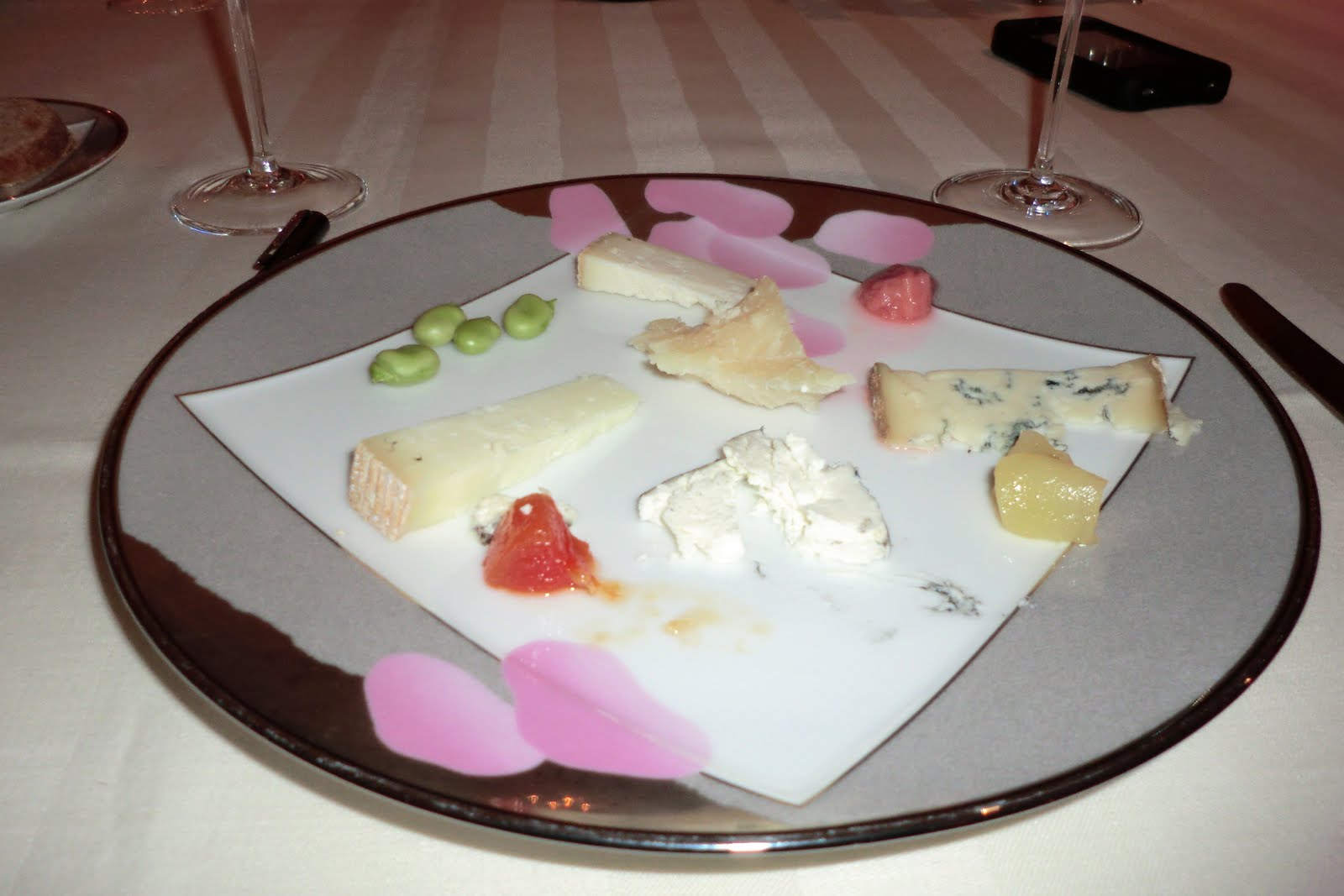
    A selection of Italian cheeses


    and a dessert in three acts:  Hazelnut tart; lemon and basil sherbet;  and passion fruit drops and wild fennel yogurt.


    The wines were a Richiari 2009 Poggio Scalette, a Chianti Classico Rancia 2007 Fattoria di Felsina, a Messorio 2003 Le Macchiole, a Barolo Percristina 2001 Clerico, and a Luce 1993 Frescobaldi.

    During the course of the meal, our table was visited by both Giorgi and Anne.  At the conclusion of the dinner, we repaired to the smoking room and lit up some Romeo and Juliettas and accompanied them with a 20-year-old Italian brandy.


    Team with Giorgi Pinchiorri (center)
    This was a great start to our trip.