Showing posts with label Massolino. Show all posts

Monday, March 11, 2019

An Introduction to 2014: Barolo Margheria from Azelia and Massolino and Rocche dell'Annunziata from Renato Corino at La Festa del Barolo

Growing Nebbiolo grapes for the production of Barolo wines was a challenge in 2014; but the show must go on. And go on it did, according to the producers who spoke at the Saturday Seminar of Antonio Galloni's La Festa del Barolo.

At the seminar we had the chance to hear from, and taste the wines of, 14 Barolo producers arranged into flights of between two and four producer/wine combinations.

The initial flight was titled An Introduction to 2014 ... and featured Lorenzo Scavino (Piemonte's response to Hollywood) presenting Azelia's Barolo Margheria, Franco Massolino presenting a similarly designated wine from his namesake estate, and Stefano Corino presenting the Barolo Rocche dell' Annunziato from Renato Corino.

Lorenzo Scavino, Franco Massolino, and Stefano Corino

I was mystified by the composition of this flight. The Azelia and Massolino wines had been paired in a flight at last year's Seminar as we probed the character of the cru. Combining them this year with the Renato Corino wine -- a wine from one of my top 18 Barolo Vineyards -- begs the question as to intent.

I have covered the fundamentals of the Azelia and Massolino estates, and the Margheria and Rocche dell'Annunziata crus, in prior posts. I will provide a brief summary of the Renato Corino operations herein to fill out the picture.

Renato Corino
Renato Corino split from his brother in 2005 and founded the estate currently bearing his name. The estate owns vineyards in the La Morra crus of Rocche dell'Annunziata, Arborino, and Pozzo, employing integrated/sustainable farming practices therein. The estate eschews the use of chemicals, using copper, sulfur, and manure instead. Grass is maintained between vineyard rows and is then tilled into the soil in the winter.Vines are trained using the Guyot system. Yield is managed through fruit drops at the end of July and pre-harvest.

Grapes for the Barolo Rocche dell'Annunziata wine is sourced from a 0.6 ha, southwest-facing plot that sits between 300 and 320 meters on clayey sand soil. The vineyard was planted in 1962.

The wine is fermented in stainless steel tanks before being transferred to wood for malolactic fermentation and 24 months aging.

The Wines


Azelia
According to Lorenzo, this wine was fermented traditionally with submerged cap and was aged for three years in the bottle after the 24 months in wood.

The wine was perfumed on the nose, with a profusion of violets accompanying notes of tar, roses, and spice. Linear and focused with beautiful fruit. Mineral and saline with good acidity. Drying on the palate as tannins make their presence felt.

Massolino
Perfumed. Violets, tar, and red fruit. Broader-based than the Azelia; fuller and rounder. Beautiful fruit. More textured than the Azelia.

Renato Corino
Lean and elegant with fine-boned tar. Violets, walnuts and truffle. Structured and complex. Great acidity, aggressive tannins, and a bitter, creamy finish. A beautiful wine.

Right about this time we got the first of many fire safety announcements from the PA system. It was a pain.

©Wine -- Mise en abyme

Friday, February 1, 2013

Massolino: "Family-Style" Barolos

Sunday October 14th was the last day of the Decanter Piedmont Reader Weekend; and we were not happy about that. We had had a great time to date visiting wineries, speaking to proprietors, eating great food, and drinking great wine; and we did not want it to end.  Well, pouting would not help.  We had a full day of activities still ahead of us, beginning with a morning winery tour and tasting with Massolino estate in Serralunga d'Alba.

Serralunga d'Alba is a small, medieval village in the Langhe region of Piedmont that is 7100 meters long, 1800 meters wide at its widest point, sits on a hill 414 meters above sea level, and serves as the eastern flank of the Barolo wine production zone.  According to massolini.it, Serralunga d'Alba is one of only three of the 11 Barolo communes that are contained in their entirety within the production zone (the remaining two are Barolo and Castiglione Falletto).

According to Gambero Rosso (Serralunga Barolo: The unrushable wine; gamberorosso.it), Serralunga d'Alba has "compact, sandstone-based soils dating from the Helvetian period."  These soils are high in sand, limestone, iron, phosphorous, and potassium and, as a result, produce wines that are intense and structured and that need time to mature.

When we arrived at the Massolino Cantina after our trip from the hotel, we were greeted in the courtyard by a smiling Franco Massolino who proceeded, during the course of an introductory "seminar" in the courtyard, and continuing dialogue during the course of our walking tour, to detail the estate's philosophy and practices.


The Massolino winery was created by Giovanni Massolino in 1896 and all through the years it has been operated as a family enterprise with brothers Franco and Roberto, enologists both, managing the current incarnation.  The style of wine espoused by the family is a pure expression of Nebbiolo which demonstrates a balance between power and excellence.  Franco refers to this style as "classic" and sees aging in large barrels as a key enabler of that style because the barrels respect and protect the classic bouquet of Nebbiolo.  There was an idea in the market, according to Franco, that consumers would like a wine that was dark in color and some winemakers began to use barriques for aging in order to acquire this darkening effect.  That is not classic Nebbiolo and the decision was made by the estate in 2006 to return to its roots and only age Barolo in large bottes.


Massolino is focused on the production of the highest quality wines possible and, towards that end, grows all of its own grapes. The principal estate vineyards are detailed in the table below.


The grape varieties planted at Massolino vineyards include Barbera, Dolcetto, Nebbiolo, Moscato, and Chardonnay.  The estate began making Chardonnay wines in 1991 based largely on a sense that the variety would thrive in the region's chalky soil.

Fermentation is carried out in resin-lined cement tanks or stainless-steel tanks.  Cement tanks are desirable for their ability to maintain purity of fruit and freshness, according to Franco.  He also mentioned that 10 to 15 years ago, consultants had been recommending deserting cement tanks for stainless steel.  Massolino had not gone down that path and now cement is back in vogue.  Their choice is to use cement vats and when those are not available then use stainless.

Large Slovenian oak casks are used for aging all the wines with the exception of the Chardonnay and Barbera which are aged in barriques.

After our walk-through of the winery, we repaired to the tasting room to sample some of the estate's offerings:
  • 2011 Chardonnay -- The grapes were picked a little early in the cycle.  Some of the fruit was aged in cement and some in oak and then blended. Golden yellow color. Sweet white flower and vanilla nose.  A rich creaminess resulting from 9 months of battonage.  Chalky minerality and spiciness.  Persistent finish.
  • 2011 Dolcetto -- Stainless steel and cement in search of a pure expression of fruit.  Cherries.  Good body. Spicy. Fresh. Soft tannins. Long finish.  Franco felt that this wine would be great with appetizers but felt that the freshness and tannins would allow it to be drunk with the entire meal.
  • 2011 Barbera -- Fermented in stainless steel and cement. Turpentine and petrol on the noseRed pepper and rust on the palate.  Tight and short on the finish.
  • 2010 Barbera -- 5000-bottle production.  Aged for 18 months in barrique.  Extracted color and more appealing nose.  Strawberry and spice.  RIch with good acidity.
  • 2010 Langhe Nebbiolo -- Violet, green flower, dill, marine, spiciness.  Freshness and purity of fruit.  Non-corrosive tannins.
  • 2010 Barolo Classico -- Translucent. Sweet tar, tobacco, and hint of violets.  Molasses on the palate along with weightiness, texture, and balance.
  • 2007 Margheria -- Perfumed nose.  Fresh, pure fruit. Elegant with a long finish.
  • 2007 Parafada -- Closed.
  • 2007 Parussi -- Tar. Green bean. Non-complex.Chalky minerality. Long finish.
  • 2005 Riserva Vigna Rosada -- Complex. Bean. Stale beer. Elegance.Late-arriving tannin. Great acidity with a long mineral finish.

This winery's focus on quality was evident in Franco's conversation as well as the look and feel of the surroundings.  This is an estate that knows the type of wines that it wants to produce and is doing so to the tune of 120,000 bottles annually.  The winery has explored what modernity has to offer and have adopted the things that have improved the quality of the operations but have discarded those which have led away from what they perceive to be the traditional style (the family style) of Barolo.


©Wine -- Mise en abyme

Thursday, October 18, 2012

The Langhe exposed: Decanter's Great Piedmont Reader Weekend

Decanter’s Great Piedmont Reader Weekend, held in Langhe (Piedmont) from Friday, October 12, to Sunday October 14, was the third in a series of trips designed to take advantage of the company’s position in the industry to expose a small group of its readers to leading proprietors/managers of a selected wine region.  The prior two events were held in Bordeaux and the Duero, respectively, and were both exceptional in their own right.  My prior experiences with Decanter, plus no prior experience with the Piedmont region, convinced me to sign up for this trip.

The scheduled activities for the weekend were: visits to Vajra, Gaja, Poderi Aldo Conterno, and Massolino wineries where we would be led in tastings by the proprietors; lunches and dinners in area restaurants, some hosted by winery proprietors; and a truffle hunt.  Our base of operations was to be the Il Boscareto Resort and Spa.  The Decanter personnel along for the trip were Sarah Kemp, Publishing Director, Emma Jones, Events Manager, and Peter McCombie MW.  I will cover the individual elements of the trip in subsequent posts but my initial, high-level impressions are covered herein.

The weather for the duration of our trip was picture perfect (contrary to pre-trip weather forecasts), with chilly morning mists yielding to bright, sunny days and with temperatures in the low-to-mid 60s.  These clear, bright days afforded clear views of the vineyard-clad slopes of the area; slopes that are bisected by winding mountain roads connecting turreted-hilltop town to turreted-hilltop town.  And, through it all, vineyards claiming various aspects of the multitudes of slopes in their mad dash from hilltop prominence to the valleys below.  The pleasant temperatures were also a boon during outdoor activities such as truffle hunting, vineyard walks, and winery facility tours (extensive in the Gaja case).


Beyond my gratitude for the weather, and the beauty of the Langhe scenery, I would also like to acknowledge the kindness and generosity of each of the proprietors whom we visited.  Our visit coincided with harvest in the Langhe yet these individuals set the time aside (between 3 and 5 hours): to explain the region and their winemaking philosophies and practices; to lead us in tutored tastings of their estate offerings; to host us at lunches (Gaja and Vajra); and to answer any and all questions completely and with an honesty and forthrightness that was truly refreshing.

Giuseppe Vaira
Plus Mom and Dad
Angelo Gaja holding court in the courtyard
Gaja and Gaia
Giacomo Conterno
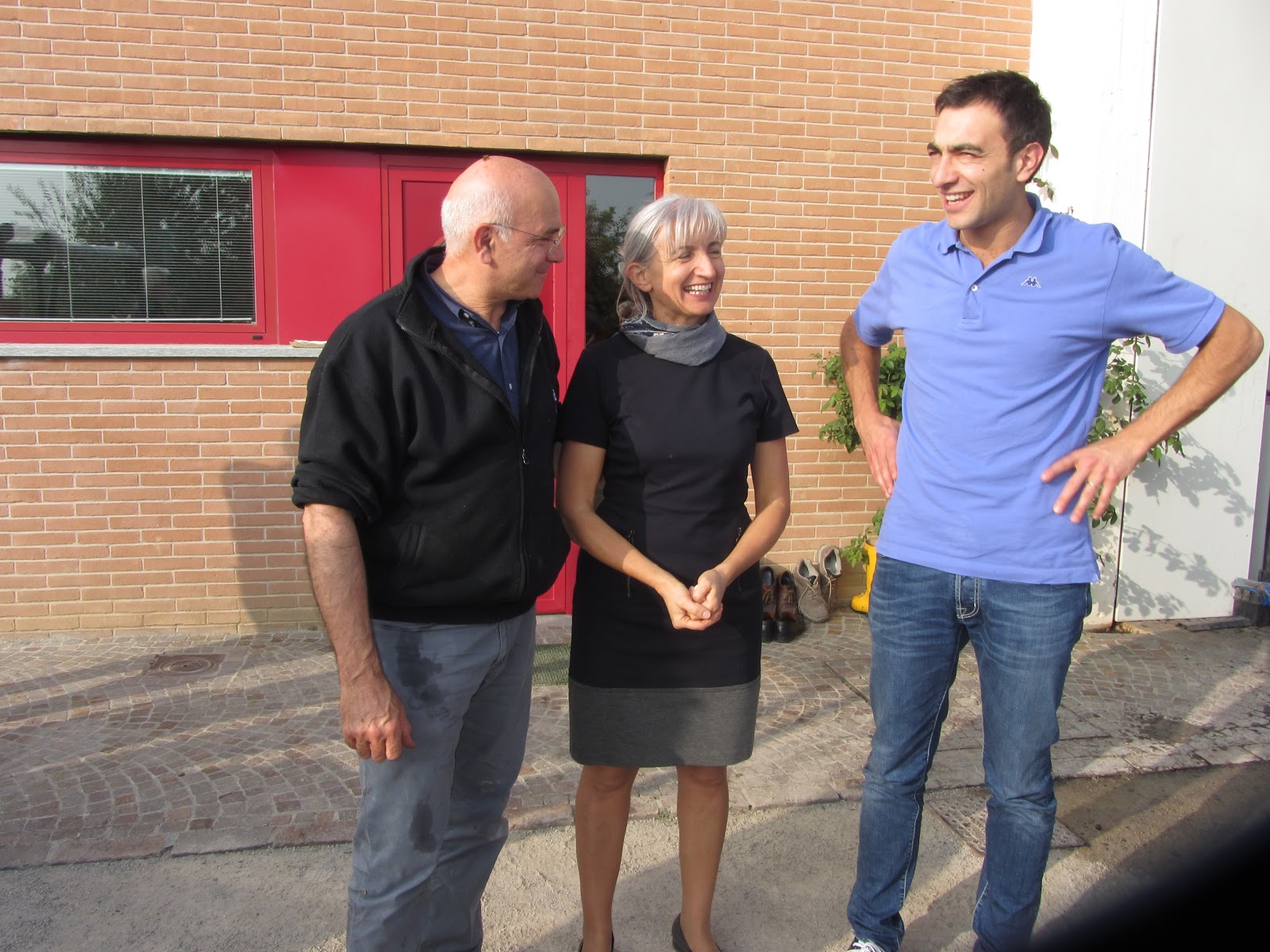
Franco Massolino
As an example of this generosity, let us take the case of the Gaja visit which occurred on Saturday, October 13th.  First off, the winery does not accept visitors in the normal course of events and, secondly, is closed on the weekend.  Yet both Angelo, family patriarch, and Gaia, his accomplished daughter, were both present to lead us through the day’s activities.  After an architectural tour of the facilities (designed to show how the winery had evolved), and a lesson on the history of the company, Angelo turned the reins over to Gaia to lead us through a tasting of vintage Gaja wines from magnums.  Absolutely phenomenal.  After the tasting, the Gajas hosted us for a lunch wherein a different set of magnums were opened to accompany the meal.  At the conclusion of the lunch we were each given a set of documentation and a magnum of 2004 Gaja Sperss enclosed in a patterned wooden box.  A stunning, unexpected gift that was humbly accepted by each recipient.  Floored us it did.


A feature of the previous Decanter trips had been extended access to leading regional estate proprietors/managers.  This trip did not disappoint in that regard.  We spent 2+ hours with Giuseppe Vaira at a tasting lunch on the first day, followed by a 45-minute truffle hunt (on which he accompanied us), followed by a visit and tour of the Vajra operations during crush – and at which time access was expanded to include his mother, father, sister, and brother – and, finally, capped by an hour-long tasting of the company’s offerings that had not been experienced at lunch.  The Gaja name is one of the most recognized in Italian wine circles and Angelo Gaja has been a tireless advocate of his family’s wines and his region.  We spent an extended period with him and Gaia and I had the distinct privilege of sitting next to him at lunch and to benefit, at a personal level, from his quick wit, sharp mind, and ever-present humor.  He is a storyteller. Giacomo Conterno walked us through an educational tasting of the Aldo Conterno wines (he poured each and every glass) and through the vineyards arrayed in the hills above the winery.  Franco Massolino did much the same, in terms of the tasting, while regaling us with stories regarding the prowess of his aunt at both the bottling and labeling stations in the winery.  The opportunity to listen and learn from practitioners of this art for such extended periods in a concentrated period of time was a very attractive proposition for me.


The team for the Piemonte experience numbered 12 individuals, six of whom had been on at least one of the previous Decanter trips.  It was a fun group that gelled immediately and was, in addition, very respectful of each other’s time, the proprietors’ contributions, and Decanter’s efforts.  The group dynamics and interaction contributed significantly to the success of the trip.
This trip was immaculate in both its conception and execution, with no hitches or hiccups along the way.  I credit Decanter for assembling such a high-powered roster of wineries and enlisting the proprietors in the conspiracy to provide its readers with a host of memorable experiences. Emma (Jones now) was her usual “model-of-efficiency self and excelled at the task of herding cats.  Sarah Kemp descended on us from on high post the lunch on Friday and from then on functioned effectively as the bridge between the team and the proprietors (with all of whom she appeared to have extremely good relations) as well as serving as the fulcrum for many in-team discourses about wine-industry-related issues.

In closing, I must say that this trip was a rip-roaring success.  Decanter once again married its readers’ loyalty, love of wine, and sense of adventure with the food, wines, fabulous accommodations, and people of a leading wine region with the result being a spectacular experience for lucky readers.  I am ready for the next trip to a region that is unencumbered by the weight of our previous passage.

©Wine -- Mise en abyme