Showing posts with label ancient grapes. Show all posts

Monday, September 18, 2023

Iran: A vitis vinifera conquest on its journey to the Far East

Dong, et al., reports on a dispersal of the vitis vinifera CG1 cultivar in four directions from its domestication point in western Asia, as illustrated in the map below.

High-Level view of the early stages of vitis vinifera
distribution from the Western Asia Domestication
Center (after Dong, et al.)

I have previously detailed hypotheses as to how the cultivar spread into Anatolia and across Europe and North Africa, with reports on the Caucasus and the Far East in the offing. Before addressing the latter endpoints, however, I will cover the evidence of transit through Iran, the point of divergence for the cultivar's onward journeys.

According to the authors, the dual domestications occurred 11,000 years ago. The Little Ice Age had ended by this time and the world was transitioning from the Pleistocene to the Holocene Epoch. 

The cold, dry climate associated with the Younger Dryas (12,800 BP - 11,600 BP) led to a rapid reduction in the size of the lushest vegetation belts and reduction in yields of natural stands of C3 plants such as cereals. 

There was  rapid return of wetter weather post the Younger Dryas and this led to the expansion of numerous lakes and ponds and cultivation of annual crops along the shorelines. The first large villages began to appear (up to 2.5 ha) and they relied on cultivated barley and wheat or "their wild progenitors." 

Neolithic farming communities thrived under the favorable climate conditions of the Early Holocene and expanded "along the Levantine Corridor into Anatolia and neighboring regions." This, then, was the first movement of the cultivated grapevine outside of its birthplace. 

Post-Younger-Dryas warming took 1000 years to reach Iran and another 1000 years to reach the heart of Central Asia. Cereal grasses and trees followed the path of this warming; as did agriculture. The Neolithic -- the period of the origins and early development of agricultural economies -- launched in the Levant around 11,000 years ago and was evident in Iran during the period 10,000 BP - 7500 BP.

Within Iran, Neolithisation did not occur in one fell swoop. Rather, it was evidenced as "a gradual unfolding of multiple episodes of Neolithisation producing patterns of change, continuity and adaptation over several millenia." The chart below illustrates the unfolding of Neolithisation in Iran.


Human groups in Iran's Zagros Mountains developed autonomously -- in relation to the Levant -- during the beginning of the Holocene, with local domestication of goats and early stage agriculture based on barley. The material culture has been confirmed by DNA studies which show that humans from the Zagros and Levant were "strongly differentiated genetically and were each descended from local hunter-gatherers." 

There were a number of core areas that were "large enough to have fostered distinct and thriving societies throughout the Neolithic and beyond":
  • Northern, central, and southern Zagros
  • Khuzistan lowland
  • Southern Iran
  • Northeastern Kopet Dag
Of the above, the Khuzistan lowland has "the longest continuous sequence of Neolithic occupation" and the "oldest substantial evidence for agriculture and animal husbandry in Iran." Given our assertion of a nexus between the adoption of agriculture and the adoption of grape cultivation, and the proximity of Khuzistan to the Fertile Crescent, it is quite likely that grape vines were cultivated in Khuzistan at some time in the Neolithic. And that assertion is bolstered by archaeological findings at Hajji Firuj, a Northern Zagros archaeological site which was occupied between 7900 and 7500 BP.

Hajji Firuz was a small village of single-family dwellings with an economy based on a mix of farming and herding, with the latter potentially requiring seasonal migration. The dates of occupation suggest that agriculture and herding at this location was relatively late when compared to Central Zagros and the Khuzistan lowlands. The location of the site is illustrated on the map below.
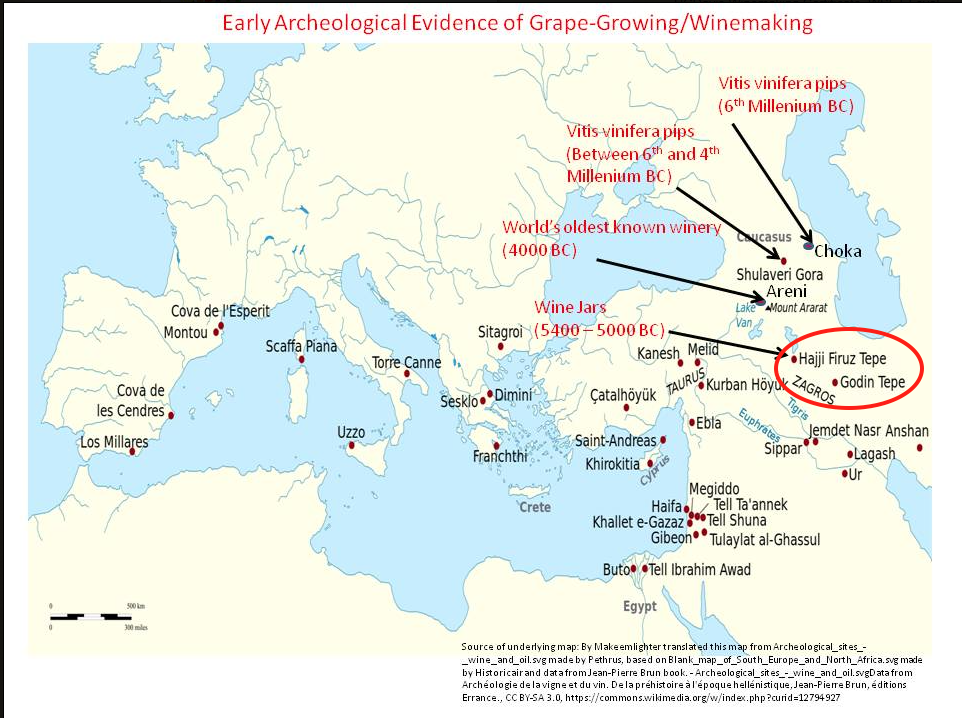
Red oval highlights archaeological sites where proof
 of winemaking in ancient Iran (Persia) was unearthed. 

Hajji Firuz Tepe was the subject of an archaeological excavation in 1968 at which five 2.5 gallon (9 liter) jars were found embedded in an earthen floor along a wall of a Neolithic mud brick building.  Two of these jars had a yellowish residue on the bottom which, after being subjected to infrared liquid chromatography and wet chemical analysis, proved to be a combination of calcium tartrate and terebinth tree resin.  Tartaric acid in the amounts found can only be associated with grapes and the amount of wine that would be housed in the five containers would be much more than required for a single family's use.  Clay stoppers that perfectly fit the openings at the top of the clay jars were found in close proximity to the jars and was assumed to have been used to prevent the contents from turning to vinegar.  These factors led the archaeologists to tag this site as a wine-production facility -- playfully called "Chateau" Hajji Firuz by Dr. McGovern. As wines in Greece even today are resinated, the assumption is that resin was added to Neolithic wines either as a preservative or for medicinal purposes.

Jar from Hajji Firuz Tepe
(Source: alaintruong.com)

The work done by the McGovern team clearly shows the use/consumption of wine within Neolithic Iran. Given that the domestication of vitis vinifera fell within the bounds of the Fertile Crescent, and that the southwestern part of Iran also fell within the bounds of that construct, its transit route into Iran becomes clearer.

Pottery-making in Iran has a history dating back to the early 7th millennium with the advent of agriculture giving rise to the baking of clay and the making of utensils. The use of clay jars for the storage of wine at Hajji Firuz Tepe is, therefore, a temporal fit.

From Iran, vitis vinifera CG1 made its way to the Caucasus and Central Asia. I will cover the former in my next post on the topic.


Bibliography
Saffaid Alibaigi and A. Salomiyan, The Archaeological landscape of the Neolithic period in the western foothills of the Zagros Mountains: New evidence for the Sar Pol-Ezahāb region, Iraq - Iran Borderland, Iraq, Vol 82, Cambridge University Press, December 2020.
Oliver Barge, et al., Diffusion of Anatolian and Caucasian Obsidian in the Zagros Mountains and the highlands of Iran: Elements of Explanation in 'leastcost path' models, Quaternary International 467 (Part B), February 2018.
Dong, et al., Dual domestications and origin of traits in grapevine evolution, Science, 3/3/23
Encyclopedia Iranica, Neolithic age in Iran.


©Wine -- Mise en abyme

Monday, June 5, 2023

Georgia is not the source of all European wine grape varieties; the Levant is

The commonly held belief was that the wild grapevine vitis sylvestris was domesticated at a single point and spread to the rest of the world therefrom. Researchers have named the single-domestication-point hypothesis the "Noah Hypothesis." The hypothesis is illustrated in the chart below where domestication candidate sites are identified and the onward distribution routes of vitis vinifera plotted.


The Dong, et al., study refutes the origin component of the Noah Hypothesis and replaces it with a dual, simultaneous-domestication model.


I now turn to the distribution aspect of the Noah Hypothesis. While the Dong, et al., study does provide for a domestication center in the Caucasus, the result was "... mainly confined to both sides of the Caucasus Mountains, with a limited dispersal into the Carpathian Basin by the northern Black Sea." According to the authors, "... CG2 (ed. The Caucasian domesticate) represents a local domestication effort that had a minor impact on grapevine domestication." The distribution path of CG2 is illustrated in the map below.

Red oval approximates the Caucasus distribution center;
black arrow illustrates the range of the grapevine.

If we take the Dong, et al., argument at face value, the mother of all grapevines originated in the Levant, the Western Asia Domestication Center illustrated above. I will delve further into the region and its inhabitants in upcoming posts. In future posts I will also trace the spread of grapevines ouward from this source point.

©Wine -- Mise en abyme

Wednesday, May 24, 2023

Grapevine domestication: A tale of two centers and selected traits

Dong, et al., (Dual domestications and origin of traits in grapevine evolution, Science, 3/3/23) have postulated, based on their study results, a dual origin for vitis vinifera stemming from simultaneous domestications of distinct vitis sylvestris pairs in separate geographic regions. I have previously described the study origin, the history of the progenitor species vitis sylvestris, and the case for dual domestication. In this post I will provide a contemporaneous look at the proposed domestication centers and identify traits selected during the grapevine cultivation process.

The Domestication Centers
The figure below locates the Western Asia (Syl-E1 to CG1) and Caucasus (Syl-E2 to CG2) domestication centers. 

Grape domestication centers (as per Dong, et al.)

According to the authors, the dual domestications occurred 11,000 years ago. The Little Ice Age had ended by this time and the world was transitioning from the Pleistocene to the Holocene Epoch. 

The Western Asia physical environment was varied, inclusive of highlands, mountain ranges, fertile river valleys, and arid and semi-arid landscapes. Notable geographic features included the Taurus and Zagros Mountains, the Anatolian Plateau, the Levant, the Mesopotamian Plain, and the Jordan River Valley. The Caucasus had a similar distribution of environments but with more prominent mountain ranges. River valleys, such as those hosting the Aras and Kura Rivers, provided conditions suitable for early agricultural development.

The populace of the two centers were mainly hunter-gatherers (hunting, fishing, and gathering), with some early agriculturists. Early farmers likely cultivated wheat, barley, legumes, and flax and domesticated animals such as goats, sheep, and cattle.

It is believed that the Caucasus was inhabited by several indigenous groups but the demographic composition is difficult to determine with any precision. Western Asia, on the other hand, was home to some notable civilizations to include the Natufians (Levant) and the pre-pottery Neolithic cultures of Hassuna, Halaf, and Samarra (Mesopotamia).

Domestication Intent and Thrusts
The authors investigated domestication signatures on the cultivars and found both shared and unique manifestations on the cultivars. Most of the shared signals are on chromosomes 2 and 17, "confirming previous findings that that the selection on flower sexual morphs (sex determination region, SDR), berry skin color (VvMybA gene cluster), and berry development (SDH gene cluster) were of great importance during grapevine domestication." The authors further identified shared domestication genes that possibly serve as foundations for grapevine growth, physiology, fruit set, and resistance to biotic/abiotic stress.

The unique manifestations are exhibited in cases where "the same goals were advanced  by using different aspects of common domestication traits." Some examples of the latter are as follows:
  • Improvement of berry palatability through the reduction of alkaloid biosynthesis (MecghR gene cluster in CG1 and TR2 and SSL gene clusters in CG2)
  • Enhancement of carbohydrate metabolism (SWEET17 in CG1 and PFKFB1 in CG2)
  • Perceived berry desirability (BEAT gene cluster for floral scent in CG1 and UFGT gene cluster for berry color in CG2)
  • Response to environmental stresses (UPL6 in CG1 and WAK in CG2).
According to the authors, "... their findings suggest that the initial cultivations of CG1 and CG2 may have been to serve early humans' caloric and micronutrient needs." And such an observation fits with the economic environment described previously; that is, a landscape populated primarily by hunter-gatherers and fledgling agriculturists.

In that both cultivars were domesticated as food sources, the selection of factors suitable for winemaking exhibited in CG2 "could have been serendipitous, and the practice of winemaking with CG2 ... possibly postdates grapevine domestication."

In my next post I will examine the spread of these cultivars outward from their domestication centers.

©Wine -- Mise en abyme

Saturday, May 13, 2023

Rewriting the story of ancient grapes: Establishing genetic populations and the story of V. sylvestris

A recently published grapevine genetic study (Y. Dong, et al., Dual domestications and origin of traits in grapevine evolution, Science 379 (6635), pp. 892 - 900, 3/3/23) "has upended the history of how humans first domesticated grapes for winemaking ..." (Melanie Lidman, It's in the DNA, Times of Israel, 3/25/23). I discussed the factors driving this study, as well as its objectives, in a prior post. In this post I describe study preparation efforts, the steps taken to define ancient vine genetic populations, and the stories hidden in the genes of V. sylvestris, the accepted progenitor of V. vinifera.

Data Collection
As discussed in my lead-in post, in 2019 Dr Chen and his lab reached out to colleagues around the world asking them to contribute material towards the study. A total of 3525 samples of genetic material were received at the State Key Laboratory for Conservation and Utilization of Bio-resources of Yunnan Agricultural University. The samples were distributed as follows:
  • 2503 Vitis vinifera, 1022 Vitis sylvestris
    • 3186 from Eurasian germplasm and private collections
      • 2237 V. vinifera, 949 V. sylvestris
    • 339 from previously sequenced samples
According to the authors, the sample population “deferentially included old, autochthonous, economically important varieties to maximize the spectrum of genetic diversity." Lidman asserts that Israel's sample submission "... constituted the largest contingent of wild grapes from a single country, or about 10 percent of the total wild grapes sequenced for the study."

According to Karlsruhe Institute of Technology (KIT),  (scitechdaily.com, Scientists Determine the Origins of One of the World's Oldest Crops, 4/17/23), it contributed "... its globally unique collection of European wild vines and very old medieval species" to the study. It also connected the research team with the Ukraine researchers who had fled Crimea -- along with the vines from the Magarach collection -- after the 2014 Russian annexation.

Data Cleanup
In this phase of the study the team "weeded out clones, mutants, synonyms, homonyms and duplicates," ending up with 2448 grapevines (1604 V. vinifera and 844 V. sylvestris) and 498 distinct genotypes.

Categorization
The team first utilized Principal Component Analysis as a mechanism for determining whether "viticultural region" was a key element in defining grapevine diversity; according to the results of the analysis, it was not.

The team subsequently "leveraged genetic ancestry information from an unsupervised ADMIXTURE analysis" (ed., a method of inferring geographical origins based on an analysis of genetic ancestry) to categorize the core accessions. The findings from this analysis were as follows:
  • The hierarchical clustering of ancestry components identifies four V. sylvestris groups from distinct geographic regions
    •  Western Asia
    •  Caucasus
    •  Central Europe
    • Iberian Peninsula
  • V. sylvestris accessions collected from other regions show admixed genetic structures
  • For cultivated grapevines, six genetic ancestries could designate six distinctive groups, all covering a broad range of geographic regions
    • Accessions with pure ancestries helped to "ascribe" names to these groups
      • CG1 -- Western Asian table grapevines
      • CG2 -- Caucasian wine grapevines
      • CG3 -- Muscat grapevines
      • CG4 -- Balkan wine grapevines
      • CG5 -- Iberian wine grapevines
      • CG6 -- Western European wine grapevines
"The four sylvestris and six vinifera groups formed identifiable clusters in the PCA plots and were thus suitable for population genomic investigations."

The V. sylvestris Story
Based on “genetic ancestries and the occupied ecological niches in the western Eurasia continent, the team designated the V. sylvestris accession from Western Asia and the Caucusus as the eastern ecotype and the accession in Central Europe and the Iberian Peninsula as the western ecotype. The similarities and differences between accessions drive this designation. For example, “both nucleotide diversity and individual heterozygosity show that the western ecotype has significantly reduced variation compared with its eastern counterpart.”

In tracing the sylvestris genetic history, the authors show that the eastern sylvestris (Syl-E in their parlance) flourished in its range from approximately 1.5 million years to 800 000 years ago. The Pleistocene was a time of changing climate cycles, however, and the population experienced a bottleneck between 800,000 and 400,000 years ago.

Illustration of a population bottleneck (Source: alevelbiology.co.uk)

Somewhere between 400,000 and 200,000 years ago there was a divergence in Syl-E, giving rise to Syl-W. According to the analysis, the geographical split which drove the divergence was gradual. The Syl-W grouping experienced its own population bottleneck 400,000 - 150,000 years ago.

The last glacial cycle ran from 115,000 to 11,700 years ago and was characterized by ”global climate trending towards drier and colder conditions.” It was during this period — approximately 56,000 years ago -- that the Syl-E ecotype split into the Syl-E1 and Syl-E2 designates. It was also during this period (approximately 40,000 years ago) that there was a system-wide bottleneck which drove vine population to between 10,000 and 40,000. Syl-W experienced its own divergence, designated by the study team as Syl-W1 and Syl-W2.

In my next post I will take up the tale of V. vinifera, as told by the genes.


©Wine -- Mise en abyme