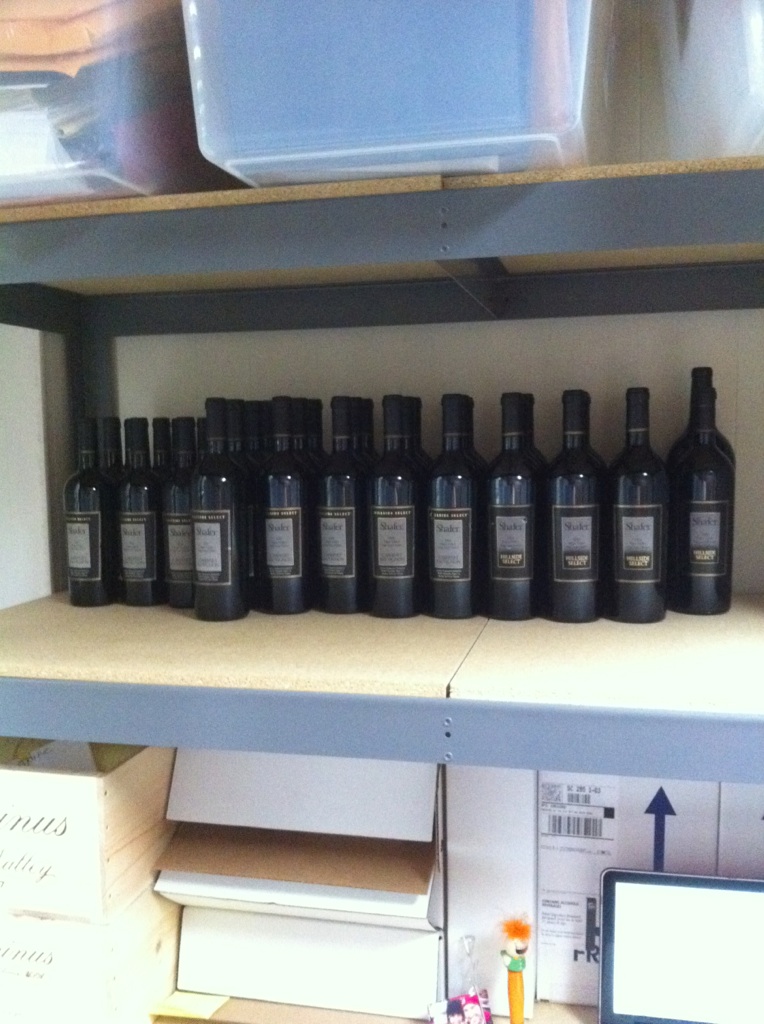
In celebration of #Cabernet Day on September 2, 2010, Wineontheway.com hosted a Shafer Hillside Select 12-vintage (1994-2005) tasting at Luma on Park. In recent posts I reported on the "back story," the event setup, and the tasting leader's (Andrew McNamara) opening remarks. In this post I report on the actual tasting of the wines.
The process Andrew employed for the tasting was inclusive and engaging. For each vintage, the attendees were asked to raise their glasses, say cheers, and clink glasses with as many fellow attendees as possible. Upon completing this ritual we: examined the color of the wine; covered the top of the glass with the palm of one hand while swirling the glass with the other hand; smelled the wine; and, finally, tasted it. He asked for group input on our observations after out assessments of color, smell, and taste. He spoke at great length on a wide range of topics, especially between vintages, to slow down the pace of the tasting and combat tannin buildup in the mouths of the attendees. The tasting began with the 2005 and proceeded in the order shown.
2005 Shafer Hillside Select -- This wine had a deep ruby color and presented dark, ripe blackcherries, mocha, coffee bean, cinnamon, anise, charred earth, and graphite on the nose. The wine showed good weight, acid, tannin and fruit on the palate and had a smooth, long finish. Andrew indicated that 2005 had been a very good vintage in Napa. It was slightly cooler than 2004 and had had lower yields.
2004 Shafer Hillside Select -- This wine did not present much on the nose initially. When tasted, tannins were dominant. The wine was all oak, graphite, and tannin with very little fruit. There was a definite spiciness, a definitive hallmark, according to Andrew, of Shafer Hillside Select. This wine was closed and Andrew recommended revisiting it again in five years. This wine was the product of a warm vintage, a year in which most wineries produced flashy, forward wines designed to be drunk young. This wine, in Andrew's view, shows that higher-quality wines of this vintage should not be drunk young.
2003 Shafer Hillside Select -- This wine was more open on the palate than the two preceding wines. It was jammy and fruity with tones of graphite, tobacco, and vanilla. It was less intense and less complex than either the '04 or '05 but had more developed flavors and aromas. This wine is approachable now and should be drunk before the '04 and '05.
2001 Shafer Hillside Select -- Andrew described the 2001 as an extraordinary vintage. The wine had a definite floral element with lavender and violet notes. There were elements of sour fruit and graphite but, beyond that, the wine was not very forthcoming. On the palate it showed great structure and depth. Andrew said that it was less powerful than when he last tasted it approximately three years ago, evidence of what he called a "mellowing out" of the wine. He sees the wine as being "in the throes of adolescence" and requiring a lot more development time. (This is one of my Wine Journey wines.)
2002 Shafer Hillside Select -- Andrew described this wine as the "most massive wine on the table" and passed it over initially to assess the 2001. When we returned to this wine, he exhorted us to study it carefully. The wine exhibited black fruits, licorice, and a round, full mouth feel. It showed great weight and power without appearing heavy. Andrew described this as the greatest Shafer Hillside Select ever made and one of the greatest wines ever made in California. He feels that, of American wines, only the 2001 Harlan approaches the level of balance exhibited by this wine. The wine is still a baby and will continue to evolve and improve over the next 20 years. (This is one of my Wine Journey wines.)
2000 Shafer Hillside Select -- This wine showed cedar, tobacco, and other secondary characteristics. This wine is approaching maturity but its structure is still evident. While 2000 was widely viewed as a bad year for Napa, Andrew feels that Shafer made a good product for this vintage.
At this point in the tasting, Andrew paused for us to reflect on the wines that had gone before. Andrew queried the attendees as to their preferences up to that point and the consensus was 2002 followed by 2001. It was felt that both the 2000 and 2003 could be drunk now while the 2001, 2004, and 2002 should be approached in that order.
We turned to the final six wines and, given the press of time and the extent to which folks were enjoying themselves and their tasting partners, the previously described tasting process was modified. To begin with, we skipped the 1999 and tasted the 1998 and 1997 comparatively.
1998 and 1997 Shafer Hillside Select -- According to Andrew, the 1997 had been an incredibly hyped vintage, one viewed as the vintage of the century in Napa. All of the wines in the vintage received great scores from the reviewers. Doug Shafer, according to Andrew, has tried to convince him that the '97 Hillside Select is in a dumb stage but he is moreso convinced after our tasting that the wine is "done."This was a 100-point wine and it is acidic and shows no fruit today. The problem with this wine was that it was not balanced from the beginning (Andrew does see the Heitz Martha's Vineyard, BV George Latour, and Dominus from this vintage performing admirably.). The 1998 Hillside Select, on the other hand, was an El Nino vintage, with a low-yield harvest, but is outperforming the 1997. It has a slightly vegetal note (which he finds alluring), and a definitively longer finish.
1999 Shafer Hillside Select -- This wine had been viewed as the second coming of the 1997 Shafer Hillside Select. It had incredible tannins, flavor, and intensity in its youth. A dark, rich, extracted wine which exhibits earth, leather, and graphite. Rather than the 1997, Andrew sees the 1999 as an older parallel of the 2001, with similar structure, fruit profile, and tannins.
1996, 1995, and 1994 Shafer Hillside Select -- By this time the attendees were becoming difficult to control (actually that had been going on for awhile). They were buzzed; they were enjoying their neighbors; the night had already been a success. They just wanted to bask in the glow of having participated in an event as spectacular as this. They did not want to discuss the wine broadly anymore. They wanted to tell Andrew what a great person he was. How much they appreciated his parents for bringing him into the world; and suchlike. Meanwhile, we are sitting with what I knew to be three great Hillside Selects, waiting patiently for us to administer the coup de grace. Andrew told the group how unique and incredibly special it was to taste all three of these wines together. The 1996 was an extraordinary vintage, he said, which overshadowed the 1995. In a previous tasting note I have described the 1994 as manifesting cigarbox, leather, graphite, stewed plums, black olive, tar, espresso, sandalwood, barnyard, and cedar.
The tasting was over but no one wanted to leave. We all trooped upstairs and continued the good vibes and wines over dinner at Luma.
Showing posts with label #Cabernet Day. Show all posts
Monday, September 13, 2010
Thursday, September 9, 2010
Shafer Hillside Select Cabernet Sauvignon Vertical -- McNamara's Opening Remarks
And the words came up from the cellar to Gigi Chilvers who had been holding back the assembled masses in the Luma bar. And Gigi spake the words and the words were "Thou shalt go down." And go down they did. Into the Cellar at Luma to partake of the fruit of Shafer's labor: 12 successive years of Hillside Select Cabernet Sauvignon.
The stairway to the cellar is L-shaped, going in a northerly direction initially and then making a sharp left turn before dead-ending at a north-south passageway after four or five steps. A right turn leads to a heavy glass door which opens into the finely appointed cellar. As attendees came across the threshold, they were greeted by an imposing array of Shafer Hillside Select bottles to the left and, ahead, white-berobed tables supporting a shimmering array of glasses each bearing a precise allotment of its homage to Bacchus. Upon hearing that there were no pre-assigned seats, attendees spread out to occupy the preferred territory from which each would be mounting his/her assault on the best that Shafer had to offer. The seats at the tables closest to the door filled first while later arrivals, and bullies, worked their way towards the back row.
The attendees were a mix of "power drinkers" and wine lovers. The Antonio's Tasting Group was well represented as was Circa and Dexter's (by the owners), and ABC (two Wine Consultants). There were about 10 women at the tasting.
Once everyone had taken their places, Adam made a brief opening statement and then turned the floor over to Andrew McNamara. His was a virtuoso performance. He exhibited great wit, exuberance, enthusiasm, and breadth of knowledge over the course of a two-hour tour which spanned not only the matter at hand, but also a broad array of wine-related topics to include wine ratings, acids, balance, beer, oak, and suchlike.
In his opening remarks, Andrew noted that this tasting was truly an extraordinary event. He had, he said, tasted each of these wines at least three of four times but never all together like this. He had tasted every Shafer Hillside Select vintage going back to the 1983 vintage and felt that the wines were "fantastic" and "extraordinary." Given the pedigree and quantity of wines on offer at the tasting, he felt that it could have easily been priced at $400 to $500 and thought it remarkable that attendees were only being charged $150 for the opportunity to participate.
Andrew noted that there were originally eight Napa Valley cult wines: Harlan Estate, Screaming Eagle, Bryant Family Vineyards, Colgin, Dalle Valle Maya, Grace Family Vineyards, Heitz Martha's Vineyard, and Shafer Hillside Select. Shafer, according to Andrew, is definitively one of the greatest wines made in America today and is his single favorite vineyard in the country. Shafer Hillside is a product of Stags Leap District which, according to Andrew, is one of the most distinct areas in Napa Valley. The Hillside Select wine is a product of a harsh growing environment characterized by volcanic soil and bedrock. Located on the east side of the valley, the Hillside grapes benefit from the warming afternoon temperatures generated by the setting sun.
Andrew has worked with Kevin Zraly in the past and considers him one of the most brilliant wine educators around. For this tasting he was going to be following Zraly's approach of going through the wines methodically with time taken between each wine. This would allow each wine to be shown as it tastes and not comparatively vis a vis the preceding or following wine. Shafer is a heavily tannic wine and, if rushed through, would yield a mouthful of tannins for the intrepid taster. Andrew expected that, as the tasting progressed, the group would be able to see the terroir characteristics -- which is what Shafer is all about -- and how the wine evolves and changes over time.
Let the tasting begin.
The stairway to the cellar is L-shaped, going in a northerly direction initially and then making a sharp left turn before dead-ending at a north-south passageway after four or five steps. A right turn leads to a heavy glass door which opens into the finely appointed cellar. As attendees came across the threshold, they were greeted by an imposing array of Shafer Hillside Select bottles to the left and, ahead, white-berobed tables supporting a shimmering array of glasses each bearing a precise allotment of its homage to Bacchus. Upon hearing that there were no pre-assigned seats, attendees spread out to occupy the preferred territory from which each would be mounting his/her assault on the best that Shafer had to offer. The seats at the tables closest to the door filled first while later arrivals, and bullies, worked their way towards the back row.
The attendees were a mix of "power drinkers" and wine lovers. The Antonio's Tasting Group was well represented as was Circa and Dexter's (by the owners), and ABC (two Wine Consultants). There were about 10 women at the tasting.
Once everyone had taken their places, Adam made a brief opening statement and then turned the floor over to Andrew McNamara. His was a virtuoso performance. He exhibited great wit, exuberance, enthusiasm, and breadth of knowledge over the course of a two-hour tour which spanned not only the matter at hand, but also a broad array of wine-related topics to include wine ratings, acids, balance, beer, oak, and suchlike.
In his opening remarks, Andrew noted that this tasting was truly an extraordinary event. He had, he said, tasted each of these wines at least three of four times but never all together like this. He had tasted every Shafer Hillside Select vintage going back to the 1983 vintage and felt that the wines were "fantastic" and "extraordinary." Given the pedigree and quantity of wines on offer at the tasting, he felt that it could have easily been priced at $400 to $500 and thought it remarkable that attendees were only being charged $150 for the opportunity to participate.
Andrew noted that there were originally eight Napa Valley cult wines: Harlan Estate, Screaming Eagle, Bryant Family Vineyards, Colgin, Dalle Valle Maya, Grace Family Vineyards, Heitz Martha's Vineyard, and Shafer Hillside Select. Shafer, according to Andrew, is definitively one of the greatest wines made in America today and is his single favorite vineyard in the country. Shafer Hillside is a product of Stags Leap District which, according to Andrew, is one of the most distinct areas in Napa Valley. The Hillside Select wine is a product of a harsh growing environment characterized by volcanic soil and bedrock. Located on the east side of the valley, the Hillside grapes benefit from the warming afternoon temperatures generated by the setting sun.
Andrew has worked with Kevin Zraly in the past and considers him one of the most brilliant wine educators around. For this tasting he was going to be following Zraly's approach of going through the wines methodically with time taken between each wine. This would allow each wine to be shown as it tastes and not comparatively vis a vis the preceding or following wine. Shafer is a heavily tannic wine and, if rushed through, would yield a mouthful of tannins for the intrepid taster. Andrew expected that, as the tasting progressed, the group would be able to see the terroir characteristics -- which is what Shafer is all about -- and how the wine evolves and changes over time.
Let the tasting begin.
Tuesday, September 7, 2010
Shafer Hillside Select Cabernet Sauvignon Vertical -- Event Setup
#Cabernet Day was a 24-hour, worldwide celebration of Cabernet Sauvignon, Cabernet Franc, and Cabernet-dominated blends held on Thursday, September 2nd. Wineontheway.com's contribution to this celebration was to host a 12-vintage (1994-2005) tasting of the renowned Shafer Hillside Select Cabernet Sauvignon. In a previous post, I covered the "back story" of the tasting. In this post I will detail the event setup.
As noted in my previous post, the event was being held in the Luma on Park Cellar. The initial plan was to have the attendees sitting in a large, u-shaped configuration with the open end of the "u" adjacent to a large-screen TV which was ensconced in the west wall of the cellar. Once the number of attendees surpassed 35, that seating configuration had to be jettisoned and a total of six circular tables, each sitting seven, was used instead.
The wines were carefully transported between Wineontheway.com and Luma by a very nervous Adam Chilvers. Luma had provided the tables and flowing white tablecloths so once the wines were safely deposited in the staging area, Adam, John Allport, and Erin Allport began the task of laying out the table mats and placing glasses in each dated circle; 42 table mats and 504 glasses.
In addition to the tables, the Cellar was equipped with a banquette at the rear -- used, in this case, for extra glasses and staff wines -- as well as a countertop below the TV which was used as the staging area for the wines.
John began opening bottles at around 5:15 pm and did some preliminary analysis of the contents to ensure that the wines were not flawed. The serious factory production did not begin, however, until Andrew McNamara arrived. He arrived with a burst of energy and began issuing directions regarding pouring order and then began to open and taste through the wines. Based on his preference (remember, he was the event leader), the wines were to be poured youngest first (2005) from bottom right to top left (1994), with the result being that the youngest wines would have the longest pre-event exposure to oxygen.
While opening the wines, Andrew noted that some of the corks in the older vintages had disintegrated but the wines did not appear to be compromised. Three of the wines -- a 1994, a 1995, and a 1999 -- were deemed to be corked. Because the final bottle count had taken such an eventuality into consideration, attendees were not adversely affected by the loss of these bottles.
The event had been slated to begin at 6:00 pm but the sheer volume of wine to be poured rendered that infeasible. Even with assistance from Derek (Luma) and Carter Nixon (Stacole), the extreme care that was required to ensure that the right vintage was poured into the right glass (and no one wanted to be the person to drop a bottle) rendered the process slower than anyone had envisioned. Guests were shepherded into the Luma bar -- a nicer place to wait out a delay can not be found in Orlando -- until the final touches were put in place and the doors were thrown open. The below posterity photo was taken just prior to the guests being welcomed down. From left to right, Adam Chilvers, Andrew McNamara, Erin Allport, the author, and Carter Nixon.
The guests were ushered in.
As noted in my previous post, the event was being held in the Luma on Park Cellar. The initial plan was to have the attendees sitting in a large, u-shaped configuration with the open end of the "u" adjacent to a large-screen TV which was ensconced in the west wall of the cellar. Once the number of attendees surpassed 35, that seating configuration had to be jettisoned and a total of six circular tables, each sitting seven, was used instead.
The wines were carefully transported between Wineontheway.com and Luma by a very nervous Adam Chilvers. Luma had provided the tables and flowing white tablecloths so once the wines were safely deposited in the staging area, Adam, John Allport, and Erin Allport began the task of laying out the table mats and placing glasses in each dated circle; 42 table mats and 504 glasses.
In addition to the tables, the Cellar was equipped with a banquette at the rear -- used, in this case, for extra glasses and staff wines -- as well as a countertop below the TV which was used as the staging area for the wines.
John began opening bottles at around 5:15 pm and did some preliminary analysis of the contents to ensure that the wines were not flawed. The serious factory production did not begin, however, until Andrew McNamara arrived. He arrived with a burst of energy and began issuing directions regarding pouring order and then began to open and taste through the wines. Based on his preference (remember, he was the event leader), the wines were to be poured youngest first (2005) from bottom right to top left (1994), with the result being that the youngest wines would have the longest pre-event exposure to oxygen.
While opening the wines, Andrew noted that some of the corks in the older vintages had disintegrated but the wines did not appear to be compromised. Three of the wines -- a 1994, a 1995, and a 1999 -- were deemed to be corked. Because the final bottle count had taken such an eventuality into consideration, attendees were not adversely affected by the loss of these bottles.
The event had been slated to begin at 6:00 pm but the sheer volume of wine to be poured rendered that infeasible. Even with assistance from Derek (Luma) and Carter Nixon (Stacole), the extreme care that was required to ensure that the right vintage was poured into the right glass (and no one wanted to be the person to drop a bottle) rendered the process slower than anyone had envisioned. Guests were shepherded into the Luma bar -- a nicer place to wait out a delay can not be found in Orlando -- until the final touches were put in place and the doors were thrown open. The below posterity photo was taken just prior to the guests being welcomed down. From left to right, Adam Chilvers, Andrew McNamara, Erin Allport, the author, and Carter Nixon.
The guests were ushered in.
Monday, September 6, 2010
Shafer Hillside Select Cabernet Sauvignon Vertical -- The Back Story
The Wineontheway.com #Cabernet Day Shafer Hillside Select 12-vintage vertical tasting generated a lot of excitement from its inception but a number of things had to fall into place in order to ensure that the final product matched up to the excitement in the air. Over the next few posts I will cover the activities leading up to the tasting, the actual tasting, and the perspectives of selected attendees. This post will cover pre-event activities.
Wineontheway.com wanted to do something significant for #Cabernet Day and, after considering a number of ideas, decided on a Shafer Hillside Select vertical; a 12-vintage vertical no less, beginning with 1994 and ending with 2005. John Allport, of Augustan Wine Imports -- the local Shafer distributor -- was approached with the idea and he agreed to provide whatever assistance was necessary. He also volunteered to speak with Master Sommelier Andrew McNamara, currently head sommelier at Premier Beverage, to see if he could be enlisted to lead the tasting. An affirmative response to this request was received in short order.
The second major decision that had to be made was the actual location for the event. The first thought was Luma on Park as it had the large cellar downstairs which not only had the seating capacity, but also had electronic equipment which would allow us to access the internet and participate in the online celebration of #Cabernet Day.
Luma management was approached and was so excited by the concept that they offered to donate the space. This was a significant concession as there is normally a $1000.00 minimum charge to book that space.
The next decision points were the number of attendees and what they should be charged. The initial plan called for 25 attendees with a cost of $150.00 for participation. Once the event was publicized, however, it quickly became apparent that a lot more than 25 people wanted to attend. The final number of paying attendees was 42. Once the headcount went north of 25, the number of bottles required needed to be adjusted upward. After discussions with McNamara, it was decided that three bottles of each vintage would be required (a total of 36 bottles).
The wines were procured from local collectors with high-quality storage as well as online retailers with excellent reputations in the area of provenance. The wines were collected at Wineontheway.com well in advance of the event and were stored standing up so that sediments would collect in the bottom of the bottle. Thirty-six Shafer Hillside Select bottles standing together sure is a sight to see.
The event was shaping up to be a great treat for attendees. Not only would they be tasting the 12 most recent vintages of the greatest American wine of today, they were also going to be walked through the tasting by one of the most electric and engaging Master Sommeliers in the business today and they were getting what appeared to be good value for their money. Based on the lowest prices on winesearcher.com, the total value of the wines that were tasted was $9147.00. When combined with the 500 glasses needed for the tasting (another $2000.00) and the $1000.00 for the room (cost avoided), the cost (excluding printing costs) per attendee was $289.00.
The final requirement was for a set of literature that would carry through the tone of elegance set by the choices of wine, venue, and tasting leader. The first order of business was a place mat which would have space for all of the vintages being tasted and would identify by year where each vintage was located on the mat. Further, wineontheway.com created a four-page booklet which contained Robert Parker's tasting notes for each of the vintages.
John Allport was instrumental in obtaining a a rich-looking, black-colored, spiral-bound document titled Shafer Owner's Manual which was placed on each table along with the Parker notes and a flyer titled Shafer: The Hillside Select Story.
The stage was now set for the actual event.
Wineontheway.com wanted to do something significant for #Cabernet Day and, after considering a number of ideas, decided on a Shafer Hillside Select vertical; a 12-vintage vertical no less, beginning with 1994 and ending with 2005. John Allport, of Augustan Wine Imports -- the local Shafer distributor -- was approached with the idea and he agreed to provide whatever assistance was necessary. He also volunteered to speak with Master Sommelier Andrew McNamara, currently head sommelier at Premier Beverage, to see if he could be enlisted to lead the tasting. An affirmative response to this request was received in short order.
The second major decision that had to be made was the actual location for the event. The first thought was Luma on Park as it had the large cellar downstairs which not only had the seating capacity, but also had electronic equipment which would allow us to access the internet and participate in the online celebration of #Cabernet Day.
Luma management was approached and was so excited by the concept that they offered to donate the space. This was a significant concession as there is normally a $1000.00 minimum charge to book that space.
The next decision points were the number of attendees and what they should be charged. The initial plan called for 25 attendees with a cost of $150.00 for participation. Once the event was publicized, however, it quickly became apparent that a lot more than 25 people wanted to attend. The final number of paying attendees was 42. Once the headcount went north of 25, the number of bottles required needed to be adjusted upward. After discussions with McNamara, it was decided that three bottles of each vintage would be required (a total of 36 bottles).
The wines were procured from local collectors with high-quality storage as well as online retailers with excellent reputations in the area of provenance. The wines were collected at Wineontheway.com well in advance of the event and were stored standing up so that sediments would collect in the bottom of the bottle. Thirty-six Shafer Hillside Select bottles standing together sure is a sight to see.
The event was shaping up to be a great treat for attendees. Not only would they be tasting the 12 most recent vintages of the greatest American wine of today, they were also going to be walked through the tasting by one of the most electric and engaging Master Sommeliers in the business today and they were getting what appeared to be good value for their money. Based on the lowest prices on winesearcher.com, the total value of the wines that were tasted was $9147.00. When combined with the 500 glasses needed for the tasting (another $2000.00) and the $1000.00 for the room (cost avoided), the cost (excluding printing costs) per attendee was $289.00.
The final requirement was for a set of literature that would carry through the tone of elegance set by the choices of wine, venue, and tasting leader. The first order of business was a place mat which would have space for all of the vintages being tasted and would identify by year where each vintage was located on the mat. Further, wineontheway.com created a four-page booklet which contained Robert Parker's tasting notes for each of the vintages.
John Allport was instrumental in obtaining a a rich-looking, black-colored, spiral-bound document titled Shafer Owner's Manual which was placed on each table along with the Parker notes and a flyer titled Shafer: The Hillside Select Story.
The stage was now set for the actual event.
Friday, September 3, 2010
Insignia Vertical at the Wine Barn for #Cabernet Day
I was fortunate to be among the 18 lucky participants at the Wine Barn’s vertical tasting of Joseph Phelps Winery Insignia and Backus wines as part of the #Cabernet Day festivities.
I arrived at the venue at 6:00pm to find very few participants in place, but the wines were ready and breathing, with the exception of the two late additions – 1981 and 1985 Insignia -- which were graciously donated by one of the participants.
After assisting the Wine Barn staff in the extraction of the corks from these two bottles (Gary – I still say that an Ah-so would have made things much easier), the tasting commenced.
The format was casual, with bottles dispersed between two pouring stations located in the front and rear of the establishment, co-located with selections of charcuterie, fine cheeses, artisanal bread, and olive oil.
The wines were laid out to sample in chronological order, requiring the taster to periodically move from the front to the back of the shop (or vice versa) in order to try the next wine. This layout added to the camaraderie of the event as it encouraged interaction and discussion with the other tasters.
As the tasting progressed from oldest to youngest wines, trends emerged. One could begin to predict the blend of grapes utilized for the particular wine based on aromatic and flavor components. The following notes represent some of the trends noted by this taster:
1981 Insignia – This wine was likely past its prime, with most of the flavors representing secondary and tertiary characteristics, the fruit presenting as slightly stewed/madierized, with a slight hint of volatile acidity.
1985 Insignia - worlds apart from the ’81 – this wine still shows fresh fruit flavors, great balance and medium + acidity and tannins.
2000 Insignia – although the ’85 exhibited fruit, the 2000 was a “fruit bomb” relative to the prior two wines, despite the 2000 vintage being much maligned. This wine exhibited great finesse, balance, and was much more of a wine to sip slowly and savor than many of the others in the tasting.
2001/2002 Insignia – I found that the oak regime on these two wines was a bit heavy handed for my palate, although on overall appeal, the ’02 was one of my favorites of the vertical, along with the ’85. The approach to the winemaking appears to have changed during this timeframe, as there is a heavy focus on toasty oak, and Petite Verdot begins to play more of a role in the blend, as evidenced by the aromas and flavors of blueberry and pencil lead in the wine.
2004/2005/2006 Insignia – the wines appear to return to the historic pattern, exhibiting a more balanced and graceful approach to the wine, with sweet, rich fruit, fine tannins, and sufficient acid to keep the wines from appearing flabby, as well as ensuring continuing ageability.
2004 Backus is the total package wine. The nose and the palate exhibit pure Cabernet character, with aromas and flavors of cassis, black cherry, and plum, with plush velvety tannins, and medium + acid.
Given the backdrop of the 2004 Backus, I was looking forward to the 2005 Backus, but it was corked (although some of the participants insisted that the wine was so big that the fruit flavors were still evident beyond the off aromas and flavors from the TCA).
With everyone well-lubricated by the prior wines, the event then proceeded to the smackdown portion of the tasting. Each of the 18 participants were encouraged to bring a Cabernet Sauvignon or Cab-based blend from their cellar for a blind tasting, with the provider of the highest ranked wine receiving a 750 ml bottle of the 2005 Insignia, courtesy of the Wine Barn.

The wines were all presented in double blind format, with each bottle wrapped in a brown paper bag and individually numbered. The wines would be scored on appearance (0-3), aroma (0-7), and flavor (0-10), with a maximum score of 20 points.
The wines entered by the participants varied significantly, from 1989 Chateau Lynch Bages to 2005 Harlan Maiden, and from 2004 and 2005 Altamura to 2006 Marquis-Phillips S2.
Ultimately, the wines were tasted (a full list of the sampled wines is available on Cellartracker (www.cellartracker.com) by searching for the WineBarn event) and the scores were tallied with the following wines receiving top honors:
- 2006 Jessup Cellars Cabernet Sauvignon Louer Vineyards
- 2006 Larkmead Vineyards Cabernet Sauvignon Solari
- 2007 Drinkward Peschon Cabernet Sauvignon Entre Deux Mères
All in all, it appears that the event was a success and that all of the participants enjoyed themselves and enjoyed sharing the tasting experience with like-minded wine enthusiasts. I look forward to future events featuring other wine styles and/or varietals.
I arrived at the venue at 6:00pm to find very few participants in place, but the wines were ready and breathing, with the exception of the two late additions – 1981 and 1985 Insignia -- which were graciously donated by one of the participants.
After assisting the Wine Barn staff in the extraction of the corks from these two bottles (Gary – I still say that an Ah-so would have made things much easier), the tasting commenced.
The format was casual, with bottles dispersed between two pouring stations located in the front and rear of the establishment, co-located with selections of charcuterie, fine cheeses, artisanal bread, and olive oil.
The wines were laid out to sample in chronological order, requiring the taster to periodically move from the front to the back of the shop (or vice versa) in order to try the next wine. This layout added to the camaraderie of the event as it encouraged interaction and discussion with the other tasters.As the tasting progressed from oldest to youngest wines, trends emerged. One could begin to predict the blend of grapes utilized for the particular wine based on aromatic and flavor components. The following notes represent some of the trends noted by this taster:
1981 Insignia – This wine was likely past its prime, with most of the flavors representing secondary and tertiary characteristics, the fruit presenting as slightly stewed/madierized, with a slight hint of volatile acidity.
1985 Insignia - worlds apart from the ’81 – this wine still shows fresh fruit flavors, great balance and medium + acidity and tannins.

2000 Insignia – although the ’85 exhibited fruit, the 2000 was a “fruit bomb” relative to the prior two wines, despite the 2000 vintage being much maligned. This wine exhibited great finesse, balance, and was much more of a wine to sip slowly and savor than many of the others in the tasting.
2001/2002 Insignia – I found that the oak regime on these two wines was a bit heavy handed for my palate, although on overall appeal, the ’02 was one of my favorites of the vertical, along with the ’85. The approach to the winemaking appears to have changed during this timeframe, as there is a heavy focus on toasty oak, and Petite Verdot begins to play more of a role in the blend, as evidenced by the aromas and flavors of blueberry and pencil lead in the wine.
2004/2005/2006 Insignia – the wines appear to return to the historic pattern, exhibiting a more balanced and graceful approach to the wine, with sweet, rich fruit, fine tannins, and sufficient acid to keep the wines from appearing flabby, as well as ensuring continuing ageability.
2004 Backus is the total package wine. The nose and the palate exhibit pure Cabernet character, with aromas and flavors of cassis, black cherry, and plum, with plush velvety tannins, and medium + acid.
Given the backdrop of the 2004 Backus, I was looking forward to the 2005 Backus, but it was corked (although some of the participants insisted that the wine was so big that the fruit flavors were still evident beyond the off aromas and flavors from the TCA).
With everyone well-lubricated by the prior wines, the event then proceeded to the smackdown portion of the tasting. Each of the 18 participants were encouraged to bring a Cabernet Sauvignon or Cab-based blend from their cellar for a blind tasting, with the provider of the highest ranked wine receiving a 750 ml bottle of the 2005 Insignia, courtesy of the Wine Barn.

The wines were all presented in double blind format, with each bottle wrapped in a brown paper bag and individually numbered. The wines would be scored on appearance (0-3), aroma (0-7), and flavor (0-10), with a maximum score of 20 points.
The wines entered by the participants varied significantly, from 1989 Chateau Lynch Bages to 2005 Harlan Maiden, and from 2004 and 2005 Altamura to 2006 Marquis-Phillips S2.Ultimately, the wines were tasted (a full list of the sampled wines is available on Cellartracker (www.cellartracker.com) by searching for the WineBarn event) and the scores were tallied with the following wines receiving top honors:
- 2006 Jessup Cellars Cabernet Sauvignon Louer Vineyards
- 2006 Larkmead Vineyards Cabernet Sauvignon Solari
- 2007 Drinkward Peschon Cabernet Sauvignon Entre Deux Mères
All in all, it appears that the event was a success and that all of the participants enjoyed themselves and enjoyed sharing the tasting experience with like-minded wine enthusiasts. I look forward to future events featuring other wine styles and/or varietals.Thursday, September 2, 2010
Dispatch from the #Cabernet Road
So I left home at 10:30 am with the intent of visiting as many Orlando-area wine purveyors as I could to identify/participate in their #Cabernet Day activiites. My first stop was at Vin'Yard in Ormond Beach. I arrived at around 11:30 am, stepped in, and was greeted by a vast array of nothing. These guys were unaware that this day existed. Even though I had communicated with them. I walked around the joint for awhile, sheepisly admiring the cheeses on display. I engaged the sales person in a dialogue about the wines on display and then left. I was heading to Deland.
I drove across to Deland and decamped at The Elusive Grape. I stepped in and Bill welcomed me with open arms. His first words were Happy Cabernet Day. He then proceeded to break open a bottle of 2005 Chateau de Chambrun and pour me a glass. "This is one of the bottles we are going to be having tonight," he said. He then continued to decant some of the bottles he was going to be having later that evening and I sampled them.
I ordered lunch from a nearby Mexican restaurant and my steak went very well with the 2002 Slaughterhouse Cellars Cabernet Sauvignon. I had only intended to spend an hour at Bill's establishment but the wine, food, and conversation stretched on pleasantly. I looked at my watch. It was 2:30! I had to get the hell out of there. On to the Wine Den in Mount Dora.
I drove across to Deland and decamped at The Elusive Grape. I stepped in and Bill welcomed me with open arms. His first words were Happy Cabernet Day. He then proceeded to break open a bottle of 2005 Chateau de Chambrun and pour me a glass. "This is one of the bottles we are going to be having tonight," he said. He then continued to decant some of the bottles he was going to be having later that evening and I sampled them.
I ordered lunch from a nearby Mexican restaurant and my steak went very well with the 2002 Slaughterhouse Cellars Cabernet Sauvignon. I had only intended to spend an hour at Bill's establishment but the wine, food, and conversation stretched on pleasantly. I looked at my watch. It was 2:30! I had to get the hell out of there. On to the Wine Den in Mount Dora.
#Cabernet Day is here
Well we have been mentioning it for over a month, and writing about it incessantly for well nigh a week, and it is finally here. Today is officially #Cabernet Day. Lock up the dogs and the kids (just kidding), grab a bottle of Cabernet and some friends, log on to your favorite social media site, and join the world in tasting the varietals and blends that we have been discussing over the past two weeks.
I began monitoring the #Cabernet Day action in Australia last night and they seemed to have gotten off to a good start. I fired up Twitterfall.com this morning and searched for #Cabernet and the wine Twittersphere in Europe was in full gear and the US was beginning to see some early action.
Let's have some fun here in Orlando today. There are a number of big events planned (The Shafer Hillside Select vertical tasting at Luma put on by Wineontheway.com and the Phelps Insignia and Backus verticals at The Wine Barn.) but you can (and should) still enjoy the day even if you are not at one of those events. Participate locally and virtually. And remember to use the hashtag #Cabernet to see what others are saying and to have what you are saying included in the stream. This hashtag will display all #Cabernet Day postings on Facebook, Twitter, Foursquare and other social media sites. If there is space in your tweet please also use the hashtag #Orlando so that we can attempt to count the Orlando tweets at the end of the day.
I will be posting updates during the course of the day.
I began monitoring the #Cabernet Day action in Australia last night and they seemed to have gotten off to a good start. I fired up Twitterfall.com this morning and searched for #Cabernet and the wine Twittersphere in Europe was in full gear and the US was beginning to see some early action.
Let's have some fun here in Orlando today. There are a number of big events planned (The Shafer Hillside Select vertical tasting at Luma put on by Wineontheway.com and the Phelps Insignia and Backus verticals at The Wine Barn.) but you can (and should) still enjoy the day even if you are not at one of those events. Participate locally and virtually. And remember to use the hashtag #Cabernet to see what others are saying and to have what you are saying included in the stream. This hashtag will display all #Cabernet Day postings on Facebook, Twitter, Foursquare and other social media sites. If there is space in your tweet please also use the hashtag #Orlando so that we can attempt to count the Orlando tweets at the end of the day.
I will be posting updates during the course of the day.
Wednesday, September 1, 2010
The Loire Valley: Classic Cabernet Franc
This is the final post in a series which has stretched over 1.5 weeks and sought to educate readers on the primary characteristics, and selected growing regions, of the "Cabs" in #Cabernet Day. Today we close by spotlighting the region that provides the benchmark expression of the Cabernet Franc grape -- the Loire Valley.
The Loire Valley is the largest wine growing area in France and is dominated by the Loire River as it flows from the Massif Central in the heart of the country northwards to its final destination, the Atlantic Ocean. The broader region is further divided inot four sub-regions -- Central Vineyards, Anjou-Saumur, Pays Nantais, and Touraine -- and, while better known for whites from Sauvignon Blanc and Chenin Blanc, its reds from Touraine (Chinon, Bourgueil, St. Nicholas de Bourgueil) and Anjou-Saumur (Saumur-Champigny) are classic representations of Cabernet-Franc-dominant wines.
The Chinon AOC covers 18 communes on both sides of the Vienne River prior to its merger with the Loire River. There are approximately 4500 acres of Cabernet Franc vines in the region and, in general, the wines from the area are fresh and supple with flavors and aromas of red fruits and violets. Three different terroirs have been identified in the area, however, and the wine styles vary based on their terroir of origin. The slopes and hills along the Vienne River are composed of a Late-Cretaceous limestone called Tuffeau and the wines from this soil have great structure and ageing capability. The area around the commune of Veron is characterized by a Late-Cretaceous clay and produces wines that are intermediate to the lighter Chinons produced in the alluvial sand and gravel soils that can be found in communes such as Panzoult. Chinon wines are barrel-aged but the neutral barrels impart no oak flavors to the wine thus allowing the natural character of the grape to advance unimpeded to the bottle. Quality Chinon producers include Couly-Duthiel, Bernard Bautry, and Charles Joguet.
Bourgueil and St. Nicholas de Bourgueil are both located on the north bank of the Loire River. Winemaking in these areas stretch back to Roman times but became institutionalized with the founding of the Abbey of Bourgueil in 990 AD. As in Chinon, the wine styles are terroir-driven. Vineyards planted in sand and gravel soils produce fruity wines which lend themselves to early drinking. Vineyards planted on the south-facing hillsides take advantage of the clay and limestone soils to yield richer wines with greater ageing potential. The climate is favorable for Cabernet Franc based on the regulating influence of the Atlantic that is pipelined along the Loire Valley and the forest-provided protection from the north winds that is afforded vines on the south-facing slopes. Quality producers from these AOCs are Domaine de la Butte, Frederic Mabileau, and Yannick Amirault.
Saumur-Champigny is a red wine appellation within the larger Saumur AOC and its Cabernet Franc wines may be blended with Cabernet Sauvignon and a local varietal called Pineau d'Aunis. The Cabernet Franc vines in the AOC are over 50 years old and reside on Tuffeau cliffs on the south bank of the Loire. The wines are described as being softer and rounder than the wines from Touraine. In addition to serving as the base terroir for the vines, the limestone cliffs serve as underground cellars for ageing of the wines. Domaine de Varinelles produces good Cabernet Franc wines in this region.
The Loire Valley is the largest wine growing area in France and is dominated by the Loire River as it flows from the Massif Central in the heart of the country northwards to its final destination, the Atlantic Ocean. The broader region is further divided inot four sub-regions -- Central Vineyards, Anjou-Saumur, Pays Nantais, and Touraine -- and, while better known for whites from Sauvignon Blanc and Chenin Blanc, its reds from Touraine (Chinon, Bourgueil, St. Nicholas de Bourgueil) and Anjou-Saumur (Saumur-Champigny) are classic representations of Cabernet-Franc-dominant wines.
The Chinon AOC covers 18 communes on both sides of the Vienne River prior to its merger with the Loire River. There are approximately 4500 acres of Cabernet Franc vines in the region and, in general, the wines from the area are fresh and supple with flavors and aromas of red fruits and violets. Three different terroirs have been identified in the area, however, and the wine styles vary based on their terroir of origin. The slopes and hills along the Vienne River are composed of a Late-Cretaceous limestone called Tuffeau and the wines from this soil have great structure and ageing capability. The area around the commune of Veron is characterized by a Late-Cretaceous clay and produces wines that are intermediate to the lighter Chinons produced in the alluvial sand and gravel soils that can be found in communes such as Panzoult. Chinon wines are barrel-aged but the neutral barrels impart no oak flavors to the wine thus allowing the natural character of the grape to advance unimpeded to the bottle. Quality Chinon producers include Couly-Duthiel, Bernard Bautry, and Charles Joguet.
Bourgueil and St. Nicholas de Bourgueil are both located on the north bank of the Loire River. Winemaking in these areas stretch back to Roman times but became institutionalized with the founding of the Abbey of Bourgueil in 990 AD. As in Chinon, the wine styles are terroir-driven. Vineyards planted in sand and gravel soils produce fruity wines which lend themselves to early drinking. Vineyards planted on the south-facing hillsides take advantage of the clay and limestone soils to yield richer wines with greater ageing potential. The climate is favorable for Cabernet Franc based on the regulating influence of the Atlantic that is pipelined along the Loire Valley and the forest-provided protection from the north winds that is afforded vines on the south-facing slopes. Quality producers from these AOCs are Domaine de la Butte, Frederic Mabileau, and Yannick Amirault.
Saumur-Champigny is a red wine appellation within the larger Saumur AOC and its Cabernet Franc wines may be blended with Cabernet Sauvignon and a local varietal called Pineau d'Aunis. The Cabernet Franc vines in the AOC are over 50 years old and reside on Tuffeau cliffs on the south bank of the Loire. The wines are described as being softer and rounder than the wines from Touraine. In addition to serving as the base terroir for the vines, the limestone cliffs serve as underground cellars for ageing of the wines. Domaine de Varinelles produces good Cabernet Franc wines in this region.
Tuesday, August 31, 2010
Cabernet Franc Digs in on Long Island
In little over 25 years, the Long Island wine industry has grown from one small vineyard to over 3,000 acres of vines and over fifty wineries producing world-class wines.

Located in New York State, on the east coast of the United States, Long Island extends approximately 120 miles into the Atlantic Ocean. The Long Island wine region encompasses Nassau and Suffolk Counties, with the majority of wineries and vineyards at the East End, on the North and South Forks, which are separated by Peconic Bay. These two peninsulas were created by the Wisconsin Glacier during the last Ice Age, over 10,000 years ago. Long Island is in essence a huge sandbar that was pushed down the Hudson Valley and deposited when the glacier finally receded. The soils are mostly sand and fine clay, extremely well-drained, with little topsoil, making them ideal for grape growing.

The first commercially viable vineyard on Long Island was planted in 1973 by Louisa and Alex Hargrave. The Hargraves were recent Harvard graduates who planted their vines using Virgil’s treatises on agriculture and a basic text on viticulture from the University of California - Davis as guidance. With no history of successful vineyard management on Long Island as a guidepost, the Hargraves and other early Long Island vineyard owners applied techniques that had been successful in the Finger Lakes region of New York and in California, neither of which took into account the specific climatic factors they faced on Long Island. It was not until they looked across the ocean to Bordeaux that they found the proper model.
It took several years to perfect techniques, realizing, for example, that canopy management techniques utilized in hot locales such as the Napa Valley provided significant shading that prevented sunburn, but in a cooler maritime climate such as Long Island actually inhibited ripening.
Long Island is on the same latitude as Madrid, but its climate is nothing like that of the capital of Spain. The summer heat is tempered on the island by the proximity to the Atlantic Ocean, Long Island Sound, and Peconic Bay. These waterbodies also help to prevent late spring frosts, effectively giving Long Island a growing season of approximately 210-220 days, similar to Bordeaux. The number of degree days (a means of judging the ability of fruit to ripen in a given time period) is similar to northern Sonoma County in California. With all of these factors, vintners on Long Island have found they get ripe fruit at lower sugar levels, leading to plush wines with naturally lower alcohol levels.
The Bordelaise assisted the Long Island vintners in 1988, when a two day symposium of Bordeaux wine researchers and producers was held on the island. The outcome of the symposium was the realization of the startling similarities of the terroir between Bordeaux, and in particular Medoc, to that of the East End of Long Island. The Bordelaise focused most of their recommendations on the vineyards and not the cellars noting that the islanders were (to that point) more concerned with winemaking than grape growing. Thereafter they changed the focus resulting in the steady increase of quality to the conditions seen today.
The first commercial wines from Long Island were released in 1977, and soon the Long Island wine industry began to grow by leaps and bounds. Proximity of the early vineyards on the North Fork to the Hamptons on the South Fork brought an influx of people in the late 1980s and early 1990s coming to winemaking from successes in other pursuits. Many bought existing farms growing other crops (primarily potatoes) and converted them to vineyards. With the influx of new blood and new money also came business acumen and a drive to produce quality wines. The new wineries hired consultants, many of them from famed Bordeaux chateaux.
There are approximately 188 acres of vineyard dedicated to Cabernet Franc on Long Island, representing less than 10% of the lands under vine, compared to Merlot, which represents over 35% of the planted vineyards. But despite its smaller presence, Cabernet Franc is gaining prominence. Many Long Island wineries are discovering that, as the star rather than as part of the supporting cast, Cabernet Franc can have its own charm and character.
The phenotypic Long Island Cabernet Franc typically exhibits an aroma of red berries (raspberry, cherry, and cranberry) and floral notes, with hints of leather, tobacco, and freshly turned earth. The palate typically shows some of the spice characteristic of the varietal with hints of menthol / peppermint and pepper, and the fruit shows blackberry, raspberry, and boysenberry notes.
Long Island Cabernet Franc producers of note include Castello di Borghese
(the original Hargrave Winery), Wölffer Estates, Roanoke Vineyards, Palmer Vineyards, Shinn Estate Vineyards, and Osprey’s Dominion.

Located in New York State, on the east coast of the United States, Long Island extends approximately 120 miles into the Atlantic Ocean. The Long Island wine region encompasses Nassau and Suffolk Counties, with the majority of wineries and vineyards at the East End, on the North and South Forks, which are separated by Peconic Bay. These two peninsulas were created by the Wisconsin Glacier during the last Ice Age, over 10,000 years ago. Long Island is in essence a huge sandbar that was pushed down the Hudson Valley and deposited when the glacier finally receded. The soils are mostly sand and fine clay, extremely well-drained, with little topsoil, making them ideal for grape growing.

The first commercially viable vineyard on Long Island was planted in 1973 by Louisa and Alex Hargrave. The Hargraves were recent Harvard graduates who planted their vines using Virgil’s treatises on agriculture and a basic text on viticulture from the University of California - Davis as guidance. With no history of successful vineyard management on Long Island as a guidepost, the Hargraves and other early Long Island vineyard owners applied techniques that had been successful in the Finger Lakes region of New York and in California, neither of which took into account the specific climatic factors they faced on Long Island. It was not until they looked across the ocean to Bordeaux that they found the proper model.
It took several years to perfect techniques, realizing, for example, that canopy management techniques utilized in hot locales such as the Napa Valley provided significant shading that prevented sunburn, but in a cooler maritime climate such as Long Island actually inhibited ripening.
Long Island is on the same latitude as Madrid, but its climate is nothing like that of the capital of Spain. The summer heat is tempered on the island by the proximity to the Atlantic Ocean, Long Island Sound, and Peconic Bay. These waterbodies also help to prevent late spring frosts, effectively giving Long Island a growing season of approximately 210-220 days, similar to Bordeaux. The number of degree days (a means of judging the ability of fruit to ripen in a given time period) is similar to northern Sonoma County in California. With all of these factors, vintners on Long Island have found they get ripe fruit at lower sugar levels, leading to plush wines with naturally lower alcohol levels.
The Bordelaise assisted the Long Island vintners in 1988, when a two day symposium of Bordeaux wine researchers and producers was held on the island. The outcome of the symposium was the realization of the startling similarities of the terroir between Bordeaux, and in particular Medoc, to that of the East End of Long Island. The Bordelaise focused most of their recommendations on the vineyards and not the cellars noting that the islanders were (to that point) more concerned with winemaking than grape growing. Thereafter they changed the focus resulting in the steady increase of quality to the conditions seen today.
The first commercial wines from Long Island were released in 1977, and soon the Long Island wine industry began to grow by leaps and bounds. Proximity of the early vineyards on the North Fork to the Hamptons on the South Fork brought an influx of people in the late 1980s and early 1990s coming to winemaking from successes in other pursuits. Many bought existing farms growing other crops (primarily potatoes) and converted them to vineyards. With the influx of new blood and new money also came business acumen and a drive to produce quality wines. The new wineries hired consultants, many of them from famed Bordeaux chateaux.
There are approximately 188 acres of vineyard dedicated to Cabernet Franc on Long Island, representing less than 10% of the lands under vine, compared to Merlot, which represents over 35% of the planted vineyards. But despite its smaller presence, Cabernet Franc is gaining prominence. Many Long Island wineries are discovering that, as the star rather than as part of the supporting cast, Cabernet Franc can have its own charm and character.
The phenotypic Long Island Cabernet Franc typically exhibits an aroma of red berries (raspberry, cherry, and cranberry) and floral notes, with hints of leather, tobacco, and freshly turned earth. The palate typically shows some of the spice characteristic of the varietal with hints of menthol / peppermint and pepper, and the fruit shows blackberry, raspberry, and boysenberry notes.
Long Island Cabernet Franc producers of note include Castello di Borghese
(the original Hargrave Winery), Wölffer Estates, Roanoke Vineyards, Palmer Vineyards, Shinn Estate Vineyards, and Osprey’s Dominion.
Sunday, August 29, 2010
#Cabernet Day -- Cabernet Franc Review
Cabernet Franc, for the most part, exists locked between the death grip of the hard tannins of Cabernet Sauvignon and the suffocating, chocolatey embrace of Merlot, with just enough room available to allow its fruity aromas to escape as it gasps for the life-sustaining air of Bordeaux. There is a growing "Free Franky" movement that is seeking to peel away the Cabernet Sauvignon/Merlot bonds and to give this varietal its own stellar place in the sun.
Cabernet Franc (also known as Bidure, Bouchet, Cabernet Blanc, Cabernet Franco, Capbreton Rouge, Kaberne Frank, and Noir Dur) has the distinction, along with Sauvignon Blanc, of being a parent of Cabernet Sauvignon but, like many a parent, has been outshone by the capabilities and broad-based acceptance of its offspring. With large clusters of blue-black grapes, Cabernet Franc looks a bit like Cabernet Sauvignon but the similarity ends at the first view. Both varieties are grown in Bordeaux but while Cabernet Sauvignon has the starring role, Cabernet Franc is primarily used as a blending grape for Cabernet Sauvignon and/or Merlot-dominated wines. Chateau Cheval Blanc is one of the few Bordeaux wines to have as much as 50% Cabernet Franc as part of the blend.
Cabernet Franc is a vigorous varietal which flourishes in a wide variety of soil types and, unlike Cabernet Sauvignon, it does well in cooler climates. The grape buds early and ripens earlier than Cabernet Sauvignon, providing a hedge against Cabernet Sauvignon losses resulting from inclement weather during harvesting. The grapes are large and have thick skins but the higher pulp-to-skin ratio renders it less tannic than Cabernet Sauvignon. The vine is prone to vigorous foliage production in cooler climates and this has to be managed to ensure that it focuses on fruit ripening.
The most heralded characteristics of Cabernet Franc are the tannin/acidity balance and its fruitiness. The fruit flavors associated with the varietal are blackberries, ripe plums, strawberries, raspberries, and cassis. The non-fruit flavors that can be identified are meat, green olives, licorice, green peppers, nutmeg, herbs, leather and violets.
Cabernet Franc comes into its own as a varietal in the cooler Loire Valley. This region is best known for its whites but in Saumur, Chinon, and Bourgeil the red wines are Cabernet Franc and are renowned for their value and ageability. In the New World, Cabernet Franc is being planted with increasing frequency and made into a standalone varietal but the best adaptations appear to be in the cooler climates of New York's Finger Lakes, Hudson River Valley, and Long Island regions.
Warm weather Cabernet Francs have less acid and more tannins and, as such, pair well with the same foods as does Cabernet Sauvignon and Merlot. Cooler weather Cabernet Franc pairs well with fish, light chicken and German Schnitzel.
Today I picked up a 2006 Chinon Cuvee Terroir by Charles Joguet and a 2005 Anjou Vendanges by Domaine Philippe Delesvaux to drink during the course of #Cabernet Day. Do not be afraid to step out of your comfort zone. Pick up a Cabernet Franc wine for #Cabernet Day. Free Franky.
Cabernet Franc (also known as Bidure, Bouchet, Cabernet Blanc, Cabernet Franco, Capbreton Rouge, Kaberne Frank, and Noir Dur) has the distinction, along with Sauvignon Blanc, of being a parent of Cabernet Sauvignon but, like many a parent, has been outshone by the capabilities and broad-based acceptance of its offspring. With large clusters of blue-black grapes, Cabernet Franc looks a bit like Cabernet Sauvignon but the similarity ends at the first view. Both varieties are grown in Bordeaux but while Cabernet Sauvignon has the starring role, Cabernet Franc is primarily used as a blending grape for Cabernet Sauvignon and/or Merlot-dominated wines. Chateau Cheval Blanc is one of the few Bordeaux wines to have as much as 50% Cabernet Franc as part of the blend.
Cabernet Franc is a vigorous varietal which flourishes in a wide variety of soil types and, unlike Cabernet Sauvignon, it does well in cooler climates. The grape buds early and ripens earlier than Cabernet Sauvignon, providing a hedge against Cabernet Sauvignon losses resulting from inclement weather during harvesting. The grapes are large and have thick skins but the higher pulp-to-skin ratio renders it less tannic than Cabernet Sauvignon. The vine is prone to vigorous foliage production in cooler climates and this has to be managed to ensure that it focuses on fruit ripening.
The most heralded characteristics of Cabernet Franc are the tannin/acidity balance and its fruitiness. The fruit flavors associated with the varietal are blackberries, ripe plums, strawberries, raspberries, and cassis. The non-fruit flavors that can be identified are meat, green olives, licorice, green peppers, nutmeg, herbs, leather and violets.
Cabernet Franc comes into its own as a varietal in the cooler Loire Valley. This region is best known for its whites but in Saumur, Chinon, and Bourgeil the red wines are Cabernet Franc and are renowned for their value and ageability. In the New World, Cabernet Franc is being planted with increasing frequency and made into a standalone varietal but the best adaptations appear to be in the cooler climates of New York's Finger Lakes, Hudson River Valley, and Long Island regions.
Warm weather Cabernet Francs have less acid and more tannins and, as such, pair well with the same foods as does Cabernet Sauvignon and Merlot. Cooler weather Cabernet Franc pairs well with fish, light chicken and German Schnitzel.
Today I picked up a 2006 Chinon Cuvee Terroir by Charles Joguet and a 2005 Anjou Vendanges by Domaine Philippe Delesvaux to drink during the course of #Cabernet Day. Do not be afraid to step out of your comfort zone. Pick up a Cabernet Franc wine for #Cabernet Day. Free Franky.
Friday, August 27, 2010
Margaret River: The über Bordeaux?
The jousting edge of the Australian landmass as it confronts the winds traveling across the Indian Ocean from the African continent, and situated on almost the same latitude as the wine regions of Chile and South Africa, the Margaret River region of Western Australia has been hailed by Jancis Robinson as "... the closest thing to paradise of any wine region I have visited in my extensive search for knowledge." Its Cabernet Sauvignons, the backbone of the region's production, and reputation, have been described as "wines of balance and subtlety" and as having "elegance and finesse" that is unparalleled in the island continent. In this post we will trace the history and characteristics of the region as we attempt to identify the contributors to the high quality of its wines.
Located 172 miles south of Perth, the town of Margaret River sits midpoint of a 19-mile-wide stub peninsula that stretches for 75 miles from Cape Naturaliste in the north to Cape Leeuwin in the south and, in its entirety, comprises what is known as the Margaret River wine region. The region is bounded to the north and west by the Indian Ocean and to the south by the Southern Ocean and is bisected longitudinally by the rolling hills of the Leeuwin-Naturaliste Ridge which runs from cape to cape and has a maximum elevation of 295 feet. The Margaret River flows east to west through the center of the region before debouching into the Indian Ocean.
The Margaret River climate is maritime, with a prevailing westerly and southwesterly air stream. Winds can be strong at times and effective windbreaks for the vines are essential. The region does not experience any extremes in summer or winter temperatures and humidity levels are optimal during the grape-growing season. The temperature is warmer in Margaret River during ripening than in the Medoc and is, in fact, more akin to the temperatures experienced in Pomerol and St. Emilion at that time.
The Leeuwin-Naturaliste Ridge consists of laterite (gravelly or gritty sandy loam) over granitic and gneissic rock. Vineyard soils are primarily laterite or, at valley level, underlying country rock. The soils are highly permeable and moisture can be quickly shed from sites located on slopes, thus driving a need for irrigation.
Western Australia has been the target of a number of governmental (both British and Australian) population-enhancement initiatives which sought to lure immigrants (Australian or European) to the area with the promise of land ownership. The first wine grapes in the Margaret River area are attributed to Italian immigrants who planted vines to provide wine as a meal accompaniment. The modern Margaret River wine history was launched by the agronomist Dr. John Gladstones who served as a bridge between the research theories of visiting UC Davis viticulturist Professor Harold Olmo and a group of eager Australian doctors who were interested in farming (particularly lupines) in the Margaret River area. Applying Dr. Olmo's theories on climate to the area, Dr. Gladstones theorized that Margaret River had soil and climatic conditions similar to (and, in some cases, better than) Bordeaux:
Based on these considerations, he recommended that the doctors plant Cabernet Sauvignon in the area around Wilyabrup rather than the lupines they had in mind. Acting on Gladstones recommendation, Dr. Bill Vasse, in 1965, planted 1/2 acre of Cabernet Sauvignon and Rhine Reisling while Dr. Tom Cullity planted 1/4 acre of vines on his property. These trials yielded excellent results and led to Dr. Cullity launching the Vasse Felix winery. Other pioneering wineries included Cullen Wines, Moss Wood, and Chateau Xanadu.
Margaret River was officially registered as a wine region in 1996. It is further (unofficially) divided into the sub-regions shown below. Most of the wineries are located in the Wilyabrup and Wallcliffe sub-regions.
Located 172 miles south of Perth, the town of Margaret River sits midpoint of a 19-mile-wide stub peninsula that stretches for 75 miles from Cape Naturaliste in the north to Cape Leeuwin in the south and, in its entirety, comprises what is known as the Margaret River wine region. The region is bounded to the north and west by the Indian Ocean and to the south by the Southern Ocean and is bisected longitudinally by the rolling hills of the Leeuwin-Naturaliste Ridge which runs from cape to cape and has a maximum elevation of 295 feet. The Margaret River flows east to west through the center of the region before debouching into the Indian Ocean.
The Margaret River climate is maritime, with a prevailing westerly and southwesterly air stream. Winds can be strong at times and effective windbreaks for the vines are essential. The region does not experience any extremes in summer or winter temperatures and humidity levels are optimal during the grape-growing season. The temperature is warmer in Margaret River during ripening than in the Medoc and is, in fact, more akin to the temperatures experienced in Pomerol and St. Emilion at that time.
The Leeuwin-Naturaliste Ridge consists of laterite (gravelly or gritty sandy loam) over granitic and gneissic rock. Vineyard soils are primarily laterite or, at valley level, underlying country rock. The soils are highly permeable and moisture can be quickly shed from sites located on slopes, thus driving a need for irrigation.
Western Australia has been the target of a number of governmental (both British and Australian) population-enhancement initiatives which sought to lure immigrants (Australian or European) to the area with the promise of land ownership. The first wine grapes in the Margaret River area are attributed to Italian immigrants who planted vines to provide wine as a meal accompaniment. The modern Margaret River wine history was launched by the agronomist Dr. John Gladstones who served as a bridge between the research theories of visiting UC Davis viticulturist Professor Harold Olmo and a group of eager Australian doctors who were interested in farming (particularly lupines) in the Margaret River area. Applying Dr. Olmo's theories on climate to the area, Dr. Gladstones theorized that Margaret River had soil and climatic conditions similar to (and, in some cases, better than) Bordeaux:
- Maritime-influenced weather
- 43 inches of rainfall per year
- No rainfall during harvest (unlike Bordeaux)
- Slightly warmer and sunnier than Bordeaux, thus causing fruit to ripen a little faster and better than in Bordeaux.
Based on these considerations, he recommended that the doctors plant Cabernet Sauvignon in the area around Wilyabrup rather than the lupines they had in mind. Acting on Gladstones recommendation, Dr. Bill Vasse, in 1965, planted 1/2 acre of Cabernet Sauvignon and Rhine Reisling while Dr. Tom Cullity planted 1/4 acre of vines on his property. These trials yielded excellent results and led to Dr. Cullity launching the Vasse Felix winery. Other pioneering wineries included Cullen Wines, Moss Wood, and Chateau Xanadu.
Margaret River was officially registered as a wine region in 1996. It is further (unofficially) divided into the sub-regions shown below. Most of the wineries are located in the Wilyabrup and Wallcliffe sub-regions.
Today Margaret River produces 3% of Australia's wine grapes but has 20% of the premium wine market. There are approximately 5500 hectares under vine in the region and 138 entities producing wines in the region. Cabernet Sauvignon is the most widely planted varietal, followed by Shiraz and Semillon. Merlot and Sauvignon Blanc are also widely planted. Margaret River wines are known for intensity of flavor, balance, and subtlety. Whites are either Chardonnay or Semillon/Sauvignon Blanc blends and the Leeuwin Art Series Chardonnay is considered one of the best Chardonnays in Australia, if not the world. Reds are primarily Cabernet Sauvignon or Cabernet Sauvignon/Merlot blends. Notable reds include Voyager Estate Cabernet Merlot, Howard Park Leston Vineyard Cabernet Sauvignon, Moss Wood Ribbon Vale Vineyard Cabernet Sauvignon, Sandalford Cabernet Merlot Prendeville Reserve, and Moss Wood Vineyard Cabernet Sauvignon.
Margaret River has a phenomenal wine tourism infrastructure but that will be the topic of a future post. In the meantime, if you do not have a wine to take to the #Cabernet Day ball, grab a bottle of Margaret River Cabernet Sauvignon or Cabernet Sauvignon/Merlot blend. You will not be disappointed.
Thursday, August 26, 2010
Chile – Decreasing Yields to Increase Quality
Wine has been part of Chile’s history for nearly 500 years, arriving with the Spanish conquistadors who brought vines to provide communion wine. The grape that arrived in Chile was referred to as Pais, and was likely a descendant of the Spanish "common black grape" brought to Mexico in 1520 by Hernan Cortez. Pais remained Chile's primary wine grape through the influx of other varietals beginning in the 1850s, and was unsurpassed until the emergence of the Bordeaux wine varietals in the late 1970s.Chile is a long, narrow country that is dominated by the Andes on one side and the Pacific Ocean to the other. Chile's vineyards are located along an 800-mile stretch of land from the Atacama Desert in the north to the Bio-Bio region in the south. The climate is varied with the northern regions being very hot and dry compared to the cooler, wetter regions in the south. In the Valle Central around Santiago, the climate is dry with an annual average of 15 inches of rain.
Despite a long history of influence from Spain, Chile owes a majority of its wine influences to France. Chile’s table wine industry really began in the mid-1800s, when wealthy industrialists and land barons imported French varietals (mostly from Bordeaux) to establish vineyards as a status symbol. Don Silvestre Errazuriz was the first, importing red and white Bordeaux varietals, and going so far as to import French vineyard managers and winemakers to ensure that his vineyards were properly planted and that his wines were made in the Bordeaux style. Some of Chile’s best-known names date from this era, including Errazuriz, Cousino Macul,
and Concha y Toro.
Being relatively isolated by the Andes, the Pacific Ocean, the Atacama to the north, and Antarctica to the south, phylloxera has never become a problem. Because of this, the vines in the Chilean vineyards are on their own rootstock. While Chilean winemakers point to this as a benefit to the flavor profile of the wine, it certainly is a boon to the bottom line of the winery, not having to worry about the expense of grafting onto louse-resistant rootstock.
The majority of Chile’s Cabernet Sauvignon and Bordeaux blend wines originate from two regions – the Aconagua and the Valle Central. These two areas are broken down further into individual growing regions/valleys - the Aconagua Valley and the Casablanca Valley within Aconagua, and the Maipo, Rapel, Curico, and Maule Valleys within the Valle Central.
The majority of the Cabernet in the Aconagua region is from the Aconagua valley itself, as the Casablanca Valley is one of the coolest viticultural regions in Chile and is more suited to Chardonnay and Pinot Noir. The viticultural areas of the Aconagua focus on the ancient river bed deposits, where alluvial soils composed of everything from large gravel and boulders down to fine silts and clays were deposited by the slowing of the rivers.
The Valle Central contains some of the most recognizable wine regions in Chile, perhaps due to the proximity of the area to the city of Santiago, Chile’s capital. The Maipo and Rapel Valleys contain most of the regions Cabernet, with over 80% percent of the vineyard plantings in the Maipo devoted to Cabernet Sauvignon. As noted earlier, the area receives very little rainfall on an annual basis, due in part to the rain shadow effect of the Andes and Coastal Ranges. These mountain ranges also serve to trap warm air in the valleys. At night, cool air comes into the area from the Andes and dramatically reduces the temperature, allowing the grapes to fully ripen during the day while maintaining high levels of acidity. The soils here range from a mixture of loam, limestone, and sand to tuffeau, a marine sedimentary stone similar to that found in France’s Loire Valley
In Chile, the quality of the wines was historically limited by the excessively high yields that were de rigueur. The vineyard owners would also irrigate by flooding the vineyards, allowing some water to infiltrate the soils and then draining off the rest through canals and ditches cut through the vineyards, which also led to higher yields as well as diluted flavors. Additionally, Chilean wines were traditionally aged in beechwood barrels, which gave the wines a “unique” taste.
The influx of foreign investment and the advent of travelling consultants, from the ubiquitous Michel Rolland, to Paul Hobbs, the late Robert Mondavi, and Chateaux owners from Bordeaux, had a marked effect on recent improvements in the quality of Chilean Cabernets.
Not only was there the influx of money and knowledge, but many internationally-known wineries and winemakers established a presence in Chile. Robert Mondavi established a collaboration with Vina Errazuriz to produce Sena, Chateau Lafite Rothschild created the Los Vascos project, and Chateau Mouton Rothschild collaborated with the Concha y Toro Winery to produce Almaviva, to name but a few.


The consultants encouraged limiting yields, switching to drip irrigation, and aging in French or American oak barrels. The consultants also brought new technology, and encouraged the development of a more international style of winemaking. Chilean winemakers have developed a distinct style for their Cabernet Sauvignon, producing an easy drinking wine with soft tannins and flavors of mint, black currant, olives, and smoky oak. Wednesday, August 25, 2010
New Zealand - Not Just for Sauvignon Blanc Anymore
While the South Island of New Zealand has garnered all of the attention for many years with the Sauvignon Blancs from the Marlborough region and, more recently, the Pinot Noirs from Central Otago, more and more we are seeing quality Cabernet Sauvignons, Cabernet Francs, and Bordeaux blends coming from the North Island, particularly from Hawkes Bay on east side of the island (southwest of the town of Napier) and from the Waiheke Island area outside of Auckland.
Cabernet Sauvignon and Cabernet Franc arrived “down under” through Australia with James Busby in 1832, and originated from cuttings and rootstock collected in France and Spain. Given the maritime climate in most of New Zealand, Cabernet Sauvignon tends to take on a lot of the flavor characteristics (floral, spice, herbal notes) typically associated with Cabernet Franc. Cabernet Franc was not widely planted until the 1990s, with only about 210 hectares (525 acres) planted as of 2006, compared to close to 1,700 acres of Cabernet Sauvignon. These are both relatively small plantings, when compared to the 42,000± acres planted to Sauvignon Blanc, Chardonnay, and Pinot Noir.
Hawke’s Bay
Hawke’s Bay is New Zealand’s oldest (with recorded plantings in the Taradale and Meanee areas dating to 1851), and second largest (after Marlborough) wine producing region. Almost three-quarters of the Cabernet Sauvignon in New Zealand is planted in this region. The region is marked by two inland mountain ranges formed from a compressed sand referred to a greywacke rock. Through centuries of weathering and climatic forces, the rock was broken down and transported down the mountain slopes by one of the five rivers that flow east through the area to form alluvial deposits at the base of the slopes and in areas where the water slowed, similar to patterns seen in the Napa Valley. Soil types in the vineyards can range from coarse gravel (Gimblett’s gravel) to combinations of sand, silt, and clay. Another component in the soils is volcanic ash and loess (a mixture of fine particulates bound together by calcium carbonate).
Much of the plantings in the Hawke’s Bay region are focused around the alluvial fans left by the Ngaruroro River. The rivers were means of early transportation and settlements and towns formed along the rivers. The early vineyards were planted in iron-rich, gravelly soils and along rock terraces deposited by the moving waters as the river changed its course over several thousand years. The presence of the gravel and rock in the vineyards is one of the keys to the ripening of Hawke’s Bay Cabernet, in that the rock collects energy in the form of heat from the sun, and gradually releases the heat at night, modulating the often drastic variations in temperature. The gravel also encourages rapid infiltration and drainage of water through the soil, forcing the vines to send roots deep in search of moisture.
Although plantings date back to the 1890’s, recent plantings have focused on hillsides and terraced vineyard plantings on Te Mata Peak, at Bay View, and at Maraekakaho. These vineyards take advantage of favorable sun exposures and the ability to shed cool night air, and have become a popular location for Bordeaux grape varietal plantings.
Hawkes Bay producers of note include Craggy Range, Mills Reef, Te Mata Estate, Sacred Hill, Mission Estate, and Babich.
Waiheke Island

Situated in the Hauraki Gulf to the east of Auckland, Waiheke Island is sheltered from the prevailing colder/wetter west and southwest winds, making it both drier and warmer than the rest of the Auckland area. Until the early 1980s, Waiheke had been known more for its hippies and marijuana production than anything else. Some of the first vineyard plantings occurred in 1978 at what is now Goldwater Estate.
Being located in Hauraki Gulf, the breezes off the water act to keep the vineyards cooled in the heat of the summer, and tend to moderate the temperatures at night. The overall effect is that the island has average temperatures comparable to much warmer growing areas without any of the extremes, and these favorable conditions extend well into March and April (the southern hemisphere’s autumn). These extended conditions allow the wineries to allow the grapes more hang time, encouraging both physiologic and phenolic ripeness (getting both the right sugar content while also developing all of the desired flavor components).
Notable producers on Waiheke Island include Stonyridge Estate, Te Motu, Kennedy Point Vineyard, and the aforementioned Goldwater Estate.
Cabernet Sauvignon and Cabernet Franc arrived “down under” through Australia with James Busby in 1832, and originated from cuttings and rootstock collected in France and Spain. Given the maritime climate in most of New Zealand, Cabernet Sauvignon tends to take on a lot of the flavor characteristics (floral, spice, herbal notes) typically associated with Cabernet Franc. Cabernet Franc was not widely planted until the 1990s, with only about 210 hectares (525 acres) planted as of 2006, compared to close to 1,700 acres of Cabernet Sauvignon. These are both relatively small plantings, when compared to the 42,000± acres planted to Sauvignon Blanc, Chardonnay, and Pinot Noir.Hawke’s Bay
Hawke’s Bay is New Zealand’s oldest (with recorded plantings in the Taradale and Meanee areas dating to 1851), and second largest (after Marlborough) wine producing region. Almost three-quarters of the Cabernet Sauvignon in New Zealand is planted in this region. The region is marked by two inland mountain ranges formed from a compressed sand referred to a greywacke rock. Through centuries of weathering and climatic forces, the rock was broken down and transported down the mountain slopes by one of the five rivers that flow east through the area to form alluvial deposits at the base of the slopes and in areas where the water slowed, similar to patterns seen in the Napa Valley. Soil types in the vineyards can range from coarse gravel (Gimblett’s gravel) to combinations of sand, silt, and clay. Another component in the soils is volcanic ash and loess (a mixture of fine particulates bound together by calcium carbonate).
Much of the plantings in the Hawke’s Bay region are focused around the alluvial fans left by the Ngaruroro River. The rivers were means of early transportation and settlements and towns formed along the rivers. The early vineyards were planted in iron-rich, gravelly soils and along rock terraces deposited by the moving waters as the river changed its course over several thousand years. The presence of the gravel and rock in the vineyards is one of the keys to the ripening of Hawke’s Bay Cabernet, in that the rock collects energy in the form of heat from the sun, and gradually releases the heat at night, modulating the often drastic variations in temperature. The gravel also encourages rapid infiltration and drainage of water through the soil, forcing the vines to send roots deep in search of moisture.
Although plantings date back to the 1890’s, recent plantings have focused on hillsides and terraced vineyard plantings on Te Mata Peak, at Bay View, and at Maraekakaho. These vineyards take advantage of favorable sun exposures and the ability to shed cool night air, and have become a popular location for Bordeaux grape varietal plantings.
Hawkes Bay producers of note include Craggy Range, Mills Reef, Te Mata Estate, Sacred Hill, Mission Estate, and Babich.
Waiheke Island

Situated in the Hauraki Gulf to the east of Auckland, Waiheke Island is sheltered from the prevailing colder/wetter west and southwest winds, making it both drier and warmer than the rest of the Auckland area. Until the early 1980s, Waiheke had been known more for its hippies and marijuana production than anything else. Some of the first vineyard plantings occurred in 1978 at what is now Goldwater Estate.
Being located in Hauraki Gulf, the breezes off the water act to keep the vineyards cooled in the heat of the summer, and tend to moderate the temperatures at night. The overall effect is that the island has average temperatures comparable to much warmer growing areas without any of the extremes, and these favorable conditions extend well into March and April (the southern hemisphere’s autumn). These extended conditions allow the wineries to allow the grapes more hang time, encouraging both physiologic and phenolic ripeness (getting both the right sugar content while also developing all of the desired flavor components).
Notable producers on Waiheke Island include Stonyridge Estate, Te Motu, Kennedy Point Vineyard, and the aforementioned Goldwater Estate.
Tuesday, August 24, 2010
#Cabernet Day -- Cabernet Sauvignon Review
"If Chardonnay is the vanilla of the commercial wine world, then Cabernet Sauvignon is its chocolate." So said Steven Kolpan in a June 18 (2010) Salon article and, with these words, he re-affirmed the primacy of Cabernet Sauvignon in the world of red wines. Invariably described as the king of red grapes, Cabernet Sauvignon has achieved prominence in many of the great wine regions around the world. In our run up to #Cabernet Day, this site will publish posts on some of the lesser-known regions producing quality product from the relevant varietals and their blends. We begin with a brief review of the Cabernet Sauvignon grape.
Research from Professor Carole Meredith of UC Davis has revealed that Cabernet Sauvignon is the result of a crossing between Cabernet Franc and Sauvignon Blanc around 600 years ago. The result of that crossing was the dark-skinned, small-berry grapes that we know today. The first probable historical mention of Cabernet Sauvignon was an 18th-century reference to the Mouton estate replacing its white grape vines with a red grape vine called Vidure. The varietal is still referred to by that name in certain parts of France. Other known names are Petit Cabernet, Petit Vidure, Uva Francese, Bouchet, Bouche, Petit Bouche, and Sauvignon Rouge.
Cabernet Sauvignon has branched out from its roots in Bordeaux to become one of the most widely planted red grapes on the planet. The iconic representations of Cabernet Sauvignon are the wines of Napa Valley and the Medoc but the grapes are currently grown in places as disparate as Chile, Australia, Italy, South Africa, New Zealand, Spain, and Bulgaria, among others.
Cabernet Sauvignon will flourish in a variety of soil types and climatic conditions but will exhibit vegetal characteristics if the correct level of ripeness is not attained. Classic examples of how soil and climatic conditions can affect Cabernet Sauvignon wines are shown by its results in Bordeaux and Napa. The soils in the Medoc are thin and gravelly and climatic conditions vary from year to year. In these conditions, the grape has not, historically, attained optimum maturity, resulting in thin, highly tannic wines which require blending and long aging to produce the maturity and complexity expected in great wines (It is thought that global warming will result in increased ripeness of Bordeaux Cabernet Sauvignon grapes as we move forward in the future.). Napa's valley-floor vineyards, on the other hand, along with warmer, more even temperatures, have yielded less acidic, more mature fruit which do not require blending in order to show its best results. The primary blending grapes for Cabernet Sauvignon are Merlot and/or Cabernet Franc which both serve to fill in the mid-palate and provide a more rounded finish.
The Cabernet Sauvignon grape contains a high amount of tannins and pigments in the skins and pips which, in turn, have a comparatively high ratio vis a vis the flesh of the grape. This structure allows the wine to extract higher levels of color and flavor from the skins the longer the contact, but also results in extraction of higher concentrations of tannin. This composition allows Cabernet Sauvignon wines to age gracefully over long periods of time as the tannins soften and the complexity and harmony of the elements increase. Cabernet Sauvignon has an affinity for oak and acquires some of the wood tannins and flavors when aged in new oak.
Depending on where it is grown in the world, the type of oak in which it is aged, and the age of the wine being tasted, Cabernet Sauvignon can exhibit a number of aromas and flavors to include blueberries, blackcurrants, cherry, asparagus, eucalyptus, mint, cassis, cedar, cigarbox, tobacco, vanilla, coconut, plum, chocolate, violet, lead pencil , tar, leather, and mineral. Cabernet Sauvignon pairs well with red meats, lamb, hearty pastas, strong cheeses and dark chocolate.
Research from Professor Carole Meredith of UC Davis has revealed that Cabernet Sauvignon is the result of a crossing between Cabernet Franc and Sauvignon Blanc around 600 years ago. The result of that crossing was the dark-skinned, small-berry grapes that we know today. The first probable historical mention of Cabernet Sauvignon was an 18th-century reference to the Mouton estate replacing its white grape vines with a red grape vine called Vidure. The varietal is still referred to by that name in certain parts of France. Other known names are Petit Cabernet, Petit Vidure, Uva Francese, Bouchet, Bouche, Petit Bouche, and Sauvignon Rouge.
Cabernet Sauvignon has branched out from its roots in Bordeaux to become one of the most widely planted red grapes on the planet. The iconic representations of Cabernet Sauvignon are the wines of Napa Valley and the Medoc but the grapes are currently grown in places as disparate as Chile, Australia, Italy, South Africa, New Zealand, Spain, and Bulgaria, among others.
Cabernet Sauvignon will flourish in a variety of soil types and climatic conditions but will exhibit vegetal characteristics if the correct level of ripeness is not attained. Classic examples of how soil and climatic conditions can affect Cabernet Sauvignon wines are shown by its results in Bordeaux and Napa. The soils in the Medoc are thin and gravelly and climatic conditions vary from year to year. In these conditions, the grape has not, historically, attained optimum maturity, resulting in thin, highly tannic wines which require blending and long aging to produce the maturity and complexity expected in great wines (It is thought that global warming will result in increased ripeness of Bordeaux Cabernet Sauvignon grapes as we move forward in the future.). Napa's valley-floor vineyards, on the other hand, along with warmer, more even temperatures, have yielded less acidic, more mature fruit which do not require blending in order to show its best results. The primary blending grapes for Cabernet Sauvignon are Merlot and/or Cabernet Franc which both serve to fill in the mid-palate and provide a more rounded finish.
The Cabernet Sauvignon grape contains a high amount of tannins and pigments in the skins and pips which, in turn, have a comparatively high ratio vis a vis the flesh of the grape. This structure allows the wine to extract higher levels of color and flavor from the skins the longer the contact, but also results in extraction of higher concentrations of tannin. This composition allows Cabernet Sauvignon wines to age gracefully over long periods of time as the tannins soften and the complexity and harmony of the elements increase. Cabernet Sauvignon has an affinity for oak and acquires some of the wood tannins and flavors when aged in new oak.
Depending on where it is grown in the world, the type of oak in which it is aged, and the age of the wine being tasted, Cabernet Sauvignon can exhibit a number of aromas and flavors to include blueberries, blackcurrants, cherry, asparagus, eucalyptus, mint, cassis, cedar, cigarbox, tobacco, vanilla, coconut, plum, chocolate, violet, lead pencil , tar, leather, and mineral. Cabernet Sauvignon pairs well with red meats, lamb, hearty pastas, strong cheeses and dark chocolate.
Monday, August 23, 2010
#Cabernet Day -- The View from Orlando
#Cabernet Day is 10 days away and closing fast. Wine -- The View from Orlando plans to keep #Cabernet Day positioned squarely in the headlights of its readers through a series of relevant posts in the days leading up to the event, coverage of Orlando-area #Cabernet Day activities on September 2nd, and post-#Cabernet-Day interviews with owners of engaged wine stores/bars.
Between now and #Cabernet Day, we will develop and post reviews of the varietals and blends covered by #Cabernet Day and some of the non-Napa, non-Bordeaux regions producing stellar products with these varietals. The intent is to highlight the factors that contribute to making these regions quality #Cabernet producers.
On #Cabernet Day, we will visit all of the participating establishments in the area and tweet from those sites. In the evening I will attend and cover the @wineontheway, 12-vintage, Shafer Hillside Select vertical tasting while my colleague HlyTerroir will attend and cover the events at the @thewinebarn Insignia and Backus vertical tastings. After these large events I will continue to make the rounds of other participating establishments, tasting and tweeting as I go (I will have a designated driver.).
Post September 2nd, we will publish posts detailing our experiences on that day. Further, I will interview establishment owners to gain their perspectives on the day and will develop blog posts centered on those interviews.
Tally-ho.
Between now and #Cabernet Day, we will develop and post reviews of the varietals and blends covered by #Cabernet Day and some of the non-Napa, non-Bordeaux regions producing stellar products with these varietals. The intent is to highlight the factors that contribute to making these regions quality #Cabernet producers.
On #Cabernet Day, we will visit all of the participating establishments in the area and tweet from those sites. In the evening I will attend and cover the @wineontheway, 12-vintage, Shafer Hillside Select vertical tasting while my colleague HlyTerroir will attend and cover the events at the @thewinebarn Insignia and Backus vertical tastings. After these large events I will continue to make the rounds of other participating establishments, tasting and tweeting as I go (I will have a designated driver.).
Post September 2nd, we will publish posts detailing our experiences on that day. Further, I will interview establishment owners to gain their perspectives on the day and will develop blog posts centered on those interviews.
Tally-ho.
Monday, August 16, 2010
The Wine Barn Ups #Cabernet Day Ante
The Wine Barn had previously announced Insignia and Backus vertical tastings and a #Cabernet Day Throwdown as its set of #Cabernet Day activities. The company has now extended the intensity and excitement of its tastings by adding the 1981 and 1985 vintages of Insignia to the already announced lineup of 2000-2002 and 2004-2006.
Orlando is looking like a great place to be on September 2nd, #Cabernet Day.
Thursday, August 12, 2010
Andrew McNamara to Lead Wineontheway.com #Cabernet Day Shafer Hillside Tasting
Wineontheway.com (@wineontheway) had previously announced a vertical tasting of Shafer Hillside Select, covering the years 1994 - 2005, as its contrib ution to the worldwide social network event celebrating #Cabernet Day. Today @wineontheway announced that the tasting will be led by the noted Master Sommelier Andrew McNamara. This is a significant development and an added treat for event attendees. Not only will they be tasting these great wines and be able to share their experiences in real-time with others around the world over relevant social networks, but they will be guided through this tasting experience by a noted expert (see Andrew's bio here) who has ranked two of the vintages that will be tasted among his list of wines of the decade.
Monday, August 9, 2010
Wine Barn Steps Up for #Cabernet Day
The Wine Barn, an Orlando-based wine retailer, will be hosting a vertical tasting of six (6) vintages of Joseph Phelps Winery’s flagship - Insignia -- as well as two vintages of Phelps’ Backus Cabernet Sauvignon for #Cabernet Day – Thursday, September 2, 2010, 6:00pm until….
Wine Barn will be opening the 2000, 2001, 2002, 2004, 2005, and 2006 vintages of Insignia and the 2004 and 2005 Backus Cabernets.
Wine Barn’s own Chef Ian Russell will be plating up plenty of Jamon, cheeses, and charcuterie.
This tasting will be limited to 18 participants (first come, first served), with a tariff of $45.00/person.
BUT WAIT, THERE’S MORE !!!
The Wine Barn is encouraging the lucky participants to also bring a GREAT bottle of Cabernet Sauvignon from their home cellar to enter into a #CABERNET DAY THROWDOWN. The wines will be tasted blind and then the tasters will rank their top three (3) wines. The participant who brings the top-ranked wine will be awarded a bottle of the 2005 Joseph Phelps Insignia.
With Wineontheway.com hosting a Shafer Hillside Select vertical and now with the Wine Barn stepping up to the plate with the Insignia/Backus tasting, what other events may we expect from other local establishments and retailers? Come on Orlando!
Wine Barn will be opening the 2000, 2001, 2002, 2004, 2005, and 2006 vintages of Insignia and the 2004 and 2005 Backus Cabernets.
Wine Barn’s own Chef Ian Russell will be plating up plenty of Jamon, cheeses, and charcuterie.
This tasting will be limited to 18 participants (first come, first served), with a tariff of $45.00/person.
BUT WAIT, THERE’S MORE !!!
The Wine Barn is encouraging the lucky participants to also bring a GREAT bottle of Cabernet Sauvignon from their home cellar to enter into a #CABERNET DAY THROWDOWN. The wines will be tasted blind and then the tasters will rank their top three (3) wines. The participant who brings the top-ranked wine will be awarded a bottle of the 2005 Joseph Phelps Insignia.
With Wineontheway.com hosting a Shafer Hillside Select vertical and now with the Wine Barn stepping up to the plate with the Insignia/Backus tasting, what other events may we expect from other local establishments and retailers? Come on Orlando!
Wednesday, August 4, 2010
Wineontheway.com rocks #Cabernet Day
Wineontheway.com, an online retailer operating in the Orlando market, signaled its intention to play, and play hard, in the upcoming #Cabernet Day proceedings by announcing a 12-year vertical tasting of Shafer Hillside Select Cabernet Sauvignon to be held at Luma on Park from 6:00 - 7:30 pm on Thursday, September 2nd. The vertical will run from 1994 - 2005, all years inclusive, and the proceedings will be led by a qualified sommelier.
Participation in the event will be limited to 25 people each of whom will be charged $150 to attend. In addition to the onsite tasting, participants will be interacting with social networks to share with other #Cabernet Day participants.
A solid launching pad for Orlando #Cabernet Day activities.
Participation in the event will be limited to 25 people each of whom will be charged $150 to attend. In addition to the onsite tasting, participants will be interacting with social networks to share with other #Cabernet Day participants.
A solid launching pad for Orlando #Cabernet Day activities.
Tuesday, August 3, 2010
Wine Bar/Retailer Maximization of #Cabernet Day
In a recent open letter to Orlando-area wine purveyors, I exhorted them to participate in the upcoming worldwide virtual Cabernet Sauvignon tasting and, in so doing, provide their customers with a novel and scintillating experience and themselves with increased business and a customer-tying event. On #Cabernet Day, that varietal is being exalted above all others and wine purveyors should, by their actions, promote this cause. Consumers should be given every opportunity to participate in this event and purveyors could help with price relief and/or provision of the wherewithal to participate.
Purveyors should by this time have a pretty good idea of what they are going to be doing for that day and when and where such action is going to occur. Program pieces should be falling into place at this time. Beyond the details of the event, the purveyor should be taking steps to promote the varietal. Retailers should be considering things such as price breaks for Cabernet bought on that day or one free bottle (same or different label) after the purchase of a case. A purveyor may want to try featuring a Cabernet from a different region each hour and have samples of that Cab available for tasting in that hour. Price breaks may apply to the region that is being featured in that hour.
Wine bars may want to have special pricing on Cabs during the course of the day and then transition into their specific, Cab-focused activities during the evening hours. Many neighborhood wine bars have trivia nights; maybe the trivia that evening could focus around the Cabernet grape.
In any case, have social-network-access tools available and be sure that you know how to use it (in case you are confronted with questions). Keep one eye on the network traffic to see what is happening and whether there are any successful initiatives that you can easily adopt.
Subscribe to:
Posts (Atom)