Showing posts with label Gaia Gaja. Show all posts

Tuesday, November 27, 2012

Winery tour and Tasting with Angelo and Gaia Gaja: Decanter's Great Piemonte Reader Weekend

On Saturday we boarded the bus in front of our hotel and headed north.  Our destination? The Barbaresco winery of Angelo Gaja, the Piemontese winemaker credited by Wine Spectator with "driving Italian wine to higher ground."  This was the second stop on our Decanter Great Piemonte Reader Weekend which had kicked-off with a Truffle hunt and a winery tour at G.D. Vajra.

We were scheduled for a tour and tasting at the Gaja winery, followed by lunch at a nearby restaurant. We were told that Mr. Gaja would be our host on this tour but we were also warned that, this being harvest time, there was a possibility that he would be unable to meet that commitment.  In the event that he could not make it, his daughter, Gaia Gaja, would stand in his stead.  We had steeled ourselves for this possibility and let out a collective sigh of relief when we rolled up to this imposing, walled enclosure and the electronic gate was being operated by a slight-of-stature, distinguished-looking gentleman: Angelo Gaja.  He was here and we would be spending the next 5 hours in his company.  Heavenly.

We disembarked and he welcomed each of us with a broad smile and an effusive handshake.  We initially toured the courtyard of the winery while Mr. Gaja described the improvements that had been made to the winery and the surrounding vineyards since 1982.  Sometime during this courtyard discussion we were joined by Gaia Gaja.  While in the courtyard, Mr. Gaja pointed up to the tower on the hill and said that that was our final destination.  The tower had been purchased by Gaja several years ago and had been connected by an underground tunnel which had been dug meter by meter over many winters.  We stepped into the winery to begin our journey to the tower.


The first room that we entered was devoted to a collection of "unique" pieces of art and larger pieces were sprinkled throughout the winery.  As we wended our way through rooms with casks and barrels, Angelo kept up a steady stream of conversation on the winery and winemaking operations.


After a fairly extensive walk underground, we debouched onto the ground floor of the castle and then made our way outdoors into a trellised garden.  The trellises were bare, the result of a plant-stripping storm which had recently passed through the area.

Used with permission of Decanter

Used with permission of Decanter
This was definitely not a wine geeky tour.  Mr. Gaja spent a lot of time on the tradition and history of the winery, his philosophy, and the challenges of getting his vision implemented in a culture which values inertia.  After completing a tour of the castle and grounds, we made our way to a room which was set up for our tasting.

Used with permission of Decanter

The table below shows the totality of the wines produced by Gaja.  The actual tasting was drawn from the subset pictured below.


We were led in the tasting by Gaia Gaja.  The first wine tasted was the 1998 Alteni di Brassica in magnum.  This 100% Sauvignon Blanc wine is classified Langhe DOC and is sourced from a vineyard attached to the famed Sori San Lorenzo as well as the Sauvignon Blanc grapes planted in Sperss after its purchase in 1988.  According to Mr. Gaja, the Alteni di Brassica gets its high acidity from Sori San Lorenzo and its sweetness from Sperss.  The wine was fermented in temperature-controlled stainless steel tanks and aged in barriques for 6 months.  The wines from the two vineyards are blended after aging.  This wine exhibited petrol, rust, and green phenols on the nose.  On the palate a hint of tannin accompanying medium+ acidity, minerality, and a long, spicy finish.

Next up was the 2009 Barbaresco DOCG in magnum.  According to Angelo, rain during this vintage caused a collapse of the surrounding hills.  Unfortunately this rain happened to coincide with flowering resulting in "more stems than berries."  It was hot during the summertime and ripening proceeded "beautifully" but "there was more skin than juice." This wine had ripe rhubarb and pomegranate on the nose along with tar.  A lean structure accompanying drying tannins on the palate.

The Sori Tildin 2001 magnum is classified Nebbiolo DOC and is 95% Nebbiolo and 5% Barbera.  According to Angelo, Sori means top of the hill facing the sun and this vineyard was purchased in 1964 by his grandfather.  It has historically been considered one of the best locations in Barbaresco.  The Barberesco soil, according to Angelo, is older and softer and softer soil yields a softer wine.  The soil is comprised of compact clay and limestone below a sandy top layer.  The vineyard is at 300 meters altitude and is always windy.  Dark fruit and licorice on the nose.  Elegance, acidity, balance, and length on the palate.

The Costa Russi 1998 was sourced from 70- to 80-year-old vines in the Costa Russi vineyard.  The vines are planted horizontally with densities of 4200 vines/ha with higher spacing between vines to compensate for higher humidity.  This wine is 95% Nebbiolo and 5% Barbera and is classified Langhe Nebbiolo DOC.  Blackberry and red fruits on the nose along with tar and a florality.  Ripe fruit and spiciness on the palate.  Drying tannins on a long finish.

The Sperss 1989 magnum is classified Barolo DOCG.  This vineyard was bought in 1988 according to Angelo, and has a lot more iron in the soil than any of the other vineyards. Wet wood and blood character along with a blueing on the nose.  Slight bitterness and heavy iron content on the palate.  Metallic tannin.

The 1978 Barbaresco DOCG showed its age in the color and exhibited a piney characteristic along with white spice on the nose.  Great weight on the palate, rust, dried fruits and a spiciness to go along with a long finish.

At the conslusion of the tasting we repaired to a nearby restaurant for lunch.

Used with permission of Decanter

Angelo Gaja is an inveterate and accomplished storyteller.  From the moment we stepped off the bus until we re-embarked 5 hours later, our ears were his.  He told stories about the expansion of the winery over the years, the procurement and incorporation of the Barbaresco castle into the Gaja winery holdings, how he got his daughter to come home and join the family business, the family history, how he had moved Gaja from a local player to a worldwide power, what it means to be an artisan winemaker, and about the greatest wine he had ever drunk.  And we listened captivated and open-mouthed.  Where did the time go?

©Wine -- Mise en abyme

Thursday, October 18, 2012

The Langhe exposed: Decanter's Great Piedmont Reader Weekend

Decanter’s Great Piedmont Reader Weekend, held in Langhe (Piedmont) from Friday, October 12, to Sunday October 14, was the third in a series of trips designed to take advantage of the company’s position in the industry to expose a small group of its readers to leading proprietors/managers of a selected wine region.  The prior two events were held in Bordeaux and the Duero, respectively, and were both exceptional in their own right.  My prior experiences with Decanter, plus no prior experience with the Piedmont region, convinced me to sign up for this trip.

The scheduled activities for the weekend were: visits to Vajra, Gaja, Poderi Aldo Conterno, and Massolino wineries where we would be led in tastings by the proprietors; lunches and dinners in area restaurants, some hosted by winery proprietors; and a truffle hunt.  Our base of operations was to be the Il Boscareto Resort and Spa.  The Decanter personnel along for the trip were Sarah Kemp, Publishing Director, Emma Jones, Events Manager, and Peter McCombie MW.  I will cover the individual elements of the trip in subsequent posts but my initial, high-level impressions are covered herein.

The weather for the duration of our trip was picture perfect (contrary to pre-trip weather forecasts), with chilly morning mists yielding to bright, sunny days and with temperatures in the low-to-mid 60s.  These clear, bright days afforded clear views of the vineyard-clad slopes of the area; slopes that are bisected by winding mountain roads connecting turreted-hilltop town to turreted-hilltop town.  And, through it all, vineyards claiming various aspects of the multitudes of slopes in their mad dash from hilltop prominence to the valleys below.  The pleasant temperatures were also a boon during outdoor activities such as truffle hunting, vineyard walks, and winery facility tours (extensive in the Gaja case).


Beyond my gratitude for the weather, and the beauty of the Langhe scenery, I would also like to acknowledge the kindness and generosity of each of the proprietors whom we visited.  Our visit coincided with harvest in the Langhe yet these individuals set the time aside (between 3 and 5 hours): to explain the region and their winemaking philosophies and practices; to lead us in tutored tastings of their estate offerings; to host us at lunches (Gaja and Vajra); and to answer any and all questions completely and with an honesty and forthrightness that was truly refreshing.

Giuseppe Vaira
Plus Mom and Dad
Angelo Gaja holding court in the courtyard
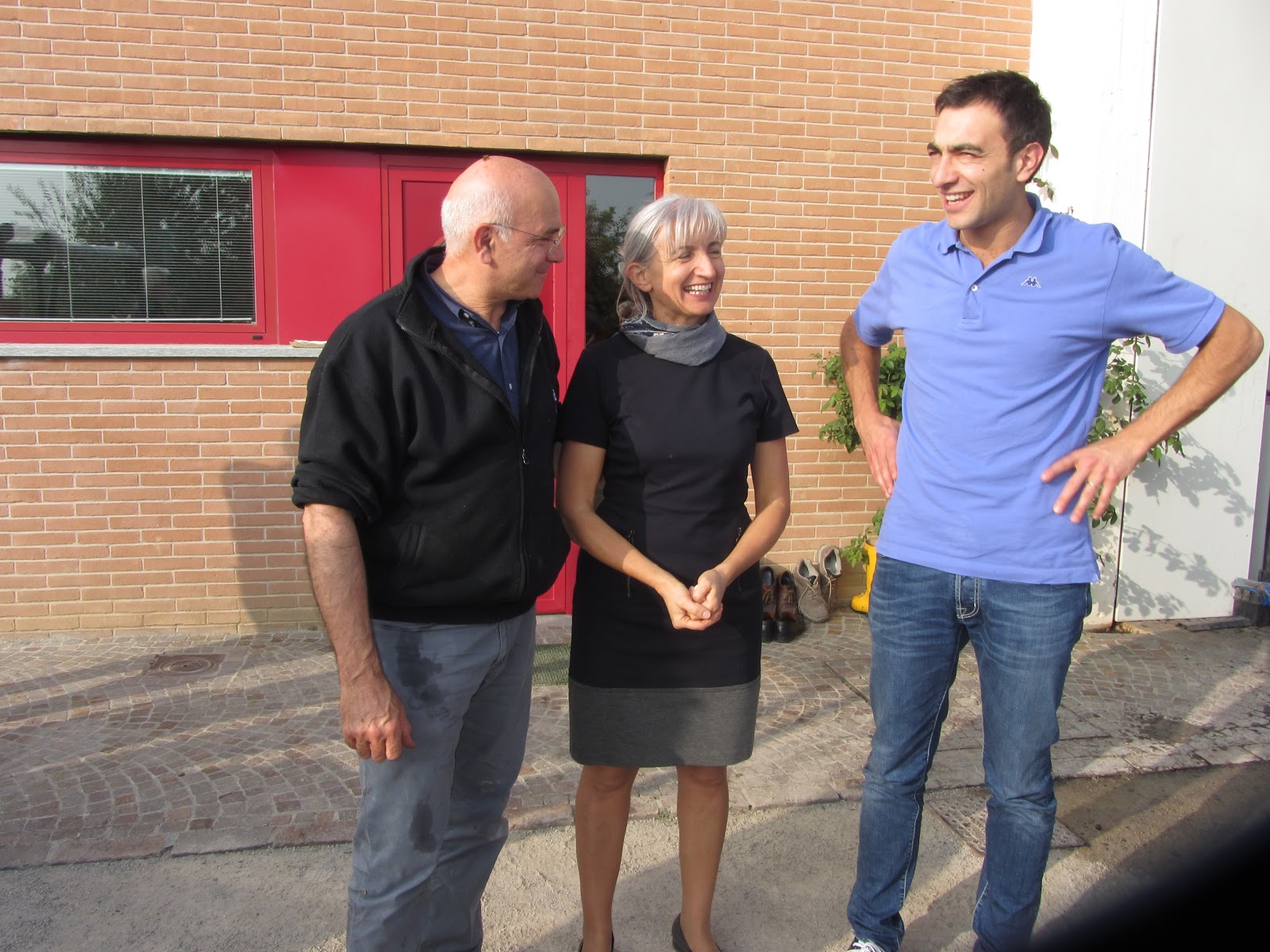
Gaja and Gaia
Giacomo Conterno
Franco Massolino
As an example of this generosity, let us take the case of the Gaja visit which occurred on Saturday, October 13th.  First off, the winery does not accept visitors in the normal course of events and, secondly, is closed on the weekend.  Yet both Angelo, family patriarch, and Gaia, his accomplished daughter, were both present to lead us through the day’s activities.  After an architectural tour of the facilities (designed to show how the winery had evolved), and a lesson on the history of the company, Angelo turned the reins over to Gaia to lead us through a tasting of vintage Gaja wines from magnums.  Absolutely phenomenal.  After the tasting, the Gajas hosted us for a lunch wherein a different set of magnums were opened to accompany the meal.  At the conclusion of the lunch we were each given a set of documentation and a magnum of 2004 Gaja Sperss enclosed in a patterned wooden box.  A stunning, unexpected gift that was humbly accepted by each recipient.  Floored us it did.


A feature of the previous Decanter trips had been extended access to leading regional estate proprietors/managers.  This trip did not disappoint in that regard.  We spent 2+ hours with Giuseppe Vaira at a tasting lunch on the first day, followed by a 45-minute truffle hunt (on which he accompanied us), followed by a visit and tour of the Vajra operations during crush – and at which time access was expanded to include his mother, father, sister, and brother – and, finally, capped by an hour-long tasting of the company’s offerings that had not been experienced at lunch.  The Gaja name is one of the most recognized in Italian wine circles and Angelo Gaja has been a tireless advocate of his family’s wines and his region.  We spent an extended period with him and Gaia and I had the distinct privilege of sitting next to him at lunch and to benefit, at a personal level, from his quick wit, sharp mind, and ever-present humor.  He is a storyteller. Giacomo Conterno walked us through an educational tasting of the Aldo Conterno wines (he poured each and every glass) and through the vineyards arrayed in the hills above the winery.  Franco Massolino did much the same, in terms of the tasting, while regaling us with stories regarding the prowess of his aunt at both the bottling and labeling stations in the winery.  The opportunity to listen and learn from practitioners of this art for such extended periods in a concentrated period of time was a very attractive proposition for me.


The team for the Piemonte experience numbered 12 individuals, six of whom had been on at least one of the previous Decanter trips.  It was a fun group that gelled immediately and was, in addition, very respectful of each other’s time, the proprietors’ contributions, and Decanter’s efforts.  The group dynamics and interaction contributed significantly to the success of the trip.
This trip was immaculate in both its conception and execution, with no hitches or hiccups along the way.  I credit Decanter for assembling such a high-powered roster of wineries and enlisting the proprietors in the conspiracy to provide its readers with a host of memorable experiences. Emma (Jones now) was her usual “model-of-efficiency self and excelled at the task of herding cats.  Sarah Kemp descended on us from on high post the lunch on Friday and from then on functioned effectively as the bridge between the team and the proprietors (with all of whom she appeared to have extremely good relations) as well as serving as the fulcrum for many in-team discourses about wine-industry-related issues.

In closing, I must say that this trip was a rip-roaring success.  Decanter once again married its readers’ loyalty, love of wine, and sense of adventure with the food, wines, fabulous accommodations, and people of a leading wine region with the result being a spectacular experience for lucky readers.  I am ready for the next trip to a region that is unencumbered by the weight of our previous passage.

©Wine -- Mise en abyme