Showing posts with label Cannubi. Show all posts

Wednesday, September 6, 2017

Tradition in Barolo: A visit to the Bartolo Mascarello cellar

The furniture and photographs of famous intellectuals, musicians, and artists adorning shelves laden with books were the same. Even the tiny sign embedded in the building's exterior near the door was the same. Although Bartolo Mascarello was no longer physically there, his presence was palpable as his petite daughter and only heir sat at the same desk where he had hand painted unique, prized wine bottle labels. In that small room where her father had welcomed clients for decades, Maria Teresa Mascarello opened the door for me onto her private life, if only a little.
So reads the opening paragraph of Suzanne Hoffman's Labor of Love, the seminal work on the wine family women of Piemeonte. And those were the words that rang in my ears as I prepared to enter into that room for my first visit ever to the estate.

I met Maria Teresa for the first time in June of 2016 at the Piemonte launch of Labor of Love.

Maria Teresa Mascarello and the author
at the June 2016 launch of Labor of Love
That was a special moment for me as I had participated in a Galloni retrospective (1958 - 2010) of the estate's wines just a little over a month earlier. At that meeting I had expressed my desire to visit the estate and she had responded with her card and the assurance that I would be welcome. I took her up on that promise during my mid-May-2017 trip to Piemonte. And now we were here.


My primary contact during the setup of the trip was Alan Emil Manley and this is who I asked for when we arrived. We were early so Maria Teresa's secretary sat us at the tasting table to await his arrival. On his arrival he indicated that Maria Teresa would be joining us shortly but he would be getting us started in the meantime.

History
Bartolo Mascarello was founded by Guilio Mascarello -- grandfather of Maria Teresa -- on January 1, 1920. Both Guilio and his father Bartolomeo were associated with the local grower cooperative but, using a 10,000-lire loan from a cousin, a loan underwritten by his father, Guilio left the coop to launch his own cantina. The business expanded in the 1930s with the acquisition of vineyard plots in Cannubi, San Lorenzo, and Rué. It was during this early period that the estate's guiding principles were enshrined in its practices (A Wine Atlas of the Langhe):
  • Wines made from grapes from a number of vineyards in order to drive consistent quality
  • No vineyard selections
Guilio's son Bartolo joined his father in the business after the end of WWII. Guilio died in 1981 at the age of 86 and Bartolo took over the running of the estate. In Bartolo's days, Mascarello blended vineyards, fermented the grapes together, and allowed the resulting wine to mature slowly. Bartolo died on March 12, 2005 and management passed to his daughter Maria Teresa.

In his preliminary remarks at the previously mentioned Mascarello tasting, Antonio Galloni stated that he expected the first flight -- themed "ready to drink" and including the 1995, 2000, 2003, and 2005 vintages -- to clearly exhibit the generational shift from Bartolo Mascarello to his daughter Maria Theresa. During her tenure, the aging time has been shortened, the winery (and the wine) has been cleaner, and they now have the equipment to do proper de-stemming. Maria Theresa got rid of the old barrels, she procured a modern de-stemmer, and the grapes are ripening such that it is easier to separate the Nebbiolo stem from the grape.

Viticulture
By this time Maria Teresa had arrived and she warmly greeted us. Given our lack of the Italian language, it was agreed that Alan would continue the discourse and cantina tour and Maria Teresa would re-join us when we returned to the tasting room.

Today the estate owns 5 ha of vineyards (distributed over four MGAs) and produces between 32,000 and 35,000 bottles of wine, 50% of which is Barolo. The characteristics of the MGAs in which the Mascarello plots are located are shown in the figure below. The characteristics of the individual plots are shown in the figure following.


The estate, according to Alan, is traditional in both its farming and cellar practices. They try to grow balanced fruit rather than going for "super" concentration. Nebbiolo is a vigorous vine and, as such, requires focused canopy and yield management regimes. In the case of canopy management, its utility as a tool in the battle against the effects of global warming also has to be taken into consideration. The vineyard architecture and cultural practices are illustrated below.


Cellar
As we discussed the elements of the cellar, we walked through areas exhibiting very old bottles of wine as well as examples of Bartolo's well-developed and highly regarded wine labels.

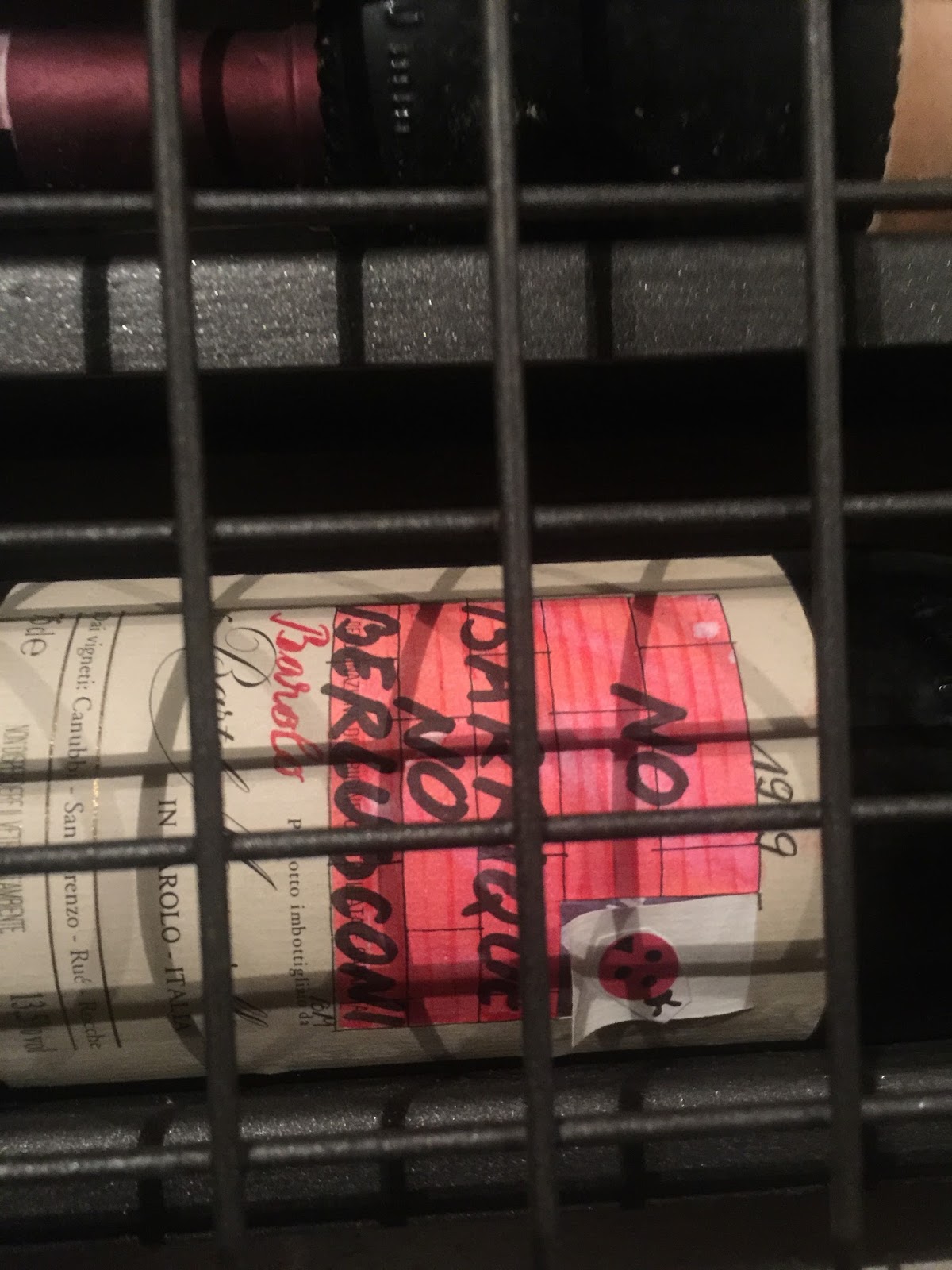

Maria had written an article for Tong Magazine a few years ago in which she described the vineyard and cellar work required to make Barolo in the Mascarello style. I have summarized her writing on the cellar work in the figure below.


The goal, according to Alan, is to make a truly harmonious Barolo. And that task begins with the harvest date: we wait for the skins to tell us when to harvest. Further, there is a strict selection of the grapes that make it into the wine. That selection begins in the vineyard, where imperfect fruit is left on the ground, and continues with a second selection at the sorting table in the cellar.

Fruit from the four plots are mixed in the fermentation vats in a process called "asseblaggio." As the harvest time differs from vineyard to vineyard, recently brought in fruit is added to the mix that is already resident. According to Alan, "the ratios change from year to year as nature gives us different quantities from year to year. What the land gives us becomes our wine. We do not adjust the proportions to keep a constant ratio. For example, in 2012 we had hail only in Rué, and half the fruit was damaged and left on the ground. We simply had less of the Rué fruit in the mix that vintage ..."

The fermentation tanks are fiberglass-lined concrete tanks from the 1940s. The Slavonian oak barrels used in the aging process are changed out every 40 to 50 years. The aging regimes are as follows: Dolcetto and Freisa, 1 year; Barbera and Langhe Nebbiolo, 2 years; and Barolo, 3 years.

Tasting
At the conclusion of the cellar tour we returned to the tasting room to sample the wines. We started with a Barbera 2014. This had been a difficult year with lots of rain. The weather cleared in the last two weeks of September and the first two weeks of October. The best wines of this vintage are excellent. Rose petal, spice, and rusticity on the nose. Good acidity and power.

Alan in the tasting room

Next up was the 2012 Barolo, This is a vintage, according to Alan, that they consider "shy" -- it requires a bit of coaxing. That year was never too hot, never too cool. They had hail in Rué and that is the vineyard that provides structure. Strawberries, honeyed nose, dried flowers, green herbs, sweet talcum powder. Delivers on palate. Fine-grained tannins. Lenghty finish.

Maria Teresa in the tasting room

The final wine tasted was the 2013 Barolo. This was a cool, classic vintage. After 21 days of maceration they terminated skin contact. Alan expects this wine to begin closing down temporarily sometime in the near future. Strawberries and roses. Honeyed nose with a hint of balsamic. Concentrated yet balanced. Lengthy finish. A wine to be aged and for the ages.

Alan and Maria Teresa

As we were going through the wines, Maria Teresa re-iterated the importance of her father's influence in everything that is done on the estate today. This adherence to his teachings is done both to honor him and because it continues to result in excellent wines that appeal to her customers.

Alan was a fount of information and a pleasure to be around if you like diving into the innards of a vat. We truly enjoyed this trip and would like to thank Maria Teresa and Alan for the hospitality and insights.

©Wine -- Mise en abyme

Monday, August 7, 2017

Top-rated Barolo crus -- tranche #3: Cannubi, Gabutti, Parafada, Lazzarito, Marenca, and Rivette

Three of the foremost Barolo vineyard experts -- Renato Ratti, Alessandro Masnaghetti, and Antonio Galloni -- have each taken a shot at classifying the crus in the Barolo zone (I have shared the frameworks of the individual schemes in a prior post.). In this series I am providing an account of the top-rated crus as identified by these experts. In the first post, I presented the crus where there was full agreement among these experts. At least two of the experts had to have identified the cru as top-level for it to be covered in the second post. In this post I cover the top-level crus identified as such solely by Renato Ratti.

The crus rated as top-level by Ratti only are Cannubi (rated as Noteworthy by Galloni and Three Stars by Masnaghetti), Gabutti (rated as Outstanding by Galloni and Three Stars by Masnaghetti), Parafada (rated as Outstanding by Galloni and Four Stars by Masnaghetti), Lazzarito (rated similarly to Parafada by Galloni and Masnaghetti), Marenca (Outstanding by Galloni, Three Stars by Masnaghetti), and Rivette (same as for Marenca). It should be noted that, in his classification, Ratti treated Gabutti and Parafada as a hyphenated vineyard and similarly treated Marenca and Rivette. In today's nomenclature, these vineyards are separate MGAs. The characteristics of these crus are shown below.


Cannubi
Cannubi is a long, gradually sloping hill which extends northeast from the village of Barolo and is contained in its entirety within the namesake commune. According to the Marchesi di Barolo website, Cannubi hill is protected from storms and extreme weather by higher neighboring hills. Both Damilano and Marchesi di Barolo point to the uniqueness of the hill in that it sits at the convergence of the aforementioned Helvetian and Tortonian soil zones resulting in "grey-blue marls rich in magnesium and manganese carbonate that, on the surface, thanks to the air and the weathering, turn into grey-white marls" (Marchesi di Barolo).

Chiara Boschis' Pira e Figli was the first Cannubi estate to convert to organic farming, gaining its certification in 2014 (Labor of Love). But she was not content with practicing this only in her vineyard. She became an evangelist on Cannubi such that today fully 99% of the producers on the hill are organic.

I tasted the 2012 Barolo Cannubi on a visit with Chiara earlier this year. Cherry, plum, tar, and herbs were the hallmarks of this wine along with a waxiness and massive tannin structure. This wine will last for a while.


I tasted the 2013 Barolo Cannubi on a visit with Silvia Altare of Elio Altare. The wine was floral on the nose along with red fruit, spice, and blackpepper. Beautiful weight on the palate and excellent finish.


Gabutti
"We are not exaggerating when we say that Gabutti is the starting point of a long ribbon of vineyards along the side of the most prestigious hill in the municipality of Serralunga, and one of the most outstanding in the entire Barolo DOCG zone." (Petrini, A Wine Atlas of the Langhe). But this strong endorsement did not result in the elevation of this MGA to the uppermost ranks of the Masnaghetti and Galloni schemas. According to Petrini, in making the decision to designate Gabutti to the highest levels of his schema, Ratti was guided by "the widespread beliefs of growers in the area and by a long-established hierarchy that had taken root in the popular consciousness and was reflected in prices in the market."

The south-facing aspect, steep slope, and protection from the wind combine to render this MGA a prime location for the growth of Nebbiolo grapes. Soils are of the Lequio Formation with loose calcareous clay marls from the Langhian stage of the Miocene epoch.

Masnaghetti sees the beating heart of the MGA as the area between Parafada and Cascina Marianot where the southern exposure compensates for the relative lack of luminosity. The style of wines from that area range from "the rugged and rather classical tannic impact of of the Cappellano wines to the rougher Barolo of Franco Boasso, whereas the eastern side of the cru offers the flowing and floral style of Giovanni Sordo's Gabutti."

Parafada
This vineyard is more uniform in its exposure that Gabutti or Lazzarito and can be seen as a bridge between those two MGAs (Masnaghetti). The Delizia plot, primarily owned by Fontanafredda, produces very high-quality wines from its "fairly shallow white clay and limestone marl" soils (Petrini).

The wines from Parafada are "less voluminous than Lazzarito and more refined than Gabutti" and are endowed with the vigor and presence on palate and nose that is the hallmark of a first-order wine (Masnaghetti).

Lazzarito
A large vineyard in Serralunga d'Alba whose name can probably be traced back to an ancient hospital for Black Plague victims on the property. According to Masnaghetti, the vineyard can be divided into two parts:
  • Eastern slope -- smaller in size and less well known
  • Western slope -- can be further divided into the La Delizia and Lazzarito amphitheaters
Masnaghetti also references a < 2 ha plot lower down on the slope called Lazzairasco, an area with favorable south to southeast exposure and with excellent quality potential. Santa Caterina, on the southern boundary, like Lazzairasco, was absorbed by Lazzarito in 1990 during the township-mapping process.

A significant portion of the vineyard is owned by Fontanafredda but Ettore Germano and Vietti also farm plots there. Sergio Germano (Ettore Germano) and Luca Currado (Vietti) were both interviewed about the vineyard on a Vinous video. Sergio sees the main characteristics of the vineyard as the elegance and finesse that it imparts to the wine. The wine is strong with lean-textured tannins and a lengthy finish. The soil has a high limestone concentration but also has some beach-like sand which gives a "slim texture" to the wine.

Luca found the vineyard challenging; he farms it more with his stomach than with his palate. It provides good minerality, spiciness, and complexity to the wine and its amphitheater-like shape provides great exposure for the grapes.

I had the opportunity to taste the 2012 Lazzarito at the Vietti estate.


The 1.7 ha Vietti plot is SW facing and the 39-year-old vines are planted 4500 vines/ha. The 2012 Lazzarito had a nose of beautiful, rich red fruit with baking spices, black pepper, and a savoriness. Powerful wine with sweet red fruits dominating the palate.

Marenca
The pronounced amphitheater of the Marenca vineyard provides the vines with excellent exposure to sunlight. The soil is a calcareous clay.

There is only one labeled wine wine originating from the vineyard -- produced by Luigi Pira -- but it is of high quality "with a structure which is among the deepest and most complex of the entire township" (Masnaghetti).

Rivette
The vineyard sits at the foot of the inhabited area of Serralunga d'Alba and is immediately recognizable by the vine rows running vertically up the hillside rather than horizontally across the hill, as is the case for neighboring  vineyards.

According to Petrini, Rivette has always been regarded as an excellent location for growing Nebbiolo. The soil is a loosely packed marl and limestone mix and the quality of the grape are "beyond dispute." Petrini's description of the MGA is a little at odds with that of Masnaghetti's who states that, with the exception of a few small plots owned by Pira and Massolino, the remainder of the vineyard -- owned by Gaja -- is used for white grape production.

©Wine -- Mise en abyme

Saturday, May 27, 2017

Cannubi Hill and its associated Barolo subzones

During my mid-May trip to Piemonte, I visited a number of estates that produce wines made from grapes sourced from one or more of the five Cannubi subzones. These subzones are five of 170 MGAs in Barolo DOCG and five of 37 MGAs in the commune of Barolo (An MGA (Menzioni Geografiche Aggiuntive) is a "more specific officially delimited area of production located within the Barolo DOCG appellation.").

The name Cannubi had historically been associated with the vineyard on the central part of the hill while the vineyard to the northeast was named Boschis/Monghisolfo and those to the southeast were named San Lorenzo, Valletti, and Muscatel, in that order. In 1995, the Commune of Barolo allowed the non-historic Cannubi vineyards to affix the name Cannubi to their vineyard names such that they were then referred to as Cannubi Boschis, Cannubi San Lorenzo, Cannubi Valleti, and Cannubi Muscatel. Subsequent legal rulings allowed these vineyards to be referenced in this latter manner or to be simply called Cannubi. In that manner, a producer using grapes from the historic San Lorenzo vineyard can either label the wines produced therefrom as Cannubi San Lorenzo or Cannubi.

When the Padano Sea retreated from what is today's Langhe, it left behind layers of clay, calcareous marl, blue marl, tufa, sand, and sulfur-bearing chalk. The Barolo zone is divided into two soil subzones based on the age of the deposits. To the west, the soils around the towns of Barolo and La Morra are composed of a calcareous (limestone-rich) marl with high levels of sand -- referred to as Tortonian (11 - 7 million years ago) -- that yields aromatic, elegant, medium-bodied wines which evolve in the bottle earlier than their counterparts.  The wines from the Barolo commune are thought to be more complex, and broader in texture, than the more perfumed and graceful La Morra wines. The Langhian (until the 1960s, Helvetian) soil around the communes of Serralunga d'Alba, Monforte d'Alba, and Castiglione Falletto was deposited between 16 and 13 million years ago. The soils of this zone are mostly calcareous clay marls with little sand content and produces a wine that is more structured and requires longer aging.

Cannubi is a long, gradually sloping hill which extends northeast from the village of Barolo and is contained in its entirety within the namesake commune. According to the Marchesi di Barolo website, Cannubi hill is protected from storms and extreme weather by higher neighboring hills. Both Damilano and Marchesi di Barolo point to the uniqueness of the hill in that it sits at the convergence of the aforementioned Helvetian and Tortonian soil zones resulting in "grey-blue marls rich in magnesium and manganese carbonate that, on the surface, thanks to the air and the weathering, turn into grey-white marls" (Marchesi di Barolo).

The red oval indicates location of the Cannubi hill 
The vital statistics of the Cannubi subzones, as well as the producers plying their trade therein, are contained within Masnaghetti's Barolo MGA. I have consolidated that data and present them in the charts below.

Note that all of the above sub-zones have the legal right
to be called Cannubi (Sources: Map is an extract from the official Barolo map;
data from Masnaghetti's MGA

Note that all of the above sub-zones have the legal right 
to be called Cannubi.
Antonio Galloni has divided the Barolo crus into four classes -- Exceptional, Outstanding, Noteworthy, and Delimited -- broadly correlating to the Burgundy classification scheme of Grand Cru, Premier Cru, Village, and Region. The characterization of these classes, and his placement of the Cannubi crus within that schema, is indicated in the table below. According to Galloni, "Cannubi is the most famous and well-known vineyard in Barolo, but it has rarely produced wines that in my view stand with the very best in Piedmont."

RatingExplanationCannubi Cru
ExceptionalVineyards that consistently produce distinctive wines of a very high quality, irrespective of the quality or style of the year

Outstanding… often produce wines of true personality and class but do so less consistently than Exceptional vineyardsCannubi Boschis or Cannubi
Cannubi San Lorenzo or Cannubi
Cannubi Valletta or Cannubi
NoteworthyA vineyard that over the years has proven to be the source of distinctive winesCannubi
Cannubi Muscatel or Cannubi
DelimitedGeographically delimited; little, no, or undistinguished track record


I will be reprising my visit to Chiara Boschis' E. Pira e Figli in my first post on the Piedmont winery visit.


©Wine -- Mise en abyme