Showing posts with label A Wine Journey. Show all posts

Thursday, September 30, 2010

A Wine Journey: 1998 Alvaro Palacios L'Ermita

In my continuing quest to taste the wines identified as the Wines of the Decade (the best wines he tasted between 2000 and 2009) by Master Sommelier Andrew McNamara, I thought to taste the 1998 Alvaro Palacios L'Ermita as part of the celebration of International Grenache Day.  This post relates the experiences associated with that tasting.
L'Ermita is the flagship product of Alvaro Palacios, one of the pioneering young winemakers who accompanied René Barbier to Priorat to reclaim that region's winemaking traditions. In what has come to be known as the "Grattalops Project," these winemakers had separate vineyards but shared winemaking facilities in order to control costs and quality.  Palacios had an excellent winemaking pedigree prior to his involvement with Gratallops.  He was one of nine children born to the owner of Bodega Palacios Remondo, a respected Bodega in the Rioja Baja, had studied winemaking in Bordeaux, and had worked at Chateau Petrus for 2 years under the famed winemaker Jean Pierre Mouiex.

Palacios bought his first vineyard in Priorat -- Finca Dofi -- in 1990 and then found, and bought, L'Ermita in 1993.  L'Ermita, named for a small chapel at the top of the hill on which the vineyard lies, is a north-east facing, 2-hectare plot that sits between 400-500 meters elevation on a precipitous, well-drained, granite slope.  The steep hillside terraces, some only wide enough for one or two rows of vines, are populated by gnarled, head-pruned Garnacha vines which were all planted between 1900 and 1940.  Since 2000, Palacios, whose practices reflect his view that wines are "a transparent expression of the terroir," has been farming L'Ermita biodynamically.

The grapes for the wine are hand picked with teams making multiple passes through the vineyard to ensure that the best grapes are picked at the right time.  Prior to 2005, the finished wine contained 20% Cabernet Sauvignon, added to provide structure.  Since 2005 the wine has been 100% Garnacha.  The wine undergoes maceration for 25 days in oak vats and is then aged in 100% new French oak for 16 to 18 months.  The yield is approximately 10 hectoliters/hectare and annual production is 250 cases.

Andrew McNamara had identified the 1998 vintage of this wine as one of his wines of the decade and Robert Parker, in assigning it a score of 97, fawned over it thusly: "The blockbuster, opaque purple-colored 1998 L'Ermita exhibits ... copious quantities of sweet oak, a boatload of glycerin and superb blackberry, cassis, and cherry fruit that explodes on the mid-palate and in the finish."

I had the wine shipped into state by overnight delivery so that it would be a part of the Wine Barn celebration of Grenache Day. The details of the evening were covered in a prior post so I will limit myself herein to the circumstances surrounding the tasting of the L'Ermita.  The wine was taken from me when I arrived at the location and was placed into a brown paper bag as were all of the other wines.  The donated wines were


marked uniquely in order to differentiate them from each other as well as from the larger group of wines. I was able to identify the L'Ermita and, after my first encounter with it, it was impossible to dislodge me from my position at the tasting table.

The wine had a youthful appearance with some slight browning at the edges and showed blackfruit, cassis, cedarbox and vanilla on the nose.  The scents were so compelling that it took significant effort to transition from smelling to tasting.  The wine delivered on the palate with blackfruit, minerality, acidity, excellent balance, and a very long finish.  All elements of the wine were fully integrated and the youthful appearance and taste of the wine signaled even greater drinking pleasure down the road.


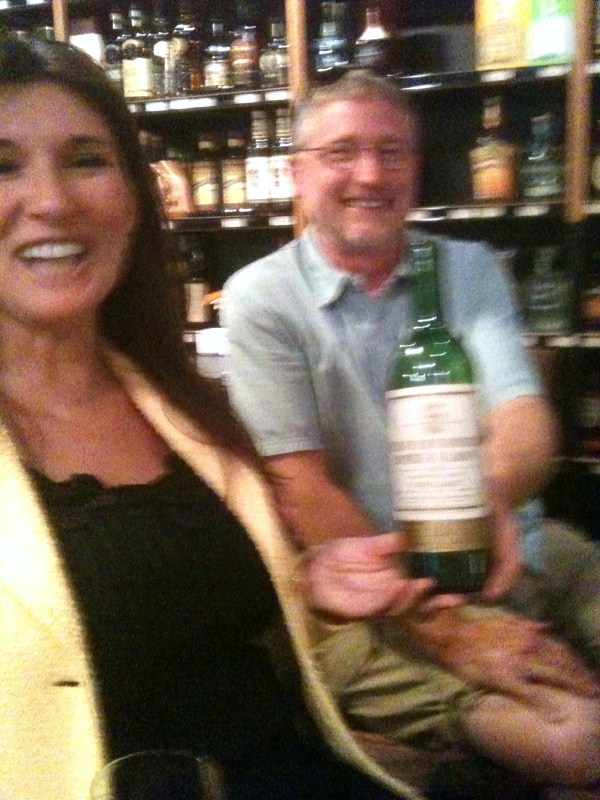
A definite homerun, as can be seen by the look of amazement on the face of Andrew Montoya, owner of The Wine Barn., as he removes the bag to reveal the identity of the wine.

Wednesday, September 15, 2010

Confluence of #Bubbly Day and A Wine Journey

Yesterday (September 14) was designated #Bubbly Day and wine drinkers were asked to mark this day by drinking their favorite bubbly and sharing their experience with others around the world via Twitter.  This online aspect of #Bubbly Day was hosted by @Atlantawineguy.

From the launch of this website I have been engaged in a quest to taste the 115 wines designated by Master Sommelier Andrew MacNamara as his Wines of the Decade.  I opted to do a #Bubbly Day-Wine Journey mashup by tasting one of Wine Journey champagnes on #Bubbly Day and selected for this purpose the 1988 Pol Roger Cuvee Sir Winston Churchill.  I did not have this wine in my cellar and had to procure it online from Benchmark Group.  I had them overnight the wine to me and installed it in my cellar to await its pleasurable sacrifice.


Pol Roger was founded in 1849 and today has approximately 87 hectares of vines in and around Epernay.  The company's line of champagnes include three non-vintage cuvees -- Brut Reserve, Rich, and Pure -- and three vintage cuvees -- Brut Vintage, Brut Rose, and Cuvee Sir Winston Churchill.  The non-vintagre cuvees are all made with equal parts Pinot Noir, Pinot Meunier, and Chardonnay while the Brut vintages are 40% Chardonnay and 60% Pinot Noir.  The mix of grapes for the Cuvee Sir Winston Churchill is not publicized.  The Cuvee Sir Winston Churchill was named after that great man, who happened to be both a friend and loyal customer of the Pol Rogers.  According to wine.com, the cuvee was made in a style preferred by Sir Winston, "... robust, full-bodied, relatively mature and dominated by Pinot Noir which contributes firmness and backbone complemented by the ethereal elegance of Chardonnay."

I had invited the members of the Antonio's Tasting Group to join me at The Imperial on #Bubbly day and we had 11 people show.


The picture below shows our champagne lineup.  We started with a Veuve Clicquot and never looked back.  With every bottle we opened I issued


 a "Big-Bird" tweet.  We were monitoring Twitterfall to gage the action that was ongoing elsewhere and noted a few retweets of our tweets and a query from @Atlantawineguy about the Sir Winston Churchill.

The Sir Winston Churchill was the last bottle opened and everyone stayed around for that event.  This wine was worth the wait.  It had tight bubbles, apple-pear notes, a certain breadiness, walnuts, good acidity and a long finish.  We had drunk a lot of very good champagne that evening but this was clearly the cream of the crop.


A good night was had by all.  We had the satisfaction of drinking locally while participating globally.  We could get to like this.

Wednesday, June 23, 2010

A Wine Journey: 1990 Gruaud-Larose

The 1990 Gruaud-Larose was the most recent conquest in my quest to "run the table" on Master Sommelier Andrew McNamara's Wines of the Decade.


Chateau Gruaud-Larose, a Medoc second growth (1855 classification), can trace its roots back to its creation in 1725 by the knight Joseph Stanislas Gruaud.  The estate, initially called Forbedeau, passed to his only heir, Jean-Sebastian Larose, upon the founder's death.  The chateau was purchased by Bordeaux merchants Balguerie, Sargent and Co., whereupon the name Gruaud-Larose was assigned.  The estate was split between two families shortly after the sale with two Gruaud-Larose wines (Sarget and Bethman) being produced and sold as a result.  The original estate was reconstituted when Desire Cordier, an east France wine merchant, bought the Sarget estate in 1917 and the Bethman estate in 1935.


The current-day Gruaud-Larose occupies 150 hectares in the St. Julien appellation, positioned directly between fellow Medoc properties Branaire-Ducru and Lagrange.  Of the 150 hectares, 82 hectares are planted to vines which are, on average, 45 years old.  The distribution of varietals on the estate is 57% Cabernet Sauvignon, 30% Merlot, 8% Cabernet Franc, 3% Petit Verdot, and 2% Malbec.  The soil under the vineyard is deep Quaternary gravel.


The Gruaud-Larose winemaking process requires that fruit be hand-picked after which it is sorted and cold-soaked.  Fermentation takes place in temperature-controlled wooden and concrete vats with the juice pumped over the must twice per day.  Upon completion of fermentation, one-third of the vintage is subjected to malolactic fermentation in oak barrels.  The entire vintage is aged in up to 50% new oak for 18 months after which it is fined and filtered and then bottled as Gruaud-Larose (25,000 cases) or Sarget de Gruaud-Larose (16,000 cases).


The Wine Quest Premier Dining Experience, an event benefiting a local charity, was being held at the JW Marriott on Saturday evening, The event schedule called for a 7:00 pm champagne reception followed by dinner at 8:00.  In order to have an even fuller evening, four of us decided to take some wine and hang out in the hotel lobby from about 5:30 pm and to then join the Wine Dinner when it began. I took a bottle of the 1990 Gruaud-Larose and a 1990 d'Yquem (for use with our dessert course) and Adam took a 2004 Chaves Hermitage Blanc


We started with the Chaves which had a pale gold color and was thick and weighty in the glass.  This wine needed decanting.  It was powerful, unctuous, weighty on the palate and with a long finish.  It actually needs more time in bottle so that it can resolve its issues.


We next turned to the Gruaud-Larose.  We did not have a wine key so we asked our server to open the bottle for us.  We were engaged in conversation but she did appear to be taking a long time to begin pouring.  we understood why when she asked us if we could help with getting the cork out.  The cork may have had some issues but the server had succeeded in punching a hole deep into the cork and expelling most of the material on which the corkscrew would grab.  We took the bottle and attempted to penetrate at the interface between the cork and the glass but to no avail.  There was not enough material.  We dispatched her to get a decanter and a sieve in the event that we had to punch the cork down but I panicked when she returned with the decanter and a flavor-stripping coffee filter (I never use those for filtering wine after I had the experience of a 1991 Dominus being brought to its knees after being poured into a decanter through one of those filters.).  By this time the anticipation had waned and it was now a rescue operation.  I took the bottle to the bar and had one of the bartenders work on it for well nigh 20 minutes before he was able to successfully extract the cork with no residue migrating through to the wine.


We decanted the wine and then poured it into the glasses.  Garnet color with bricking at the edges.  Good viscosity.  Vegetality on the nose.  Good acidity. On the palate leather and a mintiness.  Did not have a full, round mouthfeel and the finish less-than-long.  I was disappointed in this wine but I will have to retaste it.  The cork might have been an indication of prior battery to the wine and the circumstances under which it was tasted were not exactly  memorable in a positive way.  The company was great though.


Thursday, May 27, 2010

A Wine Journey: 1982 Pichon-Longueville, Comtesse de Lalande

The author is engaged in a quest, a journey in the footsteps of the Master (Sommelier) Andrew McNamara who, as it has been told, in days of yore, slew 115 bottles of very good wine -- the so-called Wines of the Decade.  Today's tale relates the pursuit, capture, and tasting of that vibrant beauty, the 1982 Comtesse de Lalande.

The story of Chateau Pichon-Longueville, Comtesse de Lalande, stretches back to 1689 when the Rauzan family bought plots in Pauillac.  The core Pichon vineyard was established after some plot exchanges with it s famous neighbor, Chateau Latour.  The new Napoleonic wine laws were responsible for the Pichon Vineyard being broken up into the Baron and the Comtesse, as it could not be passed on to a single heir while other possible heirs were alive.  The Lalande family retained ownership of its portion of the Pichon Vineyard until a sale to a consortium led by Louis and Eduoard Mailhe.  After a few twists and turns, the estate eventually cane under the control of Eduoard's youngest daughter, May-Eliane, and she quickly upped her stake from 55% to 84% by buying up the shares of other consortium members.  The Chateau was sold to the Rouzaud family (owners of Louis Roederer) in 2006.

The chateau owns 75 hectares of vines (up from 40 hectares at the beginning of May-Eliane's tenure), 64 hectares of which are in the Pauillac commune and the remainder in St. Julien.  The soil is gravel over clay and some deeper limestone and sandstone.  The vineyard is planted to 45% Cabernet Sauvignon, 35% Merlot, 12% Cabernet Franc, and 8% Petit Verdot.  The grapes are hand-harvested and then fermented in temperature-controlled stainless steel tanks.   The juice is allocated between the flagship and the chateau's second wine (Reserve de la Comtesse) after which the flagship wine is placed in 50% new French oak for 18 months.

The 1982 vintage has received widespread acclaim.  The winery refers to it as an exceptional vintage.  Robert Parker (November 1998) said "This has been the most sumptuous, delicious, and profound 1982 to drink over the last 5-6 years."  James Suckling  of Wine Spectator said "This has always been a great wine. I marvel at it each time I taste it."

This wine was bought online.  This is not a great time to be shipping wine into Florida so I had it shipped in next day air. I did not get into the office for a few days so it was languishing in the hallway outside my office.  I was very concerned.  I picked it up at the office on Friday and headed directly to our Antonio's tasting event.  They were going to be tasting this blind.

When I arrived at the venue, only HlyTerrroir and Keith M. had arrived.  I had not brought a bag with which to cover the wine so HlyTerroir lent me one (He is always prepared.).  I opened the wine without decanting and placed it on the table.  The top of the cork was covered in a greeninsh moss and the cork came out in four separate pieces.  I was concerned.  The locale filled up very quickly as this was going to be another farewell to Robert and Allison. 

The wine was a stunner from the word go.  There was very little evidence of bricking; the lighter-red  color was consistent throughout (I can see why the word claret was used in the early days by the British to describe Bordeaux wines.) .  It had a great nose.  The fruit had receded into the overall framework and the secondary characteristics were on full display.  Saddle leather. Cigarbox. Cardamom . Cedar.  On the palate the wine was very well balanced, exhibiting a full, round mouthfeel and good integration of all the elements.  It was like a Fred Couples golf swing: smooth, elegant, with a long finish and complete balance throughout.  "This is an epiphany wine."  "This is why I do this."  "This wine is begging for a roast tenderloin or a rabbit."  Those were some of the comments issuing from an awed round table.


This is, without a doubt, the best wine I have tasted in the series to date.

Thursday, May 20, 2010

A Wine Journey: 1998 and 2004 Penfolds Grange

I continue to climb this mountain one step at a time.  This is truly a case of the journey, the chase, being significantly more rewarding than the actual attainment of the end point.  Two more wines from the McNamara Wines of the Decade have fallen to my resolute corkscrew.

No one was as important to the development of Penfold's Hermitage Grange (Penfold's Grange since 1990) than the then winemaker Max Schubert but the founding and nurturing of the company can be traced back to Dr. Christopher Rawson Penfold and his wife Mary, respectively.  Dr. Penfold, who was firm in his belief in the medicinal value of wine, planted some French vine cuttings around his home in Magill, Adelaide -- called the Grange -- upon his emigration to Australia in 1844.  He produced port and sherry from the resulting grapes for dispensation to his patients.  Upon his death, Mary took over the running of the winery and, in this task, she was ably assisted by her son-in-law, Thomas Hyland.  Thomas and Georgina, Mary's daughter, assumed management responsibility when Mary retired in 1884 and the family members retained control until 1976.  The company is now owned by Southcorp, a division of Australia's Foster's Group.

Penfold's wine production consisted primarily of fortified wines and brandy up until the 1950s.  Jeffrey Penfold Hyland, reacting to his perception of changing tastes, asked Max Schubert to look into the increased production of table wines.  As a part of that mandate, Schubert visited the wine-growing areas of Europe and was very impressed by the aged wines he encountered in France.  He was convinced that with the proper technique, he could produce a quality, long-lived wine in Australia and sought to put that into practice with the production of  an experimental vintage -- utilizing the Syrah grape -- of Penfold's Hermitage Grange in 1951.  The early wines were not well received.  So much so that the board, in 1957, forbade further production of the wine. Schubert continued to produce the wine in secret and as the earlier vintages stabilized, they began to receive more favorable consideration.  These favorable comments trickled back to the board and, in 1960, they authorized Schubert to resume production of the wine.  Of course, he had never stopped and, thanks to his" cheekiness," there has been an unbroken string of Penfold's Grange produced since the experimental vintage in 1951.

From the beginning Penfold's has pursued a multi-vineyard, multi-district grape-sourcing strategy bolstered by a "house style" of complete, controlled fermentation followed by aging in new American oak barrels.  The grapes for the wine are sourced from vineyards in the Barossa Valley, McLaren Vale, and Magill, all regions falling within the Adelaide "super zone."

The vintages drank for this portion of the journey were from 1998 and 2004.  The winemaker for both these vintages was Peter Gago.  The 1998 vintage was 97% Shiraz and 3% Cabernet Sauvignon aged for 18 months in new American oak.  The 2004 was 96% Shiraz and 4% Cabernet Sauvignon aged fro 16 months in new American oak.


The 1998 was experienced at a previously mentioned dinner at the home of Keith and Nancy.  We opened the bottle at around 8:30 pm and noted that it had good color.  On the nose we experienced black olives, sawdust, cigar box, sweet tobacco, sandalwood, coconut, coffee, mocha, and salt ocean spray.  On the palate there was black fruit and some salt in the finish.  This wine was balanced, smooth and silky and had a "Jordanesque" hang time in terms of finish.

The 2004 was tasted at our regular Antonio's Friday afternoon tasting.  This wine had a complex structure with cigar leaf, raw meat, cedar box, leather, coconut, salt, black pepper, cherry, and black licorice all evident on the nose.  This wine was obviously a baby but was well integrated with smooth wood tannins across the palate and a lifelong finish.  One taster felt that this wine as more exuberant than traditional Penfold's but that it would be "smoking in ten years."  The wine was tasted one hour later and at that time the alcohol had become very evident, as was the pepperiness, and the green note had now become a green chord, the acid was now dominant, and there was significant chalkiness on the tongue.  The wine exhibited its promise in the earlier tasting and then seemed to close down.


Clearly world-class wines.

Monday, May 10, 2010

A Wine Journey: 1987 Dominus

Robert S., and Allison, members of faculty and administrative management, respectively, of a local university, and, in the case of Robert, a member in good standing of the Antonio's Tasting Group, are moving to another state in furtherance of Allison's career.  As a part of our send-off activities, a few of us got together with them for dinner at the home of Fred W., and Laurie L.


This was an occasion that merited a Wine of the Decade: a few showed up, including the 1987 Dominus, the 2001 Dominus (again), and the 1990 Dom Perignon (white, 750 ml).  This post covers the tasting of the 1987 Dominus.

Details of the Dominus Estate pedigree and winemaking philosophy and process have been covered in a previous post but a look at the label of the 1987 vintage provides new factual details.  The 1987 was the fifth vintage produced by the John Daniel Society, the name of the partnership between Christain Mouiex, Robin Lail, and Marcia Smith.  Second, the vintage has the pre-Bordeaux-style label with a non-dominant portrait of Moueix done by the Israeli artist Avigdor Arikha.

The tasting of the Dominus followed a wonderful "six-course" meal comprised of a jambalaya as a starter, followed by a gazpacho-style, apple-citrus soup, salad, planked salmon, grilled steak and a sherbert for dessert.  Many bottles of wine were consumed prior to, during, and after the dinner.  The 1987 was one of the post-dinner bottles.

The bottle was decanted by "I-need-a-light-source" HlyTerroir. Upon visual inspection, the wine had excellent color with hints of orange at the edges.  The legs were thin and evenly spaced and flowed relatively quickly back to the surface of the wine.  A perusal of the label for information on alcohol content is unrewarded but a  quick search online reveals that it is 12.9%; almost a teetotaler by the standards of today's Napa Cabernets.  That same online search also revealed that the wine is a blend of 86% Cabernet Sauvignon, 9% Cabernet Franc, and 5% Merlot and that said blend spent 14 months in French oak of which 25% was new.

On the nose the wine presents cigarbox, cedar, sandalwood, vanilla, mocha, espresso, spearmint, and eucalyptus.  On the palate there is a muted green note, cassis and a pleasant old cigar.  The late-arriving wood tannins are well integrated into this smooth and very-well-balanced wine.


Robert and Allison, you will be missed but you are permanently seared into our memories, and our senses, through this capstone dinner and the meritorious performance of the 1987 Dominus as a wine of the decade.

Wednesday, May 5, 2010

A Wine Journey: 1970 Vega Sicilia Unico

This foray into the the thicket of McNamara's Wines of the Decade takes us, once again, to the land of Ribero del Duero and that icon of classy elegance, Vega Sicilia Unico.  For many years the winery, and its wine, stood alone against the wines of Rioja so it is only fitting that the tasting of the 1970 Vega Sicilia Unico take place in a setting designed to highlight the wines of Rioja.

On the evening following the Vibrant Rioja professional seminar, this blog teamed up with Vibrant Rioja to host a dinner called A Dinner with Rioja.  The dinner was held in Lake Mary and Parlo, at whose home the dinner was held, worked closely with the chefs from Hospitality Concepts, Inc., to ensure that a food menu suitable to the occasion was on offer.  The final dinner menu consisted of four food courses and five accompanying wines:

  • First course -- Arugula and Mojito Prawn Insalata, Salsa Verde, Manchengo; paired with a 2008 Marques de Riscal Rosado
  • Second course -- Divers Scallop Escoviche, Cilantro Tomato Puree, Candied Lime; paired with a 2001 Marques de Tomares Reserva and a 1995 La Rioja Alta Reserva
  • Third course -- Sugar-cane-charred Churrusca (Skirt Steak), Creamed Yucca, nest of Asparagus, Chimichurri; paired with a 2005 Maetierra Dominus "quatro pagos"
  • Fourth course -- Trio of desserts: Guava Cheese Tart, Coconut Flan, Pineapple Tres Leches; an unusual dessert pairing of 2007 Tobia Graciano.

I welcomed the 35 guests, thanked them for coming, and turned it over to Dhane of Vibrant Rioja.


She, in turn, made a few remarks and then turned it over to Adrian Murcia, our designated driver for the evening.  Each course was preceded by an explanation of the food course by one of the chefs followed by Adrian's explanation of why the particular wine was so well-suited to the food with which it was paired.


The meal was a gustatory tour de force as course after mouth-watering course flowed across our palates and seared themselves into our collective memories.


Chef was in rare form and Adrian more than rose to the occasion.  The Marques de Riscal, Marques de Tomares, and the Graciano had all been tasted earlier in the day at the seminar and had not been exceptional.  Paired with the food, as they were that evening, they shone, especially the Graciano which was used as a dessert wine almost as an experiment.  The class of the Rioja's that evening, however, was the 1995 La Rioja Alta Reserva, two magnums of which were consumed.


After completion of the dinner, and a lot of congratulatory back-slapping, a team was assembled for the tasting of the Unico.  The team was comprised of all attending members of the Antonio's group as well as the members of the Vibrant Rioja team (Yup, the Rioja guys could bring themselves to drink juice from the "hated" Ribera del Duero if it was Unico.).

I had earlier removed the bottle of 1970 Unico from its position of honor in the cellar (in the display window and next to the 2001 Giacomo Conterno Monfortino Reserva Barolo) and I now handed it over to Adrian of Vibrant Rioja (after all, he was the most senior sommelier present) to do the honors.


As he reverently extracted the cork from the bottle, I made note of the serial number: 44631.

The wine was decanted for residue and then poured into the waiting glasses.  Even after being in bottle for well nigh 40 years, the wine had a bright color and was devoid of bricking.  To the awe of the participants, the wine offered up an aromatic feast of coffee, mocha, spice box, leather, mint, faded red flowers, raw meat, morcilla, dried currant, sandalwood, and dried tobacco.  It exhibited great structure and balance and had a very long finish.


The tasting team was blown away by the quality and finesse displayed by this wine as well as its vibrancy even after 40 years of "life."  This wine truly deserves its place on the Wines of the Decade list.

Tuesday, April 27, 2010

A Wine Journey: 2004 Didier Dagueneau Pouilly Fume Silex

The journey to taste the wines identified by Master Sommelier Andrew McNamara as Wines of the Decade continues with our first foray into the world of white wines, in this case the 2004 Pouilly Fume Silex by Domaine Didier Dagueneau.  This is an especially poignant step on the journey as Dagueneau, whose diamond-like wines, and penchant for criticism of neighboring winemakers, rocked the sleepy hamlet of St. Andelain to its core, died in a small-plane accident in September, 2008.  His death shocked the world of wines but was in character to the way he led his life: a life of adventure and risk-taking.

Didier Dagueneau, the mountain man, both visually and and as it relates to his winemaking accomplishments, was a fourth-generation winemaker who returned to St. Andelain to launch his winemaking career after spending four years pursuing fame and fortune in the arenas of motor cycle side-car racing and international dog-sled racing.  Referred to variously as "non-conformist," "independent,"and "maverick," and nicknamed "the madman of Saint-Andelain," Dageneau's "... fusion of modern winemaking and ultra-traditional techniques of vineyard management ..." allowed his Sauvignon Blanc wines to "... achieve the ultimate expressions of terroir, climate and technique."

Dagueneau began his climb to the pinnacle of Sauvignon Blanc-dom by purchasing 1.2 hectares of land in his native St. Andelain -- a village in the Pouilly-Fume appellation -- in 1982 and producing his first wine under the En Chaillone label.  This entry-level label was followed by the higher-end Silex and Pur Sang labels in 1985 and 1988, respectively.

Dagueneau's vineyard acreage lies predominantly on clay and flint (silex in French) soils and his vineyard techniques -- severe pruning, de-budding, de-leafing, cluster-thinning -- are focused on yield reduction.  A practitioner of biodynamic farming beginning in 1993, his very public denigration of the pursuit of greater yields by his colleagues had made him a very controversial figure on the French winemaking scene.  The press loved him. Fellow winemakers, not so much. 


Silex, the "Grand Cru" of Dagueneau Sauvignon Blanc labels, was produced from high-elevation, high-silex-content ST. Andelain plots.  The vines on these plots are between 15 and 50 years old and have been subjected to the full range of Dagueneau vineyard-management practices.  The wine is barrel-fermented and aged in 450 and 600 liter barrels as well as the 350-liter cigar barrels that are a Dagueneau design.

I had not tasted any vintage of the Silex before nor did I have it in my cellar.  I purchased it online and had it delivered to my place of employment.


The tasting of the 2004 Silex was a solo venture. No large tasting team.  I was home alone and decided to make the best of the opportunity.  The bottle is unprepossessing, with limited contrivances to hide the contents from the supplicant's view.  Poured into the glass, the wine gave off an aroma of freshly cut green grass, evoking a sense of a midwestern spring day (the kind that would be enjoyed by that milk-swilling daughter of the midwestern farmer).  There is a hint of a floral note (green flowers?) and sharper, more pungent notes of citrus and lemon/lime.  In the mouth, there is a lip-puckering, almost eye-watering blast of acid on the initial attack along with bitter lemon rind and a steely gunmetal-ness.  A good round mouthfeel with a very long finish and a slight pepperyness on the aftertaste.  There is a hint of apricot and green honeydew melon.  As the wine matured in the glass, the acid became less primary and the enjoyment intensified.

Thank you Andrew for having this wine on your list.  This is a robust, powerful wine that is still relatively young.  I was so enamored of it that I have since purchased a case of the '07 which Dagueneau himself has referred to as his best Silex vintage ever.

Tuesday, April 13, 2010

A Wine Journey: 1994 Shafer Hillside Select

The journey continues.  It was time for another encounter with a Wine of the Decade and the "chosen one" was the 1994 Shafer Hillside Select.  The venue for the tasting was the Wineontheway.com Board Meeting.

Shafer Hillside Select Cabernet Sauvignon is the flagship product of Shafer Vineyards, a Stags Leap District winery founded in 1972 by John Shafer, a Chicago publishing industry refugee.  With 100% of its grapes drawn from precarious, family-developed hillside terraces, the wine has  "... a solid track record of consistency and quality."

As the name implies, Hillside Select is crafted exclusively from selected blocks of hillside vineyards whose soil characteristics and micro-climate combine to produce Cabernet Sauvignon wines with excellent aging potential.  The soil on the Shafer Stags Leap properties are primarily bale loam or volcanic  -- 2- to 4-feet deep -- resting on bedrock.  The warm days and cool nights result in elongated growing seasons and a near-perfect mix of ripening and acidity.  The wines are aged for four and one-half years prior to public release.

The 1994 Shafer Hillside Select was awarded 99 points by Robert Parker who labeled it a "prodigious" Cabernet.  Further, "the 1994 combines the vintage's spectacularly ripe, luscious fruit with a rarely seen degree of elegance and finesse.  The wine is extremely rich, as well as gorgeously poised and graceful."

The Board Meeting was slated to begin at 6:30 pm.  I was leaving for work at 7:30 am, with no prospect of returning home to retrieve the bottle prior to the event.  I was going to have to take it to work with me.  I lovingly removed the bottle from its nestling place in the cellar and, without changing its orientation, placed it horizontally into a brown leather carrying case.  The case was maintained in this (uncomfortable) position while being carried, or at rest, for the remainder of the day.

I arrived at the Downtown location of Funky Monkey Wine Company (Board Meeting location) at about 6:15 pm and met up with John Alport and Frank Husic (Husic Vineyards) who had arrived previously.  I gently placed the carrying case on the bar counter, removed the wine from the case, and gave it to the bartender so that it could be slightly chilled. 

The wine was uncorked at about 6:30 pm.  The cork disintegrated under the pressure of the corkscrew and had to be pushed down into the bottle.  It was strained into a decanter and set aside so that we could consume the 15 other bottles that Board Members had brought and the one bottle (you owe us Frank) that Husic had brought.

We returned to the Hillside Select at approximately 8:40 pm.  The wine manifested cigarbox, leather, graphite, stewed plums, black olive, tar, espresso, bitter chocolate, coffee, mocha, sandalwood, barnyard, and cedar.  The finish was of medium length and the tasters all concurred that this particular bottle had reached its maximum potential. 

This was a beautiful wine.  The wine of the night, according to John Alport (Husic was still holding to his position that his wine outshone everything on offer that night).  The incident with the cork indicated that this bottle had been the victim of improper storage at sometime in its life. In spite of this, the wine was powerful enough to overcome this traumatic portion of its life and perform admirably when called to the stage for its swan song.  In addition to improper storage, the wine had suffered the indignity of, at its age, being decanted for almost two-and-a-half hours, yet still engaged our palates with a firmness and roundness that belied its age and experiences.


I have always been a Hillside Select fan, as evidenced by the fact that it is the single most populous label in my cellar. This bottle did nothing to disabuse me of my strongly held view on this matter.

Friday, April 2, 2010

A Wine Journey: 1987 Mondavi Reserve

The Wine Journey is a quest to taste all of the wines identified as wines of the decade (http://andrewmcnamara.blogspot.com/2009/12/wines-of-decade.html) by Master Sommelier  Andrew McNamara.  I opted for the 1987 Mondavi Reserve as the next wine in the series.

Robert Mondavi Winery, located in the heart of Napa Valley, was founded in 1966 by Robert G. Mondavi to "... create wines in California that belong in the company of the world's finest."  Ably led by Robert G. Mondavi, a worldwide missionary for California wines while he was alive, the winery played a key role in the development of today's US wine business.

Most of the fruit for the Mondavi Reserve is sourced from the 550-acre To-Kalon vineyard which is located in the benchland region of the Oakville AVA.  The location of the AVA (edge of the Mayacamas Mountains), its micro climate (appropriate amount of morning fog followed by day long sun), and its soil profile (bale clay loam alluvial soils) all contribute to the growth of complex, world-class Cabernet Sauvignon grapes which, in turn, power many of Napa Valley's high-profile reds.

The 1987 Napa Valley Growing season was almost perfect.  It was characterized by very mild early spring weather with the mildness extending through the summer.  The extended growing season allowed for slow and even fruit ripening, resulting in good acid levels and a desirous concentration of fruit characteristics.

Now to the wine.  I did not have a bottle of this vintage in my cellar so I purchased a bottle online from Sokolin.  The wine arrived two days after purchase and was pristine in appearance, attesting to, I hoped, good provenance.  I was scheduled to meet Adam Chilvers (wineontheway.com) for lunch at Houston's (a Winter Park restaurant) so I decided to take the bottle along for the ride.

When I arrived at the restaurant Adam was in the company of a Chateau St. Michelle winery representative and Heather Shapiro of Southern Wine and Spirits and they were tasting samples.  The Chateau ST. Michelle rep left prior to the beginning of our tasting session.  Adam's  1996 Leoville Las Cases (brought for the occasion) needed more time in the decanter so we turned to the Mondavi Reserve.  It was opened and decanted at 2:25 pm and the cork came out fully and evenly.  There was some residue on the base of the cork and moisture stains about one-third up the cork.  The color was uneven and there was a muting of the red tones away from the center of the glass.  When swirled in the glass, the wine exhibited excellent viscosity.

On the nose there were notes of cinnamon, blackberry, bell pepper, cedar box, cinnamon, nutmeg, sandalwood, cigarbox, and sweet tobacco.  On the palate the wine showed good structure with an excellent integration of tannin, acid and fruit.  I was very surprised at the retained acid levels in this, a California Cab, after 23 years.  The wine exhibited a peppery spiciness and notes of pine on the back of the palate and had a nice, long finish.


This was an extremely well-balanced wine and tasting it was truly a treat.

Thursday, March 25, 2010

A Wine Journey: 1994 Vega Sicilia Unico

The Wine Journey is centered around tasting the wines identifed as Wines of the Decade by Master Sommelier Andrew McNamara.  The first wine tasted was the 1989 Beaucastel CDP.  The second step in the journey occured on Tuesday and was both a scintillating and exhilirating tasting experience.

I decided that the 1994 Vega Sicilia (http://www.thewineacademy.es/web/eng/cata.php?id=207) would be the second wine tasted and decided to enlist the assistance of the Wine Barn team because of their vast knowledge of, and experience with, Spanish wines (Remember the Clash of the Spanish Titans?).  So I grabbed a bottle of the 1994 Vega Sicilia from the cellar, hopped into my car, and drove to The Wine Barn.

When I got to the Wine Barn, the entire team was there along with (a pleasant, and pertinent, surprise) Juan Carlos "JC" Marin, the manager of the Jorge Ordonez portfolio for Stacole Fine Wines.  No one refused to participate in the tasting.

The bottle number (a Vega Sicilia practice) was 056115 and Andrew noted that this particular vintage was made by Mariano Garcia, the winemaker at Vega Sicilia from 1968 to 1998.  The bottle was opened and decanted at 5:00 pm and I began pouring wine into the glasses at 5:15 pm.  In the glass, the wine had an oily texture and a dark cherry color.  Both Andrew and JC remarked as to the brilliance of the meniscus and lack of "bricking," an indication that the wine still had many years of life in it.

We spent approximately 15 minutes in nasal worship, contemplating the majesty of the wine as manifested in the complexity and promise of the bouquet.  The tasters observed scents of saddle leather, baking spice, sandalwood, wet stone, morcilla, bacon fat, toast, buttered raspberry, and sweet tobacco with brandy.  At the initial taste, the wine did not live up to the promise provided to the nose.  In addition, there was a strong sense of iron and the wine was both highly tannic and acidic.  It exhibited a lot of power but the finish was not as long or as deep as one would have expected.  Vegetal elements were apparent towards the back of the tongue.  We set the wine aside to see if the various elements would resolve themselves with time.  The wine delivered.  It smoothed out considerably as the elements began to integrate properly and the promise on the nose began to show up on the palate at about 5:50 pm.  The vegetal characteristic noted previously resolved into a soft chalkiness and hints of Penfolds Grange began to show through.


All in all a wonderful and memorable experience (by this time we had been joined by Jerry Spoto, a fine wine rep from Transatlantic) for all of us.

Tuesday, March 23, 2010

A Wine Journey: Wine Profile of a Master Sommelier

The exercise of attempting to taste all of the wines listed as Wines of the Decade (http://andrewmcnamara.blogspot.com/2009/12/wines-of-decade.html) by Andrew McNamara, a Master Sommelier, is a journey into/along the palate of a Master.  Aggregating the data underlying the list allows us to look into the mind of the Master and, in so doing, build his "wine profile."  In this, and subsequent posts, we will analyze the data underlying the Wines of the Decade list in order to build such a wine profile for Andrew McNamara.

The Wines of the Decade list stretches from the 1940s to the 2000s, with each intervening decade represented.  The decades with the highest representation are the 1980s (31% of all wines) and the 1990s (39% of all wines).  French wines are by far the most doiminant, comprising a full 62% of the list.  The next nearest country is the US with 15% of the listed wines.  French wines comprised 66% of the wines from the 1980s and 62% of the wines from the 1990s.  Based on the foregoing, we can surmise that Andrew has a preference for French wines that are vintage 1980s and 1990s.

In future posts we will examine regional preferences, wine styles, and varietal styles, as revealed by the list.

Saturday, March 20, 2010

In Pursuit of McNamara's Wines of the Decade: 1989 Beaucastel CDP

A journey begins with but a single step.  A small step for man, a giant leap for mankind.  Those were some of the over-the-top thoughts that were reverberating through my mind yesterday as I made my first foray in pursuit of McNamarra's Wines of the Decade (http://mowse.blogspot.com/2010/03/wine-journey-in-pursuit-of-wines-of.html).  The journey began at approximately 12:30 pm when I went to my computer and launched my wine cellar management program (The Uncorked Cellar) in order to locate the 1989 Beaucastel CDP in my cellar.  The program showed two bottles of the '89 resting comfortably beneath three bottles of the '90 in the Argentinian section of the cellar (don't ask).  I deleted the lower of the two bottles from the graphical representation of the cellar then stepped into the actual cellar to retrieve the wine.  There it was.  I carefully extracted it from the slot and took it out of the cellar to prepare it for its final act.

My plan was to take the bottle to our weekly Antonio's tasting in order to begin this journey with the right amount of ceremony.  I wanted to decant the bottle prior to going to the site in order to remove any sediment.  The cork broke just below the midpoint during extraction but I was able to remove the offending portion without any difficulty.  The wine was decanted at 12:45 pm and rebottled at 2:15 pm.  Let us take a look back at the 1989 Beaucastel CDP.


The 1989 Beaucastel CDP was named Wine Spectator's Wine of the Year in 1991 and had received a 98 rating at that time.  Chateau de Beaucastel, a Southern Rhone winery, is one of only three wineries in the region to plant and vinify all of the appellation-permitted varietals.  The Perrin brothers run a winery which consistently produces some of the best wine in the appellation. The varietals are harvested and vinified separately with the Syrah being the only one exposed to new oak.  The wine is blended in the spring following the harvest.  The varietal distribution in the 1989 vintage is as follows:  Mourvedre (30%), Grenache (30%), Miscellaneous (15%), Syrah (10%), Vaccarese (5%), Cinsault (5%), and Muscardin (5%).

In a re-tasting of the wine in 2007, James Molesworth, senior editor for Wine Spectator, raved "Gorgeous truffle, bacon fat, cedar, shaved vanilla bean and saucisson notes, but the fruit is still fresh, with currant, date and fig flavors followed by a long clove- and sandalwood-infused finish."  He upped the rating of the wine to 98 at that time.

We began to taste the wine at 3:10 pm.   It was a blind tasting and Hlyterroir and Dr. Jeff id'd it as a Southern Rhone.  Hlyterroir said that it had the softness of a Grenache or Pinot Noir but not their lightness.  Keith M. thought that it had a short finish and was light.  On the palate, the acidity and fruit were strongly in evidence with that initial tasting.  From the opening onwards, the wine continued to evolve in the glass.  After about 10 minutes, we began to identify graphite (lower intensity than the 1991 Dominus), pomegranate, and red apple.  Fine-grained tannins were apparent on the mid-tongue.

This was a well-balanced wine which, unlike many of today's wines, is very well suited to accompanying a meal.  It was refined, submissive and understated, qualities which were re-inforced with the passage of time.  Not an aha! wine for any of the group (see some members of the kill team, with trophy in hand, below) but we recognized that we were in the presence of a very good wine.

Friday, March 19, 2010

A Wine Journey: In Pursuit of The Wines of the Decade

Andrew McNamara has compiled a list of Wines of the Decade, a list of "my wines of the last 10 years in no particular order ..."  No criteria is given for how the list was devised but I suspect that it is a listing of the standout wines that he has tasted over the past 10 years.  Who is this guy who has the audacity to compile a list of the decade, you ask?  And why should I buy into his list? Check out Andrew's bio at http://www.mastersommeliers.org/Pages.aspx/Andrew-McNamara.  So, now you know. 


Peruse the list at http://andrewmcnamara.blogspot.com/2009/12/wines-of-decade.html.

My journey entails taking a random tasting walk through this list of 116 stellar wines and to report on the acquisition story (how the wine was acquired), the circumstances surrounding the tasting of the wine(s), and impressions regarding the wine(s).  Each story will be accompanied by a picture of the vanquished bottle(s), along with any other warriors who participated in the slaying of said bottle.  I have tasted, and/or have in my cellar, 14 of these wines but will revisit them to ensure completeness of the process. 

I ask that you join me in this endeavor by submitting similar information for bottles on the list that you might taste before I get to them.  The more submittals, the quicker the journey.

Thursday, March 18, 2010

A Wine Journey

Jason spent a lifetime pursuing the Golden Fleece.  Odysseus spent ten years making his way back to Penelope and his palace at Ithaca after the close of the Trojan war.  Don Quixote spent years in his quest for adventure, many of those years spent tilting at windmills.  I am about to embark on a signature journey -- a wine journey.  Join me.