Showing posts with label Jean-Marc Roulot. Show all posts

Wednesday, March 25, 2015

Lunch with Jean-Marc Roulot and Christophe Roumier at Daniel: La Paulee NYC

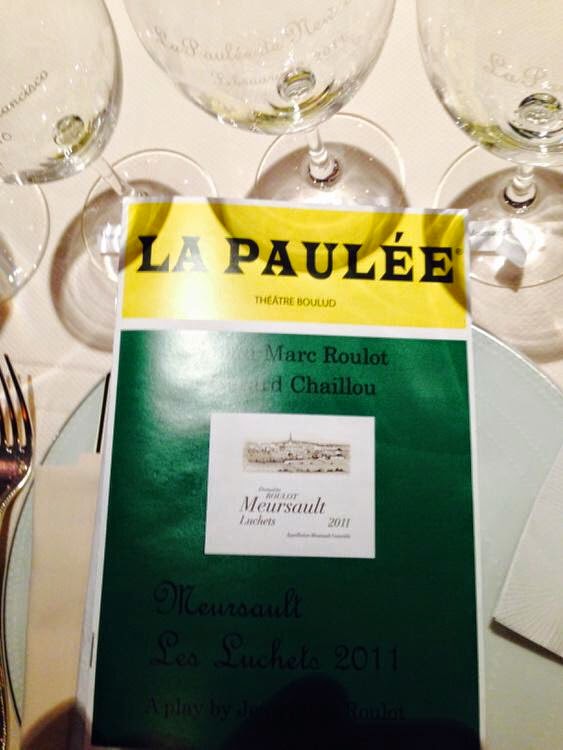
The main event of La Paulée's official Thursday afternoon schedule was a multi-course lunch, prepared by Daniel Boulud and his team, accompanied by selected wines from Domaines Guy Roulot and Georges Roumier, said wines to be presented by the respective vigneron. At the conclusion of the Roulot play, lunch attendees were shepherded back towards the front of the restaurant and into a room to the right of the main entrance. The room was populated with a number of 10-top, white-table-cloth-clad tables and as we entered, we were given additional glasses of Meursault Les Luchets 2011. As the attendees streamed in, I was pleasantly surprised to see Aubert de Villaine enter and stride to a place at the Roulot-Roumier table which was centrally located within the room. Daniel Johnnes welcomed us all and then launched the event.


The first course was called Jaune d'or et Soleil Vivace (components were Iberico Ham, truffles, and eggs) and had been prepared by Michel and César Troisgrois.


It was accompanied by 2010, 2009, and 2004 Roulot Les Luchets, the former two in magnum. The 2010 Les Luchets exhibited spice, orange-tangerine, power, minerality, orange rind, burnt orange and a slight pricking on the nose. On the palate bright, powerful, intense. Long, intense finish. The 2009 Les Luchets had similar characteristics to the 2010 except it had a little more stemminess, was a little more aromatic, and showed riper fruit. It was also not as tightly wound as the 2004. The 2004 exhibited a lemon-lime aroma along with minerality, crushed stone, sea shells and a hint of sulfur. Slight salinity and great acidity. Balanced. Bright, long, coating finish.


The second course was a Filet de Sole Duglére also prepared by Michel and César Troisgros. This was accompanied by a Roulot Meursault Charmes 2004, Roulot Meursault Tessons Clos de Mon Plaisir 2000 (in Jeroboam) and Roulot Meursault Perrières 1999 (in magnum).


The Meursault Charmes 2004 had tangerine and orange rind citrus characters accompanying notes of spice and herbs. Voluptuous, with bracing acidity and a long finish. The 2000 Meursault Tessons was elegant with apple-pear notes, spice, herbs, cardamom. The 1999 Meursault Perrières had citrus and citrus rind on the nose. Powereful, mineral, and coating on the palate.

de Villaine and Roulot 

Daniel Johnnes with the Jeroboam of Tessons

The third course was a Bœuf Wagyu Rossini which was prepared by Daniel Boulud. And this signaled a turn to the wines of Domaine Georges Roumier. The wines that he presented were the Domaine Georges Roumier Bonnes-Mares 1996, 1995, and 1990, all in magnums.


Bonnes Mares is a 15.06 ha Grand Cru appellation that sits at the northern end of Chambolle-Musigny and hosts 22 producers, one of whom is Domaine Georges Roumier with its 1.39 ha distributed over four plots. According to Clive Coates (www.clive-coates.com), the vineyard lies between 270 and 300 meters altitude and is comprised of two soil types -- terres blanches (a white marl rich in fossilized oysters) and terres rouges (red-brown soil possessing more clay) -- each yielding a different wine style from the same grape. Domaine Georges Roumier has vines on both these soil types and ferments the wines separately, blending them at a later date.

The Domaine Roumier Bonnes Mares Grand Cru 1996 exhibited ripe pinot fruit, a herbaceousness, and barrel spice on the nose. Restrained but balanced. Long, spicy finish. The 1995 Bonnes-Mares had a richer nose than the 1996, and greater power and intensity. The 1990 Bonnes-Mares showed pinot fruit, spice, and orange peel on the nose. Perfect weight on the palate. Balanced. Light stemminess/astringency. Herb finish.

Poire Tahitienne (Daniel Boulud)


Thus culminated an absolutely wonderful day. You do not get this type of variety thrown at you in the wine world every day. Especially in NYC, you can go to a play any day of the week. But it is not every day of the week that you get to see one of the leading winemakers from the famously tight-lipped and closeted region of Burgundy placing his reputation on the line by stepping on stage in front of his customers and running the risk of hurting his brand. And it is not every day that you get to follow that up with that same guy coming back and pouring you a range of his best wines. And, for good measure, he invited along one of his friends to pour some of his (the friend's wines). And all that wrapped around the food of Master Boulud.

It does not get any better than this.


©Wine -- Mise en abyme

Sunday, March 22, 2015

Meursault Les Luchets 2011: A play by Burgundy vigneron Jean-Marc Roulot of Domaine Guy Roulot

Fans of white Burgundy wines know Jean-Marc Roulot as the producer of Meursault wines which have been variously described as "subtly powerful," "feline," and Puligny-Montrachet-like.


But his skills are not bounded by the world of wine. According to Jonathon Nossiter (Liquid Memory), Jean-Marc is an "actor of considerable talent and courage" who entered the prestigious Conservatoir (the French national acting school located in Paris) at the age of 20 and only returned to Burgundy to helm the family Domaine after the premature death of his father.

It was this pedigree, and a fondness for Jean-Marc and his wines, that drove me to sign up to attend his play, and subsequent lunch, which, both held at Daniel, comprised the official Thursday events of the 2015 La Paulée de New York.


The play (the subject of this post) was titled Meursault Les Luchets 2011 and would precede the Roulot-Roumier lunch (For those unfamiliar with the Domaine, Les Luchets is one of its terroirs and wines.). I had not fully recovered from the previous evening's Collectors Dinner with Armand Rousseau because of (i) over-consumption and (ii) I had left my new camera, with my pictures of the night's events, in the back seat of a taxi. And, frantic calls notwithstanding, I had been unable to recover same.

We traveled by taxi from our hotel to Daniel. As I entered the cab, I asked the driver if he had seen my camera. He looked at me as though I had recently been released from a psycho ward. "What camera you talkin' 'bout Bro," he said. "Nothing," I said, my resolve crumbling away as I silently called down the wrath of the heavens on all taxi drivers. Well, enough about my negligence. Let's get back to the matter at hand.

We had gotten to the restaurant pretty close to noon so by the time we had deposited our coats at the coat check (darn NYC winters), checked in, gotten our programs, and were shown to the room, all of the choice seats had been taken. All of the tables in the Daniel backroom had been taken out and chairs had been arranged in an arc around a raised platform set against the rear wall. That rear wall had two openings to a passage that led to who knows where. Towards the front of the stage there was a single wooden table and chair; bare if my recollection serves me well (I had pictures on my iPhone but I lost those when my phone fell into the urinal on Saturday night.). There was an additional chair on the platform stage right and a couch stage left. Stage right, and floor level, was another solitary chair with an accordion on the floor beside it.

We made our way to some open seats house left which gave us a less-than-head-on view of the stage. Shortly after we took our seats, a solitary figure wandered through the opening in the rear wall, sauntered over to the chair associated with the accordion, and began strapping into the instrument. All the while with a bemused smile on his face. According to the program, this was Eric Proud. And he sure acted that way.

Shortly after, another individual made his way onto the stage and sat on the chair stage right. As I was familiar with Jean-Marc, this could only be Gérard Chaillou, who was playing Largeau opposite Jean-Marc's Monplaisir. Finally, Jean-Marc strode onto the stage, an impassive look on his face, staring into the distance. He was carrying a valise which he placed on the table and from which, after rummaging around inside for awhile, he produced a bottle of wine and a corkscrew. While he was opening the wine, Largeau went off stage and returned with two wine glasses into which Jean-Marc poured generous portions. The wines were sniffed and then tasted. And then the dialogue began, each man tapping "into his own language, their words to describe taste linked to their own personal memories and to the sensory world that each and every one of us build and define patiently, year after year" -- Jean-Marc Roulot.

The passion and enthusiasm of the dialogue was captivating, a testament to the skill of the actors as the entire discourse was in French. There was a TV screen high up on the rear wall stage right which displayed subtitled translations of the dialogue but it was tiring -- and tiresome -- to keep switching between the text and the players. A lot was lost in this fashion. Secondly, some of the nuances and subtleties of the situations could not be captured adequately by the subtitled presentation as evidenced by knowing snickers and laughter and expressions of appreciation along the way by French-speaking members of the audience while I sat blank-faced and unknowing.

Sometime during the course of the proceedings Jean-Marc said words akin to "presenting Les Luchets 2011" and, magically, the Somms who were assisting in the event appeared in the glass-walled hallway house right bearing lighted trays with glasses of wine. They stood there momentarily before making their way into the audience and distributing the glasses to the attendees. It was Meursault Luchets 2011. And it was then that I realized what I had been missing all along. I had not had a drink all day.

After all the wine had been distributed, the actors returned to their labors. Including, at one point, a lusty soundtrack in which all three participated.

At the conclusion of the play the attendees showed their appreciation for the actors' efforts with multiple rounds of ovations. It was very revealing to see Jean-Marc in this new environment. I have tasted wine with him at his Domaine and seen him expounding on his wines and engaging in technical discussions with Raj Parr and another US winemaker who had joined us at the tasting. We had enjoyed joyous banter and a bottle of his wine at a chance encounter at Charle Bird's when we went up to NYC for the inaugural La Fete du Champagne. And here he had peeled away those personas, or covered them over with this, the persona of the accomplished, confident, the-world-is-my-oyster actor. I was mesmerized.

©Wine -- Mise en abyme

Saturday, August 23, 2014

Tasting the wines at Domaine Guy Roulot

The tasting during our Domaine Roulot visit proceeded on two tracks: a tasting of the 2012 whites followed by a tasting, some of it blind, of some older Roulot vintages. The 2012 tasting segment tasered terroir onto our palates while the free-form segment cemented Raj Parr's reputation as an accomplished blind taster with superior knowledge of Burgundy wines.


2012 Meursaults

The 2012 vintage had been abnormal with hail damage, mildew, odium, and heat combining for a 60% reduction in stock. We tasted through the full range of Meursault wines. Given that these wines were from the same vintage, and had been subjected to similar winemaking treatments, any differences should be attributable to terroir. And we did note such differences. There were consistent observations of fruitiness, minerality, and crisp acidity but texture, degree and shade of fruitiness, type of minerality, and florality varied depending on the source of the fruit. Our observations regarding these wines are captured in the table below.

                           Domaine Guy Roulot 2012 Meursault Wines
Classification
Climats/Lieux-Dits
Location
Characteristics
Bourgogne Blanc

Meursault
Citrus, mineral, acidity
Meursault

Slope south of valley
White fruit, citrus, floral, mineral, freshness

Tillets
Highest on the slope and facing south
Floral, focused, step up in quality

Vireuils
North of Tillets at slightly lower elevation; east-facing
White fruit, richness, crisp acidity, will age well

Luchets
Further north and lower
Sweet white fruits, floral, citrus, chalky minerality, richness

Narvaux
Adjacent to Tillets
Only 1 barrel made. Slight oakiness

Meix Chavaux
North of Premier Crus but at same elevation
Lemon, stone, denser than wines preceding, mineral, sea shell

Tessons
do.
First bottle deemed improper by Jean-Marc. Second bottle fresher fruit, minerality, crisp acidity. Balanced with a long finish
Premier Cru
Bouchères
Northernmost
White fruits, mineral, citrus

Porusot
South of Bouchères
Tight minerality, sea shell, citrus, crisp acidity

Charmes
On Puligny border; 70-year-old vines
4 barrels made. Big, rich fruit structure

Perrieres

Big structure. Grand Cru quality. Pear. Weighty, mineral. Long finish


Pre-2012 Vintages

The first wine tasted in this segment was the 2011 Bourgogne Blanc. Jean-Marc said that this vintage had experienced early flowering and harvesting and there had been no attacks of odium or mildew. This wine had great texture and balance. Ron voiced that it was the best Bourgogne on the planet. The next  offering was the 2011 Tessons, a wine which revealed lemon, pear, and a distinct mineral note.

The next wine was offered blind. Tangerine, earthiness, and a chalky minerality. One of the things that we noted during this trip was that the winemakers all wanted to have Raj taste their wines blind. They constantly put him to the test and he consistently hit the mark or came pretty close. In this case he surmised 2010 Bouchères. It was 2009 Bouchères instead. Jean-Marc rapidly followed with another blind wine which Raj thought was a 2005 Tessons. It was. The third blind wine was ripe and open. 2003 Tillets said Raj. Right again. A tour de force of blind tasting in my opinion. The next wine offered had tangerine and honey on the nose and was very rich. I got lucky and tagged the vintage as 1989. It was a 1989 Bourgogne Blanc.


The final wine tasted was the 1992 Perrieres. Sweet tropical fruit to include pineapple. Ron described it as absolutely amazing. Jean-Marc called it "old Chardonnay." Raj said that this is one of his 10 best wines of all time.

A blockbuster end to a truly amazing tasting and a truly amazing day. Unfortunately the morrow did not attain this level of sustained, intense brilliance.

©Wine -- Mise en abyme

Tuesday, August 19, 2014

Winery visit with Jean-Marc Roulot of Domaine Guy Roulot

To taste a Domaine Roulot wine is to taste a sense of deep rootedness, fine and crystalline, and yet somehow open. Although subtly powerful, the wine never imposes itself before the taster has time to form his own reactions... For me, the subtlety and finesse of Jean-Marc's very feline wines fulfill the criteria for a legitimate work of art: conventions coexisting with freedom of access and interpretation.
Thus had Jonathan Nossiter (Liquid Memory) described the wines of Domaine Guy Roulot. And, after stellar visits at DRC and Domaine Armand Rousseau, we were on our way to taste the wines so eloquently described by Nossiter.

Domaine Guy Roulot is headed by Jean-Marc Roulot, scion of the namesake founder, who took the reins of the Domaine in 1989 from a succession of caretaker winemakers who had overseen production since the death of his father in 1982. The Domaine is known primarily for its plot-specific whites from Village and Premier Cru sites in Meursault but it also produces red wines with grapes sourced from Auxey-Duresses and Monthélie as well as a Bourgogne red sourced from Volnay and Puligny-Montrachet parcels.


                          Domaine Guy Roulot Meursault Climats and Lieux-Dits
Classification
Climats/Lieux-Dits
Location
Soil Characteristic
Wine Descriptors
Meursault

Slope south of valley


Tillets
Highest on the slope and facing south

Floral and mineral.
Vineyards on the upper slope make bititng, precise wines*

Vireuils
North of Tillets at slightly lower elevation; east-facing

Rich yet racy

Luchets
Further north and lower

Round with great length

Narvaux
Adjacent to Tillets

Generous, lush character

Meix Chavaux
North of Premier Crus but at same elevation

Opulent and ripe

Tessons
do.

Powerful, long, complex
Premier Cru
Bouchères
Northernmost
Shallow, stony soil
Silky texture; medium-bodied; elegant.
Bigger, rounder, easier*

Porusot
South of Bouchères
do.
Fuller body

Charmes
On Puligny border; 70-year-old vines

Round, fleshy, ripe, mineral, complex; great depth of flavor
Source: rarewineco.com; *Dominique Lafon in Nossiter’s Liquid Memory.

Jean-Marc's commitment to these terroirs, and their wines, is illustrated by his comments to Nossiter: "... I am as attached to my village vineyard designation as the premier cru. The day I can't bottle my Tillets, Meix Chavaux, and Tessons separately is the day I'll leave any system of official designation. ... We need to continue to work to understand the individual identities of each parcel of vines, whether it is at the village, premier cru, or grand cru level." In a more recent conversation with Benjamin Lewin MW, Jean-Marc ranked the differences between lieux-dits as: (i) exposition, (ii) elevation, then (iii) the clay-limestone proportions with a resultant 1-week differential in harvest-initiation between Luchets and Narvaux.

One of the early decisions that Jean-Marc made upon taking the reins at Domaine Roulot was to pursue organic farming. In explaining his decision to Nossiter, Jean-Marc spoke admiringly of biodynamicism but going organic was a huge step for the winery. It was a step, however, which allowed the individual identity of each plot to be "more strongly expressed." Even though practicing organic principles since 1989, the estate was not formally certified until 2013.

The estate produces both white and red wines with the whites made from Chardonnay or Aligoté and the red from Pinot Noir. The winemaking processes are illustrated in the graphic below.


A winemaking couple from Santa Barbara was joining us for the tasting so, after hurried introductions, we headed to the cellars. It was clear that Raj and Jean-Marc were good friends and were happy to see each other because they immediately fell into an animated winemaking conversation which threaded its way through our entire visit. It was fascinating and a wonderful learning opportunity for us.

The wines to be tasted were placed on an upright barrel in the center of the room and Jean-Marc began to open them. The tasting would unfold in two parts: a tasting of the 2012 whites followed by a tasting, some of it blind, of some older vintages.

As he opened the first bottle, Jean-Marc looked around the cellar ruefully noting that, under normal circumstances, barrels would be stacked three rows high. The 2012 vintage had not been normal though with hail damage, mildew, odium, and heat combining for a 60% reduction in stock.


Jean-Marc Roulot opening bottles for our tasting
Jean-Marc Roulot and Ron
Rajat Parr and Jean-Marc
The results of the tastings will be covered in a subsequent post.


©Wine -- Mise en abyme