Showing posts with label Ornellaia. Show all posts

Sunday, December 11, 2016

Antonio Galloni and Vinous Ornellaia and Masseto Retrospective (1995 - 2010), from Magnum

Antonio Galloni had had to work overtime in order to convince Axel Heinz (the Ornellaia and Masseto winemaker) to agree to a wine tasting that would, essentially, allow direct comparison of the estate's two major wines. Antonio's powers of persuasion carried the day and now here we were, at Bouley Test Kitchen on December 5, 2016, ready to participate in the Ornellaia and Masseto Retrospective (1995 - 2010), from Magnum.


As early arrivals stood around the dining area chatting, or searching out their appointed seating, we were served 2008 and 2009 Pierre Peters Champagne. The Champagne was then followed in short order by a number of passed Hors-d'Oeuvres, each, in its own manner, pleasing to both vision and palate.


We were eventually called to order and grudgingly took our seats with longing, backward glances towards the origin point of the Hors-d'Oeuvres. Antonio shared the particulars of the tasting with us:
  • The wines would be tasted in flights arranged from the youngest to the oldest
  • Every wine was to be poured from magnum
  • Each magnum had been sourced directly from the winery
  • The wines had been opened at 5:30 pm that day and were all in good condition
  • The tasting included all of the significant vintages falling between 1995 and 2010. 
From an operational point of view, the tasting would be broken into four flights, each flight containing two vintages and each vintage having both an Ornellaia and Masseto included. Each flight would be paired with a course, but the wines would be presented at the table prior to the associated dish being served.


Amouse Bouche

Flight 1: 2010 and 2007 Vintages
Axel was called upon to introduce the first flight. He characterized the 2007 vintage as an early year with cool conditions during harvest while the 2010 was the latest ripening vintage he had ever seen up to that time. 2010 was not, he said, the most typical vintage of the estate.

Both of the 2010s were still very young to the taste. The Ornellaia showed powerful, intense dark fruit, some structure, and a licorice coating on the palate. I found the Masseto to be unyielding on the nose. Full finish with a hint of green.

The 2007 Ornellaia was broader-based than the 2010. Dark, ripe fruit. The 2007 Masseto was perfumed with hints of balsamic and licorice. Tight. Rich dark fruit and some green on the palate.

Forager's Treasure of Wild Mushrooms with
Sweet Garlic and Special Spices

Flight 2: 2006 and 2004 Vintages
According to Axel, 2006 was a strange wine. It had not been easy to make but turned out well having, as it did, a richness, high tannins, high acidity, and concentrated fruit. The 2004 was a textbook vintage with ideal conditions yielding grapes that had ripened evenly and uniformly (masseto.com).

The 2006 Ornellaia was the first of the wines tasted to exhibit any noticeable acidity. Rich and intense, with juicy acidity surrounded by a beautiful core of fruit. Good levels of fruit and acidity in the 2006 Masseto. Rich, structured, powerful, and balanced. This wine is a buy.

The 2004s were the first wines to show really well on the nose. This illustrated the relative youth of the previous wines. The Ornellaia had floral notes along with tea, licorice, and olives. Full-bodied. Heavier than the earlier vintages. The Masseto was a beautiful wine. Classic older Merlot. Granny's attic, spice, and a dankness. Weighty and structured.

Organic Millbrook Venison with Wild Pawpaw
Fruit

Flight 3: 2001 and 1998 Vintages
The 2001 and 1998 vintages are two of the most important reference points for the estate. Michel Rolland, the long-time consulting enologist for the estate, calls 2001 the best vintage that he has ever seen in Tuscany.

The 2001 Ornellaia presented cigar box, cedar, cocoa, and coffee. Diminished fruit levels and pleasing acidity. Classic Bordeaux nose. The Masseto had been decanted earlier in the day due to "tightness." It presented green pea, a mustiness, curry, and tobacco. Sweet ripe fruit on the palate. Axel feels that the 2001 is the most opulent Masseto that he has tasted.

The 1998 Ornellaia was a beautiful wine. Cigar box, tobacco leaf, and black fruit on the nose. Textured and structured. A "come-hither" wine. The Masseto presented cigar box, tobacco, orange peel, and spice. Textured and balanced with a long finish. Axel remarked on the "smoky tobacco leaf character" of both of the wines in the 1998 vintage.


Organic Colorado Lamb with Organic Snow
Peas, Sweet Peas, Fava Beans, Okra, and
Organic Rosemary-Perfumed Quinoa

Chef's Surprise: Eggs and White Truffles

Flight 4: 1997 and 1995 Vintages
According to Axel, 1995 was a cool-climate vintage while 1997 was the year that the estate introduced a second wine at Ornellaia.

The 1997 Ornellaia was a desirable wine with still a lot of life ahead. A little green pea and coconut on the nose along with a restrained orange peel. Fresh on the palate. Fine-boned and elegant. Long finish. The Masseto was all Grandma's attic, black fruit, cedar, cigar box, tobacco, and talcum powder. Elegant. Great weight on the palate along with tobacco, dark fruit, a savoriness, and spice. A lengthy, slightly pruney finish. This is one of the vintages where I distinctly preferred the Ornellaia to the Masseto

The 1995 Ornellaia was unyielding on the nose.  A little blue fruit. Tired. The 1995 Masseto showed tobacco and Granny's attic. Great acidity and sharp red fruit. Lengthy finish. An excellent wine.

Chef's Selection of Mature Artisanal French
Cheeses by Maitre Affineur Rodolphe le Meunier


Axel Heinz signing bottles
My memento


This tasting more than lived up to expectations. I went in looking to taste as much Masseto as I could and came away with  a new-found respect for Ornellaia. I will be buying that label in a more studied fashion going-forward, rather than reflexively, as I do today.

The dishes that accompanied the tasting were all of exceptional quality. The standoiut for me though was the Organic Millbrook Venison. It had a nice spicy undertone and was so tender that the knife glided through. Great texture.

This was a memorable evening. And I made a bunch of new friends at my table.


©Wine -- Mise en abyme

Tuesday, December 6, 2016

Ornellaia - Masseto Wine Dinner: Peering into the mind of Axel Heinz, the estate's winemaker

Masseto is one of my favorite wines, as evidenced by its frequency in my cellar and the number of mentions that it has received in my social media posts. As a fanboy, then, I had to be in attendance at the Antonio Galloni/Vinous Ornellaia and Masseto Retrospective (1995 - 2010) held at Bouley Test Kitchen in New York City on December 5th. And, ... Axel Heinz, the winemaker for both labels, would be guiding the attendees through the tasting of these, the greatest vintages of the estate (For the uninitiated, Masseto is a 100% Merlot wine while Ornellaia is a Bordeaux blend. Both wines  are currently produced at the Ornellaia estate in Tuscany's Bolgheri wine zone.).


The kitchen at Bouley Test kitchen

In his opening remarks, Antonio Galloni spoke to the genesis of the tasting. Five years ago he had organized a Masseto vertical which went up to the 1986 vintage, the earliest in the label's history. It had been relatively easy to get Axel to lead that event. Not so this tasting. Antonio had to work overtime to convince Axel to do this dinner because the estate does not like to show the two wines in opposition to each other. In his opening remarks, Axel validated Antonio's comment about showing the wines together. The estate views the labels as two separate and distinct wines and treats them as such.

Axel Heinz speaking to some of the attendees
prior to the start of the tasting

As it relates to Masseto, Axel sees the wine as almost an accident of nature. When Ornellaia began, a few estates in Tuscany had already planted Merlot. Ornellaia felt that it had to do something to differentiate itself from the 400-lb gorilla in the room (Sassicaia) and that imperative drove the development of Masseto.

The early efforts in this direction were spearheaded by Andre Tschelistcheff, the noted Russian-American enologist, who found the hill with the grey clay and encouraged the Ornellaia team to plant Merlot thereon. The first harvest was in 1986 and the resultant wine was labeled Merlot. The name Masseto appeared on the label for the first time with the 1987 vintage.


With the success of Masseto, the estate did not want to use the Merlot grapes from that vineyard in the Ornellaia blend. It was a full 10 years before Merlot vines planted in other parts of the property attained the maturity to warrant their inclusion in the blend.

Axel sees the Masseto vineyard as very complex (I have assessed the vineyard in a previous post), a complexity akin to Burgundy's Clos Vougeot in that it has three levels and the soils are heterogeneous. In some vintages, they end up with as much as eight separate wines which have to be combined into the final blend (The estate harvests, vinifies, and ages individual plots separately and deploys a team to compose the final blend prior to bottling.).


Approximately 100 ha of vineyards are dedicated to grapes for the Ornellaia blend with different soils, elevations, and expositions being the order of the day. Ornellaia is more of a left-bank wine and Masseto more right bank (if one thinks in terms of Bordeaux) and Axel feels blessed in that being in Bolgheri gives him a chance to employ both winemaking styles in the same location.

I sat next to Axel during the course of the dinner and took advantage to gain his perspective on a number of winemaking issues. One area of exploration was optimal picking time. He was adamant that you need to taste the grapes in order to make a determination as to the best time to pick. In his view, no amount of data can substitute for the taste of the juice on your palate and the crunch (or not) of the seeds between your teeth. At Ornellaia they like to pick ripe with excellent aromatics without pressing through into over-ripeness.

He talked about the difficulty of working the clay soils of the Masseto vineyards. In periods of rain, the soil absobs the water and becomes very heavy. After it has become saturated, pooling becomes a problem. When the soils become water-logged, they have to leave it alone for a few days before returning to work at it again.

I asked him about the potential for a cru Masseto wine; that is, a wine drawn exclusively from one of the three areas of the Masseto vineyard. He saw that as very unlikely. Even though there are, from time to time, temptations regarding some of the components from the middle vineyard, it is the balance that these three vineyards bring in the bottle that is the essence of Masseto. He indicated that many people have told them that they should make a Cab Franc wine but they feel that Ornellaia would be hurt if they went down that path.

In closing this part of my discussion of the tasting, it should be mentioned that the estate is currently building a separate winery to support the production of Masseto. This is the ultimate gesture in showing the world that these are two truly distinct wines. While the field operations will still be conducted by a single team, the two winery operations will be separate. According to Axel, if you make a visit request to Masseto, you will go to the Masseto winery and taste Masseto wines; and likewise for an Ornellaia visit.

I will go into the details of the tasting and dinner in my next post.

©Wine -- Mise en abyme

Friday, May 20, 2011

Tenuta dell'Ornellaia Visit

The first winery we were scheduled to visit in our Bordeaux Index Taste of Tuscany was Tenuta dell'Ornellaia, one of the stars of Bolgheri DOC.  We set off at 9:15 am from our hotel on a bright, sunny morning and this made for a beautiful drive through the countryside.  We headed west on Strada di Grande Communicazione, then south along A12 and SS1, then east on Localita San Guido -- noted for the serene and stately cypress trees lining both sides of the street -- before making a right turn into Via Bolgherese and then a left turn into the Tenuta dell'Ornellaia entrance.  We were let in through the gate and met on the other side by Viola, our winery tour guide.  Viola showed us where to park and after we disembarked she began the tour with remarks on the history of the estate.


The winery was founded in 1980 by Lodovica Antinori.  In the late 1990s, Robert Mondavi took a minority stake in the enterprise and owned it fully by 2002.  Mondavi brought in the Frescobaldi's as 50% partners shortly after gaining control and they acquired full control by buying the Mondavi shares when Constellation Brands bought Robert Mondavi's holdings.

According to Viola, the estate encompasses 180 hectares, 97 of which are planted to vine, and are divided between two properties.  The facility on Via Bolgherese has 37 hectares of vineyards and the winery and is the location of the original estate.  This particular property backs up against the Sassicaia property and shares many of its characteristics.  There is another 60-hectare property called Bellaria which is located to the north of Bolgherei.  Our tour plan called for visiting both vineyards and the winery after which we would lunch in the winery dining room.  So we piled into the van and made our way to Bellaria.

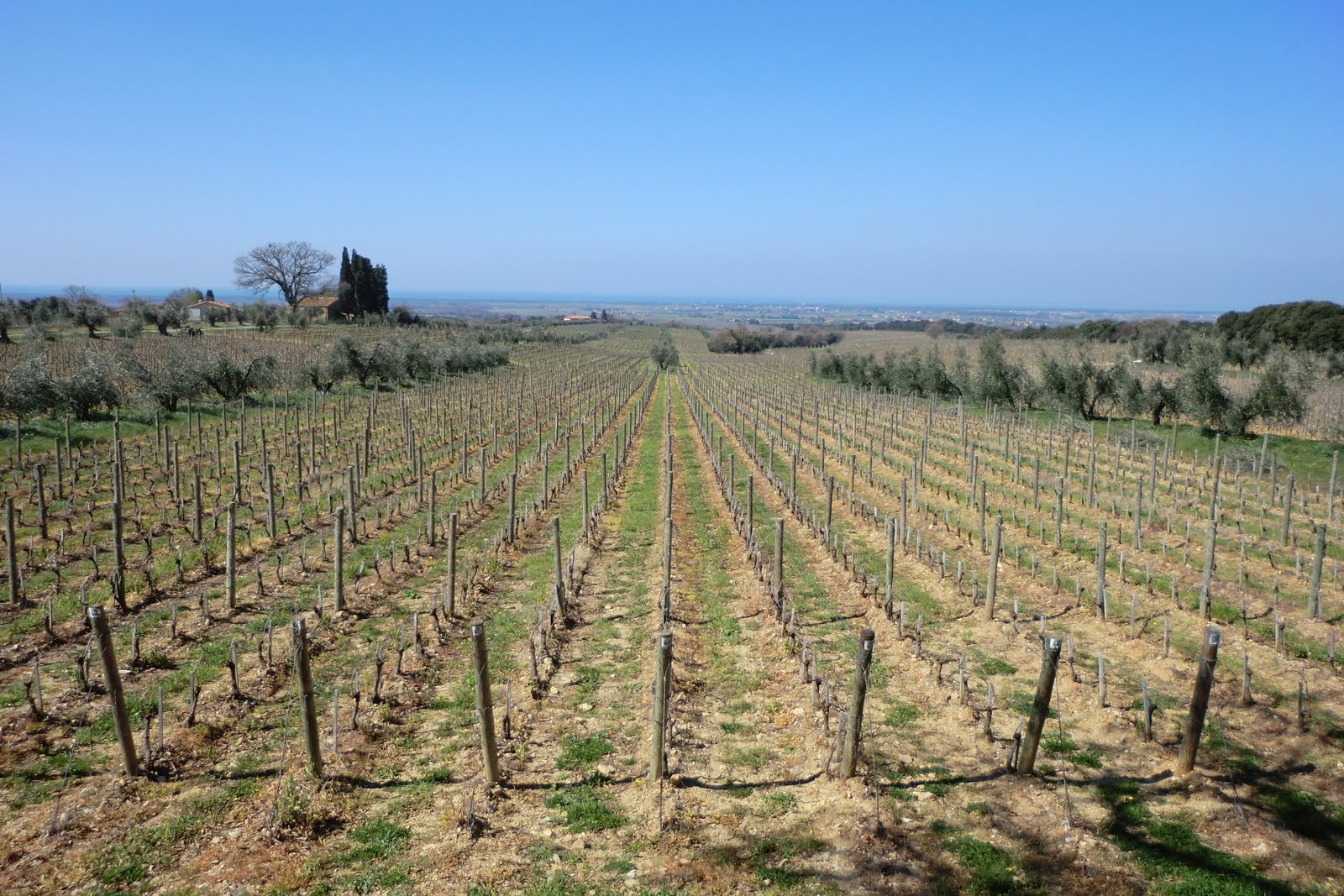
We drove back the way we came on Via Bolgherese to "Cypress Avenue" and turned right to continue our transit of this wonderful thoroughfare.  We turned left into the road at the end of the Castello di Bolgheri vineyard and continued along that road until we arrived at Bellaria.  Once on the property we drove to an elevated wooden platform from which we could view the entire vineyard and the sea in the distance.  Breathtaking.


As we took in the view, Viola peppered us with vinous tidbits.  The vineyards are planted at elevations ranging between 50 and 120 meters above sea level on slopes ranging between 5 and 20 degrees.  Here at Bellaria, the hills above the vineyards protect the vines from cold winds while the sea moderates the temperature and reflects sunlight, a boon to grape ripening.  The soil composition changes every 500 meters or so and dictates the estate's planting strategy: Petit Verdot on sandy soils; Cabernet Sauvignon on clay-limestone soils; and Merlot on clay soils.  The average age of the vines at Bellaria is 8 years.

At the conclusion of the Bellaria visit we retraced our course to the original property.  The main property is divided into a 30-hectare vineyard dedicated to Ornellaia fruit and 7 hectares dedicated to fruit for Masseto.  The soil in the Ornellaia vineyard is reddened by the presence of iron and yields high-tannin, age-worthy wines.  The first parcel was planted in this vineyard in 1982.  The Merlot grapes for the Masseto are planted on clay soils.  The average age of the vines on this property is 15 years.

The Tenuta dell'Ornellaia winemaker is Alex Heinz and the winery's philosophy is "quality without compromise."  The quality begins in the vineyard and continues throughout the winemaking process.  Grapes are hand-harvested and subjected to a three-part selection process which ensures that only the best berries make it to the fermentation tanks.  Grapes from the estate's 60 parcels (37 hectares of Cabernet Sauvignon, 38 hectares of Merlot, 12 hectares of Cabernet Franc, 10 hectares of Petit Verdot) are vinified and stored separately prior to the construction of the final blend.


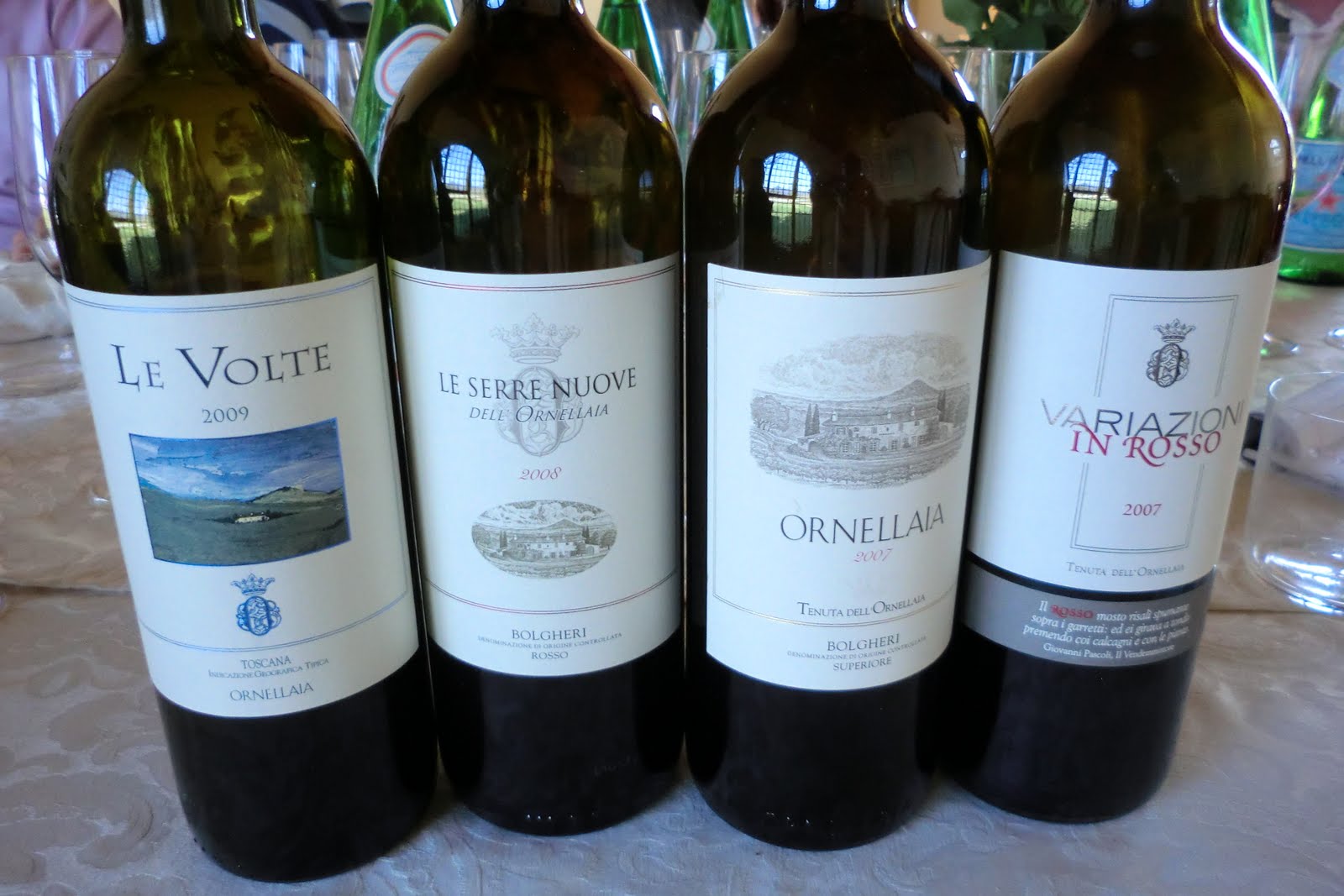
The estate's first wine is Ornellaia, a Cabernet Sauvignon (60%), Merlot (25%), Cabernet Franc (12%), and Petit Verdot (3%) blend.  This wine is fermented (natural yeasts) and macerated in stainless steel tanks and then transferred to oak barriques (70% new, 30% second year) where malolactic fermentation occurs.  The wine is aged in oak for 12 months before final blending after which it is bottled and aged for an additional 12 months.  The 1998 vintage of this wine was named wine of the year by Wine Spectator in 2001.

The second wine is Le Serre Nuove, a Cabernet Sauvignon (35%), Merlot (50%), Cabernet Franc (10%), and Petit Verdot blend.  This wine is made from grapes that did not make the Ornellaia cut as well as fruit from the Bellaria vineyard.  It is fermented in stainless steel tanks and macerated for 30 days.  Malolactic fermentation occurs both in the tanks and in barriques.  The wines are aged for 12 months before final blending and are then aged in oak for an additional 6 months before bottling.

Le Volte is a 50% Sangiovese, 20% Cabernet Sauvignon, and 30% Merlot blend, with the Sangiovese fruit sourced externally.  Alcoholic and malolactic fermentation take place in stainless steel tanks before the wine is transferred to 2- to 4-year-old barriques for 10 months of aging.

The jewel in the Ornellaia crown is the 100% Merlot Masseto.  This wine has received both critical and pecuniary acclaim.  It is fermented in oak vats and stainless steel tanks with malolactic fermentation in new oak barriques where it is aged for 24 months.

At the conclusion of the winery tour, we tasted some of the wines and then repaired to the dining room for lunch.  The traditional Tuscan lunch was pleasing to the eye and, especially so, to the palate and was paired


impecably with examples of the estate's offerings.

All in all, a super Tuscan day.