Showing posts sorted by relevance for query ornellaia. Sort by date Show all posts

Sunday, December 11, 2016

Antonio Galloni and Vinous Ornellaia and Masseto Retrospective (1995 - 2010), from Magnum

Antonio Galloni had had to work overtime in order to convince Axel Heinz (the Ornellaia and Masseto winemaker) to agree to a wine tasting that would, essentially, allow direct comparison of the estate's two major wines. Antonio's powers of persuasion carried the day and now here we were, at Bouley Test Kitchen on December 5, 2016, ready to participate in the Ornellaia and Masseto Retrospective (1995 - 2010), from Magnum.


As early arrivals stood around the dining area chatting, or searching out their appointed seating, we were served 2008 and 2009 Pierre Peters Champagne. The Champagne was then followed in short order by a number of passed Hors-d'Oeuvres, each, in its own manner, pleasing to both vision and palate.


We were eventually called to order and grudgingly took our seats with longing, backward glances towards the origin point of the Hors-d'Oeuvres. Antonio shared the particulars of the tasting with us:
  • The wines would be tasted in flights arranged from the youngest to the oldest
  • Every wine was to be poured from magnum
  • Each magnum had been sourced directly from the winery
  • The wines had been opened at 5:30 pm that day and were all in good condition
  • The tasting included all of the significant vintages falling between 1995 and 2010. 
From an operational point of view, the tasting would be broken into four flights, each flight containing two vintages and each vintage having both an Ornellaia and Masseto included. Each flight would be paired with a course, but the wines would be presented at the table prior to the associated dish being served.


Amouse Bouche

Flight 1: 2010 and 2007 Vintages
Axel was called upon to introduce the first flight. He characterized the 2007 vintage as an early year with cool conditions during harvest while the 2010 was the latest ripening vintage he had ever seen up to that time. 2010 was not, he said, the most typical vintage of the estate.

Both of the 2010s were still very young to the taste. The Ornellaia showed powerful, intense dark fruit, some structure, and a licorice coating on the palate. I found the Masseto to be unyielding on the nose. Full finish with a hint of green.

The 2007 Ornellaia was broader-based than the 2010. Dark, ripe fruit. The 2007 Masseto was perfumed with hints of balsamic and licorice. Tight. Rich dark fruit and some green on the palate.

Forager's Treasure of Wild Mushrooms with
Sweet Garlic and Special Spices

Flight 2: 2006 and 2004 Vintages
According to Axel, 2006 was a strange wine. It had not been easy to make but turned out well having, as it did, a richness, high tannins, high acidity, and concentrated fruit. The 2004 was a textbook vintage with ideal conditions yielding grapes that had ripened evenly and uniformly (masseto.com).

The 2006 Ornellaia was the first of the wines tasted to exhibit any noticeable acidity. Rich and intense, with juicy acidity surrounded by a beautiful core of fruit. Good levels of fruit and acidity in the 2006 Masseto. Rich, structured, powerful, and balanced. This wine is a buy.

The 2004s were the first wines to show really well on the nose. This illustrated the relative youth of the previous wines. The Ornellaia had floral notes along with tea, licorice, and olives. Full-bodied. Heavier than the earlier vintages. The Masseto was a beautiful wine. Classic older Merlot. Granny's attic, spice, and a dankness. Weighty and structured.

Organic Millbrook Venison with Wild Pawpaw
Fruit

Flight 3: 2001 and 1998 Vintages
The 2001 and 1998 vintages are two of the most important reference points for the estate. Michel Rolland, the long-time consulting enologist for the estate, calls 2001 the best vintage that he has ever seen in Tuscany.

The 2001 Ornellaia presented cigar box, cedar, cocoa, and coffee. Diminished fruit levels and pleasing acidity. Classic Bordeaux nose. The Masseto had been decanted earlier in the day due to "tightness." It presented green pea, a mustiness, curry, and tobacco. Sweet ripe fruit on the palate. Axel feels that the 2001 is the most opulent Masseto that he has tasted.

The 1998 Ornellaia was a beautiful wine. Cigar box, tobacco leaf, and black fruit on the nose. Textured and structured. A "come-hither" wine. The Masseto presented cigar box, tobacco, orange peel, and spice. Textured and balanced with a long finish. Axel remarked on the "smoky tobacco leaf character" of both of the wines in the 1998 vintage.


Organic Colorado Lamb with Organic Snow
Peas, Sweet Peas, Fava Beans, Okra, and
Organic Rosemary-Perfumed Quinoa

Chef's Surprise: Eggs and White Truffles

Flight 4: 1997 and 1995 Vintages
According to Axel, 1995 was a cool-climate vintage while 1997 was the year that the estate introduced a second wine at Ornellaia.

The 1997 Ornellaia was a desirable wine with still a lot of life ahead. A little green pea and coconut on the nose along with a restrained orange peel. Fresh on the palate. Fine-boned and elegant. Long finish. The Masseto was all Grandma's attic, black fruit, cedar, cigar box, tobacco, and talcum powder. Elegant. Great weight on the palate along with tobacco, dark fruit, a savoriness, and spice. A lengthy, slightly pruney finish. This is one of the vintages where I distinctly preferred the Ornellaia to the Masseto

The 1995 Ornellaia was unyielding on the nose.  A little blue fruit. Tired. The 1995 Masseto showed tobacco and Granny's attic. Great acidity and sharp red fruit. Lengthy finish. An excellent wine.

Chef's Selection of Mature Artisanal French
Cheeses by Maitre Affineur Rodolphe le Meunier


Axel Heinz signing bottles
My memento


This tasting more than lived up to expectations. I went in looking to taste as much Masseto as I could and came away with  a new-found respect for Ornellaia. I will be buying that label in a more studied fashion going-forward, rather than reflexively, as I do today.

The dishes that accompanied the tasting were all of exceptional quality. The standoiut for me though was the Organic Millbrook Venison. It had a nice spicy undertone and was so tender that the knife glided through. Great texture.

This was a memorable evening. And I made a bunch of new friends at my table.


©Wine -- Mise en abyme

Tuesday, December 6, 2016

Ornellaia - Masseto Wine Dinner: Peering into the mind of Axel Heinz, the estate's winemaker

Masseto is one of my favorite wines, as evidenced by its frequency in my cellar and the number of mentions that it has received in my social media posts. As a fanboy, then, I had to be in attendance at the Antonio Galloni/Vinous Ornellaia and Masseto Retrospective (1995 - 2010) held at Bouley Test Kitchen in New York City on December 5th. And, ... Axel Heinz, the winemaker for both labels, would be guiding the attendees through the tasting of these, the greatest vintages of the estate (For the uninitiated, Masseto is a 100% Merlot wine while Ornellaia is a Bordeaux blend. Both wines  are currently produced at the Ornellaia estate in Tuscany's Bolgheri wine zone.).


The kitchen at Bouley Test kitchen

In his opening remarks, Antonio Galloni spoke to the genesis of the tasting. Five years ago he had organized a Masseto vertical which went up to the 1986 vintage, the earliest in the label's history. It had been relatively easy to get Axel to lead that event. Not so this tasting. Antonio had to work overtime to convince Axel to do this dinner because the estate does not like to show the two wines in opposition to each other. In his opening remarks, Axel validated Antonio's comment about showing the wines together. The estate views the labels as two separate and distinct wines and treats them as such.

Axel Heinz speaking to some of the attendees
prior to the start of the tasting

As it relates to Masseto, Axel sees the wine as almost an accident of nature. When Ornellaia began, a few estates in Tuscany had already planted Merlot. Ornellaia felt that it had to do something to differentiate itself from the 400-lb gorilla in the room (Sassicaia) and that imperative drove the development of Masseto.

The early efforts in this direction were spearheaded by Andre Tschelistcheff, the noted Russian-American enologist, who found the hill with the grey clay and encouraged the Ornellaia team to plant Merlot thereon. The first harvest was in 1986 and the resultant wine was labeled Merlot. The name Masseto appeared on the label for the first time with the 1987 vintage.


With the success of Masseto, the estate did not want to use the Merlot grapes from that vineyard in the Ornellaia blend. It was a full 10 years before Merlot vines planted in other parts of the property attained the maturity to warrant their inclusion in the blend.

Axel sees the Masseto vineyard as very complex (I have assessed the vineyard in a previous post), a complexity akin to Burgundy's Clos Vougeot in that it has three levels and the soils are heterogeneous. In some vintages, they end up with as much as eight separate wines which have to be combined into the final blend (The estate harvests, vinifies, and ages individual plots separately and deploys a team to compose the final blend prior to bottling.).


Approximately 100 ha of vineyards are dedicated to grapes for the Ornellaia blend with different soils, elevations, and expositions being the order of the day. Ornellaia is more of a left-bank wine and Masseto more right bank (if one thinks in terms of Bordeaux) and Axel feels blessed in that being in Bolgheri gives him a chance to employ both winemaking styles in the same location.

I sat next to Axel during the course of the dinner and took advantage to gain his perspective on a number of winemaking issues. One area of exploration was optimal picking time. He was adamant that you need to taste the grapes in order to make a determination as to the best time to pick. In his view, no amount of data can substitute for the taste of the juice on your palate and the crunch (or not) of the seeds between your teeth. At Ornellaia they like to pick ripe with excellent aromatics without pressing through into over-ripeness.

He talked about the difficulty of working the clay soils of the Masseto vineyards. In periods of rain, the soil absobs the water and becomes very heavy. After it has become saturated, pooling becomes a problem. When the soils become water-logged, they have to leave it alone for a few days before returning to work at it again.

I asked him about the potential for a cru Masseto wine; that is, a wine drawn exclusively from one of the three areas of the Masseto vineyard. He saw that as very unlikely. Even though there are, from time to time, temptations regarding some of the components from the middle vineyard, it is the balance that these three vineyards bring in the bottle that is the essence of Masseto. He indicated that many people have told them that they should make a Cab Franc wine but they feel that Ornellaia would be hurt if they went down that path.

In closing this part of my discussion of the tasting, it should be mentioned that the estate is currently building a separate winery to support the production of Masseto. This is the ultimate gesture in showing the world that these are two truly distinct wines. While the field operations will still be conducted by a single team, the two winery operations will be separate. According to Axel, if you make a visit request to Masseto, you will go to the Masseto winery and taste Masseto wines; and likewise for an Ornellaia visit.

I will go into the details of the tasting and dinner in my next post.

©Wine -- Mise en abyme

Friday, May 20, 2011

Tenuta dell'Ornellaia Visit

The first winery we were scheduled to visit in our Bordeaux Index Taste of Tuscany was Tenuta dell'Ornellaia, one of the stars of Bolgheri DOC.  We set off at 9:15 am from our hotel on a bright, sunny morning and this made for a beautiful drive through the countryside.  We headed west on Strada di Grande Communicazione, then south along A12 and SS1, then east on Localita San Guido -- noted for the serene and stately cypress trees lining both sides of the street -- before making a right turn into Via Bolgherese and then a left turn into the Tenuta dell'Ornellaia entrance.  We were let in through the gate and met on the other side by Viola, our winery tour guide.  Viola showed us where to park and after we disembarked she began the tour with remarks on the history of the estate.


The winery was founded in 1980 by Lodovica Antinori.  In the late 1990s, Robert Mondavi took a minority stake in the enterprise and owned it fully by 2002.  Mondavi brought in the Frescobaldi's as 50% partners shortly after gaining control and they acquired full control by buying the Mondavi shares when Constellation Brands bought Robert Mondavi's holdings.

According to Viola, the estate encompasses 180 hectares, 97 of which are planted to vine, and are divided between two properties.  The facility on Via Bolgherese has 37 hectares of vineyards and the winery and is the location of the original estate.  This particular property backs up against the Sassicaia property and shares many of its characteristics.  There is another 60-hectare property called Bellaria which is located to the north of Bolgherei.  Our tour plan called for visiting both vineyards and the winery after which we would lunch in the winery dining room.  So we piled into the van and made our way to Bellaria.

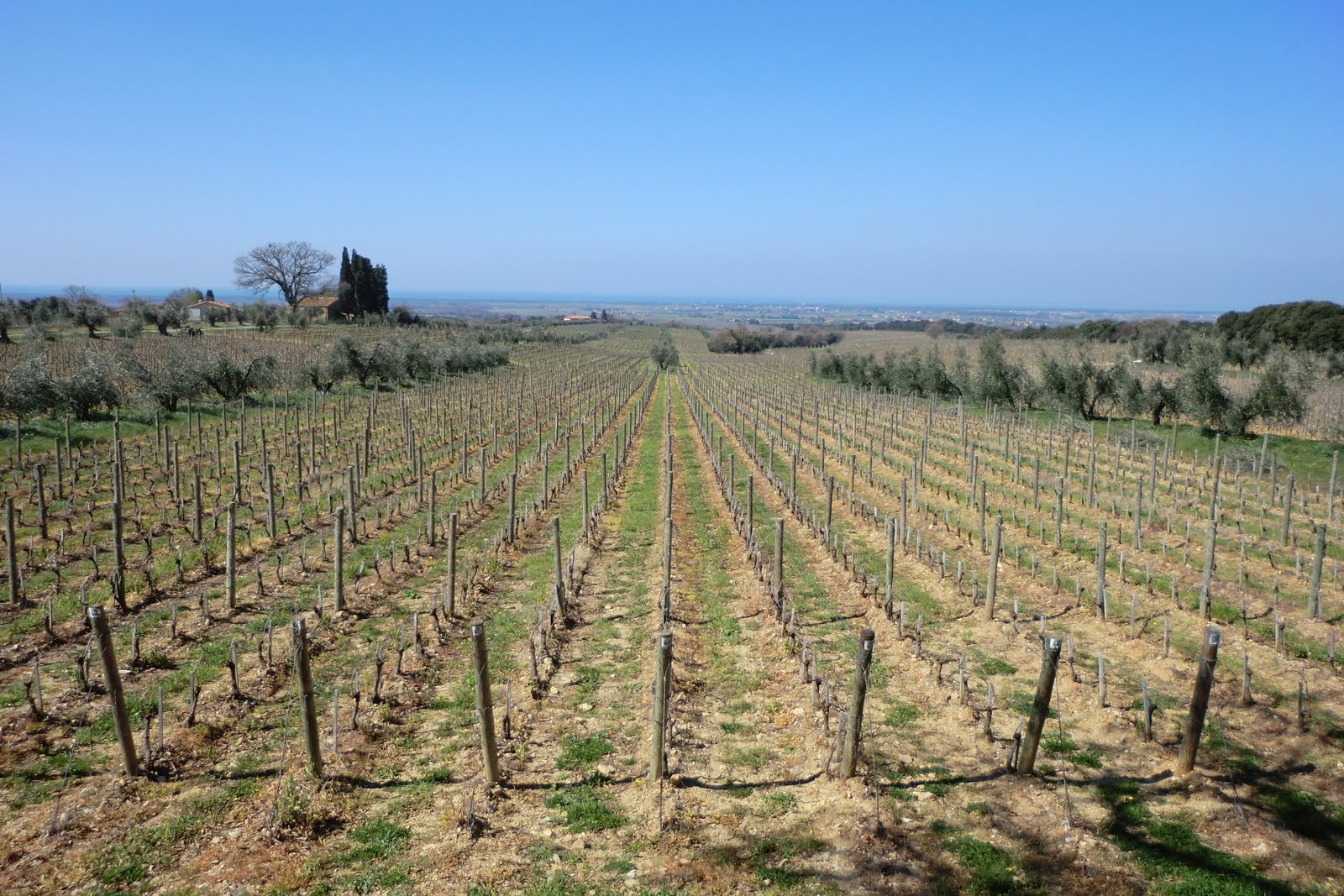
We drove back the way we came on Via Bolgherese to "Cypress Avenue" and turned right to continue our transit of this wonderful thoroughfare.  We turned left into the road at the end of the Castello di Bolgheri vineyard and continued along that road until we arrived at Bellaria.  Once on the property we drove to an elevated wooden platform from which we could view the entire vineyard and the sea in the distance.  Breathtaking.


As we took in the view, Viola peppered us with vinous tidbits.  The vineyards are planted at elevations ranging between 50 and 120 meters above sea level on slopes ranging between 5 and 20 degrees.  Here at Bellaria, the hills above the vineyards protect the vines from cold winds while the sea moderates the temperature and reflects sunlight, a boon to grape ripening.  The soil composition changes every 500 meters or so and dictates the estate's planting strategy: Petit Verdot on sandy soils; Cabernet Sauvignon on clay-limestone soils; and Merlot on clay soils.  The average age of the vines at Bellaria is 8 years.

At the conclusion of the Bellaria visit we retraced our course to the original property.  The main property is divided into a 30-hectare vineyard dedicated to Ornellaia fruit and 7 hectares dedicated to fruit for Masseto.  The soil in the Ornellaia vineyard is reddened by the presence of iron and yields high-tannin, age-worthy wines.  The first parcel was planted in this vineyard in 1982.  The Merlot grapes for the Masseto are planted on clay soils.  The average age of the vines on this property is 15 years.

The Tenuta dell'Ornellaia winemaker is Alex Heinz and the winery's philosophy is "quality without compromise."  The quality begins in the vineyard and continues throughout the winemaking process.  Grapes are hand-harvested and subjected to a three-part selection process which ensures that only the best berries make it to the fermentation tanks.  Grapes from the estate's 60 parcels (37 hectares of Cabernet Sauvignon, 38 hectares of Merlot, 12 hectares of Cabernet Franc, 10 hectares of Petit Verdot) are vinified and stored separately prior to the construction of the final blend.


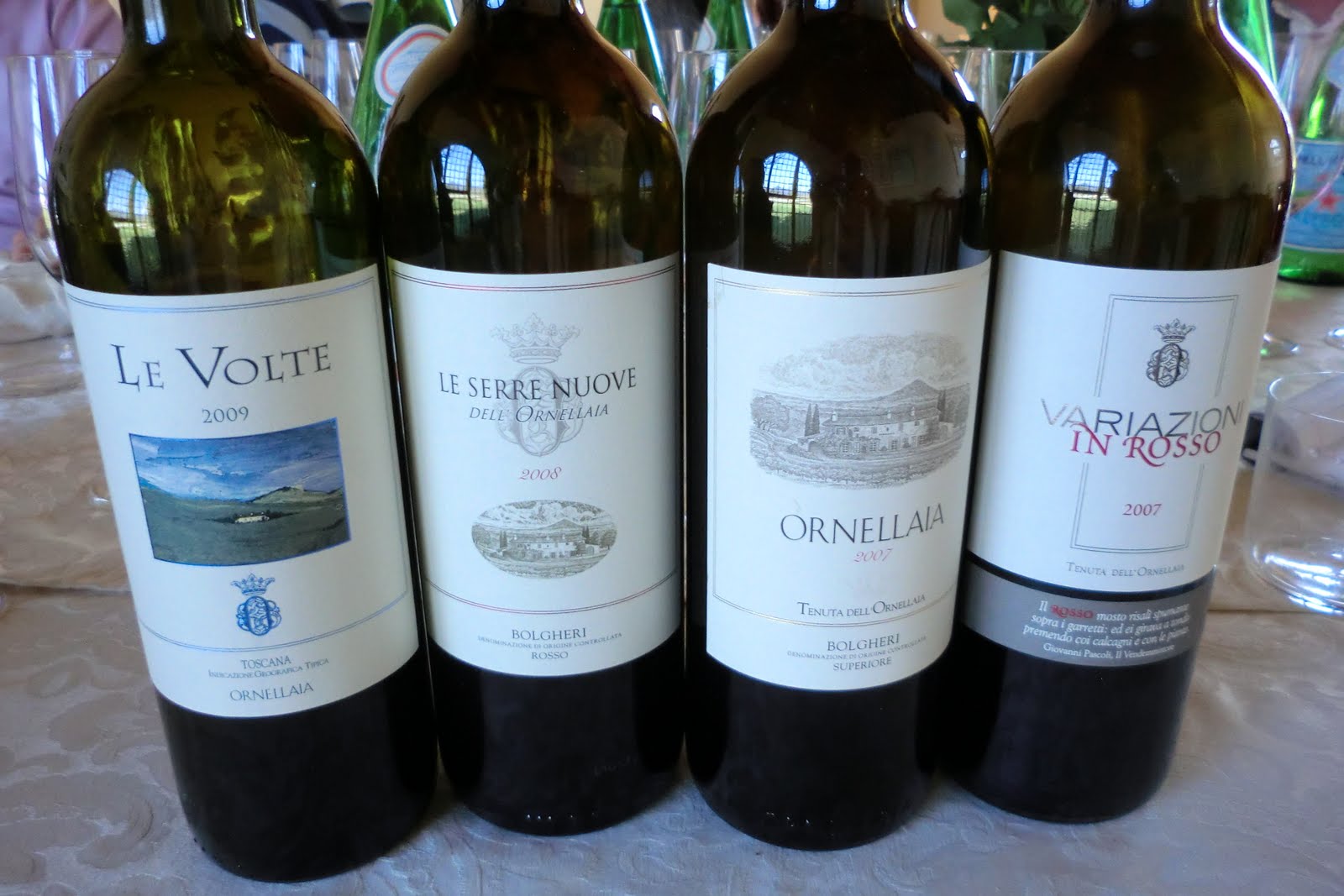
The estate's first wine is Ornellaia, a Cabernet Sauvignon (60%), Merlot (25%), Cabernet Franc (12%), and Petit Verdot (3%) blend.  This wine is fermented (natural yeasts) and macerated in stainless steel tanks and then transferred to oak barriques (70% new, 30% second year) where malolactic fermentation occurs.  The wine is aged in oak for 12 months before final blending after which it is bottled and aged for an additional 12 months.  The 1998 vintage of this wine was named wine of the year by Wine Spectator in 2001.

The second wine is Le Serre Nuove, a Cabernet Sauvignon (35%), Merlot (50%), Cabernet Franc (10%), and Petit Verdot blend.  This wine is made from grapes that did not make the Ornellaia cut as well as fruit from the Bellaria vineyard.  It is fermented in stainless steel tanks and macerated for 30 days.  Malolactic fermentation occurs both in the tanks and in barriques.  The wines are aged for 12 months before final blending and are then aged in oak for an additional 6 months before bottling.

Le Volte is a 50% Sangiovese, 20% Cabernet Sauvignon, and 30% Merlot blend, with the Sangiovese fruit sourced externally.  Alcoholic and malolactic fermentation take place in stainless steel tanks before the wine is transferred to 2- to 4-year-old barriques for 10 months of aging.

The jewel in the Ornellaia crown is the 100% Merlot Masseto.  This wine has received both critical and pecuniary acclaim.  It is fermented in oak vats and stainless steel tanks with malolactic fermentation in new oak barriques where it is aged for 24 months.

At the conclusion of the winery tour, we tasted some of the wines and then repaired to the dining room for lunch.  The traditional Tuscan lunch was pleasing to the eye and, especially so, to the palate and was paired


impecably with examples of the estate's offerings.

All in all, a super Tuscan day.

Monday, January 28, 2013

Italian Merlots: Tenuta dell'Ornellaia's Masseto (Bolgheri, Tuscany)

Any discussion of Merlot wines generally begins with a deep bow in the direction of Bordeaux's right bank and wines such as Le Pin, Pétrus, L'Eglise-Clinet and a host of others that are produced in Pomerol and neighboring St. Emilion.  And that acclaim is justified.  But Merlot wines from Bordeaux no longer have a monopoly on greatness as a number of small-production, mono-varietals reared in the Bolgheri region have begun to gain critical acclaim.  Names such as Masseto (Wine Spectator 100 points in 2001), Redigaffi (Wine Spectator 100 points in 1997 and 2000), and Messorio (Wine Spectator 100 points, 2004), among others, have grabbed the attention of critics and wine collectors alike and, in so doing, have led to steady value appreciation for those lucky enough to own these wines.

I will be exploring these Italian Merlots in a series of upcoming posts beginning with today's post on Tenuta dell'Ornellaia's Masseto, an estate which I had the privilege of visiting last year with a Bordeaux Index team.


The Ornellaia estate encompasses 180 hectares -- 97 of which are planted to vine -- divided between two properties: the 37 hectares of vineyards and the winery on Via Bolgherese and a 60-hectare property called Bellaria which is located to the north of Bolgheri.  The Via Bolgherese property is divided into a 30.37-hectare vineyard dedicated to fruit for non-Masseto Ornellaia wines and a 6.63 hectare vineyard dedicated to the growth of Merlot grapes for the fabled Masseto wine.

The Masseto vineyard lies on soil comprised of thin silty clay and broken rock fragments. There is some confusion as to the planting date of the vines with the Masseto website stating the year 1984 as the planting date and other sources (see hermitagewine.com/masseto) using 1981 as the planting date.  The older date seems to be more reasonable as the first vintage of the wine is identified as being offered on the market in 1986.

The Masseto vineyard is sub-divided into three distinct sections based on soil characteristics and resultant wines.  The lowest section of the vineyard is called Masseto Junior and its soils are characteristically a clay-sand mix.  According to the winery the wines produced frrom grapes grown in this section are lighter and serve to smooth out the tannic roughness associated with the wines from the other sections as well as contributing to the overall delicacy of the final product.  The middle portion of the vineyard is called Masseto Centrale and has the highest levels of Pliocene clays.  Wines produced from these grapes are powerful, concentrated, and tannic.  The top portion of the vineyard is located 120 meters above sea level and the soil here consists of loose clays and sand along with pebbles.  The soil here is the shallowest in the overall vineyard and the grapes tend to ripen earliest.  The wines produced from this section of the vineyard are dense and linear.

Source: masseto.com

The Tenuta dell'Ornellaia winemaker is Alex Heinz and the winery's philosophy is "quality without compromise."  The quality begins in the vineyard and continues throughout the winemaking process.  Grapes are hand-harvested and subjected to a three-part selection process which ensures that only the best berries make it to the fermentation tanks. Suspect grapes are selected-out in the vineyard and before and after de-stemming.

Fermentation is conducted in temperature-controlled stainless steel tanks and oak vats with each block fermented separately.  Blocks are aged in wooden barriques for one year prior to being blended into the final wine by the winemaker.  The barriques of choice are procured from the Massif Central area in France and have a medium toast.  After blending, the wines are returned to the barriques for an additional year of aging.  Specific lots of wines may be clarified prior to bottling depending on their characteristics.  The wines are aged for an additional year in bottle before being released to the market.

Source: masseto.com

Source: masseto.com
Annual production of Masseto averages around 30,000 bottles and the wine sells for around $450 upon release.  Recent vintages that are especially well regarded by the critics include the 2001, 2004, 2006, and 2008. Axel Heinz, the winemaker, in a Decanter interview (Ornellaia, May 2013) said "When young, Masseto can seem monolithic, but it often shows much more complexity with age."

Masseto has the distinction of being the first Italian wine to be sold through the Place de Bordeaux, a marketplace ttraditionally reserved for First Growths and a small number of foreign icon wines. Other foreign wines sold through this marketplace include Opus One and Almaviva, both estates associated with Baron Rothschild (decanter.com 11/18/08).  The first Masseto vintage offered through this marketplace was the 2006.

On a personal note, this is, for me, one of the great wines of the world.  I have had the pleasure of tasting vintages from the mid-90s and and have been consistently blown away by how elegantly they transit time.  Our team tasted the 1996 vintage during one of our many local tastings and the notes talk of a terroir-driven wine with coffee notes.  The wine was smooth with great texture and complexity.  It was concentrated but not weighty.

Masseto has been referred to as the Pétrus of Italy and it is a moniker that, in my opinion, is not without merit.  Will there come a day when we refer to Pétrus as the Masseto of France?


©Wine -- Mise en abyme

Tuesday, December 20, 2016

The best wines tasted in 2016: Part I, Antonio Galloni events

This year, I am going to present this topic in two parts: the wines tasted at Galloni events and the wines tasted everywhere else. As the title indicates, we begin with the Galloni-events wines.

I attended a total of four Galloni tastings during the course of the year:
  • Bartolo Mascarello: A Historical Perspective (1958 - 2010), a tasting dinner held at the 28º - 50º Maddox Street location (London, April 26th)
  • Soldera: Brunello di Montalcino Through the Ages (1981 - 2006), a tasting dinner held at maze Restaurant in London, on April 27, 2016. 
  • Vietti Barolo Rocche di Castiglione: A Historical Retrospective (1961 - 2011), a tasting dinner held at Vaucluse in New York City, May 10th, 2016
  • Ornellaia and Masseto Retrospective (1995 - 2010), from Magnum, a tasting dinner held at Bouley Test Kitchen, December 5, 2016.
The Bartolo Mascarello Tasting

Used with permission of Vinous Media LLC
The wines that were on my radar screen coming out of the tasting were the 1995, 1997, and all of the wines in Flights 4 and 5.

1995
I had tasted this Mascarello vintage three years ago and at that time had described it as having "a bouquet of dried cherry, soy, and sandalwood. Medium length with red fruits, leather, and mushroom." I found the wine at this tasting to be elegant on the nose with evidence of sweet flowers, tar, asphalt, and dark fruits. Intense red fruits on the palate with some stemminess. Dried rose petal, mushroom, and tobacco on the palate. Long sour finish with a drying towards the end.

1997
This wine exhibited the classic tar and roses but, in addition, an intense spiciness. Great structure and acidity. No rough edges on the palate. Long, sour finish. Best wine tasted up to that time. Antonio had similar sentiments, remarking on the sensuality, roundness, and harmony of the wine. He thought that it was the best wine of its flight.

Flight 4: Greatest Four Wines of Recent Vintages
2004
Tar, roses, green herbs. Young, balanced, focused, round. Sensation of heat. One of the first great vintages that Antonio had reviewed and he sees it as a vintage of incredible pedigree.

2006
Not very expressive on the nose. Cherries. Red fruit on the palate. Tannins present. Rich with a hint of molasses. Long, sour finish. I loved this wine. This, according to Antonio, was a vintage of structured Barolos, masculine and brooding. These wines will be long-lived.

2008
Hints of roses, tar, cigars, tobacco. Antonio saw it as having incredible aromatics and being light and delicate on the palate. He described it as being Pinot-like.

2010
Young. Spice and high-toned red fruits. Not very expressive of traditional Barolo aromas. Structured. Rich. Powerful. Brooding. Antonio considers it the greatest vintage of his time.

Flight 5: Magnum Flight
This flight included the 1986 and 1958 vintages in magnum.

1986
A very special vintage in Piemonte, according to Antonio. This vintage was under the radar. No one had paid any attention to the vintage because of hail. Few producers actually made Barolo in that year. When he speaks to producers who made wine in 1986, they consistently tell him that they prefer the 1986 to the 1985. This magnum was sourced directly from the winery.

Dried rose petals, tar, sauvage, dried herbs, leather, cigar box, and spice. Ripe and lively on the palate. Balanced. Long, sour finish. A beautiful wine. Antonio described it as powerful and pungent.

1958
Antonio thinks that this is the greatest wine ever made at Mascarello. The magnum is actually 1.9 L so that it could be used to fill two .750s while leaving the sediment in the wine remaining in the bottle.

Pungent, piercing nose with laser-sharp focus. Tar, roses, cherries, peeled green mangoes, and coriander. Savoriness. Hint of sweetness. Drinking younger than expected.

The Gianfranco Soldera Tasting


The tasting was organized into five thematic flights with the intent of allowing attendees to "trace the evolution of the wines and house styles all the way back to 1981." The flights were named and ordered as shown in the table below.

FlightNomenclatureInclusive Vintages
1
The Early Years1981, 1982, 1987, 1988
2
Sleeper Vintages2000 Riserva, 2003 Riserva, 2005 Riserva
3
The Mid-1990s1993 Riserva, 1994 Riserva, 19995 Riserva, 1996 Riserva
4
Reference Points1997 Riserva, 1999 Riserva, 2001 Riserva, 2004 Riserva
5
The Icons1993 (Magnum), 1983 Riserva (Magnum), 1990 Riserva, 2006 Riserva

After this tasting, it was clear to see why Antonio had fallen under the spell of this wine. High quality across the board and basically variations on a theme. Even in the years when vintage effects significantly affect the quality of his competitors' products, Soldera manages to produce wines that are clearly recognizable as his. I kept all of my glasses during the course of the tasting and went back at the end to taste all of the wines. Even with some of the wines being in the glass for well over three hours, they had all retained their integrity.

As it would be impractical to reproduce the notes for all of the wines in this post, I encourage you to follow the link in this title section to get to the tasting notes. Each one of these wines fall into the category of the best wines I tasted in 2016.

The Vietti Barolo Rocche di Castiglione Tasting


Used with permission. Courtesy of Vinous, LLC.
The first wine tasted was the 1986. Luca was attending enological school during this vintage when the area was hit by hail on a late morning in early May, causing the loss of 2/3 of the crop. If the hail occurs early enough, you can still make good wine. And they did. This was the wine of its flight. Balsamic, stewed fruit, iron, tea, dried rose petals, herbs and a savoriness on the nose. On the palate intense red fruit along with olives, mushroom, leather, licorice, and white truffle. Balanced with a long, elegant finish.

The 1996 was the wine of its flight. Balsamic, dried rose petals, and dried herbs on the nose. Tight focus. Elegant. Engages all elements of the palate. This wine will age forever. According to Luca, Rocche likes cool vintages and such conditions prevailed for this wine. Luca likes it because of its freshness. He called it "super classic."

The 2004 exhibited spice, red fruit, lead pencil, and licorice. Unctuous. Sweetness on the palate along with great acidity, tar, licorice, and anise. Weighty. Rich, long finish. A long growing season and the first vintage of finesse in Barolo (Antonio Galloni).

The 2006 exhibited tar, earth, and licorice on the nose and licorice and anise on the palate. Virile and powerful but with silky tannins.

Rich red fruit on the nose of the 2010 along with rose petal, mint, and tar. Rich red fruit and anise on palate. Powerful. Lengthy, tart finish. According to Antonio, has been fantastic from the beginning.

The Ornellaia and Masseto Tasting


The 2006 Ornellaia was the first of the wines tasted to exhibit any noticeable acidity. Rich and intense, with juicy acidity surrounded by a beautiful core of fruit. Good levels of fruit and acidity in the 2006 Masseto. Rich, structured, powerful, and balanced. This wine is a buy.

The 2004s were the first wines to show really well on the nose. This illustrated the relative youth of the previous wines. The Ornellaia had floral notes along with tea, licorice, and olives. Full-bodied. Heavier than the earlier vintages. The Masseto was a beautiful wine. Classic older Merlot. Granny's attic, spice, and a dankness. Weighty and structured.

The 1998 Ornellaia was a beautiful wine. Cigar box, tobacco leaf, and black fruit on the nose. Textured and structured. A "come-hither" wine. The Masseto presented cigar box, tobacco, orange peel, and spice. Textured and balanced with a long finish. Axel remarked on the "smoky tobacco leaf character" of both of the wines in the 1998 vintage.
The 1997 Ornellaia was a desirable wine with still a lot of life ahead. A little green pea and coconut on the nose along with a restrained orange peel. Fresh on the palate. Fine-boned and elegant. Long finish. 

The 1995 Masseto showed tobacco and Granny's attic. Great acidity and sharp red fruit. Lengthy finish. An excellent wine.


©Wine -- Mise en abyme

Tuesday, July 5, 2011

A World of Cabernet Sauvignon: Chile, Washington, and Tuscany

I recently convened a tasting panel at the Vines Bar and Grill on Sand Lake Road in Orlando to investigate the characteristics of Cabernet Sauvignon grown under differing soil and climatic conditions. The tasting was titled ‘A World of Cabernet Sauvignon’ and its intent and framework were detailed in a previous post.  The tasting was divided into four flights: Bordeaux; Chile/Washington State/Bolgheri; Napa/Sonoma; and Margaret River/Coonawarra/Barossa Valley.  The Bordeaux flight was covered previously.  The second flight, covered herein, included the following wines: 1997 Don Melchor (Maipo Valley, Chile); 2006 Quilceda Creek (Columbia Valley, WA); 2003 Leonetti Reserve (Walla Walla Valley, WA); and 1998 Ornellaia (Bolgheri, Tuscany). 


The 1997 Don Melchor (Parker 94 points) from Concha Y Toro was the first wine tasted in this flight.  The Puente Alto Vineyard, the source of the grapes for this wine, is located south of Santiago in the Maipo Valley at elevations varying between 1200 and 1500 feet. The climate is Mediterranean with 350 to 450 mm of rain annually and thermal oscillation in excess of 68 degrees. The soil is a combination of riverine deposits and eroded rock. The winery contends that its proximity to the Maipo Canyon renders its vineyards the coolest in the region. The Puente Alto Vineyard consists of contiguous sub-divided plots with each of the six Cabernet Sauvignon blocks having its own distinctive style.


Panel tasting notes:  This wine exhibited a lot of green on the nose; bell pepper and dill.  Ron felt that it showed up as new world immediately but, while enjoyable, he found it non-complex.  Andrew indicated that he would not call it non-complex; rather, he would say that geographically it is an indication of Chilean Cabernet.  Vegetal notes are more pronounced in the wines of Chile, especially Cabernet Sauvignon, and lends to them being easily distinguishable.  In response to a query about the ripeness of the fruit Andrew said that the grapes were ripe enough but this is the way that the grapes have adapted to the land.  Ron commented that these wines were no longer the value they used to be.

On the palate, mint, camphor and eucalyptus flavors, clay, very soft acidity, and a rich mouth feel.  A lot of fruit and indications of a hot vintage.  Uni-dimensional.


The 2007 Quilceda Creek (Parker 100 points) was the next wine up.  Quilceda Creek was founded in 1979 and produces a signature Cabernet, two single-vineyard Cabs, and a red blend.  Grapes for the signature Cabernet are sourced from the Tapteil,  Klipsun, and Discovery vineyards. Tapteil Vineyard is a 25-acre property owned by Larry Pearson and located in the Red Mountain AVA.  It is planted to Cabernet Sauvignon (15 acres), Cabernet Franc (2 acres) and Merlot (2.5 acres).  The Cabernet Sauvignon is known for concentration of color and supple tannins while the Merlot is known for the production of rich, dark wines. The vineyard sits between 750 and 900 feet on Warden silt loam soil and has a southwest facing slope.  Klipsun Vineyard sits on 280 acres – of which 120 are planted to vine (28 acres Merlot, 60.7 acres Cabernet Sauvignon, 5.2 acres Semillon, 12.6 acres Sauvignon Blanc, 5 acres Syrah, and .5 acres Nebbiola – on the western slope of Red Mountain.  This vineyard produces 300 tons of grapes annually and its fruit is renowned for structure and aromatics.  It has been designated one of the top 25 vineyards in the world by Wine and Spirits magazine.  Discovery Vineyard (Horse Heaven Hills AVA) was first planted in 2005 and is home to 17 acres of Cabernet Sauvignon, 6 acres of Syrah, and 1 acre of Petit Verdot.  It sits between 500 and 590 feet on wind-blown loess over fractured basalt soil with a south/southeast aspect.

Panel tasting notes:  According to Ron, Quilceda Creek has averaged 99 Parker points since the 1999 vintage.  He remembers Parker’s 1999 tasting notes describing Quilceda Creek as somewhere between a Margaux and a La Mission Haut-Brion so he called the winery immediately and got on their mailing list.

Dulce de leche and caramel on the nose.  Rich and creamy on the palate and reminiscent of cake batter.  Great mouth feel.  Acid and tannin balance out the massive fruit structure.  Highly extracted without being jammy.  Still young but loads of promise.  In Ron’s opinion not a 100-point wine.

The third wine tasted was the 2003 Leonetti Reserve (Parker 97 points).  Leonetti Cellar sources fruit for its wines from Seven Hills, Loess, and Mill Creek Upland Vineyards.  Seven Hills Vineyard was planted in 1980 and, as such, was one of the first vineyards in Walla Walla.  It is currently owned by Gary Figgins, Marty Clubb, and Bob Rupar and its output is sold to 25 premium wineries.  The 235 acres of vineyard sits on Edingford silt loam (wind-blown glacial loess) at between 850 and 1050 feet elevation.  Loess Vineyard sits on 28 acres at 1050 to 1150 feet elevation on Walla Walla silt loam soil.   The primary varietals are Cabernet Sauvignon, Merlot,  Petit Verdot, and Malbec and the wines are known for intense aromatics, red and dark fruits, and balance.  Mill Creek Upland is a 16-acre property sitting between 1485 and 1600 feet elevation with a south/southwest aspect.  The soil is Athena and Walla Walla silt loam.  Primary varietals are Cabernet Sauvignon, Merlot, Petit Verdot, and Sangiovese.  Wines exhibit traditional mountain fruit characteristics with dry, dark color, great acidity, dark fruits and dried herbs.

Panel tasting notes:  Raspberry and blackberry on the nose along with a certain creaminess.  The components of the wine hang together well.  Beef stock and petrol flavors.  Well integrated tannins.  Ron described the wine as refreshing and in a “perfect place” in terms of development.  Andrew felt that this wine presented much better on the nose than it did on the palate.  This wine was selected as the wine of the flight.

The final wine in this flight was the 1998 Ornellaia.  This wine was rated 93 points by Robert Parker but was rated 96 points by Wine Spectator and crowned 2001 Wine of the Year by that publication.  Full details on the Ornellaia vineyards and winemaking practices are contained in the post on my visit to the Ornellaia estate.

Panel tasting notes:  On the nose vegetal aromas, tobacco, dried earth, spice. Overall, though, a somewhat muted nose (panel agreed on the need for some more decant time).  A lively debate on the Bordeaux-ness of this wine ensued.  Ron felt that it was Bordeaux-like while I argued for the intrusion of some new world elements into the mix.  We felt that the wine was timid on the attack but built well towards the mid-palate.  Great balance.  Well integrated, even in this youthful phase, with the promise of phenomenal longevity.

The room was abuzz.  We were oblivious to the world outside our glass-encased room.  We were drinking very good wine and engaging in spirited discussions about those wines. There was an intoxicating level of dynamism and give and take.  We were in a zone and learning, and tasting, and debunking myths and sacred cows.  I was loving it.


Next up, Napa and Sonoma.

Friday, July 22, 2011

Australia and Wrap up: A World of Cabernet Sauvignon

The final flight in our tasting covered Cabernet Sauvignon wines from Australia but, unfortunately, the results were somewhat disappointing.  The wines tasted were: 2001 Gralyn Estate (Margaret River, Parker 94); 1997 Penley Estate (Coonawarra, Parker 91); 1994 Penfolds Bin 707 (Barossa Valley, Parker 90); and 2003 Two Hands Aphrodite (Barossa Valley, Parker 94).


These wines might have suffered from being the last wines on a rather long night where they were preceded by 17 quality wines.  The Margaret River was described as having an Irish Spring aroma and collapsing on the palate while the Penley Estate hinted at molasses and muddy water with a definite Shiraz leaning.  The Bin 707 had a "Grange nose" and was "Napa on steroids" while the Two Hands Aphrodite had a short finish and was "uninspiring."  The Bin 707 was designated WOTF but, according to the panel, this had more to do with the weakness of the field than the brilliance of the Bin 707.

At the conclusion of the Australian flight, I asked the panelists for their impressions of the Cabernet Sauvignon wines from the varying regions.  Ron began by stating that there had been impressive wines tasted from each region but that the Bordeaux wines stood out for him.  He would approach this discussion by asking the question "What wines do I want in my cellar?"  He would eliminate Australia immediately.  He liked the older California wines -- the Heitz, for example -- but they do not make wines like those anymore.  The more modern California wines seem one-dimensional with low acidity and high alcohol.  Bordeaux is the one for him.  Those wines stood out and were the most interesting.  He was also very pleased with the Leonetti.  Overall, as you tasted the wines, you could clearly tell whether you were in the Old World or New.  But with Bordeaux, he could tell where the wine is from and the vintage -- for example, whether it was a wet year, or a hot year.  He had heard that Chilean Cabs were Bordeaux-like but did not get that sense coming out of this tasting (it should be pointed out that we only had one Chilean Cab in this tasting); as a matter of fact, he felt that the Don Melchor was closer to Napa than to Bordeaux.

In his comments, Andrew noted that Bordeaux stood out on its own.  "You cannot confuse these wines for anything else but Bordeaux."  In a blind tasting he would have placed the Ornellaia in with the Bordeaux wines.  Ron chipped in at this point to say that he would put Italy right behind France in terms of Cabernet Sauvignon.  Andrew said that the Ornellaia was still fresh.  He found it a little hollow but would still put it in his cellar.  This tasting was an interesting window, according to Andrew, on how Cabernet Sauvignon has evolved in the New World.  For example, in Meritages he has a problem picking out the Cabernet Sauvignons from the Merlots from the Cabernet Francs, a problem he almost never encounters with Bordeaux blends which tend to be a lot more balanced.


Russell felt that the goal of the tasting was accomplished in that Cabernet Sauvignons from different parts of the world showed distinct differences in characteristics.  His bias is towards Bordeaux.  His surprise of the night was the 2003 Ducru-Beaucaillou, which showed great class and elegance.  Australia was disappointing for him in that the wines all tasted Shiraz-like but, that being said, the Penfolds was his favorite.  He enjoyed the Ornellaia.

Jeff was very sure that Australia and South American Cabernet Sauvignons were not for him (He came in with this baggage).  His preferences tend towards Napa and France depending on his mood.  If he wants the tertiary flavors like saddle leather, cedar, cigar box, etc., then he drinks Bordeaux.  According to Jeff you do not get those flavors with Napa Cabs except for wines like Dominus and some of the older Napa Cabs.  He was thrilled with the way the Heitz showed tonight.  The tasting basically served to reinforce his preferences.

I commented that I had a special place in my heart for Cabernet Sauvignons from Bolgheri but felt that the wines from Bordeaux, even the lesser ones, stood up very well against their peers from other regions. I am currently overweighting Bordeaux in my purchases in order to bring that region to a position of dominance in my cellar.  The Ducru, Leonetti, and Heitz were different, but standout, representations of Cabernet Sauvignon from my perspective.

Fred was more impresed with the New World wines than the Old but, as he says, that is his palate.  He liked the Leonetti, Revana, and Shafer.  Laurie and Lisa concurred with Fred in this position.  Laurie likes "California fruit bombs" while Lisa feels that Napa Cabs are great drinking wines which complement what you are doing today and have great flavor.


There is a clear sense of place associated with Cabernet Sauvignon from varying places around the world. Whether that difference is a result of sunlight, aspect, soil, climate, or a combination of these factors, is beyond the scope of this post.  We set out to identify regional differences and we did.