Wednesday, January 26, 2022

Agrovoltaics - A potential approach to mitigating the effects of climate change in the vineyard

The threat of the impacts of climate change on wine quality has sent winemakers scrambling for mitigating solutions to include: moving to higher altitudes; adding more heat tolerant varieties to the mix; adjusting canopy strategies; and agroforestry. But it is not only increased heat that is of concern; we also expect changes in the intensity and frequency of all adverse climatic events.

Agrovoltaics is an emerging approach that may be deployable in this engaged battle against and unleashed and unruly Mother Nature. Otherwise known as solar sharing, agrovoltaics places solar panels on the same land where crops are grown, allowing farmers to harvest the power of the sun twice.

Source: https://www.unitedwind.com/
innovation/sustainable-future-with-agrovoltaics/

Beyond a certain point -- the light saturation point -- light does not increase photosynthesis. Rather, the additional light causes the plant to sweat, increasing its demand for water. Solar panels can be positioned to allow crops just the right amount of sunlight with the excess diverted to electricity production. 

From the solar energy provider's perspective, it is expensive to clear and level land for the deployment of solar arrays. It would be much less expensive to deploy these arrays on land that is already in use.

Plants help to keep the solar panels cool, making them more efficient. It has been shown that solar panels emplaced above crops produce up to 10% more electricity than solar panels without underlying plants.

Large-scale solar arrays produce a so-called "heat island effect where temperatures in the vicinity are elevated as a result of the operation. Attempts have been made to reduce this effect by installing gravel beds below the arrays; the results have been unsatisfactory. Replacing the gravel beds with vegetation, on the other hand, has yielded significant positive effects.

According to an Oregon State University study, converting 1% of American farmland to agrovoltaics would:
  • Allow us to meet national renewable energy targets
  • Save water
  • Create new revenue opportunities for small farmers.
Crops best suited for agrovoltaics are limited to those which are grown and harvested by hand or with the aid of small machinery. These include (NRCC):
  • Shade-loving pollinator crops
  • Bedding plants
  • Small fruit trees and shrubs
  • Vegetables
  • Livestock.
There has been at least one vineyard trial utilizing this approach. The French solar provider Sun'R and its subsidiary Sun'Agri have established and experimental program in southern France in partnership with Environment and Energy Management Agency. The trial involves a 600 sq m dynamic system installed in a 1000 sq m Grenache vineyard. The system is comprised of 280 panels (capable of producing 84 kW of electricity) each placed 4.2 m above the vine rows. Movement of the panels is arbitrated by an AI system such as to optimize sunshine and water access as well as to shield the vines from heavy rain, frost, and heat.

Initial results from the trial show that:
  • The panel structure shelters the vines from stunting during heatwaves
  • The system reduces water demand by 12 - 34% due to a reduction in transpiration through the soil
  • The aromatic profile of the berry has improved, with 13% more anthocyanin and 9 - 14% more acidity evident.
Much more data need to be presented as to the break-even size required for a vineyard to embark on this path, who benefits, who pays the cost, etc., before a more definitive position can be taken as regards this approach. But the promise is clear.


©Wine -- Mise en abyme

Thursday, January 13, 2022

Los Angeles was the City of Vines before it became known as the City of Angels

I have been blaming the Spanish clergy for the Judgment of Paris debacle for French wines but further research places more direct responsibility on a ... Frenchman. Yes, a Frenchman. Sixteen years after his fellow countryman Jean David had backed out of a deal with Thomas Jefferson because, in his view, a successful US domestic wine industry could potentially do significant harm to the French wine industry, the aptly named Jean-Louis Vignes launched a US wine industry based on French varieties. Let's explore.

Jean-Louis Vignes
(Source: Balzac Communications)

Vignes surfaced in Monterey,  Alta California, 10 years after the conclusion of the Mexican War of Independence (1810 - 1821). He had been born in a small French village where his family were artisans: they made barrels for the local wine producers; they made their own wine; and they processed wine lees into lees ash for use as a fertilizer.

Jean-Louis left his village and eventually ended up in the Sandwich Islands where he grew sugar cane and distilled rum. The religious leaders were not fans and persuaded the authorities to ban the basis of his business, driving him into insolvency. He left for the US mainland, arriving in Monterey in 1831 and the Pueblo of Los Angeles later in the same year.

When Vignes arrived in LA, Mission grapes were grown by the Franciscans for sacramental purposes and outside the religious structure for the production of aguardiente (a brandy) and wine for local consumption. The primary industry was cattle-rearing but the "free-range" cattle were not suitable for consumption at table. Rather, the 76,000 head of cattle were used for tallow (62 million pounds shipped between 1826 and 1848) and hides (5 million shipped in the first half of the century). Vignes eventually purchased 104 acres of land on the west side of the Los Angeles River and named it El Aliso after the centuries-old tree located in the vicinity of the farm entrance.

Vignes started out with Mission grapes but was not satisfied with the quality of the wines. To address this shortcoming, he imported Cabernet and Sauvignon Blanc vines from his native Bordeaux, had them shipped around Cape Horn, and planted them in Los Angeles in 1833. This was the first instance of non-Mission vinifera being imported to the west coast of the US (Mazzei had imported Italian vitis vinifera to the east coast in 1774) and the first instance of Bordeaux varieties planted therein (A momentous event given that Bordeaux varietals would participate in the dethroning of French wines by Napa insurgents 143 years hence.). Vignes grafted the Bordeaux scions onto Mission rootstocks; and the rest is history.

Vignes was the first to grow quality wines in California and the first California producer to age his wines. The wood for the wine barrels was sourced from his holdings in the San Bernadino Mountains. It is likely that his first Bordeaux varietal vintage was in 1837. His wines were highly regarded and even made its way to the table of the then President Martin van Buren.

Buoyed by the prospects in California, Vignes wrote to his relatives in Cadillac, encouraging them to come join him. A nephew, Pierre Sainsevain, was the first to respond to the call, arriving in LA in 1839 and joining his Uncle's enterprise.

By 1840, the estate had made its first shipment north and by 1842, was making regular shipments to Santa Barbara, Monterey, and San Francisco, commanding prices of $4/gallon for brandy and $2/gallon for wine. By 1845 they were shipping 1000 barrels of wine and brandy north and by 1849, El Aliso was the most extensive vineyard in California with over 40,000 vines and annual production of 150,000 bottles per year.

Pierre's brother arrived in Los Angeles in 1849 and in 1855 Vignes sold El Aliso to the Sainsevain brothers for $42,000, the largest real estate transaction to that date in California. By that time Vignes was largely considered the founder of California's wine industry and would eventually have a street in downtown LA named after him. 

Vignes was instrumental in Los Angeles District becoming the original beating heart of the California wine industry. When gold was first discovered in California in 1848, demand increased for California wine and there were many new market entrants; entrants who sought out Vignes for advice and counsel. A total of 125 vineyards were operative in 1855, hosting 324,234 vines and producing 7000 lbs of fresh grapes and 100,000 gallons of wine and brandy. Seventy-five vineyards operated within the LA city limits, earning it the moniker "City of Vines." The road from Los Angeles to the port of San Pedro was called Vineyard Lane.

Los Angeles remained the center of California wine production until the nexus was shifted north by a number of factors including positives such as the arrival of the railroad and the rise of the citrus industry and negatives such as phylloxera, Pierce's disease, and Prohibition.

©Wine -- Mise en abyme

Sunday, January 9, 2022

How the Mission Monks laid the groundwork for a viable US wine industry

I took a short detour from chronicling the Spanish-driven advance of vitis vinifera northward in New Spain to cover the faltering attempts at creating a wine industry in the English colonies along the eastern seaboard. Having conducted this necessary due diligence, I now return to the true story of wine in America: vitis vinifera in California.

When last I discussed the Spanish, I provided a high-level view of the spread of grapevines in Alta California. I flesh out the details in this post.

Juan Rodriguez Cabrello, a former Spanish conquistador residing in Guatemala, was commissioned by Pedro de Alvarado, the Governor, to explore the Pacific Ocean. Cabrello sailed out of Navidad on June 27, 1542, and landed at Ballast Point in San Diego Bay 108 days on, claiming the land for Spain. The expedition continued northward to Monterey Bay and overwintered in the Channel Islands where Cabrello died. The expedition continued north after his death, eventually reaching the Rogue River in today's Oregon.

In the 17th and 18th centuries, Spain became concerned about French, English, and Russian designs on its northern holdings which were, at that point, occupied by native peoples. Expansion of English holdings on the continent after the Seven-Year War heightened Spanish concerns about foreign incursions and the decision was taken in 1768 to settle these northern reaches. 
The Spanish plan for colonization of California was threefold comprising a religious, military and civil format. First and second stages consisted of the concurrent establishment of missions to civilize native Indians and military reservations, called presidios, to guard the missions and settlers against hostilities. The third stage was the establishment of farming communities called Pueblos.
The strategy was launched in 1769 when Captain Gaspar de Portolá and Father Juniperro Serra established a Presidio and a Mission (San Diego de Alcalá) in San Diego. The totality of institutions established by the Spaniards along the Pacific coast of Alta California is shown in the figure below.

Missions, Pueblas, and Presidios
established by the Spanish in
Alta California

One source points to the formation of Alta California "when Spain separated the Dominican Missions from the Franciscan Missions in approximately 1769 with the founding of the first Alta California mission in San Diego. Separate administrations were created in 1804 when the Province of the Californias, then a part of the Commandancy General of the Provincias Internas in the Viceroyalty of New Spain, was divided in two, along a line separating the Franciscan missions in the north from the Dominican missions in the south. The southern part became the territory of Baja California ... The northern part became Alta California" which roughly encompassed the current states of California, Nevada, Utah, Arizona north of the Gila River, along with parts of Colorado, Wyoming, and New Mexico.

Alta California (Source: sfsdhistory.com)

The remainder of this post focuses on the missions of Alta California, given their importance in the history of California wine.

Mission of the Missions
Religion and culture were inseparable within the Spanish Empire with the Catholic monarchs specifically decreeing the conversion of natives in newly discovered lands. Conversion allowed the incorporation of natives into the Spanish Empire and included "instruction in religion and the language, customs, economics, and skills of the Spaniards." Franciscan monks from the College of San Fernando in Mexico, and operating under the auspices of the Roman Catholic Church, were tasked with this conversion.

The Franciscans controlled the missions in Alta California until secularization. Friars with missionary experience from the College of San Fernando were selected to take over existing missions and to create new ones: "They knew the crafts of husbandry, weaving, carpentry and masonry" and were also well-versed in the teaching of religion.

Structure of the Missions
The dominant building at the mission was the Church which, in times of danger, could serve as a defensive structure. The facility also contained housing for priests, soldiers, married neophytes, and dormitories for male and single female neophytes.

A plan view of the Mission San Juan Capistrano complex
(including the footprint of the "Great Stone Church")
prepared by architectural historian 
Rexford Newcomb in 1916.
(Source: Wikipedia)

Mission San Diego de Alcalá, first California mission
(Source: missionscalifornia.com)

Drawing of Mission San Luis Rey de Francia
(Source: dunnedwards.com)

The sites were chosen based on water availability, available arable land, accessibility by sea or land and proximity to the center of native populations and were located one-day's journey apart. The road linking these missions was named El Camino Real.

Missions lands were of two types: (i) close-in to the mission and used for farming and small-animal agriculture and (ii) the land between missions which were used primarily for cattle-grazing (This latter class of lands were stripped from the missions in the land allocations conducted after the treaty ending the US-Mexico War (1846 - 1848).). Counts from 1834 show the missions owning 400,000 head of cattle, 60,000 horses, 300,000 goats, sheep, and swine. Crops that were grown include wheat, maize, beans, and other staples. Mission products included wine, brandy, leather, hides, wool, oil, cotton, hemp, linen, tobacco, and salt.

Mission Grape
The wine produced at the missions were made with Mission grapes grown therein. The characteristics of the Mission grape are shown in the chart below.


Mission San Gabriel came to be called La Vina Madre because of its 170 acres of vineyards.

Vineyard labor was provided by the natives but it was not voluntary. The natives were enticed to become baptized and, once they were, they were made to renounce their ways, reside in the mission, and provide labor, inclusive of vineyard work.

Mission Wine
A simple table wine and a fortified wine were made at the missions. The table wine was of a lighter variety and, due to a lack of proper storage, did not age well. The fortified wine was made from a mixture of freshly crushed mission grapes and brandy, the ratio being 3 gallons of juice to 1 gallon of 180 proof brandy. The must should not be allowed to ferment. This was a very sweet wine and can still be found in small amounts in California today under the moniker Angelica.

What did the Monks Accomplish?
The monks were instrumental to the development of California and the California wine industry in a number of ways:
  • They were at the vanguard at opening up the region for settlement (On the other side of the coin, this was deleterious to the population and social fabric of the native populations who had previously occupied the land)
  • They established that grapes could be successfully grown along the western seaboard of the US
  • They established that vitis vinifera could be successfully grown in the US.
The chart below shows the correlation of the current-day California wine regions with the historical emplacement of missions within the state. To the naked eye, the correlation seems rather high.


©Wine -- Mise en abyme

Saturday, January 1, 2022

Barboursville Vineyards (Barboursville, VA): Closing Jeffersonian loops

My initial post on Barboursville Vineyards was subtitled "The marriage of Italian expertise, international varieties, and the Monticello terroir. This was not the first time that this trifecta has been attempted. Rather, it was first explored by Thomas Jefferson, the third President of the United States. I explore the historical context herein.

Barboursville was founded by Gianni Zonin -- of the 7-generation, Northern Italian winemaking family of the same name -- who acquired the 18th-century Barbour Family estate and planted it to Cabernet Franc and Merlot in 1976. In 1990 Gianni brought Luca Paschina from his Piemonte home to be the General Manager-Winemaker at the estate with the mandate to "renew those vineyards and restore them to the path of producing the fine wines of great stature which Jefferson and he (ed.: Gianni) envisioned ..." I will explore Jefferson's concept of wines of great stature and comment on Barboursville's attainment of that elevated ideal.

The First Instance of the "Jefferson Trifecta"
The first Italian to pursue making quality wines within this framework was Philip Mazzei, a Tuscan-born doctor who, when he first came up on the American radar, was operating a successful firm in London which imported Champagne, Burgundy wines, and oil and cheese from Italy. Mazzei was an engaging sort of fellow and two of his friends at that time were Ben Franklin and Thomas Adams. Franklin, one of the Founding Fathers, was, at that time, the agent in England for the colony of Pennsylvania. Adams, also a Founding Father, and the second President of the US, was, at that time, a Virginia merchant.

Philip Mazzei

Based on discussions with his American friends, Mazzei, by 1971, decided to launch an initiative focused on importing Mediterranean plants and farmers into Virginia. After some delay he was able to secure the permission of the Grand Duke of Tuscany to take plants and workers out of the duchy. The first phase of Mazzei's plan fell into place with his arrival in Virginia in November 1773 along with 10 Tuscan vine farmers.

Mazzei's plans called for the acquisition of land in the open western highlands but on the way to inspect prospective sites in Shenandoah Valley -- accompanied by Adams -- they stopped to visit Thomas Jefferson at Monticello. That meeting resulted in a change in plans. Jefferson, according to Thomas Pinney (A History of Wine in America), was "always on the lookout for interesting company and for agricultural improvements, both of which Mazzei could provide."


Jefferson offered Mazzei 2000 acres near Monticello to seed his wine venture; an offer which he promptly accepted. He settled his workers on the land, built a house thereon (called Colle), and brought in six additional vine farmers (as well as seeds and cuttings) in the summer of 1774. Further, Mazzei raised a total of £2000 (£50/subscriber) to fund the operation of a company focused on the production of wine, oil, silk, and citrus-type plants.

Mazzei began his vinifera venture with 1500 vines planted in late June of 1775. According to Jefferson, that initial vineyard had a southwest exposure and was sited on a stony red soil "resembling extremely the Cote of Burgundy from Chambertin to Montrachet ..." Approximately half of the vines were successfully rooted. Mazzei never produced a vinifera vintage in Virginia.

There had long been a debate in Virginia as to whether native grapes or vitis vinifera had the best chance of success in the colony, a debate which Mazzei leant into by planting both types on his estate. His workers had identified 200 or so wild grape varieties in the woods surrounding the estate and he had examined over 38 varieties himself, making wines from these grapes in both 1775 and 1776. Each worker was given a cask of the completed wine which they subsequently sold to Virginians at 50 shillings per bottle.

Mazzei planted an additional 2000 native vines in the spring of 1776 but by 1778 only 87 of the vines were still viable. The Revolutionary War led to the abandonment of this venture with Mazzei returning to Europe in 1779 to serve as the Virginia agent. 

"Wines of Great Stature" -- as Envisioned by Jefferson
Gianni Zonin charged his GM-Winemaker Luca Paschina to produce wines of the stature envisioned by Thomas Jefferson. But what were those wines? The literature seems to indicate that that depended on whether he was buying the wine or promoting it. 

According to Pinney, "Jefferson was, both in private and public, the great patron and promoter of American wine for Americans." In private he was an inveterate viticultural experimenter and in public "the spokesman for the national importance of establishing wine as the drink of temperate yeomen." Jefferson planted vines at Monticello on and off between 1771 and 1882 and his close-up view of the Mazzei experiments convinced him that native vines were best positioned to undergird a domestic wine industry.

Jefferson was very effusive in his praise of the Scuppernong grape, a variety of Muscadine grown in North Carolina (Subsequent research has shown that this beverage would have been more akin to a cordial than a wine.).

Jefferson's correspondence show him heaping praise on an 1809 Alexander* wine made from grapes grown in the vineyard of Major John Adlum. His friends, according to Jefferson, could not distinguish between the Alexander and a Chambertin from his collection. Jefferson was so enamored of the Alexander that he requested cuttings from Adlum's vineyard in 1810. The cuttings did not handle the trip well.

Jefferson was approached by a Frenchman named Jean David in 1815 regarding a scheme for growing grapes in Virginia. Jefferson advised him to focus on native grapes for the venture. The discourse enticed Jefferson to take another stab at growing grapes and he made a second request to Major Adlum for grape cuttings. In his letter to Adlum Jefferson states: "I am so convinced that our first success will be from a native grape, that I will try no other." Discussuions with David petered out and Jefferson was once again frustrated in his desire to place Monticello at the forefront of a domestic wine industry.

But Jefferson's personal holdings were not similarly limited. Before journeying to France in 1784, Jefferson consumed Madeira and Port but extensive travel through the wine regions of France and Northern Italy, as well as living in Paris, had an effect on the wines that he favored going forward. According to monticello.org, Jefferson "chose to drink and serve the fine lighter wines of France and Italy and ... with the exception of a 'sufficient' quantity of Scuppernong, all the wines on hand in the Monticello cellar at the time of Jefferson's death came from southern France."

With white grapes to include, Pinot Grigio, Sauvignon Blanc, Chardonnay, Vermentino, and Viognier, and reds to include Cabernet Sauvignon, Cabernet Franc, Merlot, Petit Verdot, and Nebbiolo, Barboursville Vineyard is definitely producing wines of the stature envisioned by Jefferson (based on his later-life drinking and purchasing habits and his cellar contents) and by Gianni Zonin (due to the good repute of Barboursville Vineyards and the quality of its wines).


*The Alexander grape was a spontaneous hybrid of vinifera and labrusca vine from which the first commercial wines in America were made. The grape was discovered around 1740 by James Alexander in an area where William Penn's gardener had planted vinifera cuttings in 1683. It is probable that Penn's imported European vines had entered into the formation of America's first wine grape by pollinating a native vine (Pinney).

©Wine -- Mise en abyme

Sunday, December 26, 2021

Early efforts at winemaking on the American East Coast: The Jamestown Settlement experiment

Prior to the Spanish monks planting their first vines in California (1769; then part of Alta California, a colonial property of Spain), the first experiment in winemaking by the English settlers on the east coast had already run its course. I provide some context in the following.

Explorerer/Settler Encounters with North American Wild Grapes
The east coast of North America was well-endowed with native wild grape vines if one is to believe the accounts of early explorers and settlers (However, unlike the indigenous inhabitants of Mexico, the peoples native to the eastern seaboard did not utilize these grapes in any kind of beverage.).

According to the Norse Sagas, Leif Erickson sailed from Greenland in 1021 to an unknown country to the west. Erickson named this land Vinland due to the profusion of berries (Recent study on artifacts recovered from an archaeological site at L'Anse aux Meadows in Newfoundland shows that Vikings occupied the site in 1021.).

Giovanni da Verrazzano was an Italian explorer who, while in the employ of King Francis I of France, charted the east coast of North America between the Carolinas and Newfoundland. In 1524 he encountered a region "so lovely" that he called it Arcadia and therein he found "many vines growing naturally, which growing up, took a hold of the trees as they doe in Lombardy ..."

Giovanni da Verrazzano, Explorer

Jacques Cartier, a French explorer also in the employ of Francis I, came across an island rich in grape vines and named it "Bacchus Iland."

The first reports of wine production on the east coast of North America is sourced to the pirate John Hawkins. During his 1565 trip to the New World, he provided food aid to a bedraggled group of Huguenots who had sought to establish a settlement at Fort Carolina at the mouth of Florida's St John's River. The settlement had run into difficulty. Hawkins claimed that despite all the troubles the Frenchmen had encountered, they still managed to make 20 hogsheads of wine. The French refuted this claim, indicating that any wine they had was from external sources. 

If this was not the first instance of wine production in the "US," it did birth such an event. Florida was, at that time, part of Spain's New World possessions so the Spaniards undertook an expedition to expel the French from their foothold at Fort Carolina. The expedition was successful and the Spanish established a settlement on nearby Elena Island (now Parris Island) to deter any future incursions. It is reported that the settlers had planted a vineyard by 1568 but it is not clear as to whether these were native vines or vitis vinifera.

In 1584, Sir Walter Raleigh's first expedition landed on Hatarask Island in North Carolina and found "a carpet of of grapes growing down to the water's edge."

Both the Pilgrims in the north and the Jamestown Settlement in the south made note of the abundant native grape vines that they encountered.

Let us step back and take a look at some of the native grape species that the aforementioned explorers and settlers might have encountered.

Table 1. Selected native grape species that early explorers/settlers would have encountered.

Species

Description

Vitis labrusca

  • Labrusca or northern fox grape 
  • Large berries that may come in black, white, or red
  • Best-known of the native species
  • Concord is a pure example of this species

Vitis rotundifolia

  • Round leaf grape
  • Grows on bottom lands, river banks, and in swamps
  • Commonly called Muscadine
  • Scuppernong the best-known variety

Vitis riparia

  • Found in both the north and south
  • Riverbank grape
  • Small-berried and harsh-tasting

Vitis aestivalis

  • Summer grape
  • Adequate sugar in its berries and free of the “foxy” odor of the labrusca

Vitis cordifolia

  • Winter grape
  • Harshly herbaceous

Vitis rupestris

  • Sand grape
  • Favors gravelly banks and dry water courses 
  • Distributed through the region around southern Missouri and Illinois down into Texas
Source: Culled from Thomas Pinney's A History of Wine in America (UC Press, 1989)

Jamestown: The First Winemaking Experiment
The Jamestown Settlement, funded by the Virginia Company, was established in Jamestown, Virginia in 1607 with 104 English men and boys. It was the first permanent English settlement in North America. The early settlers were "struck by the rich profusion of grapes" that adorned the surrounding woods. William Strachey, an English writer who served as Secretary and Recorder for the colony between 1610 and 1611, lauded the young wine made from these native grapes by Doctor Lawrence Bohun, "the first experimental scientist in Jamestown and one of its first physicians." While living in Virginia, Bohun produced wine and, as such, is the first named winemaker in the US.The quality of these wines, were less-than-stellar, however, as indicated by a request from the incoming Governor Lord De La Mar that one hogshead of the wine, "sour as it is," be sent to England as a sample.

King James of England saw the production of silk and wine in the colony as a source of wealth that would place England on an equal status footing with its European rivals Spain and France. The Virginia Company also needed profits to pay returns to its shareholders. These were two of the catalysts to a Virginia 1619 law requiring each householder to annually plant and maintain 10 vines. The settlers were to be aided in this effort by eight skilled French vignerons who had been sent to the colony along with vine plants. The latter is significant because it is the first recorded instance of vitis vinifera on the eastern seaboard. Further, the settlers were provided with a winemaking manual that was prepared by the King's Master of Silkworms and Wine, a Frenchman named John Boneil.

All in all, this initial effort at creating a Virginia wine industry was unsuccessful. A little wine was made from native grapes and sent to London in 1622 but was not well received. This first experiment in winemaking ran aground on a number of rocks:
  • Tobacco grew very well in Virginia and there was growing demand for the crop in Europe. Given the choice of planing vines which made unsatisfactory wine and the cash crop tobacco, the settlers voted with their pocket books every time.
  • The native wild grapes were unsuitable for the production of wine
  • The settlers blamed the vignerons for the lack of progress but a number had been killed and others wanted to cash in on growing tobacco rather than the unsatisfactory grape vines. The settlers were so upset with the vignerons that they sought to bar them from growing tobacco.
  • There were significant impediments to growing vitis vinifera in Virginia (Pinney):
    • The area experienced climate extremes, with the vines alternately blasted and frozen
    • Summer humidity steamed the vines and presented a hospitable environment for fungal diseases such as powdery and downy mildew and black rot (These diseases were unknown in Europe prior to the mid-1800s)
    • Destructive insect pests such as the grape leaf hopper and grape berry moth.
According to Pinney, "... the failure to make anything out of wine-growing in the face of a prosperous tobacco industry soon led men to give up a losing game." The boomtown mentality of Jamestown was "ill-suited to the patient labor and modest expectations of wine-growing."

But this would not be the last word on winemaking in Virginia; or on the American east coast.


©Wine -- Mise en abyme

Tuesday, December 21, 2021

Monks and the Mission: The spread of viticulture through Baja and Alta California

So let's recap. 

The thesis here is that the Spanish, and, more specifically, the Spanish monks, were responsible for the defeat of the French wines by the upstart Americans at the Judgment of Paris tasting. I began offering up proofs in my most recent post. The Spanish were the first to bring vitis vinifera to the New World; vitis vinifera was a requirement to compete with, much less defeat, the French wines.

The vitis vinifera planted at Hispaniola failed. That provided the first opportunity for the Spaniards to put a stake in the heart of the unborn American "wine industry" but they could not be deterred from the mission of embarrassing the French so they took another bite of the apple: they took vitis vinifera cuttings and seeds to Mexico. To the Mexican Highlands, no less, where the climate, and the heavy hand of Hernan Cortes, proved conducive to the growth of the vine.

King Philip II of Spain was a monarch with foresight. He saw the risk and sought to stop the menace in its tracks. He issued an edict in 1595 banning the production of wine in New Spain because it was hurting the business of the European Spanish producers.The King short-circuited his edict, however, by issuing a license to Don Lorenzo Garcia allowing the production of wine and brandy in Mexico. This edict did not accomplish its objectives as Mexican wine continued to flourish and grapegrowing to extend north.

King Philip II of Spain
A little more than 100 years later, King Charles II also saw the light and issued a second edict banning New World grape production, with the exception of wine produced for sacramental purposes. And therein lay the license for the monks to keep afloat this enterprise which would eventually become the ondoing of the French. The monks used this exception to move grapevines steadily northward, beginning with the 1697 planting of vines by Juan Maria de Salvatierra at the Loreta Mission in Baja California.

We move on from there.

After the founding of the Loreta Mission, the Jesuits began a steady march up the Baja California peninsula, founding 18 missions over the next seven decades. But it was not all peaches and cream for the team. It was rumored that they had amassed a fortune and were becoming powerful and this prompted the King to issue an order in 1768 to have them forcibly expelled from New Spain and returned to their home country. The Franciscans took over administration of the missions as did members of the Dominican Order. The Dominican Order arrived in 1772 and by 1800 had established nine missions in Baja California while managing a number of the former Jesuit missions.

While the foregoing was afoot, the Franciscans were also pushing further into the Spanish colonial holdings called Alta California.

Alta California (Source: sfsdhistory.com)

The Franciscans controlled the missions in Alta California until secularization. Friars with missionary experience from the College of San Fernando in Mexico City were selected to take over existing missions and to create new ones: "They knew the crafts of husbandry, weaving, carpentry and masonry" and were also well-versed in the teaching of religion.

The Franciscan spearheading the push into Alta California was Friar Juniperro Serra, the senior member of the community.


He is considered the farther of California wine in that he planted the first vitis vinifera vines in 1769 at a mission called San Diego de Alcalá. Mission grape cuttings were first planted at San Diego and then, in 1771, just north at Mission San Gabriel Arcángel. Subsequent plantings were made in Los Angeles, and Santa Barbara. The totality of Franciscan Missions in Alta California is shown in the image below.


It should be noted that these areas were  the colonial properties of Spain and then became a colony of Mexico after its independence in 1921. California did not become a part of the United States until 1850. 

I will continue next with winemaking activity on the eastern coast of the US.


©Wine -- Mise en abyme

Monday, December 20, 2021

Monks on a mission: The spread of winemaking through colonial Mexico and Spanish South America

The Spanish were directly responsible for the drubbing of French wines at the hands of the American upstarts at the Judgment of Paris tasting. More specifically, Spanish priests were the culprits. It's a long story -- told in two parts -- so strap in.

European wine grapes (vitis vinifera) were first brought to the New World by Christopher Columbus on his second voyage (1493 - 1496), the first installment in the Columbian exchange. Columbus brought settlers and seeds and cuttings for wheat, chickpea, onions, grapes, olives, sugar cane, and fruits on that journey with the express intent of settling the island of Hispaniola. The Caribbean provided less-than-ideal conditions for grapegrowing and this initial attempt at making wine in the New World was a failure (as was also the case for grain and olives). At this point the French wines were still ahead; but so was Mexico.

Mexico
Presented with a second opportunity to protect the self-respect of the wines of its fellow continental traveler France, Spain demurred and took a second bite at the apple of wine production in the New World. 

Pre-Columbian Mexico was home to grapevines. The inhabitants of the time used the grapes to make a drink which included other fruits and honey. The Aztecs called the fruit of the vine acacholli, while the Purépechas (seruráni), the Otomis (obxi), and the Tarahumaras (uri) all had their own nomenclature. These grapes, primarily due to their high acidity, were deemed by the Spanish conquistadores to be unsuitable for the production of wine.

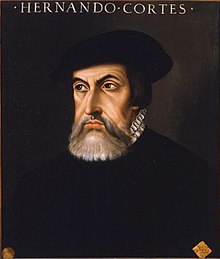
The Spanish had vitis vinifera vines in their possession, however, and began planning for their deployment. On March 20, 1524, Hernan Cortes, conqueror of the Aztecs and Governor of New Spain, ordered each lieutenant to plant the equivalent of 1000 feet of vines for every 100 slaves they possessed.

Hernan Cortes

This order fueled a significant expansion of the vineyards around Mexico City in the areas of Tacubaya, Puebla, and Hidalgo. Vines were cultivated immediately by the priests who needed wine for the celebration of Mass. According to one source, "They were the ones who transformed inhospitable deserts into areas of cultivation and wine-growing." The Jesuits and Franciscans consolidated the grape varieties planted by other friars and named it the "mission grape." 

The expansion of wine production continued with vines being planted northwards from Mexico City to Querétaro, Guanajuàlo, and San Luis Potosi. Vines were very successful in Parras Valley and, subsequently, Baja California, Sonora and the Puebla vineyards Tehuacan and Huejotzingo.

Parras Valley is the largest and oldest grape-growing region in Mexico. Wild vines were found in the valley by priests and settlers exploring the area in 1549 and they founded a mission there, naming it Santa Maria de Las Parras (Parras translating to vines). The mission made wines from the wild grapes and were soon shipping wines and brandies from this region to other parts of New Spain. Mission grapes also did well here and cuttings eventually made their way north to the formative Napa Valley. The Marqués de Aguayo winery was founded in Parras Valley in 1593. The winery officially ceased business in 1989.

As the Mexican wine industry flourished, less wine was imported from Spain, a distressing state of affairs for Spanish producers. They petitioned the King (Philip III) and he issued an edict in 1595 banning the production of wine and the planting of new grape vines anywhere in New Spain. In spite of the ban, he issued commercial rights to Don Lorenzo Garcia allowing the production of wine and brandy. Don Lorenzo founded the Hacienda de San Lorenzo winery in Valle de Parras in 1597 to exploit his license. The winery is still in operation today under the name Casa Madero.

Winemaking continued to flourish in New Spain prompting Charles II to issue an edict in 1699 banning the production of wine in New Spain except for sacramental purposes. This religious exception allowed a Jesuit priest to plant the first vines in Baja California at the Loretto Mission. In 1791, Jesuit Priests attempted to revitalize large scale production at the Santo Tomas Mission in Baja California. In 1843, Dominican Priests planted grapes at a mission in today's Valle de Guadalupe. The Mexican Reform War of the 1850s called for many of these lands to be returned to the state. The Santa Tomas Mission was sold to a group of investors and became Mexico's first commercial winery -- Bodegas Santo Tomas.

Colombia
Jesuit missionaries brought vines into Colombia from Mexico in 1530 and succeeded in crafting some wines but were forced to discontinue production after the 1595 ban by Philip III.

Peru
The first vines were planted in the heights of Chile in the 1540s but farming them was laborious so they were moved downhill towards the coast in the vicinity of Ica. The original vines were planted to suport the Catholic mass but the locals began enjoying the wine out of church as well. The wine became so well known that it was exported to Bolivia to fuel the entertainment needs of Potosi, the then "Paris of South America."

The Spanish ban on local wines caused some producers to bargain with the Crown to produce a local aguardente -- the birth of Pisco -- while others switched crops, and the remainder continued quietly producing wine.

Chile
The first grapevines were brought to Chile in 1548 by Francesco de Carabantes, a Spanish Friar. The first Chilean grower was Francisco de Aguirre, who delivered his first harvest in 1551. Other sources credit Rodrigo de Araya who was cultivating grapes in the Chilean Central Valley at the same time. Pretty soon vitis vinifera was cultivated along the length and breadth of Central Chile and Spanish-sourced varieties dominated the Chilean wine scene until disrupted by French varieties beginning in 1851.

Bolivia
Grapevines were first planted in Bolivia by Spanish missionaries in the 1560s but the tropical climate proved inhospitable to vitis vinifera.

Argentina
The first cuttings planted in Argentina were brought in from the Chilean Central Valley in 1556 by one Father Cedrón. The first small plantings occurred in San Juan and Mendoza but by the end of the 16th century vineyards could be found in every settled region. 

Growers gravitated to the Cuyo region over the first 200 years due to its high altitude, favorable climate, and plentitude of water. A total of 120 vineyards were located in Mendoza by 1739.

Grape Varieties
During the first 100 years of viticulture in the above discussed regions, missionaries brought over a number of grape varieties either in the form of seeds or sticks. The white varieties included Muscat of Alexandria, Mollar, and Palomino while the red was Listán Prieto. The Listán Prieto was the most significant planting and is sometimes referred to as the mother grape of the Americas.

Listán Prieto is native to the Castille region in Spain and was brought to the Canary Islands where it flourished. There are very limited plantings of this variety in Castille today with some supposition that it was wiped out by Phylloxera.

When brought to the Americas, the variety was generically called Criolle but had different names depending on location: Mission in Mexico, Negra Criolla in Peru, Pais in Chile, Missionera in Bolivia, and Criolla Chico in Argentina. This variety represented over 90% of the plantings in Argentina and Chile in 1833.

With the passage of time, crossings of these founding varieties occurred with Torrontés in Argentina being the most significant. There are three different Torrontés varieties: Torrontés Riojano, Torrontés Sanjuanino, and Torrontés Mendocino. Some 150 native criolla varieties have been identified to date.


©Wine -- Mise en abyme