Sunday, July 23, 2023

The Muscat wines of Samos, Greece

The Muscat grape is one of the oldest and most widespread grape families in the world, splitting, as it did, from the main branch of vitis vinifera some 10,500 years ago. The, predominantly, white wine has a pronounced aromatic quality due to the higher-than-average presence of aroma compounds in the berry. The most planted of the over 200 cultivars in the family are Muscat Blanc á Petits Grains and Muscat of Alexandria and my survey of these cultivars began with a review of the former as implemented in the wines of Asti DOCG. In this post I continue the survey with a review of the Muscat wines of Samos, Greece.

Lying just 1 mile off the western coast of Turkey, the Greek North Aegean island of Samos shows occupation layers back to Neolithic times, has been ruled by every historical Western Asia great power, and is, today, one of the world renowned producers of wines from the Muscat grape.


Samos is the birthplace of notables such as Pythagoras (Greek philosopher and mathematician) Melissus of Samos (philosopher), Epicurus (philosopher), and Aristarchus of Samos (astronomer) and is the location of historically significant sites such as the Pythagorian and the Heraion of Samos. 

While the wines of Samos have been praised by Hippocrates and Theophiastos, it is unlikely that the mentioned wines were from the Muscat variety. The island was repopulated with peoples from all across Greece in the latter half of the 16th century and, according to samosin.gr (Viniculture at Samos), it is most likely that the Muscat grape was first brought to the island from Asia Minor around this time. According to the same source, the Muscat wine of Samos was first mentioned in the poem of Kaisarios Daponte (1714 - 1784) a priest and scholar from Skopelos.

History
In the early 18th century, Samos Muscat was traded to nearby Chios, Rhodes, Smyrna, and Constantinople. By mid-century it had reached the Russian market in Odessa and Taganrog. There is mention of a 3000-barrel Muscat wine production on the island in 1787 by a German named Friesman.

There was a decrease in production during the 1821 War of Independence but, overall, there were improvements in wine production and consumption during the 19th century. The French winemaker Faye was called to the island by the Government to teach advanced grapegrowing and winemaking techniques to Samian farmers. Shortly after, a young Samian was sent to France to learn winemaking techniques which he was expected to share with fellow winemakers upon his return.

During this period trade links expanded into the Ottoman Empire, Egypt, Italy, Netherlands, and France and foreign companies settled on the island to be close to the grape sources.

There were significant vineyard losses during the latter half of the 19th century:
  • Blight during the 1850s was ameliorated by the use of sulfur
  • Phylloxera struck in 1892 and destroyed most of the vineyards, leading to a switch to tobacco
    • Vineyards were restored with the introduction of American rootstocks.
The foreign companies that were established on the island had pricing power over the many small growers so formation of some type of Coop had been under consideration since 1865. However, such a Coop was not founded until 1934. The now named United Winemaking Agricultural Cooperative of Samos (UWC Samos) has 2000+ growers as members. UWC Samos receives the grapes, produces the wine, and trades almost the entire production.

Physical Environment
Samos is 45 km (30 miles) from east to west, with several distinct mountain formations running across it. The mountains are separated by plains and valleys, the former of which is populated by olive groves and citrus trees. Bushes, pine forests, plane trees, cypresses, and chestnuts round out the large-scale flora on the island.

The soils are gravel, schistolistic, well-drained and moderately fertile. No irrigation is allowed. 


There are over 1400 ha of vineyards distributed across the island, with most found on the north side between Karlovasi and the city of Samos, especially on the northern slopes of the centrally located Mount Ampelos where:
  • Vines are protected from warm southerly winds
  • Altitudes of up to 900 m temper the warm Mediterranean climate
  • High diurnal temperature is the norm
    • Slows ripening
    • Aids development of aroma and character
    • Allows acidity retention.
Ninety-eight percent of the vines are Muscat. Vineyards are mountainous and semi-mountainous with the best wines coming from sites located at altitudes between 500 and 600 m. The cup-shaped vines are grown on dry stone terraces which are designed to hold and drain soils. The traditional vineyard architecture is illustrated in the pictures below.

Terraced Samos vineyard (Source: samoswine.gr)

Close-up of Samos stone terraces
(Source: samoswine.gr)

Training of Samos Muscat vines
(Source: samoswine.gr)

Samos Wines
The sweet rich wines from Muscat Blanc á Petits Grains are among Greece's most famous, exported as they are around the world. These wines are produced centrally in the two UWC Samos wineries located in Malagari and Karlovasi, respectively. Karlovasi produces wine from grapes grown in the northern part of the island while the Malagari winery services the grapes grown elsewhere. The Malagari site also serves as the home of the Samos Wine Museum.

UWC of Samos produces around 5 million liters of wine annually with 70% of the production exported to 25 countries. Ninety-eight percent of the wine produced is white with the remainder reds from varieties including Ritino, Fakiano, and Avgoustiatis. The sweet wines produced by the Coop are illustrated in the chart below.


The Coop does produce some dry wines (e.g., Samaina, a dry Rosé from two rare reds, and a Retsina) but they are less prominent.

Trends
Writing on Giannis Karakasis MW's Greek Wine Explained (10/28/20), Evangelie Kostaki noted a few key trends as regards Samos wine:
  • Between 2012 and 2020, a number of new wineries had "popped up" and the newer ones were run by "young people"
  • Creation of new wine styles
    • Single-vineyard wines versus cross-island wines
      • Muscat Nature Selection
    • Dry wines
      • Samos embracing the potential of producing quality dry wines from Muscat Blanc á Petits Grains
  • Vineyard changes
    • Uproot vineyards in the plains
      • Close to the sea
      • Diseases tend to flourish due to high humidity
      • Heavy, fertile soil with high water-holding capacity not ideal for highest quality wines
    • Plantings sporadically increasing in semi-mountainous areas
      • Better aeration
      • Large diurnal range
      • Sufficient ripening.

©Wine -- Mise en abyme

Thursday, July 20, 2023

Fonterenza (Sant'Angelo in Colle, Montalcino, Tuscany): Wines and winemaking

Fonterenza is located in Sant’Antimo in Colle, southeast of the town of Montalcino, where they planted their first vines in 1999. In addition to the vines on Montalcino, the sisters have been purchasing grapes from old vineyards on Mt Amiata and recently invested in their own vineyard on the mountain. In my most recent post I discussed the physical environment of the Fonterenza estate. In this post I round out the picture of the enterprise by describing its winemaking practices and wines.

Fonterenza produces eight wines (shown below): three whites, one Rosato, and four reds.


White Wines
All of the Fonterenza white wines are made with some degree of skin contact and all are IGT. The Bianco IGT is a blend of Ansonica, Trebbiano, Malvasia Toscana, and Malvasia di Candia sourced from a vineyard -- La Casa -- located in Capalbio on the Tuscan coast. The organically farmed, 60-year-old vines are co-planted in sandy, iron-rich soils. The first vintage of this wine was in 2018.

The Le Ragazze is a 50/50 blend of Vermentino and Malvasia Toscana made from organically farmed Mt Amiata grapes.

Biancospino is a Trebbiano varietal made with biodynamic fruit grown in the Casale Vineyard in Poggibonsi. Future plans call for the fruit to be sourced from the Ciliegi Vineyard on Mt Amiata.

Grapes for the white wines are hand-harvested, destemmed (partially, in the case of the Bianco), and gently pressed. The must is fermented spontaneously in stainless steel tanks (Bianco and Biancospino) and open vats (Le Ragazze) with no sulfur added. In the case of the Bianco, the must is a mix of whole cluster and destemmed fruit. The Bianco is macerated for 2 - 6 days and the Le Ragazze and Biancospino for 30 days each.

The aging regime for the wines are as follows:
  • Bianco -- mix of old oak and cement
  • Le Ragazze -- mix of tonneau, acacia barriques, terracotta, and steel tanks
  • Biancospino -- 12 months in old oak.
The wines are all bottled without filtration.

Rosato
The Rosato is made from Sangiovese grapes sourced fro each of the estate's Montalcino vineyards. The wine is fermented by indigenous yeasts and remains on the skins for 20 hours. The wine is aged for 7 months in acacia barriques.

Red Wines
The red wines are all 100% Sangiovese (with the exception of Pettirosso, a blend of Sangiovese and Ciliegiolo) made with grapes sourced from the estate's Montalcino vineyards (except Pettirosso, the sourcing of which is illustrated in the chart below).


The Albarello grapes contributed to the Rosso di Montalcino until the decision was made to begin bottling the wine separately beginning in 2015.

The grapes for all of the Montalcino-based red wines are hand-harvested, with the Brunello di Montalcino taken in multiple passes. Once in the cellar, the grapes are destemmed and fermentation is initiated. The grapes are fermented spontaneously without temperature control, oenological products, or chemical/physical treatments. A variety of cap management techniques -- to include pumping over, delestage, manual punch downs, and submerged cap -- are employed. The grapes from the various Rosso di Montalcino vineyards are vinified separately but blended prior to aging. 

The fermentation and aging regimes are summarized below.


**********************************************************************************************************
The estate avers that its winemaking approach "preserves the characteristics of the vintage and express our terroir to the fullest." 

The diverse range of wines showcase the estate's versatility and dedication to expressing the unique characteristic of each variety and vineyard. From the skin-contact for the whites, to the lack of additives during the fermentation process, the estate demonstrates its commitment to minimal intervention to natural processes and minimal intervention

©Wine -- Mise en abyme

Sunday, July 16, 2023

Is Fonterenza Tuscany's best kept secret?

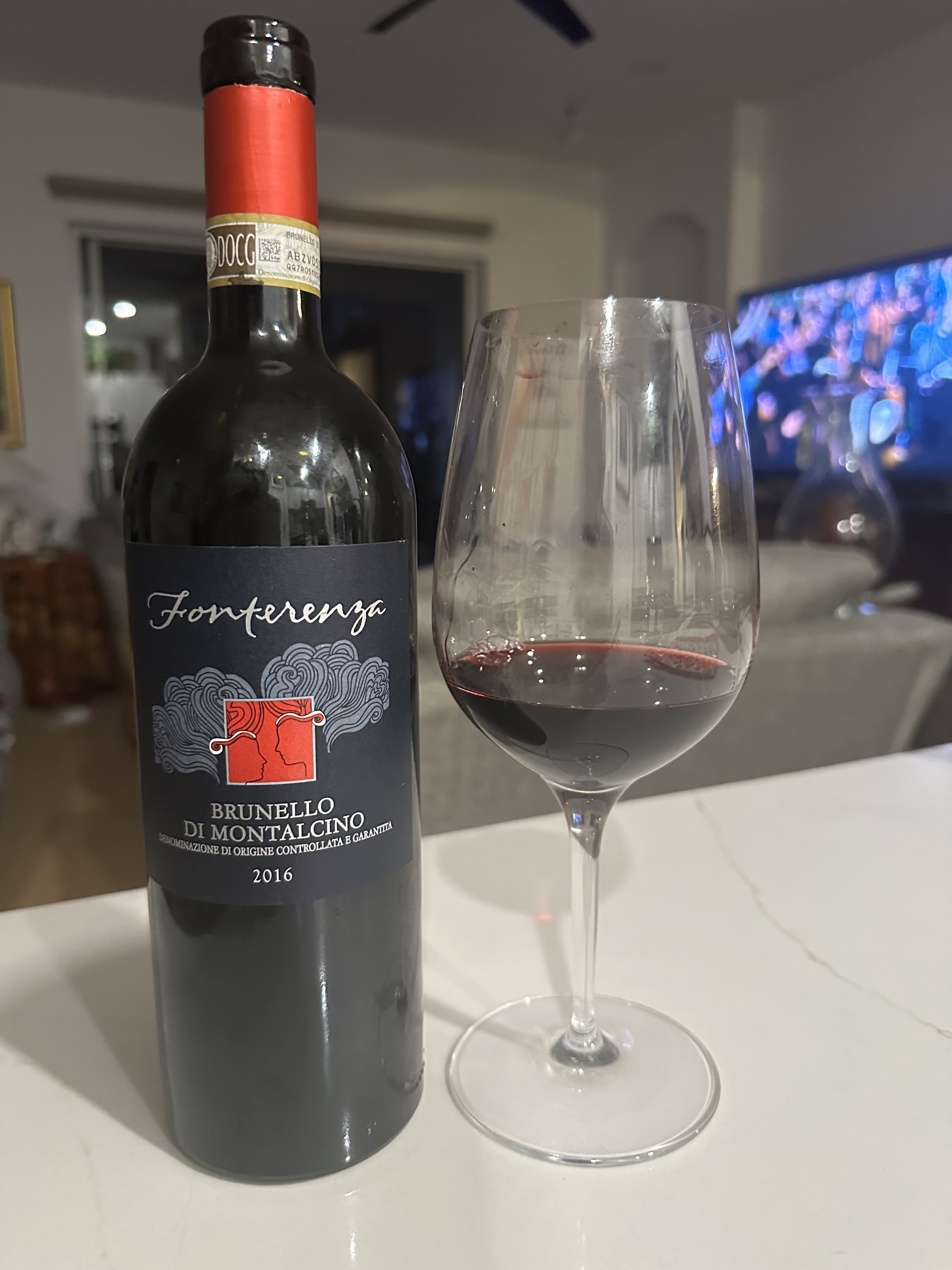
I love both the story and the wines of Montalcino so whenever I get a recommendation of a must-try Brunello, I jump at it. Such was the case for the 2016 Fonterenza Brunello di Montalcino and I share my learnings about this wine in this post.

Fonterenza was founded in 1997 by Margherita Padovani and she was joined shortly thereafter by her twin sister Francesca. Neither of the sisters had any grape-growing or winemaking experience but the family owned property in Poggio San Polo, southeast of the town of Montalcino, and they planted their first vines here in 1999. In addition to the vines on Montalcino, the sisters have been purchasing grapes from old vineyards on Mt Amiata and recently invested in their own vineyard on the mountain. The chart below shows the properties from which the sisters source the grapes for their wines.


The Montalcino vineyards are located at elevations ranging between 420 and 450 m and are situated at the meeting point of the sea winds coming from the southwest and the cool currents from the north and northeast. The vines are protected from inclement weather by a combination of Mt Amiata and the forest surrounding the vineyard.

Early on in the process the sisters decided to pursue a minimal-intervention approach in their winemaking venture. That is represented in the vineyard by a biodynamic certification. All work in the vineyard is done by hand and diseases are treated with low doses of copper and sulfur and biodynamic solutions.

On the winemaking front, grapes are de-stemmed and vinified separately, depending on the source vineyard and intended wine type. Wines are fermented spontaneously in oak vats, 10-year-old tubs, or concrete tanks with no additives. Aging is conducted in large oak vats, oak barrels or cement tanks,

I tasted the 2016 edition of the winery's Brunello di Montalcino. This wine was introduced to me by one of my retailers who described the estate as "perhaps Tuscany's best kept secret."

The source vineyard for the wine is shown in the chart above. This wine was macerated for 20 - 30 days and was aged for 47 months in 20- to 50-hl vats. 


The wine was superb. A highly perfumed nose with ripe dark fruit, sage, underbrush, an intense and persistent beeswax, and pepper spice on the nose. It flowed beautifully over the palate. Balanced, with a rust character and a slatey minerality. Medium weight with a metallic finish which evolves to a dried tamarind over time. A beaut.
*********************************************************************************************************
I will cover the wines and winemaking of the estate in a subsequent post.


©Wine -- Mise en abyme

Wednesday, July 5, 2023

Grapevine diversification in Europe after the Western Asia domestication event

At this point, we know that there were two simultaneous domestications of vitis sylvestris approximately 11,000 years ago. We also know, based on the Dong, et al., study, that the Caucasian domesticate was not the mother of all European grapevines, being, instead, "a local effort confined to both sides of the Caucasian Mountains." We also know that the Syl-W ecotype of vitis sylvestris occupied ecological niches in Europe proper. 

Give the foregoing,  Dong, et al., needed to explore: (i) the diversification history of European wine grapevines and (ii) "when and how distinct grapevine ancestors formed in Europe with relevance to Syl-W introgressions." In this post I highlight the methodologies utilized to answer those questions and present the results.

The chart below illustrates the methodologies employed and selected results obtained.


The first observation coming out of the TreeMix analysis is evidence of a Syl-W introgression earlier than the occurrence of the Muscat split. The fingerprint of this introgression is present in all further splits. The study team screened the introgression tracts in CG3 to CG6 and found that 10 shared regions among these groups "contain genes that are involved in plant immunity, abiotic stress response and carbohydrate metabolism." This supports the position, according to the authors, that "introgression helps grapevines adapt to new environments and become more suitable for winemaking."

The Muscat split occurred within 500 years of the domestication event, suggesting that it took place within the confines of Western Asia. This split supported grapes for both consumption and winemaking. The modern-day characteristics of selected elements of the Muscat family are illustrated in the chart below.


Post the Muscat split, "... unique ancestries emerged in the Balkans, Iberia, and Western Europe with the help of V. sylvestris introgressions into CG1."

***********************************************************************************************************
How did the cultivars identified above make their way to Europe? I will answer that question in the next installment in this series.

©Wine -- Mise en abyme

Saturday, June 24, 2023

The Natufians: The culture most likely to have domesticated vitis sylvestris

Given the location (The Levant) and timing (11,000 years ago) espoused in the Dong, et al., study, it is most likely the Natufian Culture that domesticated the progenitor of the major European wine grape varieties.


Prior to Dong, et al., the commonly held belief was that vitis vinifera sprung from a Neolithic Age, Caucasus-region domestication of the wild vitis sylvestris. The Dong, et al., genetic study has shown otherwise.

In previous posts I have reported on the genesis of the study, the vitis sylvestris story, how Dong, et al., established genetic populations, the study team’s case for two simultaneous domestication events, the genetic traits associated with the individual domestication centers, the Levant as the domestication center from which all European grapes originated, and the physical environment in the Levant at the time of the domestication. In this post I highlight the Culture (most likely) responsible for domesticating the Levantine vitis sylvestris.

Kebaran Culture
Since 14,500 BP, people have occupied every eco-zone in the Near East and semi-sedentism was already a settlement pattern among foragers (Bar-Yosef). The inhabitants of the Levant at this stage were of the Kebaran culture and excavations at the Ohalo II site illustrates the settlement-pattern point while also providing the earliest evidence of grape usage within the region.

In the Fall of 1989, the Sea of Galilee dropped to unusually low levels, revealing a submerged prehistoric site several meters away from the shore. The site -- Ohalo II -- included scattered artifacts and remains of huts, hearths, and graves with in-situ Kebaran remains (Kislev, et al.).

Figure 1. Ohalo II site at shoreline of Sea of Galilee
(Source: Kislev, et al.)

Table 1. Materials excavated from Ohalo II.

Tools

Animal Remains

Vegetal Remains

Typical flint tools

Fish 

Wild barley (most prevalent

Bone tools

Tortoise

Wild emmer wheat

Mediterranean shell beads

Birds

Wild almonds


Hare

Wild olive


Fox

Wild pistachio


Gazelle

Wild grape seeds


Deer


A picture of one of the excavated grape pips is shown below. These seeds were identified as belonging to the wild type by the low length/breadth ratio and the short beak. This is the first evidence of wild grapes in Israel.

Figure 2. Grape pip excavated at 
Ohalo II (Source: Kislev, et al.)

According to Kislev, et al., the food remains at Ohalo II "indicate a wide range of plant and animal species used for human consumption. This diversity attests to the broad spectrum economy practiced by the Kebarans."

The team deduced that the site was occupied at least twice a year and assumed an alignment with grass-grain harvesting in Spring and fruit gathering in the late Summer and Fall. The authors characterize thia as a "logistical mobility settlement-subsistence pattern" where "small task-specific expeditions are sent to retrieve food and other resources while the core group remains at one place." The bi-seasonality of plant food use in the same site "can be interpreted as the initial steps towards sedentism and cereal agriculture."

The Kebaran culture (20,000 - 14,500 BP) was, due to the overarching cold, limited to the coastal Levant and isolated oases. The Geometric Kebaran took advantage of climate amelioration to expand into the formerly desertic belt which had become "a lusher steppe" (Bar-Yosef).

Natufian Culture
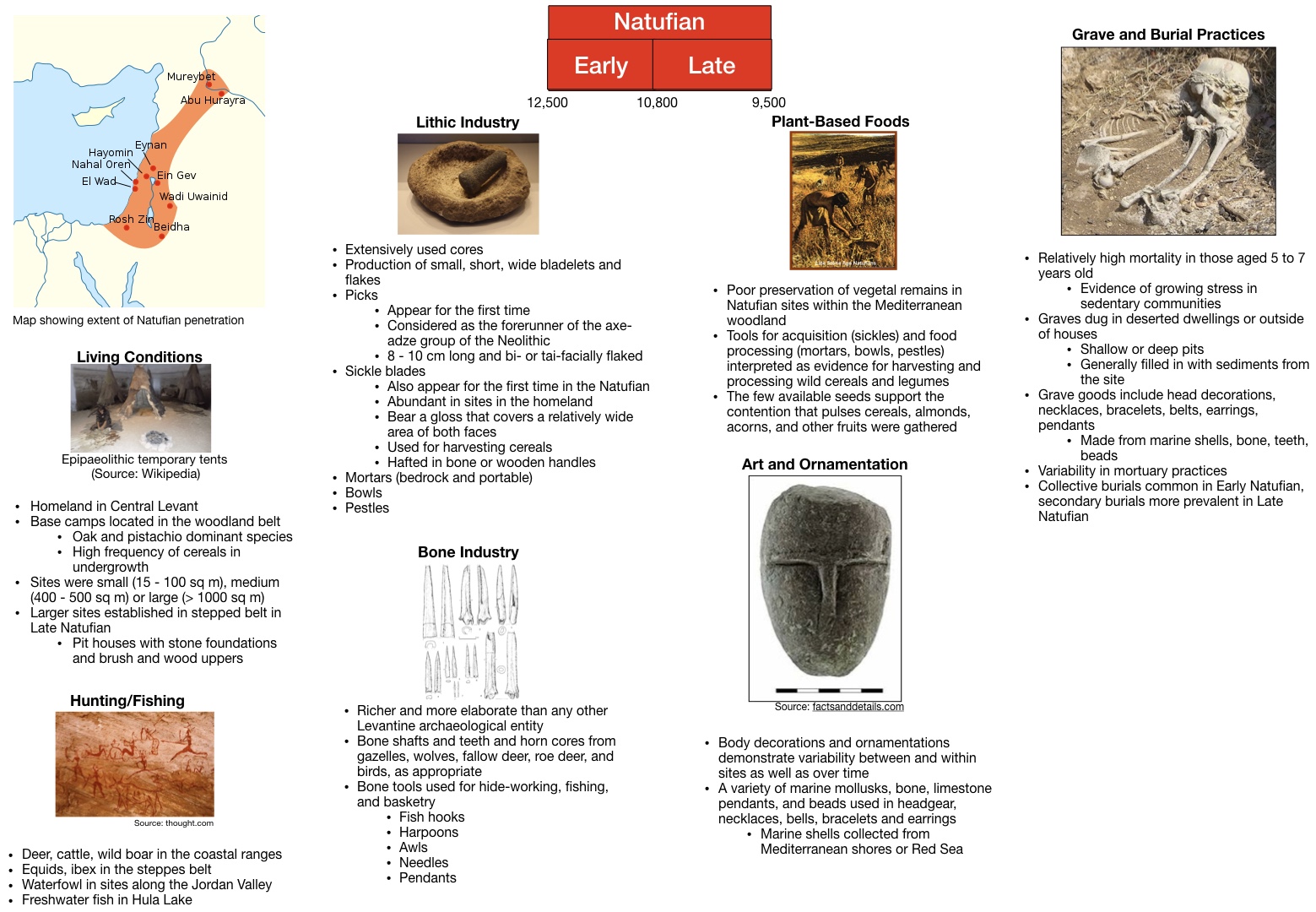
The Levant was subjected to an abrupt, short, cold crisis around 13,000 BP followed by a period of increased precipitation and warming. This improvement in climate led to an expansion in parkland and woodland and associated food resources. It was in this environment that the Natufian Culture began to gain prominence. Arriving on the scene initially as foragers, the continually improving climate led them to become sedentary -- due to plentitude of food resources -- and establish "a series of Early Natufian hamlets in a delineated homeland." The major characteristics of the Natufian Culture are illustrated in the chart below.


As much of a boon that climate was to the Early Natufian culture, it was a bane in later days. The boon? "Natufian communities practiced intensive and extensive harvesting of wild cereals as part of an anticipated summer mobility pattern." The bane? The cold, dry climate associated with the Younger Dryas (12,800 BP - 11,600 BP) led to a rapid reduction in the size of the lushest vegetation belts and reduction in yields of natural stands of C3 plants such as cereals. This change in conditions  led to changes in organizational strategies to include: reduced sedentism; shifts in settlement locations (abandonment of old sites and establishment of new sites in the steppic zone); experimental plantings; and clearing of patches of land. During this period plant and animal resources were further depleted by the activities of neighboring foragers.

According to Bar-Yosef, the increased population levels that had come with increased sedentism "made any short-term climatic change motivational for human groups to gain control over food resources." Thus, "the first experiments in systematic cultivation most likely occurred during the Younger Dryas."

Keynes was not as supportive of the theory of the Natufians as the first agriculturists: "The older theory on the origins of agriculture that had become a consensus by the late 1980s held that the pressures of the Younger Dryas drove the Natufians to adopt agriculture as a survival strategy ... By the early 2010s, this hypothesis has been rejected by some archaeologists and historians, who see the Natufians of the Younger Dryas as in a transitional stage that was only moving towards agriculture, ... in which they experimented with wild plant cultivation."

It should be pointed out that much of the foregoing discussion is based on domestication of wheat, legumes, etc., and does not involve grapevines. As a matter of fact, while we have evidence of grape consumption in the Kebaran culture, no grape residue has been recovered from any of the excavated Natufian sites in the Mediterranean due to the poor preservation of vegetal remains in the terra rossa soil.

Whether or not the Natufians were the first agriculturists, or just experimenters, the genetic study conducted by Dong, et al., places the domestication of the grapevine squarely within their space-time; and we will run with that.

Post-Younger-Dryas
There was  rapid return of wetter weather post the Younger Dryas and this led to the expansion of numerous lakes and ponds and cultivation of annual crops along the shorelines. The first large villages began to appear (up to 2.5 ha) and they relied on cultivated barley and wheat or "their wild progenitors." According to Bar-Yosef, there is ample evidence to show that the inhabitants of these villages were descendants of local Natufian populations with changes in material culture, social organization, and daily lifeways. "The first manifestation of the cultural change that heralded the Neolithic Revolution is known in the Levant as the Khiamian."

Neolithic farming communities thrived under the favorable climate conditions of the Early Holocene and expanded "along the Levantine Corridor into Anatolia and neighboring regions." This, then, was the first movement of the cultivated grapevine outside of its birthplace. 

The initial movement of the cultivated grapevine
 from the Western Distribution Center (black oval)
into Anatolia (red arrow) with the expanding
Neolithic farming communities.

I will  cover that movement more fully in subsequent posts.

Bibliography
Bar-Yosef, O., The Natufian Culture in the Levant, Threshold to the Origins of Agriculture, Evolutionary Anthropology.
Bar-Yosef, O., and F. Valla, The Natufian Culture and the Origin of the Neolithic in the Levant. Current Anthropology 31(4) January.
Dong, et al., Dual domestications and origin of traits in grapevine evolution, Science, 3/3/23
EurekAlert, Human Mobility and Western Asia's early state-level societies, Max Planck Institute of Geoanthropology, 5/28/20.M. E> Kislev, D. Nadel and I. Carmi, Epipalaeolithic (19,000 BP) cereal and fruit diet at Ohalo II, Sea of Galilee, Israel. Review of Palaeobotant and Palynology, 73 (1992): 161 - 166.
Lord Keynes, The Natufians and the Origins of Agriculture in the ancient Near East, heterodox.economicblogs.org, July 31, 2017.


©Wine -- Mise en abyme

Saturday, June 10, 2023

The domestication of vitis vinifera: The physical environment

According to Dong, et al., two variants of the wild grape vitis sylvestris were simultaneously domesticated in the Caucasus and Western Asia resulting in two variants of vitis vinifera. The Caucasus-sourced vitis vinifera flourished on both sides of the Caucasus Mountains, and even extended into the Carpathian Basin, but had no impact beyond this limited geographical area. The Western Asia domesticate, by a process of elimination, must be the source variety for the bulk of the world's wine grapes. I will explore the environment wherein this variety was domesticated as well as the people who most likely brought sylvestris to heel. I examine the physical environment in this post.

Vitis sylvestris was domesticated in the early part of the Holocene. The physical environment in Western Asia during this time period is illustrated in the chart below.


Dong, et al., did not specify the location of the domestication center within Western Asia but an eyeballing of their placement of the center on the map would seem to place it within the confines of the region called The Levant. The coverage of the Levant is illustrated in the rightmost map below and the blue arrow illustrates the relationship between that region and the Western Asia Domestication Center.


According to Bar-Yosef and Valla, "lines of evidence demonstrate that cold, wet conditions" dominated in The Levant in the late Pleistocene. This was followed by a dry spell in the transition period and a steady increase in arboreal pollen. An increase in humidity is observed for the in the Early Holocene "in the Middle Euphrates Valley in Northern Syria and from the Lower Jordan Valley" (Bar-Yosef and Valla). The paleoclimatic record shows the following (Bar-Yosef):
  • Late Glacial Maximum (20,000 - 14,500 B.P.)
    • Entire region cold and dry
    • Hilly coastal areas enjoyed winter precipitation and were covered by forests
  • 14,500 - 12,800 B.P.
    • Precipitation slowly increased over the entire region beginning at 14,5000
    • More rapid increase from 13,500 B.P. to 13,000
    • Rate peaked around 13,500 in the southern Levant
  • Younger Dryas (12,800 - 11,600 B.P.)
    • Rate of rainfall decreased
  • 11,300 B.P.
    • Increased rainfall returns
      • Very wet early Holocene in the northern Levant and Anatolia
      • Did not reach the previous peak in central and southern Levant
  • Gradual rise in sea level
    • Post the Late Glacial Maximum and until the mid-Holocene
    • Reduced the flat, sandy coastal plain of the Levant by a stretch 5 - 20 km wide and 500 km long.
During the Holocene, The Levant was characterized by a variety of landscapes running between the southern flanks of the Taurus Mountains of Turkey and the Sinai Peninsula:
  • Narrow coastal plains
  • Two parallel continuous mountain ranges with a rift valley in between
  • An eastward-sloping plateau dissected by many eastward-running ravines.
There was marked seasonality, with cold, rainy winters and hot, dry summers being the norm. Two annual patterns of winter storm tracks were observed:
  1. Humidity from the Mediterranean flowed to the southern Levant
  2. Storms arrive from northern Europe and turn to the northern Levant.
There were three vegetational zones (Bar-Yosef):
  • Where annual precipitation exceeded 400 mm/year, Mediterranean woodland and open parkland 
    • Oak-dominated parkland and woodland provided the"highest biomass of food available to humans." Dense oak forests (> 800 mm/year rainfall) maintain a lower biomass than the open parklands
  • Where precipitation was < 400 mm/year, shrub land and steppic vegetation 
  • Arid-type vegetation.

Effect of the Physical Environment on Vitis Sylvestris/Vitis Vinifera
Environmental conditions have marked effects on grape development today and it is quite likely that grapes reacted similarly in times past. It is likely that vitis sylvestris exhibited different characteristics in the cold of the Pleistocene than did vitis vinifera in the warming period of the Early Holocene. As a matter of fact, the last glacial cycle (115,000 - 11,700 years ago) was the scene of one of the most severe vitis sylvestris bottlenecks, driving worldwide population down to between 10,000 and 40,000 vines.

The warming period began with the retreat of the glaciers and the changes in the physical environment highlighted in map 1 above. Just the mere fact of the warming would have positive effects on the grapevine and its product. Warmer temperatures would lead to riper, more palatable grapes (Remember that grapes in this early period were used as a food source as opposed to a beverage.). This riper, more palatable fruit would stand in stark contrast to the potentially harder, greener product that would have been the norm in the colder, drier Pleistocene.

Increased humidity would have led to more vigorous vines and plumper fruit. Grapes would not only be more palatable, they would also be more substantial.

The forest expansion that resulted from the warming would have also been beneficial to vitis vinifera. The grapevine is a climber and more trees represented more growth/spread opportunities for the population. 

*********************************************************************************************************

In my next post I will explore the culture that most likely domesticated the grapevine.

Bibliography
Bar-Yosef, O., The Natufian Culture in the Levant, Threshold to the Origins of Agriculture, Evolutionary Anthropology.
Bar-Yosef, O., and F. Valla, The Natufian Culture and the Origin of the Neolithic in the Levant. Current Anthropology 31(4) January.
humanpast.net, Food around 11,000 BC.

©Wine -- Mise en abyme

Monday, June 5, 2023

Georgia is not the source of all European wine grape varieties; the Levant is

The commonly held belief was that the wild grapevine vitis sylvestris was domesticated at a single point and spread to the rest of the world therefrom. Researchers have named the single-domestication-point hypothesis the "Noah Hypothesis." The hypothesis is illustrated in the chart below where domestication candidate sites are identified and the onward distribution routes of vitis vinifera plotted.


The Dong, et al., study refutes the origin component of the Noah Hypothesis and replaces it with a dual, simultaneous-domestication model.


I now turn to the distribution aspect of the Noah Hypothesis. While the Dong, et al., study does provide for a domestication center in the Caucasus, the result was "... mainly confined to both sides of the Caucasus Mountains, with a limited dispersal into the Carpathian Basin by the northern Black Sea." According to the authors, "... CG2 (ed. The Caucasian domesticate) represents a local domestication effort that had a minor impact on grapevine domestication." The distribution path of CG2 is illustrated in the map below.

Red oval approximates the Caucasus distribution center;
black arrow illustrates the range of the grapevine.

If we take the Dong, et al., argument at face value, the mother of all grapevines originated in the Levant, the Western Asia Domestication Center illustrated above. I will delve further into the region and its inhabitants in upcoming posts. In future posts I will also trace the spread of grapevines ouward from this source point.

©Wine -- Mise en abyme