Monday, April 24, 2023

ChatGPT on the comments on the Kerin O’Keefe article on decanting

I recently posted a Kerin O’Keefe article on wine decanting to my personal Facebook page as well as to the Barolo and Barbaresco Facebook group page. The article elicited strong responses and I thought it would be beneficial to capture them in a blog post for wider sharing.

At the completion of the data collation effort I decided to feed the material to ChatGPT to see how it would handle such a task.

Source: medium.com

I first asked it to summarize the Kerin O’Keefe article and the below was its work product. The prompt for summarization is TLDR followed by the web address of the target article.

Kerin O'Keefe, an experienced wine writer, advises wine enthusiasts to never decant older wines. Decanting can expose the wine to too much oxygen, which can diminish its flavors and aromas. Instead, O'Keefe suggests that you should open the bottle carefully and let the wine breathe naturally in the glass. If you need to remove any sediment, use a fine-mesh sieve or a decanting funnel with a filter. Overall, the goal is to preserve the wine's delicate nuances and characteristics.

Pretty good, I thought. I next prompted it to “Review and categorize the comments and write an article discussing the major items while highlighting the most impactful contributions. The below was its work product. 

The comments above highlight different perspectives on the decanting of wines. Some believe that decanting an old wine, especially a Barolo or Nebbiolo, may cause it to lose its aroma and flavor, while others argue that decanting a wine, young or old, can help improve its taste. Some say decanting depends on the producer, variety, age, and even weather conditions during the vintage. Some decant all young red wine, and others, most "older" red wine, but don't decant very old wine, red or white, unless it's not expressing its varietal character out of the bottle.

Interestingly, most of the comments suggest that decanting depends on the drinker's personal preference and experience. Jamie Pettigrew commented that wine preparation is just another "opinion," while Scott Walker advised letting the wine dictate what to do. Brad Smith said that it's a function of the wine's variety, age, and that specific bottle. Manuel Somohano suggested that decanting an old wine is to drink it right away, while Ken Vastola shared his experience of drinking a lot of old Nebbiolo that improved after decanting.

The most impactful contributions in these comments are that there are no hard and fast rules when it comes to decanting wine. Every drinker has their own preferences, and it's essential to consider the wine's variety, age, and condition. Some wines may need decanting, while others don't, depending on how they express themselves in the bottle. It is, therefore, best to experiment with different decanting techniques or none at all and let the wine be the guide. As a drinker, you can also learn from your past experiences with a specific wine estate or producer to determine if decanting is necessary or not.

In conclusion, the comments above reveal a broad spectrum of perspectives on the decanting of wine. However, there is a consensus that decanting depends on personal preference, wine variety, age, and condition. Ultimately, the best way to find out what works for a specific wine is to experiment and trust your palate.

First, when I initially considered writing the article, I had grouped the comments according to those who agreed with Kerin, disagreed with her, fence-sitters, philosophers, etc. There was no such clear delineation in the package. Also, there were, in my opinion, impactful contributions from Manuel Burgï (again and again) and Rico Thompson but they were not called out by the bot. That being said, I thought this was a passable capturing of the themes of the comments.

©Wine -- Mise en abyme

Saturday, April 22, 2023

Upending the story of ancient grapes: Genesis of the effort

A recently published grapevine genetic study (Y. Dong, et al., Dual domestications and origin of traits in grapevine evolution, Science 379 (6635), pp. 892 - 900, 3/3/23) "has upended the history of how humans first domesticated grapes for winemaking ..." (Melanie Lidman, It's in the DNA, Times of Israel, 3/25/23). That history had been widely accepted among wine- and grape-history researchers and had served as the jumping-off point for all of the ancient wine reporting of this blog (I have, to date, covered Armenia (wine history and winemaking), Iran, and Lebanon (the Phoenicians and Renaissance interruptus).).

The core elements of this now-discounted history was that the wine grape Vitis vinifera split from its wild progenitor Vitis sylvestris as a result of a single-point domestication event which occurred 8000 years ago somewhere in the Caucasus. From that point the domesticated cultivar spread through ancient Middle Eastern kingdoms and eventually into Europe.


According to Dong, et al., there had been previous genetic grapevine studies but "critical details of grapevine domestication were inconsistent":
  • Multiple centers (Western Mediterranean, Caucasus, Central Asia) had been identified as the initial domestication site
  • Three demographic inferences yielded population split times to dates between 15,000 and 400,000 years ago
  • The single-origin theory did not bring clarity to the origin order as regards table and wine grapes
    • One school held that wine grapes came first, with table grapes splitting off ~2500 years ago
    • Several studies suggest that the earliest cultivation of European wine grapes in France and Iberia can be traced back earlier than 3000 years ago.
Those discrepancies, according to Dong, et al., arise from "inadequate sampling of grapevine accessions" (genetic material) and "limited resolution of genetic data" in prior studies.

The objectives of the Dong, et al., study were to:
  1. Build a grapevine genomic dataset from a global cohort
  2. Analyze the contents to: 
    1. systematically delineate the structure of grapevine genetic diversity
    2. explore the origin of V. vinifera
    3. deduce a putative dispersal history
    4. investigate key domestication traits and diversification signatures.
Before I get into the study design, implementation, and results, let me take you back to its origin story.

Origin of the Study Effort
According to Lidman, Dr. Wei Chen (Yunnan Agricultural Institution, Southwest China) began sequencing grape DNA in 2017 as part of a study on Chinese grape cultivars. The lab sequenced almost 500 grapevines and found that the DNA allowed them to track:
  • the way different varieties migrated across the country
  • how cultivars split off from one another to form distinct varieties.
This brought him to the realization that, with enough DNA, he could map the migration of different grape varieties through space and time.

In 2019 Dr Chen and his lab launched an international research project focusing on grape cultivars and reached out to colleagues around the world asking them to contribute material towards the study. Colleagues in Germany, France, and Spain sent either dried young leaves -- which the lab could use to extract and sequence DNA -- or sequenced DNA of local varieties. These friends and colleagues also contributed by recruiting other participants into the program.

The lab began looking for patterns in the DNA after they had received samples from 90 scientists in 70 countries.

**************************************************************************************************
I will report on the study execution and findings in a subsequent post.

©Wine -- Mise en abyme

Wednesday, February 15, 2023

Detert Family Vineyards: The least-heralded of the Collective To Kalon wines

The common ancestor of Detert Family Vineyards and Macdonald Vineyard was a plot hived of from the larger Stelling Oakville holdings in 1954.

Hedwig Detert -- the great-grandmother of the current managers of both entities -- purchased 50 acres of the To-Kalon Vineyard in 1954 from Caroline Stelling after Martin Stelling’s death in a 1950s automobile accident. Mrs Detert wanted to buy the house in the hills above the vineyard but was told that she would have to buy some land in addition for the deal to go forward (Remember that at his death, the Stelling estate had in excess of 2000 acres of land). Mrs. Hedwig agreed and named the purchase Detert Vineyards. The purchased property included the house, a 40-acre cherry orchard, and some planted grapevines.

Shortly after the purchase, Mrs Detert turned the vineyard over to her son (Gunther) and daughter and they have worked it since as two separate vineyards: Detert Family Vineyards and Macdonald Vineyard.


As was the case with Macdonald Vineyard, the early Detert grapes were sold to Charles Krug Winery and, when Robert left to form his own winery in 1966, Gunther Detert began selling grapes to Robert Mondavi Winery. Detert Cabernet Franc and Cabernet Sauvignon grapes were used in Mondavi's first Reserve Cabernets.

In 1949, Martin Stelling had planted Cabernet Franc, Cabernet Sauvignon, Johannisberg Riesling, and Chenin Blanc in the portion of his property that is now Detert Family Vineyard. The Cabernet Franc is the earliest known incidence of this variety in Napa Valley and is called the Detert Clone.

The construct of the Detert vineyard blocks are shown below.


In 1979 the East Block was replanted using cuttings from the original 1949 planting. The South Block was replanted to Clone 4 Cabernet Sauvignon in 1997. In 2015 the West Block was replanted to Cabernet Franc (Detert Clone, Clone 327) and Cabernet Sauvignon (Horton Clone, Clone 7).

The estate is farmed conventionally but is practicing organic and sustainable techniques. The Vineyard Manager is Michael Wolf who, in his career, has served as:
  • Ranch Foreman, Mendocino Vineyard, Company
  • Vice President Vineyard Operations, Juliana Vineyards (12 years)
  • Vineyard Manager, Beckstoffer Vineyards (3 years)
  • President, Emmolo Vineyard Management
  • Founder, Michael Wolf Vineyard Services.
The first commercial Detert vintage was 160 cases of 2000 Cabernet Franc. The inaugural Cabernet Sauvignon vintage was released in 2002. The winery currently produces three wines: East Block Cabernet Franc (100% Cabernet Franc made entirely from East Block fruit), Cabernet Sauvignon (95% Cabernet Sauvignon, 5% Cabernet Franc), and Cabernet Franc (85% Cabernet Franc, 15% Cabernet Sauvignon).

The Winemaker, and one of the three founders, is Tom Garrett. Tom started out as a cellar hand at Turley Wine Cellars in 1999 and has worked at Joseph Phelps, Robert Mondavi, Turley Wine Cellars, and Revana Family Vineyards, where he was the General Manager and Assistant Winemaker to Heidi Barrett.

I recently tasted 2019 editions of the estate's Cabernet Sauvignon and Cabernet Franc wines. 


The Cabernet Sauvignon grapes were fermented in 1- to 2.5-ton fermenters with 14-day maceration. Cap management was a mix of pump overs and punch downs. The wines were aged for 18 months in new (60%) French oak barrels.

Complex, perfumed nose with mint, blue fruit, baking spices, burnt oats, and spice. Faded portiness. Very pleasing on the palate. Red and blue fruit with good acid levels and firm tannins. Long, pleasant finish.

The Cabernet Franc grapes were subjected to multiple small-lot fermentations with some lots spending 20 - 30 days on the skins -- tannin and secondary flavor development -- while others spent 10 - 14 days -- freshness and primary aroma development. Cap management was a mix of pump overs and punch downs. The wines were aged for 18 months in 80% new French oak barrels.

Red fruit and baking spices on the nose. Elegant. Lighter on the palate than was the Cabernet Sauvignon with the higher incidence of red fruit apparent in the comparative colors in the glass when the wines were placed side by side. Medium weight with sour cherry flavor and silky tannins. Hint of syrup. Lengthy. Surprisingly approachable given the vintage but will stay around for a while.

*************************************************************************************************
I have tasted Detert wines before at Premiere Napa Valley events but was never overly impressed with the product. My tasting yesterday was a whole other thing. The wines were exceptional, excellent representations of the terroir. I will need to go back and drink earlier vintages in order to try to understand if/how I missed this. 

If this wine is as good as I think it is, it is  a steal. It is lighter in body than other Collective To Kalon wines that I have tasted -- and I attribute that to the deeper soils associated with the estate (It is the first stop on the path of the mountain effluvia) -- but that also lends to its mystique and intrigue.


©Wine -- Mise en abyme

Wednesday, February 8, 2023

A review of the farming philosophies and viticultural practices of Collective To Kalon (Oakville AVA, Napa)

I have been casting around for an obvious way to reference the land that is the combination of the historic To Kalon vineyard and the Stelling Extension, a task made more difficult in light of a judge’s ruling reserving the use of the words To Kalon and To Kalon Vineyard to Constellation Brands. I cannot use Historic To Kalon because it is not expansive enough and Historic To Kalon + Stelling Extension is too bulky. I have instead settled on the term Collective To Kalon, a term which preserves the singularity of the land while acknowledging the fact that a number of entities ply their trade on that hallowed ground. 

As I mentioned in my most recent post, a Decanter article on To Kalon Vineyard achieving organic certification alerted me to the fact that I had not discussed farming practices at Collective To Kalon. I correct that oversight in this post.

To Kalon Vineyard
The Constellation Brands portion of Collective To Kalon has been farmed sustainably for a number of years under the Napa Green certification regime. The vineyard map is reproduced below.


According to the previously referenced Decanter article, Constellation has been hard at work over the past three years readying the To Kalon Vineyard for organic certification. Constellation currently manages 497 acres of the Collective and, of this, a total of 331 acres have attained organic certification (CCOF). Younger vines and buffer blocks remain uncertified at this time. The first vintage of organic fruit will come with the 2023 harvest.

As a part of its certification pursuit, Constellation purchased six Monarch tractors to deploy in its vineyards. The Monarch is the "world's first fully electric, driver-optional smart tractor," offering electrification, automation, and data analysis on a single platform thus allowing farmers to "practice sustainable farming while increasing efficiency and maximizing profitability ..."(Donna Loughlin, impgr.com).

Macdonald Vineyard
Macdonald Vineyard is organic- (CCOF) certified. Graeme Macdonald is responsible for vineyard management and winemaking. He subscribes to what he calls natural farming, a requirement, he says, for getting natural flavors out of the grapes:
  • Integration of plants into the environment
  • Minimal tractor use to minimize compaction
  • No fertilizers -- planting of Fava beans between rows
  • No roundup
  • Minimal canopy management (only one trellised block in the vineyard)
  • Creation of their own compost on site.
The vineyard is oriented NE - SW which allows fuller access to the morning sun and limited access to the searing afternoon sun. Vines are 20-, 40-, and 60-years old with the youngest vines California-sprawl-trained and the oldest head-trained. Graeme is able to get away with minimal canopy management because, he says, the California sprawl creates its own balance. The trellised vines are planted at 1089 vines/acre while the rest of the vineyard is planted to 565 vines/acre.

The vines are all Cabernet Sauvignon: Clone 4 on 110R rootstocks for the younger vines and St. George for the older vines. The trellised vines are irrigated once or twice per growing season while the older vines are dry-farmed. Yields on the vineyard are between 1.5 and 2 tons per acre. Damaged vines are replaced using massal selection of the To-Kalon clone.


Beckstoffer to Kalon
The Beckstoffer To Kalon Vineyard, illustrated graphically in the map below, is located on the western edge of the Oakville AVA. The table below the map shows the distribution of varieties and clones in the vineyard today. The current distribution was arrived at in a replanting program that was rolled out between 1994 and 1997.


Table 1: Distribution of Varieties and Clones in Beckstoffer to Kalon Vineyard
VarietyCloneRootstock  AcresCab S. %Cab Fr%
Cabernet
Sauvignon
4039-16  37.948
357039-16  31.9231.92
7039-16  4.36
6039-16  4.295
  CS total  78.41100
Cabernet Franc1039-16  4.63100

According to information gleaned from Beckstoffer Vineyards, the soils are 60% Bale loam and 40% Bale clay loam. These soils provide quality drainage and adequate rooting depth as a result of loam in the first 24 inches and a gravelly loam in the subsequent 24 inches.

Vineyard management is the purview of the Beckstoffer team (the winemaker has responsibility for pick date and yields) and they have opted for the following management configuration:

Trellis System:      Vertical shoot positioning
Row Orientation:  Northwest by Southeast
Vine Spacing:        82% 6 x 7 (1037 vines/acre)
                               18% 8 x 7 (778 vines/acre)
Pruning:                Spur-Pruned to a bi-lateral cordon system

In the current partnership model, the winery is responsible for yields and harvest timing while Beckstoffer is responsible for all other aspects of viticulture. The vineyard is managed sustainably. The overall approach to vineyard management in the Beckstoffer sphere of influence is illustrated in the chart below.

Compiled from screen grab from beckstoffer.com

Andy mentioned that they will be initiating a replanting of the vineyard, an effort that will unfold over a 10-year period. He will be replacing the current rootstock -- 039-16 -- with a UC-Davis-developed derivative with the nomenclature GRN 1 and GRN 3. The current rootstock is too vigorous and is not as nematode-resistant as he would like. The nematode problem in the vineyard results in production levels of 1.6 tons/acre in some areas versus an average of 3.5 tons/acre overall. The replacement rootstock has lower vigor, higher nematode resistance, and a higher level of Phylloxera resistance.

The replanting plan is complex and will require some pain-sharing among the fruit purchasers. Andy's plan is that when a buyer's plot (or portion of a plot) is designated for replanting, his/her neighbor will be asked to share a portion of their fruit with the affected party. The upshot of this plan is that both parties will be subjected to reduced grape totals until that replanted plot becomes productive again (3 - 5 years in Andy's estimation, 5 - 7 years in mine).

Opus One
The estate currently owns and operates four vineyards, totaling 169 acres (68.4 ha), in the AVA.  The first acquisition was the Q Block (35 acres (14.2 ha)) of the famed To Kalon Vineyard from the Robert Mondavi Winery in 1981. This was followed by the acquisition of the 50-acre (20.2-ha) River Parcel in 1983, the Ballestra Vineyard (49 acres (19.8 ha)) in 1984, and the To Kalon K Block (48 acre (18.4 ha)) in 2008.  The To Kalon pieces of the estate are shown to the left of Highway 29 in the map below.

Source: Opusonewinery.com

In 1995 the Q Block was replanted with low-yield, high-density, phylloxera-resistant rootstock.  The density of the re-plantings was five to six times higher than is normal for Napa but was pursued in order to produce smaller berries with resultant higher skin-to-juice-ratio which, in turn, would translate into more intense flavors and aromas. Overall vine density ranges between 500 and 2400 vines per acre.  Vines are spur-pruned with new plantings going to Guyot.

Opus One has been operating under the Napa Land Certification for a while but has gained the new Napa Green Certification in 2022. The Napa Green Certification extends beyond the Napa Land constructs to incorporate a number of Regenerative farming practices to include climate action, regenerative farming, and social equity.

Source: Opus One

According to Angela Muscarella, Production Manager, the transition to the new regime has been "very smooth."The estate has been experimenting with biochar since 2015 and that has been a great help in adjusting to the standards. They had their first successful biochar-producing burn in 2018 and in 2020 used an air burner which "left them with an essentially smoke-free burn."

Detert Family Vineyards
This estate is located on the eastern benchland of the Mayacamas Mountains and is divided into east, west, and south blocks.


The estate is farmed conventionally but is practicing organic and sustainable techniques.

UC Davis
The UC Davis Oakridge Station is comprised of two vineyards: South Station and Old Federal Vineyard.  A few Napa brands have access to the fruit from the latter.

UC Davis plots indicated with black ovals

Vineyard management practices at these vineyards will not be consistent due to the experimental nature ot its raison d'etre.

**********************************************************************************************************
The foregoing is summarized in the chart below.


©Wine -- Mise en abyme

Saturday, January 28, 2023

Recent Developments at To Kalon Vineyard (Oakville AVA, Napa)

I recently came across a Decanter article on To Kalon Vineyard attaining California Certified Organic Farmer (CCOF) certification and it prompted two observations on my part:
  1. I had not updated my To-Kalon writings to reflect recent developments  
  2. I had never presented a view of farming practices across the Crabbe-Stelling vineyard (illustrated below).

I address these shortcomings in this and a subsequent post, beginning herein with recent developments.

Legal Developments
In a late 2019 post titled To Kalon: Land or Brand, I wrote about the Vineyard House Winery suit to allow its use of the To Kalon name on its labels. At the time of that writing, the case was still pending.

One of Vineyard House Winery's claims was that To Kalon was a place name and, as such, not "trademarkable." Constellation, which had received the To Kalon (registered by Mondavi in 1988) and To Kalon Vineyard (registered by Mondavi in 1994) trademarks as part of the proceeds of the Robert Mondavi purchase, contested this claim vigorously.

A decision was handed down in January 2021. The judge ruled that Constellation could use the term To Kalon both as a brand and " a reference to all of their alluvial fields in Oakville." In addition, a permanent injunction was granted preventing non-Constellation use of To Kalon without the trademark holder's permission.

I sought input from Graeme Macdonald of Macdonald Vineyards as to whether this ruling had had any direct impact on Constellation's effort to have the newly named To Kalon Creek renamed Doak Creek instead. According to Graeme:
  • The Napa County Board of Supervisors reaffirmed their support for the To Kalon Creek name. 
  • The California Committee on Geographic Names deferred to their original decision in support of the To Kalon Creek name.
  • A local tribe was contesting Constellation's effort to use the name Doak on the basis of D.P. Doak having displaced them from their ancestral lands in the early 1900s.
Harvesting Synergies
In my post refuting the Tim Carl proposition of the Constellation Schrader acquisition being part of a master plan to commodify To Kalon, I had proposed a plan whereby Constellation could, instead, reap greater value by combining the Schrader infrastructure and the To Kalon Vineyard to provide new offerings. Constellation has deployed such a strategy.

As it relates to Schrader proper, Constellation has introduced two new wines under this eponymous label: Heritage Clone To Kalon Vineyard and Monastery Block To Kalon. The latter, first released with the 2017 vintage, is 100% Cabernet Sauvignon Clone 169 from the vineyard's Monastery Block. The former, initiated with the 2018 vintage, is 100% Cabernet Sauvignon Clone 39 from Block N2S of the vineyard.

Schrader has a second label called Double Diamond which it had placed on hiatus in 2016. This label was first introduced in 2001 as a Cabernet Sauvignon cuvée which drew its fruit from top Napa Valley sites. With access to To Kalon fruit, the label was brought out of cold storage with the 2018 vintage as an Oakville cuvée with the bulk of its fruit sourced from the home vineyard.

Further Leveraging the To Kalon Vineyard: To Kalon Vineyard Company
In May of 2019, Constellation Brands announced its Fine Wine Division's launch of To Kalon Vineyard Wine Company, a label helmed by Andy Erickson and using fruit sourced from the To Kalon Vineyard. The initial offering -- named Highest Beauty (100% Cabernet Sauvignon) -- utilized fruit from the vineyard's 2016 harvest.

Subsequently, To Kalon Vineyard Wine Company has introduced two additional wines: (i) H.W.C.  Cabernet Sauvignon (Initials of the To Kalon founder; 100% Cabernet Sauvignon Heritage Clone) and (ii) Eliza's Red Wine (Cabernet Sauvignon-Cabernet Franc blend named after Elizabeth Yount, the widow of the founder of Yountville). The 2019 edition of this wine was a blend of 63% Cabernet Sauvignon and 37% Cabernet Franc.

Organic Certification
According to the previously referenced Decanter article, Constellation has been hard at work over the past three years readying the Tokalon Vineyard for organic certification. Constellation currently manages 497 acres of the combined historic To Kalon Vineyard plus the non-Opus portion of the Stelling Extension and of this, a total of 331 acres have attained organic certification. Younger vines and buffer blocks remain uncertified at this time. The first vintage of organic fruit will come with the 2023 harvest.

©Wine -- Mise en abyme

Thursday, December 8, 2022

Lebanese Wine: Renaissance Interruptus

My most recent post covered the role of the Phoenicians in the spread of wine across the Mediterranean. As was the case for Iranian wine, production in the Levant contracted with the introduction of Islam to the region, with wine permitted only for use by Christians in the course of their religious pursuits.

The "modern" phase of the Lebanese wine industry began in 1857 with French Jesuit monks who settled in the Bekaa Valley in the mid-19th century. This group was gifted a 25-acre plot of land in the Bekaa and chose to employ it in grape-growing. Thus was born Chateau Ksara, an enterprise still in existence today. 

The early wines were made for personal consumption with the monks moving from raisin-based wines to wines made from grapes grown on Cinsault, Carignan, and Grenache vines imported from Algeria, at that time the biggest wine hub outside of France.

At the end of the First World War, the Ottoman Empire was dismantled and Lebanon was placed under a French Protectorate. This brought in a large number of French soldiers and Administrators and drove up the demand for wine. Chateau Ksara switched from wines for personal use to a commercial enterprise in order to meet this demand.

In the early 1970s the Vatican issued a papal edict requiring that the Catholic Church sell any and all commercial concerns. This forced the Jesuits to sell Chateau Ksara to a Lebanese investment group in 1973.

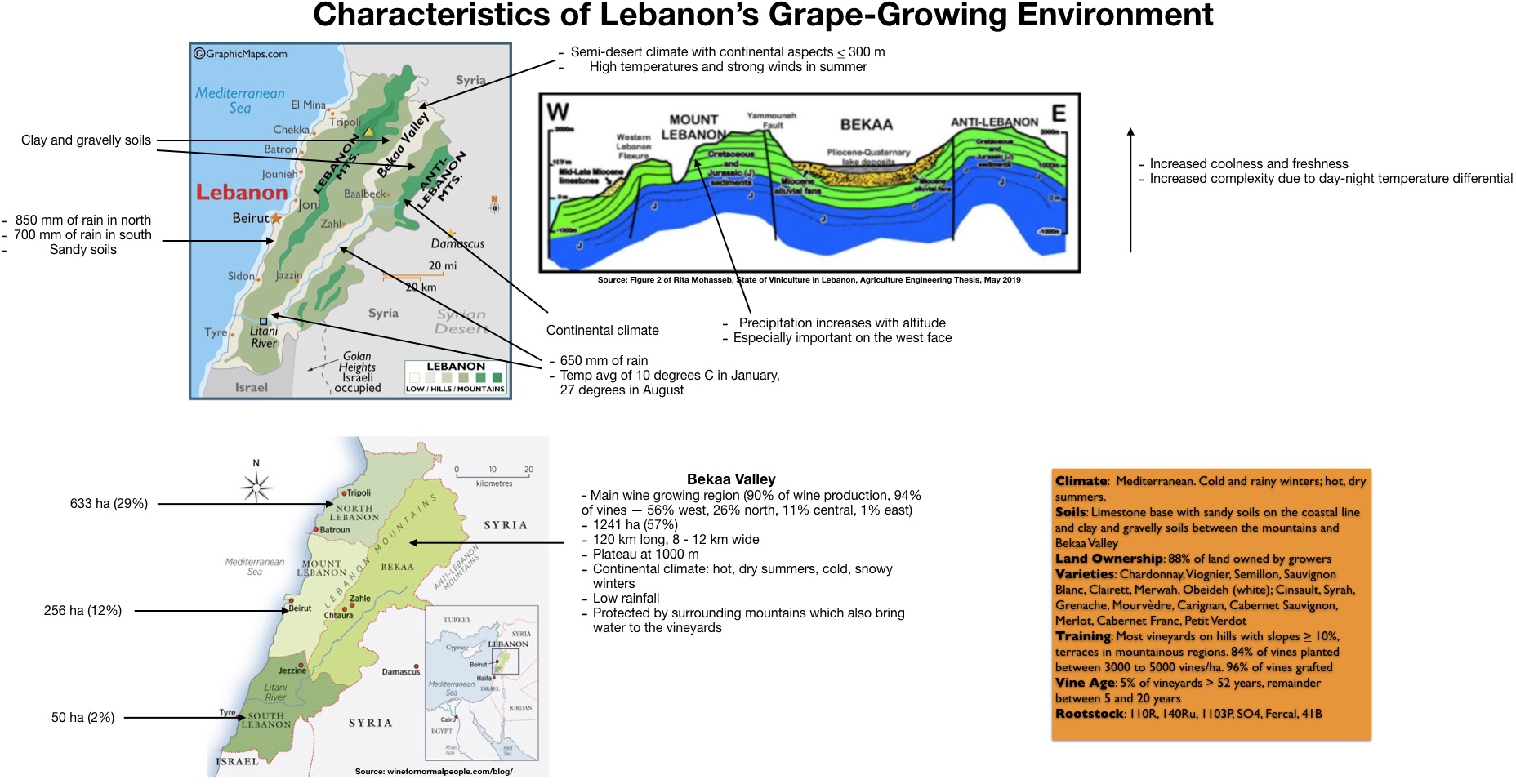
At the beginning of the Lebanese Civil War (1975 -90) a total of six commercial wineries were operational within the country. At the end of the war, Chateaus Kefraya, Ksara, Musar, and Nakad and Domaine des Tourelles, plus six new producers, dusted off the sands of war and turned their full attention to the resurrection of the Lebanese wine industry. By the mid-1990s, the number of wineries had grown to 14 and to 60 by 2018. The country was conducive to grape growing, with a dry, sunny climate and protection of the vines afforded by the peaks of the Lebanon and Anti-Lebanon Mountains.
The characteristics of the Lebanese grape-growing environment are shown in the chart below.


Chateau Musar: One of The North Stars of Lebanese Wine
One of most enduring stories of Lebanese wine has been the efforts of Chateau Musar's Serge Hochar to produce wine during the course of the Civil War. I had the honor and priviledge of tasting the estate's wines with him prior to his untimely death. The below observations are from notes taken at the tasting.

Chateau Musar's vineyards are located in Lebanon's Bekaa Valley with red and white wine grapes grown in distinctly separate environments. The red wine grapes -- Cabernet Sauvignon, Cinsault, and Carignan -- are planted in the southern portion of the Bekaa Valley on soils that are gravel over limestone. These old vines yield between 30 and 35 hl/ha. The white varieties are the indigenous Obaideh and Merwah which are planted in high-altitude (1500 m ) vineyards. Grape growing is organic and, at harvest, the berries are hand-picked by Bedouin tribespeople and trucked over the mountain to the winery which is 2.5 hours removed.

Grapes for the red wines are fermented by varietal in cement vats and then racked into French oak barriques after 6 months (In the tasting, Serge indicated that he had tried stainless steel fermentation but that it had "destroyed" the wines. He uses stainless steel for some of the younger-generation wines but exclusively uses concrete for the Hochar and Musar wines.). The barrique wines are blended after 12 months of initial residence and then returned to the barriques for an additional 12 months. The mature wine is then bottled unfiltered and aged for 3 - 4 years before being released to the market.

The white wines are fermented in French oak for 6 - 9 months before blending and bottling and are then stored in the Musar cellars for an additional 6 years prior to market release.


Serge and the Author

Renaissance Interruptus
By 2020, this Lebanese winemaking renaissance had been brought to heel by:
  • A popular revolution
  • A financial crisis -- loss of 95% of the value of the Lebanese pound
  • The impact of the coronavirus
  • A massive explosion in the Beirut port which killed in excess of 200 people, wounded over 6000 people, and dealt a massive blow to the port infrastructure and adjacent business/residential districts
  • Rising poverty
  • A fuel and electricity crisis.
These conditions served to cause a contraction in both the local (30 - 35% decline 2020 over 2019) and export (30% decline) wine markets. Wine imports have decreased by 65%. Wine producers are hit especially hard by these conditions because they need hard currency to import equipment, sulfur, yeast, bottles, corks, and labels.

Given the need for hard currency, as well as the limited local consumption, Lebanese winemakers will be forced to focus on the export market in order to survive. The prospects are better for establishments with name recognition in foreign markets as marketing funds are not readily available. 

©Wine -- Mise en abyme

Tuesday, November 29, 2022

Ancient Wine: The Phoenicians and the spread of wine across the Mediterranean Basin

According to Yuval Noah Harari (Sapiens: A Brief History of Humankind), the genus Homo evolved in Africa and spread to Eurasia 2 million years ago, resulting in the evolution of different Homo species. Homo sapiens evolved in East Africa approximately 200,000 years ago and lived there until a breakout into the broader world, commencing 70,000 years ago. The story of wine has a parallel trajectory, with its crucible being the Levant and early touch points being "near-abroad" countries. These early-adopting countries were the cult-wine regions of the time and in this series I seek to describe wine making and wine drinking therein then and now. I have, to date, covered Armenia (wine history and winemaking) and Iran and continue herein with Lebanon.

Ancient Phoenicia
Current-day Lebanon was the Phoenicia of yore. Phoenician was an ancient Greek term used to describe the Iron Age, Semitic-speaking people who inhabited the central coast of the Levant (the region along the eastern Mediterranean which roughly corresponds to modern-day Israel, Jordan, Lebanon, Syria, and certain adjacent areas).

But the Phoenicians were not limited to the Levant. Around 1100 BC the Phoenicians began founding colonies all across the Mediterranean and even on the Atlantic coasts of Europe and Africa. Carthage and Syracuse are two of the noteworthy names that have resonated down the corridors of history but these -- and most of the other colonies -- were lost to Rome during the course of the Punic Wars (264 - 146 BC).

The Phoenicians used their trade routes to spread wine and their alphabet across the Mediterranean.

Phoenicia and its trade routes
(Source: Wikipedia.org)

Wine in Ancient Phoenicia
Grape cultivation spread to Phoenicia around 3000 BC and wine became a valuable commodity for the inhabitants both as as a trade good and for local consumption in feasts and as a libation. As shown in the chart below, the wine was well-regarded and was referenced in many ancient sources.


Phoenician Winemaking
Winemaking in the Levant and across the Mediterranean, in the period between the 5th century BC and 1st century AD, utilized wine presses with the following characteristics:
  • A treading floor/basin where grapes were crushed by foot
  • A vat for the collection of the must 
  • A connecting channel between the "crush pad" and vat.
The crush pad was generally hewn out of rock or built with stone blocks.

A newly discovered wine press at the Tell el-Burak archaeological site has revealed a marked departure from this convention.

Tell el-Burak is a small Phoenician site located near the modern-day Lebanese city of Sidon. It was occupied between the 8th and 5th centuries BC. The wine press excavated from the site dates to the 7th century BC and is the earliest evidence of winemaking in ancient Phoenicia.

The press consisted of a large rectangular treading basin (4500 L) attached to a large vat. The structure was built with plaster made from a mixture of lime and recycled ceramics. This material rendered the press both easier to build and stronger than its contemporaries. The size of the vessel indicates industrial-scale wine production.

The chart immediately below captures the actual excavated material while the one following is an artist's conception of how the press would have appeared when operational.

Excavated Tell el-Burak Wine Press
(Source: Orsingher, et al., Phoenician
lime for Phoenician wine: Iron Age
 plaster from a wine press at Tell el-Burak,
Lebanon, Antiquity 377, 1224 - 1244)

Artist's conception of Tell el-Burak Wine Press
(Source: Orsingher, et al., Phoenician lime
for Phoenician wine: Iron Age plaster from
 a wine press at Tell el-Burak, Lebanon,
 Antiquity 377, 1224 - 1244)

In addition to the press, a large number of grape seeds were found at the site, confirming a large scale, industrial operation.

Wine as a Key Phoenician Trade Good
There are a number of references from ancient sources as to the importance of wine in the Phoenician trade arsenal:
  • Ezekiel's (Chapter 27) oracle against Tyre suggest the city's involvement (6th century BCE) in transporting and marketing wines produced in other parts of the Levant
  • Herodotus (Hist 3.6) claimed that Phoenician wine was imported twice a year into Egypt
  • Two shipwrecks (ca. 8th century BCE) discovered 30 nautical miles off the coast of Gaza are advanced as evidence of the scope of the Phoenician wine trade. These ships were laden with hundreds of carinated-shoulder amphorae (a distinctive Phoenician container) and organic residue from one amphora suggests that its contents were wine.
Carinated-Shoulder Amphora
(Source: amarnaproject.com)

Initially the Phoenicians tried to avoid spills during transport by covering the wine with a layer of oil but this proved unsatisfactory. They next tried a pinewood disk bedded into the necks of the amphorae with a clay and resin mixture. This resinous mix flavored the wine as it made contact during the course of the voyage and the Phoenicians -- as well as the Greeks -- thought that it also acted as a preservative. This was the precursor to Retsina.

Phoenician Influence in the spread of Wine beyond the Middle East
Domestication of the grapevine and production of wine was initiated in the Caucusus region during the Neolithic and spread to neighboring polities, reaching Phoenicia by 3000 BC. Phoenicia then became the key link in catapulting wine consumption and cultivation knowledge into the wider world:
  • It is believed that wine was first brought to Crete by Phoenician traders
  • Stassinus, author of the "Cyprus Epic Songs," stipulates that the cultivation of grape vines dates back to the early days of the Island's colonization by the Phoenicians in 3000 BC
  • The Romans learned to appreciate the consumption and production  of wine from the Phoenician/Punic and Greek peoples
  • The first vines in Sardinia were imported by the Phoenicians
  • Winemaking in Sardinia dates back to the time of the Phoenicians.
**************************************************************************************************
The Phoenicians, the progenitors of modern-day Lebanon, were clearly major players in the development and spread of wine in Mediterranean Basin and beyond.  What has become of that headstart in more modern times? I will explore that question in an upcoming post.


©Wine -- Mise en abyme