Tuesday, December 7, 2021

Il Palazzone's Rosso del Palazzone: In the vanguard of Montalcino vins de soif

Non-vintage bottlings are more frequent in the sparkling, fortified, and sweet wine spaces than for still wines. Some of the existing non-vintage still wines are flagships in their estate portfolios both in terms of quality and price (see, for example, Abacus and Reserva Especial). But that is not the case for the subject of this post, Il Palazzone's Rosso del Palazzone (RdP). 

In my discussions with Laura, she pointed me to two articles which distill the essence of RdP. The first article detailed Sauternes' introduction of a 4- to 5-year vintage blend which is much more accessible in terms of drinkability and price -- it is six times lower in cost than the estate label. The specific objective of the initiative is to get "people to enjoy the wine in a more relaxed way."

The second article was from the New York Times' Eric Asimov and described a wine class he called "thirst quenchers" (vins de soif in French and quaffers in England, according to Eric). These are "unpretentious wines that are measured not by their complexity, length or ageability but by the joy and refreshment they provide ... Generally they are relatively low in alcohol and high in acidity ... These wines cam come from anywhere ... They should be relatively inexpensive."

With this context in mind, let us take a closer look at RdP.

Rosso del Palazzone came about with Laura's elevation to General Manager in 2008. She inherited a cellar with "various dribs and drabs" and, given the complexity of managing DOCG compliance and accountability and the small lot sizes that abounded, they hit upon the idea of producing Rosso del Palazzone. In the short term, it would allow them to efficiently dispose of the inherited cellar without running afoul of the Consorzio and, in the longer term, would allow them to partially (and flexibly) plug the product hole left by the 2000 decision to discontinue the production of an appellation-approved Rosso.

Il Palazzone does not grow grapes destined for an RdP. Rather, it sets out to grow grapes for its Brunello products. After hand-harvesting, the grapes are vinified and stored separately based on the source vineyard. Once the Brunello blend is determined, the excluded barrels are declassified to become RdP stock. On average, the declassified wine will have spent 10 to 24 months in large Slavonian oak barrels. 

Il Palazzone has a stock of these wines and will blend them for each bottling. According to Laura, blending is to taste and with an eye on the customers' desire for "an authentic hit of Montalcino Sangiovese straddling old (wood aging, tertiary depth) and zippy youth." The wine bottling-date is indicated by the lotto number in the lower right of the label. It can be used to determine the wine composition using the key provided in the chart below. 


Approximately 10,000 bottles of RdP are produced annually.

You do not run into Il Palazzone products in my neighborhood wine shops so I was pleasantly surprised in August of last year when I saw bottles of the RdP at one of the local haunts. I bought a few bottles and couldn't wait to let Laura know that (i) I had seen her wine on the store shelf and (ii) I had drunk the wines and thought they were tasty. She asked after the lotto number. It was 01/16. She indicated that that was a blend of 2011 and 2014 wines, two vintages in which they opted to not produce Brunellos. One of the vintages, she said, was too hot and would have made an unbalanced and blowsy Brunello while the other had been incredibly rainy and the resulting wine was therefore too low in alcohol and high in acidity to make an estate-worthy Brunello. Together they were a perfect blend for the Rosso.


The coat of arms on the label above includes the name Parsons, the former owner. With new owners come new labels (and the Kern coat of arms) and these will be introduced with the 2/21 bottling (available January 2022). A representation of the new label is provided below.

Photo credit: Raffaella Cova

It seems as though Il Palazzone is out ahead of the pack with its RdP product. According to Monty Waldin, noted Brunello expert, "A small but growing number of producers in Montalcino are releasing non vintage red wines blended from different years. The first winery to do so was Il Palazzone with its Rosso del Palazzone ... Other estates to have followed this lead include Le Ragnaie, Cupano, and Campo di Fonterenza."

In a discussion more than five years ago  Laura told me "one of the special aspects of smaller wineries is that there are no fixed recipes or kneejerk logistical decisions but that we can behave in a very intuitive way both in the vineyard and in the cellar." That sort of intuitive reaction to the problem presented by a jumble of small lots yielded the pathbreaking (for Montalcino anyway) vins de soif that we know as Rosso del Palazzone.

©Wine -- Mise en abyme

Sunday, December 5, 2021

Regenerative Viticulture: Early steps on the road for Familia Torres

The recent Regenerative Viticulture Symposium, organized and presented by Familia Torres, was a harbinger of the still-then unformalized Regenerative Viticulture Association. The list of speakers was impressive and they covered topics ranging from holistic farming to regenerative agriculture to the soil biome and experiences with regenerative viticulture.

Miguel Torres, General Manager of Familia Torres, was the final speaker of the day. Unlike the other regenerative viticulture practitioners on the dais, his company is in the early stages of the journey. 

Miguel Torres, General Manager, Familia Torres

Familia Torres, according to Miguel, has strong roots in Penedes. The family operations are headquartered in Vilafranca del Penedes, "an area with more than 2700 years of wine history. Even the Iberians made wine here." The area is steeped in organic viticulture, with more than 39% of the DO compliant.

Miguel had two areas of focus in his talk: (i) the enterprise's carbon reduction initiative and (ii) its experimental efforts with regenerative viticulture. I focus on the latter in this post.

During the course of the carbon-reduction effort, Miguel noticed that many of their vineyards were eroded -- evidenced by the distance between the ground surface and the rootstock-scion graft point. That distance was much greater now than when the grafts were initially made. This problem is evident in many of the vineyards in Penedes and around the world. In Familia Torres' case, they lose 134 tons of topsoil for every 1-centimeter decline in soil height.

Familia Torres has historically practiced mono-crop viticulture, a cultural practice inculcated by parents, grandparents, and university teachings. This system does not, however, take the carbon cycle into account and, as a result, vineyard soils are some of the poorest around. Familia Torres have embarked on a journey to rectify this historic shortcoming.

As Miguel sees it, the only machines that exists today that can reliably sequester carbon from the air are plants. Plants sequester carbon and store it in the ground, thanks to the clay-hummus complex. Given the foregoing, Familia Torres will be focused on (i) carbon sequestration and (ii) mechanisms for recovering soil fertility; that is, regenerative viticulture. Increasing minerals, microoganisms, and organic matter are key to creating living soils that can sequester carbon. 

Learnings
Familia Torres has learned a few lessons in the early stages of its program and Miguel's recounting of those are summarized below.

People
One of the most important factors in the success of a regenerative viticulture program is the people. Miguel feels that if he had ordered the staff to adopt the program, it would have failed. Instead, he formed teams comprised of oenologists, vineyard managers, and R & D specialists. For a long time these teams took no action beyond reading, watching film, and debating. They created a chat group and talked constantly about new holistic and regenerative techniques. They even gave the program a new name -- living soils.

From that point on they began to work more and to plan. It was like planting a seed that began to grow. The group started to share ideas and to visualize the concept becoming reality.

Program Planning
Familia Torres set short- and long-term objectives for its regenerative viticulture program. The short-term objective was ambitious: 500 ha to be converted to regenerative viticulture in 5 years. The longer-term plan would be developed based on an understanding of each vineyard, the investments required, and the work schedule.

They stared on the journey with Mas La Plana (Penedes, calacreous-clay soils) and Mas de La Rosa (Priorat; metamorphic soils). These estates were chosen because of:
  • The different soil types
  • Both are high-value vineyards
  • Both produce premmium wines
  • Both are planted with old vines with established, deep reticular profiles that make it easier to manage change.
Soils
From the very beginning, they knew that the starting point had to be an understanding of the soils. They had to analyze the soil, its microbiology, and its mineral structure. When you are just starting with regenerative viticulture, you have to remember to feed the soil. Vineyards can be aided by an increase in soil organic matter. Familia Torres increased soil organic matter by using compost, animal manure, and bio-fertilizers to increase the richness of the soil.

From May/June onwards, mulching has been important in keeping soils fresh and humid thus increasing organic matter, reducing erosion, and increasing biomass in each vineyard.

Cover Crops
They always try to cover the soils 100% throughout the year. This enables carbon sequestration and increases organic matter that gradually accumulates on the ground.

They are willing to try anything as a cover crop: legumes, grasses, perennials, spontaneous, or a combination of the foregoing. The most important thing is to learn from each experiment. They currently have four cover-crop experiments ongoing:
  • CREA -- analyzing which cover crop can sequester the most carbon in the soil
  • Lleida University -- Seeking to determine which cover crop is best suited to meeting Familia Torres objectives
  • Vigo University -- Seeking to determine which cover crop has the most impact on biodiversity. 
  • Also conducting experiments to see which cover crop can absorb the most copper from the soil (copper has always been a problem for viticulture).
The most important thing, says Miguel, is to learn from each experiment. A current map of the engaged vineyards would show different plots with different objectives planted with different species.

Animals
Familia Torres does not raise animals on any of the estates involved in the regenerative tests but are working with neighboring shepherds to get sheep into the vineyards for short, intensive grazing sessions.

Machines
Doing regenerative does not mean doing away with machines. Rather, it means becoming familiar with a whole new range of machinery:
  • A machine to de-compact the soil
  • A compost spreader
  • A roller
  • A reaper
  • A seeder
  • A sprayer
  • A tiller.
Biodiversity
The regenerative viticulture program seeks to increase biodiversity by: creating wildlife corridors; building insectariums and bird boxes; planting fruit trees in the vineyards; planting vegetable patches; creating beehives; and creating amphibian ponds.

Hoped-For Results
Miguel hopes that the regenerative program will result in their wines reflecting the soils and the land and that the resilience they are pursuing will yield wines with a different profile to the wines of the 1990s (The aim of the '90s was to make denser wines from extremely poor soils.). 

He thinks that the wines they are making from more fertile soils are much more capable of expressing freshness:
  • They are finding less and less over-carmelized and over-ripe sensations
  • The wines are more elegant
  • The wines are more consistent because they are more resilient.
Closing Thoughts
In closing, Miguel noted the following:
  • There is no regenerative manual
  • Regenerative is mostly about experimenting and putting ideas into practice
  • It requires a long-term commitment with an understanding that challenges will be encountered along the way but it can be done. 
The planet will benefit from widespread adoption of such programs.

©Wine -- Mise en abyme

Thursday, December 2, 2021

The role of Saint Benedict in the identification and cru-ing of Burgundian terroir

As illustrated in my graphical summation of the history of wine styles -- described in Lukacs' Inventing Wine: A New History of one of the World's Most Ancient Pleasures -- the next significant development in wine after the Fall of Rome is place-based wines out of Burgundy. According to Lukacs, the "first wines prized for their ability to display ... individualized aroma and flavors" were made in Burgundy by the Cistercian order which had been founded in 1098. This order was focused on piety and hard work and devoted a lot of effort to tending their vineyards. In his APAVM FAW lecture (titled St. Benedict and the Blessings of Burgundy), Dr. Jonathon Britto provided insight into events leading up to and surrounding the Cistercians and Burgundian wine.


Gregory of Tours was a prelate, historian, and chronicler who "resided at the junction of Rome of antiquity and the emergence of the medieval world" and "documented the continuity of Gallo-Roman civic culture through the early Middle Ages." This Gregory was the first to sound the praises of the wines of Burgundy in a 591 writing. According to Dr. Britto, King Guntrum of Burgundy had donated land to the monks in 587.

Gregory of Tours

Saint Benedict established "the Rules," which became the governing principles of monastic life. The Rules provided for a balance of prayer, work, and study. Charlemagne was enamored and had them copied and distributed throughout his realm in the 8th and early 9th centuries in order to encourage monks to adopt the principles. Saint Benedict's Rules, according to Dr. Britto, "laid the groundwork for community discipline of labor and this ethic, plus the donation of fertile land for the growing of grapes, was the kernel for successful viticulture in Burgundy.

St. Benedict (Portrait (1926))  
Herman Nieg (1849–1928);
Heiligenkreuz Abbey, Austria

The Benedictine Abbey of Cluny was founded in 910 by Duke William I of Aquitaine and was given to the monks "untethered." The deed of gift "included vineyards, fields, meadows, woods, waters, mills, serfs, and lands (cultivated and uncultivated)." 

The Abbey started out on a modest scale, but at its peak was home to 1,000 monks and seeded monastic life throughout Europe. Such a large contingent of monks required administration, fields, and food and was financed partly through indulgences and partly through wine trade. The Benedictines became major landowners with holdings in Gevrey-Chambertin and Vosne-Romanee in Burgundy plus holdings in Rhone, Champagne, and the Loire Valley. 

When completed in the early 12th century, the Abbey was the largest church in Christendom and remained the largest building in Europe until the 16th-century completion of the new St. Peter's in Rome. Cluny was plundered and destroyed during the French Revolution.

While, on the face of it, Cluny was a success, a number of resident monks felt that monastic life had been "challenged and traded for a commercial life." These "conservatives" felt that the only way to resolve their internal conflict was to leave Cluny and return to a stricter observance of the Christian monastic tradition. 

In 1075, Robert Moleme was given permission by Pope Gregory to leave Cluny and establish his own Abbey. Robert de Moleme and his monks acquired a plot of marshland south of Dijon at a place called Citeaux and set up an Abbey as the seat of a new Cistercian Order. The Citeaux monks returned to the original Benedictine ideals of manual work and prayer, dedicating themselves to charity and self-sustenance. 

Robert was called back to Cluny and left the Abbey in the hands of Steven Harding, and Anglo-Saxon who had lost his holdings during the course of the Norman invasion. He was elected Abbot and led the Cistercian community ably. The Cistercians grew, "forging alliances with the Duke of Burgundy and, by both donation and purchase, acquired vineyards in Meursault and Clos Vougeot."  They eventually encircled Vougeot with the wall that stands to this day.  The wall was completed at the end of the 15th century. 

Harding was a prolific recorder of contemporary events and wrote that the Cistercians were the first to notice that different vineyard plots gave different wines consistently. According to Lukacs, over the course of many vintages, these monks were able to identify the characteristics of individual vineyard plots and to note that these differences were, in some cases, manifested by "only a few steps separating an excellent grape-growing spot from a merely good one." The monks marked out these plots by their differences, in some cases building a stone wall to create a "cloistered vineyard." 

Lukacs takes the position that the monks did not intend that their demarcations single out one vineyard as better than the other. Rather, they were saying that the grapes sourced from these vineyards made reliably noticeably different wines and they thus needed to be so identified. The wines from Clos Vougeot and other Cistercian crus were perceived as being so different as to be worth the trouble and expense of overland shipping to the relevant markets or waterways for onward transit.

Dr. Britto: The Cistercians therefore "laid the first foundation for labeling the Burgundy cru and the region's terroir philosophy. It was the Cistercians who defined every tiny parcel of vineyard land, identified the good and the bad points, the geology and micro-climate, and the different flavors and yields.

The diligence inherent in the Benedictine rules, and the application of the work ethic, were instrumental in the identification and mapping of the Burgundian crus that we know today.


©Wine -- Mise en abyme

Sunday, November 28, 2021

Regenerative Viticulture Association: Newly formed organization illustrates the importance of soil health and carbon sequestration to Spanish winegrowers

Following up on the Regenerative Viticulture Symposium he held in June of this year, Miguel Torres of Familia Torres pulled together a group of like-minded winemakers to form the Regenerative Viticulture Association. The organization was formalized on Monday, November 15, 2021. Its goals and objectives are presented in the following chart while the signatories are presented in the photograph following.


Left to right: Eduard Muixach, Partner, AgroAssessor;
Montse Catasús, Oenologist, Familia Torres; Francesc Font,
Founding Partner, AgroAssesor; Miquel Torres, CEO, Familia
Torres; Christian BArbier, Head of Viticulture, Clos Mogador;
Mireia Torres, Director, Jean Leon; and Joan Huguet, co-owner,
Can Feixes. (Source: https://www.viticulturaregenerativa.org
/blog/constitucion-y-presentacion-de-la-asociacion


I will be writing about the proceedings of the July symposium in subsequent posts.

©Wine -- Mise en abyme

Saturday, November 27, 2021

Solminer (Santa Ynez, California): Another organo-biodynamic producer adding Regenerative Organic Certified to its accomplishments

Solminer, a Santa Ynez winery helmed by the husband-and-wife team David and Anna Delaski, was the third Regenerative Organic Certified (ROC) awardee and, like Tablas Creek and Troon Vineyard, had gained organic and biodynamic certification prior to embarking on this path. I chatted with Anna via Zoom to gain insight into the estate's ROC journey.

Anna and David Delaski (Source: solminer.com)

Anna is Austrian and, she says, has always had an interest in sustainability in the broad sense. In addition, she has always been a passionate wine drinker. She met her now husband in LA in 2009 and, while traveling around, they fell in love with Santa Barbara. They became even more enamored with the region when they discovered Gruner Veltliner, one of Austria's native grape varieties, growing in the area. 

Their travels in Santa Barbara revealed that, though French varieties dominated, the Austrian varieties that they encountered were thriving. They began to entertain the thought of making Austrian varietal wine in Santa Barbara and brought the fantasy to reality in 2012 with the purchase of a 4-acre property, 2.5 acres of which was planted to Syrah. In that their intended focus was Austrian wines, they had to purchase grapes initially to get their feet on that path. They purchased Gruner and other Austrian varieties which, when combined with the Syrah, allowed them to produce 400 cases in their first vintage.

The property had been farmed conventionally and they sought to change that by pursuing organic certification. In 2016 they bought a 7-acre horse farm which featured compacted soils. They added calcium and compost to build up the soils and planted 2 acres of Blaufrankisch and Gruner Veltliner.

Not being formally trained as winemakers, they sought to improve their winemaking skills by taking the UC Davis course Introduction to Winemaking. They were somewhat disappointed as the focus was on industrial winemaking, rather than the artisanal approach that they were pursuing.

Solminer began practicing biodynamics in 2016. They purchased some sheep and a couple of donkeys, ceased tilling, and began making their own compost. At around this time Steve Clifton became their mentor; they were much more in tune with his intuitive approach.

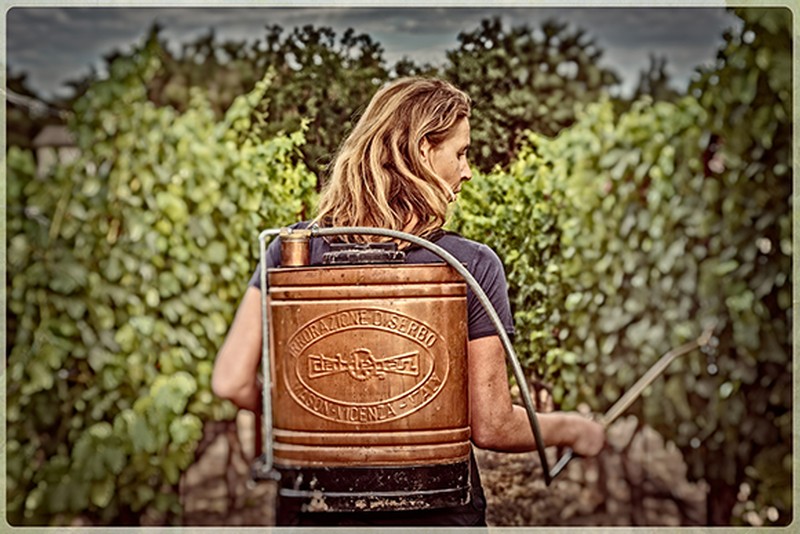
They are seeking to farm as an entity and minimize external inputs. For example, the use of manure as fertilizer minimizes external fertilizer purchase and transport. They initially applied their preparations to the understory of the vines using a backpack dispenser.

Anna applying preparations using a backpack dispenser
(Source:solminer.com)

One of the keys for Solminer was creating/adding organic matter as food for the soil. Even with these efforts, however, they still experienced a drop in yield in the year after no-till was introduced. The estate was CCOF Organic certified in 2014 and Demeter Biodynamic certified in 2018.

As far as their ROC is concerned, they became interested once they found out that the owner of Patagonia was involved (they knew he was very serious about regeneration). As they looked further into the program, they realized that it covered the things that they had been doing over the last 10 years. So it was a no-brainer; especially as the ROC Administrators make it so easy to come onboard.

They met the ROC requirements at the Silver level. The Social Welfare Pillar was hardest for them because they do most of the work themselves and when they do bring on workers at harvest, they contract through a middleman. 

This is a great program, according to Anna, for a larger company seeking to make the transition from conventional farming. Solminer, she says, may be too small an entity for it.


©Wine -- Mise en abyme

Friday, November 26, 2021

The Romans and wine: Taking a good thing and making it better

The Romans possessed an exceptional capacity for taking "good things" and making them better and, according to Professor Elizabeth Lev, this characteristic was manifested in spades in the wine world.

The Greeks were responsible for the creation of the wine culture in Italy. They named the southern portion of the peninsula Oenetria -- "the land of the tamed vines", according to Professor Lev. They also brought some of their native varieties to Italy. Aglianico, for example, is widely held to be a Greek transplant, with the Italian name being a transformation of Hellenistico (Greece was known as Hellas).

The Romans did not get involved in serious wine drinking until about the 3rd century when they developed a bread culture. Prior to this period, the main Roman dish was a porridge-like concoction called puls, which was served during cena, the main meal of the day. Adoption of bread-based meals began in the 3rd century and with it the rise of bakeries and wine drinking.

The Greeks had historically grown their grapes along the ground or trained in trees. The Romans developed the Pergola which lifted the vine off the ground, allowing greater access to the sun for all parts of the berry as well as allowing wind to dry out the vines after rainfall.


The Greeks and Egyptians had historically trod their grapes to extract the juice. The Romans adopted this practice but also added mechanical means of pressing the juice from the grapes.


The Romans  were the first to distinguish between first and subsequent pressings with the third press set aside and, in many cases, given to the slaves.

The Romans were also the first to (Professor Lev):
  • Understand vintage differential
  • Serve wine in glassware
  • Work on wine storage (both in terms of where and length).
The Romans also preferred white wines to red with Livia Augusta attributing her long life to a daily tipple of Pucinum, a forerunner to today's Prosecco.

The most famous of the Roman wines was Falernian, a sweet, high-alcohol, late-harvested wine. According to Professor Lev, this wine was made from the Aglianico grape but another source claims that it was made from Falanghina while two others give that honor to the Aminean grape. This wine was highly prized and priced. Professor Lev spoke of the Opimian vintage of 121BC which was served at a Julius Caesar banquet in 60BC.

Wines for the masses were flavored with chalk, seawater, honey, etc. The wines served to aristocrats were first boiled-down in lead-lined pots, the process concentrating the wine by 1/3 or as much as 1/2, depending on the preference. Boiling in the lead added a specific sweetness to the wine but also poisoned the drinkers. Gout and dementia are symptoms of lead consumption, conditions manifested in many of the Roman rulers of this period.

By 50AD, Romans were consuming an average of one bottle of wine per person per day. The Vesuvius eruption created a major secondary crisis in that it took out a significant portion of the Empire's best vines. This led to a panic in 79AD where folks were ripping out grain in order to plant vines. 

Unlike the Greeks, the Romans were far less interested in moderation. And this extended to their praise of the beverage. Romans loved to "talk, write, and wax poetic" about growing grapes and drinking wine. Major historical figures such as Cato, Horus, and Pliny the Elder have all contributed to the body of work from this period.


©Wine -- Mise en abyme

Friday, November 19, 2021

Troon Vineyard (Applegate Valley, Oregon): Regenerative Organic Certified

Craig Camp utilized the structure imposed by the requirements for USDA and Demeter Biodynamic certifications to transform Troon Vineyard from a disease-ravaged, underperforming vineyard to one that was reborn, regenerated, rejuvenated, and recreated. But, while he was enamored with the success afforded by the application of those programs, there were some things that were of concern:
  • The USDA Organic certification, in his view, had been largely taken over by industrial organic farms
  • USDA allows hydroponic agriculture (organic without soil is a "head-scratcher" for him)
  • Many animals on organic-certified farms, while in better condition than animals residing in feed lots, do not live in humane conditions
  • He is less-than-comfortable with Rudolf Steiner and the Anthroposocial side of biodynamics.
These concerns were some of the accelerants that pushed Craig to seek certification under the new Regenerative Organic Certified (ROC) program. According to Craig, "Regenerative Organic Certified excites me as it incorporates all the things I find important about the Organic and Biodynamic certifications while also resolving my concerns with both" (Wine Camp). The program:
  • Includes an essential word -- Regenerative
  • Combines the restrictive nature (what you can't do) of organic certification with the proactive, probiotic nature of biodynamics, thus creating a more complex structure for rebuilding soil
  • Adds social programs as a cornerstone, bringing an important element to the certification process
  • Adds animal welfare as an important component.
Troon Vineyard was eventually awarded ROC at the Silver Level, subsequent to a Regenerative Organic Alliance assessment of its farming program as it relates to Soil Health and Land Management, Animal Welfare, and Social Welfare. The information following is gleaned from an interview with Craig Camp (Troon's GM) and Garett Long (its Director of Agriculture).

Soil Health and Land Management
Possession of Organic and Biodynamic certifications meant that Troon easily met the ROC minimum entry requirements while also simultaneously vaulting well down the road to ROC certification. Troon Vineyard regenerative-relevant practices which were not previously discussed include:
  • Agroforestry -- fruit production in the orchard block (some perennials, some annuals), trees on the farm (sycamore, oak, redwood), and incorporation of trees around the pond habitat
  • Increasing biodiversity by managing the farm to integrate wild animals. According to Garett, keeping the overall health of the ecosystem in balance will keep the pest population in check
  • Controlling invasive species -- the two big ones are Yellow Star Thistle and Foxtail Weed. They utilize animals as much as they can and set fires in some areas.
The Gold Level ROC requires no-till for vineyard floor management. Troon is moving towards no-till as quickly as they can with the major impediment being the Red Blotch virus infection of older vineyard blocks. There is some concern that no-till in the older vineyards would encourage leafhopper populations with the potential for proliferation and spread to the newer blocks (The linkage between leafhoppers and Red Blotch virus is not definitive). The approach that Troon is using in the interim is tilling every other row and mowing.

Unlike the other certification systems, ROC seeks measurement data to show that programmatic requirements are being met. Gartet pointed out that ROC requires both in-field and lab testing. For example, soil may be tested for density and texture. Baseline samples are taken from three different parts of the farm and sent to the lab for testing. The samples must include GPS coordinates and multiple sub-samples as well as a composite.

Troon Vineyard will be working on a number of initiatives going forward:
  • No-till drill
  • Integration of animals into the environment
  • Rotational grazing
  • Development of a vegetable garden
  • Increasing the number of perennials
  • Biochar
  • Moving to solar/wind power on the farm
  • Moving to electric farm vehicles
  • Sourcing wine bottles from within a 400-mile radius
  • Ceasing the use of capsules on wine bottles
  • Diam corks
Animal Welfare
Troon needs to be certified for animal welfare as it has sheep, chickens, and dogs. The requirements are much simpler, however, as the meat is not sold. The eggs are sold so the chickens have to meet all organic standards.

Social Welfare
In Craig's view, Social Welfare certifying organizations "do not know what to do with the small farm" (this sentiment, by the way, is shared by the folks at Tablas Creek). Troon Vineyard sought Fair Trade certification but they had no relevant programs (they are tuned to large-scale outfits). Troon therefore went through the ROC Silver with a specially modified program. 

The Regenerative Organic Alliance has heard the complaints in this area and is working with Equitable Food Initiative to design a program that is relevant for the small farmer.

Where Tablas Creek had run up on the living-wage rocks, Troon did not have such a problem. Everyone working at Troon is an employee and is fairly well compensated.

Craig's Thoughts on the ROC
Craig thinks that the framework can be applied to a broad range of farming philosophies and can be used either as a farming framework or to build the culture of the company. 

Craig is very interested in working to convert a broader range of people to this type of farming. To that end, he will help to provide leadership on the issue within the farming community by giving talks, hosting farm tours, and hosting farm-to-table dinners. Troon has set aside a Biodynamic area on the property to entice visitors to walk around the farm. He hopes that their actions will serve as a model for farm and agricultural producers.


©Wine -- Mise en abyme