Tuesday, June 6, 2017

"Bad-Brett" management Part II: Repairing contaminated wines

In Part I of this series on Brettanomyces, I laid out the characteristics of the microbe, the contamination routes, and conventional methods employed in controlling its growth. In that post I also referenced some approaches advanced by Dr. Jamie Goode to fix wines that had been contaminated by Brettanomyces. The chart below summarizes both the "control" and "fix" tactics presented by Dr. Goode in the Somm Journal article cited in the chart.


In his book postmodern winemaking, author Clark Smith posits that "... a revolution is taking place within the winemaking industry. Precepts of the modern winemaking system we were taught in school simply don't support the making of the great wines the market demands, and as a result, some of our most successful winemakers have strayed quite far from conventional dogma." These winemakers are using what Smith calls postmodern winemaking to "... merge all of the wine's flavor into a coherent whole like a well-conducted orchestra producing a unified, soulful voice."

As stated in his book, postmodern winemaking does not seek to throw out all elements of modernity and replace them lock, stock, and barrel with a new canon. Rather, postmodern winemaking uses existing pieces where appropriate and substitutes/adds where necessary. Below I provide a graphic representation of wine production under both the modern and Smith's postmodern schemas. The key extensions of postmodern winemaking are provided in red in the below chart.
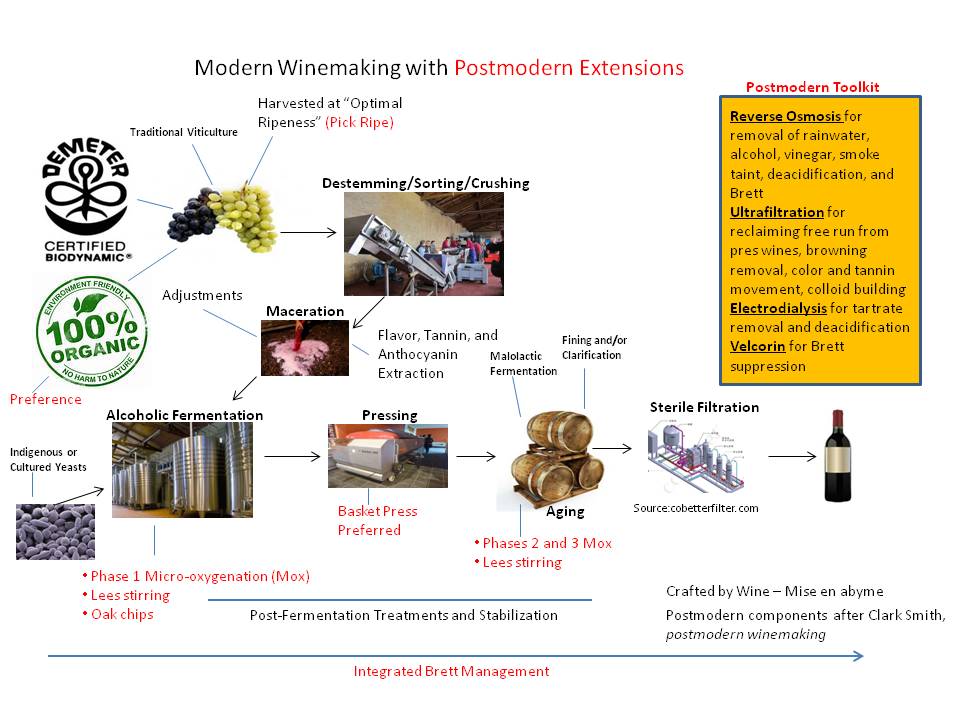

Two things to note in the chart above: (i) towards the bottom, the introduction of the concept of Integrated Brett Management (that will be the focus of Part III in this series); and (ii) the box at the top right which is labeled Postmodern Tookit. Some of the entries in that box map closely to the "fix" tactics proposed by Dr Goode. These Postmodern Toolkit/Fix mechanisms will be the subject of the remainder of this post.

Sterile Filtration
Dr. Goode mentioned filtration as the first option on his list and it is widely viewed as the most effective method of removing Brett cells. In this method, the wine is passed through a .45µ filter which captures any Brett cells in the filter mechanism. Clark Smith is not in favor of this approach to Brett removal:
The focus of postmodern philosophy is the creation and preservation of beneficial macromolecular structure. This structure manifests in wine as colloidal particles sometimes nearly as large as a bacterial cell. The benefits of good structure -- profundity, aromatic integration, and graceful longevity -- appear to be lost in sterile filtration, despite the fact that no tannin material may be retained by the filter. While this lack of residue has convinced some of my colleagues that filtration cannot be harmful to wine structure, I do not concur. My hypothesis is that the action of tight filtration somehow disrupts rather than removes structure.
It should be noted that Clark does not provide any empirical data or prior scientific studies to bolster this hypothesis.

Velcorin
Both Dr. Goode and Clark Smith mention dimethyldicarbonate (DMDC, trade name Velcorin) favorably. This product is a microbial control agent  (produced by Lanxess) that is effective at eliminating a broad range of yeast, bacteria, and molds from wine. The product works by penetrating the cell wall of the offending micro-organism and deactivating enzymes which then leads to the cell's demise. The manufacturer claims that the product has no effect on wine taste, bouquet, or color and breaks down completely into small amounts of CO₂ and methanol. The downside, according to Clark, is that this is a "nasty chemical" and must be handled carefully.

Tangential Flow Filtration
Dr. Goode refers to cross-flow filtration and nanofiltration in his list but Clark places those technologies into a class he calls the Tangential Flow Family of Filtration and they are classified based on the molecular weight of particles that pass through the pores.

Filtration System Application Molecular Weight Range (Daltons)
Crossflow Clarification

200,000 - 500,000
Ultrafiltration

1000 - 200,000

Tannin and Browning Removal 10,000 - 200,000

Protein Removal 10,000 - 40,000

Decolorization 1,000 - 5,000
Nanofiltration

200 - 1000
Reverse Osmosis

50 - 200
Source: Clark Smith, The Crossflow Manifesto, Wine Business, January 2003.

According to Smith, the idea of tangential flow filters developed in the 1960s. One of the major problems with sterile filtration is the fouling of the membrane which occurs when tight pore sizes are used. This fouling prevents the passage of material through the pores. The effective limit of traditional filtration is 0.1µ. Tangential flow filters use the scrubbing action of the flow across the surface of the membrane to keep it clean thus allowing the utilization of ever-smaller pore sizes.

All of the systems mentioned in the table employ the strategy of pumping the wine across the membrane at high velocity. As the wine flows across the membrane it continually scrubs the surface, removing fouling material. The majority of the feed stream does not pass through the filter but is retained upstream and returned to the tank. This stream, called the retentate, contains all of the high-molecular-weight components. The low-molecular-weight material that passes through the filter is called the permeate. A reverse osmosis application is illustrated below.

Reverse osmosis (Source: memstar.com.au)

It should be noted that, of the tangential flow systems mentioned in the table above, reverse osmosis is the only one specifically noted for Brett removal by Clark Smith.

Fungal-Source Chitosan
A Brett-repair technology that was not mentioned by either Jamie Goode or Clark Smith is fungal-source Chitosan. Chitosan is a deacetylated version of chitin, a compound found in the exoskeletons of crustaceans and insects as well as in the cell walls of fungi. According to Olivier Pillet (Chitosan and Brettanomyces: Origin, Impact, and Mode of Action), "the innovation that led to the use of chitosan in oenology is the process for obtaining chitin from a non-animal fungi source, Aspergillus niger." This process provides natural-source chitosan that is both biodegradable and non-allergenic and has been accepted as an oenological process by both the International Organization of Vine and Wine (July 2009) and the European Union (December 2010).

Chitosan has been documented for its antimicrobial properties which depends on the degree of deacetlylation and its molecular weight. Studies have shown that the homogenous incorporation of 4 g/hl dose of the commercial product (No Brett Inside) will "result in the total destruction of the Brettanomyces populations, or, in certain cases, a significant reduction of the contaminating populations" (Pillet).

**********************************************************************************************************
These then are some of the tactical tools that can be employed in the fight against Brett. In my final post in the series I will treat Clark Smith's Integrated Brett Management.


©Wine -- Mise en abyme

Sunday, June 4, 2017

Management of "Bad Brett": Part I, the conventional approach

Writing about Brettanomyces in Decanter, Linda Murphy stated thusly:
... at best, Brettanomyces can give wine what many believe to be positive attributes that add complexity and depth: earthy flavours of glove leather, smoked meat, bacon fat, tobacco, truffle, clove and other savoury spices. Yet when B(rett) turns bad, it can give wine the offensive stink of barnyard, manure, plasters, wet dog, sweaty horse blanket, mouse droppings and antiseptic.
Remarking about this contrast in character, Clark Smith (postmodern winemaking) stated: "... most connoisseurs have experienced on different occasions both faces of Brett: the sultry, profound earthiness and the repulsive barnyard stench." It is the latter characteristic that is of most concern to winemakers and it is that character that will be the focus of this post.

In a recent Somm Journal article, noted wine writer Dr. Jamie Goode laid out the issues associated with Brettanomyces (Brett) contamination of wines and offered up a number of control measures and fixes to combat same. Clark Smith, in his book postmodern winemaking, takes the conventional view of Brett and Brett management to task and, instead, proposes a schema he calls Integrated Brett Management. I present these competing views in three posts beginning with this one. But first, some background

Brettanomyces bruxellensis falls within the Fermentative class of wine-associated yeasts (the other classes are Basidiomycetous and Ascomycetes), the most dangerous of the wine-spoiler yeasts. According to Woolford, et al., (Genome Survey Sequencing of the Wine Spoilage Yeast Dekkera (Brettanomyces) bruxellensis, Eukaryotic Cell 6(4), April 2007), Brettanomyces bruxellensis is a major microbial cause of wine spoilage worldwide and results in significant economic loss. Brettanomyces is exceptionally dangerous because it has all of the characteristics of Saccharomyces cerevisiae but extends beyond it in that, while slower growing, "it can assimilate a wider variety of carbon choices."  The key characteristics of Brettanomyces bruxellensis are presented in the chart below and its contamination mechanism in the one following.


It was long thought that Brettanomyces contamination was a result of poor hygiene in wineries but contamination persists even in the face of intensive hygiene efforts (Renouf et al., Interactions between Brettanomyces and other yeast species during the initial stages of winemaking, Journal of Applied Microbiology 100 (6), June 2006).  Research seems to indicate that Brettanomyces can enter the winery through sour rot and can then take up residence within the facility and contaminate batches of wine essentially at will. The chart below shows Brett potential contamination sources and pathways. In the case of sour rot grapes, it can be a direct source (that is, mixed in with healthy grapes brought into the cellar) or via bees interacting with sour rot grapes in the field and then bringing Brett into the winery.


According to Clark Smith:
Except in new cellars, Brettanomyces is a ubiquitous organism, a fact of life. Like athlete's foot, one cannot usually hope to eradicate it. Like keeping one's feet dry, control of this organism based on suppressing growth by denying it facile growth conditions is the most realistic solution. Keep in mind that the goal is to facilitate a truce with Brett so a stable condition exists at bottling.
Central to this growth-suppression approach "... is the maintenance of free SO₂ at a level of around 30 ppm at relatively low pH's in order to maximize its effectiveness by increasing the percentage of the free SO₂ that is in the un-ionized molecular form." This approach greatly reduces the number of colonies of Brett that grow on a petri dish but according to Clark, may actually be reducing the culturability rather than actually killing cells.

In his Somm Journal article, Jamie Goode identified a number of actions that can be taken in the fight against Brett. The actions in the left part of the chart below are conventional growth-suppression activities.


Lisa Van de Water (Monitoring microbes during cellaring/bottling, Practical Winery and Vineyard Journal, January/February 2010) recommends testing the wine in the cellar in order to minimize the opportunity for Brett contamination manifesting in the bottle. According to Ms. Van de Water, 100 cells/ml can lead to visible Brett haze in the bottle and the production of small amounts of CO₂. Sensory changes are "profound" with compounds such as 4-EP and 4-EG present manifested by horse sweat and Band Aid odors and a bitter, metallic finish. Bottle variation is common with some bottles showing the clear evidence of "bad Brett" while others show little impact.

Ms. Van de water recommends culturing the wine on media containing 50 ppm of the antibiotic cycloheximide (to inhibit growth of other yeasts) and, if Brettanomyces is present, the culture will manifest white, hemispherical colonies in three to seven days. The culture will, in addition, produce a strong acetic acid smell.

If Brett is determined to exist in the wine at levels between 1 and 50 cells per ml, then we switch to the right side of the chart above and attempt to "fix" the problem. The most common approach has been to pass the wine through a .45µ membrane (this approach can be used both as a control and fix mechanism) but Clark Smith is opposed to this because he feels that filtration disrupts the structure of the wine.

The other wine fixes mentioned by Dr. Goode are identified as key elements of the postmodern toolkit by Clark Smith and so serves as  a bridge between the conventional and postmodern approaches. I will cover them in the next post on the topic.


©Wine -- Mise en abyme

Wednesday, May 31, 2017

A visit to the Terra Costantino winery and vineyard (Viagrande, Mt. Etna)

The 2017 edition of Contrada dell'Etna had been an unqualified success. It was well supported by producers and attendees alike and the new location allowed the sweep and scope of Etna winemaking to be displayed to full effect. But it was now Tuesday; and we had wineries to visit. Brandon Tokash had lined up two estates on the southeast flank of the volcano for us to visit: Terra Costantino and Cantine Nicosia. We began the day at Terra Costantino.

We were welcomed upon arrival by Salvatore Spampinato, who was on the second day of his job as Hospitality Manager (I would not have known it was his second day except I asked how long he had been there as a prelude to complimenting him on his knowledge -- and skilled dissemination -- of the characteristics of the estate.). We were joined by Fabio Costantino, the owner, shorty after the start of the tour.

Terra Costantino is a 10-ha organic vineyard located in the Contrada Blandano area of the commune of Viagrande on the southeast flank of Mt. Etna. The estate is owned by the Costantino family and managed day-to-day by Fabio Costantino. Maps of the estate location are provided below.

High-level view of Terra Costantino location on Mt Etna

More detailed view of Terra Costantino location
Located as it is on the volcano's southeast flank, Terra Costantino experiences markedly different climatic conditions than north-slope-resident wineries. First, it is warmer in the southeast than in the north; 4 to 7 degrees warmer, as a matter of fact.

Second, with no protective layer of mountains, the region bears the full brunt of the wind and rain coming in off the Ionian Sea. In the fall and spring, dry winds form over North Africa, pick up moisture over the Mediterranean, and barrel into the Sicilian coast at upwards of 50 miles an hour. These winds are called Scirocco and an event can last from 1/2 day to several days. The wind makes it easier to farm organically as it helps to keep mold at bay.

Third, the southeast is unprotected from the autumn and winter rains but the combination of rapid runoff and early morning sun contribute to its attractiveness as a growing region (especially for whites).

The soils here are described as lavic with low clay content and this profile is thought to provide rich flavor and body for the estate's wines. There are heavy deposits of lavic stone sub-surface and the winery has carved out a number of "exhibition spaces" to show the sub-surface architecture and the manner in which the vines negotiate these almost impenetrable rock layers in search of the water and nutrients that lie below.


The vineyards are farmed organically and are planted to Nerello Mascalese, Nerello Cappuccio, Carricante, Minella, and Cataratta with 60% of the vines planted cordone speranato and the remaining Albarello. Rootstocks are Ruggieri and Paulson. Average vine age ranges between 15 and 35 years.


The farm is not a monoculture. Chestnut, olive, and cherry trees are planted all around the estate. Legumes are planted between the rows to aid in nitrogen fixing. An old-style palmento is also located on the estate.

Salvatore leading us into the Palmento


Grapes are harvested based on sugar and acid levels as determined by tasting and analysis. There is a first selection in the vineyard followed by selection at a sorting table in the harvest reception area. In the cellar, cru reds are fermented in concrete tanks of varying dimensions and then aged in barrels. The top whites are fermented in barrels.


Brandon and Fabio just prior to us going into the tasting room

The wines we tasted are shown below.


We started out with the 2016 deAetna Rosata, a 90/10 Nerello Mascalese/Nerello Cappuccio blend. This wine was subjected to 3 - 6 hours of skin contact after which it was processed like a white wine. It had a Provencal color and showed strawberries on the nose. Great acidity on the palate along with spice, minerality, and citrus rind. A sense of effervescence. A beautiful, powerful wine.

The second wine tasted was the 2015 deAetna Bianco DOC. The year 2015 was not well regarded because of excessive rainfall. This particular wine was 80% Carricante with the remainder divided between Catarratto and Minella. Stems, tree bark, and dried herbs on the nose. Grape fruit and salinity on the palate.

The 2014 deAetna Rosso DOC was 90% Nerello Mascalese from 35-year-old vines yielding 50 - 60 quintals/ha. This wine was fermented in stainless steel where it underwent malolactic fermentation and was aged for between 6 and 10 months. It was aged for an additional year in-bottle. Elegant. Coconut-oil character along with stemminess and bark. Would have preferred a little more structure. Mineral finish. Almost austere.

The 2013 Contrada Blandano is 80% Carricante. Some coconut oiliness, beautiful white peach, rosemary and dried herbs. A Semillon fatness. Salinity on palate and surprisingly low acidity. Could be more focused. Lime and lime rind.

Two consistent features that I noted in the wines of this estate was an oiliness, a feature that I found attractive, and a sapidity. I find the salinity in Carricante whites a pleasing characteristic but thought that it was excessive in the 2015. Not sure if and how much the excessive rain of the vintage played into that. As these vines age, and as the estate continues its work on ever-improving fruit quality, these wines will become even more distinctive over time.


©Wine -- Mise en abyme

Sunday, May 28, 2017

Some casual-dining options in Milan for the #winelover in you

Like many US-originating visitors to Piemonte, I either fly into Torino and hightail it to the hills or fly into Milan with the same result. This time, though, Ron, Bev, Parlo, and I planned it differently. We flew into Milan at midday on Saturday and stayed until Sunday afternoon and, on the way out, we left Piemonte after a Friday morning meeting and stayed in Milan until Saturday (for them) and Sunday (for us). This itinerary gave us two solid blocks of time to explore some of the culinary and vinous offerings of the city.

We had no clear jumping-off point so Ron asked the concierge at the Park Hyatt for  a recommendation of a nearby establishment with a quality wine list where we could have a late lunch. He directed us to what turned out to be Giacomo Arengario located on the third floor of the Museo del Novocento. From the Hyatt we had a pleasant walk through the Galleria Vittorio Emmanuele II, across the plaza fronting the Duomo, to the museum on the other side of the square.

Galleria Vittorio Emmanuele II


We entered the museum on the ground floor but could not find the entrance to the elevator so we walked up a large spiral that circled the elevator shaft all the way to the restaurant on the third floor. We were directed to tables resident on a veranda that looked out over the Duomo and the crowds milling about on the plaza below. It was stunning. But we had work to do.

Il Quarto Stato (The Fourth Estate) by Pellizza da Volpedo.
On display on the ground floor of Museo del Novocento


Our first order of business was perusal of the wine list. It did not disappoint. Ron saw a Jacques Selosse Initial and we agreed that that would be a great welcome drink. We paired that with some Langoustines to share and were delighted. In addition to the Initial, we ordered a 2011 Le Pergole Tortre. I had some grilled oysters as an appetizer and found it to be of high quality. This was a tasty late lunch and, by the way, a concert had begun in the plaza fronting the Duomo.

Grilled Oysters


We had gotten an initial taste of what Milan had to offer; and we wanted more. We asked the manager at Giacomo Arengario to recommend a nearby wine bar and, without missing a beat, he said Signorvino. After some additional questions, we decided to visit that establishment. It was about a 10-minute walk from where we were, towards the rear of the Duomo.

As we stepped through the door, I immediately thought of Lanivin in Paris. The establishment existed on multiple levels with retail wine sales and a coffee shop on the ground floor and additional retail sales and a limited-service restaurant on the top floor. Wine was everywhere. A small, glass-enclosed room just inside the entrance housed the gems.


We went up to the top floor and were told that they were fully booked. We could have a table now but would have to yield it at 8:00 pm in order for them to meet their reservations load. They did not remind us of this after we began ordering wine.

The staff at Signorvino is friendly and attentive and the large selection of wines ensures that you will find something to pair with your food. Given that we had just finished a late lunch, we bought some finger items to accompany the wines shown below.

Wines drunk at Signorvino

We had a great time at Signorvino but all good things must come to an end. Our normal practice when we travel together is to end the night with Champagne and chicken wings at the bar in Ron's hotel. The Park Hyatt did not have chicken wings so the guys settled for burgers and the 2007 Delamotte Le Mesnil while the ladies shared a pasta and a salad.

On Sunday we were scheduled to drive to Lake Como for lunch but had some difficulty with our rental car and opted for lunch in Milan instead. The Concierge recommended Ristorante Antica Osteria Stendahl which, he said, was only a 10-minute walk away, had great food, and a great wine list. He was misinformed on two of the foregoing: it took us 20 minutes to get there and the wine list was pedestrian.

The restaurant had seating both on the inside and outside. We opted for the former. As I perused the food menu, I heard grunts of displeasure coming from Ron's direction. He was not liking the wine offerings. The food, though, was another matter. The menu was organized as is traditional in most of Italy but then it had another section -- titled "The Way it used to be" -- that provided a selection of old-style dishes. And it was there that I did my damage. After a starter of creamed codfish, followed by Langoustines, I dug into an oven-baked rustic chicken with spicy sauce and oven-baked potatoes. This dish was as delicious as it was sizable.

Creamed Codfish


Oven-Baked Chicken and Potatoes

Wines drunk at Stendahl

We had a wonderful week tasting wines in Piemonte and, after our Friday mid-morning visit at Cantina Bartolo Mascarello, we headed out of Piemonte and back to Milan. We got back to the hotel around 3:00 pm, with the postponed lunch very much on our minds. The concierge pointed us to Il Salumaio di Montenapoleone. This restaurant is located on the ground floor of the Bagatti Valsecchi Museum in the heart of Milan's high-end shopping district, about a 15-minute walk from Il Duomo.

The restaurant has a very appealing outdoor seating area but the wives opted for the inside. The wine list here is copious and deep, the staff is very accommodating, and the food was of excellent quality. This restaurant is worth your time.


Wines drunk at Il Salumaio di Montenapoleone
A late lunch begets a late dinner so we did not show for dinner at Rovello 18 until around 9:30 pm. We were running very late so we took a cab over (We walked back to the hotel at the conclusion of the dinner and it took us around 20 minutes.).

As we came into the restaurant we saw a sideboard loaded down with top-end Italian wines and knew right away that we were going to have a good time that evening. I cannot say enough about the efforts of the Corina Cotoara, one-half of the management team, who went to every length to ensure that we had the best time ever. She was very patient in explaining the offerings and options on the menu and proved her customer focus when we purchased the first bottle of wine. The wine had a granny's attic character that both Ron and I thought would blow off (the wives felt differently, and let us know that) but, unbidden, Corina opened another bottle and brought it to the table. The new bottle was much fresher and drinking well right out of the gate. She said that the owner had trained her to not let the wine get in the way of the customer having a memorable time at the restaurant. She could do no wrong by us after that.

The menu was deep here and the dishes that we selected were memorable. Ron and I had been on a Tagliatelle kick, splitting a plate in every restaurant that we went to. This one was excellent. Of the Milan restaurants that we visited, this one had the best balance between food and wine. And the balance was at a very high level.


Ham and Culatello

Tagliatelle with Veal Ragu

Chef, one-half of the management team


Rabbit with Bacon

Corina Cotoara, other half of the management team

Wines drunk at Rovello 18

So fellow traveler, tarry a while and sample some of the Milanese offerings. Your overall trip will be enriched for the effort.

©Wine -- Mise en abyme