Sunday, May 10, 2020

Mapping the Sparkling Wines of Italy: Puglia

The Salento Peninsula of Puglia is the heel of the thigh-high boot that one can envision when looking at a map of peninsular Italy. Puglia can be divided into north and south by an imaginary line running between Brindisi, on the Adriatic Sea, and Taranto, on its namesake gulf (which separates the heel of the boot from its platform).

The northern and southern portions of the region are culturally, geographically, and climatically different. The north is less flat, has a more temperate climate (it can be cool in some parts of the Murge plateau), and is more aligned with the customs and winemaking processes of central Italy. The south, on the other hand, is flatter, has a Mediterranean climate, and "retains a strong connection with its Greco-Roman past."

Overall, the region can be characterized as having a Mediterranean climate with cooling sea breezes.

Puglia is a major contributor to the Italian agricultural economy with olive trees, wheat fields, and vineyards adorning its surface. It is responsible for 50% of Italy's olive oil production and is second only to Veneto in wine production; that wine has been mostly red and has garnered a reputation for poor quality, suitable only for blending with wines from the regions to its north. As the world has pursued wines of quality, Puglian winemakers have sought to improve the quality of its red wines through technology advancements, yield reduction, and increased attention to indigenous varieties.

While red wine are oh so dominant in the region, two whites merit mention (especially seeing as how we are writing about the sparkling wines of the region): (i) Bombino Bianco is a versatile, high-acid grape with a lean bouquet which "yields excellent classic method sparkling wines;" (ii) Verdeca, an indigenous variety which produces full-bodied wines that had been used primarily in the making of Vermouth, has now been getting a second look as the source of quality white wines.

The sparkling wine map of Puglia is presented below.


Some observations:
  • Fully 75% of the sparkling wine appellations are in the region's more southerly provinces
  • The most intense sparkling wine label versatility occurs in three proximate DOCs: Brindisi, Squinzano, and Salice Salento
  • Those three DOCs have similar varietal sparkling wine labels but Brindisi and Squinzano have higher varietal content requirements than does Salice Salento
  • The Chardonnay grape is the most ubiquitous sparkling wine component.

Puglia is truly red wine country.


©Wine -- Mise en abyme

Thursday, May 7, 2020

Riparbella (Province of Pisa): The outer edges of Super Tuscandom

The Montalcino producer Podere Le Ripi has been hosting a series of Saturday webinars titled "Discover Brunello with Podere Le Ripi," featuring the estate's winemaker, Sebastian Narello, and a guest. The first week's talk featured a neighboring Brunello producer (Castello Tricerchi) but this last week featured a conversation with Ugo Fabbri, Brand Ambassador for the Super Tuscan producer Tenuta Prima Pietra.

As Marina, our host, explained it, Brunello di Montalcino and the Super Tuscans burst on the scene around the same time in the 1970s. They thought it would be a good exercise to trace the steps of the Super Tuscan movement and explore, in our discussion, whether there were any learnings for Brunello di Montalcino from this path.

Ugo began with a history of the Super Tuscan movement and Sebastian filled in some of the details. Then Ugo turned to the story of the founding of Tenuta Prima Pietra. His boss, Massimo Ferragamo, wanted to build a winery in the Super Tuscan zone and went to Bolgheri but was unable to find a property. While in the region, his adviser indicated that Sassicaia was such a success because it was on the highest ground in Bolgheri. So, as Massimo expanded his property search outside of Bolgheri, he had high-elevation as one of his key selection criteria. And so he came upon this 200-ha property on the hill in Riparbella (at that time only 7 ha was devoted to vines) and chose it for his Tuscan dream.

At this time Ugo remoted-in the winemaker from the Pietra Prima property to talk about the estate. She discussed the longer growing season resulting from a combination of the Mediterranean climate, the abundance of light, the constant wind, and the day-night temperature differentials. She mentioned the 500 mm of rain per year which was insufficient in the region and dictated irrigation. Of the 50 hectares of vineyards, 32 ha are currently irrigated.

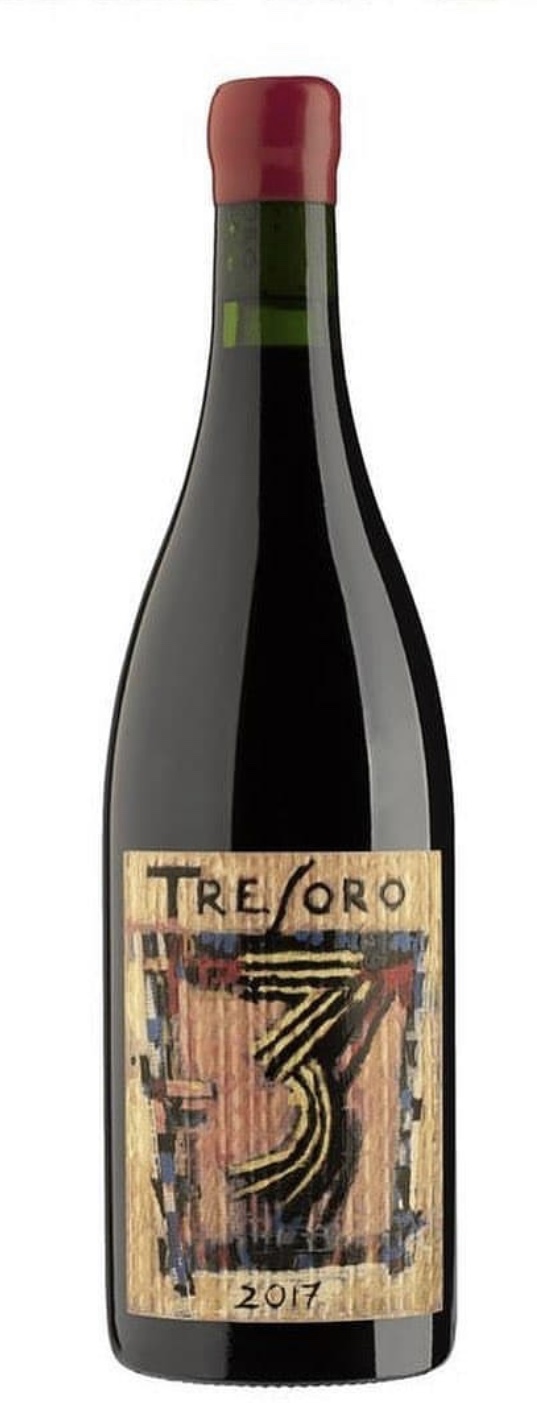
Ugo also shared some news with us. Tenuta Prima Pietra had banded together with two like-minded wineries (Caiarossa and Duemani) in the area to promote Riparbella as a wine region. Their first initiative towards this end is a cooperative wine called Tresoro. This wine is a blend of Merlot, Cabernet Franc, and Cabernet Sauvignon grown on each estate. The grapes were vinified and aged at each estate and then sent to Caiarossa for blending and bottling.


I have written extensively on Tuscan Merlots but had not encountered this region, or these wineries, prior to this presentation. My interest was piqued.

Riparbella is located in Val de Cecina (shown in the map below) which "extends along the River Cecina in the south of the Province of Pisa" and also including portions of the provinces of Grosetto, Liivorno, and Sienna. The valley is hilly in the hinterland and mostly flat near the mouth of the river.


Riparbella is located due north of Bolgheri, with the mentioned estates located on high ground in an arc to the north of the actual town.

Location of Riparbella wineries (represented by Caiarossa)
relative to Bolgheri

The area is perfect for grape growing, with plenty of sunlight, a Mediterranean climate, a steady wind blowing in off the sea (modifying the temperatures and ventilating the vines), and significant diurnal temperature variation. These conditions allows for a longer growing season -- allowing the grapes to reach full maturity -- while retaining the acidity required for freshness and aging.

The chart below shows the distribution of the estates and some of their vital statistics.


Duemani
The leftmost of the three -- Duemani -- is spread over two distinct locations. The estate is owned by Elena Calli and Luca d'Attoma, the latter a highly respected Tuscan winemaker, and was established on the Tuscan coast because the owners wanted to produce wines from their favorite grape varieties (Cabernet Franc, Syrah, and Merlot). They decided to farm biodynamically in order to respect and preserve the environment. The stated goal of the estate is "to produce wines that are fine, clean, direct, and delicious with unique and recognizable character."

The Duemani partners found the original 7 ha in 2008 and planted three vineyards on the amphitheatre-like setting: Cabernet Franc at the top; Merlot towards the bottom; and Syrah in a small, goblet-shaped vineyard in the middle of the slope. This rocky, dry-soil vineyard is the heart of the estate.

In 2014 they planted 3 more ha of Cabernet Franc at 383 m. Today they have a total of 12 ha under vine.

The Duemani portfolio is all red wines with the exception of a 100% Rosé Syrah. Two of the remaining wines are 100% Cabernet Franc, one is a Merlot/Cabernet Franc equal parts blend, one a 100% Syrah, and the last a 100% Grenache. Wines are fermented in amphorae, cement vats, conical French oak tanks, and French oak barriques and are aged in similar vessels plus tonneaux.


Tenuta Prima Pietra
The rightmost of the three is Tenuta Prima Pietra, owned by Massimo Ferragamo (who also owns Castiglione di Bosco in Montalcino). Organic farming is at the estate's core in that it "provides the best way to maintain the balance required in a natural vineyard" and allows the vine to be "consistent and sincere, a proud ambassador of the vintage, harvest, the terroir of the estate and the personality of each single varietal."

The composition of the estate's wine mirrors the distribution of cultivars in the vineyard. The grapes are vinified (separately) in steel tanks and then aged (again, separately) in French oak for 18 months before blending prior to bottling.


Caiarossa
Caiarossa, the largest of the three estates, is owned by Eric Albhda Jelgersma, who also owns the Bordeaux estates Chateau Giscours and Chateau du Tertre. Biodynamic farming is at this estate's core, as manifested in its cultivation activities (animal and grain manure and fermentation residue, biodynamic preparations, cover crops) and vine-protection initiatives (stimulation of the natural defences of the plant, spray with low doses of sulfur and copper, pesticides based on natural mineral substances, "sexual confusion" to control insect population).

The wine lineup includes a Viognier - Chardonnay blend, a late picked Petit Manseng, a blend that incorporates all of the estates red grapes, a Bordeaux blend plus Syrah, and a Sangiovese wine with small additions of Cabernet Franc and Merlot.

*******************************************************************************************************
Discovering this region and these estates was an unforeseen effect of attending the Podere le Ripi talks. They stepped out of the box and showed us something totally new. Kudos to the team.

As for the region and the estates, it will be interesting to see how they grow and evolve. I look forward to going into the area, after things have gotten back to some level of normalcy, and tasting their wines on site.


©Wine -- Mise en abyme

Saturday, May 2, 2020

Emergent Spanish wine regions: Alicante

Pedro Ballesteros Torres, in a 2/2/18 Decanter article on Spanish wine trends, wrote about newly emergent wine regions thus acclaimed based on the aggregated effects of:
  • Developments in viticulture and oenology
  • Climate change
  • A resurgence of the perennial value of indigenous varieties
  • A market eager to reward niche identities.
I have been providing a brief overview of each of these regions as well as detailing the reason(s) why they are considered emergent. I continue herein with a post on  Alicante.

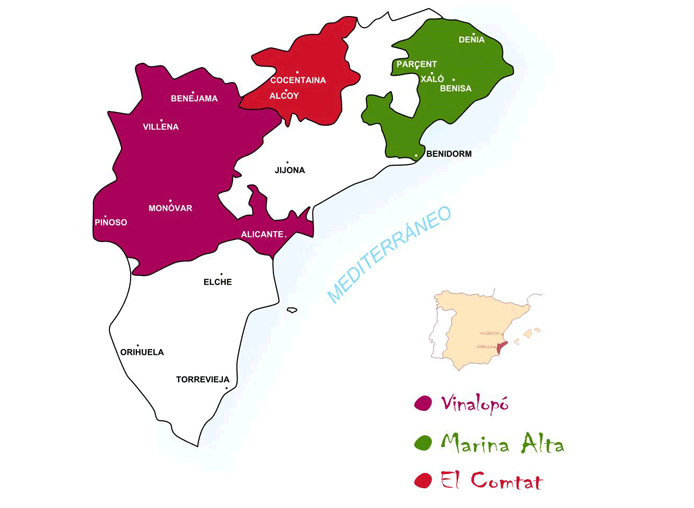
Alicante was awarded DO status in 1957. It is divided into two major zones and the area between:
  • La Marina -- the northernmost region, sited in the coastal area between the towns of Denia and Calpe. The climate here is Mediterranean with annual rainfall of 500 mm. The soil is limestone and the vines are dedicated to the Moscatel grape.
  • Vinalpo -- the southernmost region. Large, more inland section between the towns of Villena and Pinoso. The climate is continental and dry with rainfall of 300 mm/year. Primarily produces red wines from Monastrell. Iconic red is sweet Fondillon made from overripe grapes in the Rancio style.
  • El Comtat -- the area between the two, both in terms of geography and climate. Produces both dry red and sweet white wines.

DO Alicante (Source: goodfoodrevolution.com)

The soil in the region is limestone, with low levels of organic matter, and alluvial material, with some clay, near the coast.

When the DO was established in 1957, the requirements only allowed for Alicante Bouschet, Monastrell, Moscatel, and Bobal. The Moscatel (La Marina district) made delicious fortified and dessert wines, including the famed Moscatel de Alicante.

Why Alicante as an Emergent Region?
Alicante was once known as a region of bulk production and indifferent quality. However, according to Cellar Tours, a new generation of winemakers has come to understand which varieties fit their territories and, as a result, are producing some excellent blends that are more familiar to the world markets. In addition, these producers are also focusing on elegant and fresh reds,

According to BBR, the renovation of the infrastructure and vineyards in the region have helped rehabilitate Monastrell's reputation as it now produces "fleshy, concentrated, complex wines with intense violet and redcurrant notes."

******************************************************************************************************
The regions identified as emergent by Torres in his initial article are:
©Wine -- Mise en abyme

Wednesday, April 29, 2020

Mapping the DOC(G) sparkling wines of Italy's Campania region

In my quest to map the sparkling DOC(G) wines of Italy, I have completed overviews of the sparkling wines of North and Central Italy and the southern Italian regions of Abruzzo and Molise. I now turn to the sparkling wines of another south Italy region: Campania.

Campania, the shin of the boot that is Italy, is its third most populous region. And with its 5.8 million people resident in an area covering 13,590 sq. km., it is the country's most densely populated region. But it is famed for factors beyond population. "The region is home to 10 of the 55 UNESCO sites in Italy ..." and its "... rich natural beauty ... makes it highly important in the tourism industry, with the city of Naples, the Amalfi Coast, Mount Vesuvius and the islands of Capri and Ischia continuing to be major attractions" (Wikipedia).

Campania is well-suited to the production of high quality wine. Its abundant sunshine, dry and hot summers (with coastal Mediterranean breezes tempering the heat), mild winters, mountainous terrain (allows planting at higher elevations), volcanic soil, lengthy growing season, and own-rooted vines (Phylloxera did not visit) add up to a growing environment that is a winemakers dream.

And this environment supports a number of high-quality white wines (Tom Hyland):
  • Greco di Tufo
    • Very good levels of acidity and excellent aging potential
    • Less aromatic but with a bigger structure
    • Minerality and concentration
    • Does well in the volcanic soil in the mountainous terrain of Avellino
  • Fiano di Avellino
    • One of the most complex and elegant white wines of Italy
    • Aging potential of 10 or more years
    • Does well in the volcanic soil in the mountainous terrain of Avellino
  • Fiano di Salerno
    • More clay and limestone soil; fruit-driven, with less minerality
  • Falanghina and Asprinio
    • Both high-acid wines. 
Grapes that produce high-acid white wines are good candidates for sparkling wines. The chart below shows the appellations which allow sparkling wine within their borders and the grape varieties (and their proportions) utilized in their production. The chart directly following shows the sparkling wines produced in the region, in many cases, utilizing the described grapes grown in the highlighted regions.


Some observations:
  • One of the four DOCGs and nine of the 15 DOCs allow for the production of sparkling wines
  • Most of the Campania appellations are bunched in the upper part of the region as is the allowed sparkling wines
  • With one exception -- Costa d'Amalfi DOC -- no international varieties are used in the production of the region's sparkling wines. Both Chardonnay and Pinot Nero are approved for use in the Costa d'Amalfi Spumante
  • A total of 38 labels are approved over the 10 appellations shown above making for an average of 3.8 labels per appellation. Of course, the bulk of the labels are distributed between Sannio DOC and Vesuvio DOC
  • 15 of the approved labels are Metodo Classico specifications
  • Thirty-one of the approved labels are for varietal sparkling wines with Falanghina, Fiano, and Greco featuring prominently.
The sparkling wines in Greco di Tufo DOCG are made in the traditional manner and stay on the lees for at least 3 years. According to tasteatlas.com, "These straw yellow wines are intense, herbaceous, floral, and fruity with typical notes of apples, jasmine, thyme, or sage. They are best paired with rich seafood dishes and could go well with lobster or cod ... they are also an excellent aperitif and would be a great match to various appetizers."

Feudi di San Gregorio, one of the leading independent wine producers in Campania, has established a separate label -- DUBL -- under which to market its Spumante wines. This project began in 2004 and was aimed at bringing the classic sparkling wine method to the grapes of the Campanian tradition: Greco, Aglianico, and Falanghina.

Feudi San Gregorio felt that they had the high-quality fruit for such an initiative. The internal areas of the region are ideal for growth of grapes destined for sparkling wines:
  • Diurnal temperature differences would allow grape ripening with acid-retention
  • The ventilation and exposure of the vineyards are ideal
  • Rugged terroir 
  • Volcanic soils.
They did not, however, have the requisite skill. To fill that gap they sought the advice and assistance of Anselme Selosse -- of Jacques Selosse grower-Champagne fame. The wines that resulted were a 100% Greco sparkling wine, a 100% Aglianico sparkling Rosata, and a 100% Falanghina as a Double Brut.

In April 2016, DUBL extended its product portfolio with DUBL Esse, a Dossagio Zero line, with a white sparkling made from the best grapes from the most exciting vineyards in the Tufo area and a Rosata which comes from grapes from the most exciting vineyards in the Taurasi area.

********************************************************************************************************
With Campania now in the rearview mirror, I will next look to the sparkling wines of Puglia.

©Wine -- Mise en abyme

Friday, April 24, 2020

Emergent Spanish wine regions: Bierzo

Pedro Ballesteros Torres, in a 2/2/18 Decanter article on Spanish wine trends, wrote about newly emergent wine regions which have become so propelled by the aggregated effects of:
  • Developments in viticulture and oenology
  • Climate change
  • A resurgence of the perennial value of indigenous varieties
  • A market eager to reward niche identities.
I am in the process of providing brief overviews of each of the identified regions, including the reasons why they are considered emergent. I cover Bierzo herein.

Bierzo is a small, rural, remote, ancient region sited within the boundaries of the autonomous region of Castillo Y Leon (it is shown in the northeastern portion of the map of the autonomous region below).


The region (awarded DO status in 1989) has surged in popularity after Alvaro Palacios (of Priorat fame) established vineyards there with his nephew Ricardo Pérez. It is divided into two terroirs: Bierzo Alta, a mineral-rich, mountainous terrain with terraced vineyards; and Bierzo Bajo, a "wide and verdant plain."

Bierzo's climate is continental but much cooler than Castillo Y Leon inland areas due to its relative proximity to the Atlantic Ocean. The Cordillera Cantábria to the north protects  the vineyard from north winds while the Sierra de los Ancares to the northwest calms the force of Atlantic storms.

Average rainfall is 720 mm/year.

The soil is predominantly slate and granite on the higher slopes with alluvial soils of quartz and clay in the lower reaches.

Mencia is the undisputed star variety of Bierzo. This recently prominent red grape accounts for 2/3rds of the region's planted vines. The slate and granite soils allows the Mencia grape to produce riper wines with greater mineral character and less alcohol than any other region in Castilllo Y Leon. According to Michael Schacter (Wine Enthusiast's Editor of Spanish and South American Wines), "when vinified properly, it delivers wines with purity of fruit, superb structure, fine balance, versatility at the table and good to excellent value." Premium examples of the wine are "typically characterized by intense yet smooth flavor, often including floral and spicy notes."

The other red variety of note in the region is Garnacha while the whites are Doña Blanca, Godello, Palomino, and Malvasia.

The wines of the region are shown in the table below.

Table 1. Selected Wine Types and Styles in Bierzo DO
Type
Style
Variet(ies)y
Requirements
White

Godello and Doña Blanca complemented by Palomino and Malvasia in different percentages


Gran Reserva

> 6 months in oak; > 18 months in bottle
Rose

Mencia (50%) and mixing red or white grapes


Gran Reserva

> 6 months in oak; > 18 months in bottle
Red
No oak
> 70% Mencia
First or second year wine

Crianza

> 2 years aging; > 6 months in oak barrel of < 300 L

Reserva

> 3 years aging; > 12 months in oak barrel of < 300 L

Gran Reserva

> 5 years aging; > 18 months in oak barrel of < 300 L; remaining period in bottle

Why Bierzo as an Emergent Region?
One commentator sees the region's mineral-rich slate soil, continental climate, and intrepid winemakers combining to create some "truly memorable" red wines.

According to Michael Schacter, Mencia has been the fire for the fuel that is engulfing Bierzo.

Another commentator: "Bluntly stated, Bierzo is arguably Spain's most exciting wine region, where you can trade in the country's big-bodied, sometimes fiercely tannic Tempranillos and Garnachas for wines with exotic aromas, alluring flavor profiles and undeniable style."

******************************************************************************************************
The regions identified as emergent by Torres in his initial article are:

©Wine -- Mise en abyme

Tuesday, April 21, 2020

Sangiovese: the variety at Italy's core

As I work my way through the sparkling wines of Italy, I have been diverted from time to time by the urge to dig deep into the details of significant varieties on the Italian wine landscape. Such was the case for Grechetto and Grechetto Gentile; and such is the case for Sangiovese.

Sangiovese is the most widely planted of the Italian varieties (63,000 ha; 10% of all plantings) and is the basis for some of the most important wines in Central Italy. The grape, the name of which translates to "Blood of Jove," is small-to-medium in size, round-to-oval in shape, and grows in tight clusters with wings at the shoulders. The skin is thin, with a deep-blue to dark-purple color. The flesh is translucent, seeded, and endowed with high acidity and medium-to-strong tannins.

In addition to the name Sangiovese, the variety has been referenced variously as: Sangiovese grosso, Sangiovese piccolo, Sangioveto, Sangiogheto, San Gioveto, San Zoveto, Prugnolo, Morellino, Brunello, and Nielluccio.

Research has shown it to be the offspring of Calabrese Contenuova and Ciliegiolo but this finding has been disputed by subsequent, competing research results.

Clones
It was previously thought that the grape had three manifestations -- Sangioveto in Chianti, Prugnolo Gentile in Montepulciano, and Brunello (Sangiovese Grosso) in Montalcino -- but clonal research initiated in 1980 (representatives from Banfi, the Chianti Classico Consortium, and the Universities of Florence, Perugia, and Milan) showed that:
  1. Sangiovese is a family of highly adaptive grapes
  2. There are two biotypes: Tuscan (57 clones) and Romagnon (13 clones).
In further work, Banfi has identified 650 clones in the Montalcino zone and has studied and registered 15 of them. The Banfi study has assessed a number of characteristics (berry size and weight, sugar accumulation, color capability, and tannin polymerization capability) and found significant variation from clone to clone. The team also found that Sangiovese is, moreso than other grape varieties, adaptable to different growing environments.

A total of 70,948 ha of Sangiovese is planted worldwide, with 63,000 ha of that total located within the borders of Italy. Argentina (2804 ha), Romania (1700 ha), Corsica (1633 ha), California (1371 ha) and Australia (440 ha) are the other "significant" players on the field. Within Italy, plantings are concentrated within the Central provinces but are also to be found in Lombardia, Emilia Romagna, Valpolicella, Campania, and Sicily.

Wine Characteristics
Jancis Robinson sees Sangiovese wines ranging along a spectrum which includes mulberries, prunes, spice, tobacco and (sometimes) leather and chestnut. "It tends to be savoury rather than sweet and, if not fully ripe, can smell distinctly farmyard-like."

Ian D'Agata, of Vinous, sees "violet aromas and black tea leaf on the nose and a red fruit profile (red currants and strawberries in cooler areas, red cherries in warmer areas) on the palate  with leather and underbrush notes appearing as the wine ages."

According to Vine Pair, the traditional characteristics of Sangiovese are as follows:
  • Ripe and tart red fruit (particular sour cherry)
  • Savory herbs (fennel, rosemary, thyme)
  • Non-fruit notes to include tomato, iron and balsamic
  • Minerality (clay, dark rock)
  • Medium- to full-bodied
  • High acid
  • High tannin.
As has been pointed out previously, however, the Sangiovese character is strongly influenced by the soil in which it is planted. The variety clearly has an affinity for Tuscany, attributable, it has been said, to the limestone levels in the region. There are higher levels of limestone in the soils of Montalcino and Chianti Classico than in the more clay-based soils of Chianti; the difference in wine quality is illustrative. The chart below shows the variety's character as represented in some of its most famous wines in its most famous region.


In addition to Toscana, Sangiovese can be found in:
  • Emilia-Romagna -- Sangiovese di Romagna is the most important Sangiovese zone outside Tuscany. The wine has to be a minimum 95% Sangiovese and expressions range from full-bodied and tannic to lighter, fruitier options, based on location
  • Umbria -- The grape is used in the Montefalco Rosso DOC (60 - 80%); Torgiano Rosato and Rosso DOC (> 50%); and Torgiano Rosso Riserva DOCG (> 70%)
  • Marche -- Some pure expressions but primarily used as a blending agent (up to 15%) with the Montepulciano grape in Rosso Conero
  • Lazio -- Important red wine grape in this province.
Sangiovese has aging potential but the vast majority of its wines are consumable in the earlier parts of their lives. Brunello is an exception in that it requires 5 - 10 years to be optimal. Most other Sangiovese wines are ready at around 5 years and peak at around 10.

Winemaking
Sangiovese's high acidity, light color (due to a lack of acylated anthocyanins), and light body can be problematic for winemakers. They have, however, devised a number of methods to add body and texture to wines made from the variety.

Varietal Blending
Winemakers have historically blended Sangiovese wines with other varietals in order to complement its attractive qualities and fill in some of the gaps. These historical blending partners include Canaiolo, Ciliegiolo, Mammolo, Colorino, and white grapes Trebbiano and Malvasia.

Since the late 20th-century, it has become fashionable to blend Sangiovese with Bordeaux varietals, especially Cabernet Sauvignon and Merlot. Cabernet Sauvignon adds "rich saturation and structure" while Merlot adds lushness and softness. Chianti limits Cabernet Sauvignon to 15% of the blend.

Clonal Blending
Growers are utilizing  the newly commercialized clones that have emerged from research to affect the character of their wines. Banfi has taken the lead in clone blending, choosing 15 of them as being best-suited to its microclimate and preferred style of Brunello. One of these clones provides more violet aromas, another provides greater acidity, while a third provides deeper color.

Other Tactics
A number of other tactics have been deployed:
  • Utilization of grapes from extremely low-yielding vines
  • Adjusting fermentation temperature and length
  • Extending maceration from a period of 7 - 12 days to a period ranging between 3 and 4 weeks
  • Use of new French oak for aging rather than the traditional large, used oak botti
    • Transferring the wine to new French oak barrels for malolactic fermentation results in higher levels of tannin polymerization and a rounder, softer mouthfeel
    • Wine flavor is enhanced due to Sangiovese's sponge-like acquisition of sweet vanilla and other oak components from the barrels.
Sangiovese and Food
According to Food and Wine, "Pair Sangiovese with rare steaks, roasted game birds (or wild boar), rich chicken or mushroom dishes or anything with tomato sauce. On her Il Palazzone blog, Laura Gray, the Estate Manager, shared a wonderful recipe for Onion and Paprika Beef Spezzatino to accompany the estate's 2013 Brunello. It looks fantastic.

*********************************************************************************************************
I took a detour from sparkling wines and happened upon the "Blood of Jove."

©Wine -- Mise en abyme

Sunday, April 19, 2020

Greek Wines: Santorini and Beyond (A conversation with Yiannis Karakasis MW), Part 2

In Part 1 of my conversation with Yiannis Karakasis MW, we covered existing and emerging Greek wine terroirs. The conversation continues and concludes in this post.


Vineyard plantings are approximately 55% white grape varieties and 45% red but, more importantly, 90 - 95% of the 65,000 ha are planted to indigenous varieties. This is important for us. We have carried the flag of indigenous vineyards for a lot of years. We are proud of our indigenous varieties.

In response to a question on the differences of Assyrtiko and Malagousia across geographic regions, Yiannis responded thusly. There are 2000 ha of Assyrtiko vines planted nationwide with 40 - 45% of the plantings in Santorini. If you have a scale with minerality on one side and fruit on the other, Santorini comes down hard on the minerality side with high minerality, saltiness, and evaporating smoke. If you go to mainland Greece, the Assyrtiko is broader, with more fruit. In the islands, the Assyrtiko is balanced between fruit and acidity.

In discussing emergent producers, Yiannis talked about waves of Greek wine producers. He saw the first wave as establishing the foundation of Greek wines and included producers such as Alpha Estate, Domaine Gerovassiliou, Ktima Kir Yianni, Ktima Pavlidis, Boutari, Sigalas, and Gaia. These were then followed by a second wave and a third wave, because we are always looking for something new (I have attached a link to Yiannis' 2016 article on a new generation of Greek winemakers here). What he is looking for are producers that are doing exciting new stuff. An example of that is Santor, the first biodynamic winery in Greece.


As it relates to the regions, most are limited in plantings. For example, Rapsani only covers 100 ha and Naousa 700 ha. Nemea, the largest PDO, only extends 2500 ha; and Santorini covers 1100 ha. He would like to see more things happening in the vineyard because everything starts from there. He is expecting to see more from Nemea in the future. Some of the areas where he expects to see new stuff happening include:
  • Keffalonia
  • Crete
  • Peloponnese
  • Several islands in the Aegean
  • Rapsani
  • Goumenisa.
There is an emphasis on producers going to high elevation vineyards both to change the expression of the variety as well as to combat climate change.

A lot of people are pursuing organic farming but he would like to see more. Fewer wineries are experimenting with biodynamics. Only one winery is certified in the country. They do need to do a lot more work in the vineyard. Especially in the areas of bush vines and clonal selection. He sees bush vines as a strategy to improve quality in the face of a changing climate.

In terms of varieties, you have to ask the question: Do we have a variety that can produce world class wines? Assyrtiko has answered that question. And we can say the same about top-quality Xinomavro. But Xinomavrio is a capricious variety, requiring extreme care in its handling in order to make top-quality wine. It requires good handling in the vineyard to attain phenolic ripeness and gentle handling in the winery in order to avoid a lot of aggressive tannins.

Beyond those two he thinks that:
  • Agiorgitiko can produce world class within two or three years
  • Robola cam produce top quality wines
  • Liatiko can produce high-quality wines (as evidenced by the wines of Economou)
  • Mavrodaphne can produce top quality, unique wines.
The top-level wines in Greece are mostly varietal. Xinomavro is blended in Goumenisa and Rapsani. While the law in Santorini allows for a minimum of 75% Assyrtiko, most of the wineries produce 100% wines.

He likes what he is seeing in the cellars:
  • A lot of experimentation with old oak
  • Moderate alcohol
  • Amphorae and concrete as fermentation vehicles
  • Low-intervention winemaking.
He is hoping that the natural wine regulations instituted in France is adopted by all the European countries such that confusion is minimized. There is some skin-contact wines being made in Crete, Attica, and in the north but people are still confused as to skin-contact and natural wines.

I asked about Retsina and Yiannis said "Will the real Retsina please stand up." The winemakers, he said, are using so little resin today that you cannot spot it in the wine. They go for elegant but if you don't spot the resin then you don't have Retsina. Retsina brings bad memories for a lot of people but we need to be proud of the really good Retsinas on the market.

The external markets (20%) for Greek wines are Germany (50% of exports), France, USA, Canada and the UK. The Germans are looking for inexpensive wines but beyond that, the wines are consumed in top restaurants in London, Paris, and New York. The wines are food-friendly and allow Somms to experiment freely.

As to how things will look post-lockdown, Yiannis shared that tourism is 15% of the Greek economy and, indirectly, 20 - 25%. If the lockdown ends towards the end of May, then they can work their way back slowly to where they were pre-lockdown. If it extends beyond that, "it's a big problem."

I wished him all the best on that Good Friday night in Athens and for the days to come. Thank you Yiannis.


©Wine -- Mise en abyme