Showing posts with label Cuba travel. Show all posts

Tuesday, January 3, 2017

Out and about in Havana: In search of the co-op

I was awakened by sunlight streaming into our room through the sliding glass door leading onto the balcony. After a top-level breakfast at Sierra Maestra, we went down to the hotel lobby to explore options for our second day in the city.

We decided to start off with a city tour and opted for one of the Classic American cars parked outside the hotel. The problem, though, was that the person who solicited our business was not the same person driving the car. The person with whom we negotiated the deal spoke perfect English. Once we got into the car and engaged the driver, we realized that this was not going to work. The driver had very little English; a slight problem when you are looking forward to a narrated tour -- in English. We asked the driver to pull over and got out. We then went to plan B: the hop-on, hop off buses.

Hop-on, hop-off service is ubiquitous in tourist destinations around the world and is a great way of getting an overview of a new city at your own time and pace. The problem with the Havana service was the frequency (or, rather, the lack of same) and the paucity of information conveyed by the onboard "tour guide"(who also doubled as the cashier). After a frustratingly long wait, the bus showed up and we (wait for it) hopped on.


We began our ride in Verdado and traversed the entire length of the Malecón to Old Habana, with one or two stops along the way.

View of the Malecon with Straits of Florida in background

Sea wall and promenade of the Malecon

View of the waters from the Malecon sea wall

View Vedado to Old Havana

Hotel Nacional, as viewed from the Malecon
We disembarked at Central Park and immediately made our way over to the brightly colored vintage American cars that were lined up waiting for passengers. As we walked among the cars, we were constantly asked whether we wanted to take a tour of the city in one of the cars. Or if we wanted to have our pictures taken sitting in one of the cars.

The area was bustling with tourists walking among the cars, getting into cars at the beginning of trips, or getting out of cars at the conclusion of tours. As I stepped across the street to take a wide-angle shot of Parlo among the cars, I sensed someone coming towards me. Out of the corner of my eyes I saw him pause and look down at my socks (The tops of my socks displayed the colors of the Jamaican flag.). I could see the wheels turning over in his head as he sought to incorporate this observation into his approach. And then he pounced. He greeted me like a long lost brother. He loved Jamaica (I am not Jamaican); his Grandmother came to Cuba from Jamaica when she was 5 years old; etc., etc.

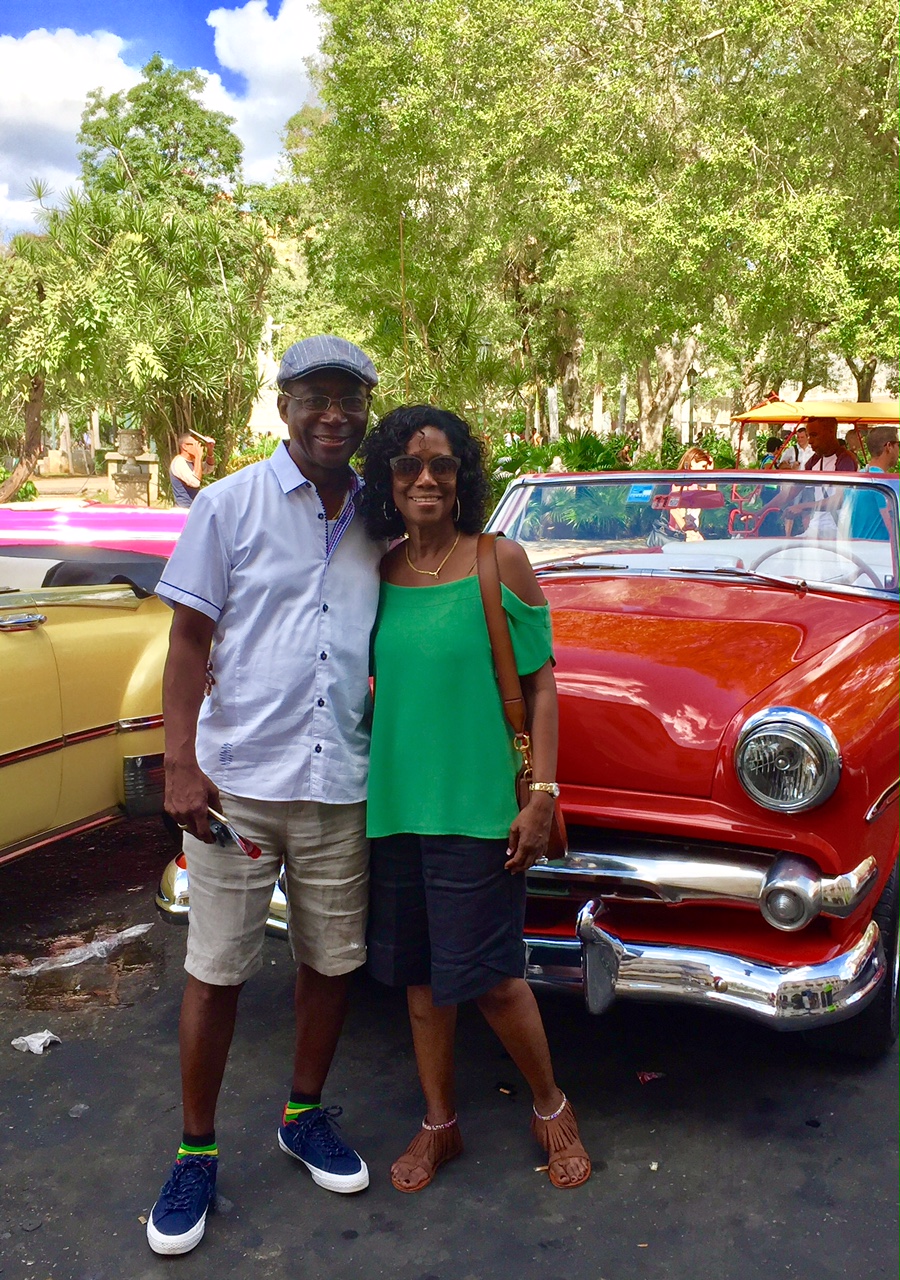

After this hearty opening, he proceeded to the lines of whether we wanted to take a city tour in one of the cars; or wanted to have our pictures taken sitting in one of the cars. Now he did not own a car. He was what I have previously described as a "steerer." When he realized that we were not interested in any car-related activities, he pitched going to the co-op where we could purchase cigars significantly below the price being charged at the hotel. This sounded interesting because I thought I would see some cigar production activities. And, according to my guy, the co-op was within walking distance.


We headed west away from Central Park and then turned south. Conditions deteriorated rapidly and we appeared to be swimming upstream against a mass of humanity that was hell bent on getting out of the area that we were going into. After walking for a little while I realized that this was the area that my wife's friend had pointed out to me from my hotel room as an area to avoid. Well, we were already in it.  My wife was cheerily taking photographs of her surroundings as we went along and I kept thinking "I know the crime rate is low in Cuba but I wished you had left that ring in the US."


We walked for a while. People looking at us because we were obviously tourists. Our "guide" hailed folks along the street and in some of the apartments which lined the street on both sides. He was as a big game hunter returning to the village with a trophy kill. Us.

After what seemed like an eternity, we turned into a dilapidated apartment building and walked down a hallway off which a number of doors opened. Living quarters all; and not very palatable. This was definitely not what I had expected when we set out on the "visit to the co-op."

There were a few other souls in the room perusing the cigar display. A woman was attempting to close a sale with a reluctant buyer so my guide launched into sales mode. Purchasing the cigars here would be helping these people and the price was significantly lower than at the hotel. As he went through the spiel, he was handing me different packaging options: Cohiba in bulk; smartly packaged Robustos; and a pocket-sized edition.

During the time that I smoked cigars seriously, Cohibas had always been my favorite. But there was an adage among Cohiba smokers: There are many more Cohibas sold than are made. There was no controlling for authenticity in this environment so I would not bite. My guide was not happy.


But he perked up when we said that we needed to have lunch. He knew just the place, he said. So we embarked on another long march to the other side of the old town. I will cover that experience in a subsequent post.

©Wine -- Mise en abyme

Wednesday, May 27, 2015

Short- and long-term implications of US-Cuba travel liberalization for Caribbean tourist destinations

My friend recently bought a vacation home on the Jamaican north coast and, as a result, we have been making the trek between MCO and Norman Manley Airport with some frequency. On my last trip over, I happened to have a window seat (a fate second only to having a middle seat) and noted the broad expanse of Cuba as we traversed its airspace. And that set me wondering. With the recent opening to Cuba announced by President Obama, it is conceivable that a fuller liberalization will follow sometime in the the future. What then would be the impact of such liberalization on non-Cuba Caribbean tourism, in general, and Jamaican tourism, specifically. My curiosity was piqued so I set out to investigate.

According to the Jamaican Tourist Board (jtbonline.org), there were 25 million tourist arrivals in the Caribbean in 2013, a 1.8% increase over 2012. The United States was the most important contributor, with 12.3 million of its citizens having travelled to the region in that timeframe, up 2.9% over 2012. The percentage distribution of visitors to the region is shown below.

Country/Region
Percent of Total
USA
45.3
Canada
12.3
Europe
18.9
Caribbean
6.4
South America
5.8
Other
7.3

The three most visited islands, ranked by frequency of visit, are Dominican Republic, Cuba, and Jamaica (It should be pointed out that Cuba is second in the ranking even though it had less than 100,000 US visitors in 2013.). Jamaica itself had 2 million stopovers in 2013, 1.8 million of whom were foreign and the remainder non-resident Jamaicans. One million of these visitors came for "liesure, recreation, and holiday."

Cuba had 2.8 million visitors in 2013 with a total spend of $2.3 billion (Jessop). Of the visitors, 92,000 were from the US (the 350,000 - 400,000 Cuban-Americans who visit Cuba annually are not included in these numbers).

Just to review, the recent Obama initiative allows the following (knowledge.wharton.upenn.edu):
  • Americans can visit Cuba for any of 12 reasons without having to obtain a special government license
  • American travelers to Cuba can bring back up to $400 worth of goods inclusive of cigars and liquor
  • Travelers can now use their debit and credit cards on the island
  • US financial institutions can open accounts at Cuban banks and enroll merchants there.
Jessop sees a number of short-term implications associated with this opening:
  • Increasing pressure on available hotel rooms
  • A concomitant upward trend in currently low-priced room rates
  • Increased investment in the hotel sector by foreign companies
  • Pressure from US legacy carriers to fly scheduled services to Cuba out of the US
  • The increased attraction of sailboats into the recently constructed Cuban marinas
  • Increasing number of calls by cruise ships
  • Rapid diversification and decentralization of Cuba's tourism product.
But these implications are associated with the current Obama initiative. A number of economists have been studying the issue of a complete elimination of the US tourist barriers -- a not-inconceivable development, given where things are headed -- both in terms of its implications for Cuba as well as for its neighbors. In commenting on Padilla's projection of the Cuban tourism industry post-Castro, Crespo estimates that his forecast of 3.2 million additional US visitors to Cuba annually would require:
  • Betweeen 98,000 and 116,000 additional hotel rooms at a cost of between $4.3 and $5.7 billion
  • Additional uplift capability to carry those visitors.
According to Crespo, it would take between 17 and 22 years to build an additional 58,000 - 76,000 rooms and this factor alone ensures a non-apocalyptic increase in US tourism to Cuba.

Romeu, in an IMF Working Paper, used a  gravity trade model to assess the outcome of US travel liberalization. His findings were as follows:
  • Liberalization would increase overall visitor arrival to the Caribbean by between 2 and 11%
  • The current budget-conscious, adventure-focused OECD visitor will be displaced by the US visitor who has lower transportation costs and demands higher levels of service
    • It is likely that these tourists will select destinations with which they might have had a former colonial relationship or some language or other cultural affinity
  • There will be a loss of US tourists for the other Caribbean countries but their losses will be offset somewhat by the redirected OECD tourists
    • Spend will be at lower levels though given the type of tourists being redirected
  • Strong tourism growth awaits some destinations while others face potential long-term decline

In the short-term, there will be a slow but steady increase in the number of US tourists visiting Cuba. Given the constraints imposed by the President, these trips will most likely be taken by culture warriors, not a core constituency for the Caribbean tourist market. In addition, these trips will be one-offs; "I was there while the country was still unspoiled."

In the longer term, however, there are significant risks for Cuba's neighbors. Its attractiveness is reinforced by the fact that it is the second-most-visited Caribbean country, even with a paltry amount of US tourists. If tourism were liberalized, and even if a large amount of US tourists visiting Cuba were first-time Caribbean visitors, there would still be some siphoning-off of "Caribbean regulars." So it is likely that Jamaica, for example, would see a decline in its US-origin visitors. And I would propose that it would be a consistent drop over a number of years as some percent of those visitors seek to "try-out" Cuba. The country would have a significant additional competitor for the US tourist dollar. And the pool of redirected OECD numbers will be split between the countries and, in addition, the per capita spend of each individual will fall below the per capita spend of the US tourist. The financial implications are evident.

In order to compete in this marketplace, the countries will have to focus on customer attraction and retention. Customer attraction will revolve around giving first-time visitors a reason to come. Cuba is a large country with a diverse array of experiences to offer to the tourist. These countries will have to map out points of interests and activities to get customers to visit their countries and to stay. For example, I have been visiting Jamaica for years now and have never been to Port Antonio. I visited there on my last trip and was blown away by the history of the area, the available activities, and its place as the home of the jerk style of cooking. These countries will have to do a better job of providing a more fulsome picture of the available areas of interest (in addition to the sun and sand and rum).

In terms of customer retention, the folks at Disney and Universal are constantly adding to the palette of attractions, giving visitors a reason to come back to Orlando again and again. These countries will have to adapt that mentality and constantly be on the lookout for additions to the "attractiveness" portfolio.

One of the reports that I read suggested that these countries partner with Cuba in order to develop packages where someone could spend three days, lets say, in Cuba and two days in another country. I do not see this happening. Cuba can easily support a tourist over seven days with the diversity in its environment and it would have no incentive to partner with these smaller countries. What would those countries bring to the table that would be of interest to Cuba when Cuba has the tourist sitting behind the wheel of a 1959 Dodge in Havana? I can't see it.

REFERENCES
David Jessop, Cuba and Carribean Tourism, Dominicantoday.com, 1/9/2015
Havana or bust: How US-Cuba Realtions will impact Tourism, knowledge,wharton.upenn.edu
Nicolas Crespo, Comments on "The Tourism Industry in the Caribbean after Castro" by Padilla, ascecuba.org
Rafael Romeu, Vacation Over: Implications for the Caribbean of Opening US-Cuba Tourism, IMF Working Papaer, 7/2008.

©Wine -- Mise en abyme