Showing posts with label Brettanomyces. Brettanomyces management. Show all posts

Tuesday, June 6, 2017

"Bad-Brett" management Part II: Repairing contaminated wines

In Part I of this series on Brettanomyces, I laid out the characteristics of the microbe, the contamination routes, and conventional methods employed in controlling its growth. In that post I also referenced some approaches advanced by Dr. Jamie Goode to fix wines that had been contaminated by Brettanomyces. The chart below summarizes both the "control" and "fix" tactics presented by Dr. Goode in the Somm Journal article cited in the chart.


In his book postmodern winemaking, author Clark Smith posits that "... a revolution is taking place within the winemaking industry. Precepts of the modern winemaking system we were taught in school simply don't support the making of the great wines the market demands, and as a result, some of our most successful winemakers have strayed quite far from conventional dogma." These winemakers are using what Smith calls postmodern winemaking to "... merge all of the wine's flavor into a coherent whole like a well-conducted orchestra producing a unified, soulful voice."

As stated in his book, postmodern winemaking does not seek to throw out all elements of modernity and replace them lock, stock, and barrel with a new canon. Rather, postmodern winemaking uses existing pieces where appropriate and substitutes/adds where necessary. Below I provide a graphic representation of wine production under both the modern and Smith's postmodern schemas. The key extensions of postmodern winemaking are provided in red in the below chart.
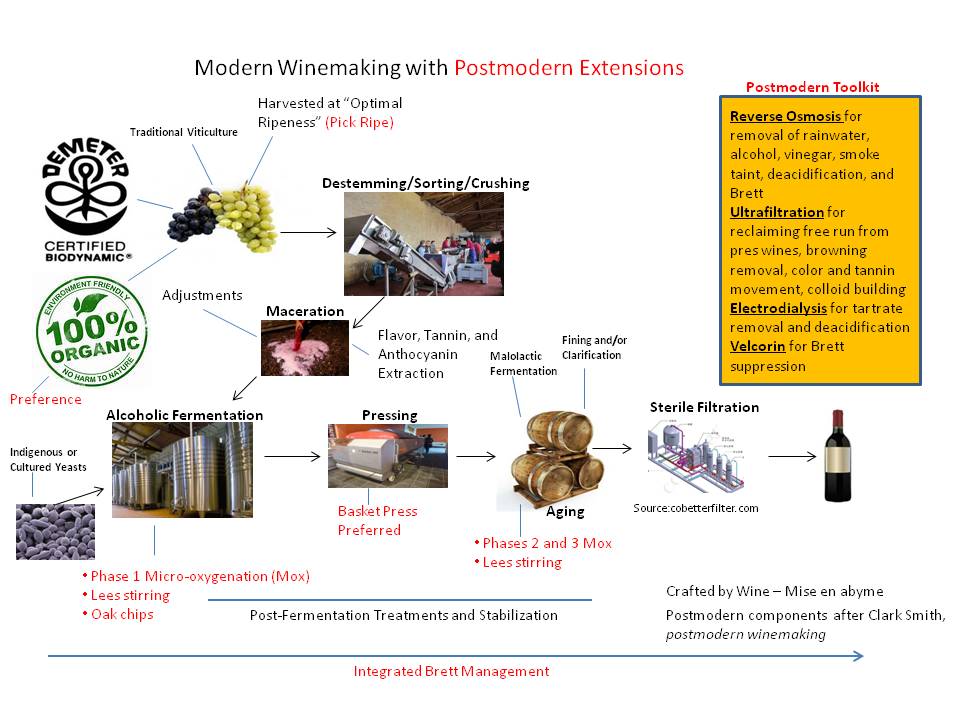

Two things to note in the chart above: (i) towards the bottom, the introduction of the concept of Integrated Brett Management (that will be the focus of Part III in this series); and (ii) the box at the top right which is labeled Postmodern Tookit. Some of the entries in that box map closely to the "fix" tactics proposed by Dr Goode. These Postmodern Toolkit/Fix mechanisms will be the subject of the remainder of this post.

Sterile Filtration
Dr. Goode mentioned filtration as the first option on his list and it is widely viewed as the most effective method of removing Brett cells. In this method, the wine is passed through a .45µ filter which captures any Brett cells in the filter mechanism. Clark Smith is not in favor of this approach to Brett removal:
The focus of postmodern philosophy is the creation and preservation of beneficial macromolecular structure. This structure manifests in wine as colloidal particles sometimes nearly as large as a bacterial cell. The benefits of good structure -- profundity, aromatic integration, and graceful longevity -- appear to be lost in sterile filtration, despite the fact that no tannin material may be retained by the filter. While this lack of residue has convinced some of my colleagues that filtration cannot be harmful to wine structure, I do not concur. My hypothesis is that the action of tight filtration somehow disrupts rather than removes structure.
It should be noted that Clark does not provide any empirical data or prior scientific studies to bolster this hypothesis.

Velcorin
Both Dr. Goode and Clark Smith mention dimethyldicarbonate (DMDC, trade name Velcorin) favorably. This product is a microbial control agent  (produced by Lanxess) that is effective at eliminating a broad range of yeast, bacteria, and molds from wine. The product works by penetrating the cell wall of the offending micro-organism and deactivating enzymes which then leads to the cell's demise. The manufacturer claims that the product has no effect on wine taste, bouquet, or color and breaks down completely into small amounts of CO₂ and methanol. The downside, according to Clark, is that this is a "nasty chemical" and must be handled carefully.

Tangential Flow Filtration
Dr. Goode refers to cross-flow filtration and nanofiltration in his list but Clark places those technologies into a class he calls the Tangential Flow Family of Filtration and they are classified based on the molecular weight of particles that pass through the pores.

Filtration System Application Molecular Weight Range (Daltons)
Crossflow Clarification

200,000 - 500,000
Ultrafiltration

1000 - 200,000

Tannin and Browning Removal 10,000 - 200,000

Protein Removal 10,000 - 40,000

Decolorization 1,000 - 5,000
Nanofiltration

200 - 1000
Reverse Osmosis

50 - 200
Source: Clark Smith, The Crossflow Manifesto, Wine Business, January 2003.

According to Smith, the idea of tangential flow filters developed in the 1960s. One of the major problems with sterile filtration is the fouling of the membrane which occurs when tight pore sizes are used. This fouling prevents the passage of material through the pores. The effective limit of traditional filtration is 0.1µ. Tangential flow filters use the scrubbing action of the flow across the surface of the membrane to keep it clean thus allowing the utilization of ever-smaller pore sizes.

All of the systems mentioned in the table employ the strategy of pumping the wine across the membrane at high velocity. As the wine flows across the membrane it continually scrubs the surface, removing fouling material. The majority of the feed stream does not pass through the filter but is retained upstream and returned to the tank. This stream, called the retentate, contains all of the high-molecular-weight components. The low-molecular-weight material that passes through the filter is called the permeate. A reverse osmosis application is illustrated below.

Reverse osmosis (Source: memstar.com.au)

It should be noted that, of the tangential flow systems mentioned in the table above, reverse osmosis is the only one specifically noted for Brett removal by Clark Smith.

Fungal-Source Chitosan
A Brett-repair technology that was not mentioned by either Jamie Goode or Clark Smith is fungal-source Chitosan. Chitosan is a deacetylated version of chitin, a compound found in the exoskeletons of crustaceans and insects as well as in the cell walls of fungi. According to Olivier Pillet (Chitosan and Brettanomyces: Origin, Impact, and Mode of Action), "the innovation that led to the use of chitosan in oenology is the process for obtaining chitin from a non-animal fungi source, Aspergillus niger." This process provides natural-source chitosan that is both biodegradable and non-allergenic and has been accepted as an oenological process by both the International Organization of Vine and Wine (July 2009) and the European Union (December 2010).

Chitosan has been documented for its antimicrobial properties which depends on the degree of deacetlylation and its molecular weight. Studies have shown that the homogenous incorporation of 4 g/hl dose of the commercial product (No Brett Inside) will "result in the total destruction of the Brettanomyces populations, or, in certain cases, a significant reduction of the contaminating populations" (Pillet).

**********************************************************************************************************
These then are some of the tactical tools that can be employed in the fight against Brett. In my final post in the series I will treat Clark Smith's Integrated Brett Management.


©Wine -- Mise en abyme

Sunday, June 4, 2017

Management of "Bad Brett": Part I, the conventional approach

Writing about Brettanomyces in Decanter, Linda Murphy stated thusly:
... at best, Brettanomyces can give wine what many believe to be positive attributes that add complexity and depth: earthy flavours of glove leather, smoked meat, bacon fat, tobacco, truffle, clove and other savoury spices. Yet when B(rett) turns bad, it can give wine the offensive stink of barnyard, manure, plasters, wet dog, sweaty horse blanket, mouse droppings and antiseptic.
Remarking about this contrast in character, Clark Smith (postmodern winemaking) stated: "... most connoisseurs have experienced on different occasions both faces of Brett: the sultry, profound earthiness and the repulsive barnyard stench." It is the latter characteristic that is of most concern to winemakers and it is that character that will be the focus of this post.

In a recent Somm Journal article, noted wine writer Dr. Jamie Goode laid out the issues associated with Brettanomyces (Brett) contamination of wines and offered up a number of control measures and fixes to combat same. Clark Smith, in his book postmodern winemaking, takes the conventional view of Brett and Brett management to task and, instead, proposes a schema he calls Integrated Brett Management. I present these competing views in three posts beginning with this one. But first, some background

Brettanomyces bruxellensis falls within the Fermentative class of wine-associated yeasts (the other classes are Basidiomycetous and Ascomycetes), the most dangerous of the wine-spoiler yeasts. According to Woolford, et al., (Genome Survey Sequencing of the Wine Spoilage Yeast Dekkera (Brettanomyces) bruxellensis, Eukaryotic Cell 6(4), April 2007), Brettanomyces bruxellensis is a major microbial cause of wine spoilage worldwide and results in significant economic loss. Brettanomyces is exceptionally dangerous because it has all of the characteristics of Saccharomyces cerevisiae but extends beyond it in that, while slower growing, "it can assimilate a wider variety of carbon choices."  The key characteristics of Brettanomyces bruxellensis are presented in the chart below and its contamination mechanism in the one following.


It was long thought that Brettanomyces contamination was a result of poor hygiene in wineries but contamination persists even in the face of intensive hygiene efforts (Renouf et al., Interactions between Brettanomyces and other yeast species during the initial stages of winemaking, Journal of Applied Microbiology 100 (6), June 2006).  Research seems to indicate that Brettanomyces can enter the winery through sour rot and can then take up residence within the facility and contaminate batches of wine essentially at will. The chart below shows Brett potential contamination sources and pathways. In the case of sour rot grapes, it can be a direct source (that is, mixed in with healthy grapes brought into the cellar) or via bees interacting with sour rot grapes in the field and then bringing Brett into the winery.


According to Clark Smith:
Except in new cellars, Brettanomyces is a ubiquitous organism, a fact of life. Like athlete's foot, one cannot usually hope to eradicate it. Like keeping one's feet dry, control of this organism based on suppressing growth by denying it facile growth conditions is the most realistic solution. Keep in mind that the goal is to facilitate a truce with Brett so a stable condition exists at bottling.
Central to this growth-suppression approach "... is the maintenance of free SO₂ at a level of around 30 ppm at relatively low pH's in order to maximize its effectiveness by increasing the percentage of the free SO₂ that is in the un-ionized molecular form." This approach greatly reduces the number of colonies of Brett that grow on a petri dish but according to Clark, may actually be reducing the culturability rather than actually killing cells.

In his Somm Journal article, Jamie Goode identified a number of actions that can be taken in the fight against Brett. The actions in the left part of the chart below are conventional growth-suppression activities.


Lisa Van de Water (Monitoring microbes during cellaring/bottling, Practical Winery and Vineyard Journal, January/February 2010) recommends testing the wine in the cellar in order to minimize the opportunity for Brett contamination manifesting in the bottle. According to Ms. Van de Water, 100 cells/ml can lead to visible Brett haze in the bottle and the production of small amounts of CO₂. Sensory changes are "profound" with compounds such as 4-EP and 4-EG present manifested by horse sweat and Band Aid odors and a bitter, metallic finish. Bottle variation is common with some bottles showing the clear evidence of "bad Brett" while others show little impact.

Ms. Van de water recommends culturing the wine on media containing 50 ppm of the antibiotic cycloheximide (to inhibit growth of other yeasts) and, if Brettanomyces is present, the culture will manifest white, hemispherical colonies in three to seven days. The culture will, in addition, produce a strong acetic acid smell.

If Brett is determined to exist in the wine at levels between 1 and 50 cells per ml, then we switch to the right side of the chart above and attempt to "fix" the problem. The most common approach has been to pass the wine through a .45µ membrane (this approach can be used both as a control and fix mechanism) but Clark Smith is opposed to this because he feels that filtration disrupts the structure of the wine.

The other wine fixes mentioned by Dr. Goode are identified as key elements of the postmodern toolkit by Clark Smith and so serves as  a bridge between the conventional and postmodern approaches. I will cover them in the next post on the topic.


©Wine -- Mise en abyme