Showing posts with label Greco di Tufo. Show all posts

Monday, March 7, 2022

The Greco cultivar and Greco di Tufo wine

Irpinia, the ancient name of Campania's Avellino Province, is home to three of the four regional DOCG production zones: Taurasi (red), Fiano di Avellino, and Greco di Tufo (the latter two both white wines). I treat the Greco variety, and its wines, in this post.

The Greco group of grapes, according to Ian D'Agata (Native Wine Grapes of Italy), "along with the Malvasias, may be the most confusing of all grapes." While the grapes, for the most part, are Greek imports, "many other grapes that never graced Greek soils were named 'greco' too because they were used to make wine in the 'Greek style' ... Rather than a family, the Grecos are a group of grapes sharing the same name and very little else."

"The most famous and best-known of all Italian Greco varieties is simply called Greco, and it is the one with which the world famous Greco di Tufo wine is made" (D'Agata). It is this variety that I will be focusing on in this post.

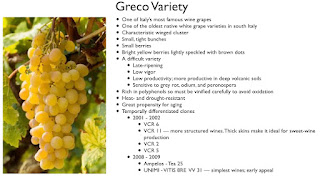
Greco is one of the oldest native white grape varieties in southern Italy, with roots dating back to the Greek colonization of the region. The main characteristics of the variety are detailed in the below chart.

While instances of the variety can be found in Calabria, Puglia, Lazio,, and Tuscany, it is most widely deployed in Campania. The Greco wines authorized in the region are shown in the chart below.
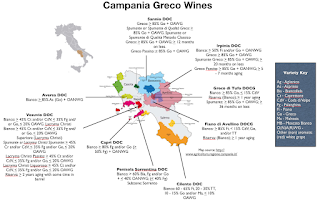

The chart shows, first of all, the versatility of the Greco grape in that it can be used for the production of sparkling (both Charmat and Metodo Classico), still, and dessert wines. Secondly the variety is used in blends in the coastal zones while it is mostly the dominant variety in the inland wines.

While the variety is grown across the region, it is in Tufo, and surrounding municipalities, that the variety expresses itself best. The combination of soils, cooler temperatures, persistent sunshine, and high diurnal temperature variation combine to produce wines of intense aromas and "particular mineral notes." The Campania Greco di Tufo terroirs are illustrated in the chart below.
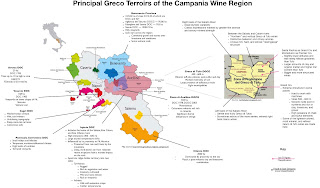


Feudi di San Gregorio divides the Greco di Tufo zone into three broad regions with the most classic examples of the wine being produced in the central zone on the right bank of the Sabato River. Ian D'Agata focuses in even tighter, classing Tufo and Santa Paolina as Grand Cru growing zones and Montefusco as a Premier Cru, with mineral, refined wines from Tufo and bigger, more structured wines from the remaining two.

This post wraps up my coverage of the Campania DOCGs but no review of Campanian wines would be complete without a discussion of the Falanghina variety and its wines. I will undertake that task in my next post.

©Wine -- Mise en abyme

Wednesday, April 29, 2020

Mapping the DOC(G) sparkling wines of Italy's Campania region

In my quest to map the sparkling DOC(G) wines of Italy, I have completed overviews of the sparkling wines of North and Central Italy and the southern Italian regions of Abruzzo and Molise. I now turn to the sparkling wines of another south Italy region: Campania.

Campania, the shin of the boot that is Italy, is its third most populous region. And with its 5.8 million people resident in an area covering 13,590 sq. km., it is the country's most densely populated region. But it is famed for factors beyond population. "The region is home to 10 of the 55 UNESCO sites in Italy ..." and its "... rich natural beauty ... makes it highly important in the tourism industry, with the city of Naples, the Amalfi Coast, Mount Vesuvius and the islands of Capri and Ischia continuing to be major attractions" (Wikipedia).

Campania is well-suited to the production of high quality wine. Its abundant sunshine, dry and hot summers (with coastal Mediterranean breezes tempering the heat), mild winters, mountainous terrain (allows planting at higher elevations), volcanic soil, lengthy growing season, and own-rooted vines (Phylloxera did not visit) add up to a growing environment that is a winemakers dream.

And this environment supports a number of high-quality white wines (Tom Hyland):
  • Greco di Tufo
    • Very good levels of acidity and excellent aging potential
    • Less aromatic but with a bigger structure
    • Minerality and concentration
    • Does well in the volcanic soil in the mountainous terrain of Avellino
  • Fiano di Avellino
    • One of the most complex and elegant white wines of Italy
    • Aging potential of 10 or more years
    • Does well in the volcanic soil in the mountainous terrain of Avellino
  • Fiano di Salerno
    • More clay and limestone soil; fruit-driven, with less minerality
  • Falanghina and Asprinio
    • Both high-acid wines. 
Grapes that produce high-acid white wines are good candidates for sparkling wines. The chart below shows the appellations which allow sparkling wine within their borders and the grape varieties (and their proportions) utilized in their production. The chart directly following shows the sparkling wines produced in the region, in many cases, utilizing the described grapes grown in the highlighted regions.


Some observations:
  • One of the four DOCGs and nine of the 15 DOCs allow for the production of sparkling wines
  • Most of the Campania appellations are bunched in the upper part of the region as is the allowed sparkling wines
  • With one exception -- Costa d'Amalfi DOC -- no international varieties are used in the production of the region's sparkling wines. Both Chardonnay and Pinot Nero are approved for use in the Costa d'Amalfi Spumante
  • A total of 38 labels are approved over the 10 appellations shown above making for an average of 3.8 labels per appellation. Of course, the bulk of the labels are distributed between Sannio DOC and Vesuvio DOC
  • 15 of the approved labels are Metodo Classico specifications
  • Thirty-one of the approved labels are for varietal sparkling wines with Falanghina, Fiano, and Greco featuring prominently.
The sparkling wines in Greco di Tufo DOCG are made in the traditional manner and stay on the lees for at least 3 years. According to tasteatlas.com, "These straw yellow wines are intense, herbaceous, floral, and fruity with typical notes of apples, jasmine, thyme, or sage. They are best paired with rich seafood dishes and could go well with lobster or cod ... they are also an excellent aperitif and would be a great match to various appetizers."

Feudi di San Gregorio, one of the leading independent wine producers in Campania, has established a separate label -- DUBL -- under which to market its Spumante wines. This project began in 2004 and was aimed at bringing the classic sparkling wine method to the grapes of the Campanian tradition: Greco, Aglianico, and Falanghina.

Feudi San Gregorio felt that they had the high-quality fruit for such an initiative. The internal areas of the region are ideal for growth of grapes destined for sparkling wines:
  • Diurnal temperature differences would allow grape ripening with acid-retention
  • The ventilation and exposure of the vineyards are ideal
  • Rugged terroir 
  • Volcanic soils.
They did not, however, have the requisite skill. To fill that gap they sought the advice and assistance of Anselme Selosse -- of Jacques Selosse grower-Champagne fame. The wines that resulted were a 100% Greco sparkling wine, a 100% Aglianico sparkling Rosata, and a 100% Falanghina as a Double Brut.

In April 2016, DUBL extended its product portfolio with DUBL Esse, a Dossagio Zero line, with a white sparkling made from the best grapes from the most exciting vineyards in the Tufo area and a Rosata which comes from grapes from the most exciting vineyards in the Taurasi area.

********************************************************************************************************
With Campania now in the rearview mirror, I will next look to the sparkling wines of Puglia.

©Wine -- Mise en abyme