Showing posts with label Lebanese wine. Show all posts

Thursday, December 8, 2022

Lebanese Wine: Renaissance Interruptus

My most recent post covered the role of the Phoenicians in the spread of wine across the Mediterranean. As was the case for Iranian wine, production in the Levant contracted with the introduction of Islam to the region, with wine permitted only for use by Christians in the course of their religious pursuits.

The "modern" phase of the Lebanese wine industry began in 1857 with French Jesuit monks who settled in the Bekaa Valley in the mid-19th century. This group was gifted a 25-acre plot of land in the Bekaa and chose to employ it in grape-growing. Thus was born Chateau Ksara, an enterprise still in existence today. 

The early wines were made for personal consumption with the monks moving from raisin-based wines to wines made from grapes grown on Cinsault, Carignan, and Grenache vines imported from Algeria, at that time the biggest wine hub outside of France.

At the end of the First World War, the Ottoman Empire was dismantled and Lebanon was placed under a French Protectorate. This brought in a large number of French soldiers and Administrators and drove up the demand for wine. Chateau Ksara switched from wines for personal use to a commercial enterprise in order to meet this demand.

In the early 1970s the Vatican issued a papal edict requiring that the Catholic Church sell any and all commercial concerns. This forced the Jesuits to sell Chateau Ksara to a Lebanese investment group in 1973.

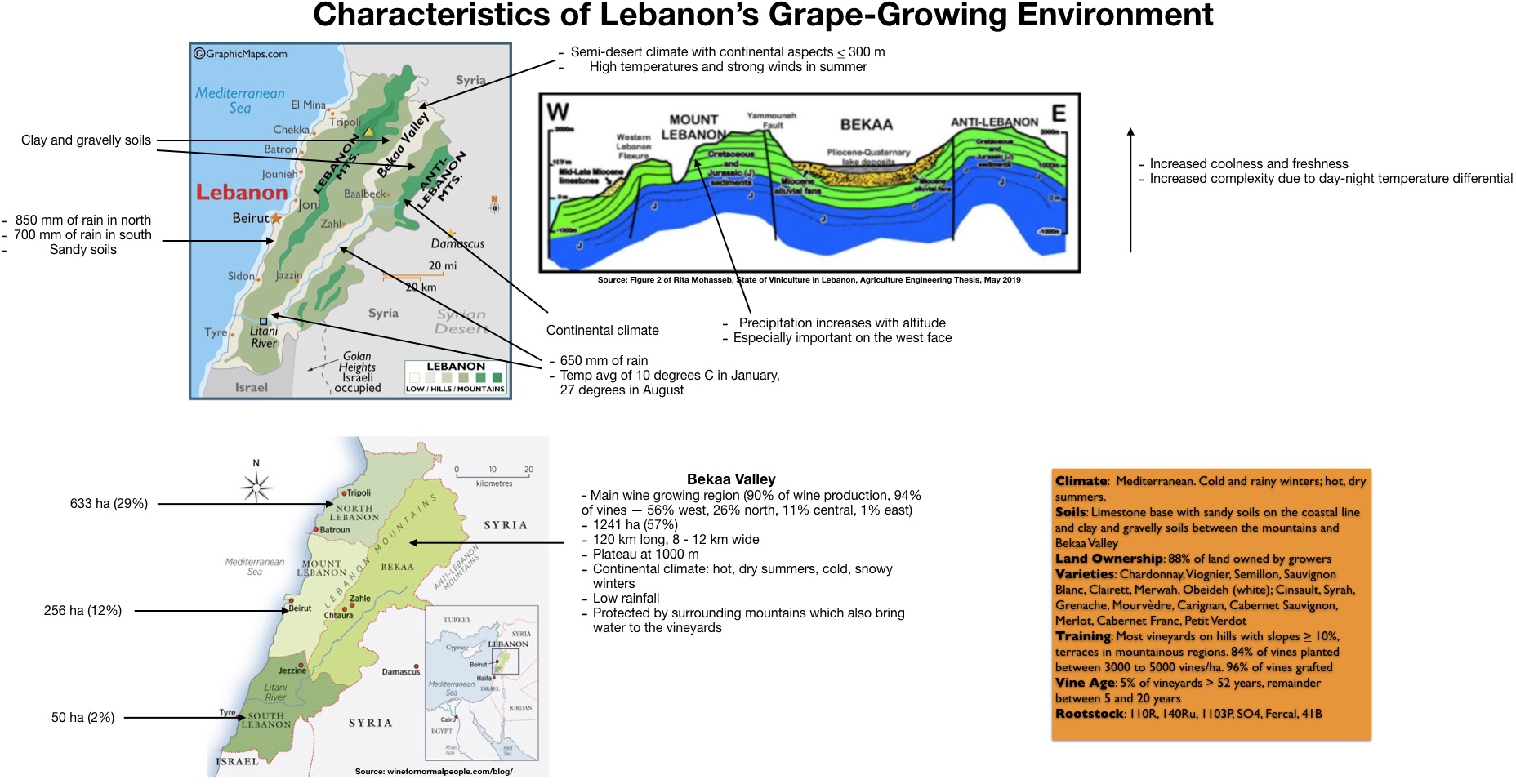
At the beginning of the Lebanese Civil War (1975 -90) a total of six commercial wineries were operational within the country. At the end of the war, Chateaus Kefraya, Ksara, Musar, and Nakad and Domaine des Tourelles, plus six new producers, dusted off the sands of war and turned their full attention to the resurrection of the Lebanese wine industry. By the mid-1990s, the number of wineries had grown to 14 and to 60 by 2018. The country was conducive to grape growing, with a dry, sunny climate and protection of the vines afforded by the peaks of the Lebanon and Anti-Lebanon Mountains.
The characteristics of the Lebanese grape-growing environment are shown in the chart below.

Chateau Musar: One of The North Stars of Lebanese Wine
One of most enduring stories of Lebanese wine has been the efforts of Chateau Musar's Serge Hochar to produce wine during the course of the Civil War. I had the honor and priviledge of tasting the estate's wines with him prior to his untimely death. The below observations are from notes taken at the tasting.

Chateau Musar's vineyards are located in Lebanon's Bekaa Valley with red and white wine grapes grown in distinctly separate environments. The red wine grapes -- Cabernet Sauvignon, Cinsault, and Carignan -- are planted in the southern portion of the Bekaa Valley on soils that are gravel over limestone. These old vines yield between 30 and 35 hl/ha. The white varieties are the indigenous Obaideh and Merwah which are planted in high-altitude (1500 m ) vineyards. Grape growing is organic and, at harvest, the berries are hand-picked by Bedouin tribespeople and trucked over the mountain to the winery which is 2.5 hours removed.

Grapes for the red wines are fermented by varietal in cement vats and then racked into French oak barriques after 6 months (In the tasting, Serge indicated that he had tried stainless steel fermentation but that it had "destroyed" the wines. He uses stainless steel for some of the younger-generation wines but exclusively uses concrete for the Hochar and Musar wines.). The barrique wines are blended after 12 months of initial residence and then returned to the barriques for an additional 12 months. The mature wine is then bottled unfiltered and aged for 3 - 4 years before being released to the market.

The white wines are fermented in French oak for 6 - 9 months before blending and bottling and are then stored in the Musar cellars for an additional 6 years prior to market release.


Serge and the Author

Renaissance Interruptus
By 2020, this Lebanese winemaking renaissance had been brought to heel by:
  • A popular revolution
  • A financial crisis -- loss of 95% of the value of the Lebanese pound
  • The impact of the coronavirus
  • A massive explosion in the Beirut port which killed in excess of 200 people, wounded over 6000 people, and dealt a massive blow to the port infrastructure and adjacent business/residential districts
  • Rising poverty
  • A fuel and electricity crisis.
These conditions served to cause a contraction in both the local (30 - 35% decline 2020 over 2019) and export (30% decline) wine markets. Wine imports have decreased by 65%. Wine producers are hit especially hard by these conditions because they need hard currency to import equipment, sulfur, yeast, bottles, corks, and labels.

Given the need for hard currency, as well as the limited local consumption, Lebanese winemakers will be forced to focus on the export market in order to survive. The prospects are better for establishments with name recognition in foreign markets as marketing funds are not readily available. 

©Wine -- Mise en abyme

Tuesday, November 29, 2022

Ancient Wine: The Phoenicians and the spread of wine across the Mediterranean Basin

According to Yuval Noah Harari (Sapiens: A Brief History of Humankind), the genus Homo evolved in Africa and spread to Eurasia 2 million years ago, resulting in the evolution of different Homo species. Homo sapiens evolved in East Africa approximately 200,000 years ago and lived there until a breakout into the broader world, commencing 70,000 years ago. The story of wine has a parallel trajectory, with its crucible being the Levant and early touch points being "near-abroad" countries. These early-adopting countries were the cult-wine regions of the time and in this series I seek to describe wine making and wine drinking therein then and now. I have, to date, covered Armenia (wine history and winemaking) and Iran and continue herein with Lebanon.

Ancient Phoenicia
Current-day Lebanon was the Phoenicia of yore. Phoenician was an ancient Greek term used to describe the Iron Age, Semitic-speaking people who inhabited the central coast of the Levant (the region along the eastern Mediterranean which roughly corresponds to modern-day Israel, Jordan, Lebanon, Syria, and certain adjacent areas).

But the Phoenicians were not limited to the Levant. Around 1100 BC the Phoenicians began founding colonies all across the Mediterranean and even on the Atlantic coasts of Europe and Africa. Carthage and Syracuse are two of the noteworthy names that have resonated down the corridors of history but these -- and most of the other colonies -- were lost to Rome during the course of the Punic Wars (264 - 146 BC).

The Phoenicians used their trade routes to spread wine and their alphabet across the Mediterranean.

Phoenicia and its trade routes
(Source: Wikipedia.org)

Wine in Ancient Phoenicia
Grape cultivation spread to Phoenicia around 3000 BC and wine became a valuable commodity for the inhabitants both as as a trade good and for local consumption in feasts and as a libation. As shown in the chart below, the wine was well-regarded and was referenced in many ancient sources.


Phoenician Winemaking
Winemaking in the Levant and across the Mediterranean, in the period between the 5th century BC and 1st century AD, utilized wine presses with the following characteristics:
  • A treading floor/basin where grapes were crushed by foot
  • A vat for the collection of the must 
  • A connecting channel between the "crush pad" and vat.
The crush pad was generally hewn out of rock or built with stone blocks.

A newly discovered wine press at the Tell el-Burak archaeological site has revealed a marked departure from this convention.

Tell el-Burak is a small Phoenician site located near the modern-day Lebanese city of Sidon. It was occupied between the 8th and 5th centuries BC. The wine press excavated from the site dates to the 7th century BC and is the earliest evidence of winemaking in ancient Phoenicia.

The press consisted of a large rectangular treading basin (4500 L) attached to a large vat. The structure was built with plaster made from a mixture of lime and recycled ceramics. This material rendered the press both easier to build and stronger than its contemporaries. The size of the vessel indicates industrial-scale wine production.

The chart immediately below captures the actual excavated material while the one following is an artist's conception of how the press would have appeared when operational.

Excavated Tell el-Burak Wine Press
(Source: Orsingher, et al., Phoenician
lime for Phoenician wine: Iron Age
 plaster from a wine press at Tell el-Burak,
Lebanon, Antiquity 377, 1224 - 1244)

Artist's conception of Tell el-Burak Wine Press
(Source: Orsingher, et al., Phoenician lime
for Phoenician wine: Iron Age plaster from
 a wine press at Tell el-Burak, Lebanon,
 Antiquity 377, 1224 - 1244)

In addition to the press, a large number of grape seeds were found at the site, confirming a large scale, industrial operation.

Wine as a Key Phoenician Trade Good
There are a number of references from ancient sources as to the importance of wine in the Phoenician trade arsenal:
  • Ezekiel's (Chapter 27) oracle against Tyre suggest the city's involvement (6th century BCE) in transporting and marketing wines produced in other parts of the Levant
  • Herodotus (Hist 3.6) claimed that Phoenician wine was imported twice a year into Egypt
  • Two shipwrecks (ca. 8th century BCE) discovered 30 nautical miles off the coast of Gaza are advanced as evidence of the scope of the Phoenician wine trade. These ships were laden with hundreds of carinated-shoulder amphorae (a distinctive Phoenician container) and organic residue from one amphora suggests that its contents were wine.
Carinated-Shoulder Amphora
(Source: amarnaproject.com)

Initially the Phoenicians tried to avoid spills during transport by covering the wine with a layer of oil but this proved unsatisfactory. They next tried a pinewood disk bedded into the necks of the amphorae with a clay and resin mixture. This resinous mix flavored the wine as it made contact during the course of the voyage and the Phoenicians -- as well as the Greeks -- thought that it also acted as a preservative. This was the precursor to Retsina.

Phoenician Influence in the spread of Wine beyond the Middle East
Domestication of the grapevine and production of wine was initiated in the Caucusus region during the Neolithic and spread to neighboring polities, reaching Phoenicia by 3000 BC. Phoenicia then became the key link in catapulting wine consumption and cultivation knowledge into the wider world:
  • It is believed that wine was first brought to Crete by Phoenician traders
  • Stassinus, author of the "Cyprus Epic Songs," stipulates that the cultivation of grape vines dates back to the early days of the Island's colonization by the Phoenicians in 3000 BC
  • The Romans learned to appreciate the consumption and production  of wine from the Phoenician/Punic and Greek peoples
  • The first vines in Sardinia were imported by the Phoenicians
  • Winemaking in Sardinia dates back to the time of the Phoenicians.
**************************************************************************************************
The Phoenicians, the progenitors of modern-day Lebanon, were clearly major players in the development and spread of wine in Mediterranean Basin and beyond.  What has become of that headstart in more modern times? I will explore that question in an upcoming post.


©Wine -- Mise en abyme