Showing posts with label Langhe Nebbiolo. Show all posts

Monday, August 3, 2015

Langhe-Roero: Where Nebbiolo is called Nebbiolo

During the course of this journey through the geographical locations and naming conventions associated with the Nebbiolo grape, we have encountered it as Chiavennasca (Valtellina, Lombardia), Picotendro (Donnaz, Valle d'Aosta), Spanna (Vercelli-Novara region of Alto Piemonte), and Prunent (Val d'Ossola). We will round out our journey by reviewing the wine zones where Nebbiolo is actually called Nebbiolo.

Langhe, inclusive of Barolo DOCG and Barbaresco DOCG
The Langhe region may not have been the origin point of the Nebbiolo grape but it has become its spiritual, emotional, and financial home and Barolo DOCG and Barbaresco DOCG provide the reference points against which all Nebbiolo wines are measured. A detailed discussion of these regions is presented here.

Roero DOCG
Roero is a small DOCG (DOC 1985, DOCG 2004) located on the north bank of the Tanaro River and running along said bank for approximately 24.1 km (15 miles) between Bra and Govone. The zone is approximately 878 ha (2169 acres) in size with 2014 production of approximately 436,000 cases. The relative positioning of Roero DOCG is illustrated in the map below.

Source: vinotravelsitaly.com
The climate of Roero is described as cold temperate and manifests as harsh, cold winters; hot, humid summers; and unpredictable springs and autumns. Climatic effects are moderated by (i) the warm Mediterranean winds meeting and mitigating the cold winds flowing down from the north and (ii) the Apennines providing a barrier to the winds from the sea.

The soil is primarily sand, a result of the area being an ancient seabed, with clay and/or limestone intermixed in specific areas. Unlike the Langhe, formed 15 million years ago during the Miocene, the soils of the Roero are only 5 million years old, laid down, as they were, during the Pliocene period of the Tertiary era. The proliferation of sea fossils in the sand is a testament to its sub-sea past. According to Antonio Galloni (Exploring Roero, Vinous, May 2015), the soil characteristics give the Roero wine much of its mid-weight, perfumed personalities. In the places where the sand is intermixed with silty soils rich in clay and marine deposits, the grapes grown thereon confer a greater depth and structure to the resulting wines (Galloni).

Roero DOCG governs the production of white and red wines within the zone. The white wines are produced from Arneis, maybe the most important white grape in Piedmont. The reds are made from Nebbiolo and Barbera and, according to Michael Skurnik, the young reds from the region have a "particularly fresh and vibrant character." Galloni sees Roero excelling with Arneis and expressed pleasure with both the top-end and entry-level Nebbiolos and Barberas. He does see some challenges for the region though:
  • The most famous Roero wines are made by producers who are based outside the region (Giacosa and Sandrone, for example)
  • The region lacks a visible, reference point producer who might be able to elevate the standing of the entire area
  • The region continues to live in the shadow of Barolo and Barbaresco.

Nebbiolo d'Alba DOC and Alba DOC
Nebbiolo DOC was founded in 1970 and covers production in 25 communes on both sides of the Tanaro River. The production zone extends over 536 ha (1370 acres) and is used as a fallback appellation by producers whose wines do not meet the stringent standards of the Roero, Barolo, and Barbaresco DOCGs. Nebbiolo d'Alba DOC wines are 100% Nebbiolo and are aged for 1 year prior to market. Alcohol level has to be 12% at a minimum. The wine can be made as dolce and spumante.

Alba DOC was established in 2010. It has a vineyard area of 2 ha (5 acres) and produces 630 cases annually. The red wine is 70 - 85% Nebbiolo, 15 - 30% Barbera, and 5% max other authorized varieties and is aged for 17 months, nine of which are in barrel. The Riserva has a similar varietal requirement but is aged for 23 months, 12 of which are in barrel. The minimum alcohol level is 12%.

Carema DOC
Carema is the last Piemontese village before you cross over into Valle d'Aosta. The vine-growing region is 12 ha (32 acres) in size and elevation can range as high as 762 m (2500 feet). Annual production is fewer than 10,000 cases. The DOC was established in 1967 and requires a minimum of 85% Nebbiolo plus other authorized grapes. The resulting wine is light-to-medium body; exudes aromas of tar, licorice, camphor, and strawberry; and is both tannic and more acidic than the reference Nebbiolos.

The wine is produced as Rosso and Riserva, both with minimum alcohol levels of 12 % but with the former aged for 24 months and the latter for 36. Both styles require 12 months aging in barrel.

To summarize then, following are the characteristics/requirements of the wines produced in the areas where the variety is called Nebbiolo.

Region
Style
Varieties
Aging
Alcohol (min %)
Barolo DOCG
Rosso
100% Nebbiolo
Min. 38 mos (18 in barrel)
13

Riserva
100% Nebbiolo
Min. 62 mos (18 in barrel)
13
Barbaresco DOCG
Rosso
100% Nebbiolo
Min. 26 mos (9 in barrel)
12.5

Riserva
100% Nebbiolo
Min. 50 mos (9 in barrel)
12.5
Roero DOCG
Rosso
Nebbiolo (95%) + OA
Min. 20 mos (6 in barrel)
12.5

Riserva
Nebbiolo (95%) + OA
Min 32 mos (6 in barrel)
12.5
Langhe Nebbiolo
Rosso
Nebbiolo (85%) + OA

11.5
Nebbiolo d’Alba DOC
Rosso
100% Nebbiolo
Min. 12 mos
12

Superiore
100% Nebbiolo
Min. 18 mos (6 in barrel)
12.5

Spumante
100% Nebbiolo
Min. 6 mos
11.5

Spumante Rose
100% Nebbiolo
Min. 6 mos
11.5
Alba DOC
Rosso
Nebbiolo (70-85%), Barbera (15-30%), OA (max 5%)
Min. 17 mos (9 in barrel)
12.5

Riserva
Nebbiolo (70-85%), Barbera (15-30%), OA (max 5%)
Min 23 mos (12 in barrel)
12.5
Carema DOC
Rosso
Nebbiolo 85% + OA
Min. 24 mos (12 in barrel)
12

Riserva
Nebbiolo 85% + OA
Min. 36 mos (12 in barrel)
12

OA = Other Authorized

©Wine -- Mise en abyme

Wednesday, November 7, 2012

Lunch and winery tour with G.D. Vajra: Decanter's Great Piemonte Reader Weekend

Azienda Agricola G. D. Vajra, a winery owned by Milena and Aldo Vaira, produces Nebbiolo, Barbera, and Dolcetto wines in the Barolo commune of the Langhe sub-region of Piemonte. In this post I will discuss our lunch and winery visit hosted by this esteemed estate as a part of Decanter’s Great Piedmont Reader Weekend.

The G. D. Vajra (The family name is Vaira, similar pronunciation as for the winery, with the difference in spelling resulting from a printer's error which the owners retained as the winery name.) vineyards cover 60 hectares and are planted to Nebbiolo at elevations between 350 and 400 meters and Dolcetto and Barbera at lower elevations.  In addition to the vineyards in Barolo (Bricco delle Viole, Fossati, La Volta, and Coste de Vergne) the Vairas have taken over control of the Serralunga d'Alba vineyards (Baudana and Cerretta crus) of Luigi Baudana via a purchase by the Vaira children.  Giuseppe is the winemaker for the wines produced from these vineyards.

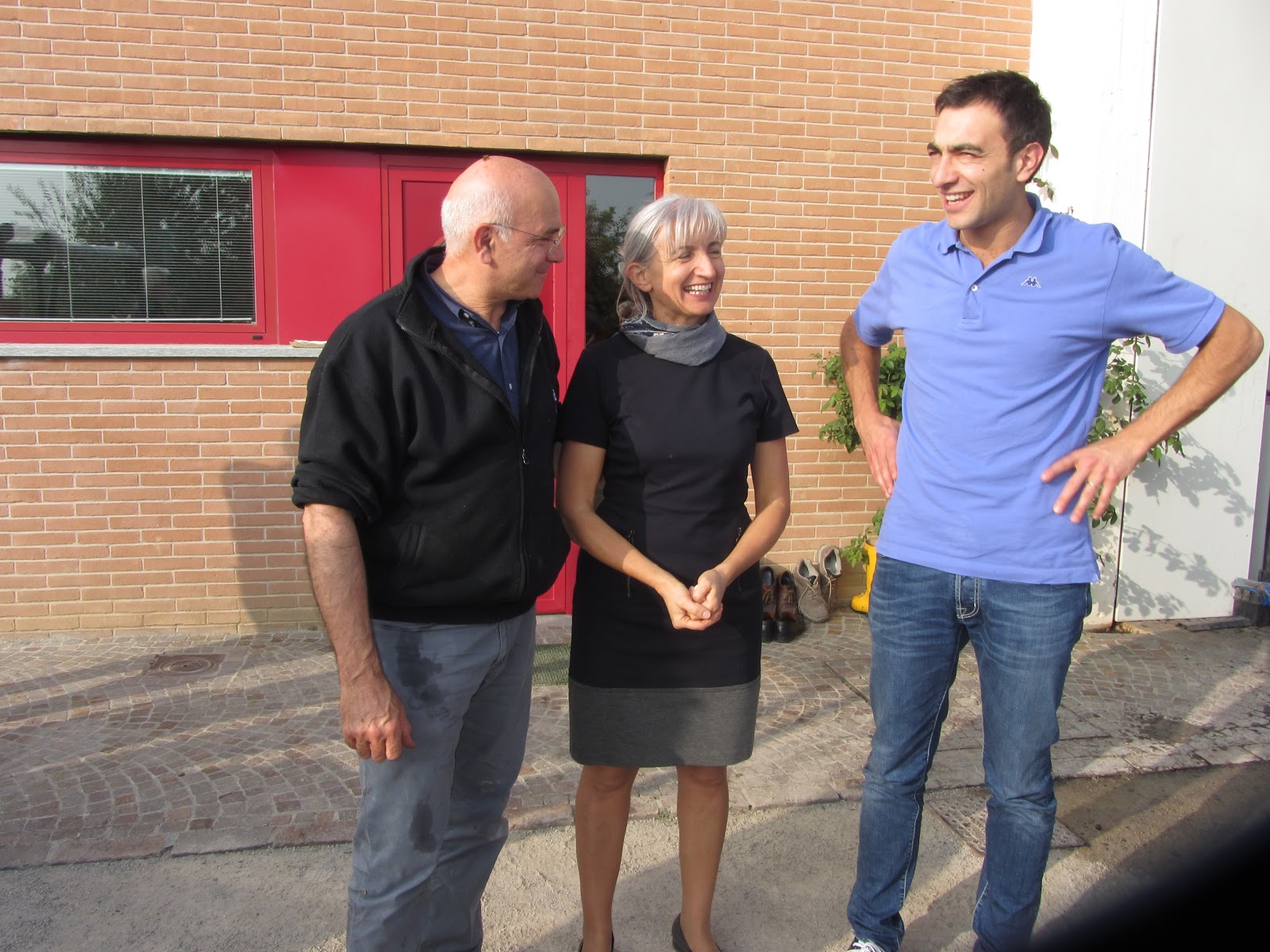
We were scheduled to begin the day's events with a lunch at Tra Arte e Quercie (between art and oak trees) in Monchiero with Giuseppe Vaira (of G.D. Vajra).  When we arrived at the destination, we were greeted warmly by Giuseppe in the restaurant courtyard and treated to a short discourse on the area, the restaurant, and our activities for the remainder of the day.  After this sun-soaked introduction, we were ushered into the restaurant for a much anticipated lunch paired with Vajra wines.


The first wine tasted at lunch was the 2011 Langhe Riesling.  According to Giuseppe, 2011 was a warm vintage in Langhe, one that will prove to be exciting because of the incidences of rain and hailstorm.  He saw it as reminescent of the 2008 vintage.  Prior to the 2011 vintage, the Langhe Riesling was called Langhe Bianco.  The vines for this wine were planted 21 years ago and the wine, according to Giuseppe, is notable for its sense of place, its personality, and its ability to pair well with regional foods.  This wine had a lot of tropical notes and was perfumed and floral.  It reminded Giuseppe of a Trocken from Rheingau.  On the palate, lime, a sweet minerality and refreshing, palate-cleansing acidity.  To me, a fruitier version of a JacobsCreek Steingarten Riesling.

Our second course, the Pumpkin Pudding with Cheese Fondue, was paired with a 2010 Dolcetto d'Alba.  The beauty of Dolcetto, according to Giuseppe, is that it can be a difficult teenager so you have to give it extra love.  It needs a good vineyard in order to blossom and needs to be smelled and tasted regularly in the cellar.  It is a reductive wine and has to be racked two to three times more than Barbera.  It is truly a high maintenance wine.  This wine exhibited cherry and blueberry notes which carried through to the palate.  It paired beautifully with the meal which served to extend and expand the weight and reach of the wine on the palate and in the finish.


The Langhe Nebbiolo 2010 DOC was Giuseppe's favorite of the wines we were tasting at lunch.  The wine was made from grapes sourced from young vineyards.  It is not yet focused but its potential is apparent.  Giuseppe described it as ethereal and a perfect pairing for cheeses.  Florality and spicy cherry notes with proto-Barolo tannins and power accompanying a long finish.

The final wine tasted at lunch was a 2008 Barolo Alba, a gentler and more approachable style of Barolo.

At the conclusion of lunch, we embarked on a truffle hunt in the forest adjoining the restaurant and, following that, travelled to the Vajra facilities for a winery tour and taste-through of the remaining wines in the portfolio.

Upon our disembarkation at the winery, we were greeted by Aldo and Milena.  In describing his philosophy, Aldo indicated that he sees the winemaker's task as deriving the greatest harmony possible from the factors at his disposal: terroir; diversity and complexity of soil; and grapes (each variety bringing its own characteristics).  He expressed that being able to interact with customers was a gift and that his greatest disappointment is not knowing each and every pwerson who drinks his wine.  Post our conversation with his parents, Giuseppe referred to his Dad as the creative mind in the business and his Mom as the support structure.


As we toured the facility we learned that Vajra had gained the first organic certification in Barolo in 1971 but had stepped back from that arena in the 1990s.  They farm all of their own vineyards and practice green harvesting in order to ensure high quality in the surviving grapes.  A first sort of the grapes is conducted in the vineyard at harvest.  A table has been placed between the crusher and destemmer in order to allow a sorting for stems and minimal stem effects in the wine.  Top quality grapes make it into the top wines while second level red grapes are bottled as Langhe Rosso.  WInes are subjected to long periods of maceration in stainless steel tanks.


Upon completion of the tour we repaired to the tasting room to complete our immersion in the Vajra wines.  The first wine up was the 2011 Dolcetto d'Alba.  This was the current release of the wine tasted earlier in the day and had similar characteristics.  Grapes for this wine were sourced from southern exposures in the Costa di Vergne and Fossati vineyards.


The 2009 Barbera d'Alba Superiore was sourced from the Bricco delle Viole vineyards blended with grapes from the Bric Bertoni vineyard in Serralunga d'Alba. The wine was macerated for 35 days and then spent 2 years in large casks prior to bottling.  The 2009 vintage in the Langhe resulted in richer wines and this wine was no exception.  It had great aromatic strength with cherries and blueberries dominant.  Minerality and acidity on the palate preceding a spicy, medium-long finish.

The 2008 Barolo Bricco delle Viole exhibits violet florality, rusticity, iron, orange zest, and sweet tobacco on the nose.  Tannic on the palate but elegance shines through.

Cerretta is an up-and-coming, clay-limestone vineyard in Serralunga d'Alba from which 300 cases of the Barolo Cerretta is produced.  This 0.8 ha vineyard was originally planted in 1970 and lies on Serralunga d'Alba's eastern slope.  These wines are fermented partially in oak and partially in stainless steel and are aged in Slavonian casks for 36 months.  The 2008 Barolo Cerretta exhibited violets, cocoa, tar, mint, and chocolate on the nose.  On the palate, depth, complexity, and a long finish.  The 2008 Barolo Baudana, drawn from another famed Baudana cru, is also grown on limestone soils.  This wine had a rustic minerality, violet, tomato, dried tobacco leaf, leather, and sweet tobacco on the nose and elegance on the palate.


All in all a wonderful day.  Giuseppe was a wonderful host and teacher all day and it was a pleasure to observe the lovingkindness that suffuses the entire family as they work towards their objectives.  Wonderful wines.

©Wine -- Mise en abyme