Showing posts with label French oak. Show all posts

Sunday, May 24, 2020

Oxygen transfer during the oak aging of wine

According to Del Alamo-Sanza and Nevares*, the oak barrel behaves as an interactive vessel with wine, allowing the transfer of substances from the wood to the wine (covered here) and the dynamic transfer of oxygen from the air to the wine.


I cover the transfer of oxygen from air to wine in this post.

Oxygen Transfer Rate
The annual rate of oxygen entry into barrels is the amount of oxygen that enters a barrel full of wine over the course of a year; the unit of measure is mg/L.year. A number of studies over the years (Ribereau-Gayon, 1933; Amerine and Joslyn, 1970; Prillinger, 1965, for example) have defined and refined this measure, but it was Singleton's efforts which sought to establish the oxygen entry point. According to Singleton, oxygen entered the barrel through the dry wood at the top where it is in contact with the headspace.

Vivas and Glories, in a subsequent study, measured oxygen entry into barrels (sourced from Limousin and Centro) full of wine -- wet-wood barrels -- and found that (i) oxygen entry into the wine varied between 20 and 45 g/L for new barrels and 10 mg/L for the 5-year-old barrels. These values have become the accepted oxygen transfer rates for French oak barrels.

In the same study it was found that the oxygen transfer rate was 45 mg/L with a silicone bung and 28 mg/L when the barrel was tightly sealed.

Other later studies have shown that sealing the joints between the staves of full barrels did not prevent oxygen entry into the wine. The conclusion, then, was that oxygen entered the barrel through the wood, joints between the staves, and through the bung; not through the dry wood at the top of the headspace (as had been posited by Singleton). In more recent times, the bung as a source of oxygen entry has seemed to lose prominence with the widespread use of food-grade silicone bungs that allow a tight seal.

The entry of oxygen into the barrel, and its relationship with wine flow into the oakwood, is illustrated in the figure below.


It has been shown that French oak allows more oxygen entry than does American oak. While 50% of American oak's oxygen ingress was through the wood, fully 75% of French wood's ingress was through the same channel. The finer the grain, the greater the oxygen permeation in both species. An oak stave that is 27-mm thick would allow a maximum oxygen transfer rate of 26 ml/L.year.

Oxygen entry through the joints between staves is not uniform along the length of the joint. Rather, it is greater at the middle of the stave, where the pressure is between 0 and 3 bars, and less so at the ends where the pressure ranges between 25 and 30 bars.

The process of topping up the wine barrel has been seen as a source of air entry into the barrel. According to Del Alamo-Sanza and Nevares, however, good management of the barrel-topping process "does not necessarily involve an increase in wine oxygenation."

Oxygen reaching the wine does so both via the wood and the joints between the staves. The oxygen transfer rate of the barrel, then, depends on the wood from which it is constructed as well as the construction process.

Oxygen introduced into the wine reacts with pigments and tannins such that:
  • The red color in wine is stabilized and enhanced
  • Tannins are softened
  • Complex aromas develop
  • Improvement in the mouthfeel and body of the wine is evident.

*This post draws heavily on the work of Del Alamo-Sanza and Nevares (Maria del Alamo-Sanza & Ignacio Nevares (2018) Oak wine barrel as an active vessel: A critical review of past and current knowledge, Critical Reviews in Food Science and Nutrition, 58:16, 2711-2726, DOI: 10.1080/10408398.2017.1330250)

©Wine -- Mise en abyme

Wednesday, July 11, 2012

Oak: Its contribution to wine aroma and overall quality

Wine odor is one of the key markers of wine quality and, as a part of my series on wine quality, I have set myself the task of identifying and characterizing the sources of wine odor and showing how the interactions of these odor components aid in the perception of wine quality.


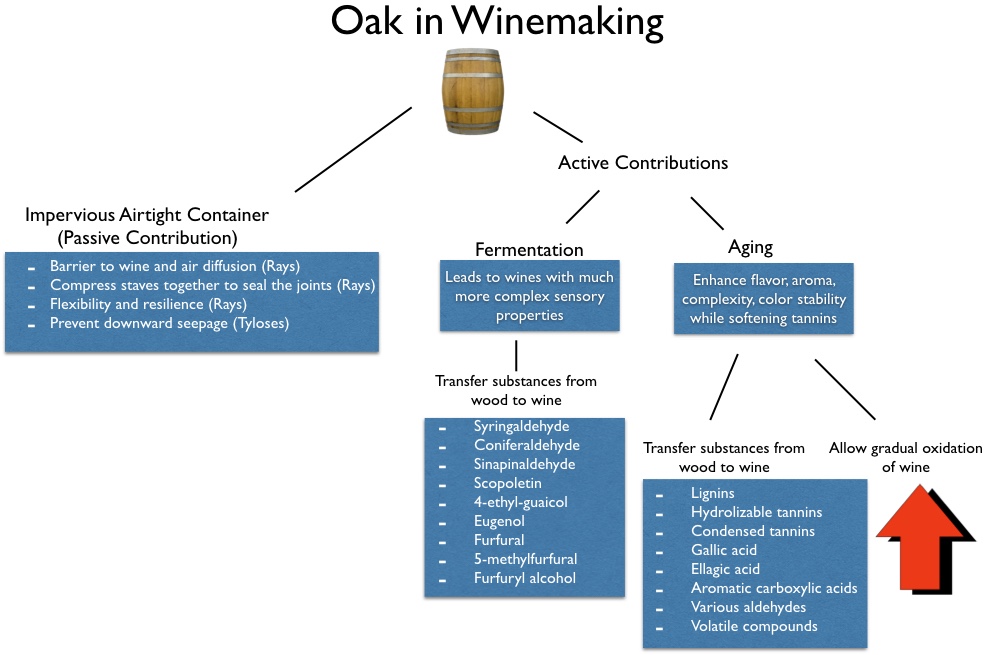
Wine is aged in wooden barrels to: (i) enhance its flavor, aroma, and complexity through transfer of substances from the wood to the wine; and (ii) allow gradual oxidation to occur.  As a result of its "strength, resilience, workability, and lack of undesirable flavor," oak is the wood of choice for most wine cooperage applications.


The oak used in the maturation of alcoholic beverages fall into one of three species: Quercus alba, Quercus robur, and Quercus sessilis.  Q. robur and Q. sessilis, and their respective subspecies, are European white oaks while Q. alba is the source of 45% of the white oak lumber produced in the US.  American oak used in barrel production is sourced from Kentucky, Missouri, Arkansas, and Michigan but there is no apparent regional distinction.  European oak, on the other hand, may have designations which reach all the way to the forest from which the oak originated.  For example, French oak from the department of Alliers may be sourced from a forest named Tronçais.

Sources: enologyinternational.com; Dr. Murli Dharmadikari; Principles and Applications in Wine Science

Oak wood used in the production of wine barrels must possess the following characteristics (Ronald S. Jackson, Principles and Applications in Wine Science): straight-grained; strong; resilient; fault -free; and free of undesirable odors that could taint the wine.  Once the tree is harvested, the resulting log is first cut into tubular sections and they are, in turn, split into halves, quarters, eighths, and then the final stave size.

The rough-hewn staves are now ready to be seasoned.  The cut staves are stacked in the open air in alternating east-west, north-south rows for a period of about three years.  Open-air drying exposes the staves to wind, rain and UV rays.  The stacks are dismantled and randomly re-assembled annually in order to ensure that a single barrel does not gain an inordinate number of staves from a single tree.  Some producers choose to kiln-dry the staves but, while attainment of the desired humidity levels occurs earlier, it can result in the loss of as much as 70% of desirable compounds.

The oak staves undergo a number of chemical changes as a result of seasoning: (i) ellagitannins are polymerized and become less soluble; (ii) there is an increase/decrease of lignin degradation products (such as eugenol, vanillin, syringaldehyde) in the outer portion of the staves; and (iii) the leaching and degradation of phenolic compounds (such as tannin) by oxygen, rain, and UV radiation.

After seasoning is completed, the staves are cut to their final sizes and then assembled into a shape approximating that of the final product except that one end is open and there are spaces between the staves (these spaces widen as one travels closer to the open end of the assembly).  A heat source is introduced into each proto-barrel through the open end and heat is applied to the inner surface for a duration, and at an intensity, consistent with the level of toast desired for the finished barrel.  The table below shows the chemical changes to the oak that result from varying toast levels.


As stated previously, wine is aged in wooden barrels to: (i) enhance its flavor, aroma, and complexity through transfer of substances from the wood to the wine; and (ii) allow gradual oxidation of the wine. In the first instance, many of the wood's native aromatic compounds, as well as the aromatic compounds created during seasoning and toasting, are absorbed, and integrated, into the wine, thus contributing to wine richness and aromatic complexity.  For example, hemicellulose will hydrolyze upon exposure to wine, creating, as a result, sugars and acetyl groups.  The sugars are further converted to furanaldehydes and ketones while the acetyl groups are converted to acetic acid during maturation.  A small proportion of lignin will dissolve in wine (these are called native lignins) while some undergo ethanolysis and are oxidized to aromatic compounds.  These compounds have low olfactory thresholds and will, therefore, impact the wine's aromatic profile. As noted by Dr. Murli Dharmadikari, common descriptors of oak-aged wines are oaky, vanilla, smoky, toasty, spicy, and coconut.

In terms of gradual oxidation, wine loss from barrels amount to approximately 2% per year, resulting from the fact that water and ethanol are smaller molecules and will diffuse into the wood and, ultimately, escape as vapor.  If the air in the cellar is dry, more water is lost and the wine is more concentrated in terms of alcohol.  If the environment is too humid then more alcohol is lost, reducing the ethanol content in the remaining wine.  This loss of liquid opens up a space between the wine surface and the barrel which the winemaker generally "tops up" in order to prevent oxidation and acetic spoilage.  During this "topping-up" process, small amounts of oxygen are dissolved in the wine.  Oxygen is also introduced into the wine during winery operations such as filtering and racking.

The oxygen which is now in the wine reacts with resident phenolic compounds (pigments and tannin) in a manner such that: (i) the red color in wine is stabilized and enhanced (monomeric anthocyanins combine with tannins to form stable polymeric pigments); (ii) tannins are softened (polymerization and precipitation as well as tannin-polysaccharide combinations); (iii) complex aromas develop; and (iv) there is improvement in the wine's body and mouthfeel.  It should be noted here that the tannin resident in the wine at this time is a combination of grape tannin plus the oak tannin absorbed from the barrel (30% from the innermost four millimeters of wood).

While the discussion above has been limited to oak cooperage, winemakers have been seeking similar benefits -- at significantly reduced cost  -- by using cooperage substitutes.  Using substitutes such as oak chips and staves allow for the transfer of oak flavors to the wine while supplemental techniques such as micro-oxygenation and the use of neutral barrels will facilitate controlled oxidation, the other significant benefit of oak barrels.

For wines with the appropriate phenolic structure, oak maturation can be especially beneficial to the quality of the finished product.


© Wine -- Mise en abyme