White wine grapes in the Langhe are forced to compete with powerhouse, world-renowned reds for vineyard space and customer attention. This state of affairs, combined with a reputation for "finnikiness," almost led to the demise of the Novello-origin cultivar Nascetta in the period between the two World Wars. I explore this variety, and the 2016 vintage of Elvio Cogno's offering, in this post.
The Variety
There is written reference to the variety -- and Novello as its origin -- in literature dating back to the mid-1800s. Alternatively referred to as Nas-cetta, or Anascetta, the cultivar was vinified as a sweet wine or as the aromatic contribution to Piemonte blends. It had a reputation of being "a delicate and sensitive grape" which was, due to inconsistent yields, "expensive to produce." The characteristics of the grape, and its authorized production within the Langhe, is shown in the chart below.

No significant plantings of Nascetta existed in the Langhe when, in 1993, Elvio Cogno and Valter Fissore (both of Elvio Cogno), plus a number of other Novello producers, attended a tasting organized by the journalist Armando Gambara. The subject of the tasting was a 1986 Nascetta and the Elvio Cogno duo were so impressed that they decided to pursue producing a wine from the grape. They were able to procure a few vines after a diligent search and produced an initial vintage of 800 bottles in 1994.
The wine producd in 1994 did not fall under any of the in-place wine production regulations. As a matter of fact, Nascetta was awarded its DOC in 2002 and then gained a further authorization in 2010 for Langhe Nascetta del Comune di Novello for 100% Nascetta wines produced within the confines of the municipality.
The wine that I tasted for my exploration of this grape's expression was the 2016 Elvio Cogno Anas-Cëtta Langhe Nascetta Comune di Novello.
The Estate
Elvio Cogno purchased Cascina Nuova in 1990, thus launching his own estate after a decades-long association with the Marcarin estate in La Morra and, earlier, making wines for patrons of his family's restaurant. In 1996 Elvio passed his business on to his son-in-law Valter Fissore, husband of his daughter Nadia. Today the winery owns 11.5 ha of vineyards in the Ravera cru, distributed over four vineyards: Cascina Nuova, Bricco Pernice, Ravera, and Vigna Elena.
The vineyard follows organic-farming principles and, as such, has eliminated the use of synthetic treatments and fertilizers.
Elvio Cogno purchased Cascina Nuova in 1990, thus launching his own estate after a decades-long association with the Marcarin estate in La Morra and, earlier, making wines for patrons of his family's restaurant. In 1996 Elvio passed his business on to his son-in-law Valter Fissore, husband of his daughter Nadia. Today the winery owns 11.5 ha of vineyards in the Ravera cru, distributed over four vineyards: Cascina Nuova, Bricco Pernice, Ravera, and Vigna Elena.
 |
| Elvio Cogno and its vineyards (Source: elviocogno.com) |
The vineyard follows organic-farming principles and, as such, has eliminated the use of synthetic treatments and fertilizers.
Ravera Cru
Ravera is the largest of the Novello MGAs, its shared status with the Barolo commune notwithstanding (According to Masnaghetti, 4% of its 130.41 ha falls within the borders of the Barolo commune.). There was a recent significant expansion of the Cru (probably as part of the MGA classification process) because Petrini (A Wine Atlas of the Langhe) had defined it more narrowly: "The territory we have identified as the Ravera vineyard ... covers about five giornate (two hectares). It is a south-facing vineyard that runs along the Ravera municipal road descending from Novello, near the church of San Rocco, to the Panerole municipal road." A rough approximation of the boundaries of the currently defined cru is illustrated in the map below.
Ravera is the largest of the Novello MGAs, its shared status with the Barolo commune notwithstanding (According to Masnaghetti, 4% of its 130.41 ha falls within the borders of the Barolo commune.). There was a recent significant expansion of the Cru (probably as part of the MGA classification process) because Petrini (A Wine Atlas of the Langhe) had defined it more narrowly: "The territory we have identified as the Ravera vineyard ... covers about five giornate (two hectares). It is a south-facing vineyard that runs along the Ravera municipal road descending from Novello, near the church of San Rocco, to the Panerole municipal road." A rough approximation of the boundaries of the currently defined cru is illustrated in the map below.
 |
| An approximation of the Ravera Cru illustrated in brown |
The altitude of the vineyard ranges between 300 and 480 m (Masnaghetti), among the highest in the Barolo zone. This height, coupled with the lack of barriers between it and the mountains to the north, exposes the vineyard to cooler north winds. The vineyards experience copious amounts of direct sunlight and significant day-night temperature variation, yielding brilliant fruit endowed with great acidity (Luca Currado, Vietti). These growing conditions usually have the Ravera Nebbiolo vines blooming 10 days, on average, later than the vines in other crus but they catch up during the course of the growing season (elviocogno.com).
The Wine
The soil composition is 57% loam, 28% clay, and 15% sand, with the clay contributing to its water-holding capability. The limestone content is high, as is the pH (8.2).
The Wine
Grapes for this wine are grown on an eastern-facing, 2-ha plot on top of the hill. The soil is limestone/clay with a small percentage of sand. The vines, planted at 4000/ha, are vertical-trellis-trained and Guyot-pruned. Half of the vines are newly planted while the remainder are between 10 and 20 years old.
The 2016 vintage was one of the longest seasons on record, according to the Cogno website. It was the perfect vintage for Nascetta, yielding fresh and bright acidity and intense, complex flavors.
The grapes were cold-soaked (skin contact) for 12 hours prior to fermentation with indigenous yeasts in stainless steel tanks. The wine was aged on the lees for 6 months prior to bottling and spent a further 2 months in bottle before commercial release.
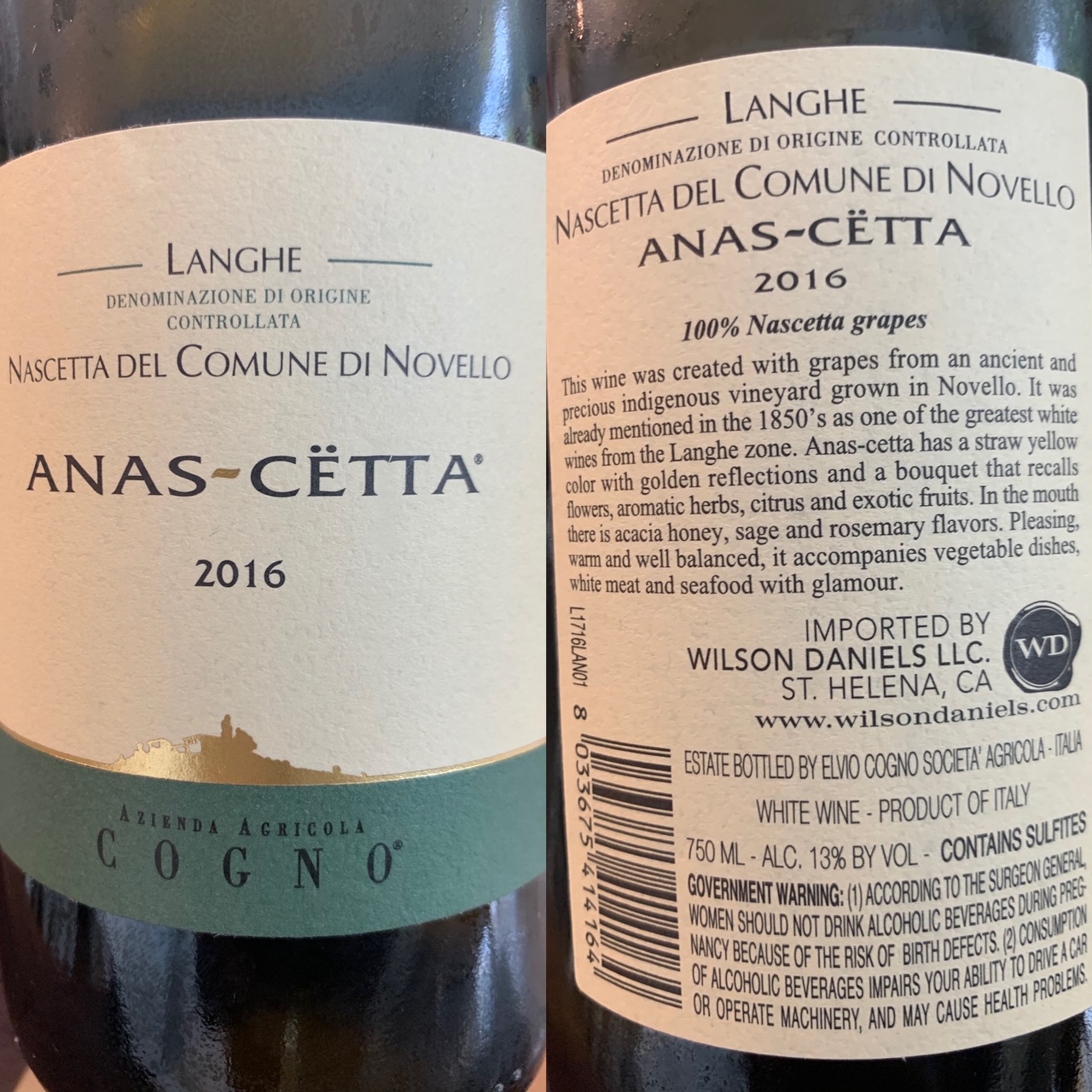
The wine had a yellow-green color with golden flecks.
Green herbs, minerality, and a marine character on the nose initially. Star apple and white peaches and increasing salinity with time.
Searing acidity on the palate along with astringency from the skin contact. Medium weight. Grapefruit, salinity and minerality. With residence in the glass exhibits the rusticity that I associate with white wines made in the Barolo zone.


