Showing posts with label Piemonte. Show all posts

Thursday, November 12, 2020

Gattinara DOCG and the wines of Conterno-Nervi and Travaglini Estate Winery

Nebbiolo, the variety undergirding the Langhe's famed Barolo and Barbaresco wines, is considered Italy's most noble grape, primarily based on its performance in that region. The cultivar is, however, grown -- and referred to by other names -- in areas beyond the home of the "King of Wines." The table below shows the names by which the variety is known outside the Langhe-Roero regions and the associated planting sizes.

RegionSub-RegionVariety NomenclaturePlanting Size (ha)
LangheBaroloNebbiolo
2098

BarbarescoNebbiolo
716
Alba

Nebbiolo1262.5*
Roero

Nebbiolo139.5**
Alta PiemonteGattinara, Ghemme +Spanna
884

Val d’OssolaPrunentN/A
LombardyValtellinaChiavennasca
900
Valle d’AostaDonnaz, Arnand-MontjovetPicotendro25***
SardiniaGalluraNebbiolo52***
Compiled from Tong #16. *Author's estimate; ** author's estimate based 
on relative production; ***2004 data.

In the Alto Piemonte region,  the Nebbiolo grape-- called Spanna therein -- is also viewed fondly by "native" winemakers who embrace the fact that their wines differ markedly from that of their better-known brethren to the south. 

Alto Piemonte Wine Region (Source:skurnik.com)

I have been on a journey of exploration through the subzones of Alto Piemonte and continue in this post with a discussion of Gattinara DOCG.

Gattinara DOCG
The Gattinara wine region is a 105-ha wine zone encompassing the entirety of the municipality of Gattinara. The zone, which is older than Barolo, covered 600 ha at the end of the 1800s but was completely destroyed by phylloxera and the devastating 1905 hailstorm. The key characteristics of the region are detailed in the chart below.


Gattinara soils, as shown in the chart, are both acidic and rich in a variety of minerals and elements. The vines grown in this soil produce grapes "with a unique flavor profile" and high acidity and tannin levels.

Selected Estates: Nervi-Conterno and Travaglini Estate Winery
Conterno-Nervi
Roberto Conterno, one of the most influential Barolo producers, bought Nervi, the oldest officially recognized Gattinara winery, in 2018. Nervi was founded in 1906 by Luigi Nervi and its 28 ha includes the notable cru vineyards Molsino and Valferana as well as the top sites Garavoglie and Cassace. According to rarewineco.com:
The south-facing amphitheater of Molsino is one of Piedmont's great vineyards, revered since the 15th century as a source of Gattinara of both power and finesse. Valferana's open west-facing slopes can trace an even longer history, as documents dating back to 1231 attest. This cool terroir produces a very elegant and mineral Gattinara to complement the more potent Molsino.
Nervi was purchased from the family by the steel magnate Germano Bacciolone in 1991 and then sold to Erling and Katherine Alstrop in 2009 before finally making its way into the hands of Roberto in 2018. Operations are very traditional with pruning and harvesting done by hand and fermentation and aging in large oak casks.

Conterno-Nervi makes two single-vineyard wines from Molsino and Valferana, a cuvée using grapes from all four vineyards, and a Rosato from the same sources.

Travaglini Estate Winery
The Travaglini family has owned land in Gattinara since the 19th century wherein they farmed a few hectares of vines and produced wine for local consumption. A small winery was established Clemente Travaglini who was succeeded by his son Arturo who was in turn, succeeded by his son Giancarlo. Gtiancarlo established the Travaglini Estate Winery in 1958. He was also instrumental in viticultural and winemaking developments in the area through pioneering research into:
  • High-density planting (up to 5000 vines/ha)
  • 100% hand-harvesting
  • Guyot training
  • The use of barriques.
The estate today is 55 ha in size with 52 of those dedicated to vines. The majority of the plantings are Nebbiolo with some of the older vines being Vespolina and Bonarda. Vines are between 6 and 45 years of age.

All vines are trained Guyot and are planted facing south and southwest. Older vines are planted at 3500/ha while younger ones are deployed at 5000/ha. Vineyard elevation ranges between 320 and 420 m.

In addition to the Gattinara DOCG normale, the estate produces a Riserva and a cuvée (Tre Vigne) made from grapes sourced from three historical vineyards. Other Nebbiolo-based wines produced by the estate include a Coste delle Sesia Nebbiolo and a Metodo Classico Nebolé.

Two Wines from the Estates
I tasted a 2016 vintage from each of the estates.


2016 Nervi-Conterno Gattinara -- Hand-harvested. Gentle de-stemming and crushing followed by fermentation in stainless steel vats. Macerated for a minimum of 15 days post alcoholic fermentation. Malo in oak barrels. Aged for 30 months in large oak barrels.

Popped and poured. Darker in color than the Travaglini. Dark cherries, licorice, anise, herbs, and spice on the nose initially. Herbs, hint of shoe polish, juniper berry, black pepper with time. Spice on the palate, rose water, green herbs, round tannins on the palate initially. More textured with the passage of time. Weightier and increasing character. With additional time, earthier, dark red fruits, salinity, shoe polish, and dried herbs.

2016 Travaglini Gattinara -- Grapes crushed and macerated for 15 days in stainless steel tanks. Aged for three years (two of which were in Slovenian oak casks of different origins and sizes) before bottling. Spent three months in bottle before release on market.

Lighter in color than the Conterno-Nervi. Cherries, raspberries, rosemary and earth on the nose. Medium body with elevated acidity and chalky tannins. Lighter and brighter than the Conterno-Nervi.

©Wine -- Mise en abyme

Sunday, July 12, 2020

The white wines of Piemonte: Gavi (Cortese di Gavi) DOCG

Piemonte is home to two of the world's iconic red-wine regions -- Barolo and Barbaresco -- but its indigenous-variety white wines are also demanding of attention in their own right. I have written previously on the Timorasso, Erbaluce di Caluso DOCG, and Roero Arneis DOCG wines and was extremely pleased with the quality. I continue my exploration with this post on the wines of Gavi DOCG.

Gavi (also called Cortese di Gavi) is a Piemonte region dedicated to the production of wines from the (white) Cortese grape. According to enricosrafino.it, "The Gavi area, the southern part of Alto Monferrato, rises from the banks of the Tanaro River into the mountains of the Apennines and the water divide between Piedmont and Liguria."

Gavi DOCG indicated by red circle to the bottom-
right of the Piemonte map

The region spools out over the hills of 11 communes in the province of Alesandria. It gained DOC status in 1974 and was promoted to DOCG in 1998. The allowed wines in the appellation are a Bianco, Bianco Riserva, Spumante, and a Spumante Metodo Classico, all made from 100% Cortese.

The Gavi climate is characterized by cold winters and hot, airy summers. Again from enricoserafino.it: "The combination of the Ligurian sea breeze and the Apennine snow make this particular corner of Piedmont so special." In addition to the Apennines, the region is also influenced by the presence of the Alps. The significant day-night temperature variation allows flavor concentration while preserving crisp acidity in the wines.

The mineral-rich soils of the region are purported to contribute to the flavors of the Gavi wine. The complexity of the soilscape is displayed in the chart below.

To summarize the chart, the northern part of the region is dominated by red ferrous soils and gravel mixed with clay from ancient alluvial activity while the central area alternates between soils of marl and sandstone. The south has fossil-rich white soils composed of clay-calcareous marls.

Serafino.it credits the region's climate and the soils on the hillside vineyards as being responsible for the complexity of the wines. "Highly reputed for its 'white soils' is the area of Gavi Village, very well known for clear-cut character, amazing freshness, as well as complex wines that here become the Gavi del comune di Gavi docg.

The Cortese cultivar makes its first appearance in the literature in 1659. It is a highly productive, thin-skinned grape that is disease-resistant. It is noted for delivering bone-dry wines that are crisp and flinty with floral and peach aromatics.

I am teaching two of my nephews (Al and Devawn) the two or three things I know about wine so we get together every other Saturday for a theory lesson and a wine tasting. The last time we got together we tasted two Gavi wines: a 2018 Marchesi di Barolo and a 2018 La Scolca Gavi dei Gavi.


I could not find much material on the viticulture or viniculture associated with the Marchesi di Barolo wine beyond the fact that the grapes were grown on medium-bodied marl on slightly sloping hills and that the grapes were slightly pressed before being fermented in stainless steel tanks. I liked the wine though. Parsley on the nose, along with a red pepper spice and expansive minerality. Broad on the palate, with citrus (young lime) and minerality preceding a long spicy finish.

According to La Scolca, the Gavi wine that is the basis of today's appellation was invented at their winery back in the 1950s. Further, the area in which the vines for its Black Label wines are grown -- Rovereto -- can be consideerd the Grand Cru of the DOCG. The company manages about 50 ha of vineyards, with planting density of 4500 vines/ha. The grapes are harvested manually and fermented separately based on vineyard origin. The Black Label wine is sourced from vineyards averaging 60 years of age.

The wine was intense on the nose, with green herbs, lemon and muted honeydew melon. Intense acidity on the palate with a sourdrop character yielding to a cupric mineral finish. Much more acidity than the Marchesi di Barolo wine. This wine screams out for food. Both wines were of excellent quality but the Marchesi is a more all-purpose wine in that it can be drunk on its own while the La Scolca needs a friend.

Subsequent to tasting the wines above, I tasted the 2021 Villa Sparina Gavi di Gavi.


Villa Sparina is produced at the Villa Sparina Resort and Winery, located in Monterotondo, the heart of Piemonte's Gavi DOCG. The facility was founded by the Moccagatta family in the 1970s. The estate sits on 100 ha, 70 of which are dedicated to grapes for the production of Gavi and Barbera.

Monterotondo is a cru for the Cortese grape of Gavi. The grapes are grown in vineyards resident at 250 - 300m altitude with mainly south and southwest exposures and soils of clay and marl. The vines are trained Guyot and are planted 4200 vines/ha density. Avearge age of the vines is 30 years.

The first year of production of the Gavi was 1974. The wine is fermented for 3 weeks in stainless steel tanks.

The wine is aromatically intense with sweet fruit notes, honeycomb, pepper, minerality, and mint. Great acidity on the palate. Medium weight with initial citrus note rising to a palate-puckering lime in the nether regions. Persistent pepper spice and salinity on the finish. Creaminess on the palate gives way to a slatey mineral finish. After some residence in the glass, the wine shows beeswax and pepper on the nose and lemon skin and minerality on the palate.  A long, bitter, slatey finish. This wine paired beautifully with a sauteed cod on a bed of mixed vegetables.

©Wine -- Mise en abyme

Friday, June 12, 2020

Erbaluce di Caluso DOCG: Another stellar Piemontese white wine entry

Erbaluce di Caluso DOCG is a wine appellation covering the production of wine from the Erbaluce grape variety grown in 37 communes located in the Piemonte provinces of Torino, Biella, and Vercelli. The region is illustrated in the two maps following.

Piemonte wine region map (Source: winescholarguild.com)

Erbaluce di Caluso DOCG map
(Source:http://www.erbalucecarema.it/en/)

At 188 ha, this is a relatively small appellation. It became a DOC in 1967 and was elevated to DOCG status in 2010.

The soils in the region are remnants of a post-ice-age glacial moraine. The thin topsoils are a mix of clays, pebbles, and shale rich in phosphorous, magnesium, and potassium.

The disciplinaire allows for the production of still, sparkling, and passito wines made wholly from the Erbaluce variety planted in the morainic soils at elevations ranging between 200 and 500 m. Vines must be trained Caluso pergola which dictates 500 m between rows and 5000 vines/ha.

Erbaluce is a high-acid, late-ripening grape of unknown origin. The vine is vigorous and productive, with elongated bunches and bright yellow berries.

The wine I tasted as part of my regular Zoom event was the Cieck Erbaluce di Caluso Vigna Misobolo 2018. The grapes for this wine were sourced from the Misobolo Vineyard which was originally planted in the 1970s. This low-yielding vineyard is rich in mineral salts. It is sited at 320 m on the side of a hill which, with its south and southwest aspects, provides excellent exposure to the sunlight and protection from winter frosts.

The grapes were hand-picked after which the selected grapes were whole-bunch-pressed in order to preserve the fruit character. Pips, stems, and skins were removed post-press and the must cold-fermented in stainless steel tanks. The wines were kept in tank for 5 months before bottling and release on the market.


The wine had a faded green and hay color. Herbs, mint, and sweet fruit on the nose initially. Bright acidity on the palate along with a saline minerality, metallic character, citrus, citrus skin, and heavy excitation of the salivary glands. Some weight, but clean. After some residence in the glass, the edge came off the acidity and the taste was sour citrus fruit, green herbs, minerality, and salinity. I held some of the wine over to the next day and it had become a cross between a Carricante, an Assyrtiko, and a Friulano from Collio: salinity, minerality, and weightier acidity but with the addition of a strong blackpepper character.

This wine is a marked contrast from other Piemontese white wines that I have tasted in the past. Where the international white varieties planted to the south tend to be rustic, and Arneis tends to be somewhat ephemeral (except in cases like Vietti and Giacosa, for example), and the Timorasso hews more towards a Benanti Pietra Marina, this wine is of the land but cries out for the sea.

©Wine -- Mise en abyme

Friday, November 29, 2019

The DOC(G) sparkling wines of Piemonte

I have been contemplating the construction of an Italian Sparkling Wine Map -- akin to the one I developed for France -- for a while. Every time I sat down to begin the effort, though, I would retreat into a corner, cowed by the vast amount of data that exist and the paucity of real estate on which to model same. After continuously banging my head against the wall, I came to the conclusion that the only way forward -- in order to be as comprehensive as I wanted to be -- was to attack the problem in bite-sized chunks; that is, one region at a time. To that end I have put together the Sparkling Wines of Piemonte map shown below. One look at this map will alert the reader as to the impossibility of capturing the entirety of Italian sparkling wine production on a single chart.


While the region is best known for its Nebbiolo grapes, and the resulting Barolo and Barbaresco wines, the above map shows that many of the appellations provide frameworks for the production of sparkling wine. In most of the cases, the dominant DOC variety serves as the source material. If the producer does desire to do so, he/she could also utilize the much more forgiving Piemonte DOC for sparkling wine production.

The map shows the designation under which sparkling wine is produced in each region and specifies the mix of allowed varieties and their relative proportions. The map also illustrates which wines are made via the Charmat Method and which use the traditional Champagne Method. The Champagne method utilizes re-fermentation in the bottle to produce its bubbles while the Charmat method accomplishes that goal in the following manner:
At the conclusion of alcoholic fermentation, the base wines are assembled into batches and pumped into large, sealed tanks (autoclaves) for the secondary fermentation. Sugar and yeast are added to the tanks and the consumption of the sugar by the yeast results in the Carbon Dioxide that gives the sparkling characteristic to the finished wine.  This method of sparkling wine production is called the Italian (because it was first demonstrated as industrially viable by an Italian, Martinotti) or Charmat (the name of the Frenchman who refined the process such that it became feasible for large-scale industrial production), or Martinotti-Charmat method.  It is felt that this method preserves the aroma of the grapes yielding fruity, floral wines. This second fermentation can run between 20 days and 3 months after which the wine is bottled.
Selected Piemonte sparkling wines are discussed below.

Asti DOCG
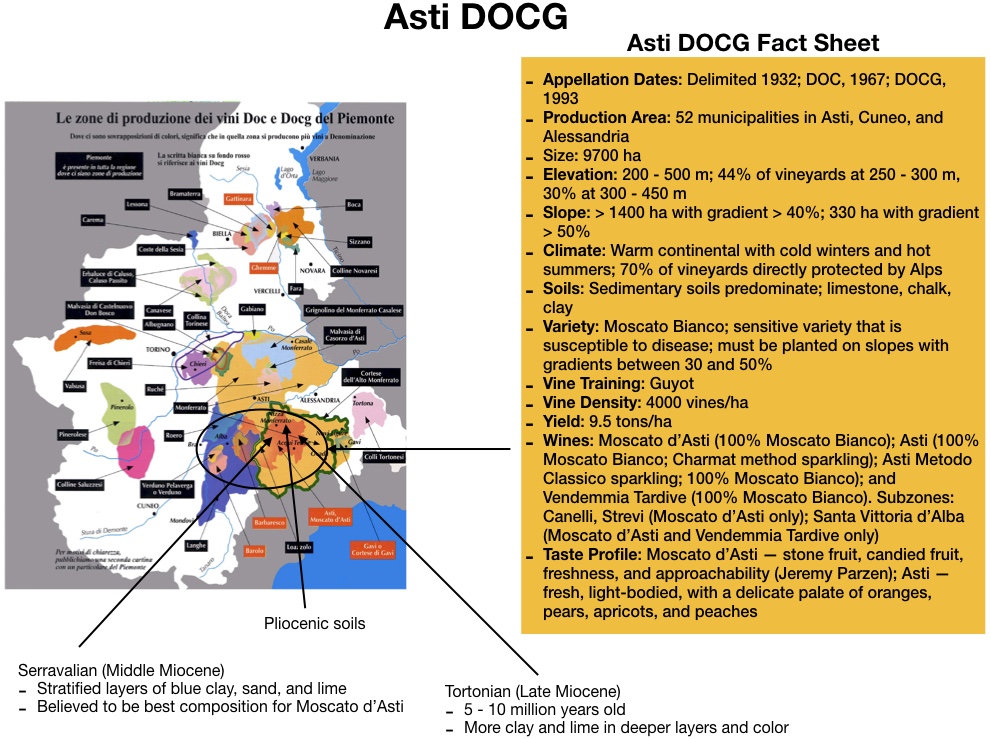
Asti DOCG is by far the largest sparkling wine appellation in Piemonte with 9700 ha under vine in 52 municipalities stretching across the provinces of Alessandria, Asti, and Cuneo. Most Asti production is via the Charmat method but, as the map shows, there is a designation for Asti Metodo Classico. The Moscato Bianco grape is used as the raw material for the Asti wine.

Muscat is a large family of grapevines characterized by a unique "muscat" flavor. Moscato Bianco is the primary member in that it is grown in every Italian region and is the key component in at least 13 DOC(G) wines (Moscato d'Alessandria and Moscato Giallo are also very important members of the family.). All red Muscat varieties are directly related to Moscato Bianco which, in addition, has parent-offspring relationships with the two Moscato's mentioned previously as well as Moscato di Scanzo, Moscato di Violetto, and Moscato Rosa.

Outside of Italy, Moscato Bianco has long been cultivated in many temperate European countries. Within Italy, it is mainly associated with Piemonte. In the 16th century, it was widely planted in Asti Alessandria, and Cuneo, with the most important centers of production being Canelli, Santo Stefano Belbo, and Loazzolo. A Moscato d'Asti Consortium was initially formed in 1932, two years prior to the formation of the similar Barolo organization.

The key details of Asti DOCG is presented in the chart immediately following.


The Metodo Classico wine is produced using the Champenois method but the stars in this region are the Asti and Moscato d'Asti wines, both made using the Charmat method. The Charmat method is preferred, not only because of its lower cost of production and quicker-time-to-market, but also due to its ability to preserve the primary aromas of the variety through the process. The Asti production process is illustrated below.


Alta Langa DOCG
Alta Langa -- DOC in 2002, DOCG in 2011 -- is the new kid on the sparkling-wine block but the combination of its terroir, traditional Champagne varieties, traditional production method, skilled growers, and savvy producers bode well for the future.

The Alta Langa DOCG is spread over 142 communes in the provinces of Alessandria, Asti, and Cuneo. Given the geographic scope of the region, one encounters a variety of climates, exposures, elevations and soil types. In general, the soil is a mildly fertile calcareous clay marl.
Source: altalangadocg.com

Growers in the region have looked enviously at Champagne since the early 1800s. So much so that the Counts of Sumbay planted Chardonnay and Pinot Noir vines with an eye to making a Champagne-like sparkling wine. The chart below summarizes the history of the effort to make a Metodo Classico wine in Piemonte.


Vineyards are required to be planted at 250 m and above on the region's steep, terraced hillsides. Allowed varieties are Pinot Noir and Chardonnay and other non-aromatic grapes. Planting density is a minimum of 4000 vines/ha with the vines trained using the low espalier system and pruned traditional Guyot and spurred cordon. The maximum allowed yield is 11,000 kg/ha.

The Alta Langa producers -- 27 currently -- do not grow enough fruit to meet their needs but that gap is bridged with fruit from 80 growers who own their land and are guaranteed producer-payment for their grapes and labor.

The above two Piemonte sparkling wines would be the ones that most American consumers would encounter domestically.

Gavi/Cortese di Gavi DOCG
Villa Sparina Metodo Classico is produced at the Villa Sparina Resort and Winery, located in Monterotondo, the heart of Piemonte's Gavi DOCG. The facility was founded by the Moccagatta family in the 1970s. The location of the winery is shown in the following slide.


The estate sits on 100 ha, 70 of which are dedicated to grapes for the production of Gavi and Barbera.

Monterotondo is a cru for the Cortese grape of Gavi, the grape that is the basis for the Villa Sparina Metodo Classico Brut. The grapes are grown in vineyards resident at 250 - 300m altitude with mainly south and southwest exposures and soils of clay and marl. The vines are trained Guyot and are planted 4000 vines/ha density.

The grapes for the base wine are fermented in stainless steel tanks over a 3-week period. Second fermentation is carried out in bottles with the wine spending 36 months on its lees.

The wine had an initial breadfruit nose upon opening which gave way to a sweet white flower/fruit, citrus, citrus skin, pineapple and a steadily increasing pepper spice. Peach on the palate with a lemony-lime acidity. Medium weight, not as crisp as I prefer. Sparing, emaciated bubbles. Mineral persistence -- chalky clay -- on the palate. Short finish. The taste profile falls somewhere between a Franciacorta and a Prosecco; shaded towards the Prosecco end of the spectrum.

©Wine -- Mise en abyme

Sunday, August 11, 2019

Alta Langa DOCG: Piemonte's burgeoning answer to Franciacorta?

During the Labor of Love pre-launch dinner party, Giampiero Cordero, the Sommelier at Ristorante Il Centro (Prioca d'Alba), introduced me to a sparkling wine -- Contratto Metodo Classico -- with which I was unfamiliar. The wine was intriguing so I sought out Giampiero later on in the evening, seeking additional information. He indicated that the wine was from a new sparkling wine DOCG called Alta Langa and promised to make arrangements for me to visit the winery on the Saturday post the dinner. He did make the arrangements and Parlo and I did make the visit. Before discussing the winery and its wines, I provide some background on the region.

The leading lights of Italian sparkling wine are Prosecco, Franciacorta, and Asti. If you confine your horizon to Piemonte, Asti and Moscato d'Asti are the most prominent. Alta Langa -- DOC in 2002, DOCG in 2011 -- is the new kid on the sparkling-wine block but the combination of its terroir, traditional Champagne varieties, traditional production method, skilled growers, and savvy producers bode well for the future.

Source: altalangadocg.com

Growers in the region have looked enviously at Champagne since the early 1800s. So much so that the Counts of Sumbay planted Chardonnay and Pinot Noir vines with an eye to making a Champagne-like sparkling wine. The chart below summarizes the history of the effort to make a Metodo Classico wine in Piemonte.


The Alta Langa DOCG is spread over 142 communes in the provinces of Alessandria, Asti, and Cuneo. Given the geographic scope of the region, one encounters a variety of climates, exposures, elevations and soil types. In general, the soil is a mildly fertile calcareous clay marl.

Vineyards are required to be planted at 250 m and above on the region's steep, terraced hillsides. Allowed varieties are Pinot Noir and Chardonnay and other non-aromatic grapes. Planting density is a minimum of 4000 vines/ha with the vines trained using the low espalier system and pruned traditional Guyot and spurred cordon. The maximum allowed yield is 11,000 kg/ha.

As is the case in Champagne, the Alta Langa producers -- 27 currently -- do not grow enough fruit to meet their needs. That gap is bridged with fruit from 80 growers who own their land and are guaranteed producer-payment for their grapes and labor.

Alta Langa DOCG covers a Spumante and Spumante Rosata, each built from a minimum of 90% Chardonnay and/or Pinot Noir and a maximum of 10% non-aromatic grape(s), fermented in the traditional method, and aged for a minimum of 30 months on the lees. A Riserva has to spend 36 months on the lees. An Alta Langa Rosso DOC has the same varietal requirements but no stated aging requirement.

Using Avezza Paolo's (one of the producers) practices as an example, the grapes are hand-harvested (a requirement) and taken to the cellar where they are crushed whole. Only the free-run juice is fermented.

Most of the producers ferment in stainless steel tanks but Bera Valter uses a mix of stainless steel and wood, with the majority done in steel. The base wine is placed under crown seal with the liqueur de tirage for the second fermentation (Bretta Rossa blends in a small amount of cuvée from the prior year's production.). The wine rests on its lees for a minimum of 30 months prior to disgorgement and dosage. The aforementioned Contratto always produces a vintage wine with zero dosage and a minimum of 48 months on the lees.

Franciacorta is the most significant Metodo Classico wine in Italy so some comparisons are in order.

Category Franciacorta Alta Langa
First Sparkling wine
1961
1848
DOC
1967
2002
DOCG
1995
2011
Size (ha)
3000
106
Municipalities
19
142
Grape sources Estates (104) Estates and Growers (107)
Soils Glacial morainic (4 types) Calcareous clay marl
Elevation “Gentle hills” Minimum 250 m

One of the things that I find disconcerting about Franciacorta is its richness. This stems from fruit ripening afforded by its relatively southerly location and acidity-robbing, low elevation vineyards. Alta Langa has the potential to produce a crisper sparkling wine given its more northerly provenance and its relatively high elevation.

The Piemonte region has a good track record in handling the Chardonnay grape. While not in the same geographic region, Gaja's Chardonnays take a back seat to no one and I am personally enamored with Aldo Conterno's Bussiador.

In most of the cases, the Alta Langa product is one component of a red-wine centric portfolio for both the growers and the producers. Contratto is one of the exceptions in that it is a standalone sparkling wine establishment within the broader Rivetti portfolio. The challenge for the region will be its relatively small size in a red-wine centric region where there will always be competition for attention and vineyard space vis a vis the the region's red wines.


©Wine -- Mise en abyme

Sunday, March 4, 2018

Ceretto, Brovia, Roagna, Cordero di Montezemolo, and Poderi Colla: Barolos from Castiglione Falletto and Monforte

The Antonio Galloni celebration of Barolo is held annually in New York City and consists of (i) a gala dinner and (ii) a Masterclass tasting of 15 Barolos on the day after the dinner. This year's Masterclass was titled 2013 Barolo: Sublime Finesse and Elegance and featured 15 of the region's top producers discussing, in turn, their estate's 2013 vintage.

The wines were presented in flights and, to date, I have reported on the following: The Renaissance of Verduno and Monvigliero, The Art of the Blend, The Classicism of Brunate, The Emergence of Novello and Ravera, and the Nuances of Margheria. In this post I report on the first flight which featured 2013 Barolos from Ceretto, Brovia, Cordero di Montezemolo, and Poderi Colla and a 2012 Barolo from Roagna.

Antonio Galloni kicking off the Masterclass

This was the most atypical of the flights:
  • Five wines versus two
  • Set at the commune level (with the exception of the Barolo-blend flight, all flights were intra-cru comparisons)
  • Four of the five wines were from Castiglione Falletto
  • Each of the Castiglione Falletto wines was from a different MGA
The particulars of the flight are shown in the table below.

Commune Producer Wine MGA Vineyard Winery Representative
Castiglione Falletto Ceretto Barolo Bricco Rocche Bricco Rocche

Alessandro Ceretto

Brovia Barolo Rocche dei Brovia Rocche di Castiglione

Alex Sánchez

Roagna Barolo Pira Vecche Viti Pira

Luca Roagna

Cordero di Montezemolo Barolo Enrico VI Villero

Alberto Cordero di Montezemolo
Monforte d’Alba Poderi Colla Barolo Bussia Dardi Le Rose Bussia Dardi Le Rose Pietro Colla

I begin with a brief look at the wine-producing regions under consideration and will then examine the wines tasted.

Castiglione Falletto
"Even if the vineyard surface cultivated for the production of Barolo places it solely in sixth place among the townships, Castiglione Falletto, in terms of notoriety, certainly cannot be considered a township of secondary significance given that, not merely producers of great fame but also, and above all, vineyards of exceptional prestige, can be numbered within its confines" (Masnaghetti). Whew. That was a long sentence. But you get the point. Castiglione Falletto, as a commune, is highly regarded.

The map below shows the location of the Castiglione Falletto MGAs from which the wines included in this flight were drawn. Rocche di Castiglione and Villero were numbered among my 18 Greatest Barolo Vineyards and are described here. Information on Bricco Rocche and Pira follow.


Bricco Rocche
As per ceretto.com:
This Castiglione Falletto vineyard is the smallest geographic area within the Barolo specification and comprises just over 1 hectare. It is the most prestigious part of what was once called La Serra and is nestled between the Villero and the Rocche (rock face) of Castiglione, which represents the best of the top parts; it can be considered a monopole as the whole parcel is the exclusive property of the Ceretto family.
The height of the vineyard is optimum, going from 350 to 370 meters above sea level, with southeast to southwest exposure. The earth (sandstone of Diano) reinforce the ideal sense of balance, suggested by the geographic location, and see good percentages of sand, silt and clay. 
Pira
According to roagna.com:
Pira is ... exposed to the southeast, ... it derives from the disintegration of the Rocche di Castiglione. It is a GMA and property of our family since 1989, the year it was purchased. It has ... a unique soil and microclimate, as it is protected in the upper part by the Rocche di Castiglione and downstream from the woods with a stream coming from the Bussia di Monforte. The cultivated vines are Barbera, Chardonnay and mainly Nebbiolo, in which we can classify 6 different micro-plots according to the composition of the soil, which goes from the limestone rock of the Rocche to the bluish marl, and according to the age of the vines. 
Monforte
At 292.3 ha, Bussia is the second largest MGA in Monforte d'Alba (and the Barolo Zone as a whole), bested only by Bricco San Pietro which weighs in at a massive 380.09 ha. The various vineyards included in the Bussia MGA are shown on the map below.


Dardi
This is a 7-ha vineyard located in the hamlet of Dardi in Bussia Soprano. The best plots are located above the village. The topmost point of the vineyard is known as Mondoca. According to the winery website, this vineyard was the first to be vinified separately by Beppe Colla back in 1961, thus allowing him to place the cru name on the label.

The Wines
The available data on the physical characteristics of the individual vineyards and their viticulture and viniculture practices are presented in the table below followed by my perception of the resulting wines.

Characteristic Ceretto Bricco Rocche Brovia Rocche Roagna Pira Cordero di Montezemolo Poderi Colla
Vineyard Size 1 ha from one source; 1.4 ha from another 1.5 ha 4.88 ha
2.2
8 ha (of which 6 planted to Nebbiolo
Elevation (m) 340 - 370m
350

300
300 - 350
Exposure SE to SW SE SE S S and SW
Soil Silty loam (Sandstone of Diano) Lean, slightly sandy, loose calcareous soil Layers of alternating white limestone, gray and blue marl, and sand with a high mineral content Calcareous and micronutrient rich

Vine Training Guyot


Vine Density (Vines/ha)
4248


4000 viness/ha
Yield


37hl/ha

Year Planted
1982

Oldest plants date back to 1937

1978 - 1985


Harvesting Hand Hand


Hand
Reception Hand sort Light pressing and separation of stalk Immediately destemmed and crushed

Destemmed and crushed
Fermentation Vessels Stainless Steel

Oak SS

Yeasts Native

Pre-fermentation pied de cuve


Fermentation Period

15 - 20 days 10 days; submerged-cap maceration for 70 - 90 days 6 - 10 day maceration, 10 -12 days fermentation 12 - 15 day maceration


Barrel Aging 12 mos 310 l oak barrels; moved to 25 Hl oak casks for remainder of elevage 2 years in 30 Hl Frenck oak casks Aged in neutral oak for 5 years 20 months in barriques Aged ionic casks for 24 - 28 months
Fining/Filtering

None None


Bottle Aging

18 - 24 months


In his presentation, Alessandro Ceretto stated that the wines were fantastic from fermentation through aging. And that showed on the resultant 2013 Barolo Bricco Rocche. This wine was floral with violets and beautiful red fruit notes. The wine explodes on the palate with dried red fruit, rose petals, lovely acidity, great weight, and a long dry finish.

Alex Sánchez said that the 2013 Rocche del Brovia was very different on the nose than on the previous night. Elegant nose. Hint of tar, roses, and persimmon. On the palate sour persimmon, tar, and silky tannins. More intensity on the palate than was the case for the Ceretto. Long coating on palate. Bitter finish.

The 2013 Roagna 2012 Barolo Pira Vecchie Viti showed broad-based red fruit, shoe polish, and green flowers. Full round on the palate with drying fruit, dried rose petals, and silky tannins. Long, silky finish.

The 2013 Barolo Enrico VI showed hints of coconut, licorice, and dark fruit. Sweet fruit on the palate. Weighty with lengthy finish.

The 2013 Poderi Colla 2013 Barolo Bussia Dardi Le Rose was elegant with dried rose petals and bright red fruit on the nose. Power on the palate. Very different from the previous wines. Lenghty finish.

©Wine -- Mise en abyme