Showing posts with label Verduno. Show all posts

Wednesday, February 7, 2018

Fratelli Alessandria and G.B. Burlotto: The Renaissance of Verduno and Monvigliero

The Antonio Galloni celebration of Barolo is held annually in New York City and consists of (i) a gala dinner and (ii) a Masterclass tasting of 15 Barolos on the day after the dinner. This year's Masterclass was titled 2013 Barolo: Sublime Finesse and Elegance and featured 15 of the region's top producers discussing, in turn, their estate's 2013 vintage.


The wines were presented in flights and I will report on them in that fashion over a number of posts. I begin with the flight titled The Renaissance of Verduno and Monvigliero. This flight featured 2013 Monviglieros from Fratelli Alessandria and G.B. Burlotto presented by Vittore Alessandria and Fabio Alessandria, respectively.

Verduno
G.B. Burlotto was founded by Ignacio Burlotto and his nephew -- Giovanni Battista (G.B.) Burlotto -- was the winemaker from that time until his death in 1927. G.B. had a storied career as a winemaker and elevated the stature of both the estate and the town of Verduno as a result:
  • He was a pioneer in the sale of Barolo wine in bottles rather than in casks or demijohns as was the order of the day.
  • He was the official supplier of wines to the Royal House of savoy.
  • He was the official supplier of wine to the Duke of Abruzzo's Arctic expedition.
  • He was focused on wine quality and won many a gold medal as a result.
(According to North Berkeley Imports, in the 1870s, "... Verduno was the center of Barolo winemaking ... internationally recognized as the face of Barolo and sought out by collectors across the European continent.")

In the years following G.B.'s death, the farm lost its luster; as did Verduno. But Verduno has come to the fore again (a renaissance, according to North Berkely Imports) thanks in large part to the winemaking and marketing efforts of Fabio Alessandria, the great-great-grandson of Giovanni and the brothers Gian Battista and Alessandro (and Alessandro's son Vittore) of Fratelli Alessandria who, together, "are guiding the wines of Verduno back to the heights they once held."

Monvigliero
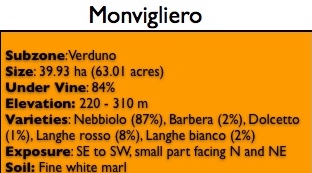
Verduno is the northernmost of the Barolo sub-zones and Monvigliero, its most famous cru, is one of its most northern vineyards. The River Tanaro runs through the cru and affects its microclimate as the warmth of the summer is mitigated by a cooling breeze that flows along its valley during the nights. This breeze contributes to a significant diurnal temperature variation, a variation that is important for the characteristics of the wine: perfect maturity of fine, gentle tannins. (IDTT 246, Levi Dalton interview of Fabio). For a fuller description of the Monvigliero cru, please visit here.

Burlotto Monvigliero
The grapes for the Monvigliero are drawn from a 2-ha, limestone-rich, south-facing plot whose vines are, on avearge, 45 years old. The grapes are not de-stemmed. They are gently foot-trod (allowing extraction of tannins without the green tannins and aromas that would result from rough handling of the stems) and fermented in open-top fermenters with indigenous yeasts. The grapes are macerated on the skins for 40 to 60 days, depending on vintage, with a submerged cap.

The skins are gently pressed vat-side upon completion of the maceration process and the first-press juice is added to the wine. The free-run and first-press wine are transferred to large wooden caks (33 to 60 Hl) for malolactic fermentation. Malolactic fermentation is long and slow as no attempt is made to help it along.

The Monvigliero is aged for an average of 24 months with as little racking as possible being done over the course of the process. The wine is bottled unfined and unfiltered and allowed further aging in bottle before being released to the market.


Fratelli Alessandria Monvigliero
Fratelli Alessandria owns 1.3 ha of the Monvigliero cru. This south-southwest wedge has a near-vertical slope at elevations ranging between 250 and 320 m. The 30-year-old vines are pruned Guyot at 4500 vines/ha.

The grapes are hand-harvested and then subjected to a 15+-day wild yeast fermentation with some post-fermentation maceration. The wines then spend 3 years in 20- or 30-hl Slavonian and French oak casks, 2 months in stainless steel tanks, and 6 months in bottle before being released for sale.


The Wines
These wines were both true to the cru: elegance and finesse. The Fratelli Alessandria showed delicate roses and violets along with dark herbs. Cherries and strawberries accompanying a tamarind flavor. Long finish. The Burlotto also showed delicate roses on the nose but with a hint of licorice. Elegant cherry on the palate along with retreating tamarind, strawberry, and black olives. Elegant, lengthy finish.

©Wine -- Mise en abyme

Friday, November 24, 2017

The Barolo Zone by the numbers

The raw data presented in Masnaghetti's Barolo MGA provides an opportunity for a more detailed comparative analysis of the Barolo subzones. I attempt such an analysis in this post.

Methodology
The relevant data were entered into a spreadsheet with columns being associated with subzones and rows associated with relevant characteristics. Some of the information provided in the Results comes directly from Masnaghetti (MGAs, for example), while others come from summations of columns and/or rows, averaging of columns and/or rows, and calculations of ratios. All calculations were completed using the embedded spreadsheet tools.

Results
The chart below shows the distribution of wineries in the Barolo Zone. A total of 246 wineries are shown across the zone when the Masnaghetti numbers are summed. There is an average of 41 wineries per subzone, that average being padded significanty by the La Morra (62 wineries, 25% of the total) and Monforte d'Alba (53 wineries, 22% of total) contributions.

Chart1. Wineries in the Barolo Zone, by subzone. A total of 246
wineries and an average of 41 per subzone.

Chart 2 below shows the distribution of MGAs (cru-equivalents) across subzones. Barolo, La Morra, and Serralunga d'Alba have almost similar numbers followed by Castiglione Falletto with approximately half of their MGA totals. All of the remaining subzones fall into the 11-or-less category.

Chart 2. MGAs in the Barolo Zone, by subzone. A total of 177 MGAs
and an average of 29.5 MGAs per subzone.

Chart 3 shows surface hectares by subzone. La Morra and Monforte d'Alba are markedly larger than the other subzones but, if you look at Chart 2, has fewer MGAs than La Morra and Serralunga d'Alba, giving an indication that its MGA must be hefty.

Chart 3. Surface hectares by subzone. A total of 8,084.84 ha across all
subzones and an average of 847.47 ha/subzone.

Chart 4 shows the area under vine by wine and total on the left side of the chart and the percent of each subzone under vine on the right side. The numbers used here are from Masnaghetti's 2013 data. A total of 2,426.83 ha is under vine in the zone with an average of 437.81 under vine per subzone. A total of 1,984.17 ha is planted to Nebbiolo for Barolo with an average of 330.70 ha per subzone planted similarly.

Chart 4. Area under vine by variety on left and percent of each subzone under vine to the right.
Chart 5 shows that with the exception of Monforte d'Alba (29.77%), Novello (34.32%) and Roddi (45.75%), all of the subzones devote in excess of 50% of their surface area to the growing of grape vines. In the case of Castiglione Falletto, the percent devoted to grape-growing exceeds 100% and I am unsure as to whether this is an anomaly or a mistake on the part of Masnaghetti in presenting the numbers. I will pursue this with Mr. Masnaghetti at next year's La Festa del Barolo.

Chart 5. Percent under vine by subzone
Chart 6 shows areas devoted to the varying wine types as a percent of the areas under vine. Barolo is far and away the prime wine but there is not insignificant contributions from the other wine types in the Barolo, Castiglione Falletto, La Morra, Serralunga d'Alba, and Verduno subzones.

Chart 6. Varieties planted as a percent of land under vine.
All of the Masnaghetti caveats concerning the data carry through to this exercise. Also, the reader is reminded that averages are just that and can be skewed by extremes at both ends of the scale.

©Wine -- Mise en abyme

Tuesday, August 29, 2017

Monvigliero, the "Grand Cru" of Barolo's Verduno commune

In my most recent post I wrote about my visit to Comm. B. G. Burlotto and its iconic single-vineyard wine sourced from the Monvigliero cru. This cru is widely held to be the best in Verduno and one of the best in the entire Barolo zone (see, for example, Vittore Alessandria in his Vinous video on the Monvigliero vineyard and Gian Battista Alessandria in his video interview with BBR). In his scheme, Galloni rates this vineyard as Outstanding while Masnaghetti rates it as Three Stars. Renato Ratti did not mention this vineyard in his scheme.

As shown in the figure immediately below, Verduno (to the north of the red borderline) is the northernmost of the Barolo sub-zones. Monvigliero is one of its most northern vineyards. Monvigliero is shown at the top of the first map (orange-brown color) and is highlighted within the red border in the satellite map following.

Verduno commune with Monvigliero cru at top center
(orange-brown color).

Rough (red) outline of Monvigliero cru

The River Tanaro runs through the commune and, according to Fabio Alessandria of Comm. G. B. Butlotto,  affects its microclimate. The vineyard is south-facing and has full access to the sun's rays all day. In addition, the soils are white. This combination results in summer warmth but this is mitigated by a cooling breeze that flows along the river valley during the nights. This breeze contributes to a significant diurnal temperature variation, a variation that is important for the characteristics of the wine: perfect maturity of fine, gentle tannins. (IDTT 246, Levi Dalton interview of Fabio). The Monvigliero vineyard is a beneficiary of these conditions.

The characteristics of this cru are shown in the figure below.

Source: Masnaghetti's Barolo MGA

The soil, according to paoloscavino.com, is primarily light-colored limestone mixed with chalky veins. According to Fabio (Vinous video on Monvigliero), the soil is traditional Sant'Agata marls with a mix of 40% silt, 30% limestone, and 30% sand. These white limestone soils drain well and ally with the micro-climate to give considerable finesse to the wines.

The producers plying their trade in the cru are shown below. Known vineyard sizes are Fratelli Alessandria (1.30 ha over three plots), Scavino (0.8340 ha), and Bel Colle (1.35 ha).


Wine Characteristics
According to Fabio, Verduno wines provide perfume, elegance, and finesse, especially from Monvigliero, which is considered the most feminine vineyard in the Barolo area. In the interview with Levi Dalton (IDTT wine 246), Fabio described the Monvigliero as being "lighter and more airy than other Barolos". In my interview with him Fabio described the wines from this cru as having a different quality of tannin in the mouth, a deepness, and a complexity of texture. The Monvigliero, according to Fabio, "exalts brightness and freshness."

Vittore Alessandria sees Monvigliero as producing "Barolo wine that is very fragranced and delicate with a balanced body and with soft tannins." This is "an extremely long-lasting wine which preserves these characteristics through time."

In my tasting of the 2012 Monvigliero at the Burlotto cantina, I described the wine thusly: "The Monvigliero had an almost see-through color; cinnamon, raspberry, strawberry, rhubarb, green herbs, and black olives on the nose; and stems on the palate. Fruit concentration balanced by acid levels. Pure. Will have a long, fruitful life."


©Wine -- Mise en abyme

Monday, August 28, 2017

Comm. G.B. Burlotto (Verduno, Piemonte) rising: A visit to the estate

Late last year, six bottles of 2012 Burlotto Monvigliero showed up in my shipment from Morrell. I had not had the wine before but bought it on my Rep's recommendation. It was young by my Barolo drinking standards but I opened a bottle to try and was pleasantly surprised in the way that it brought Burgundy to mind.

At this year's La Festa del Barolo, we had occasion to taste this wine at the Saturday morning seminar and my bud Ron Siegel was so blown away that he immediately embarked on an online search. He found a single source and immediately bought the case that this vendor had in stock.

My third encounter with this wine was during a visit to Enoteca Pitti Gola e Cantina opposite the Pitti Palace in Florence. I saw it on the shelf and ordered it. I had a lengthy conversation with the owner regarding this wine and he was kind enough to have me sample an older vintage as well as some other wines that he felt were akin to this. All these experiences fed a strong urge to visit this producer during my upcoming trip to Piemonte. And, thanks to the folks at Vinous, I did.

The Comm. G. B. Burlotto cantina is located in Verduno, the northernmost of the Barolo villages and, after a lunch at Osteria Veglio in Annunziata -- fortified with a Jacques Selosse Initial and a 2010 Ettore Germano Barolo Lazzarito -- we wended our way up to that side of the zone.

There is not a wealth of parking around the cantina but I was eventually able to stash the car in a conscience-mitigating spot. We walked back to the cantina where we were welcomed by Fabio Alessandria, the estate's winemaker.

Exterior of the Burlotto cantina. Photo credit: Ron Siegel
Bev in the Burlotto doorway. Photo credit: Ron Siegel

Fabio and Bev
Fabio suggested that we start with a tour of the cellars during which he would tell us the story of the estate. Burlotto, he said, was founded by Ignacio Burlotto and his nephew -- Giovanni Battista (G.B.) Burlotto -- was the winemaker from that time until his death in 1927. G.B. had a storied career as a winemaker and elevated the stature of both the estate and the town of Verduno as a result:
  • He was a pioneer in the sale of Barolo wine in bottles rather than in casks or demijohns as was the order of the day.
  • He was the official supplier of wines to the Royal House of savoy.
  • He was the official supplier of wine to the Duke of Abruzzo's Arctic expedition.
  • He was focused on wine quality and won many a gold medal as a result.
In the years following G.B.'s death, the farm lost its luster; as did Verduno. But both have come to the fore once again, in the case of Burlotto, thanks in large part to the winemaking and marketing efforts of Fabio Alessandria, the great-great-grandson of Giovanni. Fabio produced his first vintage at the estate in 1994.

Burlotto farms, according to Fabio, between 15 and 16 ha of land, 12 to 13 ha of which are in Verduno and 0,7 ha of which is in Cannubi Valletta. The figure below show the sources of fruit for the estate's wines.


As shown in the figure (and mentioned previously), Verduno is the northernmost of the Barolo sub-zones and Monvigliero, its most famous cru, is one of its most northern vineyards. The River Tanaro runs through the cru and affects its microclimate as the warmth of the summer is mitigated by a cooling breeze that flows along its valley during the nights. This breeze contributes to a significant diurnal temperature variation, a variation that is important for the characteristics of the wine: perfect maturity of fine, gentle tannins. (IDTT 246, Levi Dalton interview of Fabio). According to Fabio, Verduno wines provide perfume, elegance, and finesse.

Fabio's father has primary responsibility for the vineyard and manages it with respect for the local traditions (grassy vines, long-pruned canes, limited plowing, etc.). Fabio revealed in the interview, however, that they are experimenting with some forms of Guyot in order to combat vine diseases such as Esca.

The cantina has a number of different wine-production schemas. As regards the Barolos, four are produced: two single-vineyards (Monvigliero and Cannubi) and two cuvees (Acclivi and a Barolo normale).

Monvigliero
The grapes for the Monvigliero are drawn from a 2-ha, limestone-rich, south-facing plot whose vines are, on avearge, 45 years old. The grapes are not de-stemmed. They are gently foot-trod (allowing extraction of tannins without the green tannins and aromas that would result from rough handling of the stems) and fermented in open-top fermenters with indigenous yeasts. The grapes are macerated on the skins for 40 to 60 days, depending on vintage, with a submerged cap.

Photo Credit: Ron Siegel

Photo Credit: Ron Siegel

The skins are gently pressed vat-side upon completion of the maceration process and the first-press juice is added to the wine. The free-run and first-press wine are transferred to large wooden caks (33 to 60 Hl) for malolactic fermentation. Malolactic fermentation is long and slow as no attempt is made to help it along.

The Monvigliero is aged for an average of 24 months with as little racking as possible being done over the course of the process. The wine is bottled unfined and unfiltered and allowed further aging in bottle before being released to the market.

Other Barolos
The Cannubi Barolo is made from grapes sourced from the Cannubi Valletta vineyard. The Barolo normale is made from grapes grown on young vines in Verduno. The Acclivi Barolo is a blend of grapes from the Neirane, Monvigliero, and Rocche dell"Olmo vineyards in Verduno. For these wines, the grapes are de-stemmed and crushed and placed into open-top fermenters with indigenous yeasts. Cap management is a mix of pumping over and punchdown. The Acclivi has the mantle of a Riserva in that it uses the best grapes from the best part of the vineyard as source material. However, it does not have the cellar aging time to qualify for the traditional Riserva nomenclature (IDTT 246).

Other Reds
The Dolcetto, Barbera, and Pelaverga undergo malolactic fermentation in stainless steel tanks immediately after fermentation.

Sauvignon Blanc
Fabio's parents planted Sauvignon Blanc vines in 1986 as an experiment. Two Sauvignon Blanc wines are currently made: one drawn from all parts of the vineyard (in pursuit of complexity) -- and acacia-barrel fermented and aged -- while the other is made from young vines and is aged in stainless steel tanks. Fabio finds the acacia barrels to be more tight-grained than barriques and, as such, (i) reduces oxygen ingress and (ii) infuses the wine with less barrel-sourced material. Using acacia serves up texture without the oak taste. The first Sauvignon Blanc vintage for the estate was 1992.

Tasting the Wines
The first wine tasted was the 2016 Langhe Sauvignon Blanc Viridis. The wine showed citrus, flint, spice acacia flowers, and white flowers on the nose. Lime juice and salinity on the palate. A US-style Sauvignon Blanc.


The Rosato is a made from a blend of 10% Barbera, 35% Nebbiolo, and 55% Pelavarga held in contact with the skins for 1.5 days. Strawberries, lime, and lime rind on the nose; rose petals, salinity, and spice on the palate.


The 2015 Verduno Pelaverga showed strawberries, peppers, green herbs on the nose. Strawberries and red peppers along with Carricante-level salinity on the palate. Long, hot finish. Fabio feels that the 2011 and 2012 vintages of the wine should be drunk now while the 2010 and 2013 should be cellared.

We tasted 2015 versions of both the Classic Barbera and the Barbera Selection Aves. The former is aged in big barrels and is redolent with blue fruit which is apparent on the palate along with a salinity which has threaded through the wines tasted so far. Approachable. The Aves is aged in smaller barrels and shows more concentration and depth than its compatriot. Red fruit, more concentrated fruit, and a spiciness. Tar and salinity.


We tasted 2013 versions of the Acclivi, Monvigliero, and Cannubi Barolos. The Acclivi showed tar, roses, blackpepper, cherry-strawberry, and sweet fruit on the nose. Restrained. Burgundian. Menthol on palate. Perfectly balanced. Gentle tannin structure. Elegant.

The Monvigliero had an almost see-through color, Cinnamon, raspberry, strawberry, rhubarb, green herbs, and black olives. Stems on the palate. Fruit concentration balanced by acid levels. Pure. Will have a long, fruitful life.

The Cannubi showed violets, minerals, herbs, and iodine on the nose. Fresher than the Monvigliero. Red fruits and lengthy finish. Most structured of the three Barolos.

Photo Credit: Ron Siegel

Photo Credit: Ron Siegel

Photo Credit: Ron Siegel

**********************************************************************************************************
In a Q and A with Union Square Wines, Fabio was asked "What sets your wines apart from other Barolo producers?" In response he said, "It's difficult to find a bad Barolo, but I prefer the more elegant, traditional style of Barolo. For us, the Verduno Village is well-known for the elegance and finesse of the wine, especially from Monvigliero, which is considered the most feminine vineyard in the Barolo area. We, in the family, think that while power is important, we don't want to lose the finesse, the drinkability of the wine. We want to retain the aromaticity of the Cannubi, for example."

In the interview with Levi Dalton (IDTT wine 246), Fabio described the Monvigluero Barolo as being "lighter and more airy than other Barolos," the result of a combination of the soil and the maceration regime. In comparing and contrasting the Cannubi and Monvigliero wines, Fabio saw the Cannubi as "kind of elegant" with a different texture, bigger taste, and a more austere finish than the Monvigliero. The Cannubi also has more power and tannic pressure than does the Monvigliero. The Monvigliero has a different quality of tannin in the mouth, a deepness, and a complexity of texture. The Monvigliero, according to Fabio, "exalts brightness and freshness."

©Wine -- Mise en abyme