So you are a major international corporation. Let's say your name is Sony. And you are hacked by some nefarious organization calling themselves Guardians of Peace (who, while guarding the peace, create a lot of havoc in the process). So you have a crisis on your hands. So what is your response? Deny. Deny. Deny.
First you act as though nothing has happened and batten down the hatches. Next, as info begins to flow, you begin pointing fingers at North Korea. As your executives' boorish behavior and your sexist business practices are spread all over the internet, you adopt a bunker mentality. You have your high-priced, Brooks-Brothers-suited lawyers send letters to the major news outlets threatening them with legal action for doing their jobs -- reporting on the news. Then you give the theaters an opening which allows a few of them to opt out of screening the film on Opening Day. And when they opt out, you pull the film "because the cinemas will not be showing it."
You caved to the GOP. You caved to a bully and set a horrible precedent for corporate blackmail in the future. And still, to this date, you have not made a formal statement to the public or your investors.
Compare that to the case of Coravin, freshly minted producer of the freshly minted wine-extraction device.
When Coravin began getting reports of wine bottles breaking while the device was being employed, they immediately contacted the FDA. Shortly after, they wrote a very detailed letter to existing Coravin owners alerting them to the problem, telling them what they thought the problem was, and discouraging them from using the product until further notice. The keys here were: identification of the problem; taking ownership of the problem; getting the appropriate governmental officials on board early in the process; getting government officials on board voluntarily, rather than being forced to (hear that vehicle airbag manufacturer?); and early, clear communications with the customer base.
Once Coravin fully understood the problem (some bottles that were defective could break under the slight pressure exerted within the bottle by the insertion of the argon gas), they set about developing and testing a solution. Once that solution was tested and accepted by the FDA, they then sent the solution to every customer along with instructions as to its use.
Again, a timely, effective solution developed with government oversight and communication with the customer along the way. Coravin suffered very little PR damage from this affair and its openness was widely lauded.
Coravin, could you please send some of your PR people over to Sony.
And the Oscar for Best Crisis Management Response of the Year goes to -- not Sony.
©Wine -- Mise en abyme
Showing posts with label Coravin. Show all posts
Thursday, December 18, 2014
Tuesday, August 20, 2013
The Coravin wine access system has set my cellar free
The Coravin wine access system was first brought to my attention by Ron Siegel who had encountered the product while dining at 11MadisonPark simultaneous with the restaurant's beta-testing of the product. Ron was extremely impressed and spoke glowingly about the product on his return to Orlando. Based on his enthusiasm, I visited the Coravin website to learn more and, while there, signed up to be notified once they began selling product to members of the public. I had forgotten all about this until Ron recently emailed me his Coravin order confirmation along with a link to the store. The Wine Barn had also received similar notification and Andrew and I both purchased the product on that same day.
We all received our shipment on the same day and were like kids in a candy store. We were examining the product and texting back and forth with each new discovery or question. Andrew was the most adventurous -- or did not have a life -- as he had set up the tool and violated a bottle of wine within 30 minutes of opening the package. He is not one to savor the moment.
The Coravin external packaging is slick and pleasing to the eye and this continues through to the interior. Extensive documentation on setup and usage of the product is included in the packaging. The parts of the system (needle and spout) that could potentially be damaged during transit -- or could injure the user if not approached with the appropriate care -- were covered with bright yellow plastic covers which the user was advised to discard prior to system use.
I examined the contents of the package but did nothing further that day. We had a wine tasting that night and Andrew brought his Coravin along to demonstrate its use. The two things that struck me about the product were (i) its ease of use and (ii) the relatively slow rate of flow of wine from the bottle. But this was not a time for discourse on the topic. We had a tasting to do.
My initial interest in Coravin was driven by my lack of appreciation for the status quo. Outside of wine dinners/tastings, I like to drink a glass of wine or two; sometimes with dinner, sometimes without. In any case, I am forced to open a bottle of wine to meet this need. Because I know that I will not drink all of that wine at one sitting, I go for a low-cost option in order to minimize the cost of spoilage in the event that I do not get back to the bottle in a timely fashion. I do employ a spoilage retardation device (see below) but it has its shortcomings. In this case I am making drinking decisions, not on what I would like to drink, but on financial considerations. And once that bottle is open, the next time I am looking for something to drink, I will gravitate to that open bottle. Not necessarily because that is what I want to drink but because I want to finish it before vinegar kicks in. Coravin promised an end to that. It promised me the ability to tap into any bottle that I wanted to (no more Tuesday-night wine), whenever I wanted to, with retention of the integrity of the contents. I was hooked.
On Day 1 I hooked up the tool to a bottle of 2009 Fleurie (old habits are hard to break) and extracted my poison. The wine bottle is held at an angle to the glass and a tongue-like flap is pressed for a short period. This injects argon into the bottle and forces wine out through the needle and into the waiting glass. After the required amount of wine is extracted, the bottle is turned upright and the needle is pulled up and out of the cork. As I have noted earlier, the wine flow rate is relatively slow but (i) bearable for a single person or small group and (ii) is a small price to pay in order to reap the promised benefits.
I revisited the same bottle on the second and third days (I was not willing to begin puncturing corks left and right until I was assured that short-term spoilage due to oxygen intrusion was not going to be an issue.) and saw no apparent change in the wine over this period. After extracting each day's portion of wine, I returned the bottle to the cellar and laid it on its side in its designated bin. There was no leakage of wine as a result, proving Coravin's contention that the cork reseals itself after needle-withdrawal. I inserted the needle through the foil on each occasion and that material does retain evidence of needle intrusion but the hole is minute. After the third day I switched to a higher-value wine -- a 2001 Brunello di Montalcino -- and the results were similar.
Because there is some turbulence when the argon is injected into the bottle, I wondered how sediments would be handled by the tool. Would they be fed into the glass? Would they gum up the works by blocking the needle? I directed this question to Greg Lambrecht, Coravin Founder, and he pointed me to a YouTube video on extracting wine from a heavily sedimented bottle. While clear in discussing the steps that one should take when confronted with this situation, the video does not address my question of turbulence and its effect on sediment residence and tool impacts. This is a test that I will probably have to conduct for myself.
All-in-all I am very happy with my Coravin in that it has delivered on its promise in the short term. I am now in control of my cellar. I can drink what I want to when I want to. Wines which I used to look at longingly are now just an insertion away. But remember, this is only one side of the coin. The product has demonstrated accessibility with no short-term issues. I will have to observe some test bottles over longer periods to determine whether the other aspect of the promise (long-term integrity) holds true.
©Wine -- Mise en abyme
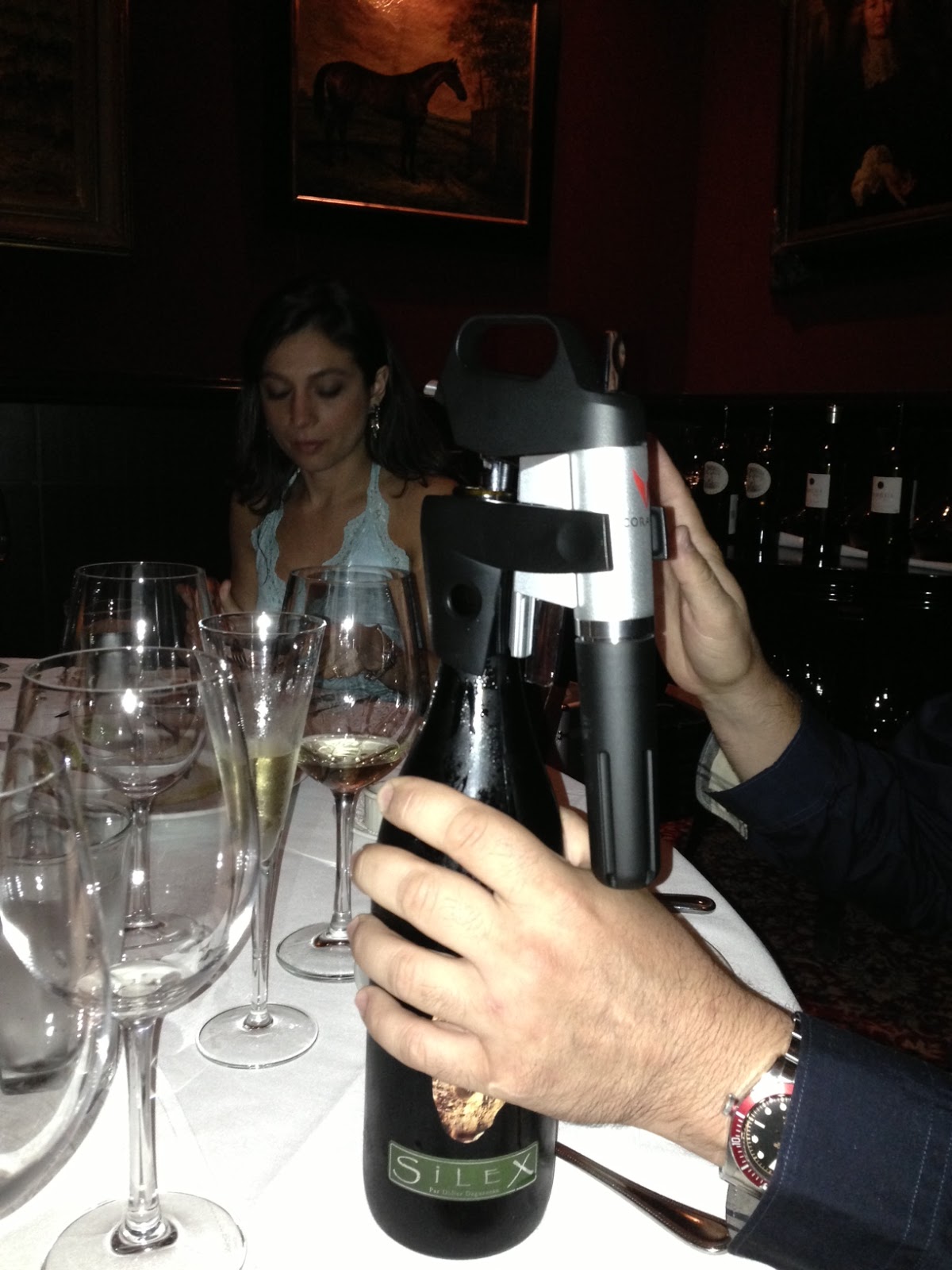
We all received our shipment on the same day and were like kids in a candy store. We were examining the product and texting back and forth with each new discovery or question. Andrew was the most adventurous -- or did not have a life -- as he had set up the tool and violated a bottle of wine within 30 minutes of opening the package. He is not one to savor the moment.
![]() |
| Photo courtesy of Andrew Montoya |
The Coravin external packaging is slick and pleasing to the eye and this continues through to the interior. Extensive documentation on setup and usage of the product is included in the packaging. The parts of the system (needle and spout) that could potentially be damaged during transit -- or could injure the user if not approached with the appropriate care -- were covered with bright yellow plastic covers which the user was advised to discard prior to system use.
I examined the contents of the package but did nothing further that day. We had a wine tasting that night and Andrew brought his Coravin along to demonstrate its use. The two things that struck me about the product were (i) its ease of use and (ii) the relatively slow rate of flow of wine from the bottle. But this was not a time for discourse on the topic. We had a tasting to do.
My initial interest in Coravin was driven by my lack of appreciation for the status quo. Outside of wine dinners/tastings, I like to drink a glass of wine or two; sometimes with dinner, sometimes without. In any case, I am forced to open a bottle of wine to meet this need. Because I know that I will not drink all of that wine at one sitting, I go for a low-cost option in order to minimize the cost of spoilage in the event that I do not get back to the bottle in a timely fashion. I do employ a spoilage retardation device (see below) but it has its shortcomings. In this case I am making drinking decisions, not on what I would like to drink, but on financial considerations. And once that bottle is open, the next time I am looking for something to drink, I will gravitate to that open bottle. Not necessarily because that is what I want to drink but because I want to finish it before vinegar kicks in. Coravin promised an end to that. It promised me the ability to tap into any bottle that I wanted to (no more Tuesday-night wine), whenever I wanted to, with retention of the integrity of the contents. I was hooked.
| Pre-Coravin wine-access and integrity-retention devices |
On Day 1 I hooked up the tool to a bottle of 2009 Fleurie (old habits are hard to break) and extracted my poison. The wine bottle is held at an angle to the glass and a tongue-like flap is pressed for a short period. This injects argon into the bottle and forces wine out through the needle and into the waiting glass. After the required amount of wine is extracted, the bottle is turned upright and the needle is pulled up and out of the cork. As I have noted earlier, the wine flow rate is relatively slow but (i) bearable for a single person or small group and (ii) is a small price to pay in order to reap the promised benefits.
I revisited the same bottle on the second and third days (I was not willing to begin puncturing corks left and right until I was assured that short-term spoilage due to oxygen intrusion was not going to be an issue.) and saw no apparent change in the wine over this period. After extracting each day's portion of wine, I returned the bottle to the cellar and laid it on its side in its designated bin. There was no leakage of wine as a result, proving Coravin's contention that the cork reseals itself after needle-withdrawal. I inserted the needle through the foil on each occasion and that material does retain evidence of needle intrusion but the hole is minute. After the third day I switched to a higher-value wine -- a 2001 Brunello di Montalcino -- and the results were similar.
| Post-Coravin wine-access and integrity-retention devices |
All-in-all I am very happy with my Coravin in that it has delivered on its promise in the short term. I am now in control of my cellar. I can drink what I want to when I want to. Wines which I used to look at longingly are now just an insertion away. But remember, this is only one side of the coin. The product has demonstrated accessibility with no short-term issues. I will have to observe some test bottles over longer periods to determine whether the other aspect of the promise (long-term integrity) holds true.
©Wine -- Mise en abyme
Subscribe to:
Posts (Atom)
