Continuing my series of revisiting favorite wines (of which I have tasted multiple vintages), I turn my attention to Pomerol's Chateau L'Evangile.

Pomerol
Pomerol, at 800 ha, is one of the smallest communes in Bordeaux. This home to some of the most lauded Bordeaux offerings is generally grouped with St. Emilion and other neighboring communes into an unofficial sub-region called Libournais. The commune is located 3 km from the city of Libourne and approximately 30 km northeast of Bordeaux on a rolling plateau that slopes to the Isle River at its confluence with the Dordogne.
Pomerol is bounded by the Barbanne stream to the north, St. Emilion to the east, and Libourne to the south and east. The area was originally a part of the St. Emilion AOC but was awarded its own designation by INAO (the AOC governing body) in 1936. A total of 150 producers currently operate in the defined area.
Pomerol is bounded by the Barbanne stream to the north, St. Emilion to the east, and Libourne to the south and east. The area was originally a part of the St. Emilion AOC but was awarded its own designation by INAO (the AOC governing body) in 1936. A total of 150 producers currently operate in the defined area.

Pomerol is blessed with a mild maritime climate with drier summers and higher daytime temperatures than experienced in other Bordeaux communes. The risk of frost is very low due to the moderating influence of the Dordogne and Isle rivers.
A rough approximation of the Pomerol soil is shown in the graphic below. The composition is a gravelly topsoil with layers of clay and sand with the clay more prevalent in the west and sand more apparent close to Libourne. The subsoil has a high proportion of a ferruginous sandstone which the locals call "crasse de fer." Several types of clay can be found in the soil but the blue clay is the most highly regarded. The Petrus vines are planted almost 100% on blue clay.
 |
| Pomerol soil composition with the Pomerol plateau shown in gray. (Source: Handout at 12/4/17 Zachys Lafleur Tasting) Originally from Neil Martin's book Pomerol. |
The Pomerol plateau (the area shaded in gray in the map above) is home to the best producers. Its soil is a complex blend of gravel, clay, sand, crasse de fer, and iron oxide.
The vineyards are planted to Merlot (80%), Cabernet Franc, Cabernet Sauvignon, and a dollop of Malbec. The current vines are very old and low-yielding. This, coupled with the small surface area available for planting, results in sky-high prices for the wines.
The wines of Pomerol are elegant and distinctive, characterized, as they are, by intense aromas, ripe fruit, and supple tannins. The wines are velvety and fruity in their youth and exhibit flavors of grilled almonds and black truffles in later years. The average yield is 38,000 Hl annually.
Chateau L'Evangile
As shown in the figure above, L'Evangile sits on the famed and desired Pomerol plateau. The 22 ha that comprise L'Evangile sit on a deep gravely soil that is mixed with clay and sand and supports vines that are, on average, 35 years old. The vineyard is planted with a mix of Merlot (contributes fruit, body, and softness to the wine) and Cab Franc (for structure and finesse).
The finished L'Evangile product is approximately 80% Merlot and 20% Cabernet Franc (or Bouchet, as it is called locally). The Chateau practices late harvesting which lowers yields and results in rich, concentrated wines. The grapes are picked by hand, fermented in cement tanks for 8 - 12 days, and aged in oak barrels for 18 months. The average production of the estate (inclusive of the second wine Blaison L'Evangile) is about 5000 cases.
Tasting of Selected Vintages
2008 L'Evangile -- Developing but -- wait for it. Blackberries, plum, dark chocolate, toffee. Medium-bodied with dark fruits and chocolate. Tannins evident. Lengthy finish.
2004 L'Evangile -- Blackberries, violets, cocoa and earth on the nose. Broad on the palate, but smooth, and with a full, round mouthfeel. Lengthy finish.


1982 Bordeaux Tasting at the Bull and the Bear -- The now-legendary 1982 vintage is considered a marker in the history of Bordeaux wines due to (i) exceptional wines across the region and (ii) the emergence of Robert Parker as a force to be reckoned with in the wine-prognostication arena. Propelled by the siren song of the vintage, a group of us got together at the Bull and Bear Restaurant at the Waldorf Astoria to taste a representative sample of wines from this noted vintage.
The touchstones of the vintage were (i) a successful and populous flowering in June and (ii) heat throughout the summer capped by a September heatwave. The large crop of super-ripe grapes that were harvested produced wines which were, according to the NY Times, "rich, supple, tremendously fruity, full-bodied, and already drinkable."
Skeptics took the position that the wines from the 1982 vintage lacked balance and were destined for short shelf lives. Robert Parker stood alone in describing this as one of the all-time great vintages; and history has borne him out. In a 2000 retrospective tasting of 61 of the wines from 1982, Parker assigned 100-point scores to Lafite, Latour, Mouton Rothschild, Pichon Lalande, Leoville Las Cases, and Lafleur.
Flight I: Chateau Certan de May, Chateau L'Evangile, and Chateau Latour à Pomerol.
The L'Evangile was rated 96 points by Parker. Aromas of dried rose petals, potpourri, acorn-fed meat, prosciutto, sugar cane, and cedar box. On the palate reinforcement of aromas along with a chocolate creaminess and a long finish. This wine was judged to be the wine of the flight by participants.
1982, 1990, and 1995 L'Evangile I had tasted the 1982 vintage on previous occasions and felt that it was one of the best wines that I had ever had. This bottle did not disappoint. It attacked the senses with tones of graphite, iron, gunpowder, licorice, chocolate, vanilla, sandalwood, and raw meat. There was a slight vegetal streak on the nose.
The 1990 was new to all of us and, shockingly for me, stood shoulder to shoulder with the 1982. It exhibited lightly roasted coffee and was reminiscent of the 1991 Dominus in the concentration of pencil lead and graphite. It was redolent of sweet black fruit.
The 1995 was the disappointment of the three in that it was very un-Bordeaux-like. It seemed to be confused as to its heritage in manifesting as a disordered Napa meritage. It had gooey black fruit, vanilla, licorice, clove and a marked vegetality (I know. Not a word. But I want to convey the vibrancy of the vegetal-ness). Dried earth on the palate (I have had occassion to taste this wine on multiple subsequent occasions and have not been able to duplicate this note.).
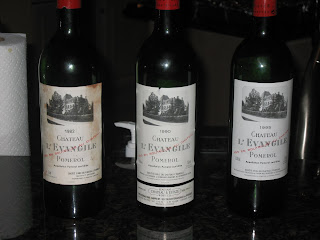
On another encounter with the 1995 I found dark fruit, cinnamon, cayenne pepper, tobacco, and black pepper on the nose. Red fruit, cayenne, cocoa on the palate. Medium weight with good acid levels. Balanced. Long, rich, creamy finish initially but gets leaner with residence in the glass and develops a not-unbecoming bitter note on the finish.
The 1990 was new to all of us and, shockingly for me, stood shoulder to shoulder with the 1982. It exhibited lightly roasted coffee and was reminiscent of the 1991 Dominus in the concentration of pencil lead and graphite. It was redolent of sweet black fruit.
The 1995 was the disappointment of the three in that it was very un-Bordeaux-like. It seemed to be confused as to its heritage in manifesting as a disordered Napa meritage. It had gooey black fruit, vanilla, licorice, clove and a marked vegetality (I know. Not a word. But I want to convey the vibrancy of the vegetal-ness). Dried earth on the palate (I have had occassion to taste this wine on multiple subsequent occasions and have not been able to duplicate this note.).

On another encounter with the 1995 I found dark fruit, cinnamon, cayenne pepper, tobacco, and black pepper on the nose. Red fruit, cayenne, cocoa on the palate. Medium weight with good acid levels. Balanced. Long, rich, creamy finish initially but gets leaner with residence in the glass and develops a not-unbecoming bitter note on the finish.
***********************************************************************************************************
I have not tasted all of the the great Pomerols but, until I do, L'Evangile has a special place in my heart and on my table. I buy the 1982 whenever I encounter it and this tasting drilled this wine even deeper into my wine psyche. The 1990 was a stunning and pleasant surprise, not because of anything that I had seen or heard, but that I had, unwittingly, foregone the pleasure of this great wine for as long as I had. The 1995 lived up to the hype after my initial disappointment.


