Showing posts with label Peter Liem. Show all posts

Thursday, August 16, 2018

Peter Liem's case for a single grouping for the Val du Petit Morin, Côte de Sézanne, Vitryat, and Montgueux Champagne zones is weak

In his best-selling book Champagne: The Essential Guide to the Wines, Producers, and Terroirs of the Iconic Region, Peter Liem unveiled a new and unconventional schema for the Champagne sub-regions. I have been adhering to this schema in my exploration of the "Great Growers" of Champagne but find myself in opposition to his classification covering the areas Coteaux du Morin (Val du Petit Morin), Côte de Sézanne, Vitryat, and Mongueux. I clarify my opposition in this post.

The Union de Maisons de Champagne schema has historically been the lens through which the Champagne region has been viewed. In this schema, the four growing zones mentioned above have been included in the Côte des Blancs sub-region. Liem has grouped them together (shown in the graphic below) because, he says, they are new plantings.


As Liem describes it, the vineyards of Champagne were decimated, sequentially, by the Phylloxera epidemic, the First World War, and economic depression, and The Second World War. Prior to the Phylloxera infestation, the region was home to 60,000 ha of vineyards, almost double today's 34,000 ha. Following the conclusion of WWII, interest in the Champagne region was rekindled and large scale replantation was begun. By the 1960s and 1970s that interest begun to extend to the zones under discussion; zones which "had lain fallow for the last half century."

According to Liem:
Today, these viticultural areas are established, yet there are still fewer grower-producers in these regions than in others, with growers selling most of their grapes to houses or cooperatives. This means that it's still early days yet for deciphering the characteristics of the soil, climate, and exposure unique to these southern and eastern parts of the Champagne region.
Based on the foregoing, (i) there is no clearly definable reason for breaking these zones out from the UMC schema nor (ii) is there a clearly credible rationale for grouping them together.

As it relates to the geology of the region, the slow sagging of the Paris Basin caused an upthrusting of ancient geologic formations at the outer perimeter with each formation exhibiting as a concentric, outward-facing escarpment. In the case of Champagne, the escarpment is comprised of sands, marls, and lignitic clays of the Tertiary period capping chalk from the upper Cretaceous and, below Chalons, clays and sands of the lower Cretaceous.


The soils in the defined Champagne region is not monolithic, however. The Côte de Bars region of Champagne has Kimmeridgian soil of the same construct as the soils that underpin the vineyards of Chablis and Sancerre. In the Aisne region the upper Cretaceous has dipped into the Paris Basin  and the soil is comprised entirely of Tertiary clays and sands. In the area below Chalone -- referred to as wet Champagne -- the poor-permeability clays and sands of the lower Cretaceous period are dominant. The Champagne soils distribution is illustrated graphically below.


The chart above shows that Coteaux du Morin and Côte de Sézanne have source soils that are similar to the core Côte des Blancs and the broader Champagne while Montgueux and Vitryat seem to reside on a soil that is unique to the region. And Liem notes this in his book:
The Campanian chalk found in the Côte des Blancs or the Côte de Sézanne is what Champagne is famous for, but the chalk found here in Vitryat is different, hailing from the earlier Turonian Stage ...the chalk in Montgueux is Turonian, like the chalk in Vitryat.
While these zones are warmer, and do contain higher levels of clay than the soils of the more northerly vineyards, they are similar to the Côte des Blancs in the primacy of Chardonnay.

In summary (i) there is no clearly definable reason for breaking Coteaux du Morin (Val du Petit Morin), Côte de Sézanne, Vitryat, and Mongueux out from the UMC schema nor (ii) is there a clearly credible rationale for grouping them together. If pressed, I could agree to Montgueux and Vitryat, given their southerly locations and unique soil type, being joined in a separate zone. I do not see any benefits accruing from such a scheme, however.

©Wine -- Mise en abyme

Tuesday, May 1, 2018

Book Review: Peter Liem's Champagne

Champagne lovers are swimming in a sea of plenty with the recent release of three high-quality books on the topic: David White's excellent But First, Champagne, Robert Walters' Grower-focused Bursting Bubbles, and the subject book, Peter Liem's Champagne. If you could only buy one of the three, I would strongly recommend the latter. This book is a tour de force that is backed by the author's 10 years of living among, and writing about, the Champenois and their wines.

Source: penguinrandomhouse.com

In objective and thrust, The Liem and Walters book mirror each other. They both feel that the traditional Champagne Houses and methods consign the beverage to a place that is atypical when compared to other fine wines. Rather than celebrating "place," Champagne celebrates the winemaking and blending processes. But having lived in Champagne for over 10 years, and having tasted myriad vin clair wines, Liem has come to the conclusion that Champagne can be a terroir-expressive wine (the same conclusion reached and proffered by Walters).

In the Preface of his book , Liem states, "The contemporary movement in Champagne ... is, rather simply, the acknowledgment of champagne as a wine like any other":
... a new generation of producers are asking a more complex and detailed set of questions, employing more conscientious viticultural techniques and deepening their understanding of agricultural expression to present a more precise portrait of place ... this proliferation of new champagnes offers an unprecedented opportunity to glimpse the intricacies of Champagnes's terroir.
 There are challenges still to be solved on the way to defining this terroir:
It is still not yet possible to write a comprehensive analysis of Champagne terroirs, given the lack of tools and information available compared with other historic regions. However, it is my hope that this book can in some small way help to push the dialogue further toward acknowledging champagne as a terroir-expressive wine, and to provide a foundation for envisioning that."
The chart below shows the organization of the Peter Liem book and, at first blush, it covers all the bases of what one would expect from a wine-region-based book. As a matter of fact, there is some similarity to the White book both in terms of organization and practice. In terms of practice, some of the same devices (sidebars, etc.) are employed effectively in both books. But there are significant differences in coverage areas; where White eschews coverage of viticulture and viniculture, those areas are critical elements of the Liem book -- and are handled masterfully. But even in the areas of similar coverage the assurance and depth in the Liem book is surpassing.


What distinctively sets Liem apart from the competition, however, is his treatment of terroir.

The conventional approach to regionalizing Champagne shows Champagne's vineyards extending over 4 districts (shown in the map below), 20 sub-regions and 319 villages.  The districts are Montagne de Reims, Vallée de la Marne, Côte des Blancs, and Côte des Bar.

Source: champagne.fr

In Champagne, Peter Liem expands the districts from four to seven. The new schema: divides the Vallée de la Marne into the Grand Vallée and the Vallée de la Marne; adds the Coteaux Sud d'Épernay; and combines the disparate zones between the heart of Champagne and Côte de Bar into a single sub-zone. The construct of this schema is illustrated in the map below.


Liem walks us through the villages associated with each of these sub-regions and the lieux-dits of note in each of these villages. He provides descriptions of the soils of these Grand Cru and Premier Cru vineyards, and included lieux-dits, and details the types of wine they produce. He tells of conversations and tasting with the principals producing wines from these terroirs. The granularity is unparalleled.


At the conclusion of each section on the reconstituted districts, Liem provides recommendations for terroir-expressive wines from that region.

The book is beautifully packaged in a two-compartment box set with one compartment containing the book and the other reproductions of long-lost maps of the Champagne region. The front cover is adorned with a picture of multiple bases of Champagne bottles and rich golden text listing the book title and the author's name. The paper on which the book is printed is thick and rich and the included photography compares very favorably with that employed by Walters, for example.

Source: Peter Liem's Champagne

I strongly recommend this book.


©Wine -- Mise en abyme

Thursday, January 18, 2018

Champagne's Côte des Blancs (After Peter Liem)

In Champagne, Peter Liem states that the 20 or so subregions into which the Comité Champagne divides the appellation "... is useful but perhaps a little too granular for most people's needs." He reduces this granularity to the seven subregions that I graphically illustrated in my most recent post. In that post I promised to delve into Liem's subregions and begin here with a look at the Côte des Blancs.

The Unions des Maisons de Champagne (UMC) divides its Côte des Blancs subregion into a further five sub-subregions:
  • Côte des Blancs
  • Montgueux
  • Sézannais
  • Val du Petit Morin
  • Vitryat.
In his subregion classification, Liem retains Côte des Blancs as a subregion and combines the remaining UMC sub-subregions into a single subregion: The Coteaux du Morin, Côte de Sézanne, Vitryat, and Montgueux.


A top-level view of the Côte des Blancs and the associated villages (as identified by Liem) are presented below. The characteristics of the subregion are shown on the right side of the chart.


The villages are divided into northern and southern because, according to Peter, the
... wines from the northern part of the Côte des Blancs tend to be richer and marked by a certain girth, while farther south the wines become more piercingly saline and tense. Part of this relates to soil, since the northern areas tend to have a higher clay content and sometimes a deeper layer of topsoil. 
The characteristics of selected northern and southern villages are shown below.


A look at the UMC plantings data begins to give a sense as to why Peter limited his Côte des Blancs subregion to the escarpment south of Epernay, While, based on UMC data, Chardonnay plantings were 97.11% of the plantings in Liem's Côte des Blancs, only the Vitryat sub-subregion, with 97.49%, was in the same ballpark. Montgueux (90.25%), Sézannais (74.85%), and Val du Petit Morin (51.78%) all had more marked exposures to red grape varieties.

NOTE: In a subsequent post, I have called into question Peter Liem's removal of Val du Petit Morin, Côte de Sézannais, Vitryat, and Mongueux from the Côte des Blancs sub-region and made the case that these zones rightly belong here. In my future naakyses and writings I will treat these zones accordingly.


©Wine -- Mise en abyme

Tuesday, October 21, 2014

Inaugural La Fête du Champagne sparkles

The inaugural edition of La Fête du Champagne, organized and hosted by Peter Liem and Daniel Johnnes, was a grand production -- in the tradition of La Paulée -- with Producers and Sommeliers galore and Champagne flowing like water down a dry gulch after a torrential downpour. As marketed, the event would provide a Grand Tasting (at which more than 20 producers would pour their wines), a series of themed seminars (running sequentially and slotted within the timeframe of the Grand Tasting), and a Gala Dinner (to which attendees could bring bottles of Champagne to share). Expectations were exceeded.

This event was highly anticipated, a result of the caliber and track record of the organizers, as well as a broad-based love for the subject wine. A testament to the pent-up demand for such an offering was the fact that the Selosse seminar was sold out on the first day of a pre-offer to customers of the event's Grand Cru sponsor; and tickets to Peter Liem's session were closed out very soon thereafter.

The weather in New York had been exceptional for the three days leading up to the event and the day-of followed suit. The weather was a portent of what awaited us within the confines of Astor Center, the event locale.

The seminar schedule is shown below.


I did not attend the Peter Liem event because it sold out early. My buddy Ron and his wife Bev did attend and they thought that it was exceptional. According to Ron, Peter laid out the various terroirs of Champagne in a manner that was very enlightening to him in terms of its meaning in the glass.

Peter Liem and Daniel Johnnes at opening seminar
(Picture courtesy of Ron Siegel)
I did attend the following three seminars and found them exceptional in terms of content, moderator-panelist interaction, and attendee participation. The Louis Roederer session was moderated by Levi Dalton (host of the I'll Drink to That podcast) and Levi did an excellent job of staying out of the way and allowing Jean-Baptiste Lecaillon (House Chef de Cave) the time and space to provide an excellent perspective on the House's philosophy and practices and how that mapped with the environment (terroir) in the production of its wines. The wines presented at the seminar were the Roederer Brut Premier and Brut Natural 2006 and the Cristal Brut 1995 and Brut Rosé 2002, excellent wines all.

Levi Dalton and Jean-Baptiste Lecaillon, Roederer Chef de Cave
The second seminar that I did attend was a rather lively affair led by Daniel Johnnes and featuring Champagne - Food pairings chosen and presented by four Sommeliers. The pairings were as follows:
  • Pascaline Lepeltier, Wine Director, Rouge Tomate: Jacques Lassagne Blanc de Blancs Extra Brut Le Cotet with Hawaii Walu Crudo from Andy Bennett, Exective Chef, Rouge Tomate
  • Aldo Sohm, Chef Sommelier, Le Bernardin: Pierre Moncuit Blanc de Blancs Grand Cru with Le Bernardin Salmon Rillette from Eric Ripert, Chef/Owner, Le Bernardin
  • Rajeev Vaidya, Chef Sommelier DANIEL: Georges Laval Brut Nature Cumières Premier Cru with Mosiac of Venison and Daikon Radish from Jean-François Bruel, Executive Chef, DANIEL
  • Rajat Parr, Winemaker, Sandhi Wines: Savart Expression Brut Nature Premier Cru 2009 with Smoked Sturgeon, Caviar, and Rye from James Kent, Executive Chef, NoMad Hotel.
This was a fun and revealing exercise which Daniel spiced up by having us go back and taste some of the foods with Champagnes they were not originally paired with. A key takeaway was that while Champagne is an easy call (in that it pairs with everything), texture matters.

Panelists for A Sommelier's Perspective
Dishes paired with the Sommeliers' Champagne choices
Ron and Bev at the Sommelier's Perspective
My final seminar was my most highly anticipated. I have written extensively on Anselme Selosse in this blog (Selosse: Terroir expression or market misdirection?) and dialogued with Tom Stevenson, noted Champagne writer, on Selosse's style (Tom Stevenson's Selosse critiques; Galloni versus Stevenson; and Continuation of response to Tom Stevenson) so I was looking forward to getting his perspective on the issues. Anselme speaks little English so a translator was utilized to facilitate communication between him and the audience. Peter Liem moderated the session. This session had a few shortcomings in that (i) Peter's questioning was not tightly focused enough, (ii) the translator seemed to not fully relay what Anselme was saying, and (iii) just the fact that a translator was being used meant that we got half of the input that we would have if we spoke French. That being said, it was a fascinating session. Anselme is extremely philosophical in his approach to winemaking and conveys that in both his speech and carriage. I disagree with him on his concept of minerality but he is the winemaker and I am the drinker. Ron and I queried him on the Tom Stevenson issue and he became very animated; he left the translator behind. I cannot be convinced that the translator captured the length and breadth of all that he said in response to those two queries. Anyway, click here for my blog post on the Selosse seminar.

Anselme Selosse, Jean-Baptiste Cristini, and Pascaline Lepeltier
Sposa with Anselme Selosse post seminar
Author with Peter Liem
After my final seminar, I repaired to the main area where the Grand Tasting was being held. Ron had already made a pass through so were were able to head to the "prime" spots first before doing a more stately pass through the bevy of pourers.


And the Champagne flowed. each table was pouring either three or four bottles of their estate's best offerings. It all went too quickly. In addition to the Champagne tables, there were a number of food stations peppered throughout the hall with the standouts being, in my opinion, a spicy, yielding, wagyu beef from DeBragga. The Grand Tasting was scheduled to end at three and these guys were relentless in getting pourers and attendees out so that they could prepare for the Gala Dinner.

Ron with Anselme Selosse at the Grand Tasting
The dinner was a blast. And not because of the food, which was, with the exception of the chicken, less-than-memorable. But that faded into a distant memory, drowned under an avalanche of fermented beverages, sharing and comparing of stories and wines, and establishing contacts for the "next time."

We were welcomed with glasses of Christian Moreau Chablis Grand Cru Le Clos 2011 and that was featured throughout the cocktail hour. Canapés prepared by James Kent, Abram Bissel, Guenter Seeger, and Daniel Boulud were served during this period.

Our table ran along the far wall and we were seated next the the owner of Wally's and just behind our Chief Interlocutor for the evening, Zach Baum of Crush Wine and Spirits.


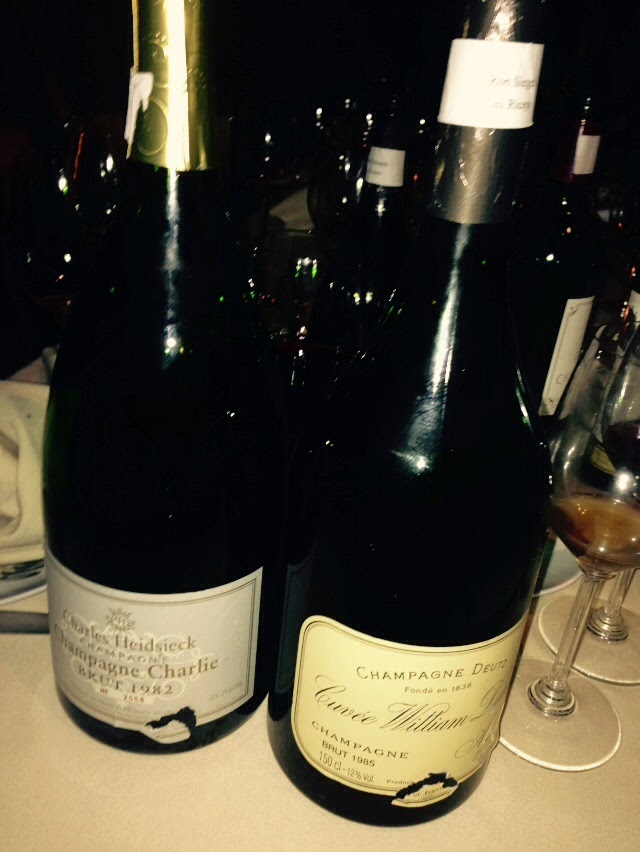
The evening began rather tamely with some relatively basic mags but then began to pick up the pace, both in terms of quantity and quality. Each person had three glasses and those very quickly became inadequate for the volume of wine that was rapidly coming downstream. For example, our table was being managed by Levi Dalton, Raj Parr, and the Somm from the Bristol Hotel in Paris. These guys were in charge of our wines and ensuring that we got them in a timely fashion. In addition, the producers were walking around and pouring their wines into your glasses (At least one producer sat at each table.). In addition, folks from other tables were bringing their wines over and pouring us. And, finally, Crush Wines had instructed that every wine poured at their table should be poured for us also. Pretty soon I was drowning. A partial listing of the Champagnes poured at dinner is provided below as an Addendum.

Cristal Rosé in Mag

Lobster: Marinated with Truffles, Grapefruit, and Radish
-- Abram Bissel

Roasted Poularde: Porcini Cream, Oyster Mushrooms, Salsify,
and Swiss Chard - Daniel Boulud


Part of our contribution to the evening


This was a Champagne dinner but we figured that by the end of the evening, folks would be craving some red wine so Ron and I took, in addition to some excellent Champagnes, multiple bottles of Burgundy and Barolo.

Red wine time
Ron with a bottle of '99 Chambertin
Parlo and Bev with Daniel Johnnes
Beauty and the Beasts. Nicole Beloyianis,
Event Organizer, between Ron and Author
A great night. Drank some phenomenal Champagnes. Met some good people. Drank some great reds (By the way, the guys from Wally's brought a 1982 L'Evangile, one of my favorite wines). I would be remiss in not pointing out what a great job Nicole did from Day One up until the last glass was drained. It was a pleasure to work with efficiency so immaculately packaged. Kudos to Peter and Daniel for visioning this event and delivering at such a high level the first time out of the gate. I will be back.

***************************************************************************************************

Addendum -- Partial List of Champagnes Poured at the Gala Dinner (as compiled by Ron Siegel)

1976 Dom Ruinart BB Mag
1989 Krug Collection Mag
1985 Dom Rosé Oenotheque Mag
1923 Veuve Clicquot Mag
1982 Dom Oenotheque Mag
NV Raphaele & Vincent Bereche Côte Millesime 3L
1981 Krug Collection Mag
1975 Dom Mag
1975 Bollinger RD 3L
L'Accomplie Brut 3L
1999 Pierre Peters Cuvee Special Mag
1990 Dom Mag
2002 Dom Ruinart Mag
1996 Bollinger Grande Anee Mag
1989 Clos ds Goisse Philipponnat Mag
1995 Cristal Mag
1995 Dom Oenotheque
1989 Cristal Mag
1964 Delamotte Mag
1979 Cristal
1982 Agrapart & Fils Mineral BB Mag
1990 Dom
1982 Charles Heidsieck Champagne Charlie Mag
1988 Dom
1985 Dom
1985 Deutz Cuvee William Millesime
1982 Dom
1976 Taittinger Comte Champagne

©Wine -- Mise en abyme